




Likes
20
Share


@The_Bearded_Grower
Follow
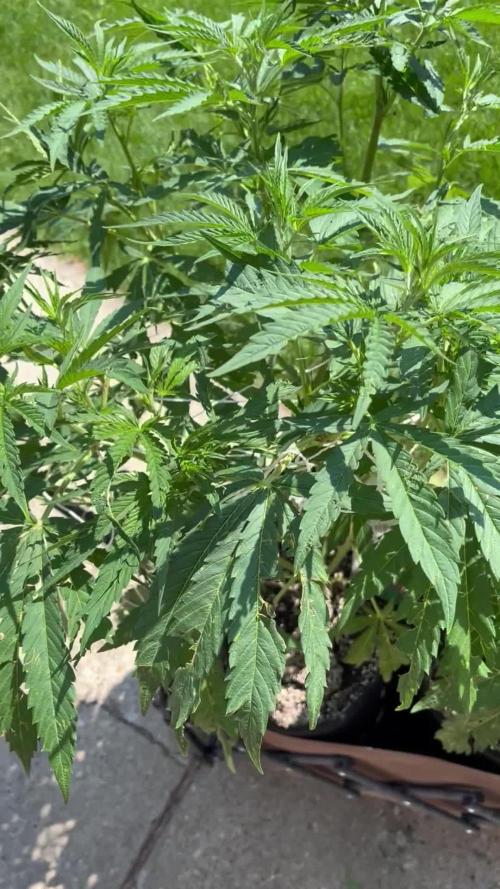
welcome to 📅 Day 36 flower 4/19/2021 she is growing just as I have come to expect she looks very healthy and full. she has many tops and they are developing fast. That's all for this week happy growing and keep your stick on the ice 🏒

Likes
20
Share


@All_our_small_plants
Follow
Bewässerung: 5000 ml jeden 3 Tag in der Zwölften Woche
pH-Wert: 6,2
EC-Wert: 1,4 mS/cm
Temperatur: 22ºC
Luftfeuchtigkeit: 50%
Schädlingsbekämpfung: im Moment haben wir keine Anzeichen das es was zu bekämpfen gibt, sobald die ersten Anzeichen da sind werden wir handeln :)
Düngemittel: Sie bekommen ab jetzt Brenneseljauche da sie im Outdoor Bereich ist.
Besonderheiten: Sie wurde nach draußen umgepflanzt.
-Tag 78 Heute haben wir ihr nochmals ne Ordentliche Dosis Jauche verpasst, sie ist nun ca 1.5 m hoch und der Geruch wird auch immer intensiver.😍 Diese Sorte ist einfach unglaublich, wenn es so weiter geht hat sie in ein paar Tagen die 1,7 oder 1,8 meter erreicht. für eine auto ist das sehr nice.
-Tag 81 Heute war es wieder ein sehr Heißer Tag und wir haben sie wieder mit 5 Liter Wasser gegossen. sie ist nun 1,6 Meter hoch und wird noch immer weiter wachsen.
-Tag 84 sie ist sehr durstig und hat wieder Wasser bekommen.

Likes
14
Share


@MG2009
Follow
03/20/2022
Biscotti Skunk looking lovely first four pictures.next up is lemon OG,followed by the three Grape Skunk girls middle one is my favorite so far (Middle in height)
I did a light feeding of fish and seaweed, a little extra something just incase they get hungry in final weeks.

Likes
57
Share


@Fibro_Witch
Follow
Alright all, it's been awhile since I've been able to update so I have a couple weeks to catch up on.
Unfortunately my cheap phone was having issues last week and I had to do a deep clean and got rid of some photos, photos I though I'd uploaded to my drive that I actually hadn't. I seriously could have kicked myself. But thankfully I at least have a video instead of nothing.
So on August 1st I got some spent hardwood substrate blocks from a mushroom farmer down the road. I crumbled the blocks around the base of each plant and watered them in. The purpose of putting the blocks down is that they still have live mycelium in them, and the mycelium creates a symbiotic relationship with the cannabis plant and it's root structure. The cannabis roots can only take up so much surface area, but the mycelium can take up the space the roots do not and form a network where in exchange for sugars the mycelium will provide nutrients for the cannabis plants. Also, watering with the molasses gives the mycelium the sugars it wants.
I'm sorry I don't have more pictures, I wasn't even thinking when I was cleaning up my phone because I was so frustrated with it (there's a reason LG stopped making phones recently). It's just been wayyyyyyyy more busy than I expected or wanted it to and I've had hardly any time in the garden. It's all this rain! Last year I was complaining about how there wasn't enough rain, now this year there's plenty of it. When I'm not doing Garden stuff I'm working part time with my husband doing landscaping and tree work, which includes mowing lawns. Last year with the drought we were mowing lawns maybe every 2 weeks. This year it's every 4-5 days. It's crazy.

Likes
13
Share


Likes
33
Share


@Rollex420
Follow
22-05-21 (Day 8)
Today begins a new week for the Kosher Cake.
I must say that it has a very rapid growth..
Maybe it will be that I am not used to growing autoflowers and therefore for me it is as if it were a new thing, being used to growing only photoperiodic plants.. 🤷♂️🏻😇
I am very curious to see what she will have to give ..
As always, see you at the next update! 😎
Happy growing to all you guys ☮️💚
23-05-21 (Day 9)
Today, bio-grow (0.7ml/2L) has been added to start giving sugars and vitamins to the plant essential for the initial phase of vegetative growth.
Much love fam! ☮️💚
24-05-21 Day 10
She’s starting to grow some new shoots on her main stem, Now it is starting to take shape. 👏🏻☺️
Stay blessed fam, much love! ☮️💚
30-05-21 Day 16
The girl is growing at her best, I'm sorry to have to move her outside in the future..😕
She seems to really like her environment where she is living now.
I started with a slight LST in order to let the light penetrate also in the lower branches..
Thanks to all of you for your support!
☮️💚

Likes
17
Share


@Lazuli
Follow
The growth went as planned, not too bushy and not mich stretch and fast flower

Likes
30
Share


@SooSan
Follow
Stretch + 6
J'ai divisée la 90x60x140 en 3 parties (et donc 3 Diaries) :
1️⃣
🏠 60x60x140
☀️ FC-E 4800 => puissance a 20%
🍁
1x Black Bomb / Philosopher Seed
2x Amnesia Lemon / PEV Seeds
1x Blueberry / PEV Seeds
1x Blueberry / 00 Seeds
1x Wappa / Paradise Seed
1x Dark Phoenix / Green House Seed
1x Quick Sherbet / Exotic Seeds
1x Mango Cream / Exotic Seeds
1x Banana Frosting / Sensi Seed
1x Hindu Kush / Sensi Seed
1x Fast Mix / Sweet Seed
📎 https://growdiaries.com/diaries/122084-grow-journal-by-soosan
2️⃣
🏠 30x60x90
☀️ TS1000 => puissance a 50%
🍁 4x Fast Mix - Sweet Seed
📎https://growdiaries.com/diaries/124052-grow-journal-by-soosan
3️⃣
🏠 30x60x50
☀️TS1000 => puissance a 50%
🍁 4x Quick Sherbet - Exotic Seed
📎 https://growdiaries.com/diaries/122080-grow-journal-by-soosan
Sponsorisé par Mars Hydro

Processing
Likes
33
Share


@Darksoul
Follow
Week 6 - Maybe the last vegetative week. Everyone is topped and LST. I think I will let them grow in peace this week (Ill just fix the lst, no more toppings or cutting fan leaves) and install my scrog net

Likes
17
Share


@Hashy
Follow
Week 5
Light cycle=18/6
Light Power=120w
Extractor controller settings
High temp= 25c
Low temp= c
Temp step=0c
High Rh= 58%
Low Rh= %
Rh step=0%
Speed max=7
Speed min=1
Smart controller settings (during lights on).
Lights on=06.00am
Radiator on= below 21c
Radiator off= above 22c
Humidifier on= not in use.
Humidifier off= not in use.
Dehumidifier on= not in use
Dehumidifier off= not in use
Smart controller settings (during lights off).
Lights off=00.00am
Radiator on= below 18c
Radiator off= above 19c
Humidifier on= not in use
Humidifier off= not in use
Dehumidifier on= not in use
Dehumidifier off= not in use
VPD aim=0.6-1.3
DLI aim=28-34
EC aim=1.7
PH aim=6.3
Fri 19/1/24
#1 (Day 29)
📋 Looks fine
Cold spell seems to be going now.
Sat 20/1/24
#1 (Day 30)
📋 Lst the 4 colas.
H=34cm D=41cm DLI=35.1
Sun 21/1/24
#1 (Day 31)
📋
💧💧💧💧💧💧💧💧💧💧💧💧💧💧💧💧
Method= automatic
Feed=Veg nutes
Test run while setting drip rates.
Total volume made=12L
Total volume left=1L
Neutralise=0.1ml/L
Silicon=1.0ml/L
Calmag=1.0ml/L
Terra grow=3.0ml/L
Roots=0.2ml/L
Easy Ph down=0.125ml/L
Volume=2.75L (Est)
Ec=1.7 PH=6.3/6.4
Time=7.00pm
Runoff.
Total runoff=3L
Ec=4.6 PH=5.6/5.7
💧💧💧💧💧💧💧💧💧💧💧💧💧💧💧💧
Mon 22/1/24
#1 (Day 32)
📋 H=36cm D=39cm DLI=36.6
Raised light 8cm
H=36cm D=47cm DLI=29.4
Tues 23/1/24
#1 (Day 33)
📋
Wed 24/1/24
#1 (Day 34)
📋
Thur 25/1/24
💧💧💧💧💧💧💧💧💧💧💧💧💧💧💧💧
Method= automatic
Feed=water
Neutralise=0.1ml/L
Roots=0.2ml/L
Easy Ph down=0ml/L
Ec=0.25 PH=6.4/6.6
Time start=12.00pm
Finish time=13.05pm
(7×5 minute runs with 5 minute gaps)
Total flow rate=200ml/min
Flow rate per plant=50ml/min.
Total volume made=12L
Total volume left=5.5L
Total volume used=6.5L
Volume per plant=1.6L (Est)
Runoff.
Total runoff=0L
Ec= PH=/
Did not work properly so need to sort it out.
Total flow rate=185ml/min
Flow rate per plant=46ml/min.
Ran for an extra 15 mins while sorting out system. Should be about 200ml/min now (50ml/min each plant).
💧💧💧💧💧💧💧💧💧💧💧💧💧💧💧💧
#1 (Day 35)
📋 H=41cm D=40cm DLI=33.5
Had no problems at all with this one, all iv done is adjust the LST slightly. Looks a little sad today as I went a little long inbetween waterings.
The tent is starting to smell real nice. I'm hoping to flip to flower quite soon.
Back soon.
Take it easy.


Likes
54
Share


@MrJones
Follow
The yield this run was just amazing, the VIPARSPECTRA XS-2000 performed very well, they run so cool, it's just crazy, you can set the lights about 10 inches from your plants at 70% without fear of burning them, sweet seed cream mandarin auto al, always yields very well, this harvest was even better, largest amount from any Auto Flowers yet, I know that you folks that grow DWC can push it a bit better but when grown in the soil the terpenes and flavors seem to be a click better in my opinion. If you have not tried these seeds you just have to, you will not be disappointed!
Likes
2
Share


@ReggaeShark_420
Follow
Im very happy with this girl. 26.8 for a plant got a bit hurt and struggled, the bud is sou beautifull.
Likes
28
Share


@Ultraviolet
Follow
If you are lonely when you are alone, then you are in bad company.
Bee pollen is considered a “vitamin bomb” due to the presence of almost all vitamins with an average of 0.02–0.7% of its total content, with a higher amount of water-soluble than fat-soluble vitamins. Bee pollen contains vitamins A, D, E, B1, B2, B6, and C. It also provides minerals such as calcium, magnesium, phosphorus, potassium, zinc, copper, manganese, iron, and selenium, I mixed a bunch of that with some honey and RAW cane molasses to make a nice big bucket of tea. A family friend who is a beekeeper was kind enough to share some honey. The nutritional content of raw honey is impressive and includes high levels of protein, amino acids, B vitamins, calcium, manganese, potassium, magnesium, zinc, and iron, as well as various polyphenolic antioxidants.
I am loading up nature's finest sugars, and sweet things, Honey & Mollases.
UV-B-induced DNA damage (CPDs and 6–4 PPs) can be repaired efficiently by photolyases. Pyrimidine dimers can be repaired by nucleotide excision repair (NER), or bypassed by replicative polymerases (Britt 2004). The expression of the CPD photolyase (PHR) gene is induced by UV-B light dependent on UVR8 signaling pathway, and is also induced by blue and UV-A light (Li et al. 2015)
https://link.springer.com/article/10.1007/s44154-022-00076-9?fromPaywallRec=true
Old but gold.
The camera picks up far more light than there is during the night cycle, camera is showing bright pink violet collages but my eyes barely see a thing, about 0.25ppfd in that tent overnight. Have been tweaking the spectrum of moonlight/intensity and watching the responses overnight.
Tweak, tweak, tweak all week.
PAR is 400-700nm,
Overnight UVA in the tent is all 365nm and 385nm, so the meter only picks up a fraction of the light curve that makes it photosynthetically active past 400nm. Of the light in the tent, 0.25ppfd is from UVA
Looks like It makes them 🕺 🕺 💃 all night.
Better flower soon or ill be screwed for space, they are stretching, but is it "the stretch"? She has fire in her belly.
Growing crops with insufficient light (i.e., below “optimal,” as defined here) limits the yield potential, which in turn wastes the other production inputs including labour, water, nutrients and electricity. As lighting fixture is one of the most expensive investment of the production, what is the relationship between light intensity and yield?
Potter and Duncombe (2012) grew cannabis plants with varying canopy-level PPFDs during the flowering stage and found that increasing PPFD from 400 to 900 μmol·m−2·s−1 increased yield an average of 1.3 times higher, across seven cultivars, with no light intensity treatment effects on floral cannabinoid concentrations. Vanhove et al. (2011) found that cannabis yields were 1.3 to 3.1 times higher (depending on cultivar) when plants were grown under approximately 1000 μmol·m−2·s−1 compared to approximately 450 μmol·m−2·s−1 during the flowering stage.It was predicted that cannabis yield would exhibit a saturating response to increasing Light intensity, thereby signifying an optimum light intensity range for indoor cannabis production.
However, a new research from Morrison (2021), after 81 days‘ experiment, found that When plants grew under LI ranging from 1200 to 1800 μmol·m–2·s–1 provided by light emitting diodes (LEDs), inflorescence yield increased linearly as LI increased up to 1800 μmol·m–2·s–1.
"Cannabis will not stop flowering if the lights are turned on for a few minutes once or twice during the 2-month-long flowering cycle. If a light is turned on for 5 to 30 minutes—long enough to disrupt the dark period—on 3 to 5 consecutive nights, plants will start to revert to vegetative growth."
"Less than one half of one foot-candle of light (0.1ppfd) from sunlight will prevent cannabis from flowering. That is a little more light than is reflected by a full moon on a clear night. Well-bred indica-dominant plants will revert within three days. Sativa-dominant plants take four to five days to revert to vegetative growth. Once they start to revegetate, it can take from four to six additional weeks to induce flowering again!"
Guess ill find out my answer soon.

Likes
7
Share


@Krissci
Follow
Day. 2 - watering and LST.
May switch to blooming nutrients today.
New product called C-results (organic). I will be using this.. only needs to be applied once.
Likes
12
Share

@Northern_Ent
Follow
July 18: Plants are recovering from hail damage 7 days ago. Weather is good now but it’s fairly hot reaching 30 C the last couple days and about 21 C overnight which is quite warm for Edmonton.
Starting force flowering tonight. That is 10 h darkness plus 2 h virtual darkness using 730 nm far red light at dusk to initiate dark mode. In garage at 9 pm, few seconds of 730 nm far red and then out of garage at 7 am. 12 h darkness within the ‘26 h day’. Your mileage will vary at different latitudes but that timing works for me here at 53 N.
Likes
32
Share


@Theia
Follow
I think this will be the final weeks for ChiBan. The cold has forced a turn of purple colour which with her frost looks beautiful. Nice dense buds with a tropical smell. Delicious..
That's all this week for her.
Stay safe 😷😷
Grow well 🌿🌼🙏🏻👍🏻

Likes
19
Share


@Captensmokey
Follow
I participate in the dutch passion master grower with this 3x auto duck dutch So vote for me. And follow this crazy breeding of the autos duck🦆🍀💯
Likes
21
Share


@GODSGIFT_2005_JM
Follow
🍼Greenhouse Feeding BioGrow
⛺️MARSHYDRO
The ⛺️ has a small door 🚪 on the sides which is useful for mid section groom room work. 🤩
☀️ by VIPARSPECTRA (models: P2000 & XS 2000)

Likes
321
Share


@Tropicannibis_Todd
Follow
🤔🤔🤔🤔🤔 HAPPY GROWING 🤔🤔🤔🤔🤔
Looks like I've can upload short videos 👉 so I will do what I can my friends
We are now 35 Days in and everything is going great 👍 👈 We now Flip To Flower 👌
👍 decided to showcase the Mini BigBand , was a extra seed that germed so I kept it as a Mini Me 😊
Day 39 and all is well 👈
Except for some watering it's been pretty smooth I've done a little maintenance and manipulation of the canopy 👈
Might do a slight defolation later in the week 🤔
👉Soil Medium Provided by ProMix.ca
👉Nutrients Provided by Agrogardens
👉Lighting Provided by MarsHydro.ca
I would like to thank the many growmies for support throughout the years 🙏 So Let's Do This 👊👊👊 Happy Growing
