




Likes
32
Share


@Roberts
Follow
Critical x animal cookies has grown into the nutrition now good. She did get topped today and roots pruned. She has been doing okay beside the nutrition burn early on under the Hortibloom Solux 350. She should start making some decent progress now with growing. Thank you Hortibloom, and Ripper Seeds. 🤜🏻🤛🏻🌱🌱🌱
Thank you grow diaries community for the 👇likes👇, follows, comments, and subscriptions on my YouTube channel👇. ❄️🌱🍻
Happy Growing 🌱🌱🌱
https://youtube.com/channel/UCAhN7yRzWLpcaRHhMIQ7X4g

Likes
35
Share


@XxxAuto
Follow
Again thanks too Fastbuds, for this amazing strain.... it's SOOOOOOOO fucking good !!!!!!!! 😘😍 and a beautiful lady

Likes
4
Share


@Uk420time
Follow
Coming along nicely .. introduced pk slowly and seems to be doing a really nice kob along with the boost .. how long left you recon guys ?? 3 or 4 weeks ? ... Happy growing grhomies 🤟❤️
Likes
15
Share

@Mmc94
Follow
Last week , shes floping over everywhere 😂 , definitely could have done with more support, she went 90 days from sprout 🌱 , my quickest Coco atuo so fare , she about 2.5kg whole plant wet
Likes
7
Share


@BG107
Follow
These girls are starting to stink . Green Apple Jolly Rancher, Menthol, Lemon Pine sol. Also, I backed off of the nutes this week. I've got brown tips all over the fan leaves.. nothing too bad, but definitely nute burn.
Likes
1
Share


Likes
4
Share


@The_Projexx
Follow
Welcome to week 8 of flower!! Things are really starting to get heavy and loaded in frost! I will be checking the trichomes this week to see what plants are nearing the end and which ones will still need a bit more time to mature and finish. To say the least Im very excited to get to the finish line with these ladies!
Huge shout outs go to @MarsHydroLED and Hidden Vault Genetics for their dedication on making stellar gear that making growing extra fun and really easy.
Huge HUGE shout outs go to all my followers and to the people who stop into the diary alike to show their support! Keep on inspiring to grow!
-The Projexx
Day#50F Some of the ladies are still putting on some mass!
Day#51F Pictures N/A. Macmelonz and Banana Smoothie #1 will deff need more time to finish then the rest of the ladies in this room!
Day#52F Started removing some leaves from the bottom , I will be looking to continue this until harvest day.
Day#53F I knew I should have installed the second net, Some of the flowers are leaning right over now haha. Going to get some stakes to add into the buckets for some support.
Day#54F Checked the trichomes looking like 6 of the 8 plants will be starting their flush while Macmelonz and Banana Smoothie #1 will continue to feed for a bit longer before starting to flush.
Day#55F Really digging trichome production on Creamy Cereal #2 , she's got a wild Lucky Charms aroma to her that's quite unique.
Likes
103
Share


@Schnabeldino
Follow
_____ Week 6 | Day 49 - 56 ______
Day 49 🌞
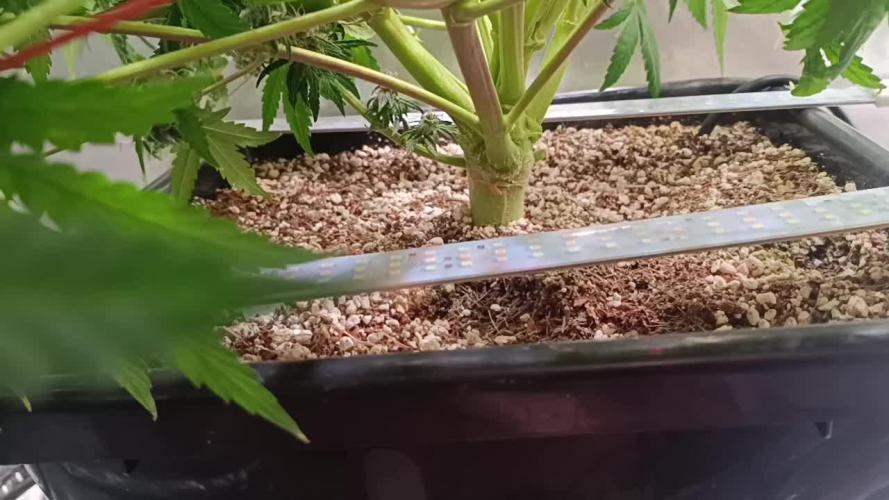
- Install 2 LED BARS from Spider-Farmer.
https://www.proximitylighting.com/home-2-1
THE OPTIMAL ADDITION OF LIGHT
By increasing PPFD levels in the most
light-hungry layers of the crop,
deploys addional wattage where it's
most useful to encourage:
• Tighter internodal spacing
• Larger average cola size
• Increased cola uniformity
• Higher output per square foot
Day 50 🌞
- 2 Liter each Plant....gluck, gluck, gluck....
Day 53 🌞
- light switch to 12/12
- defoliation all leafs under the net
Day 55 🌞
- 2,5 Liter each Plant....gluck, gluck, gluck....
____________________________________________________________________________________________
Light - 18/6 h - 400 Watt 60% Dim.
PPFD - 600 - 650 µmol
Temp. avg. - 22,1°
Hum. avg. - 72 % RLH

Likes
14
Share


@Kakui
Follow
15 Noviembre:
-Hoy se instaló el sistema de riego "Drip to Waste" que me permitirá hacer riego de precisión, con protocolo "Crop Steering".
-Se instalaron sensores de humedad de suelo, para saber cuándo y cuánto regar, el sistema manda datos de humedad de suelo, temperatura y humedad ambiente, etc vía internet a mi celular.
-Mañana se comienza con el primer riego de precisión.
17 Noviembre: Segundo día de riego automático, 3.0EC y 5.9pH, las plantas crecen a buen ritmo, las raíces ya están saliendo por los orificios de drenaje a 2 días de transplantadas.
20 Noviembre: Se realizó una pequeña defoliacion de las hojas tipo abanico muy grandes.

Likes
8
Share


@EhCndGrower
Follow
Day 17 and she is growing nicely, but hope the side branching will pick up a bit for training. Keep freaking out thinking I have mites again but I don’t see them on my leaves. Plus I think I have grasshoppers nibbling on all my gals leaves. As of Saturday Fozzy Bear (we wanted it Fozzie but official paper work says otherwise) joined the family and his new big brother Buddy. He has already grown a few inches since we got him but god is he ever cute, and god bless Buddy for taking his playful shit since

Likes
15
Share


@PiusWaxis
Follow
Here we are at the end of my plant's wonderful eleventh week of flowering, another week full of exciting developments and new discoveries.
The constant and unstoppable growth of the plant has come to an end, showing a beauty and vitality that are a true spectacle for the eyes. 😎
The abundant layer of resin that has formed is a clear sign of the health and well-being of the plant, once again confirming the benefits of the premium nutrients used throughout the entire growth cycle.
TrollMaster's "TENT-X" environmental control system continues to prove its worth, precisely maintaining optimal temperature and humidity levels to promote vigorous plant growth.
The combination of advanced and precision technologies ensures that plants can thrive in a controlled and conducive environment😎
I am thrilled to share with you the latest video showing the temperature, humidity and VPD trends of this last week of flowering, providing further demonstration of the extraordinary performance of the TrollMaster control system and its synergy with the other elements of the grow room.With each week that passes, the anticipation for the new discoveries and challenges that await us continues to grow.
With the constant support of Plagron nutrients, trust in the TrollMaster control system and the excellence of MEDIC GROW LED lighting, I am sure that I am always ready to face any challenge!
Thank you again for being by my side in this extraordinary adventure, dedicated to exploring the wonders of plant cultivation. Together we continue to look to the future with confidence and enthusiastically anticipate the successes that each new week holds for us. 💪👽🌱✨
REVIEW TENT-X:
I was pleasantly surprised by the effectiveness and functionality of the TROL MASTER!
This device is simply amazing, as it has allowed me to monitor the environments I use it in accurately and efficiently.
One of the most impressive features of this device is its ability to operate LED lights easily and intuitively. Thanks to its user-friendly interface, I could easily customize the lighting of my rooms according to my tastes and different situations. I particularly appreciated the possibility of programming the sunrise/sunset simulation, thus creating a more natural situation.But that's not all: the device goes further and manages to keep me constantly informed about the humidity and temperature of the surrounding environment. This feature has proven to be very useful, especially in times when I am not present.
I was able to set humidity limits, so that the device would immediately alert me if the levels exceeded the desired threshold. This allowed me to intervene promptly and avoid excessive oscillations.
The accuracy of the temperature measurements was another welcome surprise. The device is equipped with a high precision sensor that allows me to constantly monitor the temperature of the rooms. Here too I was able to set temperature limits, allowing me to be notified immediately if they were exceeded.
Overall, I was really satisfied.
The TENT-X exceeded all my expectations. Its ease of use, precision of measurements and possibility of customization make it an indispensable tool for those seeking to monitor and optimize environmental conditions.

Likes
15
Share

Likes
23
Share


@555ABKY555
Follow
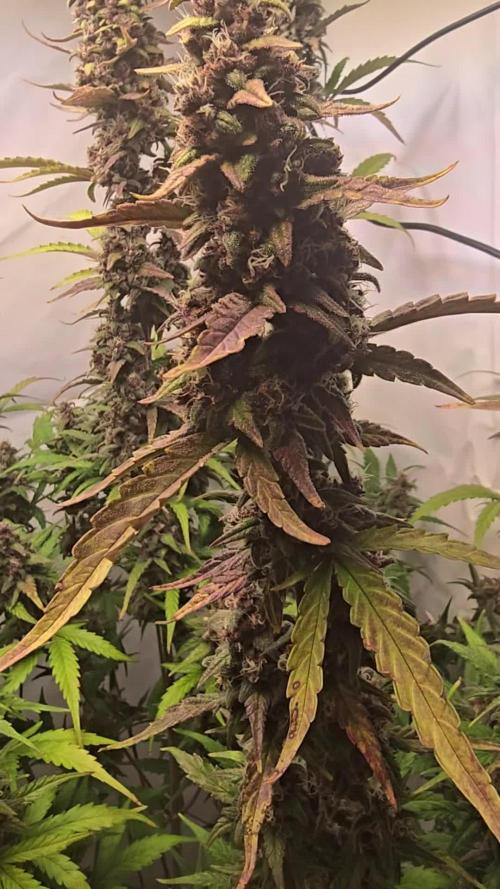
the past few weeks the girl scouts have been irrigated and fertilized but the little land used has made them dwarf, I performed lollipopping due to a redness that appeared on the leaves of one in particular now it is the most luxuriant. the skunk has really grown up in the background and the little shade has earned it its luxuriance


Likes
82
Share


@BigBadLion
Follow
Hey everyone!
Sorry for the delay!
This week I raised the amount of phosphorus and potassium! And yikes! I went suuuuuuper high by mistake! I gave them (after pH and TDS checks) a total of 1968 ppm which I believe was just way too much for my babies 😬 gladly they barely showed some nutrient burn. With the exception of Boomer and Falcho, which both plants are still showing some chlorosis (better than last week tho) and I believe it's probably because of some sort of nutrient lock out or maybe the plant is just getting too old!
You'll see from the photos how the plants developed after overfeeding them. They didn't wither 😱 or anything (and only some few leaves started to show some signs of nutrient burn) so I'm happy so far. I'll be more careful next week about this!
Besides that big mistake everything went well. I kept removing dry/yellow leaves and taking care of my babies 👌
Thanks everyone for reading!


Processing
Likes
24
Share


@Cogollo_eu
Follow
**Encontrarás la traducción a español al final de la descripción**
If you like this week, please hit a like, it costs you nothing! 👊. Thanks in advance 😉!
From/Desde: 19/08/19 || To/Hasta: 25/08/19
From day/Desde día: 28 || To day/Hasta día: 34
-----IMAGES & VIDEOS-----
P5 - I'm loving this photo, is the first complete cool photo of the AK i've taken. With the structure, the fixing rods with the same length as the diameter of the AirPot, and those beauty rubbered green cables 😍.
P8 - I'm feeling that those branches looks too weak, and slim for what's coming. From next week i will use Rinho Skin to see if it can help them to get fat in upcoming weeks and before flora time. I'm also minding to create some branch supports with the 3d printer that will be placed on the LST structure, I need to twist my mind a bit with it.
-----WEEK SUMMARY-----
Another super heat week. While at home i'm at 34~36º in the street things are worse :(. Also humidity fluctuate from 50~65º.
At last I removed those ugly & dangerous cables from the branches and used a rubber covered one. For now i only need to fix her in 4 points, 1 per each main branch, as you can see, at about 13 cm of the main branch. Later i will fix her with another 2 points per branch, one in the border of the pot from inside, and the last one also in the pot's border but outside.
This week i removed the first horizontal internode on each main branch, and also removed the branch that grows vertically down from the second internode leaving in place the one that grows totally up.
At the end of the week i will fix the SCROG mesh, but it's not going to be permanent until later, or maybe not at all due to dark photography, as if i place the mesh i will not be able to move the plant (i need to think about it). For now, I just need it 3 or 4 days to test it as i never placed this 60x60 mesh before, and also i had to cut the central rods for the mesh.
About Alice K. she's growing beauty and healthy, some week ago i found a little white spider that i killed, @time (week 7) I didn't noticed any insect signs more. Also remark that she's standing well those temperatures and some days of very low humidity some hours 35% inside the tent. And also the equitative distribution she's developing.
As i said on previous week, i will kill those clones at mid week as i'm going to plant 4 more seeds in a week, and all is going to be too much work 😞to compatibilize it well with my job.
-----WATERING CALENDAR-----
23/08/19 (Day 32) - 3,000 ml with all week nutrients @ 1.1 E.C. PH5.8
*****ESPAÑOL*****
Por favor, si te gusta esta semana dale un like, no te cuesta nada 👊. ¡Gracias por adelantado 😉!
-----IMÁGENES & VÍDEOS-----
P5 - Me encanta esta foto, es la primera foto completa guay que hago de la AK. Con la estructura, las barras de aluminio de la medida del tiesto y esos cables cubiertos de goma verde, me empieza a encantar el aspecto de la planta 😍
P8 - Tengo la impresión de que las ramas son demasiado endebles y finas para lo que está por venir. A partir de la semana que viene, usaré Rinho Skin para ver si las puedo ayudar con el engorde antes de que llegue el tiempo de floración. También estoy pensando en crear unos soportes para las ramas con al impresora 3D que irían enganchados a la estructura para LST, necesito darle unas cuantas vueltas a esto último.
-----SUMARIO SEMANAL-----
Otra semana super calurosa. Mientras que en casa estoy entre los 34~36º en las calles la cosa es mucho peor. También la humedad está un poco loca ya que a diario me fluctua en casa del 50~65º.
Al final he quitado esos cables feos y peligrosos de las ramas y he usado un cable con goma en condiciones. Por el momento sólo he tenido que atar la planta a 4 puntos, 1 en cada rama que he dejado, como se puede ver a unos 13 cm del tallo principal. Más adelante usaré otros dos puntos de fijado en el borde del tiesto, uno de ellos en la parte interior y otro por fuera del tiesto.
Esta semana he quitado el primer nodo de cada rama y también la rama que crece hacia abajo del segundo nodo, dejando la rama que crece totalmente hacia arriba.
Al final de la semana colocaré la malla de SCROG, pero no va a ser de manera permanente, por lo menos hasta más adelante. Voy a empezar a hacer fotografías de fondo oscuro, y el tener la red me va a imposibilitar la tarea ya que debo sacar la planta del armario para las sesiones (necesito pensar en ello). De momento la quiero montar 3 o 4 días para probarla ya que nunca la había montado antes y también tenía que cortar las barras horizontales para la malla.
Sobre Alice K. está creciendo super bonita y sana, hace un par de semanas encontré y maté una arañita blanca (Requiescat In Pace), a día de hoy (semana 7) no he visto más signos de insectos. También debo remarcar lo equitativamente que está creciendo y lo bien que soporta las altas temperaturas y la escasa humedad, hay alguna vez que he mirado el higrómetro y estaba al 35% dentro del armario.
Como dije en la semana anterior, mataré los clones a media semana, voy a plantar otras 4 semillas la semana que viene y va a ser demasiado curro 😞para compatibilizarlo con mi trabajo.
-----CALENDARIO DE RIEGO-----
23/08/19 (Day 32) - 3.000 ml con todos los nutrientes semanales @ 1.1 E.C. PH5.8
