


Likes
Comments
Share

@xTaps
Follow
23.08
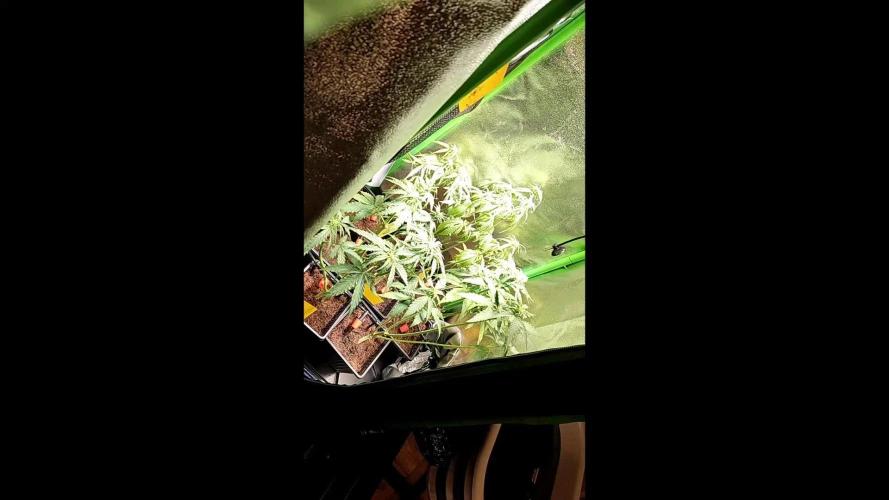
The Drainmaster moved into the tent to control the drain.
Defoliated and lollipopped them.
25.08
First run with the drain system.
Nutrient Solution (Tank):
Volume: 8.5 L
EC: 3.05
pH: 5.5
Nutrients: Advanced Nutrients Micro/Grow/Bloom + CalMag
Irrigation Run:
Pump time: 30 minutes
Total Drain: 5.0 L (≈ 60%)
Drain EC: 2.6
Drain pH: 6.0
🔎 Observations
Drain volume was far too high (target is ~20%).
Drain EC lower than input EC → medium was relatively “empty”, plants absorbed nutrients quickly.
pH drift from 5.5 → 6.0 shows some buffering effect left in the reused substrate, but limited.
Substrate behaves more like coco than soil now (low buffer, fast response).
💡 Insight / Lesson Learned
30 minutes pump time is way too long → resulted in 60% runoff instead of 20%.
For 8 × 1 L pots, a single irrigation event should be ~1.0–1.2 L total, with ~200–250 ml runoff.
Solution: shorten pump time to ~5 minutes and re-test runoff.
Better approach: run shorter, more frequent irrigations (daily) with a lower EC (2.0–2.2), instead of heavy feedings (EC 3.0) only 3× per week.
This will keep EC more stable in the root zone and prevent salt buildup in the tiny 1 L pots.
27.08
Adjusted the pump timer to 5 minutes, gave the first dose of PK13/14.


Likes
12
Share


@OGbros
Follow
the roots broke the plastic basket😱
Very strong genetic, very recommended👽

Processing
Likes
14
Share


@OutForReal
Follow
Song of the week : Jingle bells 🌲
14.12
Boom bang 🔥 ! I think I've found my outdoor 12/12 Autoflowering phenotype , with this height , that shape in a 7tL pot , the flowering under 18/6 , and the vigour : she have all that I was searching for.
Now I have to wait and see for the flowering and yield to really know if I've found my winner
I also hope that the sex reversion will be effective soon but to stop doubting I prefer to spray it again with sts
Now concerning her health and feeding : she has been feed with 1 tea spoon of Mr.B's Green trees Bloom because it's time to push some more pistils but on the other hand the lower leaves are starting to yellowing a bit so suspect her to be or a huge eater or that the pot is so small that she need to be feed at each watering. Whatever it could be she will 're rice s little amount of beg nuts this week then I'll get back to the regular feeding ✌️🏼🦎
-------
15.12 - I have made 2 videos today. One to show you how it rain in my country and the second to show you the wind during the rain. A regular rain not the hard one
Likes
6
Share


@gabigarcia
Follow
Third week of vegetation and the plants, especially the autoflowering ones, have grown a lot approximately 7 cm in 7 days, they have grown both long and wide, I think this harvest is worth it!!

Likes
7
Share


@Hempcules
Follow
WEEK 5 (DAY29-35)
The Runtz are thriving so far.
Both plants have developed eight evenly spaced shoots, and now I’m waiting for the flowering to begin.
Additionally, I have trained both plants with hooks to create a beautiful canopy.
I’m still excited and hope they continue to grow as well as they have so far.

Likes
19
Share

@Northern_Ent
Follow
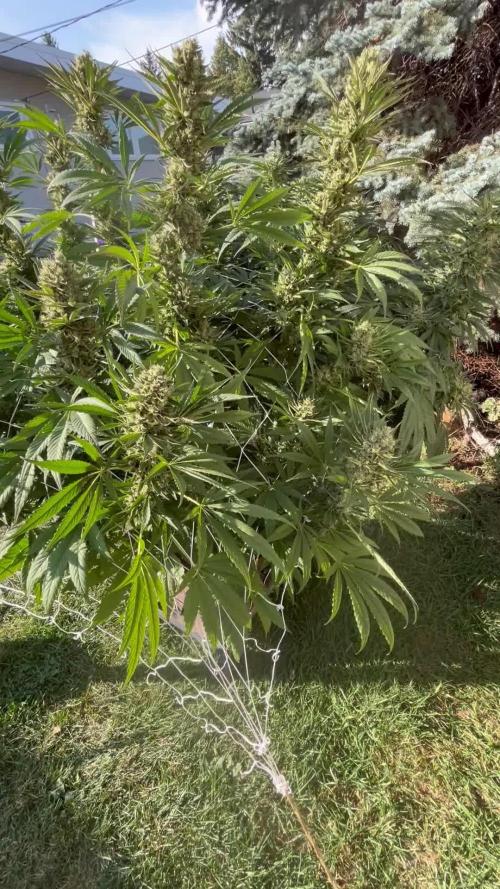
Sep 20: Tropicana Cookies Fast Flowering is huge and the buds are still getting bigger. Will try to wait another week before I start harvesting the tops. The buds look a bit immature still so will try to wait another week longer.
Did a second flush as she needs more time, but I like what the flush last week did to the buds.
Sep 25: harvested 310 g wet buds into freezer and 1040 g fresh for ice water hash. Total 1350 g is equivalent to 340 g of dried buds. There is likely almost 1 kg of wet still on the plant so this plant will likely be good for 600 g dried. Probably should have left them for another week but the weather is getting iffy and the timing with the rest of everyday life was good.

Likes
19
Share


@Sato_Growing
Follow
Low stress training has began to 5 of my plants and i will do the rest of them in this week.
Grow running perfect with good conditions. Plants are looking heathly and respond well to my nutrients, and i will start to incrense the nutrients i am giving to the plants.
Watering 0.5 L water each plant every day for this week with the following nutrients
4L Water with
Micro Grow Bloom B52 VoodooJ Rhino Tarantula
1ml
1ml
1ml
1ml
1ml
1ml
1ml
Likes
3
Share


@mistaminista420
Follow
So I had to cut all leaves, and also some of the smaller leaves due to mold. It was only a little bit mold but I cut away every part that seemed to white for me in the end. It probably would habe worked out growing her 2-3 weeks longer but I decided to chop/save her.
Likes
2
Share

@youdan
Follow
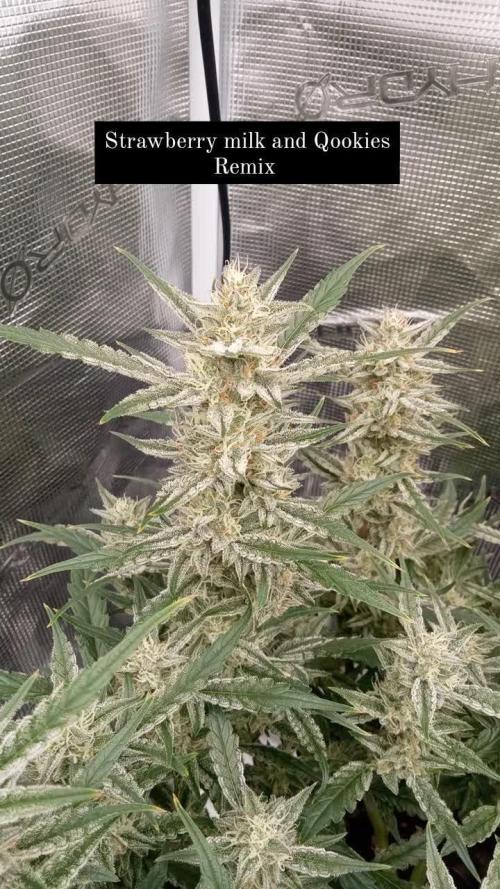
una fioritura bestiale, i tricomi sono fuori scala penso che si potrebbe lavare anche al 9%, sara un ottima prescelta per le estrazioni!!! non vedo l'ora!


Likes
9
Share


@drbill
Follow
I'm shocked and impressed at how much abuse from my mistakes (high PH, low PH, no nutrients, to nutrient burn to light burn) and it turns out so good!
I did a rough trim on them and hung the branches on hangers. I weighed each hanger so I can update it later
Epsilon one
66 g hanger one
Hanger to 61 g
Hanger 3 40 g
Hanger for 47 g
Hanger 5 72 g
Epsilon two my
Hanger one 49 g
Hanger to 33 g
Hangar 375g
Hanger for 71 g
Hanger 540 g
Hanger six 93 g
Epsilon 3
Hanger one 95 g
Hangar 295
837
Hangar to 59 g
Hanger for 75 g
Hanger five 52 g
5grams loose bud
Wet harvest 1028g 36.26oz 2.26lb
Likes
39
Share


@Velk1
Follow
It's flush week in the main room for the girls I have kept back one gold glue the monster mbap and gwk they will be given longer as a bit behind
This has been a smooth run can't wait to move the wilmas in to there new home more space efficient and feeding friendly
The gold glue I will definatly run again and again lol one of my new favs
This grape walker kush was neglected Unfortunatly but still turned out super frosty and stankkkkkkky the ones one my next run will have all my care and love
Mbap great bud formation and size this is another strain to put in the vault to save for years to come !
Updates have been a bit slow due to my phone being rubbish 🙈 Issues uploading vids and photos catch my vids on my Instagram @velk_1

Likes
5
Share


@Oktoberfest
Follow
Von links nach rechts: Sleepy Joe, Lava Cake, Runtz.
02. Mai 2025
Die Wurzeln sind jetzt sehr gut entwickelt. Seit dem Einschalten des Lüfters haben die drei gut 20l Wasser verbraucht. 😅 Sie wachsen so unglaublich schnell, dass sie in drei Tagen fast die LED berührt haben. Dadurch leichte Verbrennungen an den Spitzen der Lava Cake. Viel höher darf die Runtz nicht werden, sonst muss ich die Spitze nach unten binden. Das Zelt ist nur 180 cm hoch.
Der Lüfter des Filters läuft jetzt schneller mit 50% Leistung. Die Luftfeuchtigkeit lag heute bei 75% und musste aus dem Zelt. Das führt aber auch dazu, dass die Wärme abgesaugt wird. Wird Zeit, dass es draußen konstant wärmer wird.
03. Mai 2025
Die Lüftung habe ich über den Trenntrafo wieder eine Stufe langsamer gestellt. Aber auch vorher lag die Temperatur nachts bei 22°C, also alles im grünen Bereich.
Licht:
Eine der zwei Sanlight S4W strahlt exclusiv seitlich auf die Runtz. Normalerweise würde ich das nicht so machen, aber die Runtz wächst sehr luftig und hat sehr großen Abstand zwischen den Blättern. Sie sieht gesund aus und wächst gleichmäßig. Die Rückseite der Pflanze zeigt keinen Lichtmangel durch unsymetrisches Wachstum. Eine Beleuchtung von oben wäre aktuell schlechter. Ich muss schon sagen, die Runtz überrascht mich immer wieder und ich mag das zwar hohe aber sehr luftige Wachstum!
Die Sleepy Joe und die Lava Cake sind vergleichbar hoch und teilen sich die zweite Sanlight S4W. Auch ihnen geht es gut, etwas größer wachsende Pflanzen sind mir aber lieber.
Wasserbrauch:
Bisher 30l. Heute den kleinen Tank mit 20l Wasser inkl. 64 ml Canna Aqua Flores aufgefüllt. 34 ml pro 10l bei hartem Wasser gemäß Rechner von Canna. Beim letzten Grow habe ich noch pH-down verwendet, das ist laut Canna nicht nötig und funktioniert aktuell perfekt! Canna: "Es sind pH-Stabilisatoren enthalten die ein Einstellen des pH-Werts unnötig machen." Quelle: https://www.canna-de.com/canna-aqua-flores
Die Pflanzen wachsen wie beim letzten Grow kräftig und gesund, ohne Anzeichen von Mangelerscheinungen. Und sie sind nicht übertrieben dunkelgrün durch zu viel Stickstoff. 😱

Processing
Likes
15
Share


@Messypies
Follow
amazing growth this week from all 3 plants. The peanut butter cookies is recovering from the transplant. Both the auto cheese and auto cinderella jack have both started to show signs of flowering and have bushed out incredibly well. The pbc has had its first top done and has started growing 2 extra nodes.
07/08/2020 - training has been done on all the autos. They have recovered extremely well and seem to not be slowing down. Finally starting to see the type of flowers I have been striving for. After a semi unsuccessful first grow, this has been a huge relief. Both autos are now showing signs of going into flower so I will try to stop LST unless any unruly branches form.
The peanut butter cookies has now started to fully recover from the transplant and topping. Will now allow this to flourish and grow as big as it wants as both autos should be done before its too big (hopefully)


Likes
Comments
Share


@VirginiaGrownExotics
Follow
She’s getting nice a frosty and budding up nicely growing in sohum just add water
Likes
13
Share


@GrandmasBoy2021
Follow
Week 14,
Week 14 was the last week before Harvest/Havrest! I flushed the plant and trimmed her a bit before harvest. I hope you all enjoy the videos and the pics!


Likes
6
Share


@Skunkstar
Follow
Flipped the girls fed ec 1.5 runoff was 1.7 coco drying back to half the weight of pot every feeding and started with the shogun boost hung the gavita 1000w se pro about 3 ft high and added another fan to the mix ph is around 6.2 on runoff im using a wet vac to clear all the runoff temps are around 26 day 22 night im looking to keep night time temps closer within 10 degree's diffrence for tighter intonode space there on a stretch looking to do some defolation usually I like to right before the flip and day 21 but I'm going for week after flip and end of week 3

Likes
24
Share


@Firepharmer
Follow
Beautiful gas fuelled grapefruit terps with earthy under tones Awesome strain to grow been grow her for about 3 years.. some of the best yields for me from this slurricane ix . 53 huge tops on the 2 lady’s . The crystals colours and terps just get better and better every grow .. adding another futur vert FM8 and a uva bar to the next run ..


Processing
Likes
3
Share


@420cfm
Follow
Next time will flip two weeks earlier for this strain. Canopy got away from me! Otherwise please with progress and learning from previous grows.
Likes
21
Share


@Dapper_Buds
Follow
What’s going on lady’s an gentleman. we got the Moab strains going on W/1 in living soil. They where planted into the root riot cube an treated with neem oil to kill off the fungus gnats, they are thriving now. An getting bigger as the day goes. They will be trans planted into the auto pot system at end of this week. Into the 2x4. Under the double UFL3000 mounted on custom frame. Pumping 402w from the wall. Currently both the girls are in the veg/solo cup cabinet under the UF2000 100w light. Currently 60% rh and temps running 79 lights on. Thanks for viewing an happy growing!
