


Likes
Comments
Share


@jonnyMcKush
Follow
Ein pheno konnte schon geerntet werden von der fast Diesel von Izi


Likes
14
Share


@Snickelfritters
Follow
10/28 - First week in the books. I figured now would be as good a time as any to use a sprouted seed tea because the plants seem to be starting to fully stretch. Pistils are coming slowly but surely. Canopy isn't full but it's still the best I've ever done and I'll take that knowledge into future grows. Exciting weeks ahead. Crazy to think in two weeks it will look more like the finished product than the plants you see before you.
I'll take them out for a photo shoot this weekend. The amount times I will be taking them out of the tent will be limited from here-on-out. These plants are getting cumbersome.


Likes
56
Share


@Prilyfe13
Follow
May 17, 2024 Day 92
This is the last week of the Flowering phase. I'll be harvesting most likely next midweek or earlier. The goal is to harvest by the end of the week, but I don't think they will be done.
Banana Purple Punch A looks amazing! Her branches are nice and leaning. Not too much, just enough. She's also starting to show signs of fade. Or at least unhappy leaves turning yellow. One weird thing I noticed is the back leaves all have signs of nitrogen toxicity. What's weird is that I haven't used nitrogen in over a week and the last time I used it, I did a quarter dose. This should not be happening. I'm confused.
Other than that, it's the end and I'm not worried about it, but it's still weird. Any insight?
Banana Purple Punch B looks great as well. Tons of orange pistils and lots of frost. What's nice is that a lot of that frost is still clear trichomes. Imagine what they will look like in the end. I'm so excited!
Both plants still have water in their basins, so I'm going to let them drain out and most likely not water again. It should be about a week for them to dry out completely. Perfect timing for harvest.
I may put Banana Purple Punch A in a dark period while Banana Purple Punch B finishes up for a couple days. I'm doing the same thing with my Tropicana Cookies.
Lighting. Well, it hasn't changed. Lol. Duh. Hahahahaha. Another week of this light intensity.
I've all but given up on the environment. It's got tons of airflow and lots of light. The temp is fine. It's just the damned humidity. I give up. I'll just keep removing the plants from the tent as need be.
I didn't touch Banana Purple Punch A today though. She is propping up the last Tropicana Cookies for the next 2 days. I will however, make sure to inspect her as much as I can. And as soon as she is freed up, I'll be flipping her around. And pulling her away from the side of the tent. Same with Banana Purple Punch B. Both are squished for the moment.
I also managed to get all 4 Sour Diesel plants in the tent after pulling one of the Tropicana Cookies. So these ladies are a bit tight for now. But only for a couple of days. If that. I was considering putting the Sour Diesel in the back and keeping the Tropicana Cookies up front for ease of access, but that will just cause chaos with bendy floppy branches. So I'm leaving it. It all fits. Snug as the Tetris skills I had to use to make it happen.
Grow System Environment:
Temp: 76.4°
RH: 61.4%
VPD: 1.17 kPa
Quick update on lighting:
I had to increase the light power up to 80% for the Sour Diesels now in the tent. They were at like 16 mol/m²/d instead of the 20 to 25 mol/m²/d it should be. Anyway, so the light was increased. It didn't change much. Some spots went back up to 40 mol/m²/d, and some went up to 38 mol/m²/d. Overall the spread is 34 to 40 mol/m²/d. These 2 should t have any issues with the light increase. I wonder if it will help along the maturing process. I don't know science. Maybe the dark does? Maybe they both do and just in different ways. Yah, that's it.
May 18, 2024
Watering day. Both ladies got a full gallon reservoir refill of plain water today. No sense in running the Flawless Finish anymore. They have mere days left to maybe a week. I'll just keep extending the time until I'm right. Lol. Hopefully it will be the last watering. Neither plant is thirsty at all, so it should take around a week for the reservoirs to empty.
Banana Purple Punch A looks great! She is nearly ready. No fade yet though. I don't really understand. Is she not fading because she isn't done yet? Or is this just how it's going to be? Insight? Lol.
Banana Purple Punch B is coming along nicely. I don't think she is near done yet. I don't get why they are taking so long. Either way, when she's done, there will be some amazing bud.
The light isn't hurting anything that I can tell. So it will stay the same.
The environment is an absolute mess now. With more power to the light comes more heat. Now I'm stuck in the mid 60s for humidity and 78° for the temp. All bad. I've been checking each plant for mold, mildew, bud rot and anything else that doesn't look right. So far we're safe.
Grow System Environment:
Temp: 75.4°
RH: 64.2%
VPD: 1.06 kPa
Can you say horrible environment? I'm so screwed. Even if I don't get any issues like bud rot, the humidity is doing a toll on trichome production.
Update: After some research, I have found that high humidity can cause plant production to slow down significantly. That could be the problem I'm facing right now. My humidity is entirely way too high and the plants aren't able to take in water. And some other science I'm sure.
Also, I've noticed the leaves on Banana Purple Punch A are really shiny and clawing just like nitrogen toxicity, but I'm in the second week of plain water and flushing agent. What gives? If anyone knows, I would greatly appreciate a comment or a DM. Thanks!
May 19, 2024
Not a lot to do today. No watering or trichomes.
Banana Purple Punch A is being weird with this nitrogen toxicity during flush. How would that work? Anyway, her leaves are starting to die off a little but no fade. Still, she has huge buds that smell wonderful.
Banana Purple Punch B is starting to show a bit of color in her leaves. Just a hint of purple but just a hint. If she fades, it won't be for a bit.
But it's time I don't really have. Let's hope she starts to fade quickly. Both have been in plain water for a week and before that a week of Flawless Finish. Must be more nutrients in the soil.
Nothing to talk about with lighting. We all know where it's at.
The environment. I'm really confused. So a week of high humidity and my room is also humid. Today, it's low humidity and my room is still high. Even with the door open from outside it's still high. Why? What sorcery is this? Anyway, the tent is still stuck at 65% humidity and temps are down to 73°.
Grow System Environment:
Temp: 72.5°
RH: 68.3%
VPD: 0.84 kPa
May 20, 2024
We are starting to fade! Finally! Both ladies are starting to fade in their own way. No watering today. They definitely don't need it at all. Maybe a half gallon before the drying period.
Banana Purple Punch A is fading in her own messed up unhappy way. Her leaves are super shiny and clawing like she has nitrogen toxicity, but she's flushing. I don't get it. Leaves are canoeing and turning yellow. Maybe this is her fading in the most messed up way. But she's fading. Some of her leaves are starting to get a purple hue. Her buds are super fat and stinky. It's wonderful.
Banana Purple Punch B is the picture of a perfect small plant. She is fading like a normal plant. She's getting purple hues on her leaves, buds are developing purple as well. By the end, I hope to have a couple deep purple plants. I'm still wondering why it's taking so long. They should have been done weeks ago.
The lighting is the same.
The environment is the same. Although, it dropped to 40% outside yesterday and the humidity stubbornly stayed in the mid 60s. It makes no sense. Anyway, I'm stuck at 65% still and the temp is finally under control again. I have it a bit low for the last bit of flowering at 73° it's going to be hot today, so I'm hoping my room stays cool. Maybe the humidity will drop again and I can try to get the humidity to come down.
Grow System Environment:
Temp: 72.6°
RH: 67.7%
VPD: 0.86 kPa
May 21, 2024
Trichome day! Some good things happening today.
Both ladies are looking great! They finally have some fade going on. Not a lot, but some.
Banana Purple Punch A is almost out of water. I'm going to let her dry out a bit more and then add another half gallon to her reservoir. Her trichomes are starting to show more amber. Maybe 5% now? About 10% clear and the rest are cloudy. She still has a bit more time to go. I'd say another 5 to 7 days? Maybe slightly less? Hopefully slightly less.
Banana Purple Punch B has a saturated bottom. I think it's because the roots never grew out of the container, so the soil is sucking up all the water and I guess the roots are not? I'm not sure, but I can def say that she is barely drinking. I'll pull the wicks tomorrow.
Her trichomes are looking great. She has around the same as her sister plant. About 5% amber, 10% clear and the rest cloudy.
Both plants have huge dense buds. I can only imagine how much more dense they will get over the next few days while they finish up.
We finally got the central air on in the house. It made all the difference in the environment. Well, that was until it shut off and then my room needed assistance. In the form of wet cold air. Definitely not good there, but the AC will kick on in no time. It's 80° out today, so I expect the central air to kick on anytime now.
When it's on, the humidity drops to 56% and the temp stays at 74°. Very nice.
Grow System Environment:
Temp: 72.7°
RH: 62.9%
VPD: 1.00 kPa
May 22, 2024
Nothing to do today with these two. I might have to water Banana Purple Punch A in a little while. I was hoping I could get away with it, but I think she is dried up enough for another half gallon of tap water PHed to 6.1.
Banana Purple Punch A looks good but has clear signs of previous stress. Interesting. Her tops are leaning even harder now. Those buds must be super heavy. The branches are pretty thick.
Banana Purple Punch B looks amazing. Purple is coming in quickly. Her buds are definitely denser and fatter now. Probably as big as they will get. Now it's just time for her to mature.
I have a small problem. I have 1 Tropicana Cookies left and 4 Sour Diesels in pre-flower in the tent as well. Suffice it to say, I need to make room for the Sour Diesels to stretch. And that could start anyway now. I'm concerned I'm going to run into massive crowding and cause mold. As it is, the humidity is still really high, so I don't want to risk it.
All that being said, I might now be able to wait for perfect doneness with these ladies. I might have to harvest them in a matter of a couple days. The last Tropicana Cookies in the tent should be pulled either tomorrow or the next day, unless the Sour Diesels start to significantly stretch, then all three including these two will have to be pulled.
So there you go have it. My current issue is space for 7 plants in a 3x3 tent. I know, I'm ridiculous. But you gotta do what you gotta do.
On a side note, I'm wondering what I'm doing wrong to always have plants go way past their time. Seriously, it kind of messes with my schedule. For example the Sour Diesels. Those were planted on 4/20 and these ladies were supposed to be fully done a week later. But it's been 4 more weeks and they still aren't done. Total wrench in my plans. What could I be doing wrong?
The environment is still a mess. The central air hasn't kicked on yet, so I'm relying on my own portable AC. The problem with that is it blows out really humid air when the compressor kicks off. So my humidity is high again. Over 60% yet again. The temp is fine at 75°.
Grow System Environment:
Temp: 75.7°
RH: 59.4%
VPD: 1.20 kPa
May 23, 2024
Last day of the week and we have some real purple coming in now. Especially on Banana Purple Punch B. Most of her tops are now a nice deep purple. Leaves are also getting the nice purple hue as well.
Banana Purple Punch A looks great. Lots of leaning branches now. She should be ready for harvest in just a few days. Not as much purple as I'd hoped, but it's fine. Her buds still look fantastic.
Banana Purple Punch B is quite nice. She has super heavy tops and should be ready in maybe 5 days. There's still too many white pistils on the lowers. I can't express how nicely the purple is coming in. A little late from what I've seen in other grows, but here nonetheless.
She still hasn't finished her gallon of water and it's been well into a week. I think I'll turn off the bottom feed system for her tomorrow. It should be perfect timing for her last week of life.
I definitely cannot change the lighting for these two. The Sour Diesels need more of it. I'll have to drop it down soon, they are growing pretty fast and starting to seriously pray. Too much.
So the light will remain her for now. I might still lower the light and turn down the intensity. I'm not sure yet.
The environment is starting to calm down. Not quite fast enough for my liking to be honest. Currently the temp is around 76.5° and the humidity is still high at 61%, but it will drop in a little while. Maybe we can get down to 50% today.
Update: I've decided to give these two no more than a week to finish up. Both of the Tropicana Cookies are out now and they are taking around 5 days to dry, maybe 7. But no longer than that. The other reason is the Sour Diesels that are now sharing the tent are in pre-flower and will need the space ASAP.
Grow System Environment:
Temp: 76.2°
RH: 60.6%
VPD: 1.18 kPa

Likes
4
Share


@GanjaFarmer101
Follow
Incredibly sticky... fingers still sticking to keys as I type :)
One more Linda Seeds left to harvest....

Likes
9
Share


@Chupadeos
Follow
Todas están finalizando su floración aunque llevan días de diferencia finalizando la floración,los olores son tremendamente intensos y potentes,hay dos fenotipos de sweet skunk y dos fenotipos de killer kush ,gorilla Girl parece ser la más estable,aunque haya distintos fenotipos (2) los olores son similares pronto llegará la cosecha ,deseando que llegue dulces humos familia!!😍💓🇪🇦

Likes
5
Share


@BasiGoToGrow
Follow
🌱🌞🌱Week4🌱🌞🌱
Bruce is much smaller, LST is almost completely tied to the ground, but looks super healthy. All the side shoots have now been directed and I hope that she will now grow nicely upwards 😅
Sherbet is my queen in this grow so far 🌞
It's just fun to watch the beauty grow. To start the fourth week, I removed some leaves today and directed the shoots in the right direction, otherwise Brucie will soon be completely overgrown 😂 but hopefully it will also have the effect that the good energy of growth will now go in the right direction.... I'll be surprised. Now she looks like a beautiful chandelier 😎
Likes
31
Share


@Tweak
Follow
Growth has been great, just plain water for this girl growing in organic super soil. I’ve started a slow transition to flower, extending her night by 15 minutes every day until I get to 11/13. I’ve also started Foliage spray of a very week seaweed and water solution (¼ recommended dose every other day.

Likes
62
Share


@Hou_Stone
Follow
This week i flush the roots with tap water ( PPM : 310 , PH : 7.5) after i add water with 0.7 grow powder and 0.1g of Booster PK+ to reach 720PPM and adjust PH to 5.8
----------------------------------------------------
-Daytime temperature: 27°C
-Night temperature: 23°C
-Humidity: 45-65%
-Lamp: Mars Hydro FC3000. intensity 80% at 40cm from the top leaves
-Room: Mars Hydro 100x100x180cm
-Extractor: Mars hydro 402 CFM Max. power 2/10
-Substrate : 70% coco, 25% perlite, 5% vermiculite.
My instagram : https://www.instagram.com/p/CuMhQ_BsjRP/?utm_source=ig_web_copy_link&igshid=MzRlODBiNWFlZA==
Likes
8
Share


Likes
20
Share


@Boomdrawfyah
Follow
El 10 de mayo pusimos las 4 semillas en un vaso de agua para germinarlas, y el dia 15 salieron en el sustrato, con una maceta de 2 L , a partir de la primera semana bebieron bionabis, este cultivo vamos a seguir la tabla de elicitación y nutrición como el anterior, ademas probaremos el enzynabis y el living soil de terranabis ! Ya vamos por la segunda semana de vegetación, en breves nos ponemos al dia ! Saludos.

Likes
18
Share


@Wakesk8
Follow
5 week still in veg I think I will give them 2 weeks more and I will get some clones from Monster Zkittlez and Dosidos33 !
Likes
10
Share


@Barzenegger
Follow
For this week or the next, I had planned to harvest the Sour Strawberry, but while inspecting the plant, I found some nanners - still mostly in hidden inside the bract - which made me decide to chop it a few days early.
Most likey due to heat stress endured due to stretching too much or me turning up the lights to 80% for a while a few weeks ago, I can't be certain that there aren't other nanners or haven't been any in the weeks prior.
I expect to find some seeds here and there, but overall I don't think it's going to be a lot.
The nanners and harvest aside, this week wasn't very eventful just like the last one. The Acapulco Gold has started to visibly and quickly fade, I'm removing a couple of yellow leaves every day. Trichomes are still in part clear, I expect this one to take at least another 2-3 weeks.
The other plants haven't changed much, the trichomes are also still partially clear, similar to the Acapulco Gold, so I'll probably give them at least another 2 weeks. They started drinking less water, so I'll probably also put a little less into the tank this week, given that it's one less plant now, too.


Likes
8
Share


@hooolian
Follow
20/03: most of the plants are very near the end - there has been an issue with two kush - severe nute burn - I have hung them up to dry before the burn killed off any of the buds - will cut later this week and add the weight to the overall harvest. 1 more week nutes - 1 week flush and 1 week to dry. The white widow colas are blooming so that the stalks are unable to hold them up - added cable ties to keep everything in place
Likes
30
Share


@XperencdGmanXG
Follow
another week of no rain right after a 100mm storm. Plants are in full bloom now and need a regular supply of water. I hope mother nature starts to co operate here.
Likes
3
Share


@Smithsgrow420
Follow
Looking forward to this girl to really start to grow
Thanks divine seeds


Likes
11
Share


@Thigh
Follow
Sun is coming out. Cut some leafs off. I removed a few, day after day. Hope she likes it😄👨🏽🌾
Think she is starting to bloom, add her some BioBizz Bloom to the water.
Likes
4
Share

@Puff_TM_Dragon
Follow
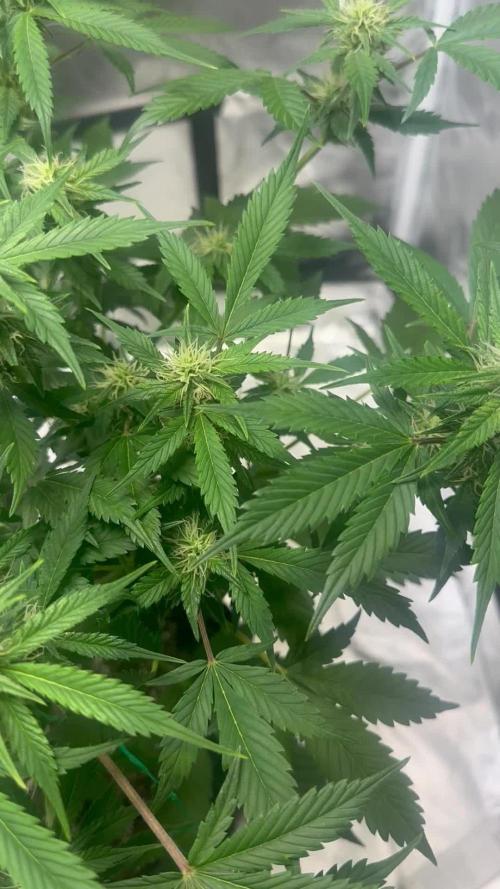
Top dressed with Dr Earth Flower Girl. Slowly but steadily removing foliage and undergrowth. Watering about every 3-4 days. Smelling good.
Backing off on the LST for no reason other than than laziness.