


Likes
Comments
Share

@I_T_C_R_W___GROW
Follow
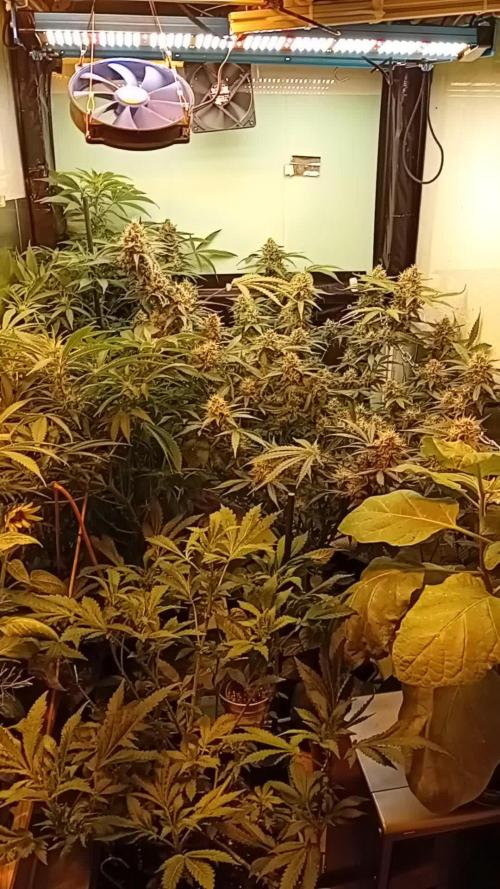
Rotated the plants 180° to separate some buds on the other side.
Last defoil and waiting...
Some early harvest.

Likes
12
Share


@mikemobes
Follow
I am pleasantly surprised with this grow. This is my second time growing Cream Cookies and my yields have increased by 400%. Cream Cookies #2 was the heaviest yielder coming in at 224.04 grams wet. Coming in at almost a quarter POUND for one plant just makes me grin from ear to ear. Im so extremely happy with how ive been taking care of them. It seems that proper and methodical defoliation is the key to massive yields. Cutting fan leaves which block out a significant portion of the available light to the lower and developing bud sites proved to be a great choice. The plants look a little 'skinny' after defoliation, but the newly exposed bud sites explode into the canopy. Im just so very happy with how everything went.
Haven't smoked yet its curing now, will update in two weeks!

Processing
Likes
26
Share


@Teamdirtbag2
Follow
Plants are going into flower. I took night time pics so you can see them sleep. They are a all looking great. This girl and her sister at the moment is 24 inches. Very nice branching on all three plants. I should defoleate and remove some of the bottom branches now.

Likes
20
Share


@420DeepGrow
Follow
Blue Zushi entra en su recta final con una presencia imponente. Cada rincón del cuarto de cultivo refleja el esfuerzo de estas semanas, y las plantas están en su punto más vistoso hasta ahora.
Los cogollos han alcanzado un nivel de compactación sobresaliente. Se sienten duros al tacto, pesados y llenos de resina. La capa de tricomas es densa y opaca, como una escarcha blanca que lo cubre todo. El característico tono azul se ha intensificado al máximo, sobre todo en las hojas cercanas a las puntas, creando un contraste visual que parece sacado de una postal.
La nutrición sigue igual: XpertNutrients como base y Sticky Fingers como potenciador de resina, que no ha dejado de sorprender. En esta fase, la acumulación de terpenos se hace evidente: los aromas son más penetrantes, complejos y embriagadores. El perfil se define con notas cítricas más dulces, casi caramelizadas, sobre un fondo kush cremoso y ligeramente especiado.
La iluminación con Adlite sigue marcando la diferencia. La densidad de cogollos incluso en zonas menos expuestas lo confirma. La distribución de la luz ha permitido un desarrollo muy equilibrado de toda la planta.
Las condiciones ambientales se han mantenido estables, lo que ha permitido evitar cualquier estrés: temperaturas entre 22 y 24 °C y una humedad que ya se empieza a bajar ligeramente, en torno al 45-50%, para prepararnos de cara al final.
El ambiente está cargado de aroma, intenso y agradable, pero también indica que se acerca el momento decisivo. La mayoría de los tricomas están ya lechosos y muchos comienzan a teñirse de ámbar. La planta pide calma, pero ya deja entrever que la cosecha está muy cerca.
Una joya que está casi lista para brillar al máximo.
¡Últimos pasos antes del gran final! ✨
Seguimos creciendo fuerte! 💪
Likes
3
Share


@Vincent420
Follow
Всем ку!! Сегодня нам 35 дней - прошла ровно неделя после последних фото. Продолжаю загибать, хочется подметить кустистость растения, также склоняюсь к тому, чтобы вечером перевести на цвет, подстричь ее (в пределах разумного) и подгибать только главные колы.

Likes
4
Share


@2x2UkGrow420
Follow
9weeks and 4 days seed to harvest, 125g dry weight👊🏻 Banging straight after a dry 💯 white ash, gonna be killa when had a good cure😎😤


Likes
32
Share


@AsNoriu
Follow
Day 64. All is good, one Mimoza ( off course biggest ) didn't liked new house ... Maybe after this one she will bounce back. The rest of the girls are going, think it's 10 days max left for two smallest plant in a week few more will be ready, the rest - around the floor .... Too croudy, no love, hope extra lightning will hurry them up, . I'll have Mars SP3000 soon to add.
Gave full feed today, other two waterings will be plain water.
Some selective defoliation here and there ...
Day 69. Second day after few girls went outdoors. I need more light, but I will get it in a week only.
Happy Growing !!!


Likes
15
Share


@mrbigbong
Follow
very well, fragrant and resinous buds, it doesn't miss much anymore. I use co2 tablets on the hottest days.
Very happy and satisfied 👽😎





Likes
36
Share


@Suemchen
Follow
Sanlight evo at 100%
Day 71: Looks really good 👍 a couple of days now and then darkness 🤙 giving No water now...
Day 73: well, that's IT🤗 The Journey Has come to an end.... 😢 Today I turned off the lights, sprayed purolyt. She will get 48 hours of darkness and then cut and hung..

Likes
2
Share

@BasedBuds_89
Follow
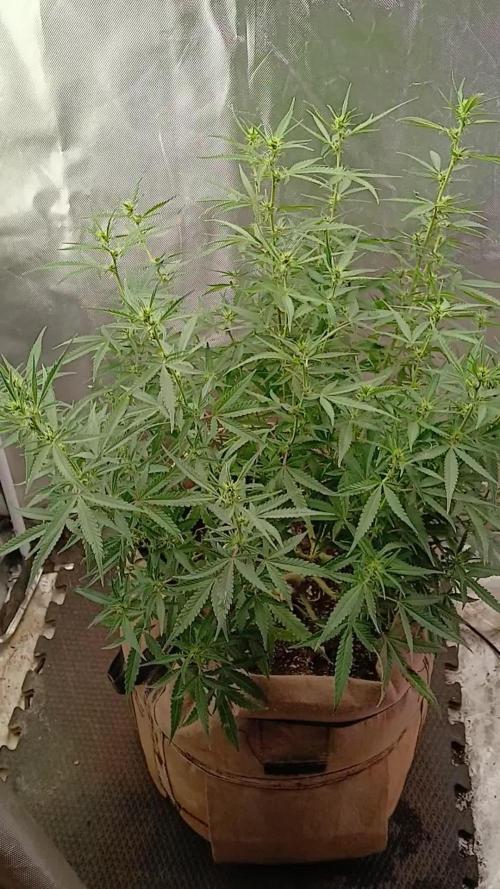
Had an awesome week, she finished her final stretch and now ill focus on one final defoliation and lollipop to redirect energy to buds.

Likes
7
Share


@Sunstonedgrows
Follow
Came in well and has officially sprouted! I put it in soil and the hanging pot I'll be using for this grow. It's a small ~.5 or less gallon pot (tbh not 100% sure), thay I'm reusing from a plant I got at a nursery a while back.
I thought it'd be neat to try and grow a hanging weed plant so now here we go! Will post when the sprout comes out

Likes
16
Share


@Rando1314
Follow
I’m quite surprised as to how well these girls are looking and smelling!! They’re quality genetics but i also believe every strain will provide pros and cons during the grow. This one particularity has been quite the learning experience. Cannabis is quite the resilient plant and I definitely like growing them. As far as this week goes they’re definitely producing more trichomes and resin glands and appears there’s no more stretch from the plant. No more new growth even small amounts hidden within the canopy. I did a little flush earlier this week and it made the tips of what fan leaves turn yellowish so it def means we’re getting close to the end. Prob got another 2 weeks before I fully flush for Atleast a week then pulling them down. The trichs will be the ultimate deciding factor. I’ll pull when i see the first sign as I like more of a heady high than a couch-lock with little to none clear. Well till next week y’all happy growin and hopefully ya had a good thanksgiving
Likes
21
Share


@Bluemels
Follow
Nachdem die Cookie Gelato etwas stärker gerochen hat, ist nun etwas milder geworden.
Aber vielleicht liegt es auch den Wind den wir in letzter Zeit hier haben 😯
Processing
Likes
47
Share


@rhodes68
Follow
10/21 Day 23
Well may be seeing some improvement on Brandy and Maggie from the drench and mag foliar spray. Will spray again tomorrow.
Layla is just lovely and holding off another day on watering, temps have lowered and humidity is up so drying is slow.
Just dont get it but I have decided to go full Coco coir from here on, something aint right
10/22 Fed Layla
Big Bloom 3tsp - Fish Mix 1tsp - CalMag 1tsp - Recharge 0.5tsp - Fish Sh!t 0.5tsp / Gal at 6.5 ph for 0.5 gal
Brandy and Maggie seem to be improving, had to train and gave another foliar spraying nothing else done.
10/24 Update
New Pics - note new growth
Plants beginning to drink more and Maggie showing most improvement. Afraid Brandy will stunt but sure that was going to happen a week ago.
Leaf structure is improving greatly.
Prob will feed in a day or two and another foliar spray at the same time
10/26 Day 28 Finally fed all three girls - nothing much has changed appearance wise and pics tomorrow on new week.
Including initial dose of bloom nuets as hairs are showing strong - no foliar spray until Sunday.
Feeding:
Cal-Mag 5ml - Big bloom 15ml - Fish Mix 5ml - Bio-Bloom 5ml - Fish Sh!t 5ml / gal @6.45 ph for 1 gal (Layla) 0.75 gal (Maggie) 0.5 gal (Brandy) as they are drinking at different rates unfortunately. Final PH is taken after all nuets added, makes a difference.
NOTE:
Since this veg cycle is ending and the plants will be moving to the Flowering tent and this tent will be doing drying duty for the LSD-25 for a few days, time we were getting the Growit Coco coir ready for the Green Crack grow in a week or so. Hydrated the first brick (2 cuft hyd) and am single buffering the coco with 30 ml of cal-mag in four gallons of water for 24 hours.
This will also serve as a safety wash just in case the factory lies :)
Its supposed to be pretty good coco, little if any peat or croutons I can see.
Will do second brick when this one finished and I can store
Looking at using a different system this time around. Hope yall follow along
Went ahead and posted the daily pics of the problem children just for giggles.