


Likes
Comments
Share

@BLAZED
Follow
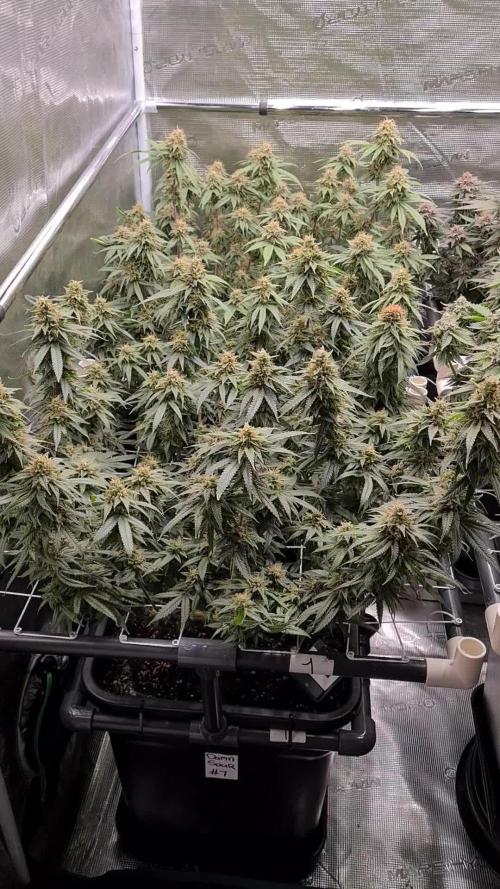
Week 18 (26-5 to 1-6)
26-5
Temps: 19.5 to 24 degrees
Humidity: 44% to 58%
Watering: Both 1000 ml. EC: 1.3
27-5
Temps: 19.8 to 25.9 degrees
Humidity: 48% to 58%
Watering: Both 1000 ml. EC: 0.3
28-5
Temps: 20.4 to 25.9 degrees
Humidity: 49% to 60%
Light set from 75% to 70% strength.
29-5
Temps: 20.5 to 26.2 degrees
Humidity: 52% to 59%
Watering: Both 1000 ml. EC: 0.3
30-5
Temps: 21.8 to 26 degrees
Humidity: 54% to 62%
Watering #1: 1000 ml. #2: 750 ml. EC: 0.3
Light set from 70% to 60% strength.
31-5
Temps: 22.1 to 25.9 degrees
Humidity: 52% to 60%
Watering: Both 1000 ml. EC: 0.0
1-6
Temps: 20.5 to 24.9 degrees
Humidity: 49% to 61%
Watering: Both 1000 ml. EC: 0.0
Will harvest next week!

Likes
14
Share


@GoldenWeedGrower
Follow
D08/V04 - 08/04/23 - Nothing
D09/V05 - 09/04/23 - Nothing
D10/V06 - 10/04/23 - Nutes added EC 0,6
D11/V07 - 11/04/23 - She's ok
D12/V08 - 12/04/23 - New water and some nutes EC 0.6
D13/V09 - 13/04/23 - Nothing
D14/V10 - 14/04/23 - Nothing

Likes
14
Share


@Boilly
Follow
So far pretty fast growing for 2 weeks since start. Had 1 that was over watered but made a easy comeback. Started giving half nutes or less because of size and container size. Will be putting in final pot next week. Also had some cloudy cold weather but the next 2 weeks are looking good so they should really take off as it said 9 weeks to harvest from germination. Happy growing

Likes
52
Share


@SomeLikeItGrow
Follow
Has a big and heavy buds, some branches falling down because of their heavy weights. Perfect strain for the daytime and creative jobs. If you like a clean high daytime this one is definitely for you 😊 Peace and Love to everybody!0

Processing
Likes
70
Share


@CBD_Sweden
Follow
@MephistoGenetics,
Hi all the happy people here in GrowDiaries.
This is my second cultivation ever and it will be fun to try a bigger space than my closet grow.
First, I'm just going to say I'm done with the construction of my new growroom.
The room is 2.14 meters by 1.7 meters and has a ceiling height of 2 meters.
It provides a floor area of 3.6 square meters.
I use a 54 Watt Lightwawe T5 for germination and 2 Pcs 400 Watt HPS lamps.
I have a channel fan that replaces the room air about 40 times an hour to get a comfortable environment in the room, the air enters a fresh air intake from the outside.
The air is purified through a carbon filter to then leave the room to the rest of the basement.
Then I use that heat to heat the rest of the basement.
I will use 10 pcs 15 liter Autopots to grow with and a 100 liter water tank that supplies the pots of water and nutrition.
I will grow completely organically in soil and will watercure my buds to get the best possible medicine for me.
But there are no cultivation rooms to be displayed here, so I continue with what is most important.
Today I have put my seeds in paper towel and hope the seeds have germinated within a few days.
I am very excited to see how the new growroom will work and how this Illuminauto 21 - Sour Crinkle will turn out.
Illuminauto 21 - Sour Crinkle (Grape Crinkle x Sour Crack)
Two of our fastest and frostiest varieties collide to make a sweet and sour delight!
Expect super frosty, compact nugs that won't be a toke for novices.
Destined to be a great strain for extraction work too!
Plant size - Small - Medium
Cycle time - 60-65 days from sprout
Indica/Sativa - 80/20
Frost level - Extra Ridiculous
https://www.mephistogenetics.com/product-page/illuminauto-21-sour-crinkle
.................................................................................................................................................................................................................................................................................................................................................
2017-08-21. Started to germinate the seed.
.....................................................................................................................................................................................................................................................................................................................................................
2017-08-23. Seed germinated and put in small pot in the humidity dome.
.........................................................................................................................................................................................................................................................................................................................................................
2017-08-27. Slow and steady she grows.
---------------------------------------------------------------------------------------------------------------------------------------------------------------------------------------
2017-08-28. Transplanted in 15 liter autopot. Check the roots on this girl
-----------------------------------------------------------------------------------------------------
2017-08-29. New movie of the girl.
-------------------------------------------------------------------------------------------------------------------------------------------------------------------------------------------------------------
2017-08-29.
Hello to you who read my diary, I just want to say that I am pleased that you have chosen to check in with me and in my diary.
I just want to say that I do this for myself and for a steady flow of my medicine.
Everything you read and see in my diary is 100% honest and I will never distort or beautify anything here.
I document my crops so that I can learn from my mistakes and also to look back at those different crops.
I try to update with pictures every day and with text if something special has happened in the garden.
This is my strainhunt for the best medicine and the beginning of my journey with cannabis and the cultivation of it.
-----------------------------------------------------------------------------------------------------------------------------------------------------------------------
2017-08-30. Cleaned the room this morning, just vacuuming and cleaning with chlorine solution. Im testing the fan to control temp and humidity, it works great.
Added some pics and a movie. Everything is looking great right now.
-------------------------------------------------------------------------------------------------------------------------------------------------------------------------------
2017-08-31. 3 new pics.
---------------------------------------------------------------------------------------------------
2017-09-01. New pics and a video from the grow room today.
------------------------------------------------------------------------
2017-09-02. New pic.
----------------------------------------------
2017-09-03. New video from this morning.
---------------------------------------------------------------------
2017-09-04. Week 2 starts now, new pics.
-----------------------------------------------------------------------------------------------------------------------------------------
2017-09-05. KL 08.00. Cleaned the room this morning, just vacuuming and cleaning with chlorine solution.
KL 12.00. The girl got 2 liters of water with nutes in it, added a video.
---------------------------------------------------------------------------------------------------------------------------
2017-09-06. KL 08.00. The girls woke up after their beauty sleep, the leaves are always a bit down after 6 h of darkness, but they will stretch now when the HPS lamp starts.
Everything looks good and I keep trying to tuck the leaves so they get the maximum amount of light where needed. Added pics and video.
--------------------------------------------------------------------------------------------------------------------------------------------------------
2017-09-07. Day 17 from sprouting. I have never tested PH in my grows, when growing organic in soil iv learned that it adapt PH by it self. But im curious by nature so i had to test.
Kl 10.00 Tested PH in the soil, it was 6.9 and tested my tap water and it was 6.8. Added video of the girl.
Kl 22.30. New pics.
------------------------------------------------------------------------------------------------------------------
2017-09-08 KL 08.00. Good morning, added new video.
2017-09-08. Kl 23.50. Gave every girl 3 liters of water and nutes, added new video.
------------------------------------------------------------------------------------
2017-09-09. Kl 21.00. Defoliated a lot and added pics.
-----------------------------------------------------------------
2017-09-10. Kl 08.00. Last day of week 2. New video.
2017-09-10. Kl 23.00. 3 new videos.


Likes
12
Share


@Jays_Not_Here_Man
Follow
The ladies have rebounded very nicely. They are filling in the scrog nicely. Did a lot of tucking and bending of tops and leaves this week. The stretch during flower for these ladies is real. Even with the bending and tucking, the girls have easily gained 4 inches this week as well as quite a bit of girth as they bushes out.
Temps have been good and RH has been steady between 55-60%. I have good airflow all around and don’t worry too much about it he higher RH at this point in the grow.
I’m e seen some incredible phenos of this strain, and can’t wait to see what I’ll get! Happy Gardening Growmie’s 🇨🇦👊❤️

Likes
28
Share


@GodZilla_Owner
Follow
We are at the beginning of the 9th week of flowering. The trichomes are slowly beginning to change color.
I'm now going on vacation for 9 days, I couldn't have planned it any shittier. But anyway, I've decided to keep them growing and then probably harvest them straight after my vacation.


Likes
28
Share

@GodZilla_Owner
Follow
I was on vacation for 9 days, unfortunately I discovered some budrot on the S.A.D. despite the dehumidifier and air conditioning. It is probably also due to the fact that the flowers are extremely compact and hard. It is of course on the side facing away from the fan. It shows once again how important good air circulation is.
Apart from that, it has not been fertilized for a week and has only been watered with tap water. The plants have not had any water for 5 days and are on the verge of drying out.
The harvest will take place in the next few days. I will report further.
Likes
10
Share


@DeepRootsGrowTrees
Follow
ROYAL QUEEN CBG AUTO
ROYAL QUEEN SEEDS
Week #4 overall
Week #3 Veg
This week she really took off stretched along with side growth she's doing well in the organic soil and with the FOOP nutrient line. This strain is great for cancer patients as far dealing with symptoms and not getting the high.
Stay Growing!!
ROYAL QUEEN CBG AUTO
Likes
37
Share


@DaddyPrime2
Follow
6/3/24
These genetics really chunk up.
I may have to harvest everything early. Luckily the autos in my tent are close to being done. They could be chopped now without much issue.
My whole tent system went out for about 8 hours and My humidity was 75 and my Temps were 73. I really hope everything is ok but that is a possible
6/5/24 she's still plumping up alot. She's going through water almost too fast now. Not giving anything but water and slf100 for a week or

Likes
150
Share


@Budz_Bunny
Follow
Week 4: Continued Growth and Training
Hello dear Weed friends,
welcome to my fourth weekly report on my exciting grow with four different strains: Lemon Gelato, Orange Sherbert, Apple Fritter and Bruce Banner.
This week I learned a lot and continued to care for and promote my plants.
I took the following steps:
I applied LST (Low Stress Training) to all plants to improve their shape and let more light reach the lower branches.
I topped the Apple Fritter several times, as it grows the fastest . I hope that this will result in many thick buds.
I topped the other three strains only on the main stem to allow them more side branches.
The plants look good, even though I sometimes doubt whether I am doing everything right. But I am confident that they will be even stronger and more beautiful in 1-2 weeks.
My next goal is to repot the plants in larger pots in 2 weeks and attach a net in the tent. This should help me distribute the plants evenly and use the space optimally. I also want to avoid having such a mess in the tent as last time. That made harvesting very difficult.
Another highlight this week was buying a new lamp: the Lumatek 300 Watt Pro Edition. This lamp is simply fantastic! It has a great illumination, a high efficiency and a cool look. It looks like a UFO! I am very happy with this investment and gave my old lamp to my brother. So it stays in the family.
I water my plants as needed with 1 liter of water each, to which I add 100 percent of the recommended fertilizer schedule. I use all options of the fertilizer, which you can read in the fertilizer directory.
I would also like to show you my timelapse video that I have been making since the first week. The video shows you how my plants have changed from week to week. It is really impressive to see how they have grown. I will update the video every four weeks and show you the latest video.
I hope you enjoyed my report and are looking forward to the next weeks. See you soon!


Likes
10
Share


@Growbody
Follow
Hallo und herzlich Willkommen zu einem etwas anderen Gropwbericht. Die Blueberry Zkittlez Automatic von Sensi Seeds (der Strain heißt jetzt Blueberry Candiez Automatic) hatte ich letztes Jahr bereits angebaut und war vom Geschmack total begeistert. Deshalb baue ich den jetzt wieder an und dazu die Blueberry Automatic von Zamnesia Seeds, die schon einige Zeit in meiner Samenbank liegt. Mal sehen, wie sich die Pflanzen unterscheiden.
Die URL der Blueberry Automatic von Zamnesia Seeds:
https://www.zamnesia.com/de/3323-zamnesia-seeds-blueberry-automatic-feminisiert.html
Die URL der Blueberry Zkittlez Automatic von Sensi Seeds:
https://sensiseeds.com/de/research/blueberry-candiez-automatic
Beide Strains erhalten die gleichen Bedingungen. Beide stehen in einem 9 Liter doppellagigen Stofftopf von ROOTIES (ChillWelten war der Vorgänger der Firma, heute heissen alle ROOTIES), beide haben die Sonnenerde Bio Hanferde und bekommen und später gibt's noch eine Mulchschicht mit Sonnenerde Bio Faser. Beide haben am Anfang eine Bioledex mit 10W im gleichen Abstand.
Tag 70: Die Blueberry Auto von Zamnesia Seeds hat Spinnmilben bekommen und wird sicherheitshalber separiert. Da waren wohl nicht genügend Raubmilben in den 2 Packungen und die Florfliegenlarven hätten das eigentlich auch verhindern müssen.
Tag 70: Die Blueberry Zkittlez Automatic von Sensi Seeds hat Blattläuse bekommen und wird sicherheitshalber separiert.
Schau mal wieder rein, wenn es dir gefallen hat. Schönes Adventwochenende und bleibt friedlich und humorvoll. ✋😎

Likes
10
Share


@nonick123
Follow
Día 35 (10/06) N/A
Día 36 (11/06) Se va a quedar un pequeño gran cogollo porque ya se ha detenido el strecht
Día 37 (12/06) N/A
Día 38 (13/06) Avanza la floración para estas pequeñas
Día 39 (14/06) Riego 150 ml de H20 pH 6,5
Día 40 (15/06) N/A
Día 41 (16/06) 500 ml de Té de Floración con Healthy Harvest 8 ml/L + Insect Frass 16 ml/L + Melaza 1 ml/L
💦Nutrients by Lurpe Solutions - www.lurpenaturalsolutions.com
🌱Substrate PRO-MIX HP BACILLUS + MYCORRHIZAE - www.pthorticulture.com/en/products/pro-mix-hp-biostimulant-plus-mycorrhizae
Likes
12
Share


@Willy_Balls
Follow
First week of flowering.
Girls are super happy. And drink a lot. I very much prefer the lower plant count with 8 plants. And I’m probably not going to go back to more than 9 plants. Perhaps will even try 6 or 7. 12 or 16 was a bit of overkill. Maybe with super short veg it has its place.
26.01 first day of flower.


Likes
3
Share


@SgtDoofy
Follow
Aug 28
So close to harvest time. Smell is getting super strong. Not many amber trichomes on the colas closest to the lights yet, telling me that it needs a little more time to cook. Otherwise the trichomes look to be cloudying up.



Likes
42
Share


@Only4passion
Follow
Day23 today I increased the power of the light at 600w 🤩
I took the seek gorilla melon out finally haven’t recover 😢
Day 24 I topped the Two gorilla melon and two of the papaya sherbet 🍀✌️
Day27 all good 👌
All guava auto’s enter in flowering stage first pistil are showing 😎
Processing
Likes
20
Share


@Speezy
Follow
I think I'm off to a good start. This is the roughest part of a grow for me so far. One thing that I learned from my past killings was to not get obsessive and that's the approach. I've got a way better understanding of feeding now. I was confused about feeding charts, thinking that it was mix and feed.
Even though I checked the PH and PPM (incorrectly a few times) I'd consistently fry my plants to near death, bring them back with plain, proper ph'd water and then re-fry the next feeding. It hadn't dawned on me that the nutrient mix while being in the optimal PH range, mixed in right order and correct measurements, my PPM/EC was way too high for the stage of the plant. Yikes, I was feeding a toddler 3 double Whoppers with extra everything. And XL fries.
You burn and learn I guess. The little girl was starting to look hungry so I took a shot and fed light nutrients with some hydrogen peroxide (will update the chart soon getting sleepy). I also punched a lot more holes in the bottom of the solo cup. Few hours later her leaves perked up like she was giving me a high five. Leaves are looking good too with a PPM of about 211. It's going to be a warmer weekend so I figure I'll crack another seed and put my 5 gallon pot to use. Possibly a photoperiod?
Likes
6
Share


@CryptAnon
Follow
Week 7 flower - buds are fattening this week and smell is very strong. Two distinct phenos. I suspect a bit of nutrient burn so dialed back ec to 2.1-2.2.
