


Likes
Comments
Share

@Z420Organics
Follow
🔥 Kannabia Grow Update 🔥
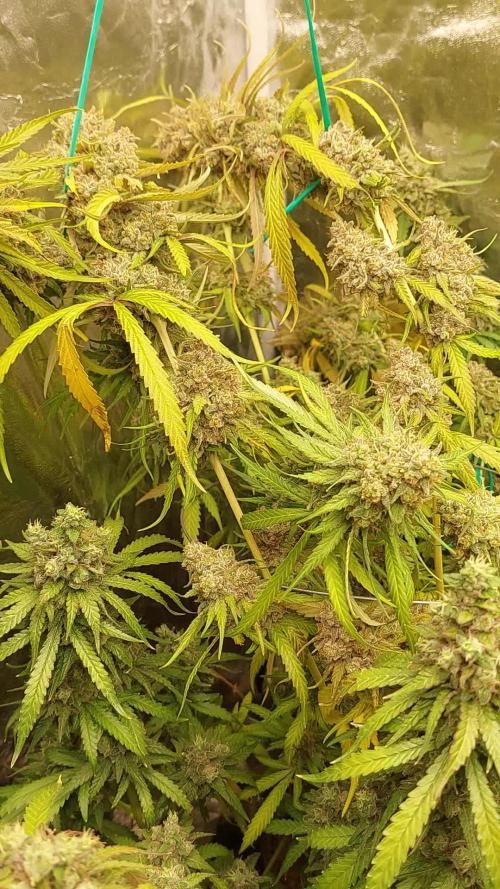
The plants are starting to show their beautiful colors! 🌈
They’re ripening perfectly — trichomes are now mostly milky, sparkling under the light ✨
We’re officially in the final stretch! ⏳
Can’t wait to see how these beauties finish — it’s harvest season vibes! 🌿💚



Likes
48
Share


@Northern_Ent
Follow
Aug 3: woohoo week two of flowering. Plant is definitely flowering and looks to be on its way to a strong finish. Very excited for this one and it looks very promising.
Group pic is Cheese in front, Gelato, Gorilla Cookies, and Bruce Banner. Last two are 16 cola manifolds, and the front two are 8 colas.
Aug 5: video shows use of 730 nm far red light as a bloom booster. A few seconds at dusk is all it takes. I use Civil Twilight as listed on timeanddate.com for my latitude each night. Currently getting 2 minutes earlier each night.
The far red light at dusk, at the same point in the light cycle each night, causes the plant to go into dark mode about two hours faster. It’s like getting an extra two hours of darkness in a 26 h day. Works indoors and on autos too. Moves up flowering by about 3-4 weeks here. Don’t miss a night and keep it at the same relative time each night. This is sometimes called phyto-forcing. Easier than moving the plants into the garage each night.
Aug 6: foliar spray of potassium silicate and Extreme Blend done in early evening. Plants drink a lot when it is hot and they’re this big and have been watering twice a day lately.
Aug 7: did another round of compost tea this morning.
Aug 9: defoliated the understory to improve airflow and remove shaded bits. Mostly fan leaves and popcorn bud sites with a few small branches that were growing in towards the centre.

Likes
7
Share

@Mannirumpel420
Follow
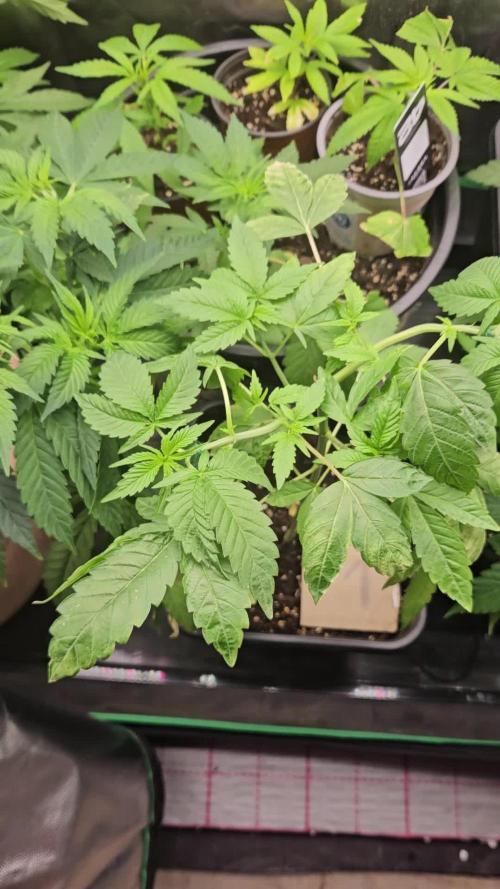
Ich habe sorgen,dass aufgrund ihrer Größe p2 und p3 Schwierigkeiten in der blüte haben werden.Sie könnten in der stretch Phase zu nah an die lampe,deswegen binde ich sie stark herunter und schaue,dass wenn der Topf trocken ist und die wurzeln etwas weiter gewachsen sind, ich sie in die Blüte schicke.
Ich habe von jeder Pflanze einen steckling genommen und zum Glück ist jeder angewurzelt,sodass ich die Genetik sicher habe.


Likes
9
Share


@Kindbot
Follow
The second plant did not respond nearly as well to some drought stress tests.
We use it for comparison.
Consider this an experiment in stunted growth due to damage in early veg.


Processing
Likes
27
Share


@ROM101
Follow
One more week of feeding then flush. Will give more detail in each tester diary in their harvest week. This girl is about 2 weeks away.

Likes
14
Share

@DogDoctorOfficial
Follow
GMO Cookies Served with Extra Curiosity ?🍪
Drying & Trimming Report | Garlic, Gold & Preservation
And once again… yes 😄
We are dividing the reports.
At this point it almost became tradition.
But honestly, there is simply no realistic way to fit:
* harvest,
* drying,
* trimming,
* curing,
* smoke review,
* fresh frozen,
* washing,
* strain review,
* extraction plans,
* terpene analysis,
* and all the small details we love documenting…
into one single update without turning everything into chaos.
So first of all:
thank you for the patience.
Everything from seed until harvest was already documented in the previous reports, but for the people arriving only now, let’s quickly recap how we got here.
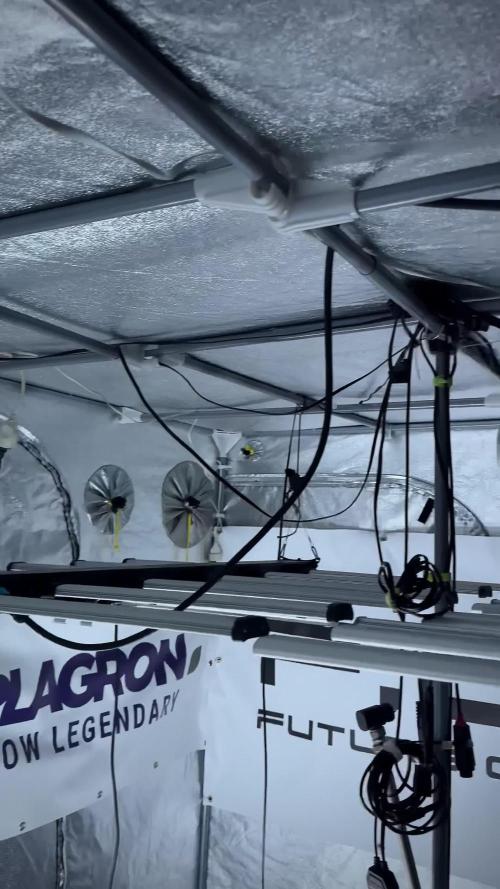
This GMO Cookies run was grown under a 12/12 from seed cycle using the F.O.G. LED setup, with environmental management focused on healthy plant development, airflow, structure, and resin production. Throughout flower the girls received selective defoliation, LST, continuous observation, and careful feeding while expressing one of the loudest terpene profiles we have had in the room in a while.
And now?
Now the plants have moved beyond harvest and entered one of the most important phases of all:
preservation.
Because growing beautiful flowers means very little if drying and trimming are rushed afterward.
So this report belongs to:
* drying,
* trimming,
* handling,
* preserving terpenes,
* collecting resin,
* and slowly preparing the medicine for cure.
The branches that were selected for drying spent approximately:
* 10 days drying,
* around 60% humidity,
* temperatures between 18–20°C,
with the first couple of days running slightly drier in order to help remove excess surface moisture before stabilizing the environment more carefully.
And honestly?
The aromas coming from these flowers during drying were absolutely ridiculous.
Now, to be completely honest and transparent:
these were not the densest flowers from the tent.
Visually they actually looked denser while still wet than they ended up feeling after drying.
But what they lacked slightly in density…
they completely compensated for in aroma, terpene expression, flavor potential, resin behavior, and overall personality.
And honestly, that trade-off is something many growers happily accept.
Because this GMO profile is LOUD.
Like…
walk-into-a-kitchen loud.
Real GMO lovers will understand this instantly.
Every trimming session felt like sitting next to a chef smashing fresh garlic cloves directly beside us.
Savory.
Greasy.
Funky.
Sharp.
Warm.
Almost oily-smelling.
And hidden underneath all that madness:
sweetness,
cookie notes,
earthiness,
and weird creamy undertones slowly revealing themselves as the flowers cured further.
This is not a shy cultivar.
Not even close.
Once the drying process finished, it was finally time to trim.
So:
gloves on.
Trim station ready.
Trim bin prepared.
Scissors cleaned.
Glass jars nearby.
Grove Bags prepared.
And of course…
little self-medication beforehand 😄
Because trimming sessions and cannabis culture somehow always belonged together naturally.
The branches were broken down carefully by hand, one by one, and every flower was trimmed individually with patience instead of speed.
As always, we used pointed curved trimming scissors.
And honestly, they are fantastic for this type of flower structure.
Especially with fluffier or more open flowers, curved pointed scissors allow you to:
* enter tighter spaces,
* remove excess leaf material precisely,
* preserve flower structure,
* avoid crushing calyxes,
* and maintain a more natural-looking final product.
Straight scissors work perfectly fine too of course, but for this type of trimming, curved points genuinely feel more comfortable and surgical.
And with GMO?
You quickly realize precision matters.
Because these flowers become sticky almost immediately.
The scissors start collecting resin.
The gloves become greasy.
Finger hash starts forming naturally.
And suddenly trimming stops being just “work” and starts becoming part of the experience itself.
The first dried branches gave us:
137.1 grams.
After trimming and weighing, the flowers were carefully transferred into Grove Bags, with smaller amounts also resting inside glass jars for comparison and monitoring during cure.
Then we moved onto the flowers dried on the drying rack.
Again:
not the densest plant from the tent.
And honestly, we believe temperatures played a role there.
This cultivar appeared slightly more sensitive to higher temperatures than some of the others around her. Our personal feeling is that she continued pulling significant water during flower development, which likely contributed to the final structure remaining slightly more open once dry weight settled.
But despite that?
The quality remained absolutely beautiful.
Sometimes growers become overly obsessed with density alone.
But density is not everything.
Aromatic expression,
resin quality,
effect,
smoothness,
flavor,
and terpene complexity matter just as much — sometimes even more.
And this GMO absolutely shines there.
The second drying batch landed at:
224.2 grams.
Again carefully bagged for preservation.
And speaking of preservation:
we decided to use Grove Bags for most of the flower storage.
Why?
Because preserving terpenes matters deeply to us.
Especially with a cultivar this expressive.
The idea behind Grove Bags is maintaining stable curing conditions while reducing the constant need to burp jars manually. They help regulate humidity exchange while still allowing the flowers to continue stabilizing naturally over time.
Of course, glass jars still remain legendary and we still use them too.
Honestly?
Both methods have their place.
And later during cure and smoke review, we will probably compare the differences more deeply.
But for now, the priority is simple:
protect the terpenes.
Protect the medicine.
Protect the work.
Now let’s talk about something we personally love a lot:
the “gold.”
Or what many people simply call:
kief.
During trimming, tiny trichome heads naturally separated and fell through the trim bin screen.
And honestly… watching that happen never gets old.
At one point we jokingly started “playing the drums” Moroccan style across the trim bin while working, moving material gently across the screen and collecting the resin heads gathering underneath.
And the result?
Beautiful golden powder.
Tiny greasy trichome heads.
Pure aromatic dust from the plant itself.
Eventually we pressed part of it together gently using finger warmth and pressure, creating a tiny mini temple ball.
Small.
Dark.
Sticky.
Greasy.
Beautiful.
The type of resin that already tells you:
“This plant is going to wash beautifully later.”
And yes…
that curiosity is still alive and stronger than ever.
Because despite everything already documented here, we still have:
more than 700 grams of fresh frozen flower material waiting patiently inside the freezer.
That future report is still coming.
And honestly?
We are incredibly excited for it.
But there is no rush.
That material is preserved safely and waiting for the right moment to become:
* ice water hash,
* solventless resin,
* or whatever expression this GMO decides to offer us later.
For now, this chapter belongs to drying, trimming, preservation, and preparation.
Before ending this report, one more important thing:
cleaning.
Once trimming was finished and the room slowly emptied, it was time to clean everything thoroughly and prepare the environment for future runs.
And honestly, this part matters far more than many growers realize.
Between runs we strongly believe in:
* deep cleaning,
* sanitizing surfaces,
* cleaning fans,
* sterilizing tools,
* removing plant residue,
* using UVC if available,
* using ionizers or environmental tools carefully,
* and resetting the room properly.
Because prevention is always easier than fighting problems later.
A clean room protects future harvests.
And after a run like this?
The room deserved a respectful reset.
Now next week?
Next week we finally move deeper into:
* curing,
* smoke review,
* terpene evolution,
* flavor,
* effects,
* smoothness,
* strain review,
* and our true thoughts about GMO Cookies after spending months with this cultivar from seed until cure.
And honestly…
we cannot wait.
Before ending, as always:
Thank you.
To Zamnesia.
To F.O.G.
To Plagron.
To Lumiflora.
To Grove Bags.
To the platform.
To the community.
To the growers sharing knowledge.
To the hash makers.
To the flower lovers.
To the silent supporters.
To the curious people following this strange garlic-filled adventure 😄
To everyone spending even a few moments here with us.
This GMO Cookies run truly was served with extra curiosity.
And honestly?
That curiosity still hasn’t disappeared yet. 🌱
📲 Don’t forget to Subscribe and follow me on Instagram and YouTube @DogDoctorOfficial for exclusive content, real-time updates, and behind-the-scenes magic.
GrowDiaries Journal: https://growdiaries.com/grower/dogdoctorofficial
Instagram: https://www.instagram.com/dogdoctorofficial/
YouTube: https://www.youtube.com/@dogdoctorofficial Deleted by Youtube - https://www.youtube.com/@TheDogDoctorOfficial NEW
Vimeo : https://vimeo.com/dogdoctorofficial Under construction stay tuned ⸻
Explore the Gear that Powers My Grow
If you’re curious about the tech I’m using, check out these links:
🔆 Lighting & Environmental Control
• Future of Grow — Advanced LED lighting technology
https://www.futureofgrow.com/
DISCOUNT CODE: DOG20
• Lumiflora — Under-canopy LED lighting
https://lumiflorade.com/
• TrollMaster — Environmental controllers and automation gear (past collaboration)
⸻
Genetics
• Zamnesia Seeds — Genetics used in this project
https://www.zamnesia.com/
⸻
🌱 Soil, Substrates, Boosters & Root Support
• Plagron — Substrates, bio mixes, and supportive products
https://plagron.com/en/
⸻
🎒 Storage, Curing & Preservation
• Grove Bags — Curing and storage solutions
https://grovebags.com/
⸻
📸 Photography Equipment & Tools
(Not sponsors, but part of my creative toolkit)
• Sony A6700
• Sony full-frame macro lens + few more
• Stacking photography workflow - learning
• iPhone (for behind-the-scenes shots)
As always, this is shared for educational purposes, aiming to spread understanding and appreciation for this plant. Let’s celebrate it responsibly and continue to learn and grow together.
With true love comes happiness. Always believe in yourself, and always do things expecting nothing and with an open heart. Be a giver, and the universe will give back in ways you could never imagine.
💚 Growers love to all 💚
📸 P.S. – The Eye Behind the Lens
All photos in this diary (for now — except for the ones showing the camera, which I took with an iPhone) are taken with a Sony A6700 paired with a Sony full-frame macro lens and a few more.
Photography is part of the story — it’s how we share the fine textures, the glow, and the quiet details that words can’t always capture.
I’ve also started experimenting with photo stacking — a technique where multiple images, each taken at a slightly different focus point, are layered together to create one perfectly sharp image from front to back.
It’s not digital enhancement or AI; it’s pure photography — a way to reveal the plant’s beauty in microscopic depth, from trichome to petal.
You’ll even see a few shots of "ghost me" capturing the shots — camera, lens, setup — because every grow deserves not just to be cultivated, but documented like art.
FOR DISCOUNT CODES AND MORE JUST FOLLOW THE LINK https://website.beacons.ai/dogdoctorofficial
NEW DISCORD - Official Server Invite Link : https://discord.gg/ksjAkA5T74
Likes
9
Share


@mangodalat
Follow
CAFE RACER
22/4---->13/8
Everything was fine until week 4 when i brought her to my garden. The changing environment slowed her down.
Week 7 starts to appear preflower.
Streching lasts for 3 weeks(streching x2)
Week 4 of bloom starts to smell ( weak)
Week 7-8 of bloom: rains a lot so the humidity is high so i harvested her by week 8 of bloom.
I have moldy buds(about 5g).
THANKS FOR WATCHING THIS DIARY. SEE YOU THE NEXT DIARY.

Likes
4
Share


@Chuckwaggon420
Follow
This clone smells killer omg hash plant/christmas/sweet/heavy skunk. It smells killer and is a decent resin coverage it looks like coming in early like this in week 3 in flower. It filled in the 18"x 24" space i had open just perfect.
She gets a heavy feed of canna nutrients @ ph of 5.6-5.7. I think staying on higher side of nutrients and back off if I see burn has been doing good on chimera run and don't tend to b hurting this clone either so full steam ahead!
Much changes coming for me new flower tent is going to help alot!
Stay up everyone
Happy boxing day all u Canadians!
Processing
Likes
5
Share


Likes
3
Share


Muy buena cepa, potente, productora y fácil de cultivar. El efecto fue exactamente lo que buscaba; intenté curar la yerba lo mejor que pude para poder preservar los terpenos y así disfrutar aún más. Cepa recomendada😄

Likes
7
Share


Likes
6
Share


@Arcadium
Follow
Another cold wet week. Witnessed the spiderlings band together for a few days, web making at night. Then one day the wind picked up and they all disbanded, stretched out their silk and flew away all over my yard. It was such an incredible experience to watch! I should have an army of Orb weavers come flower time.
Did another top dress of compost mixed with 70/30 Gaia Green AP/PB, maybe 20Tbsp. When I pulled back the mulch I got to see all the soil creatures and roots consuming the material, this really does help build extra root zone over time.
Minor defoliating, I'm keeping nodes 1, removing 2 and final top at 3 (next week) to keep her spaced, then let her stretch and trellis. Should all help fill in the canopy.

Likes
11
Share


@MaestroBud
Follow
Despite starting a week later than the others, Acapulco Gold filled the gap thanks to its natural genetic strength. Clear sativa structure, long-fingered leaves, slightly more spaced internodes, but with excellent reactivity to pruning.
VPD: 1.2
EC solution: 1.45 mS/cm
Daytime temperature: 28.3°C
💧 Fertigation:
Uniform hydration on 40 L of BioBizz All-Mix substrate with pre-switch mycorrhizal treatment (Extreme Mykos + Carboload). Sensizym and Rhino Skin in metabolic support.
🧠 Notes:
Some leaves show marginal yellowing, corrected with the calibrated insertion of Cal-Mag.
The plant expands very homogeneously, ready to receive active floral stimulators starting from mid-week.
🔧 Objective: control of the stretch, shade management in the lower part with direct ventilation and completion of the last 10% of the SCROG network.

Likes
21
Share


@Felloffthegrid420
Follow
made some tea out Original Concentrate
Nature'🙌s Living Soil add 6 tablespoons to half of 5 gal bucket of spring water stringht out the good old mountain 😷💪🙏👌


Likes
19
Share


@eldruida_lamota
Follow
Que pasa familia, perdonar por la tardanza pero aquí estamos de nuevo y es que traemos la 6 semana de floración de nuestras gorillas.
No veas que aroma que empiezan a desprender , es increíble.
Son plantas con forma indica y follaje sativa, floración rápida unas semanas más y ya están listas para cortar.
Ph controlado, 7 semana prepárate lavado raíces y solo agua, que lo agradecerán.

