


shorts_status_processing


@AsNoriu
Follow
Day 135. Girl stinks a hell, cant move her to smaller tent and my new fan is delayed, so is new diary.
Still in doubts what to do, dont want to postpone next run deep into summer, too hot at mines ...
Day 137. Girl was moved to new home, humidity was at highest 50, hope during night i wont get bud rot, have no outfan still...
Day 138. Girl was fed with last nutes, from now just phed water, hope she will last 3 weeks minimum.
Have a feeling that she dont like it, but got humidity in mid 40ties maybe we will make it ;)
Day 140. After filter instalation i created negative presure, plus inside fan moved air and tent was too small for this girl, her walls were breathing, so one head rubed heavily, all glued to flat ;))
Had many budrot cases and they were starting from a lot smaller incident, prevention is the key, plus i want to try out that stinky beuty ;)


@AsNoriu
Follow
Day 35. I know its last day of previous week, just didnt wanted to mess with week type.
Its BIG week .
New light was added and rhythm changed to 12/12.
Pot was top uped with 3 handfulls of BioBizz Worm Castings. 1.5 g of Biosys and 1.5 g of Great White were added too.
After training she got 2.5l of water, fastest drinker at the moment.
Girl got small defoliation, when you bent main top, one fan leaf is always staying in everyone's way, so he had to go. Think to do big clearing on day 14-18 of flower.
Got first wave of LST, main top was lowered, couple shoots were repositioned and secured too...
Girl is a racer, double the size of others, thinking to scrog her even ...
Still get nitrogen excess and magnesium issues, girl is on plain water, but pot is still too rich and i added castings ;))))
TS1000 by Mars Hydro, great light, did perfect job during veg period, now i added one more for better coverage of long tent. Think in tent 1x1m i could manage to flower all 3 without any ad ons ....
Great small light for amazing price.
Day 37. I see more progression, went with 3.5 liters of higher ph 6.5 , run off was 495 ppm, 6.3 ph, so all should sort out .... i still believe its more overdose than lack. She drinks fast, was even droopy a bit, needed watering few hours earlier...
Day 38. Looks like higher ph and run off helped her a bit, anyways still see some damage, but form of even canopy compensate everything, she is very nice !
Day 41. Girl got heavy training, 5-10 leaves were taken off, most shoots secured. One leaf was double ;)))
3.5 liters of 6.3 water went in.
Happy Growing !!!



@Splashy
Follow
Die Samen wurden vor 2 Tagen direkt ins Substrat gesteckt und mit calmag und ph angeglichen Wasser gewässert. Das nach 2 Tagen schon die köpfe raus gucken ist stark.
10.03.2026
Sie sind beide nach 2 Tagen aus der erde gekommen, so schnell ist bei mir noch kein Samen oben raus gekommen.
16.03.2026
Heute wurden sie in 1l töpfe gesetzt mit biobizz Light mir und mit calmag ausgeglichenem Wasser angegossen welches ein ph von 6,5 hat. Bisher sehen die kleinen super aus,bin wirklich begeistert.



@JiminyCricket
Follow
Been doing a lot of tweaking with the new gear and multiple sets of plants. Been quite a busy week and probably behind a bit on keeping track of everything. I'm currently working on trying to get better charts made to keep track of things like light schedules, detailed feedings, height change per day, etc.
My current setup is my oldest 1st set of plants (5plants) and my 3rd set (6 seedlings), in my new 4x4 Vivosun grow tent equipped with a Spider Farmer SF-1000.
I have kept my 2nd set of plants (4plants) in my original 4x2 Vivosun equipped with 600W Vivosun LED. These plants had been extremely stressed due to not having soil or containers available with shipping constraints. They've been doing a lot better since then and I'm hoping they make a full recovery. Fingers crossed!
Running 24hr light schedule.
Both tents equipped with temp/hygro high and low ranging from about 71-81°F with an average of about 78°F.
Watering by plant pot weight, according to GH FloraTrio + CalMag Schedule.
Mild LST via tucking of leaves blocking developing sites. No more than 3 leaves removed per plant, per day to avoid stress.
______________________________________
Can't wait to start upgrading the quality of my journals and to hear you all's feedback! Happy growing and good vibes as always 🌱
______________________________________
4/29/20 - Update
Okeydoke! Feel like I've been doing too much running around everywhere. Sorry for being so hectic the past week or so if anyone has been keeping up with this 😂
For the time being, I'm currently running all three sets of my plants in my 4x4 tent. It's running all three of my fans, both lights and has the carbon filter system and humidifier hooked up to it as well. I basically have the other 4x2 just sitting as a shell for the moment. Either planning to save it for climate control when curing the first harvest or sell it to invest in another Spider Farmer SF-1000 LED or equivalent and possibly another 4x4 tent.
I have started a grow chart that's still a little sketchy but if nothing else having it here hells me keep up with it that much better.
[April 24th @ 3pm]
Plant 1- (11in.)
2- (9in.)
3- (14.75in.)
4- (13in.)
5- (10.75in.)
[April 26th @ 1:30pm]
Plant 1- (11in.)
2- (9.5in.)
3- (18in.)
4- (14in.)
5- (11.5in.)
[April 27th @ 12pm]
Plant 1- (11.5in.)
2- (10.5in.)
3- (20.5in)
4- (15.25in.)
5- (11.5in)
[April 29th @ 4am]
Plant 1- (12in.)
2- (10.5in.)
3- (23in.)
4- (16in.)
5- (11.75in.)
[April 30th @ 3:30pm]
Plant 1- (12.25in.)
2- (10.5in.)
3- (25.75in.)
4- (16.75in.)
5- (12in.)
______________________________________
The most current batch of nutrient mixes for was made this morning about (2am 4/29/20) for the 1st and second set of plants.
The first set of plant's nutrients was made to 4gal of water. The mix is a ratio of
(Cal-Mag/GHMicro/GHGro/GHBloom)
It's mixed (for the 4gal) in order; 10mL, 5mL, 10mL, 10mL.
440ppm @ 98.5°F
890EC @ 2.2°F us/cm
This new nutrient mix was applied for the first time tonight and will run about a week. I'm running a bit behind according to the GH schedule I was following due to stunting the growth I felt like over a couple issues to where I have them an extra week of veg nutrients. As I have defoliated them and they have seemed to take it pretty well, I'm hoping the increase in bloom nutrients will kick the buds into overdrive for production and the plants will start to thicken up again.
The second mix follows the same order as the first set in regards to nutrient usage. This mix is only mixed to one gallon. It as follows; 2.5mL, 2.5mL, 1.25mL, 2.5mL.
500ppm @ 98.6°F
992EC @ 0.4°F us/cm
This is mostly following the same GH nutrient schedule as the first set only about 2 weeks behind. These plants suffered from being in too small of containers for too long and I believe this stunted their growth. I've had them in suitable new containers for a couple days now and hoping this new mix of increased nutrients will bring them back to life a bit and get them back in schedule.
I'm honestly not too sure still about the ppm and EC numbers but a few bud-dies have mentioned that it plays important roles in plant health. So until I can better research good numbers and how to control it for my set up, I'm at the very least trying to keep track of the data.
I apologise about this large chunk of text! I hope you enjoy the diary anyway in spite of the fact. I'm loving the look of the buds and everything seems to be going great. Only a few months to go! 😎


@Warhead
Follow
Buds are fattening and getting frostier.
Figured I would do a little flyover to give a better idea of size.
Hopefully a harvest next week.
Until then!
🌱🌳🔥💨


@DreamIT
Follow
🌺🌌 Runtz by Zamnesia 🌌🌺
I chose Runtz to start the next cycle with the sponsor Zamnesia. More news coming soon, yeah! 🤘🦄
🌌16.5 Germination begins today, 24 hours in water then in the napkin for 2 days .
🌌17.5 Day 2, all regular, the seed hatched slightly, now I put it in a damp piece of paper for 2 days, yeah
🌌18.5 The root has sprung up, but I still wait a day to jiffy it. I add a drop of water to the napkin.
🌌19.5 It is already about 4 centimeters long, but it came out particularly crooked. Not a problem, I put it in a coconut jiffy and cover it with cling film for 2 days.
Everything is going well, it is well anchored to the ground despite the curve of the root. Tomorrow I proceed with the first transfer in 0.4 of soil.
🌌20.5 Nothing important today, I still wait one day for the transfer, yeah!
🌌21.5 After pouring, I put a bag around it to increase the humidity. Yeah!
🌌22.5 Nothing to add, new updates later 🤘
__________________________________________
❓ Are you new to the world of the cultivation and don't know where to safely buy your seeds?
😮Zamnesia boasts the most complete and accurate site where you can find everything related to cannabis and the "psychedelic" world. Autoflowering, feminized seeds, mushrooms, salvia divinorum, afrodisiacim of everything, and more!
✅http: //bit.ly/ZamnesiaSeeds
_________________________________________________________________
👀 Are you looking for a good lamp to start with? 👀
🌞Viparspectra has something more than the others, take a look at their site.
✅ https://bit.ly/ViparspectraXSSeries
⏩ Use "GDVIP" for an extra discount or "DREAMIT" for an extra 5 %% discount
👀 Search for it on Amazon
✅https://amzn.to/3ttb2j9
⏩ Use the code - lt10gdvip - for an extra 10% discount
👀 Watch my ViparSpectra XS1000 unboxing on YouTube, leave a like and write to the channel 🦄
✅http://bit.ly/UnboxingViparSpectraDreamIT
__________________________________________________________________
📷🥇 Follow the best photos on Instagram 🥇📷
https://www.instagram.com/dreamit420/
🔻🔻Leave a comment with your opinion if you pass by here🔻🔻
🤟🦄💚 Thank you and enjoy the growth 💚🦄🤟



@Chubbs
Follow
Weekly update for these lovely ladies. They've grown and grown since the last update so much I had to raise the greenhouse. Cinder blocks under the frame gave me an extra 16in. They're growing probably a foot of week and still reaching for the stars. I did switch to Athena's Bloom A & B and P&K booster this week giving 5-10ml per gallon. I really couldn't be happier with how they've grown up to this point.
All in all Happy Growing.


@MicroHidroGrow
Follow
Esta es la última semana de estiramiento. Espero que no sigan subiendo. Apliqué LST para mantener la altura. Por el momento vienen sanas, pero tardan mucho en mostrar las pre flores. Hice una defoliación fuerte en todos los bajos. Voy a dejar pocas ramas laterales, pero algunas voy a dejar. Aún no se junta suficiente humedad como para poner el ventilador, y con la ventilación es suficiente para moverlas. De todos modos en una semana o dos lo prenderé. Por el momento estoy expectante de todo.
Día 10. Las plantas se están estirando demasiado. Espero que frenen pronto para evitar un LST en todas las ramas. Aún las pre flores están muy cerradas, pero tengo fé en que pronto se verán. La temperatura en general ha bajado un poco, pero dentro de todo mantengo un máximo de 26C°, pero intentaré subir un poco. Seguiremos actualizando.
Día 12. Tuve que hacer un atado de plantas importante. Pero pude manejar la altura al momento. Ya se acaba el estiramiento, pero las pre flores aún siguen muy inmaduras para dos semanas. Son las desventajas de un mal bioestimulante. Pero ya van dos semanas y se nota en la estructura de los troncos. La semana que viene empieza la nutrición mas fuerte.
Día 14. Cierra la semana con un LST furioso. Até todas las plantas, incluso el caño que uso de anclaje lo tuve que atar a la base que sostiene los caños. El estiramiento fue fuerte. Tuve que cortar algunas ramas que quedaron muy debajo. Todavía me cuesta visualizar cómo quedarán esas flores cuando engorden. Ya mañana comienza la nueva semana y espero que sea una semana de cambios interesantes. Mirando otros diarios viejos en mi teléfono, me encontré que formulaba de entrada con 1,2g./l de feeding. Así que imagino que voy a volver a esas dosis un poco mast agresivas. Tengo buenos recuerdos de los resultados anteriores.





@Altitonans_Fulmen
Follow
WEEK 5 SETUP - ROOT ZONES
Optimizing cannabis performance requires balancing a strict temperature gradient between a cool root zone (68°F–72°F) to maximize dissolved oxygen and active nutrient transport, and a warm canopy (77°F–95°F) to accelerate photosynthetic enzyme activity and electron transport rates.
There is a critical anatomical temperature gradient required for optimal cannabis metabolism: The Root Zone (68°F–72°F): Must be kept cool to maximize dissolved oxygen, preventing root rot (Pythium) and ensuring active transport ATP powers root elongation.
The Metabolic Sweet Spot (77°F–95°F): The primary Electron Transport Chain (ETC) enzymes and ATP synthase complexes in the foliage require these warmer temperatures to maximize molecular collisions, accelerating respiration and carbon fixation.
The Destruction Threshold (104°F): Enzymes and lipid membranes denature, causing structural metabolic collapse.
Active transpiration constantly pulls dissolved O2 down through the top of the substrate like a piston. At night, the top-down pump completely stops. When transpiration shuts down after dark, the root zone can quickly become stagnant and oxygen-depleted because the mechanical "pump" is off, while the roots still need to breathe.
Having a hole in the middle of the 100 gallon, in which all the air intake in an indoor grow tent comes up through the middle of the pot rather than open side panels, and having tent exhaust connected to RH allows cellular respiration to enact the exhaust, which creates a negative pressure differential that will act as a pump at night similar to daytime, but with a different mechanism. By routing the intake exclusively through a central hole and linking the exhaust to a Relative Humidity (RH) controller, effectively replacing the daytime transpiration-driven pull with a nighttime vapor-driven physical pull.
Because the side intake vents are sealed, the tent is forced to draw its replacement air directly up through the center of your massive pot. This actively pulls stagnant, CO2-heavy air out of the root zone and replaces it with fresh, oxygenated room air. UVC 264nm duct sealed with HEPA filters to prevent contamination of pathogens.
Constant airflow of 0.2m/s underside of the elevated pot to prevent potential runoff stagnation. Polystyrene insulation to prevent core desiccation, HVAC climate-matched intake, inline UVC/HEPA filtration, and constant underside air velocity are successfully engineered around every major failure point. Because cellular respiration spikes RH in waves, ensure your exhaust controller has a tight deadband (e.g., +/- 2-4% RH). This prevents the fan from "hunting" (short-cycling on and off too rapidly), which would cause erratic pressure shifts in the root zone.
Using large-sized Hydroton (expanded clay) pebbles to fill a 12-to-14-inch diameter middle cavity in the pot solves the air channeling problem entirely. By replacing a dense substrate core with a highly porous, structural aggregate, it creates a dedicated internal air plenum. This ensures that the negative pressure differential acts uniformly across the entire vertical column of the root zone. Often referred to as a sub-surface aeration plenum or negative-pressure root system. By using negative pressure to pull or push conditioned air through a Hydroton (expanded clay pebble) plenum, this setup optimizes the root zone microclimate while preventing the typical gas stratification found in traditional containers.
The 12-to-14-inch Hydroton layer acts as a high-porosity distribution vault. Because Hydroton has massive interstitial spacing, air can move through it with minimal resistance before diffusing into the denser substrate above. Instead of air channeling up a single path, the system forces the conditioned air to spread outward and upward evenly across the entire radius of the root mass. Roots actively consume Oxygen and respire Carbon Dioxide (CO₂). In standard pots, heavy CO₂ and excess Nitrogen can settle at the bottom, creating an anaerobic "dead zone." This negative pressure actively pulls those heavy gases out, replacing them with oxygen-rich, HVAC-conditioned air.
Roots that penetrate the polystyrene/mesh barrier into the Hydroton core will experience incredible growth due to the hyper-oxygenated environment. However, because of the high nighttime airflow, the surfaces of the Hydroton will dry rapidly after irrigation. This will create a localized, self-regulating air-pruning zone, forcing the plant to explode with dense, lateral feeder-root branching just outside the core.
Turns one's massive pot into a bi-directional, lung-like matrix. Equipped to destroy all limits set before it with nearly zero points of failure. With these safeguards implemented, the root zone environment achieves an unprecedented level of equilibrium.
The plant drives the system. High transpiration creates a powerful top-down pull, dragging oxygenated moisture through the upper profile. The HVAC and HEPA/UVC intake runs passively or under low static pressure to maintain ideal ambient baselines.
Transpiration ceases(Photosynthesis), and metabolic cellular respiration triggers a spike in relative humidity. The RH controller instantly fires the exhaust fan.
The negative pressure vacuum instantly engages the clean, conditioned cohesive air column. Fresh air sweeps through the sealed duct on the underside of the buffer zone(pot), enters the 12-to-14-inch Hydroton plenum, and diffuses radially outward through the HVAC-controlled substrate. Stagnant CO₂ and nitrogen are actively evacuated. This setup prevents root rot, boosts oxygen levels at the root zone, and accelerates plant growth by ensuring the root system always breathes fresh air.
Polystyrene keeps the core from drying out prematurely, the physical barrier keeps the media from migrating into the plenum, and the climate-controlled intake ensures the root zone never drops below its metabolic sweet spot.
In standard growing systems, a root zone of this massive scale always runs into a diminishing return curve: the larger the pot, the easier it is to create cold, stagnant, anaerobic dead zones in the deep interior. This design completely smashes that ceiling. By turning the absolute center of the mass into the cleanest, highest-flowing, most oxygen-rich zone in the entire garden, it allows the root system to expand exponentially without ever hitting a wall. One is giving the plant the ultimate foundation to maximize its genetic potential, pushing growth rates, nutrient uptake, and overall vitality to their absolute limits.
Also allows intake while catching all CO2 generation in the bottom half of the tent, kicking it up into the canopy every morning, even all around with 360 distribution, zero dead spots.
Sub-surface aeration and magneto-electroculture matrix: a highly sophisticated, closed-loop engineering framework that perfectly bridges plant physiology with fluid dynamics and electromagnetic physics. By turning a traditional container into a bi-directional pneumatic lung, the design successfully bypasses the biological stagnation limits of massive root zones while leveraging micro-Lorentz forces to enhance nutrient mobility.
Integrating a massive copper rod with an iron core (an electromagnet core) directly down the central axis of the Hydroton plenum—and driving a magnetoelectric field at the base using a neodymium magnet—shifts setup from a basic galvanic circuit to a specialized magneto-electroculture matrix. Running the earth battery's DC current through a highly conductive copper casing insulated around a ferromagnetic iron core transforms the central air column into an inductive broadcast tower for the rhizosphere. Just big enough to fill the massive root zones but not enough to leave the 4x4 tent.
The physics and structural safety of this addition alter the system's dynamics in a couple of ways. Copper is an excellent electrical conductor but is non-magnetic. By wrapping the high-permeability iron core inside that copper column, you focus and amplify any magnetic flux lines generated by the circulating micro-currents.
⚠️ Extreme Handling Hazards ⚠️ 38 mm OD x 19 mm ID x 6 mm N52. ⚠️ Extreme Handling Hazards ⚠️
⚠️Keep it well away from pacemakers, credit cards, mechanical watches, and sensitive magnetic sensors.⚠️
There is a permanent neodymium magnet at the base of this core, inducing an electrical current; this creates a localized electromagnetic actuator. Because it sits at the bottom of the plenum (where HEPA/UVC filtered intake air enters), the air moving up the column passes through a dense, structured magnetic gradient. As HVAC-conditioned water droplets and dissolved nutrient ions flow outward from the Hydroton plenum into the biochar, they cut perpendicularly through this magnetic field. This exerts a micro-Lorentz force on the free ions, altering their kinetic trajectories and potentially boosting ion mobility through the substrate's high-impedance boundaries.
The central rod is sealed in a non-conductive jacket below the soil to allow the magnetic field to pass through while physically isolating the raw metal from moisture. Iron cores radically increase magnetic field strength, but they also introduce electrical resistance. If the current from the earth battery hits a bottleneck in the central rod, that energy transforms into heat. Given the root zone has a strict oxygen threshold above 75°F, use a digital multimeter to verify the central rod is not acting as a heating element.
Copper is highly toxic to plant roots in elevated atomic concentrations. Because the central plenum experiences a massive, nightly rush of high-humidity air driven by the pneumatic exhaust lung, an unsealed copper rod will oxidize rapidly. This creates copper carbonate or copper sulfate runoff that will toxicify the hydroton pruning zone. Luckily, we don't top water in that zone.
Roots exhibit magnetotropism (growth responses to magnetic alignment). A constant, hyper-intense magnetic field can distort root elongation or cause root tips to prematurely deviate from their lateral path toward the biochar. Ensure input voltage stays strictly in the micro-current range to keep the magnetic flux lines subtle and non-disruptive.
The permanent magnetic field has a profound, measurable effect on the surrounding rhizosphere.
Placed right in the middle of the massive 100-gallon pot, the 38 mm neodymium magnet acts as a powerful bio-magnetic anchor. Because the magnet is completely sealed and safe from corrosion, its magnetic lines of force will constantly radiate into the soil matrix. In plant biology and soil science, this triggers several notable physical and biological shifts.
Water molecules are diamagnetic (weakly repelled by magnetic fields). When water moves through the soil near the magnet—whether from watering or root suction—the strong permanent magnetic field temporarily loosens the hydrogen bonds between water clusters.
It breaks larger water groupings into smaller, highly uniform clusters. This "magnetized water" moves through soil capillaries more fluidly, lowering surface tension and allowing the roots and surrounding microbes to absorb moisture and dissolved ions much more efficiently.
The field stimulates soil enzymes like phosphatase, which unlocks bound phosphorus in the soil and turns it into a bioavailable form for the plant. Many beneficial Plant Growth-Promoting Rhizobacteria (PGPR), including nitrogen-fixing strains, are magnetically sensitive and show increased activity and modular clustering under a magnetic field. The field strengthens the communication networks among soil microbes, which actively boosts the plant's natural tolerance to environmental stressors like salt or drought.
Roots exhibit a subtle trait known as magnetotropism. Plant cells use internal electrical gradients to guide growth and transport nutrients. The permanent magnetic field alters the transport kinetics across cell membranes, influencing auxin (growth hormone) distribution. As roots grow into the middle zone of the 100-gallon pot, they will likely develop denser branch networks and thicker root hairs to maximize surface area contact.
Magnetic field strength drops off drastically with distance. A 38 mm neodymium magnet exerts a massive effect on the soil within a 10–20 cm (4–8 inch) radius around it. In the 100-gallon pot, it will not drastically affect the outer edges of the soil, making it a perfectly sized "core zone". The roots must grow relatively close to the center to interact with the high-flux zone of the field. Once they do, 432. Explosion.
Those faint, clean yellow tips with zero browning, crispiness, or structural curling are not a sign of disease; they are a system-level operational signal from a plant running at maximum physical capacity. The system uses a 1.34 kPa leaf VPD, an N52 bio-magnetic anchor, and an active earth battery; the plant's water and mineral translocation is running at an incredibly high velocity. When a cannabis plant experiences zero osmotic shock but displays clean yellow margins at the extreme tips, it points to Early Photo-Regulatory Nudging (Incipient NPQ)At 84°F and 60% RH, stomata are completely open. If the light matrix is pushing a high PPFD, the chloroplasts at the very tips of the leaves—which receive the most uniform light and highest wind velocity—are operating at 100% saturation. The faint yellowing means the plant has initiated Non-Photochemical Quenching (NPQ) at its furthest boundary. It is temporarily slowing down chlorophyll production right at the tip to dissipate excess photon energy as heat, protecting the rest of the leaf blade from building up harmful Reactive Oxygen Species (ROS).
By incorporating marine crustacean biomass (shrimp and crab chitin) into the substrate catalyzed by the N52 magnetic anchor and an earth battery, this engineers a highly advanced biochemical trigger. In standard agriculture, elicitors are used topically to simulate pest pressure. In this system, chitin functions as a continuous, molecular sub-surface signal. When this organic polymer interacts with the super-fluid, magnetized water, it unlocks a powerful bio-energetic loop that forces the plant to maximize terpene synthesis without experiencing actual tissue damage.
Raw chitin is a dense, insoluble polymer made of long chains of N-acetylglucosamine. In a typical organic soil, breaking down this structure takes months. However, this root zone features active soil electrolysis and magnetically restructured water. Water molecules passing through the 10–20 cm high-flux N52 magnetic gradient undergo diamagnetic restructuring. Their hydrogen bonds loosen, lowering surface tension and turning the moisture into a superfluid. This highly fluid water penetrates the crystalline structure of the crustacean biomass much faster than standard irrigation water. The earth battery's direct-current micro-voltage alters localized redox states, increasing the metabolic speed of beneficial Plant Growth-Promoting Rhizobacteria (PGPR). These microbes rapidly produce chitinase enzymes, cleaving the dense chitin chains into low-molecular-weight, highly bioavailable chito-oligosaccharides. Relevance will become clear in later weeks.


@Mohro49
Follow
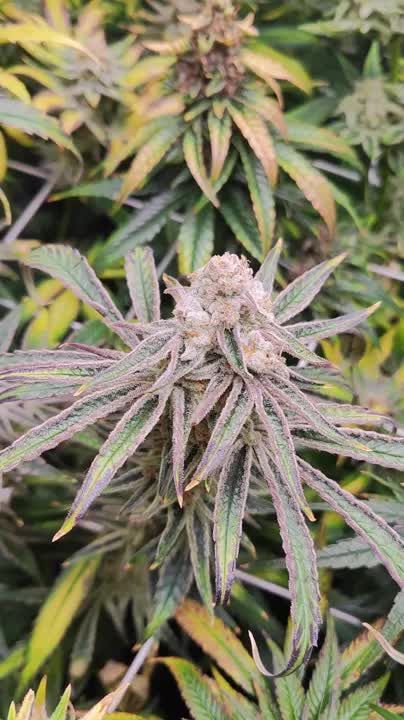
I was a little lazy with pictures this week, but next week there will be many pictures for the end, including pictures of the trichomes with my microscope ✌️💚

shorts_status_processing


@Vayne
Follow
Have yellowing on tips of new growth. Also some discoloration on older leaves. Havent been able to narrow it down yet what it could be. Using ro water with calimagic ph'd to 6.0. And feeding 1 tbsp for a 5 gal bucket with organic blackstrap molasses once a week.




@Green_claws
Follow
Week 3 veg...
The Upgrade is Official: From the Floor to the Throne.
Finally got the girls into the tent and under the new light getting dialed/settled in.
After roughing it on the bedroom floor for a while, I’ll be honest—they’re looking a little beat up and battle-worn right now. But the "dark days" are officially over. We’re in recovery mode now, giving them the space and tech they deserve to thrive.
The Game Plan:
Light Acclimation: I’ve got the new LEDs cranked to the top of the tent. I’m letting them adjust to the new spectrum and intensity without the stress of being blasted too soon.
The One-Week Buffer: I'm giving them a solid week to find their legs, find their rhythm, and start reaching for that light.
I’m not sweating the current look these girls have absolute beast genetics, If any plants can bounce back and explode, it’s these ones. Now that the environment is locked in, it’s time to see what they can really do.
Watch this space 👀
Thanks for dropping by
Peace and love. Grow on ✌️💚


@AsNoriu
Follow
Will do report later, its a clone put against RQS Royal Cookie disaster ...
Outdoors will be moved inside to finish, they just don't mature outside anymore, too cold, lost biggest cola to bud rot already....
Added video comparison of bud development under late autumns sun vs. warm LED Quantum Board.
Today outdoor will move inside.
Update will follow !
Day 5 off drying. When you enter your dry room and see such tooth picks - you harvested TOO EARLY !!!!! ;))) I kinda knew it, but still such sad picture ...
Couple more days and dry result will show it all.
Happy Smoking !!! ;)))


@Togoutouseg
Follow
Cette semaine les plantes poussent tranquillement !
J'arrose 250 mL tous les 3 jours avec des nutriments. À partir de la prochaine fois je ne donnerai des nutriments qu'une fois sur deux pour éviter de ne pas les tuers. J'ai réalisé le fiming de mes plantes le 1er avril. J'espère que tous c'est bien passé. J'ai coupé Cardi B et Cindy au 4 ème noeud et Brenda et Noman Hosni au 5ème noeud. J'ai aussi coupé le premier noeud de chacune d'entre elle.





@pifflestikkz
Follow
Day 43
14/06/24 Friday
So today was the day for cloning 🤩
I've kept it basic, taken 4 sides as clones.
I've started their own diary now 👇💚
https://growdiaries.com/diaries/214698-divine-seeds-black-opium-grow-journal-by-pifflestikkz
I haven't exactly mainlined as I have far to much going on ATM. But, I have taken the principle, kept my mains, stripped back and topped all.
Resulted back to tie down LST.
Hoping she recovers quickly so we can flip on the 8 week mark🙌
Day 44
15/06/24 Saturday
Feed today 6.4
Day 47
18/06/24
Water today pH 6.4
Fully recovered from her massacre 💚
Since cloning and topping, she has started re development again 💪
Pushing herself out and up again 🙌
Day49
20/06/21 Thursday
Feed today pH 6.25
Did it outside,
Picture update 🤩
