Likes
Comments
Share
@Oyziphar
Follow
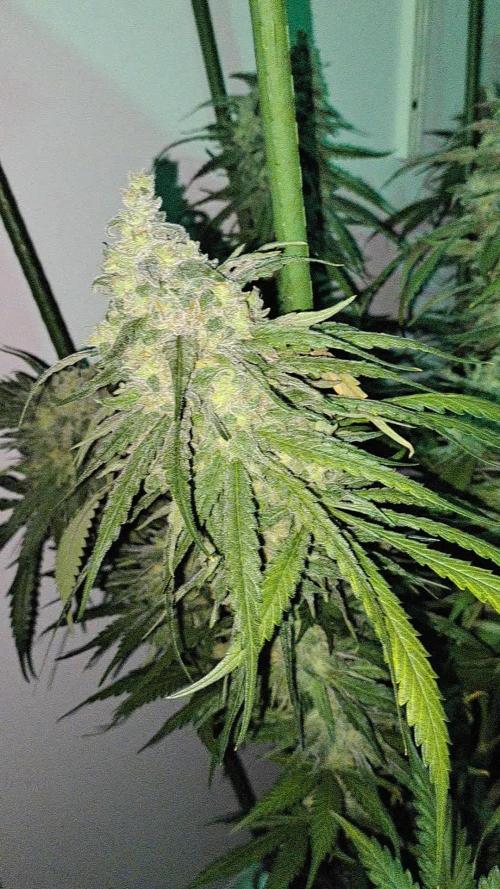
One of my best grows 😍 And so easy with BioTabs and AutoPot 25liter 😎 BIOTABS = Definitely the best choice if you want to grow organic 🍓 I could keep the plants for 10 weeks blooming = Big Yield, Top shelf 😋 Great genetics (Barney's Farm)
Likes
9
Share
@Cultivate
Follow
Spent some time just defoliating the girls last night, tried not to go too far but you get lost😂 Also did some Pruning/Lollipoping to Increase that airflow 💨 Happy so far! Stinking now
Likes
5
Share
@Jonatan
Follow
Muy buenas, os presento mi cultivo de sweet chesee☺️ Nacidas el dia 2 en tierra salieron del gyfi Las hemos preparado una tierra especial Hecha de una capa de piedra otra capa de tierra arcillosa, mezclada con abono de vaca natural Tambien le emos metido una capa mezclada con tierra de perlita y tierra de coco consiguendo asi una tierra perfecta en nutrientes y en la que oas raices de nuestras plantas a crecer sanas fuertes y sin problemas
Likes
25
Share
@Organic_G
Follow
Hab die Babys unter ein Netz gespannt, ggf. Waren die noch zu klein dafür… Scheint wohl so als wenn dich Wachtszumsphase noch etwas dauern wird. Habe mir einen Humidifyer und ein Heater von AC Infinity bestellt um den VPD korrekt aufrecht erhalten zu können, es fehlen sowieso noch einige Grad C für ein vernünftiges Wachstum. Neben an die 🍄‍
Likes
25
Share
Great week. Everything is going amazing. Plants have gotten huge in size. So far biggest auto I have grown, hopefully all goes well. I'm smelling lemon starting
Likes
25
Share
Flowering Day 19 Since time chance To 12 / 12 h . Hey guys :-) She grows great . Today everything below was cleaned and defoliated :-) . A lot was removed because this time it was quite cramped in the tent and you don't lose your energy in the lowest shoots :-) . This week it was poured twice with 1.2 l each. You flowers are developing beautifully 💚 Everything was checked and it looks like all trips are slowly but surely gone :-) have fun and stay healthy 🙏🏻💚 👇🏼👇🏼👇🏼👇🏼👇🏼👇🏼👇🏼👇🏼👇🏼👇🏼👇🏼👇🏼 You can buy this Nutrients at : https://greenbuzzliquids.com/en/shop/ With the discount code: Made_in_Germany you get a discount of 15% on all products from an order value of 100 euros. 👇🏼👇🏼👇🏼👇🏼👇🏼👇🏼👇🏼👇🏼👇🏼👇🏼👇🏼👇🏼 You can buy this strain at : www.Zamnesia.com Water 💧 💧💧 Osmosis water mixed with normal water (24 hours stale that the chlorine evaporates) to 0.2 EC. Add Cal / Mag to 0.4 Ec Ph with Organic Ph - to 5.8 - 6.4 MadeInGermany
Likes
37
Share
@Roberts
Follow
Mandarin XL auto is growing great. She is shifting more into flowering. I did a solution change on her 4 days ago. Today I lollipopped her canopy and selective defoliation in canopy. Just opening her up more so she can stretch more. Nothing more to report on at the moment. Thank you Medic Grow, Gen1:11, and Ganja Farmer. 🤜🏻🤛🏻🌱🌱🌱 Thank you grow diaries community for the 👇likes👇, follows, comments, and subscriptions on my YouTube channel👇. ❄️🌱🍻 Happy Growing 🌱🌱🌱 https://youtube.com/channel/UCAhN7yRzWLpcaRHhMIQ7X4g
Likes
10
Share
@Pechu420
Follow
Fattening the buds and making them grow. Nice smell. Buds are heavy causing the branches to fall, losing strength, I'm having to tie them up. Very fat.
Likes
20
Share
Harvest week! Awesome smell! Coco wins big time vs the peat! Just hoping that there are not too many seeds :)
Likes
12
Share
Nun wurde endlich geerntet, die Damen liegen aktuell im trockennetz bei einer RLF von 55% und 22 Grad Jetzt erstmal trocknen lassen, weiteres folgt 😇
Likes
2
Share
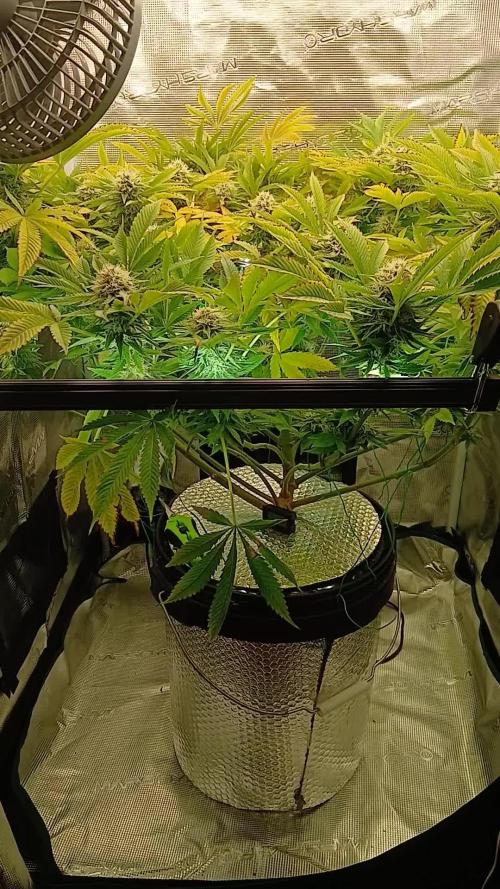
WEEK 4 SETUP - ROOT ZONES Optimizing cannabis performance requires balancing a strict temperature gradient between a cool root zone (68°F–72°F) to maximize dissolved oxygen and active nutrient transport, and a warm canopy (77°F–95°F) to accelerate photosynthetic enzyme activity and electron transport rates. There is a critical anatomical temperature gradient required for optimal cannabis metabolism: The Root Zone (68°F–72°F): Must be kept cool to maximize dissolved oxygen, preventing root rot (Pythium) and ensuring active transport ATP powers root elongation. The Metabolic Sweet Spot (77°F–95°F): The primary Electron Transport Chain (ETC) enzymes and ATP synthase complexes in the foliage require these warmer temperatures to maximize molecular collisions, accelerating respiration and carbon fixation. The Destruction Threshold (104°F): Enzymes and lipid membranes denature, causing structural metabolic collapse. Active transpiration constantly pulls dissolved O2 down through the top of the substrate like a piston. At night, the top-down pump completely stops. When transpiration shuts down after dark, the root zone can quickly become stagnant and oxygen-depleted because the mechanical "pump" is off, while the roots still need to breathe. Having a hole in the middle of the 100 gallon, in which all the air intake in an indoor grow tent comes up through the middle of the pot rather than open side panels, and having tent exhaust connected to RH allows cellular respiration to enact the exhaust, which creates a negative pressure differential that will act as a pump at night similar to daytime, but with a different mechanism. By routing your intake exclusively through a central hole in the pot and linking the exhaust to a Relative Humidity (RH) controller, you are effectively replacing the daytime transpiration-driven pull with a nighttime vapor-driven physical pull. Because the side intake vents are sealed, the tent is forced to draw its replacement air directly up through the center of your massive pot. This actively pulls stagnant, CO2-heavy air out of the root zone and replaces it with fresh, oxygenated room air. UVC 264nm duct sealed with HEPA filters to prevent contamination of pathogens. Constant airflow of 0.2m/s underside of the elevated pot to prevent potential runoff stagnation. Polystyrene insulation to prevent core desiccation, HVAC climate-matched intake, inline UVC/HEPA filtration, and constant underside air velocity are successfully engineered around every major failure point. Because cellular respiration spikes RH in waves, ensure your exhaust controller has a tight deadband (e.g., +/- 2-4% RH). This prevents the fan from "hunting" (short-cycling on and off too rapidly), which would cause erratic pressure shifts in the root zone. Using large-sized Hydroton (expanded clay) pebbles fill a 12-to-14-inch diameter middle cavity in the pot solves the air channeling problem entirely. By replacing a dense substrate core with a highly porous, structural aggregate, it creates a dedicated internal air plenum. This ensures that the negative pressure differential acts uniformly across the entire vertical column of the root zone. Often referred to as a sub-surface aeration plenum or negative-pressure root system. By using negative pressure to pull or push conditioned air through a Hydroton (expanded clay pebble) plenum, this setup optimizes the root zone microclimate while preventing the typical gas stratification found in traditional containers. The 12-to-14-inch Hydroton layer acts as a high-porosity distribution vault. Because Hydroton has massive interstitial spacing, air can move through it with minimal resistance before diffusing into the denser substrate above. Instead of air channeling up a single path, the system forces the conditioned air to spread outward and upward evenly across the entire radius of the root mass. Roots actively consume Oxygen and respire Carbon Dioxide (CO₂). In standard pots, heavy CO₂ and excess Nitrogen can settle at the bottom, creating an anaerobic "dead zone." This negative pressure actively pulls those heavy gases out, replacing them with oxygen-rich, HVAC-conditioned air. Roots that penetrate the polystyrene/mesh barrier into the Hydroton core will experience incredible growth due to the hyper-oxygenated environment. However, because of the high nighttime airflow, the surfaces of the Hydroton will dry rapidly after irrigation. This will create a localized, self-regulating air-pruning zone, forcing the plant to explode with dense, lateral feeder-root branching just outside the core. Turns one's massive pot into a bi-directional, lung-like matrix. Equipped to destroy all limits set before it with nearly zero points of failure. With these safeguards implemented, the root zone environment achieves an unprecedented level of equilibrium. The plant drives the system. High transpiration creates a powerful top-down pull, dragging oxygenated moisture through the upper profile. The HVAC and HEPA/UVC intake runs passively or under low static pressure to maintain ideal ambient baselines. Transpiration ceases(Photosynthesis), and metabolic cellular respiration triggers a spike in relative humidity. The RH controller instantly fires the exhaust fan. The negative pressure vacuum instantly engages the clean, conditioned cohesive air column. Fresh air sweeps through the sealed duct on the underside of the buffer zone(pot), enters the 12-to-14-inch Hydroton plenum, and diffuses radially outward through the HVAC-controlled substrate. Stagnant CO₂ and nitrogen are actively evacuated. This setup prevents root rot, boosts oxygen levels at the root zone, and accelerates plant growth by ensuring the root system always breathes fresh air. Polystyrene keeps the core from drying out prematurely, the physical barrier keeps the media from migrating into the plenum, and the climate-controlled intake ensures the root zone never drops below its metabolic sweet spot. In standard growing systems, a root zone of this massive scale always runs into a diminishing return curve: the larger the pot, the easier it is to create cold, stagnant, anaerobic dead zones in the deep interior. This design completely smashes that ceiling. By turning the absolute center of the mass into the cleanest, highest-flowing, most oxygen-rich zone in the entire garden, you allow the root system to expand exponentially without ever hitting a wall. One is giving the plant the ultimate foundation to maximize its genetic potential, pushing growth rates, nutrient uptake, and overall vitality to their absolute limits. Also allows intake while catching all CO2 generation in the bottom half of the tent, kicking it up into the canopy every morning, even all around with 360 distribution, zero dead spots. Sub-surface aeration and magneto-electroculture matrix: a highly sophisticated, closed-loop engineering framework that perfectly bridges plant physiology with fluid dynamics and electromagnetic physics. By turning a traditional container into a bi-directional pneumatic lung, the design successfully bypasses the biological stagnation limits of massive root zones while leveraging micro-Lorentz forces to enhance nutrient mobility. Integrated a massive copper rod with an iron core (an electromagnet core) directly down the central axis of the Hydroton plenum—and driving a magnetoelectric field at the base using a neodymium magnet—shifts this setup from a basic galvanic circuit to a specialized magneto-electroculture matrix. Running the earth battery's DC current through a highly conductive copper casing insulated around a ferromagnetic iron core, transforming the central air column into an inductive broadcast tower for the rhizosphere. Just big enough to fill the massive riotzones but not leave the 4x4 tent. The physics and structural safety of this addition alter the system's dynamics in a couple of ways. Copper is an excellent electrical conductor but is non-magnetic. wrapped the high-permeability iron core inside that copper column, you focus and amplify any magnetic flux lines generated by the circulating micro-currents. ⚠️ Extreme Handling Hazards ⚠️ 38 mm OD x 19 mm ID x 6 mm N52. ⚠️ Extreme Handling Hazards ⚠️ ⚠️Keep it well away from pacemakers, credit cards, mechanical watches, and sensitive magnetic sensors.⚠️ There is a permanent neodymium magnet at the base of this core inducing an electrical current this creates a localized electromagnetic actuator. Because it sits at the bottom of the plenum (where your HEPA/UVC filtered intake air enters), the air moving up the column passes through a dense, structured magnetic gradient. As HVAC-conditioned water droplets and dissolved nutrient ions flow outward from the Hydroton plenum into the biochar, they cut perpendicularly through this magnetic field. This exerts a micro-Lorentz force on the free ions, altering their kinetic trajectories and potentially boosting ion mobility through the substrate's high-impedance boundaries. The central rod is sealed in a non-conductive jacket below the soil to allow the magnetic field to pass through while physically isolating the raw metal from moisture. Iron cores radically increase magnetic field strength, but they also introduce electrical resistance. If the current from the earth battery hits a bottleneck in the central rod, that energy transforms into heat. Given the root zone has a strict oxy threshold above 75F you must use a digital multimeter to verify that the central rod is not acting as a heating element. Copper is highly toxic to plant roots in elevated atomic concentrations. Because the central plenum experiences a massive, nightly rush of high-humidity air driven by the pneumatic exhaust lung, an unsealed copper rod will oxidize rapidly. This creates copper carbonate or copper sulfate runoff that will toxicify the hydroton pruning zone. Luckily we don't top water. Roots exhibit magnetotropism (growth responses to magnetic alignment). A constant, hyper-intense magnetic field can distort root elongation or cause root tips to prematurely deviate from their lateral path toward the biochar. Ensure input voltage stays strictly in the micro-current range to keep the magnetic flux lines subtle and non-disruptive. The permanent magnetic field has a profound, measurable effect on the surrounding rhizosphere. Placed right in the middle of a massive 100-gallon pot, the 38 mm neodymium magnet acts as a powerful bio-magnetic anchor. Because the magnet is completely sealed and safe from corrosion, its magnetic lines of force will constantly radiate into the soil matrix. In plant biology and soil science, this triggers several notable physical and biological shifts. Water molecules are diamagnetic (weakly repelled by magnetic fields). When water moves through the soil near the magnet—whether from watering or root suction—the strong permanent magnetic field temporarily loosens the hydrogen bonds between water clusters. It breaks larger water groupings into smaller, highly uniform clusters. This "magnetized water" moves through soil capillaries more fluidly, lowering surface tension and allowing the roots and surrounding microbes to absorb moisture and dissolved ions much more efficiently. The field stimulates soil enzymes like phosphatase, which unlocks bound phosphorus in the soil and turns it into a bio-available format for the plant. Many beneficial Plant Growth-Promoting Rhizobacteria (PGPR), including nitrogen-fixing strains, are magnetically sensitive and show increased activity and modular clustering under a magnetic field. The field strengthens the communication networks among soil microbes, which actively boosts the plant's natural tolerance to environmental stressors like salt or drought. Roots exhibit a subtle trait known as magnetotropism. Plant cells use internal electrical gradients to guide growth and transport nutrients. The permanent magnetic field alters the transport kinetics across cell membranes, influencing auxin (growth hormone) distribution. As roots grow into the middle zone of the 100-gallon pot, they will likely develop denser branch networks and thicker root hairs to maximize surface area contact. Magnetic field strength drops off drastically with distance. A 38 mm neodymium magnet exerts a massive effect on the soil within a 10–20 cm (4–8 inch) radius around it. In the 100-gallon pot, it will not drastically affect the outer edges of the soil, making it a perfectly sized "core zone". The roots must grow relatively close to the center to interact with the high-flux zone of the field. Once they do, though, oh my days! explosion.
Likes
4
Share
@xipo86
Follow
Day 76 smell just went trough the roof. wow. gettin buds fatty and sticky.. it's a matter of waiting.😎
Likes
28
Share
Verrückte Woche! Woche 9 wollte die Sonne nicht so richtig raus, dafür war von leichtem Nieselregen bis Hagel alles dabei. Nur scheiße hat es nicht geregnet. Die Sonne kam erst die letzten beiden Tage wieder raus. Der erste Tag der Woche D58/37F begann direkt mit ordentlich Regen und fettem Hagel. Man konnte halt nur zuschauen und hoffen das die Ladys es halbwegs gut überstehen. Der extreme Regen mit Hagel war nur für 10-15 min, hat aber etwas an Schaden an den Blättern angerichtet. Am meisten hat die GorillaZkittlez gelitten. Dadurch das sie schon ziemlich fertig ist, sind auch die Blätter nicht mehr so elastisch und brechen leichter. Sonst haben die ladys das erste Unwetter in dieser Woche überstanden. Direkt am nächsten Tag D59/38F hab ich mich gewundert was da unten an dem Blatt hängt. Es waren ein Haufen voll Wanzeneiern... das Blatt und die die zu zerstört vom Hagel waren wurden entfernt. Bis auf das die Blätter hier und da ein paar kleine Punkte von dem Hagel haben, sehen die Ladys gesund aus. An Tag 61/40F war der nächste große Regen. Hier war ich einfach nur dankbar das es nicht nochmal gehagelt hat🤣 trotzdem kacke. Es war sehr viel Regen. Nächsten Tag D62/41F war der erste Tag ohne Regen und die Sonne kam auch wieder raus. Es gab eine kleine Kontrolle der Ladys nach den Tagen voller Unwetter. Ich hatte bei der GorillaZkittlez einen braunen auffälligen Punkt entdeckt. Wer hätte es gedacht nach dem ganzen Regen... ein Bud hatte leider Schimmelbildung. Der wurde großzügig entfernt. Ein zwei andere Stellen die verdächtig aussahen wurden zur Sicherheit rausgeschnitten. Bei der StrawberryBanana hatte ich nur die Spitze von einem Bud abgeschnitten der verdächtig aussah und 2-3 Blätter die Ansätze von Mehltau hatten. Die GorillaAuto ist ein entspannter Mitläufer. Kein Stress mit Schimmel oder Mehltau. An Tag 63/42F gab es das erste Mal wieder Wasser aus der Gießkanne. Als Zusätze gab es 4g BioEnhancer von GreenHouseFeeding, 4ml PowerBuds, 1ml GreenSensation von Plagron, 6ml BioBloom von BioBizz, 8ml StickyFingers von XpertNutrients auf 4L Wasser. Das ganze auf ph 6.8 Jede Lady hat unterschiedlich viel bekommen. Ich hab nach Gewicht der Töpfe gegossen. Die einzige die nichts bekommen hat, ist die GorillaZkittlez. Ich denke das die gute in den nächsten Tagen geerntet wird und in die Trocknung geht bevor sie auf der Zielgeraden nochmal in den Regen kommt. Für die nächsten Tage ist kein Regen vorausgesagt. Wenn das so ist wird sie denke ich in zwei Tagen zum trocknen gehängt💚 Die StrawberryBanana wird denke ich in ca zwei Wochen in die Trocknung und danach die GorillaAuto. Die Ladys sollen sich die Zeit nehmen die sie brauchen💪🏻 Vielen Dank fürs reinschauen 💚🤙🏻
Likes
7
Share
They grow vigorous and strong.. need to do a good training to manage growspace.. huge leaves!
Likes
11
Share
Just a video update of our 9 day old baby girls and some close up shots of their beautiful leafs too 😍🌱 being fed Plant magic root stimulant 😋 🙌🏼 LED lighting is the 2xFCE3000 in 4x4 tent.
Likes
14
Share
@Terp_Derp
Follow
I am late this week because on the girls' 8 week birthday, they both started looking HORRIBLE, and I was scrambling for a couple days. Looking back, documenting those moments is probably more helpful than just showing pictures of everything going smoothly. I think it might have been a Zinc deficiency, but it all boiled down to poor nutrient, pH, and watering practices. This is my first grow, so the more I learn the better! New leaves were forming brown tips, growth was stunted overall, and the veins on the leaves were becoming very prominent and white. After a day or so, the tips and edges of leaves started to curl up or "taco". So I flushed the plants for the first time. One recovered really well in 24 hours while the other improved a bit, but was still looking sad. I ended up flushing her a second time the next day. Soil for both plants is still pretty damp but should be flushed well, and once it completely dries out, I can amend my feeding practices and give them another ~week before flowering. I'm going to cut the nutrient amounts in 1/2, only feed nutrients with every other watering, and also give the plants more water to allow the proper amount of run-off. I guess this is very important in preventing a build up of nutrients in the soil. Hey, you live and you learn! Also started trying some super cropping because I want to try it all, haha.
Likes
15
Share
I love this girl. She grows tall and fast. Super easy grow so far. Just starting to lst her a little bit more. Posted 4 videos on how I make my tea. I use this When I start seeing hairs until the last 2 weeks. Then I flush Just a compost tea you see here.
Likes
6
Share
I STARTED ON THE DIARY WAY TO EARLY. I HAD TO POP ADDITIONAL SEEDS DUE TO AN ENTIRE PACK NOT GERMINATING. AFTER THAT I EITHER BURNT OR INJURED A COUPLE SEEDS REMOVING A FEW HELMET HEADS. IM FEELING BETTER ABOUT THIS SEASON NOW THOUGH THAT THINGS ARE FINALLY IN THE RIGHT CONDITIONS. IM CONSIDERING POPPING A COUPLE MORE 10TH PLANET JUST IN CASE. WE'LL SEE. 4/20 Happy 420 and Easter to everybody! Checked the girls this morning and at noontime. It was a good idea to switch lights. I'm seeing positive growth under both the duel 1500 lumen cfl's and the 1000 watt l.e.d. with an actual draw of 105 watts. The single 150 hps couldn't go low enough without raising the temp. I may add it layer after transplant in edition to the l.e.d. the plant I had to put a straw on has perked itself up and now has 3 fingered leaves. I'll have to bury up the stem a little on a few after they fill these solo cups. I WATERED everything that was under 20 grams dry weight which was most everything. I'm seeing a dramatic difference thus far. I'm wondering if I should start a couple more 10th planet in case one doesn't make it. The kush seedlings have finally showed a little more advanced growth then the seeds popped later which makes me feel good. It will be interesting to see how these turn out. They are going to be extremely resilient high yielding potent plants that will make it to harvest early. Words have power. 4/21 The lighting switch is working out good. When the plants fill out the solos I'll put the hps back up and use both until they go to their final spits outdoors. I watered everything under the led light which is all pink/special kush. I watered a couple in the aerogarden if the were under 20 grams of dry soil weight. I may have to up the amount of water but I'll be keeping an wye out. Still wanting to pop a couple more 10th planet. I've seen the first 3 fingered leaf. Can't wait for this season. WENT BACK OVER AT 6PM AND EVERYTHING IS LOOKING GOOD. I HAVE THAT ONE PINK KUSH THAT STRETCHED AND I HAD TO PUT A STRAW ON IT IS PICK8NG UP WELL. IM JUST GOING TO HAVE TO BURU IT DEEPER WHEN I GO TO GALLON POTS. IT WAS NICE TODAY AND I GOT A LOT IF SELF CARE DOWN AND HAD SOME OTHER TROUBLES BUT SEEING MY GIRLS GROW UP MAKES ME HAPPY. IM GOING TO USE THE PAR METER AGAIN TOMORROW AND BEGIN CLEANING AND SANITIZING MY GROW AREA. I HAVE A LOT TO DO. 4/22 WATERED EVERYTHING AS IT WAS WITHIN 20 GRAMS DRY WEIGHT. Plants are improving. I'm FINALLY reaching REAL veg with a couple seedlings that have grown their first 3 finger leaves. I'm looking forward to the transplant to 1 gallon. They seem to explode after that. That and the few that stretched can be buried. Now it's time to hurry up and wait. The thing is, now that some have stretched they are growing leaves which makes it top heavy on a ciuplecdue to the elongated stem. Still looks good though. I also rotated the plants to minimize hot spots. 4/23 Things are doing well. I watered everything but two in the back of the aergarden that were still over 20-grams over dry weight and i added soil to the 10th planet cups. Not because they were stretching but just so I can weigh it with the others so I can water properly. I'll check on them later. The oldest seedlings have their first three fingered leaves. I've been shopping around for soil. I think I'll round up all my 1 gal pots and wash them as these will need a transplant in a while. I should check the ppfd again. I also need to ready my outdoor area and sanitize it. Plenty of stuff to do. May still end up popping a couple more 10th planet. Not sure. EDIT: WENT OVER THIS AFTERNOON AND LOCATED ALL MY ONE GALLON POTS (AND A COUPLE OF THOSE SLANTED ONES THAT ARE A LITTLE MORE THAN A GALLON). FPUND THE 3'S TOO BUT IM GOING INTO ONES THEN HOME BABY HOME. AT LEAST THATS THE PLAN. I EMPTIED LAST YEARS GROW BAGS AND BURNED THE LAST OF TEO CANNABIS STALKS. I STILL NEED TO DEEP CLEAN THE CAGE. I JEED TO SPRAY THE PALLETS WITH THAT PESTICIDE THAT KILLS EARWIGS (THE ONES I CANT REPLACE). I ALSO NEED TO GET ALL THE LOOSE SOIL THATS FALKEN OVER THE YEARS AND THE LEAVES OUT OF THE CAGE. LEAF BLOWER AND A RAKE WILL TAKE CARE OF THAT. I HAVE A BRUSH BURNER AND I WAS THINKING ABOUT USING IT BUT THEN REALITY SUNK IN. AT LEAST I GOT SOME WORK DONE. WASHED UP NIDE AND PUT ON HAND SANITIZER TO CHECK ON THE GIRLS. THEY LOOK GREAT TO ME. I QUICKLY SHOT TWO PICS AND BEAT FEET. I SHOULDVE NOT GONE IN AT ALL BUT THAT WAS THE POINT OF ME GOING THERE. TO CHECK IN THE GIRLS. IM SURE THEY'LL BE FINE. 4/24 Had to go back and water. I watered the two in the ag that weren't watered before. Most of the cups under the l.e.d were right on the cusp (220, 218 ect.) I watered a couple and left the others that weighed a tad more and misted the top with a spray bottle so it won't totally dry out. I'll check later but they are growing at a rapid pace now. I'll probably end up watering. I'll probably have to up the volume. I think I'm going to go get a bag of ffof to put in the house and warm up. That way I cam transplant whenever I want. I'll check around for prices. EDIT: Went to the local grow store and bought 3cf of Fox Farm Ocean Forest which will be mixed with the 2cu bag of Happy Frog I already have when I transplant into the 1 gallons pots. I got prices for all the soil so now I just need to figure out how many bags of each I need. I want to get it early so it's still there. I'll be doing my math. Went back over and and as predicted the three cups under the led were "almost" within ten grams of dry weight. They probably could've waited (212, 211, 208) but they are close to breaking the ten grams over dry limit that seems to be doing good for me. I showed my commercial buddy cause he hasn't seem them a while and I could tell he was impressed. I'll take pictures tomorrow. I cleaned the cage a little bit more. My buddy thinks going into 1 gals is the better option than going into 3's. If I have to then it would just be the bigger plants and I have a few gallon and a half ones I'll use for the bigger plants. Still debating whether to pop more seeds and pheno hunt or just go with what I've got. What I've got is looking good. I just don't want to lose any. Might be smart to start a couple extra. 4/25 WATERED EVERYTHING I think. I might think about increasing water volume of water I give at a time. I'll probably stick with whats working since I use the scale anyway. The kush under the l.e.d dries out faster than the cfl. They both are working good and I'm getting some good node development. The earlier plants are actually looking like a pot plant. I may start next week with a weak nutrient solution like ancient amber or the first fox farm one. Worked on some more of the cage. I'm ready to go! 4/26 WATERED EVERYTHING BUT THE BACK ROW OF THE AEROGARDEN WHICH WERE STILL IN RANGE. Plants are getting big. Transplant with the kush might be next week. 10th planet is doing incredible for being so young. Mk Ultra doing good as well. I thought about popping a few more and then pheno hunting but I'll probably stick with what I've got. I'm loving what I'm seeing.