


Likes
Comments
Share




Likes
2
Share


@Balquaza
Follow
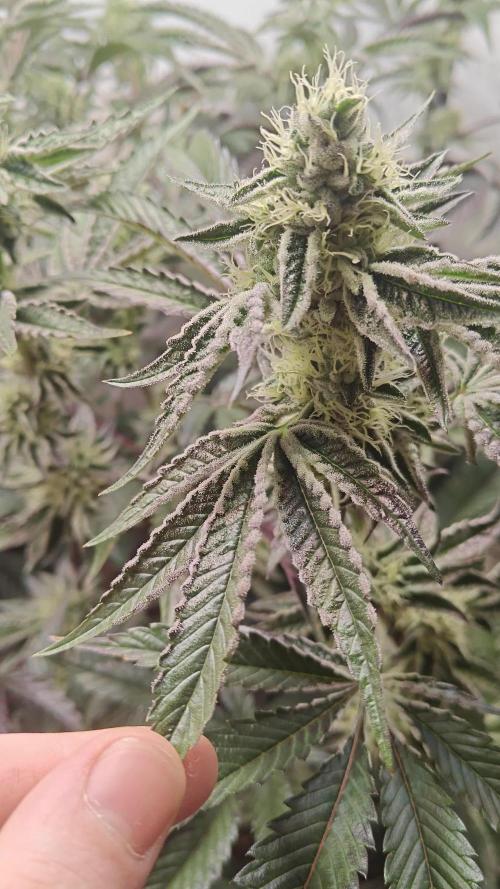
Day 48 - defoliation rotate plants and fed with 1.5l each @6.5 ph
Day 51 - more defoliation , rotated plants again and gave 1.5l @6ph full week 2 nutes
Day 53 - doing some testing here I again gave another full nutes with this feeding to see when it starts showing some nute burn. gave each plant 1.5l each full week 2 nutes @5.8ph

Likes
175
Share


@love_2_grow
Follow
Day 1 Flower (Day 43)
Wooohoooo! First day of flower! I decided to flip both plants after all. The thing is that I will be fully vaccinated against Corona by mid-July, and when that is done, I'm off on vacation. After 1,5 years of this pandemic crap, I'm more than ready to travel again, to see the world, meet new people, and have new experiences.
So yeah, this strain is supposed to be a fast flowering strain (45 days!), so mid-July should do it.
I switched to the Flower Induction light recipe in my main tent, and I will let that recipe run for some days before I switch over to the regular Flower recipe. The tiny tent has nothing so fancy and was switched to a regular 12/12 schedule.
Speaking about lights. That cheap budget light that I bought for my veggies when I moved in my ViparSpectra light into the tiny tent broke down after only two days. So much for trying to save a bit by buying something cheap. I've already sent it back and won't get another light as I think the tomatoes and chilis are ready to move outside. I'll wait and buy this fall instead, but I won't go for the cheapest light I can find then. lol
I was foliar feeding the girls with filtered compost tea while they were still sleeping. I only spray when the lights are out to avoid any leaf burns.
A few hours later, after the girls woke up, I gave them each around 3 liters of unfiltered pH 6.2 compost tea. I FINALLY remembered to pH the compost tea. Woooooo!!!
That was all today.
Day 2 Flower (Day 44)
Today was a really busy day. I opened the tents, took pics, closed up the tents. Phew! Exhausting.
Day 3 Flower (Day 45)
Alright, today was a bit more work than yesterday but still fairly relaxed.
I watered the girls; the left one got 3 liters, and the right one got 4.5 liters of pH 6.0 water.
I noticed a bit of light bleaching on the girl in the small tent, so I turned down the light a bit and increased the distance to the canopy.
It is very tight in there, but that is expected with such a small tent.
I will need to raise the light more in the future, and I'll probably have to resort to a bit of MacGyver-ism to make it work but that's a problem for a later day.
The girl in the main tent has a bit of an uneven canopy where the left side is taller, so I raised the left light as the light level was around 1300 PPFD.
I also super-cropped half a dozen branches to slow them down and let the rest of the canopy catch up. It's probably the last training I do before the girls go into flower.
Finally, I did a bit of defoliating by removing a few leaves that weren't getting any light low down on the girls.
Day 4 Flower (Day 46)
Fuck. Disaster struck. I opened the main tent today and found that the CO2 bag had fallen down and broken one of the main branches. That one branch is responsible for about a quarter of the canopy, so losing it would suck.
I got busy right away taping the broken branch and used some old chili stalks to support the branch further. I also watered it with around 1.5 liters of pH 6.5 water hoping that it will be beneficial.
Now, all I can do is wait and hope for the best.
For those of you who have been following this diary, you already know that I dislike this CO2 bag because it smells like shit. Literally. Now though, I really hate this friggin shit bag and its weird hanging contraption that is as shitty as the smell from the bag.
Day 5 Flower (Day 47)
So far so good. Last night, I checked in on her a couple of hours after I taped the broken branch and the left side of the canopy was already back up with no drooping leaves or branches. YES! However, it was still nerve-wracking to open the tent today but she looked just fine. Fingers crossed that it holds.
Naturally, I don't want to disturb her much right now so all I did today was to water her and carefully LST a couple of branches that got messed up yesterday. I gave her 2 liters of pH 6-0 water and 1 liter of water to the girl in the small tent.
Speaking of the small tent. There's some light bleaching on the tips of the leaves closest to the light so I turned down the dimmer even further down to 40%. I need to try to raise the light but can only gain another 5-7 cm. The tent is soo tiny lol. Will be interesting to see if she will even fit in there after the stretch is done.
I also raised the lights in the main tent as the canopy was getting a bit close.
That was it for today.
Day 6 Flower (Day 48)
Chill day today. All I did today was to water the girls 3 liters each of pH 6.5 water.
Day 7 Flower (Day 49)
Today was the end of a rather tumultuous first week of flower. It looks like I got lucky, though, and that the branch on the right girl will survive. She is growing strong and loving life. I am hopeful.
She is a big girl and drinks a lot, so I'm watering her every day (around 10% of pot volume), and I gave her 3 liters of pH 6.4 water today. The left girl didn't need any, so I just measured both girls, snapped some pics and videos before zipping up both tents.
The left girl is 50 cm tall (12 cm increase in a week), and the right girl is 77 cm tall (31 cm increase in a week!)



Likes
5
Share


@Insaniac_0
Follow
Veg Week 3 Day 21 to 27 - 4/17 to 4/23
A lot more to talk about this week. It's topping and transfer week.
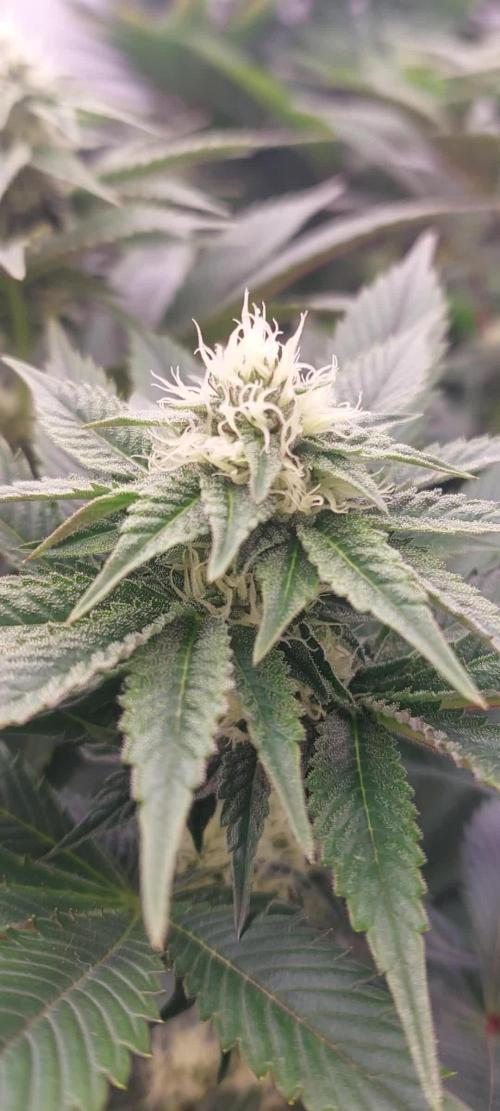
I started the week off (day 21exactly) by making sure I had at least 5 to 6 nodes of growth and topped P1 down to the 4th node and P2 down to the 2nd node as a test. (typically I top to the 3rd) I also removed all other node branches and fan leaves and usual. I left a large stump in my tops so the nodes can use it to grow around and help support the larger weight of a mature plant. I gave a couple of days of recovery while I hand spread the nodes daily to train the new waterways through the nodes. I changed my schedule and watered a day after and then transferred the plants into their forever pots/top watered in
Feed this week was .5gal transfer and top feed at 100ppm total before add-ins. I used 100ppm Veg concentrate mix (recipe week 2)
I then also added 1ml/gal of CaliMagic (General Hydroponics 1-0-0) and ph balance this week was for 6.2
Feed plan next week will be a final top feed of .5gallon and then turn the reservoir on.
Videos:
Topping and
Transfer

Likes
17
Share


@The_Projexx
Follow
I yielded just over half pound dry 10oz and abit to be exact not to bad off 2 plants that I could of let go a little longer. The absolutely reak of Gas terpenes very different for me but very enjoyable


Likes
3
Share


@blaze454
Follow
Big Week. Massive Defoliation - Lolly Popping - Soil Moisture Sensors - Transplanting from 3gln to 5gln Fabric Pots - Got 99% of Irrigation Parts -Transfer To Flower !!!
Still trying to get a new probe for my ph meter. I ordered one from Hanna directly hopefully this will fix the situation as i am semi blind using old ph meter.
Removed probably 50 stalks trying to decrese the bulk and eliminate popcorns.
Half to address the white mold on the roots. I will give a Lost Coast Plant Therapy root drench. i am adjust main room humidity down and turning down humidifier. Might be looking at getting a dehumidifier. A/C would be nice to but...
Let the Kolas Grow
Likes
14
Share


@AndrewC
Follow
So this is the Tear Down week. The timing of it makes it so i will need to the harvest flag in a few days when I can weight and test the plants.
I have included the Cleaning, and Cutting and some Root Porn.
I will make the harvest post in about 4-5 days, when I can trim these plants. There is a lot of Plant here. I got way more than I was expecting. I don't have a scale that measure this amount of plant, without taking like 10 measurements and then adding them together. So I will just be posting the dry weight. I will post the wet weight as dry weight * 1.65.
Autopots: Wow, what a great product. I have been blown away by how well and how easy it was to work with them. They really did solve the watering issues. Excellent product. If you are a beginner, start with Autopots.
-= Lessons Learnt =-
- Overdrive the air to your Autopots. In my control plant, I used a small rectangle air stone (instead of a standard air dome). This lead to root rot and some other issues, it also put significantly less air into the water. The root rot, give the material for the Brown Algae to grow. Using a huge Air-disc-Air-Stone would be an excellent combo to mix in with the air dome itself. Something like this: https://www.amazon.ca/Pawfly-Diffuser-Suction-Hydroponics-Aquarium/dp/B01MY3AQ33 at the bottom and the air-dome on top of it, will be what I do with my next experiment.
- Air stone in the reservoir. I had two instances where algae grew into the res. An air stone would have helped. It would have also helped my control plant get less root rot. Given the amount that the air-domes and air sources got engulfed, having the water have more o2 in it would have only been beneficial.
- Don't grow 6 plants in a 4x4. Since my control plant was about 1/8th the size of the others, I think I could have grown 5 in the shape of a 5 (on a 6 sided dice)⚄ This placement would give a much more spaced canopy for airflow and more importantly light. The sides of some of the plants were lighter green and produced larf due to lack of light penetration.
- This tent was on 19-5 schedule. This worked out very well for this strain. After every lights on, they were in the praying position, so this strain was able to recover in that 5hrs off. If I had more seeds, I would run these again, and try 20-4. I think this strain could handle it. All for all, I think I'm going to 19-5 as my default timing. This kept up a solid DLI.
- Staring at .9EC (really .7 EC cause my water here is .2 EC) Then bumping up at .1 a week, until 1.6EC worked out VERY well. I experimented on this crop all the way up to 1.9EC, which burnt the tips of this plant. I think if I did this strain again, I would do 1.6EC until 3-4 weeks left then crank it to 1.9. It did plump them up when I went to 1.9, however it left them looking rough. Bulk was added though.
- Sticking to 6.0PH for all of veg, and 2 weeks into flower worked great. The plant had solid and consistent color and leaf shape . The plant's did get hurt, due to some issues (as noted on the weeks). I switched to 6.5 PH in the last 3-4 weeks and it helped them recover, and plump up noticeably.
-VPD. The #1 thing I focused on was VPD. I keep it .9kpa range, as best as humanly possible. It was honestly, HUGELY noticeable compared to my other grows. I know truly understand the value of properly dialed in VPD. This is the one lesson that will stick with me forever.
- Super-cropping: On the plants I give the chiropractic treatment too, had much thicker stems as much larger channel internally. I did this treatment to 4 of the 6, and the 4 that had it done has larger buds and recovered from defoliation faster.
TLDR; VPD is king. Super-cropping is worth the time. Keeping PH and EC dialed in were all wins. Autopots kick ass.
Likes
49
Share


@Roberts
Follow
Mandarin Squeeze smells amazing if you love oranges. The girls grew great. One took dominance as I expected in the grow. I hope it tastes as good as it smells. It would be my new favorite indica strain. I will be back with a smoke report in a few months. Thanks again Terpyz Mutant Genetics, and Spider Farmer. 🤜🏻🤛🏻🌱🌱🌱
Thank you grow diaries community for the 👇likes👇, follows, comments, and subscriptions on my YouTube channel👇.
Thank you Happy Growing 🌱🌱🌱
https://youtube.com/channel/UCAhN7yRzWLpcaRHhMIQ7X4g


Likes
2
Share


@HighOhioAn
Follow
She is a fighter packing on the pound mimosa cake for the wind not the Beautifullest plant I’ve ever grown but still stinky sticky and frosty as ever🔥
Likes
9
Share


@TiRobotProds
Follow
Ce porte bien cette dame de Ganja Farmer Seed. Cette semaine division en 16 branche c'est la dernière doublure avant passage en floraison a bientôt pour plus d'informations.


Likes
3
Share


@King000David
Follow
1st grow in 10 years so wish me luck or let's just call it a practice run 👍
Likes
36
Share


@nonick123
Follow
Día 87 (26/08) Aplicación foliar de Bacillus thuringiensis a 1 g / litro para evitar a las temidas orugas de los cogollos!
Hace un día nublado (29 ºC de maxima) y NO es necesario regar
Elimino la malla de sombreado de la cara sur, ya que las temperaturas son más suaves después de la canicula
Día 88 (27/08) Riego con 500 ml H2O pH 6,5
Empiezan a bajar las temperaturas a 29 ºC de máxima, y se nota en la demanda de agua por parte de las plantas!
OnionOG Se empiezan formar los erizos y se pueden apreciar los primeros tricomas sobre las futuras hojas de azucar 😍💥
Día 89 (28/08) Riego con 500 ml H2O pH 6,5
Cada planta empieza a ir un poco a su marcha en la demanda de riego dependiendo de su tamaño y estado de floración
Día 90 (29/08) Riego con 250 / 500 ml H2O pH 6,5
He detectado un gusano de los cogollos muerto sobre una hoja! 💥 Parece que los Bacillus thuringiensis funcionan estupendamente! 😁
Día 91 (30/08) Riego con 250 / 500 ml H2O pH 6,5
Día 92 (31/08) Riego con 1 litro H2O pH 6,5 + 25 ml de Humus de Lombriz Liquido
Día 93 (01/09) Aplicación foliar Bacillus Thuringiensis
No es necesario regar tras el litro de ayer y dia nublado con pequeños chubascos!
💦Nutrients by Lurpe Solutions - www.lurpenaturalsolutions.com
🌱Substrate PRO-MIX HP BACILLUS + MYCORRHIZAE - www.pthorticulture.com/en/products/pro-mix-hp-biostimulant-plus-mycorrhizae


Likes
19
Share


@Comfrey
Follow
Beginning of week 8: Tropicana is 24 cm high and the stem is 36 cm long. She is a legal frosty angel (10 degrees last night) growing on a rotten balcony in a small town in germany.
Day 50
🌥️☁️☁️ 10-19 degrees, humidity 78%
I noticed that the soil has sunk. It moved downstairs, between the drainage I guess. New pots problem.
Got my compost, summer will be long and there will be a second round for sure. So I prepared bigger pottery pots, maybe 15 liter, which will be ready for seeds in about a month or two.
Tropicana needs rainwater now, some sunny hours during the day. That’s all.
I like how she develops.
Day 51
☁️🌨️☁️☁️☁️🌦️🌈 14-19 degrees and humidity is around 77%.
I gave Tropicana too much nitrogen. Spotted some signs and stop with fertilizers for now. It‘s ok but the comfrey manure had more nitrogen than I expected. In the next days we‘ll have a lot of rain, so Tropicanas soil will be washed and this will solve the problem maybe. It‘s a big difference to grow cannabis in a pot then veggies in the ground in a no dig garden with yearly compost mulching. My Tomatoes in ground loved this 1:5 comfrey manure breakfast but for Tropicana less would have been more. Maybe 1:15 or 1:10. It always depends on the raw material for the liquid manure. This year we had a lot of rain and the comfrey had maybe more nitrogen as usually.
Day 52
🌥️🌤️🌦️🌤️ 13 - 19 degrees and the humidity is 69%. Tropicana had about 0.8 Liter pure rainwater today. It was raining the whole night.
Day 53
🌧️☁️☁️🌧️ 13-17 degrees, humidity is around 90%. Me and Tropicana have a rest. We chill with a tasty vape on the balcony while doing nothing more then chill.
Day 54
🌧️☁️☁️🌧️ 13-18 degrees, humidity is around 93%. Saturday, time for cleaning the balcony and take some fotos of my flowers.
Her smell is getting much more intensiv. I see that the color of the buds is getting diverse. The soil is moist from the rain.
Day 55
🌧️☁️☁️☁️ 13-18 degrees, humidity is falling, now 69%.
Tropicana spend the day chilling with her friends on the balcony. They talked about the weather and what to do in the next week.
Day 56
⛅️🌤️☀️🍉 12-24 degrees, humidity is around 78%
Tropicana had a sunbath for hours. I bought a cheap magnifying glass today and I‘m so happy with this one. It have 30x / 60x lenses and two LEDs. I found it in a shop for mycologists. I‘m crazy about mushroom hunting. Normal mushrooms, yes. So this is absolutely relaxing viewing the structure of fruits, my homemade soil, little insects living inside. Actually this was a tip out of a blog article of Fast Buds Tropicana Cookies week by week guide, which I can highly recommend.
I gave Tropicana in the morning a 1:20 field horsetail tee, ~ 0,7 liter in three steps. 100-200-400 milliliters. She was drinking it till sunset. The pot got lighter till evening, around half a kilo or maybe more.
Likes
111
Share


@Herbalize
Follow
Hello folks 😎
6th week of flowering and and no problem to report
They drink about 5 liters every 4/5 days and this week after 2 watering with PK, i just put ph'd water to start reducing the PPM slowly until the end
next week I'll give them a last small dose of nutrients (500 ppm max) and will follow the flush for the end, that's my plan 👌
my first impression on the smell that comes out, it's really piney/lemony ! 😍
unlike my Pineapple Kush, the buds are really huge on these Toxic 💪 but a little less frosty 😄
anyway Stay tuned and see you next week guys 😘
I also have another diary with one Pineapple kush if you want to see
Peace Love & Weed GD Fam😍👊


