


Likes
Comments
Share


@mingokoon
Follow
WEEK 6 – MARCH 7 - 13
week 6 for all but the younger 24 (which is the only one that is not flowering). I'm getting frost on the DG. I sacrificed the weaker DG- it got light burn and never recovered. it was growing but sickly. . I now have a light meter and they are all getting the proper PPFD. I am increasing the nutes faster in the young 24 and it seems to be taking it. I am trying to keep an eye on my ppm. So far no signs of lock out or nute burn - I will increase the levels quicker next grow.

Processing
Likes
4
Share


@Andres
Follow
nothing to say ... that his growth is still good and he has a small greenhouse in a bottle to keep the humidity ..........

Likes
21
Share


@Herbman420
Follow
This week went ok she started expanding her leaves and geting bigger. I'm still feeding her the same amount of nutrients and pH of 6.5 .she has nice purple stripes in the stems which I'm quite pleased about so hopefully she will turn out a nice looking plant. She will be going outside later on this month with a supplemental lighting at the end of the day and maybe flowered towards the end of this year or during the summer . Thank you for looking at the diary and we'll be an update next week and remember it's 420 somewhere
Likes
47
Share


@MadeInGermany
Follow
Info:
Unfortunately, I had to find out that my account is used for fake pages in social media.
I am only active here on growdiaries.
I am not on facebook instagram twitter etc All accounts except this one are fake.
Have fun with the update.
Hey everyone 😊.
This week has continued to develop great :-).
It was poured once with about 200 ml because it is still under the hood with very high humidity that is enough :-).
Next week the hood will be opened bit by bit so that it can get used to the surroundings :-).
Otherwise the tent was cleaned and the humidifier refilled every day this week.
I think I'll repot next week and then start training :-).
Until then, I wish you lots of fun with the update.
Stay healthy 🙏🏻 and let it grow 👍
You can buy this Strain at :
https://www.exoticseed.eu/
Type:
Herz Og
☝️🏼
Genetics:
Larry OG X Kosher Kush
Indica 60 % / Sativa 40 %
👍
Vega lamp:
2 x Todogrow Led
Quantum Board 100 W
💡
Bloom Lamp :
2 x Todogrow Led
Cxb 3590 COB 3500 K 205W
💡💡☝️🏼
Soil :
Canna Coco Professional +
☝️🏼
Fertilizer:
Green House Powder Feeding
☝️🏼🌱
Water:
Osmosis water mixed with normal water (24 hours stale that the chlorine evaporates) to 0.2 EC. Add Cal / Mag to 0.4 Ec Ph with Organic Ph - to 5.5 - 5.8 .

Likes
23
Share


@Zuppler
Follow
🍦**Grow Report by Zuppler - Week 3 Flowering Phase** 🍦
Yo yo, what’s poppin’? It’s Zuppler back with that grow update straight from the heart of the city, ya feel me? We’re in Week 3 of the flowering phase, and let me tell you, the ladies are lookin’ fresh as hell right now. Everything's running smooth, no stress. The buds are starting to show up like diamonds in the rough, you know what I’m sayin’?
The girls are growing like real queens, standing strong and firm, like they know they’re about to take over the spotlight soon. Nodes are tight, no stretchin’, everything stayin' solid like a real OG. Lights are on that 12/12 cycle, and the nutes are mixin’ in just right – no overfeedin’, no deficiencies, just smooth sailin’, bruh.
Water game is on point too – pH is dialed in, no dry-out drama. Roots are doing their thing, and the ladies are sucking up that H2O like they’re thirsty in the desert. We’re usin‘ that clean and pure Osmosewasser.
So far, everything’s rollin’ as planned. I’m hyped to see how these next few weeks turn out – buds gettin’ fatter, stickier, and that smell’s gonna get even crazier. Stay tuned, yo – Zuppler out.
Peace!
Likes
15
Share

@DeepRootsGrowTrees
Follow
SHERBERT QUEEN AUTO / RQS
HARVEST WEEK
I didn't have any issues from seed to harvest this lady stayed short in stature however she did produce some frosty buds and they looked and smelled amazing!! Stay Growing!!
Thank you for stopping by and taking a look during this grow it's much appreciated!!!
Thank you to ROYAL QUEEN SEEDS!!!
RQS / SHERBERT QUEEN AUTO

Likes
14
Share


@Fullmeltalchemist
Follow
Welcome to my Seedsman grow. This is my first real attempt at growing from purchased seeds. I didn't know too much about genetics when I bought these but hopeful they turn out dope. The idea was to have the tent filled with drastically different colored buds 😅I like symmetry
D1 - 9.13 - 3 fem White Widow Fast and 3 fem Black Sugar (Soaked/toweled) were dropped in to solo cups with bottom 1/3 NLS super soil and top 2/3 Fox Farms.
D4 - 9.16 - We got sprouts 100%
D6 - 9.18 - Third set of leaves making their move. Seedling station light is Phlizon 600W LED. I have it at 18in with full spectrum on.
D7 - 9.19 - Growin

Likes
3
Share


@Takeaims
Follow
Defo going keep going with f1 I have more still growing and there the biggest plants I've had thanks zameizia you guys are amazing

Likes
5
Share


@killerjoint
Follow
8th days/Flowering /little change
10TH DAYS OF FLOWERING
DUE TO RAIN HAD TO TRIM BOTTOM -LITTLE EARLY
MY HUM WAS HEATING 70 TO 76 BLOWING FANS....
AND CHECKING FOR SEX
POP 9 SEEDS 100% SUCESS
AND ALL FEMALE
THANKS TO COPY CAT GENTICS.
11TH DAYS -FLOWERING
RAINING SEASON HAD TO TRIM BOTTOM FOR AIR VENTILATION
MY HUM HITTING 72%.......T T DUE TO RAIN RUNNING EXTRA FAN FOR AIR VENTILATION.
EVERYDAY PLANTS GROWING ABOUT 2 TO 3 INCHES
LET'S GO GOOMIES


Likes
28
Share


@TheHighentist
Follow
First week of flower👏
They got 2 hours extra darkness before flip. Not because of scientific evidence, but simply practical.
Still looking back to the first weeks of veg. WHAT A MESS and WHAT A MIRACLE 🙏
Coming into flower, they had two defoliation and the latest one was 7/10.
Last feed 8/10 Introducing Biobizz CalMag(0.5ml/l) + BioBloom(0.25ml/l)+Topmax(0.25ml/l)+Rootjuice(0.25ml/l)
Still 2ml/L Fishmix+BioHeaven(Fishmix will be switched out with BioGrow)
👽👉10/10 VPD is 1.2,-1.3. good airflow above and below canopy.
👽👉11/10 Mild signs of light stress. They will get used to the VPD. Can't wait to feed in a couple of days and see the reaction. Im sure they are really hungry!
👽👉12/10 Waterday** Introducing higher doses of bloom nutes. The Run off PH and EC are all within the limits
👽👉13/10 They lit up after some nutes. They look happy! Let the stretch begin
👽👉14/10 Already see fast growth. Just monitering factors, to make sure the climate is optimal and their are no symptoms.
👽👉15/10 Waterday* Thirsty ladies
👽👉16/10 Last day of week 1 of flower. Everything is going fine, Good airflow, None of the small symptoms has gotten worse, so overall happy ladies!
How ever one has a little stunned growth or maybe just a bit behind of going into stretch
Likes
31
Share


@JonnyKush
Follow
Gender: Auto
Genes: 75% Indica / 25% Sativa
Genetics: Afghan OG x Strawberry Pie
Harvest: 650 g/m²
Flowering: 65 - 75 days
THC: 21.0%
CBD: 1.5%

Likes
Comments
Share

@frigo_camelo
Follow
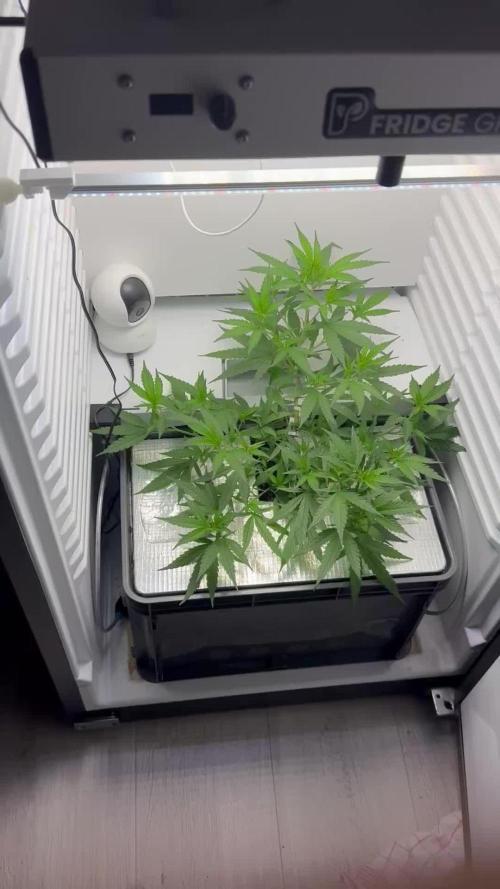
end if week 2 veg | start of flower tomorrow | looking really good

Likes
7
Share


@Messypies
Follow
This week started strong. Some small concerns due to small orange spots appearing on fan leaves which on researching indicates a calcium/magnesium deficiency. Will add a small amount of cal mag to their next feed

Likes
2
Share


@Springtime
Follow
Tag3: die kleine beschleunigt gerade Wachstumstechnisch. Ist jetzt schon 45cm hoch! Läuft! Erste vorblüte ist aufgetaucht. Also geht es jetzt vermutlich in den Stretch.
Wenn es 70cm werden bin ich echt zufrieden.
Tag5: 50cm erreicht! Wetter war gut. Ich habe ein wenig das Gefühl Zuviel gefüttert zu haben, den Rest der Woche gibt’s nur noch Wasser.

Likes
4
Share


@Questpeace
Follow
Amazing how Criticical Orange Punch took some advantages of the nice weather. She s growing hard. Did some defoliation on her. She did an extra week in vegetation due to several defoliation sessions.
Milky Way is doing great although she's not that tall as I was expecting.
Smell is mix of lemon and mint with some spicy tones. Realy nice. 🤩
Some top layer for both with plagron bat guano. They had some treatment with compost tea last week. Now just watering every 2nd day.

Likes
4
Share


@Growstopher
Follow
6.18.25.
7th week of flower started on 6.16. To bad I stunted this one so bad because the quality is very good just quantity is sad. About 2-3 weeks left until harvest! Started lowering nutrient strength get a nice flush for the final 2-3 weeks

Likes
25
Share


@Ultraviolet
Follow
ANTHOCYANIN production is primarily controlled by the Cryptochrome (CR1) Photoreceptor ( !! UV and Blue Spectrums are primary drivers in the production of the pigment that replaces chlorophyll, isn't that awesome!
1. Diverse photoreceptors in plants
Many civilizations, including the sun god of ancient Egypt, thought that the blessings of sunlight were the source of life. In fact, the survival of all life, including humans, is supported by the photosynthesis of plants that capture solar energy. Plants that perform photosynthesis have no means of transportation except for some algae. Therefore, it is necessary to monitor various changes in the external environment and respond appropriately to the place to survive. Among various environmental information, light is especially important information for plants that perform photosynthesis.
In the process of evolution, plants acquired phytochrome, which mainly receives light in the red light region, and multiple blue light receptors, including his hytropin and phototropin, in order to sense the light environment. .. In addition to these, an ultraviolet light receptor named UVR8 was recently discovered. The latest image of the molecular structure and function of these various plant photoreceptors (Fig. 1), focusing on phytochrome and phototropin.
Figure 1
Ultraviolet-visible absorption spectra of phytochrome, cryptochrome, phototropin, and UVR8. The dashed line represents each bioactive absorption spectrum.
2. Phytochrome; red-far red photoreversible molecular switch
What is phytochrome?
Phytochrome is a photochromic photoreceptor, and has two absorption types, a red light absorption type Pr (absorption maximum wavelength of about 665 nm) and a far-red light absorption type Pfr (730 nm). Reversible light conversion between the two by red light and far-red light, respectively(Fig. 1A, solid line and broken line). In general, Pfr is the active form that causes a physiological response. With some exceptions, phytochrome can be said to function as a photoreversible molecular switch. The background of the discovery is as follows. There are some types of plants that require light for germination (light seed germination). From that study, it was found that germination was induced by red light, the effect was inhibited by subsequent far-red light irradiation, and this could be repeated, and the existence of photoreceptors that reversibly photoconvert was predicted. In 1959, its existence was confirmed by the absorption spectrum measurement of the yellow sprout tissue, and it was named phytochrome. Why does the plant have a sensor to distinguish between such red light and far-red light? There is no big difference between the red and far-red light regions in the open-field spectrum of sunlight, but the proportion of red light is greatly reduced due to the absorption of chloroplasts in the shade of plants. Similar changes in light quality occur in the evening sunlight. Plants perceive this difference in light quality as the ratio of Pr and Pfr, recognize the light environment, and respond to it.
Subsequent studies have revealed that it is responsible for various photomorphogenic reactions such as photoperiodic flowering induction, shade repellent, and deyellowing (greening). Furthermore, with the introduction of the model plant Arabidopsis thaliana (At) and the development of molecular biological analysis methods, research has progressed dramatically, and his five types of phytochromes (phyA-E) are present in Arabidopsis thaliana. all right. With the progress of the genome project, Fi’s tochrome-like photoreceptors were found in cyanobacteria, a photosynthetic prokaryotes other than plants. Furthermore, in non-photosynthetic bacteria, a homologue molecule called bacteriophytochrome photoreceptor (BphP) was found in Pseudomonas aeruginosa (Pa) and radiation-resistant bacteria (Deinococcus radiodurans, Dr).
Domain structure of phytochrome molecule
Phytochrome molecule can be roughly divided into N-terminal side and C-terminal side region. PAS (Per / Arndt / Sim: blue), GAF (cGMP phosphodiesterase / adenylyl cyclase / FhlA: green), PHY (phyto-chrome: purple) 3 in the N-terminal region of plant phytochrome (Fig. 2A) There are two domains and an N-terminal extension region (NTE: dark blue), and phytochromobilin (PΦB), which is one of the ring-opening tetrapyrroles, is thioether-bonded to the system stored in GAF as a chromophore. ing. PAS is a domain involved in the interaction between signal transduction-related proteins, and PHY is a phytochrome-specific domain. There are two PASs and her histidine kinase-related (HKR) domain (red) in the C-terminal region, but the histidine essential for kinase activity is not conserved.
3. Phototropin; photosynthetic efficiency optimized blue light receptor
What is phototropin?
Charles Darwin, who is famous for his theory of evolution, wrote in his book “The power of move-ment in plants” published in 1882 that plants bend toward blue light. Approximately 100 years later, the protein nph1 (nonphoto-tropic hypocotyl 1) encoded by one of the causative genes of Arabidopsis mutants causing phototropic abnormalities was identified as a blue photoreceptor. Later, another isotype npl1 was found and renamed phototropin 1 (phot1) and 2 (phot2), respectively. In addition to phototropism, phototropin is damaged by chloroplast photolocalization (chloroplasts move through the epidermal cells of the leaves and gather on the cell surface under appropriate light intensity for photosynthesis. As a photoreceptor for reactions such as escaping to the side of cells under dangerous strong light) and stomata (reactions that open stomata to optimize the uptake of carbon dioxide, which is the rate-determining process of photosynthetic reactions). It became clear that it worked. In this way, phototropin can be said to be a blue light receptor responsible for optimizing photosynthetic efficiency.
Domain structure and LOV photoreaction of phototropin molecule
Phototropin molecule has two photoreceptive domains (LOV1 and LOV2) called LOV (Light-Oxygen-Voltage sensing) on the N-terminal side, and serine / on the C-terminal side. It is a protein kinase that forms threonine kinase (STK) (Fig. 4Aa) and whose activity is regulated by light. LOV is one molecule as a chromophore, he binds FMN (flavin mononucleotide) non-covalently. The LOV forms an α/βfold, and the FMN is located on a β-sheet consisting of five antiparallel β-strands (Fig. 4B). The FMN in the ground state LOV shows the absorption spectrum of a typical oxidized flavin protein with a triplet oscillation structure and an absorption maximum wavelength of 450 nm, and is called D450 (Fig. 1C and Fig. 4E). After being excited to the singlet excited state by blue light, the FMN shifts to the triplet excited state (L660t *) due to intersystem crossing, and then the C4 (Fig. 4C) of the isoaroxazine ring of the FMN is conserved in the vicinity. It forms a transient accretionary prism with the tain (red part in Fig. 4B Eα) (S390I). When this cysteine is replaced with alanine (C / A substitution), the addition reaction does not occur. The effect of adduct formation propagates to the protein moiety, causing kinase activation (S390II). After that, the formed cysteine-flavin adduct spontaneously dissociates and returns to the original D450 (Fig. 4E, dark regression reaction).
Phototropin kinase activity control mechanism by LOV2
Why does phototropin have two LOVs? Atphot1 was found as a protein that is rapidly autophosphorylated when irradiated with blue light.
The effect of the above C / A substitution on this self-phosphorylation reaction and phototropism was investigated, and LOV2 is the main photomolecular switch in both self-phosphorylation and phototropism. It turns out that it functions as. After that, from experiments using artificial substrates, STK has a constitutive activity, LOV2 functions as an inhibitory domain of this activity, and the inhibition is eliminated by photoreaction, while LOV1 is kinase light. It was shown to modify the photosensitivity of the activation reaction. In addition to this, LOV1 was found to act as a dimerization site from the crystal structure and his SAXS. What kind of molecular mechanism does LOV2 use to photoregulate kinase activity? The following two modules play important roles in this intramolecular signal transduction.
Figure 4
(A) Domain structure of LOV photoreceptors. a: Phototropin b: Neochrome c: FKF1 family protein d: Aureochrome (B) Crystal structure of auto barley phot1 LOV2. (C) Structure of FMN isoaroxazine ring. (D) Schematic diagram of the functional domain and module of Arabidopsis thaliana phot1. L, A’α, and Jα represent linker, A’α helix, and Jα helix, respectively. (E) LOV photoreaction. (F) Molecular structure model (mesh) of the LOV2-STK sample (black line) containing A’α of phot2 obtained based on SAXS under dark (top) and under bright (bottom). The yellow, red, and green space-filled models represent the crystal structures of LOV2-Jα, protein kinase A N-lobe, and C-robe, respectively, and black represents FMN. See the text for details.
1) Jα. LOV2 C of oat phot1-to α immediately after the terminus
Rix (Jα) is present (Fig. 4D), which interacts with the β-sheet (Fig. 4B) that forms the FMN-bound scaffold of LOV2 in the dark, but unfolds and dissociates from the β-sheet with photoreaction. It was shown by NMR that it does. According to the crystal structure of LOV2-Jα, this Jα is located on the back surface of the β sheet and mainly has a hydrophobic interaction. The formation of S390II causes twisting of the isoaroxazine ring and protonation of N5 (Fig. 4C).
As a result, the glutamine side chain present on his Iβ strand (Fig. 4B) in the β-sheet rotates to form a hydrogen bond with this protonated N5. Jα interacts with this his Iβ strand, and these changes are thought to cause the unfold-ing of Jα and dissociation from the β-sheet described above. Experiments such as amino acid substitution of Iβ strands revealed that kinases exhibit constitutive activity when this interaction is eliminated, and that Jα plays an important role in photoactivation of kinases.
2) A’α / Aβ gap.
Recently, several results have been reported showing the involvement of amino acids near the A’α helix (Fig. 4D) located upstream of the N-terminal of LOV2 in kinase photoactivation. Therefore, he investigated the role of this A’α and its neighboring amino acids in kinase photoactivation, photoreaction, and Jα structural change for Atphot1. The LOV2-STK polypeptide (Fig. 4D, underlined in black) was used as a photocontrollable kinase for kinase activity analysis. As a result, it was found that the photoactivation of the kinase was abolished when amino acid substitution was introduced into the A’α / Aβ gap between A’α and Aβ of the LOV2 core. Interestingly, he had no effect on the structural changes in Jα examined on the peptide map due to the photoreaction of LOV2 or trypsin degradation. Therefore, the A’α / Aβ gap is considered to play an important role in intramolecular signal transduction after Jα.
Structural changes detected by SAXS
Structural changes of Jα have been detected by various biophysical methods other than NMR, but structural information on samples including up to STK is reported only by his results to his SAXS. Not. The SAXS measurement of the Atphot2 LOV2-STK polypeptide showed that the radius of inertia increased from 32.4 Å to 34.8 Å, and the molecular model (Fig. 4F) obtained by the ab initio modeling software GASBOR is that of LOV2 and STK. It was shown that the N lobes and C lobes lined up in tandem, and the relative position of LOV2 with respect to STK shifted by about 13 Å under light irradiation. The difference in the molecular model between the two is considered to reflect the structural changes that occur in the Jα and A’α / Aβ gaps mentioned above.
Two phototropins with different photosensitivity
In the phototropic reaction of Arabidopsis Arabidopsis, Arabidopsis responds to a very wide range of light intensities from 10–4 to 102 μmol photon / sec / m2. At that time, phot1 functions as an optical sensor in a wide range from low light to strong light, while phot2 reacts with light stronger than 1 μmol photon / sec / m2. What is the origin of these differences? As is well known, animal photoreceptors have a high photosensitivity due to the abundance of rhodopsin and the presence of biochemical amplification mechanisms. The exact abundance of phot1 and phot2 in vivo is unknown, but interesting results have been obtained in terms of amplification.
The light intensity dependence of the photoactivation of the LOV2-STK polypeptide used in the above kinase analysis was investigated.
It was found that phot1 was about 10 times more photosensitive than phot2. On the other hand, when the photochemical reactions of both were examined, it was found that the rate of the dark return reaction of phot1 was about 10 times slower than that of phot2. This result indicates that the longer the lifetime of S390II, which is in the kinase-activated state, the higher the photosensitivity of kinase activation. This correlation was further confirmed by extending the lifespan of her S390II with amino acid substitutions. This alone cannot explain the widespread differences in photosensitivity between phot1 and phot2, but it may explain some of them. Furthermore, it is necessary to investigate in detail protein modifications such as phosphorylation and the effects of phot interacting factors on photosensitivity.
Other LOV photoreceptors Among fern plants and green algae, phytochrome ɾphotosensory module (PSM) on the N-terminal side and chimera photoreceptor with full-length phototropin on the C-terminal side, neochrome (Fig. There are types with 4Ab). It has been reported that some neochromes play a role in chloroplast photolocalization as a red light receiver. It is considered that fern plants have such a chimera photoreceptor in order to survive in a habitat such as undergrowth in a jungle where only red light reaches.
In addition to this, plants have only one LOV domain, and three proteins involved in the degradation of photomorphogenesis-related proteins, FKF1 (Flavin-binding, Kelch repeat, F-box 1, ZTL (ZEITLUPE)), LKP2 ( There are LOV Kelch Protein2) (Fig. 4Ac) and aureochrome (Fig. 4Ad), which has a bZip domain on the N-terminal side of LOV and functions as a gene transcription factor.
4. Cryptochrome and UVR8
Cryptochrome is one of the blue photoreceptors and forms a superfamily with the DNA photoreceptor photolyase. It has FAD (flavin adenine dinucle-otide) as a chromophore and tetrahydrofolic acid, which is a condensing pigment. The ground state of FAD is considered to be the oxidized type, and the radical type (broken line in Fig. 1B) generated by blue light irradiation is considered to be the signaling state. The radical type also absorbs in the green to orange light region, and may widen the wavelength region of the plant morphogenesis reaction spectrum. Cryptochrome uses blue light to control physiological functions similar to phytochrome.
It was identified as a photoreceptor from one of the causative genes of UVR8 Arabidopsis thaliana, and the chromophore is absorbed in the UVB region by a Trp triad consisting of three tryptophans (Fig. 1D). It is involved in the biosynthesis of flavonoids and anthocyanins that function as UV scavengers in plants.
Conclusion
It is thought that plants have acquired various photoreceptors necessary for their survival during a long evolutionary process. The photoreceptors that cover the existing far-red light to UVB mentioned here are considered to be some of them. More and more diverse photoreceptor genes are conserved in cyanobacteria and marine plankton. By examining these, it is thought that the understanding of plant photoreceptors will be further deepened.

Likes
11
Share


@PanGrower
Follow
Do not pay attention to the temperature on the thermometer in the middle, it lies by a couple of degrees. I have a good thermometer on top of the box that shows the temperature.
Day 29: After a terrible fracture, we see that the plant is beginning to recover. I'm honestly disappointed because it makes it very difficult for me to train mainlining and it will also increase the amount of time it takes to grow.
Day 30: It looks much better already, I could superprune the right branch, but I don't want to stress it. I will try to bend the right branch harder, I will bend the left one a little in the morning the next day, maybe early.
Day 31: This morning I cut the lower leaves, photo in the evening and continued the LST training after the injury. Photo in the evening.
Day 32: I am completely sure that the plant has moved away from the stress, but we can see on the left circle, the right bud (and side) slowed growth.
Day 34: I saw traces of salt on the tips of the new leaves, so now I pour water with regular 15 PPM.
Likes
16
Share

@Northern_Ent
Follow
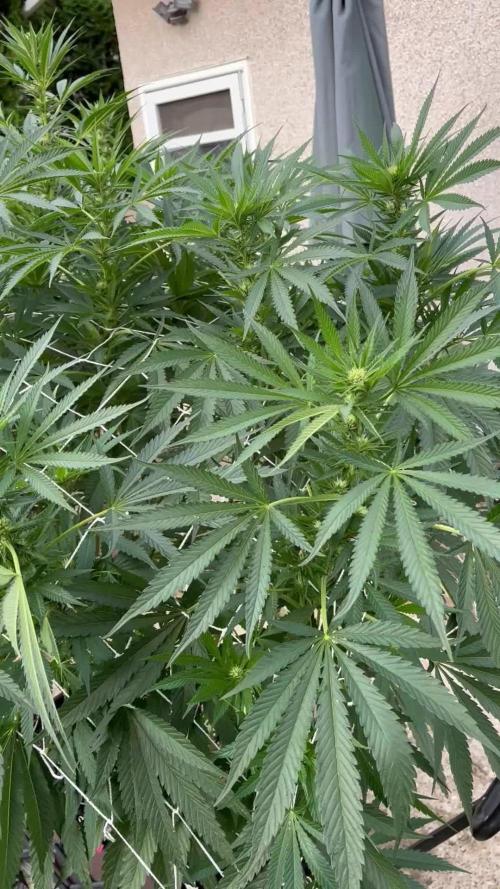
Aug 9: Lemon Cream Kush is doing fine and is starting to stretch a bit. I’m surprised how much it grew last week.
Got the UV led lights from AC Infinity going. The sunlight gets weak here quickly starting in mid-August and the UV helps form trichomes. Used it last year and it seems to help. Nice weather days only as these lights are not intended for outdoor use.
Aug 14: rainy last few days. Noticeably stretched last night. Had UV lights going in afternoon after a few days of not using them.

Likes
20
Share


@Boomdrawfyah
Follow
57 dias de vida y 31 dias de trasplante vaya diferencia en solo 10 dias han crecido 50 cm ha augmentado el tamaño exageradamente , hay algun saltamontes comiendo alguna hoja pero nada grave , estan creciendo muy sanas y con unas hojas de 11 foliolos grandísimas la última foto hay una comparación con el culo de una garrafa de 5L

Likes
44
Share


@The_Good_Twin
Follow
11 Sep 2021
Today starts week 2 of the flowering stage and week 10 of life for my lovely Ladies. I did some massive defoliation and pruning the other day and all three of my babies are looking amazing afterwards!! Absolutely beautiful! I have a short video log (I’m not cool enough to call it a vlog), and a few pictures to upload to start this week.
I must admit that I really thought I may have overdone the defoliation and pruning, but so far it’s turning out exactly as I had hoped. There are budlets forming at every node, and all three plants are looking healthy and strong.
I decided to look at my feed chart and to count backwards from the date that they should be ready for harvest and to arrange their feeding schedule. I made a plan where I can provide a good steady level of nutrients in the proper stage of growth, and schedule time for the flush to be done by the time harvest time arrives.
So today I started the Mid-Bloom stage 4 of my Flora-Trio 6 part feeding chart. I’m still giving half the nutrient level until I know there are no issues, then I will adjust to full strength if necessary. At 50% strength each plant was given: CALiMAGic 2ml, FloraMicro 2.4ml, FloraGro 2ml, FloraBloom 4.2ml, Floralicious Plus 1ml, and Liquid KoolBloom 1ml mixed into a gallon of water. The initial pH for all three gallons was 6.3. I wanted to adjust them up, so I added 1.2ml of pH UP to each gallon which adjusted them as follows: C1 - 6.7, and C2/C3 were both adjusted to 6.6.
I still don’t have a replacement TDS meter, so only pH was measured in the runoff. Runoff pH was as follows: C1 - 5.9, C2 - 6.1, and C3 - 5.8. The runoff levels of C1 and C3 are still lower than id like, but still manageable.
As I mentioned several times above; my plants are looking great, and I plan to keep growing them as they are until this method needs to be adjusted or changed. I’m just letting them grow wild. Granted, I’m trying my best for them to grow the way I want, but I’m not using a support net at all (yet). I say (yet), because once the buds start to bulk up, they may need support to stand upright. If that day comes, I’ll use the net. Time will tell.
The temperature in the tent was 82F, and the humidity was 45%. So far my trio is growing beautifully! Enjoy everyone! I am!!
14 Sep 2021
I ended up using only about half of each gallon the other day, so today I gave the rest of each gallon to the perspective plant it belonged to. None of the plants had any real runoff from the amount given today, so I’ll probably start feeding every two days instead of every 3-4. It happens with each grow. The trick is to identify how much they need, and how often. It seems to change with every plant.
So as I stated above; each plant received about 1/2 gallon of water and nutrients that was prepared a few days ago. Each plant received CALiMAGic 2ml, FloraMicro 2.4ml, FloraGro 2ml, FloraBloom 4.2ml, Floralicious Plus 1ml, and Liquid KoolBloom 1ml.
The pH going in was: C1 - 6.7, C2/C3 - 6.6. As I said above, there wasn’t enough runoff to measure, so I don’t have runoff data today.
The temperature in the tent was 84F, and humidity was 57%. I measured each plant and adjusted the lights according to their growth. C1 is now 23 inches tall, C2/C3 are both 23.5 inches tall. I adjusted the lights to all be 15 inches over each plant. Light spill off is still awesome for all three plants, and each one of my lovely ladies is looking absolutely amazing!
15 Sep 2021
My plants are doing AWESOME!! I looked in on them a little earlier today and just sat in my floor and looked at them. They are doing amazing! Absolutely beautiful!!
I have used a support (scrog) net for each of my grows so far; till this one. At least so far that is. I may end up putting it in to support the branches once they are loaded with bud, but for right now I have just let them grow as they naturally want too.
Of course there are some exceptions to that last statement. At the end of my first week of flower I decided to defoliate and prune them down. I did so much defoliation and pruning that I thought I may have hurt my girls, but nope! They have responded even better than I had hoped.
I trimmed off all of the lowest branches that weren’t already long enough to get full light exposure, as well as most of the small intermediate branches growing off of more established branches. The result… every node growing on every branch is developing buds! All of them are getting full light exposure, and ventilation from the fans inside the grow room.
These three are looking better than any of my previous plants thus far. I am very pleased with how they’re doing!
I’m feeding again today because what I gave them yesterday just didn’t seem sufficient. None of them had any runoff to measure; so I’m going to make sure that they do as well as possible!
I’m sticking with the mid-bloom stage 4 of my Flora-Trio 6 part feeding chart at 50% of recommended levels. My plants are doing great at 50% strength so far, so if it isn’t broken, don’t fix it! No deficiencies have been seen, so I’ll keep on keeping on that.
Each plant received a mixture of a gallon of water with the following nutrients: CALiMAGic 2ml, FloraMicro 2.4ml, FloraGro 2ml, FloraBloom 4.2ml, Floralicious Plus 1ml, and Liquid KoolBloom 1ml.
C1 and C2 didn’t take the whole gallon, but about 3/4 of it. C3 took the whole gallon, but that may be because it is in a bigger pot.
The initial pH of each was: C1 - 6.4, C2 - 6.5, and C3 - 6.3. I added pH UP to each as follows: C1 - 2ml, which adjusted to a final pH of 6.7. C2 - 1ml, which adjusted to 6.9, and C3 - 1.5ml, which adjusted to 6.6.
I still haven’t gotten another TDS meter, so no TDS data to report. Runoff for all three plants was lower than I expected. C1 was 5.8, and C2/C3 were 5.7. I really expected them to be near 6.2 or thereabouts, but nope. I’m going to have to keep an eye on that.
The humidity today was 65%, which is pretty good. The temperature in the tent was 84F. It was over 90F outside today, so hot outside = hot in the tent. 🤷♂️
They’re still looking great! Happy growing everyone!