Likes
Comments
Share
@Chucky324
Follow
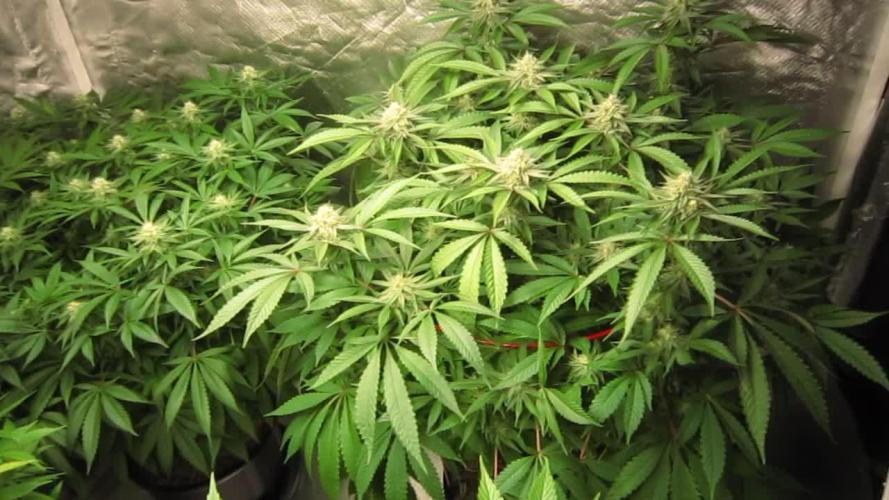
Hello This is the end of week 5 and the beginning of week 6 of flowering. I can smell the diesel on my fingers when I touch the resin, but there is a fruity smell also, maybe dried strawberries. The plant is doing well and growing great. It gets watered about twice a week now. I've got to dump the dehumidifier twice a day now. The rh is starting to climb with the bug buds growing bigger. Might remove a few more big fanleaves from the top and n middle to get better light penetration and air flow around the big buds.. OK. Be Great, Chuck.
Likes
2
Share
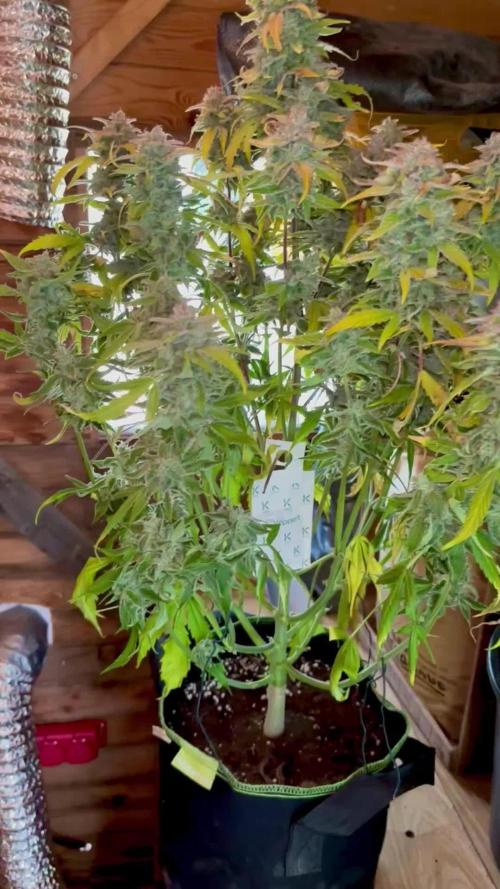
Week 7 - 08/11 - Topped most of the plant so far - LST tied down all main colas - Had an issue with the PH - has since been neutralized - clean water feeds for the next 2 weeks - prepping for transplant into 7 gallon pot. 8/15 - 7 week veg transplant - Myco/Worm castings added to the soil and perlite (60/30/10) - Humidity 85%
Processing
Likes
16
Share
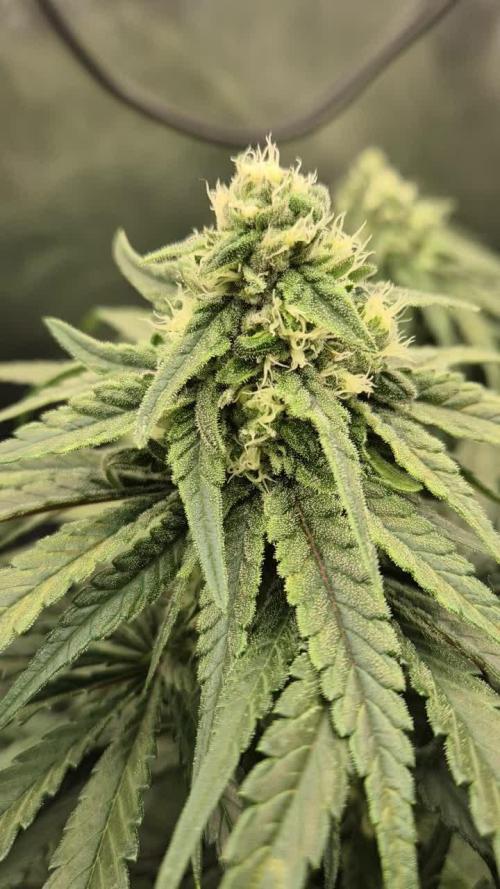
This is my first time growing a kush strain. The growth is explosive. Short and stocky build on this pheno type. I hoping for a great harvest with a tasteful nightcap kind of smoke.
Likes
47
Share
All content on this diary is for inspirational and educational purposes only. The ideas shared are not a substitute for professional advice. This diary/account is not officially affiliated with Alan Watts or his estate. All materials are used under the principles of fair use. I honor the legacy of Alan Watts by sharing his wisdom respectfully and with the intention of inspiring awareness and self-understanding. 2nd net is up. Early bud formations are promising. holding up to the extremes pretty well, some leaves taking minor damage, but overall, she is holding up, gave her 1 night at 50F see how she would react, stressful. Not advised as it messes with her metabolism, but I want to see if it triggers any anthocyanin response. Love to see her purp up but no signs yet. Remember, For every molecule of glucose produced during photosynthesis, a plant needs to split six molecules of water. This process provides the hydrogen needed for synthesizing glucose and other organic compounds, while oxygen is released as a byproduct. Homework. If Rubisco activity is impaired and it cannot properly function or regenerate its substrate, the plant's leaves are likely to turn a pale green or lime green, a condition known as chlorosis. Essentially, Rubisco activity is highly regulated and susceptible to various environmental and metabolic factors that can cause it to become inhibited, leading to an apparent failure in RuBP regeneration due to a lack of consumption. Rubisco regeneration is intrinsically linked to nitrogen supply because Rubisco is a major sink for nitrogen in plants, typically accounting for 15% to over 25% of total leaf nitrogen. The regeneration phase itself consumes nitrogen through the synthesis of the Rubisco enzyme and associated proteins (like Rubisco activase), and overall nitrogen status heavily influences the efficiency of RuBP regeneration. RuBisCO is a very large enzyme that constitutes a significant proportion (up to 50%) of leaf soluble protein and requires large investments in nitrogen. Insufficient nitrogen supply limits the plant's ability to produce adequate amounts of RuBisCO, thereby limiting the overall capacity for photosynthesis and carbon fixation. Maintaining the optimal, slightly alkaline pH is crucial for the proper function and regeneration of Rubisco. Deviations in either direction (too high or too low) disrupt the enzyme's structure, activation state, and interaction with its substrates, leading to decreased activity and impaired RuBP regeneration. (Lime/yellowing) Structural Component: Nitrogen is an essential building block for all proteins, and the sheer abundance of the Rubisco protein makes it the single largest storage of nitrogen in the leaf. Synthesis and Activity: Adequate nitrogen supply is crucial for the synthesis and maintenance of sufficient Rubisco enzyme and Rubisco activase (Rca), the regulatory protein responsible for maintaining Rubisco's active state. Nitrogen deficiency leads to a decrease in the content and activity of both Rubisco and Rca, which in turn limits the maximum carboxylation rate, Vmax, and the rate of RuBP regeneration Jmax, thus reducing overall photosynthetic capacity. Nitrogen Storage and Remobilization: Rubisco can act as a temporary nitrogen storage protein, which is degraded to remobilize nitrogen to other growing parts of the plant, especially under conditions of nitrogen deficiency or senescence. Nitrogen Use Efficiency (NUE): The allocation of nitrogen to Rubisco is a key determinant of a plant's photosynthetic nitrogen use efficiency (PNUE). In high-nitrogen conditions, plants may accumulate a surplus of Rubisco, which may not be fully activated, leading to a lower PNUE. Optimizing the amount and activity of Rubisco relative to nitrogen availability is a target for improving crop NUE. Photorespiration and Nitrogen Metabolism: Nitrogen metabolism is also linked to the photorespiration pathway (which competes with carboxylation at the Rubisco active site), particularly in the reassimilation of ammonia released during the process. To increase RuBisCO regeneration, which refers to the process of forming the CO2 acceptor molecule Ribulose-1,5-bisphosphate (RuBP) during photosynthesis, the primary methods involve optimizing the levels and activity of Rubisco activase (Rca) and enhancing the performance of other Calvin-Benson-Bassham (CBB) cycle enzymes. Biochemical and Environmental Approaches: Optimize Rubisco Activase (Rca) activity: Rca is a crucial chaperone protein that removes inhibitory sugar phosphates, such as CA1P (2-carboxy-D-arabinitol 1-phosphate), from the Rubisco active site, thus maintaining its catalytic competence. •Ensure optimal light conditions: Rca is light-activated via the chloroplast's redox status. Adequate light intensity ensures Rca can effectively maintain Rubisco in its active, carbamylated state. •Maintain optimal temperature: Rca is highly temperature-sensitive and can become unstable at moderately high temperatures (e.g., above 35°C/95F° in many C3 plants), which decreases its ability to activate Rubisco. Maintaining temperatures within the optimal range for a specific plant species is important. •Optimize Mg2+ concentration: Mg2+ is a key cofactor for both Rubisco carbamylation and Rca activity. In the light, Mg2+ concentration in the chloroplast stroma increases, promoting activation. •Manage ATP/ADP ratio: Rca activity depends on ATP hydrolysis and is inhibited by ADP. Conditions that maintain a high ATP/ADP ratio in the chloroplast stroma favor Rca activity. Enhance Calvin-Benson-Bassham (CBB) cycle enzyme activity: The overall rate of RuBP regeneration can be limited by other enzymes in the cycle. •Increase SBPase activity: Sedoheptulose-1,7-bisphosphatase (SBPase) is a key regulatory enzyme in the regeneration pathway, and increasing its activity can enhance RuBP regeneration and overall photosynthesis. •Optimize other enzymes: Overexpression of other CBB cycle enzymes such as fructose-1,6-bisphosphate aldolase (FBA) and triose phosphate isomerase (TPI) can also help to balance the metabolic flux and improve RuBP regeneration capacity. Magnesium ions, Mg2+, are specifically required for Rubisco activation because the cation plays a critical structural and chemical role in forming the active site: A specific lysine residue in the active site must be carbamylated by a CO2 molecule to activate the enzyme. The resulting negatively charged carbamyl group then facilitates the binding of the positively charged Mg2+ion. While other divalent metal ions like Mn2+ can bind to Rubisco, they alter the enzyme's substrate specificity and lead to dramatically lower activity or a higher rate of the non-productive oxygenation reaction compared to Mg2+, making them biologically unfavorable in the context of efficient carbon fixation. The concentration of Mg2+ in the chloroplast stroma naturally increases in the light due to ion potential balancing during ATP synthesis, providing a physiological mechanism to ensure the enzyme is activated when photosynthesis is possible. At the center of the porphyrin ring, nestled within its nitrogen atoms, is a Magnesium ion (Mg2+). This magnesium ion is crucial for the function of chlorophyll, and without it, the pigment cannot effectively capture and transfer light energy. Mg acts as a cofactor: Mg2+ binds to Rubisco after an activator CO2 molecule, forming a catalytically competent complex (Enzyme-CO2-Mg2+). High light + CO2) increases demand: Under high light (60 DLI is a very high intensity, potentially saturating) and high CO2, the plant's capacity for photosynthesis is high, and thus the demand for activated Rubisco and the necessary Mg2+ cofactor increases. Mg deficiency becomes limiting: If Mg2+ is deficient under these conditions, the higher levels of Rubisco and Rubisco activase produced cannot be fully activated, leading to lower photosynthetic rates and potential photo-oxidative damage. Optimal range: Studies show that adequate Mg2+ application can enhance Rubisco activation and stabilize net photosynthetic rates under stress conditions, but the required concentration is specific to the experimental setup. Monitoring is key: The most effective approach in a controlled environment is to monitor the plant's physiological responses e.g., leaf Mg2+ concentration, photosynthetic rate, Rubisco activation state, and adjust the nutrient solution/fertilizer to maintain adequate levels, rather than supplementing a fixed "extra" amount. In practice, this means ensuring that Mg2+ is not a limiting factor in the plant's standard nutrient solution when pushing the limits with high light and CO2. Applying Mg2+ through foliar spray is beneficial to Rubisco regeneration, particularly in alleviating the negative effects of magnesium (Mg) deficiency and high-temperature stress (HTS). While Mg can be leached from soil, within the plant it is considered a mobile nutrient, particularly in the phloem. Foliar-applied Mg is quickly absorbed by the leaves and can be translocate to other plant parts, including new growth and sink organs. Foliar application of: NATURES VERY OWN MgSO4 @ 15.0g L-1 in a spray bottle. For those high-intensity workouts when 1 meal a day is just not enough! Foliar sprays are often recommended as a rapid rescue measure for existing deficiencies or as a supplement during critical growth stages, when demand for Mg is high. Application in the early morning or late evening can improve absorption and prevent leaf burn. The plant was getting a little limey yellow in the centre. Shortly thereafter, she was back in business, green mostly regenerated. The starting point [of creativity] is curiosity: pondering why the default exists in the first place. We’re driven to question defaults when we experience vuja de, the opposite of dĆ©jĆ  vu. DĆ©jĆ  vu occurs when we encounter something new, but it feels as if we’ve seen it before. Vuja de is the reverse—we face something familiar, but we see it with a fresh perspective that enables us to gain new insights into old problems. Confidence is evidence... nothing more. You are confident because you have driven 10,000 times, you are confident because you have spoken 10,000 times. People think confidence is a feeling, but it's not. If you want more confidence, then you need to create evidence, take more shots, collect more data, build more experiences, take more risks; fail, confidence doesn't come first; it is the reward you get for doing the work. no one else wants to do.
Likes
65
Share
@Dendegrow
Follow
Woche 4 bricht an und es lƤuft hervorragend! Die Orange Sherbet bekommt diese Woche frischen Boden: eine Mischung aus Bio-bizz All-Mix und Greenhouse-Feeding, perfekt für die letzten Vegetationswochen und blüte. Zudem hat sich die Orange Sherbet sehr gut mit dem Backhefe-Buttermilch-Melasse-Experiment entwickelt, was zu einem starken CO2-Anstieg auf bis zu 1500 ppm geführt hat. šŸ’Ø Ich bin gespannt, wie sie sich in der neuen Umgebung entwickeln wird. Auf der anderen Seite explodieren die Frozen Black Cherries fƶrmlich in der Hydroponik! 🌱 Die Entwicklung ist beeindruckend, und ich kƶnnte nicht zufriedener sein mit ihrem Fortschritt. Die Blütephase rückt nƤher, und ich bin gespannt, wie sich alles weiterentwickelt! Ich halte euch auf dem Laufenden! šŸš€ Week 4 is here, and things are going great! The Orange Sherbet is getting new soil this week—a blend of Bio-Beth All-Mix and Greenhouse-Feeding, setting her up perfectly for the final weeks of vegetation and . Additionally, the Orange Sherbet has responded well to the back yeast-buttermilk-molasses experiment, resulting in a significant CO2 increase of up to 1500 ppm. šŸ’Ø I'm excited to see how she adapts to her new environment. Meanwhile, the Frozen Black Cherries are absolutely thriving in hydro! 🌱 Their growth has been phenomenal, and I couldn't be more impressed with their progress. The flowering phase is getting closer, and I can't wait to see how everything unfolds! I'll keep you updated! šŸš€
Likes
35
Share
@valiotoro
Follow
A wonderful genetic thank you Fast Buds ā¤ļøā€šŸ”„šŸ¤© The trim was super easy the buds are FAT & FROSTY full of resin 🤤 I’m very happy with the harvest 103g !! For the light i’ve used the Spider Farmer SE-7000šŸ’”
Likes
9
Share
This girl is looking Amazing! I am so excited to see what this plant produces. Does anyone have any tips on what I should do with this plant as far as should I defoliate or "lollipop" it? I've never gone this far before in a grow of photoperiod!?
Processing
Likes
7
Share
@Kushizlez
Follow
(Days 21-28) (Day 23) I like the amount of stretch I’m seeing on practically all the plants. I'm going to lower the light at the end of the week to stop the stretch. The more stretch they get in veg the less I have to lollipop or prune down the road. Makes lst easier too. I’m going to try topping this week. Last time I topped at the 7-10th nodes and didn’t get the best horizontal growth. This round I’m ready to give everything 3 or more toppings, stay on top of training and defoliate much less. This soil looks insane. I should have added a thicker layer of oats because it’s starting to look proper. (Day 24) Got my stuff from the hydro store today and amended my soil again. Next visit I will be grabbing a P booster like bat guano before I enter flower. Today, I got the 2gal pots, some primo worm castings, 5-2-4 insect frass, 0-0-22 langbenite, 1-0-3 alfalfa meal and an exhale co2 bag. Guy at the store said it gets his 4x4 tent 1000ppm+. It takes a few weeks at least for it to start putting out any amount of co2. I got the room sealed and two fans bowing. I fed a compost tea with a little bit of each dry amendment, BSO dry compost, boogie brew base and worm castings aerated for 24h. I diluted it to about 850ppm which still might be a little high. (Day 25) Opened a bottle of EM1 that was improperly stored and it exploded all over me and part of the tent. I wiped off the plants but there is still specks here and there. Cleaned it off and sprayed with method1 pps. (Day 26) Topped 9/15 plants. Will do the rest next week once I see a little more growth. 5 of the bbb’s I started 6 days after everything else so they are still quite behind. I’m going to push the transplant another few days until they recover. Going to start lst after transplant. (Day 28) Transplanting into 1.6gal pots that I thought were 2gals tonight... Depending on how many females I get, they will be going into either 3, 7 or 10 gallon fabric pots. Growth is looking solid so far, zkittlez and the 3 WW’s are leading the pack in terms of growth speed and cotes are yellowing out. I’m pretty sure what I have is a zkittlez bagseed but there is also a strong chance it could have been from some shitty Canadian biker weed. I accidentally misplaced the seed so it’s possible it got mixed up and I germinated the wrong one. Judging by the rapid growth I’d say that’s a fair bet. Biker weed is notoriously fast growing. Either way it won’t be hard to tell once they’re in flower. The white widow is probably going to be a breeze. I’ve heard that’s why it’s so popular too. It’s just a hardy rookie strain with good resistance, decent quality and above average yield. A sure investment. The blackberries are lagging behind but I’m sure they will blow the others away in terms of quality. One of the tunas looks great and the other is a stubby runt. The stubby runt I currently have in flower is killing it right now so I’m not writing it off yet. Can’t wait to see if the tuna god produces some nostalgic smells. Tuna strains are still super popular on the Canadian black market. I plucked the first set of leaves that were starting to appear on each plant. These branches almost always turn to larf and they're so small I can't that stressing the plants out at all this early. If anything, the zkittlez and white widows need to slow down a bit anyway. I’ve been doing a shit ton of research over the past year into what causes weed and cigarettes to have black ashes/poor fire holding capacity. Smoking black weed drives me crazy because it’s all the legal and black market have nowadays. The cigar industry has numerous studies on the cause of ash color and burn rate and apparently it has to do with the ratio of mineral content in the soil/water. Soil/water that is high in phosphorus, magnesium, chlorine and other heavy metals will burn poorly and reduce to flaky black ashes. Whereas soil that has higher levels of potassium and calcium carbonate have thick uniform white ashes with no streaks. Calcium carbonate (wood ash, biochar) can also prevent heavy metals in the soil making them unavailable to the plant. I’m discontinuing my ā€œOrganic cal magā€ as it is full of chlorine which I did not realize when buying it. I’m going to be pretty cheesed if that stuff ruined the burn of my current flowering crop. My dog also found and destroyed my Alaskan fish fertilizer so that’s being discontinued for now too.
Likes
9
Share
@Headies
Follow
So I had a little less nutrient last week then i needed. Def a calcium deficiency. I think it's clearing up but this plant has spot all over it. I changed the water, gave it the right amount of nutrients and a little exra hydrated lime for calcium. Hydro is hard. I hoping It's not sick. I hope It doesn't get the other plants sick. Just a few weeks left.
Likes
30
Share
It's the same height that it was last week but I did top it this week. So she did grow I just cut her back down. I topped and defoliated every plant. I'm trying to form them into canna-bushes. Hopefully I'm doing the correct training procedures to make them all grow that way both indoors and out.
Likes
17
Share
She is going well, topped main & secondary branches ( 2nd topping) & performed some l.s.t. training & mainline training. Thanks to Fast Buds for the cool apparel & FF seeds, my prize for being 1 of 10 winners for November diary of the month šŸ‘
Likes
15
Share
@Autofutur
Follow
She is short and compact.tight internodal spacing.large fan leaves. Typical indica looking plant. Cut of 2 big fan leaves and kept lst as much as possible to open her and create more colas.
Likes
4
Share
Hey y'all week 8 in 3 days and things seems to be going not half bad. There's yellowing going on and I think that's due to me not checking my runoff and not correcting but they are in ranges of 6.4 to 6.8 ehhhh I know. But won't let that happen again. Besides that have you seen the frost on these lady's so far, especially for Pheno 1 she is super frosty and has a nice šŸ‡ šŸ‹ smell that keeps getting better by the week. Pheno 2 smells like lemon citrus and Pheno 3 has a nice šŸ§€ šŸ‡ smell going for her. Pheno 4 on the other hand is very subtle at the moment but I'll keep my fingers crossed. Till next week growmies Happpy growing y'all šŸ¤™āœŒļø
Likes
19
Share
La planta aun estÔ en pleno estirón del inicio de la floración, por lo que tengo que ir cropeandola casi a diario para mantener una altura homogénea en las ramas y que no se estire demasiado. EstÔn comenzando a formarse los primeros brotes, aun no tiene un olor intenso pero ya huele a haze y eso es maravilloso... aun le quedan meses de floración pero ya tengo ganas de fumarmela.
Likes
3
Share
The girl is hungry and asked for 5 liters watering. (1200 ml has flowed through)šŸ˜‹
Likes
25
Share
Currently checking daily and tying away branches/leaves to give the buds more light and watering when the soil is dry. Currently my plants drink exactly 1,5L a day. I have the feeling that the right plant is lacking a bit of potassium. I'll leave everything as it is for now because the left plant (fresh new soil) is growing well. Since the right plant is quite bushy anyway, I'll defoliate it again later and remove any lower shoots. I started adding the Bio PK booster towards the middle of the first week of flowering, 2ml per liter of water; as the pH value drops too much, I correct it upwards with Biobizz pH up - from pH 5.5 to 6.5 for 3L, I add a total of 39 drops. My water is mixed as follows: 3L osmosis water, plus 6ml CalMag, 6ml BioPK 5-8 and 39 drops of pH + BioBizz.
Likes
27
Share
Bonus material- my cannabutter pics. No smoke report for a while but I can give you an edibles report in a few hours šŸ˜‚ Plant #1 suffered gravely and thus was harvested early, dried, and turned into beaaautiful butter/edibles hehe. The rest of it is box drying and I'll be doing the same with that. The top of the plant (first harvest of sorts, after bud rot discovered) was 49g dry, not inc ofc what was binned. I'll let you know the dry weight of the rest but no point giving you a smoke report. She was cut early and suffered a looooot The purple lemonade began as the underdog and quickly took over as my #1 babe. It was far more resilient to environmental conditions and changes- and let's not forget that they went through a hurricane with me and power out for a few days! I don't find her strong on the nose at all despite how big some of her buds are, and how frosty. Very piney, and that dominates everything else. Very excited to see what terps come out more in the cure though- I hear great things about this strain. She was cut today and is hanging in a dark closet with small fan, RH 65% and temp 22c. I did not take a wet weight, but she's heavy. Super looking forward to smoking this one, after a few more weeks of TLC... Sigh. Always we try to wait haha. I will report back when I have more for you all. Thanks to everyone that answered my questions and supported me through my first grow. I've definitely got the bug now and there'll be no stopping me haha Will be back with smoke report and dry weights laterrr šŸ‡ØšŸ‡¦ --- Nov 12 - Plant dried for 6 days. It is a lot airier than I thought it was going to be, so most of it ended up as shake for edibles or something. I ended up with 38g of big bud, 33 of smaller, and over 40g of larf and shake. Even the big buds are airy though, not dense at all. A little disappointing for sure, but I made a lot of mistakes so it isn't a surprise. It is now in jars with humidity packs and I'll report back in a couple of weeks or so with a smoke report :)
Likes
12
Share
All round the grow went well first time grow the forbidden runtz and I'm pretty happy about it.