


Likes
Comments
Share

@Stoney_Stark
Follow
Sticky Mango Auto — Week 4 Update
Grower: Stoney Stark / Little Lilly Farms
Stage: Late Veg → Early Flower Transition
⸻
Growth Overview
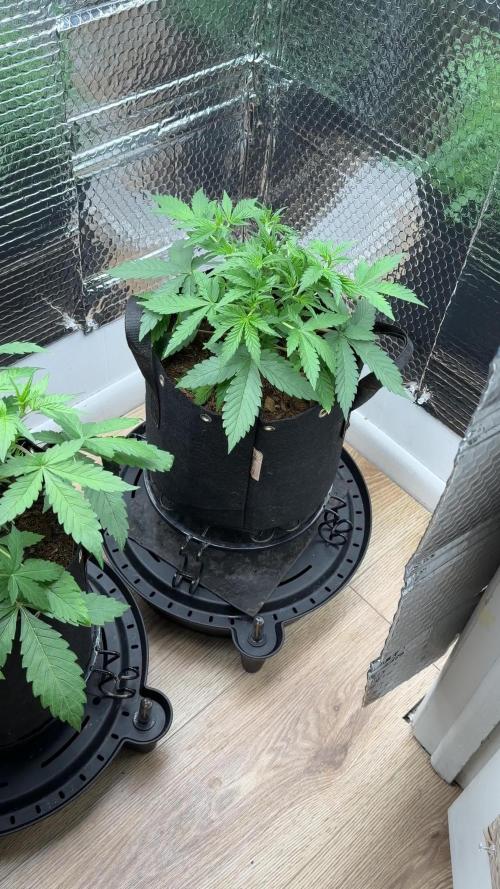
By Week 4, a noticeable size difference has developed between the two plants. One plant is nearly double the size of the other, while the smaller plant has entered early flower first, showing visible white pistils. This staggered development is not uncommon in autoflowers and appears to be influenced by early root-zone moisture differences.
The larger plant remains in late vegetative growth, while the smaller plant is clearly transitioning into flower.
⸻
Moisture Management & Wicking Adjustments
2/1
Signs of overwatering observed. Pots were placed on stands to remove them from the wicking rope and mat. The absorbent pad was removed from the pot showing more stress, while the healthier plant remained on the mat.
After ~11 hours, both plants were returned to their wicking material.
2/2
Plants continued to show signs of excess moisture. Both were again placed on stands to fully disconnect from the wicking ropes.
2/3
Decided to extend dry-back by another 24 hours to allow the root zone to re-oxygenate.
These adjustments helped slow water uptake and encouraged healthier root respiration before flower onset.
⸻
Flower Initiation
2/5
First signs of flower observed — white pistil hairs visible.
2/6
Smaller plant clearly showing pistils. Both plants were low-stress trained by tying down branches to open structure and manage height differences.
⸻
Feeding Log — 2/6
• Total volume: 1 gallon (split evenly)
• Amount: ½ gallon per plant
• PPM: 877
• pH: 5.9
Nutrients (per gallon):
• Armor Si — 1 ml
• Micro — 5 ml
• Grow — 2 ml
• Bloom — 4 ml
• CaliMagic — 1.5 ml
• Floralicious Plus — 1 ml
⸻
Nutrient Strategy & Purpose (Week 4 Transition)
Armor Si (Silica)
Used to strengthen cell walls and improve stress resistance. Especially important here due to recent moisture stress, training, and the upcoming stretch phase.
Micro
Provides essential micronutrients (iron, manganese, zinc, copper) that support chlorophyll production and enzyme activity. Keeps growth balanced as the plant shifts metabolic focus toward flowering.
Grow (Reduced)
Nitrogen is still needed, but at a lowered rate. This supports continued leaf function without pushing excess vegetative growth, which can be counterproductive once flowering begins—especially for the smaller plant already showing pistils.
Bloom (Increased)
Phosphorus and potassium are ramped up to support flower initiation, root signaling, and early bud site development. This helps both plants transition smoothly despite their size difference.
CaliMagic
Calcium supports cell division and structural growth, while magnesium is essential for chlorophyll production. Critical in coco, especially during stretch and early flower when demand increases.
Floralicious Plus
Provides organic acids and bioactive compounds that enhance nutrient uptake, improve root efficiency, and help buffer stress from training and environmental adjustments.
⸻
Notes Going Forward
With one plant entering flower ahead of the other, feeding will remain balanced but conservative on nitrogen while continuing to support early bloom development. Moisture management will stay a priority to prevent further root stress and ensure a smooth transition into full flower.

Likes
13
Share


@Xelxz
Follow
ºDay 57 (03Dez) - Start of week 9, 16th watering (1st nute), 4rt video;
ºDay 60 (06Jan) - 17th watering (2nd vegNute);
ºDay 63 (09Jan) - 5th video, end of week 9;

Likes
218
Share


@ClubRiot
Follow
Start week 4 , Bio Grow 2 ml/L + Alg-A-Mic 1 ml/L + Sensi Cal-Mag Xtra 1.5 ml/L (Ph 6.3).

Likes
Comments
Share


@UrbanBoer
Follow
I would be lying if I knew how far her flower phase come, this couple weeks been absence only gave me results, and left me with a catalogue nightmare, but thank goodness my previous posts are dated, so it gives a rough idea, but genes differ within strains, some strain grow vigorously at certain stages, and I think this baby hit her phase. She will be my best tree when it comes bud quantity, when it comes to potency, I will have settle with what I encounter and except the outcome.
Likes
4
Share

@Grasshopper96
Follow
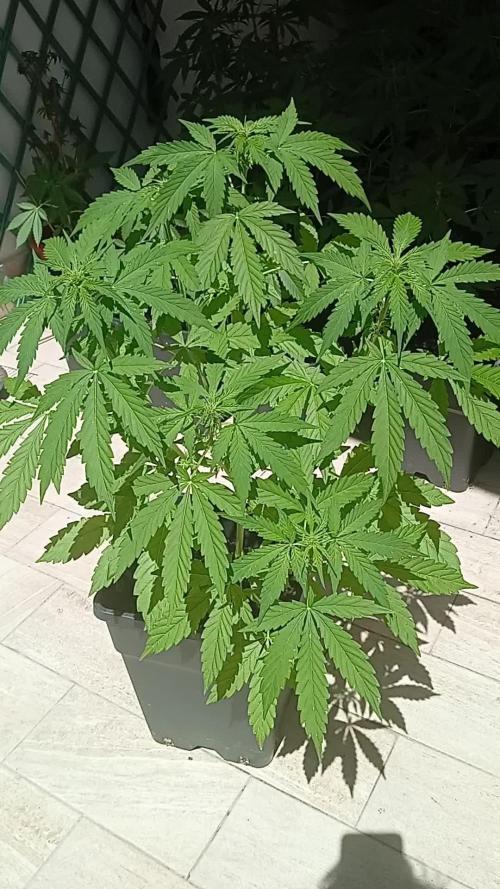
Let's start flowering oh my peshmerga squad, thiss Is a Hope for free and indipendente Kurdistan,and peace in mid orient than ukraina, when a run start to flower i belief most , the flowering of weed Is a message of peace older than man and woman 💛
I decide: thiss morning i do pooja to Shiva for the peace in the Word for the frist time, no for me but for all the Planet, this afghan kush grow up me?! And my Spirit?!
PS the photos are picked saturday, tomoroow i do Better photo

Likes
8
Share


@artems
Follow
The Scrooge has really impressed me! Despite minimal training and almost hands-off approach on my part, the plant has turned out incredibly robust and beautiful! 🌿 So far, there's no sign of the minty aroma, but I'm looking forward to drying and curing to see how the flavors develop. 🍃 It's been a rewarding journey watching this plant grow, and I can't wait to enjoy the final product! 🌟 Overall, it's been a lesson in patience and observation, and I'm grateful for the experience. ✨ All the best to everyone! 🌿

Processing
Likes
15
Share


@CannabisAprendiz
Follow
Hola con esta semana ya quedamos al dia con el seguimiento ya que estaba atrasado en el tiempo. Se nota una producción de resina notable en esta genética que nos ha gustado mucho por su olor y estructura de las plantas .
hemos creado un video por cada una de las 14 plantas del seguimiento, hay varias muy llamativas que están "pre-seleccionadas" para mantener a futuro, el olor que se llega a sentir es muy florar y dulce, si tienen alguna pregunta no duden en preguntar saludos.
Hello with this week we are already up to date with the follow-up since I was late in time. There is a remarkable resin production in this genetics that we liked a lot for its smell and structure of plants.
We have created a video for each of the 14 floors of the follow-up, there are several very striking that are "pre-selected" to keep in the future, the smell you get to feel is very flowery and sweet, if you have any questions do not hesitate to Ask greetings.
Processing
Likes
8
Share


@Yiyis_Grow
Follow
Estas 6 plantas sobraron de 15 esquejes que hice para regalar (mis primeros esquejes) . Quizá mis amigos no las escogieron porque eran las más débiles y feas, pero en vista que nadie se las llevó, vamos a sacar algunos gramos.
Ellas viven con 12 horas indoor y 6 horas de mal sol interrumpido, quizá por esa razón se han espigado tanto esta semana. En todo caso, solamente voy a dejarlas 1 o 2 semanas más en vegeta y luego a florar y ver cuánto me dan.
Son esquejes AK47
Buenos humos


Likes
16
Share


@ButterfliesLittleFarm
Follow
Hello Diary,
The first week of vegetation on my little farm has ended. I'm a little late in updating the diary, but I'll try to change that.
After the plant has received 4 leaves, the vegetation phase officially begins.
In the case of Cherry Pie, it is 9 days since I planted the seed in the ground, or 5 days since the plant sprouted.
Cherry Pie has been growing beautifully since the beginning, you can see a drastic difference every day.
I have put photos on the 1st day of vegetation and the 7th day of vegetation and the difference is obvious in those seven days.
Cherry Pie - Day 1. - 3.5 cm
Cherry Pie - Day 7. - 7 cm
Conditions on the farm are not ideal.
I still suffer from the unbearable summer heat, which also affects the temperature in the apartment.
When I add Migro Aray 4 to that, the temperature sometimes reaches 32 degrees.
I don't see that it has a bad effect on the plants, but I would like it if the temperature were lower.
The lights are now set at 35 cm from the plants and are dimmed at 40% of their power.
Watering is every three to four days.
I prepare about 4 liters of water, add 1 ml/L Calcium and Magnesium supplement and this week I started adding Bio Grow Fertilizer, a new product from RQS.
After all, I lower the pH to 6.0. and with that amount I water all three plants on the farm.
Here's a quick recap of the week.
25/07/2024 - Day 1.
The official start of the vegetation.
After photographing the plants, I watered them. I still put the seed booster in there, also a new product from the RQS organic fertilizer collection.
28/07/2024 - Day 4.
Watering.
I prepared 4 liters of water again, added Calcium and magnesium supplement, Bio Grow Fertilizer and finally lowered the pH. with Lemon Kick.
31/07/2024 - Day 7.
End of the first week of vegetation. Taking photos and after that I watered all three plants on the farm.
Cherry Pie - Day 7. - 7 cm.
That's all from me for this week, see you soon.
Likes
4
Share


@JacareGrows
Follow
Unfortunately is the end of this diary.
I found today why the leafs lost their color so fast. The fucking spidermites 😢😢
It was just one plant not so bad. But she was Smelling so good, i was dreaming with her and now she is dead.
Processing
Likes
8
Share


@ThatoneAKguy
Follow
Well what a week indeed. I left for work and my assist got sick and was unable to check the ladies on a very critical day for coco and missed a feeding and the roots went dry for a split second. That was enough to put them behind where I wanted to be but luckily we didn’t lose them all together. How quickly it can happen when they increase their water uptake! But all is well that ends well and these 3 ladies are on track to go to flower in a week.

Likes
7
Share


@Organic473
Follow
My first time growing this strain. One new seed hack for glass of water method “leave seed floating on top for longer tap root in record time”. Use warm water for best results.

Likes
6
Share


@DE_BW
Follow
The plant is now in the final ripening stage and is clearly approaching harvest. Bud development is fully complete, with swollen calyxes and no further vegetative growth. Most pistils have darkened and receded, while trichomes are predominantly cloudy with the first signs of amber appearing. Resin production is very heavy, showing strong frost and deep purple coloration alongside a natural fade of the fan leaves. Feeding has been reduced to support a clean finish, with the next 7 days focused on controlled ripening and terpene preservation before harvest.
Likes
80
Share


@Fatnastyz
Follow
3-17
Photo bombs today 😂😂
Gave 4ml green sensation, 3ml cal/mag and 1 ml slf-100.
Run off ppm 1300 ph 7.0
Hope can get the ph down a bit.
3-21
1.5 grams game time, 3ml green sensation, 3ml cal/mag, 1ml Slf-100 ph 6.0 ppm 350
Runoff 1432 ph 6.9
Yo, dropped 1 💪🤘
See ya next week
Likes
Comments
Share


@Anonimo88
Follow
The flowering it's started and the vegetation is nice.
Other coffe and light mix, added grid for scrog and new lateral lamp 4 watt.
Likes
72
Share


@BodyByVio
Follow
Day 65 : officially 1st day of flush . Changed the reservoir with fresh water and 1.2g/5 gallons of Yucca extract and 5ml/gallon of Cleanex from Botanicare .
Day 68- I did some defoliate. Few more days until harvest.

Likes
14
Share


@MaxMo8
Follow
Hello friends, this week is interesting, busy and even enthusiastic. I put compost tea for all of them, wish you happy days

Likes
79
Share


@JUNGLE_B4RNS
Follow
-Sensi Seeds Research:
The Sensi Seeds Research breeding project has created eleven cannabis seed varieties. How? By combining new cannabis cultivars with a selection of strains from their long-established cannabis gene bank.
For the first time in thirty-six years, they are opening the doors of the Sensi Seeds Research and Development Department.
Week 8 finished, this is where Vegging longer Indoor starts to become a waste of time,energy and money, you can go for another last week if needed but any longer than 9 weeks makes no sense !
By the way there’s just enough space left between top of canopy, the lamps, and ceiling for the Flowering stage ( keep in mind that the plants will stretch about twice in size during the stretch phase ), meaning it’s really the time to switch to 12/12 ( otherwise the plants will finish too close to the light ).
For now on, the genetics are excellent, even the Black Domina didn’t mind to be topped. Seams like everyone is suitable for the ScrOG method, almost every holes are occupied by a shoot, the trellis is full at around 90 to 95 % , at least all the light coverage is used which is the main goal to reach !
Had to fed them on the 24/08 and watered them on the 27/08 to keep the soil moist but not dampened ! It’s Ganja, not water lilies in a swamp !
Unfortunately, there’s no perfect schedule for watering plants. The quantity needed by cycles depends on the size of your pots, the size of your plants and the environment, and the rule is the same for the period between two cycles. This is where you can be the only judge and you must learn to read your plants leaves (overwatering symptoms: droopy leaves with some kinds of speed bumps between the veins).
So technically, this is where if you work in a Grow Operation, the Boss is happy, you’re killing it with just two conventional 600w fixed on large wings and no professional lightening equipment like Gavita’s 😎
Stay tuned folks, just hit the like button and subscribe for the incoming Stretch and Bloom stage 😉
(I’m looking for a job in the Cannabis industry as Master Grower, Mineralogist, Quality Control 🐞)
Likes
16
Share


@Jazzvet
Follow
Very good week. The plant has grown up well, I keep doing the LST and it gave me 4 new tops, unfortunately I broke one.
There are some yellow tips on the new leaves, I don't know why, maybe heat stress or some nutrient deficiency, so I gave the girl bio grow for the first time, 0.1 ml per 1L for start.
See you next week.
Happy growing
Likes
11
Share


@AestheticGenetics
Follow
3/28/25 chopped and humidity was a little high starting off
3/30/25 have them drying at 60% and 70°
4/3/25 Still needing a day or so of drying to be at a stable humidity
Beautiful plant. Fan leaves with Triched out patterns visibly everywhere.
Even though i chopped quite a bit off of the plant, i still got quite a bit bigger yield than i expected. All sizable nugs.
Pulled 65 grams.
Likes
38
Share


@TrueNorth
Follow
SO UPDATE! OCTOBER 3rd 2019 finally dry in thee herbs now drier and i bought a new scale cause it seemed off not even an ounce wet! TURNS OUT 57grams dry!!!! Wooo!!!!! Spoke with the owner of herbsnow did some reverse calculations and the wet number was 69.6 WET. What a disaster
GREAT SMOKE GREAT HIGH
