


Likes
Comments
Share

@GoodTimesOrganics
Follow
Welcome Back!💚
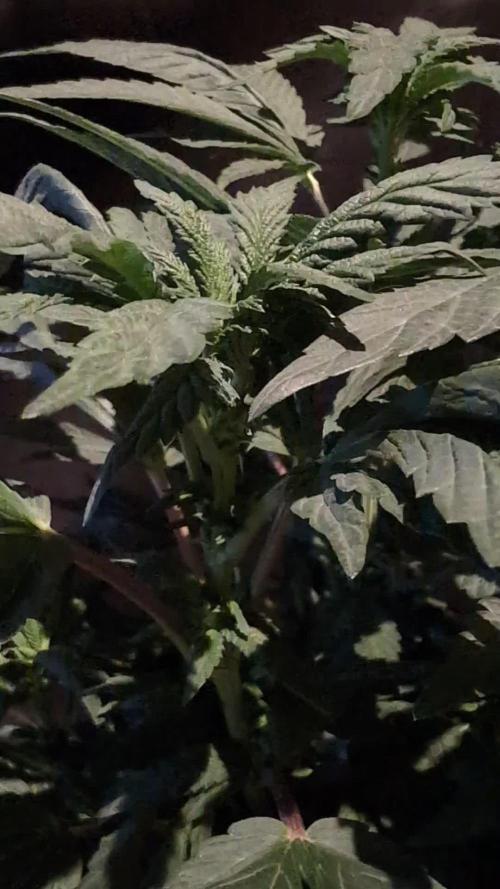
Nach der ersten Blütewoche sieht man bisher kaum etwas an Blüten/Stigmenansätzen. Sie ist bisher echt der krasseste LowGainer, den ich seit ich Growe gesehen hab.
Bisher muss ich leider sagen dass mich die Genetik hier etwas irritiert.
Mal schauen ob die Pflanze in der Blüte noch was reißt 😁
🙈
Die Umgebungsgegebenheiten sind top:
—————
🌞 Temp: 23°C
🌚 Temp: 18°C bis 19°C
💨 RH: 51%
VPD: 1,05 kPa
😎 PPfD: 630 mqm
—————
Viele Grüße 👋
Likes
15
Share
@GoodTimesOrganics
Follow
Hi liebe Community and Welcome Back! 💚
Woche 10 (Tag 80) im Vergleichsgrow!
Bio Tabs NL. vs. Weedefix (Stuttgart/ Germany)
Hier im Bio Tabs Grow haben wir nun nach 80 Tagen des Einpflanzens eine Höhe von 120cm erreicht.
Der Stretch ging nur bei der Bio Tabs Pflanze so steil. 🤷
Daher habe ich den längsten Haupttrieb gecropped, das bedeutet einfach etwas abgeknickt, dass er gleich hoch bleibt, da mir sonst die Höhe ausgeht.
Blütetag: 35 (BW5)
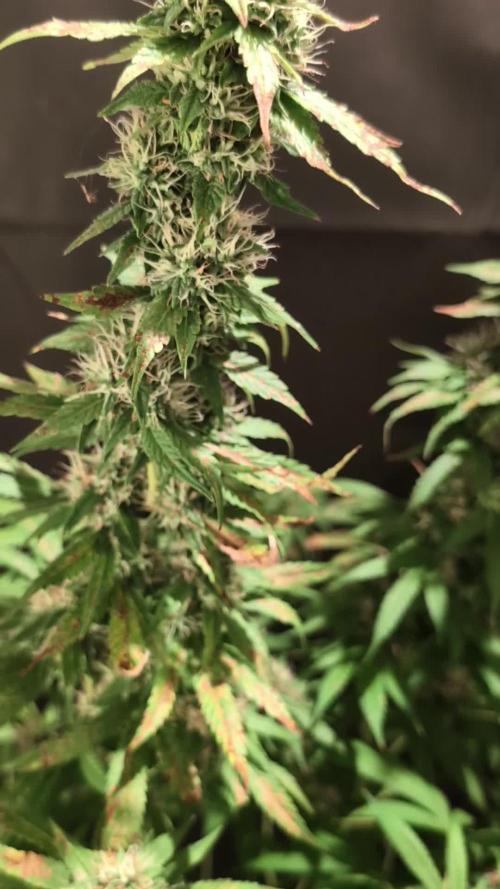
Nach der vierten Blütewoche, lässt sich eine etwas differenzierte Performance der beiden Düngersysteme beobachten.
Achtung Plottwist.
Bei der Bio Tabs Pflanze treten dass erste Mal überhaupt Schwierigkeiten auf.
Es bilden sich nekrotisierende Punkte auf der Pflanze.
CalMag Defizit ist ausgeschlossen!
Ich vermute eher ein leichtes Wurzelproblem. Daher lass ich die Erde nun etwas mehr abtrocknen.
Komischerweise ist dass Problem nach der Zugabe des Komposttees aufgetreten.
Der war allerdings wie gewohnt 🤷 daher gerne Erfahrungem hierzu.
Ansonsten nur Wasser.
Die Bedingungen im Growzelt sind aktuell wieder in Ordnung!
—————
🌞 Temp: 26
🌚 Temp: 18°C bis 19°C
💨 RH: 62%
VPD: 0,74 kPa
💡ppfd: 630 mpm
—————

Likes
11
Share


@CocoLogic
Follow
August 30th: (F13)
Fertigation once a day with same recipe (1150 EC 6.1 PH) watered until 10-20% run-off
August 31th: (F14)
Fertigation once a day with same recipe (1150 EC 6.1 PH) watered until 10-20% run-off
Sept 1st: (F15)
Fertigation once a day with new recipe (Mid-Bloom)(1200 EC 6.2 PH) watered until 10-20% run-off
Screwed each QB Board to the roof of each tent to gain some height space
Supercropped two branches on the TUT
Sept 2nd: (F16)
Fertigation once a day with same recipe (1200 EC 6.2 PH) watered until 10-20% run-off
Sept 3rd: (F17)
Fertigation once a day with same recipe (1200 EC 6.2 PH) watered until 10-20% run-off
Sept 4th: (F18)
Fertigation once a day with same recipe (1200 EC 6.2 PH) watered until 10-20% run-off
Sept 5th: (F19)
Fertigation once a day with same recipe (1200 EC 6.2 PH) watered until 10-20% run-off
Defoliation on both plants
Note: Im happy the TUT stretch is finally over, we are on the extreme limit on the light distance from plant in the TUT tent, I don't see any stress sign so far, will have an eye on this for sure in the next week! :)


Likes
26
Share


@ButterfliesLittleFarm
Follow
Hello Diary.
The first week of flowering is behind us. The plants grew to almost 1 m. and I had to attach the lights to the box itself because the height of the box of 178 cm is not enough to maintain a distance of 35 cm from the plant itself. 😟
Unfortunately, their roommate, the Green Gelato Automatic is now too far away from the light, although I raised it, it is still some 50cm away.
Earlier in the week, I changed the light regime to 20/4, four hours of sleep from the start of flowering.
I started giving BioBizz full range for the first week of flowering. They began to be more thirsty than before, which is not surprising given the height of the plants. They are very elongated, especially when compared to the Green Gelato which remained small and dense.
I started adding Cal-Mag, preventively, since I had a shortage of Cal-Mag with Somango and Royal Haze before.
The temperature is higher than I want, around 27-28 degrees, but it’s summer, it could be a lot worse. That’s the advantage of Led lights, and the Migro was a great choice.
Humidity in the air is about 50-55%, which is currently good.😀
The tips of the upper leaves are intensely yellow, I sincerely hope it’s a little stress due to the heat, or is it something else, we’ll see.
Otherwise the plants look satisfied, there are no signs that they are missing anything. I hope it doesn’t grow too high anymore because I will have a problem like with Mother Gorilla in an earlier grow.
The leaves are not too dense so the light reaches the lower branches to some extent, but I am planning a small defoliation next week.
10/07/2020 - Day 22.
I changed the light regime to twenty hours of light and four hours of sleep. It was also watering day. They got the full range of BioBizz for the first week of flowering. I prepare 9 liters of water each time in which I put BioBizz, p.H. I regulate with Plagron’s, Lemon Kick and as of this week I’ve started adding Cal Mag preventively. With that amount of water, I water all three plants evenly.
12/07/2020 - Day 24.
Watering. The procedure is the same as the previous times. This time I also filmed the way I do it.
15/07/2020 - Day 27.
Watering. Same 9 liters as before, with full BioBizz and preventive Cal-Mag.
16/07/2020 - Day 28.
Photography and filming.
That’s it for this week, I hope it will still be all right and it will stop growing in height :). See you next week.

Likes
44
Share


@Chedderbob112
Follow
Here’s some other shit that’s Hapnin waiting for some to sprout 🌱 and got some in glass water 💦 and the clone wae roots


Likes
27
Share


@Dunk_Junk
Follow
Wow she's frosty!!!??!?!!
Did I mention that before? 😁 😂
Trichomes going cloudy now.

Likes
6
Share

@TrickzGrowz
Follow
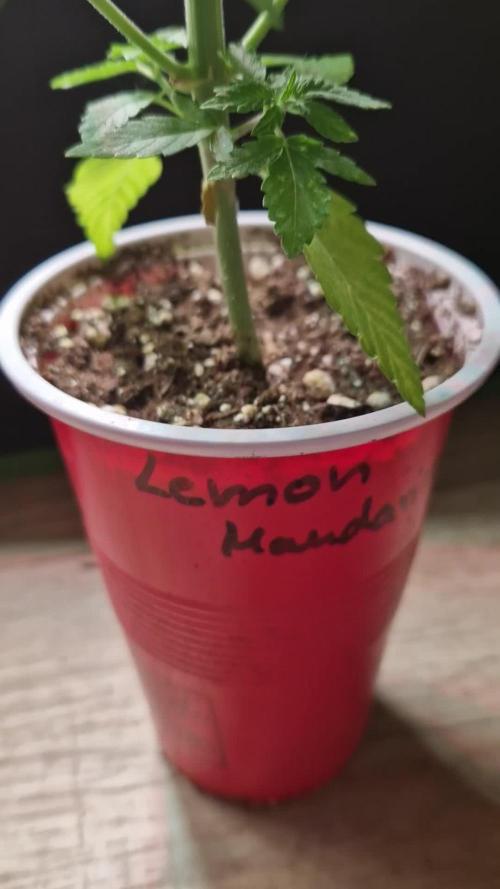
Getoppt um Platz zu schaffen, da mein Wachstumszelt nur 40x40 cm hat. Jetzt kann Sie schon einmal neue Triebe ausbilden.
Likes
9
Share


@masterofsmeagol
Follow
6/8 Haven't had to water yet (besides the two tens and I should've held off). It's an overcast day. Perfect for the plants. I've noticed more off shoots of 3 pronged leaves so a few plants will reveg but thats fine. I'm happy with how things are going thus far. These are certainly very resilient strains. I've done some SLIGHT LSTing.
EDIT: IT'S BEEN A NICE DAY TODAY. A LITTLE OVERCAST BUT SUNNY AT TIMES. PERFECT WEATHER FOR THE GIRLS. THEY ARE LOVING IT OUT THERE!
6/9 And the girls are lookin' Fiiiiiine. In all seriousness everything is doing pretty good. Even that overwatered pink kush runt in the 10gal is coming out of its little funk. Some of my FIM's turned out amazing! With the reveg of some of these I'll definately have my hands full. Very grateful for smart pots and well draining soil! We've gotten some harsh rain but the girls all seem fine. It's the wind today that's a little worrisome. I may stop over later. I COULD put up tarps around the cage as wind blocks (and have before in the past) but it increases the humidity of an already extremely humid day. These girls are strong. I'm sure they'll be fine. I've found that the tarps typically hurt worse than they help.


Likes
7
Share


@Huntablunt
Follow
Hi guys and welcome to Week 7
As you see, the small plant really suffers and I really dont have no clue anymore whats really up. So she needs to go through like this. Signs of overnutrition cant be possible with the ec the drain has. As mentioned the ph was increased, thats why I flushed, but anyways. Compared to the other two she really doesnt seem to like these circumstances.
Next run I really am goint to measure everything three times,lol.......I really dont know what the actual problem is now. Anywys the small plant stretched a bit and gained also a bit of buds. The other two are showing interesting colours. One will turn quite purple, the other seems to develop slight red tones. I am curious when they will really explode and really hope they dont had too much stress with that.


Likes
15
Share


@Homegrown93
Follow
160 days of life harvested on day 63 of flower. I don’t have photos of her vegging but she started off great. About two weeks in, she started having some major issues. Her leaves started atrophying, curling up at the borders, growing 3 finger leaves, all new growth was deformed and twisted and growth in general almost stopped completely, to what I suspect was from broad mites. These fuckers are nasty! I dm’d my local grow shop and tried out some Neem Oil. I diluted it in water like they recommended and sprayed that baby every day for one week, then every other day the following week, then down to once a week. I sprayed her leaves stem and surface of the soil. I also cleaned the entire grow space with some bleach solution. Doing this allowed her to really bounce back, growth started to take off again! So I vegged for a few more weeks and trained her as much as I could to keep her uniform but short, she responded well to this. During flower, she was very happy. I had two main issues during this time, one was being too hot in Nitrogen and a week of very hot temperatures which burned her a slight bit, although she didn’t seem to mind much. I also could’ve continued a once a week spray of Neem oil because I think they might’ve started to come back on the lower and younger leaves that weren’t getting much light. Overall it was a dope grow and hope to do better on the next one!


Likes
4
Share


@The_Doctor_Green
Follow
Buenas a todos! Esta semana solo regue con trico más por última vez, aguardando que estén listas para cortar, solo se regara con agua.
Utilice 1gr x litro de agua de trico +(Con un ph 6.8) , las ppm no las controle, lo que si debo reconocer que la planta al estar controlada en altura si noto que la cantidad de flores no será igual que su antecesora del diario anterior.
Pero para alguien que no quiere que la planta no se haga alta, es una buena alternativa, ya que con la malla a 70 centímetros del suelo, en altura total no debe pasar los 120 cm( la medi y tiene en su copa más alta, 116 cm)
Likes
60
Share


@m0use
Follow
The time has come! Flowering has been initiated and is off to a good start,
The Photoperiod is now running at 11/13 on/off and the intensity of the light has been bumped up to 60% giving me a DLI of aorund 37.5 at 30" hang height in my 2x4.
As the plants where topped a bunch I have found in previous grows the stretch will not be as crazy as if I left them on their own, however the increased pot size may negate that effect, only time will tell :D I also gave them a 2nd watering as the last one was leaving the pots a bit to light. This could be their new normal 1gal one week, 2 gal the next separated by a few days.
They have all been amended with a 50/50 mix of grow and bloom from Gaia, Also added in some extra Insect Frass, Yeast and Bokashi grains, mixed this all with worm castings and compost for the top dress. added the compost after mixing it into the top layer so it gives it a bit of a blanket. made a little video of it and me watering the plants on a speed run. One thing I need to find is a sprayer head that has a 70-90 degree bend on it. I'm tired of watering from overhead as my wand is straight and does not have a bend. Its made of hard plastic and was thinking I would toss the tip in the oven to soften it up and place a coat hanger though it, then bend it ever so slightly and wait for it to cool, can snip off the wire and pull it out once its all done and have a bent tip. or I can get a 2nd wand attachment for it. Just been so busy have not had time to search for it,
the peppers are doing much better as well, after the defoliation from last week they where getting a bit more light but that is all gone now, the plants have taken it back. and they are in shade, the plants seem to like it more. only the one strain likes the intense light of the led's, Fatalii peppers, It might be the hottest ones I'm growing if the goronong don't measure up. The JigSaw peppers are also starting to show some of their variegation in the leaves that make them pretty to grow now they are in the shade more. and its bound to be better then pure purple leaves from the LED"s Butterwort is eating all the gnats as well. so no problem there. Will apply the nematodes later next week to kill em off in the medium. Don't want them getting trapped in the flowers. stupid little fuckers.
I left out some of the extras in the water this week as it was its first topdressing, didn't want to stress it out to much, I will be topdressing every week and diving the total ammount of amendments in 4 parts. vs one big feeding at beginning of the month like its been suggested on the label, I find this helps avoid the N burn I normally see and gives them a bit better of a breakdown for flowering period. It worked really well with my G13 Labs Blue Cindy grow so I am repeating the process and will likely make this my new standard. I will also be adding in some Mg into every other water till stretch is done same with a very light feeding of molasses, I know it has been negative in past grows but going to try it out again with much smaller amounts. 1tea/pot, the extra sugars should work wonders on the Bokashi added into the soil and allow it to thrive.
Plants are starting to get more of a funk to them as well, So i feel that's what was happening with the gifted plant to my parents smelling up the place, it was just entering flowering as it was not in a tent n the lighting must have been to low. And the little cuttings I did last week are fine, no roots but will soon have a bunch of little clones to go. Just in time for spring.
I think that's it.
Big shoutout to Medic Grow for sponsoring the lighting in my tent, They have provided me with 2x Mini Sun 2's in the 240w configuration, They use the v1 growing spectrum that is a all purpose seed to harvest spectrum so their is no hassle of switching it mid grow. If you interested in learning more about Medic Grow products please visit the web link below.
https://medicgrow.com/
https://growdiaries.com/grower/MedicGrowLED

Likes
116
Share


@bioaccessory
Follow
Как и ожидалось, растение резко увеличивается в размерах, надеюсь я всё правильно расчитал. Идея с кольцом мне всё больше нравится, как только растишка войдет в активную стадию цветения — сделаю дефолиацию.
30/03 PH7,0 PPM860
31/03 PH6,9 PPM790
01/04 Дал Delta9 по листу.
Откалибровал PH-метр, оказывается я невольно кислил компот, а буфер возвращал показатели до нормального значения.
02/04 PH6,1 PPM858 Сделал дефолиацию.
03/04 PH6,0 PPM940
05/04 PH6,1 PPM744
За прошедшее время в моём гроубоксе появились: 3 маленьких горшочка - проращиваю чили-перцы, 2 больших кирпича - в случае необходимости готов опустить на них горшок, а это плюс 10см высоты. В первый раз в жизни покупал кирпичи.😕
Открываю новую рубрику "а знаете ли вы, что":
Green Gelato — Soft Secrets award winner — voted “Best New European Strain for 2019” Grow Champions! 💪
👉Планирую сделать интересный досвет низов по периметру, оставайтесь на связи.
Спасибо, что заглянули, и будьте здоровы! 🙏
Продолжение следует ...😶
Likes
20
Share

@Roberts
Follow
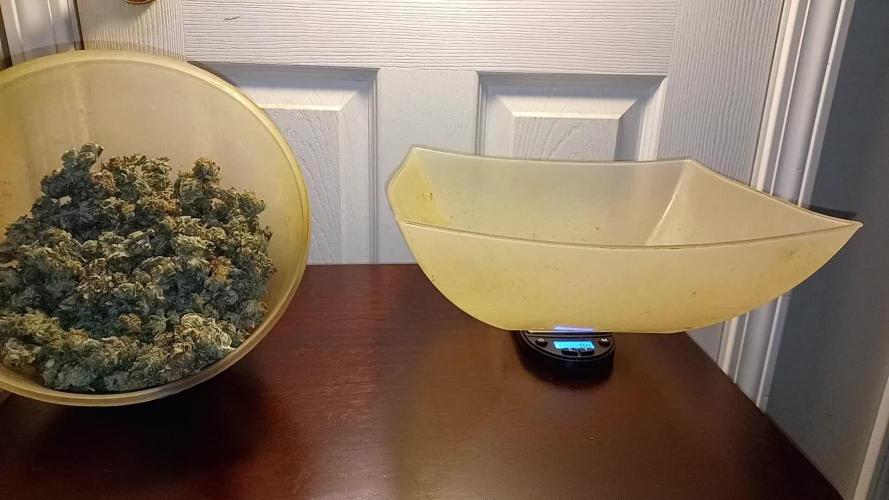
Tangerine Band grew excellent. She was the biggest plant in the run of 4. She grew vigorously and has some really frosty colas on her. She actually got too big for my grow space. I am cutting her down today and everything looks great. Thank you Exotic Seeds, Spider Farmer, and Athena nutrition. 🤜🏻🤛🏻🌱🌱🌱
Sorry my video cut off mid harvest and I lost the last half of the
Thank you grow diaries community for the 👇likes👇, follows, comments, and subscriptions on my YouTube channel👇.
❄️🌱🍻 Happy Growing 🌱🌱🌱
https://youtube.com/channel/UCAhN7yRzWLpcaRHhMIQ7X4g.
Likes
9
Share


@Krissci
Follow
Day 3
1st bit of training this week.
Looking healthy.
My aim is to allow lowest bud sites to keep up with the main heads..
LST LST LST LST LST
During this stage is most important to train Ur plant into the shape u want.


Likes
49
Share

@Roberts
Follow
I just did a solution change yesterday. I was having a issue getting the right amount dialed in. She has shifted into flowering, and is still making progress. She is under the Medic Grow Mini Sun-2 320 watt. I have her in Athena blended line nutrition she hopefully bounces back now fast, and makes some great progress. Thank you Medic Grow, Athena, and Fast Buds. 🤜🏻🤛🏻🌱🌱🌱
Thank you grow diaries community for the 👇likes👇, follows, comments, and subscriptions on my YouTube channel👇. ❄️🌱🍻
Happy Growing 🌱🌱🌱
https://youtube.com/channel/UCAhN7yRzWLpcaRHhMIQ7X4g
If anyone needs to purchase fastbuds here is a link for my affiliate program
https://myfastbuds.com/?a_aid=60910eaff2419