


Likes
Comments
Share

@GoodTimesOrganics
Follow
Welcome Back!💚
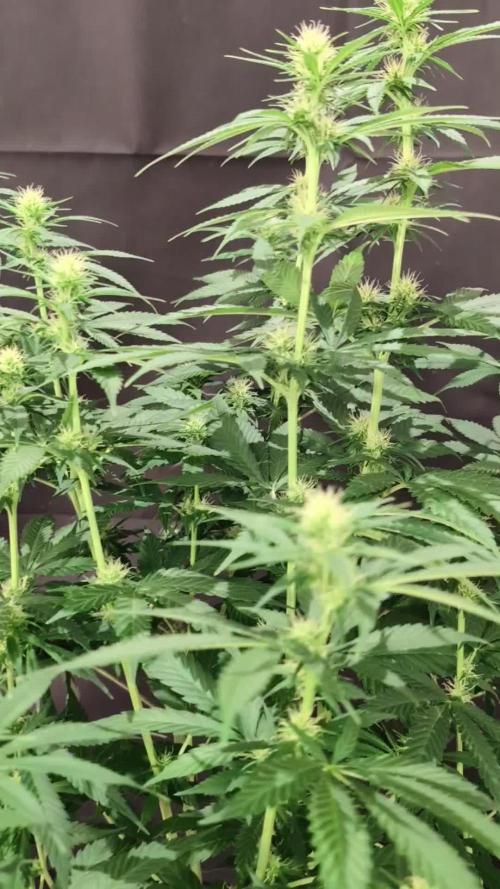
Nach der dritten Blütewoche zeigen sich immer mehr stigmen!
Die Pflanze beginnt nun richtig mit der Blütenproduktion und dennoch Stretched sie immernoch ordentlich. 8cm Höhenwachstum in einer Woche.
Daher ist eine Technik um die Höhe im Zaum zu halten absolut erforderlich.
Und Leute! Weiterhin keine männlichen Polensäckchen in Sicht! 😁
Das freut mich besonders, da ich schon sehr lange darauf warten diesen Strain in voller Pracht zu sehen.
Sie hat inzwischen eine richtig buschige und breitgefächerte Struktur.
Ich habe nun die unteren Triebe entfernt und noch etwas Laub rausgenommen.
Die Beleuchtung habe ich in dieser Woche nochmal auf dass Maximum hochgefahren. Aus der Erfahrung heraus, ist es für die Pflanze ab BW3 ein guter Zeitpunkt für die Kosten/Nutzen effizients so zu fahren.
Die Umgebungsgegebenheiten sind gut:
—————
🌞 Temp: 23°C
🌚 Temp: 18°C bis 19°C
💨 RH: 52%
VPD: 0,85 kPa
😎 PPFd: 830 mqm
—————
Viele Grüße 👋

Likes
6
Share


@meangreenmachine
Follow
Started using a fish 5-1-1 (one Tbs /gallon) twice a week with a general 3-2-2 (1oz/gallon).
Noticed some holes in leafs starting from underneath, had seen this a little last week and trimmed those leafs off or at least most of them. I notices different leafs were affected and was worried it mite be spider mites. In response I mixed 3 essential oils (Cedar Mint, Peppermint, & Melaleuca Oil) with some water (pH 6.25) but did not check the ph of the mixture in the spray bottle. I sprayed the leaves and underneath the leaves and the surrounding environment in the tent. May have put too many oils in the the spray or perhaps the mixtures pH was way off because when I went to check on them again the leaves looked sick. I haphazardly trimmed off the leafs that were ill looking but left the ones that were not as effected and were not drooping. Hopefully the defoliation will inspire Runtz (one with rocks) to grow more branches/ potential bud sights as well as to inspire Blue Cookies (Middle ) to spread out her branches some more to increase surface area. Team Cream (Left-side) was affected the least from the spray and didn't have to prune more than a leaf or two.
Team Cream is definitely consuming the most water of the three, being potted first and was the largest clone initially. She is full of surprises in terms of how I think she'll grow. None the less she is responding to training fairly well. If I'm not mistaken I would assume she has more sativa traits than the other two due to her wanting to grow in hight opposed toeing bushy and branching out. IDK it might be how I trained her /got her.
Runtz is second in water consumption and responds to training the best of the three, although some lower branches are taking time to develop.
Blue Cookies is consuming the least amount of water and has the most run off. Possibly due to being potted a day or two later as well as being the smallest of the clones at first and also suffered the most nutrient burn durringthe 1st or 2nd week when I was feeding them too much.


Likes
57
Share

@squalino
Follow
🌿 Journal de Culture : Cherry Cola (Auto)
Date : 25/03/2026
Âge : 62 jours (Semaine 9)
Phase : Maturation (Gonflement et sénescence précoce)
📊 Paramètres de mon espace
Température : 24,5°C (Jour) / 20°C (Nuit).
Humidité : 50%.
Éclairage : Pure LED 240W réglée à 75% d'intensité, maintenue à 75 cm de distance.
💧 Nutrition & Arrosage
J'ai ajusté le dosage pour accompagner la fin de floraison :
Apport : 4 ml de PK 5-8 (BioTabs).
Le phosphore et le potassium sont essentiels maintenant pour durcir les têtes et maximiser le poids final.
📏 Suivi des Plantes & Évolution
Plante #1 (Celle aux pistils orangés)
Taille : 41 cm (+1 cm depuis le 18/03).
État : Elle est la plus avancée dans son cycle. Presque tous ses pistils sont devenus orangés/bruns, ce qui est un signe clair que la plante approche de la fin de sa production de nouvelles calices. Ses feuilles commencent à montrer des signes de sénescence (jaunissement naturel), ce qui signifie qu'elle puise ses dernières réserves pour finir les fleurs.
Plante #2 (La Petite)
Taille : 33 cm (+3 cm depuis le 18/03).
État : Bien que plus compacte, elle est extrêmement dense. Ses pistils sont encore majoritairement blancs et longs, ce qui indique qu'elle a encore un peu de temps pour gonfler par rapport à sa voisine.
🔍 Mes observations
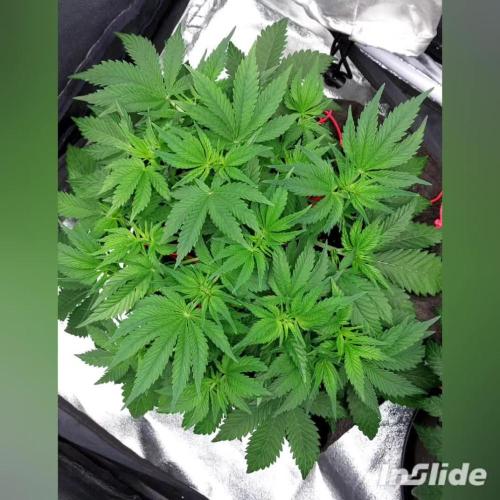
Le filet de SCROG est maintenant totalement rempli. La production de résine est impressionnante, les têtes sont littéralement givrées et la couche de trichomes descend jusque sur les grandes feuilles.
L'odeur sucrée de bonbon devient plus complexe et lourde. La Plante #1 semble prête à entamer sa phase de rinçage très bientôt, tandis que la Plante #2 profite encore pleinement du PK pour épaissir sa structure. On sent que la récolte approche à grands pas .

Likes
50
Share


@Ferenc
Follow
Day 65, 14th of November 2020:
Nice! Topping has stopped her to grow and strech too much which is good she is more chubby type strain so i expect some thickness lol....
Pre flowers and pistils are out so just waiting for the fruit lol ;)
Really nice all good.
Fertilization happens every 2nd day with the ratio and mix above.
I set the lamp 15 minutes shorter to switch off earlier so she receives 11:45 of darkness. I would like to imitate the nature when longer nights come with time till the 4th week (when she will receive 13 hours darkness a day 15 minutes minus 4 times = 1hour) so every week 15 min longer darkness for 4 weeks and then back to 12/12 to have bigger buds from the 4th week....

Likes
5
Share


@doobieandthedutchess
Follow
This is the week. We know we put it as veg but we are turning back the timer this week. Around and hour a day we click back the timer. We use to just flip it to 12/12 in one day, but we thought it was too hard on the ladies, so we are trying this now. The gruntz is just trying to bully the others out the tent. She is a beast. We think going with 4 in the tent from seed might not work. If they were clones for awhile maybe. The clones we took off them are somewhat making it, might have to take a few more just to be sure. Otherwise it’s just been water. We left a few leaves on the soil surface to help hold some moisture in. I just hope the Bruce and gruntz don’t stretch much after the flip is done. The tent feels a little full already. If you see anything we can do better, let us know. Spread some love and share some bud!

Likes
21
Share


@BB_UK
Follow
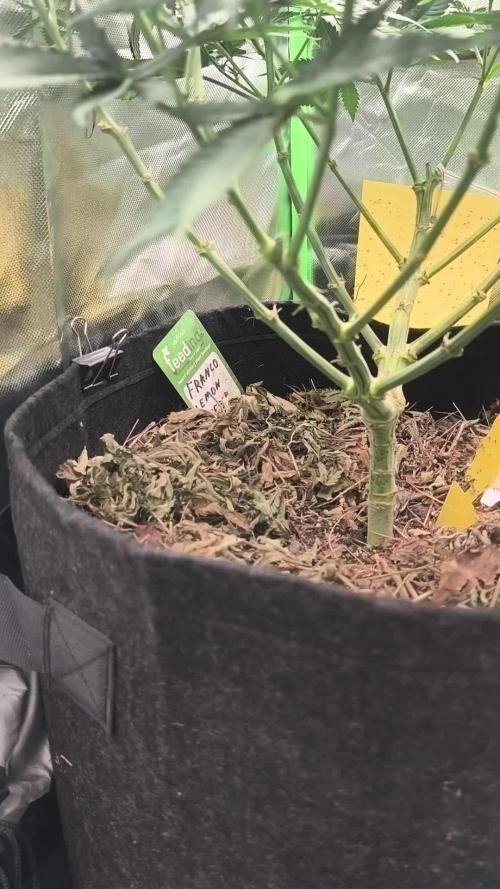
This girl has only been in action! She has got up to the scrog now and I’m confident in her stretch capabilities as she’s about to preflower, it’s the things with photos, even at 4 weeks well let’s say 12-12 from seed as I’ve done this! They tend to flower when they’re ready! But as I said she’s doing amazing and I’m feeding her with an irrigation method as she’s so far at the back I set up a system that’s working tf and helps me take it easy when feeding! May do it to them all on a lazy vibe next time lol maybe lol defoliated her lower fan leaves too and as time goes on I can see I’ll be in some difficulty to prune her and the other rear plants but I will figure it out I’m sure! 😎




Likes
18
Share


@Wicked_Stix
Follow
Been another smooth week. A few of the plants are starting to show signs that they are moving towards to finish line. Seeing some swelling, pistils starting to brown, and some beautiful purples coming out in some of the buds. Been debating on giving them a dose of dry koolbloom, but I will probably just keep them running on the maxibloom until flush since they look pretty happy. Thos candy cane is popping up a lot of deep purple tones but I'm not really liking the lack of swelling in the calyxes at this point. She has a nice sweet candy aroma, but I am thinking she will be the loser of this grow when judging bag appeal alone. Hoping she puffs up over the next week or so.

Likes
4
Share


@ZweetZkittlez
Follow
Estuvo unos días con sodio y luego pasó a Led. Estoy usando Viparspectra

Likes
142
Share


@MadeInGermany
Follow
Hi everyone :-)
This week the buds developed super ;-) All are beautiful 😍.
Super genetics 👍.
Blue Cheese pheno 1 is slowly coming to an end :-)
This week I will start to use up the remaining nutrients and harvest in 10-14 days ;-)
Everyone else needs something else :-) have fun with the videos, stay healthy 🙏🏻 and let it grow 🌱


Likes
56
Share


@Prilyfe13
Follow
February 23, 2024 Day 8
Both babies got 250 ml top water today. I'll check on them in a couple hours and see how they are. Other than that. Nothing else to do.
I did want to mention how very similar these two are. I think they're the same phenome. Although, it may be a bit early to really tell. That would be cool though.
Beautiful green color and perfect little stalk. The true fan leaves are starting to show themselves now, so I can officially move them into the Veg Stage.
So for this week, the focus will be watering and ensuring the light intensity is at the right level. I'll probably wait another few days before I think about introducing some nutrients. I'd like to start when the true fan leaves are fully showing. As I've said before, the soil is used, so I think a bit of recharge and Advanced Nutrients 3 Part Base solution would be a good idea. At a minimum of course. I'm counting more on the recharge to really kickstart the soil back to life. I'm definitely going to need to do a full watering when the first node starts and with the nutrient solution. However, I feel like I may need to do that sooner rather than later. Based on my last grow, the biggest plant had the most water in the second week of growth. I even thought I overwatered, but nope.
So I'm going to try to replicate that. Especially because this is a super fast strain. They'll need all the water they can get. I'll start that on my next watering. I'll bump it up to 500 ml and focus mainly on the outer rim to help the rest of the soil get to the right moisture level without disturbing the environment they already have at the base.
The light is still the same distance from the plants with the same PPFD. I'll start to focus more on DLI in the coming days as they grow. I have my light schedule for the week and plan to stick to it, letting the intensity slowly increase for the start of the next week and so on. I was considering increasing the power to 40% when I need to increase the intensity, but I have so much distance to play with, I might as well keep it at the same level until I get some nodes going. By flower, I'm hoping to have a perfect DLI of 45 by flowering. And hoping to be able to bring the light up to 100% for super deep penetration by then. I'd also like to get the light down to 24" for the veg stage. It seems to be the sweet spot for the coverage footprint.
Also, I think I got the Tent Environment down for once. The night temp drops to around 68° while the day temp, although slow to climb, stays around 77°. I'm hoping that doesn't cause a stunting issue with the temp swing at such a young age. I think it will be fine. We shall see. The average temp is a bit low though. I may increase the night temp to 72°. That should put the average over 75°. The RH is pretty steady across the board around 72% with it dropping a little bit to 68% and up a bit higher at night to 74%. The VPD is also spot on averaging around 0.82 kPa. During the day it climbs up to 1.03 and at night drops down to 0.77 kPa. It's a bit low for my taste, but with the increased temp, I should see a nice round 0.83 kPa at night.
Someday I'll get an automatic humidifier.
Anyway, I know it was a lot, but it's a new week.
See you tomorrow:
Grow System Environment:
Temp: 74.6°
RH: 71.8%
VPD: 0.82 kPa
February 24, 2024
Kind of a big deal today for both ladies. So I in have a pair of Tropicana Cookies sharing the tent with these plants. The TC is showing signs of deficiencies. So to combat that, I added a 1/4 tsp of Recharge to a gallon of water. As I'm growing both strains as similarly as possible, I fed 250 ml to all 4 plants. Hopefully the packaging is correct and it won't burn these little babies. They are definitely hitting Veg already. But to be on the safe side, I covered them with a Starbucks cup and then watered them. It kept the soil from getting saturated at the base and will also help promote outward growth.
As for watering itself, I feel like I should be watering more to prep the soil for when the veg stage really hits and the roots start to search more. I'd like to get to the point of runoff by the end of the week. Maybe I'll add another 250 ml with the cup in place again tomorrow. I will also need to water at the base in the next day or so.
They are both growing the exact same still. I know it's only been a day, but a lot can change in that time, so nothing yet. Plus, what else am I supposed to document?
Stems are strong. Leaves are a beautiful green color and the true leaves are starting to spread more. Lookin good.
I'd also like to mention that it is 16° outside today, so even with the heat cranked, it's not really doing much. So low temps for a bit today. Around 70° much too low, but not much I can do until the heat catches up.
Grow System Environment:
Temp: 73.4°
RH: 67.6%
VPD: 0.90 kPa
February 25, 2024
Not much to do today. I'll either water 250ml today or 500 ml tomorrow. Either way, it's time to start wetting the whole container. I'm starting to think I should have done this the day before planting them. Oh well, I'll try that next time. For now, I'll stick with the gradual watering. It'll be increased again next week if needed.
These babies look great. The leaves are getting longer and seem to be a medium width. Much like a true hybrid. So far at least. It's still pretty early to tell. We shall see.
The light intensity is pretty good as well. No changes needed at the moment. However, I have a feeling I'll be dropping it an inch or two in a couple of days to match the schedule. I don't think I need to increase the power yet. I'll start increasing the power when I start training. It makes sense. I'll be pulling the tops down, so the DLI will be off a bit. But instead of dropping the light, increase the intensity so it can penetrate the new canopy right away. And if I can hover between 22" and 24" light distance, it should be perfect. I feel like that has the best footprint for this setup.
Interesting Theory: Mostly for My Records:
I may be slow on the info, but I think I figured out how brightness and distance make a difference in PAR and Brightness as well as footprint.
The light distance defines the footprint. And the light power defines the brightness. Combining the two makes for a PAR reading.
However I feel that the higher the brightness, the deeper the canopy penetration. Distance doesn't really change the brightness. It does change the PAR, but we can fix that with Distance. As long as we match the PAR reading to the proper level, there's no difference, correct? Maybe not. A less bright light even super close to a canopy would not be strong enough to penetrate the canopy because the power isn't strong enough. Even at the same PAR reading, it still wouldn't be powerful enough to penetrate. On the other hand a brighter light with the same PAR reading would work differently. Same PAR reading at a higher distance. But the power would also be higher. I feel that the light will penetrate deeper as long as the PAR remains the same.
An example is a too large plant for the setup. Light distance was under 9" and power was down to 30% the PAR reading was much too high even with such low power. The light however couldn't penetrate below the first set of leaves and buds very well. But, in a smaller tent with a 100 watt light, I grew a wonderful plant where the light penetrated the canopy deeper because it was brighter and the distance was deeper. The plant wasn't nearly as big as it was in a 2x2 tent and 1 gallon container compared to the 3x3 tent and a 5 gallon container. But it had dense buds almost all three way down to the base. The larger plant had bud as far down as I allowed, as it mostly came out as popcorn, loose buds and some larf.
This all brings me to believe that light power directly affects the canopy penetration and not necessarily distance. Distance plays a role with footprint and brightness, but not power. I also believe light heat makes a difference as well. A brighter light is warmer and plants like to be warm. So they will stretch to the warmth of the light as well. Less power means a cooler light and a less happy plant. My opinion of course.
As I'm keeping this for my records, if anyone has any extra info, or correcting facts, please let me know. I'd rather have a theory be corrected or supported so I have the correct information. Doesn't matter how old this Diary is as I check all comments. Thanks in advance!
Update: I decided to water in 250 ml of Recharge without the domes. I'll do another 250 ml tomorrow with the domes on and so forth until they get too big to fit under the dome. Then it will be normal watering.
Grow System Environment:
Temp: 76.1°
RH: 74.4%
VPD: 0.57 kPa (a bit low, but I'm measuring 2 different probes)
February 26, 2024
Mid-week update:
Both ladies are looking great! Still wonderful green and growing nice and steady.
They are about 6 cm tall or 2 3/4".
DLI: 18.1 mol/m²/d
PAR: 280 ppfd.
I also watered in another 250 ml with the domes on today. I'll run the 250 ml daily until week 3 and then I'll change it up to 500 ml every other day for that week. After that, everything should be good to go for the flowering stage. I'll also install the basins after week 3. It should be excellent timing. They are 1 gallon basins. So refilling should be every other day or so. The goal with this run is to not have to top water at all. The basins should work perfectly as long as I set them up properly.
Grow System Environment:
Temp: 75.8°
RH: 70%
VPD: 0.83 kPa
February 27, 2024
So major problem in my opinion. My humidifier is blanketing the whole tent with the white powder they give off. I wasn't running my exhaust fan as I didn't need it at all. So I turned it on as low as possible and started one of my circular fans. Hopefully that solves the problem. I had to carefully wipe it off of Banana PP B. However, regardless of the powder, these two are growing quite nicely. Maybe a little slower than I was hoping, but still nice steady growth.
They both got a little misting today as well as will be getting the 250 ml watering after the water comes up to room temp. This watering will be PHed to 6.0 and will be dome free. There was still about 400 ml of Recharge left, so I let it stay and just won't add more til next week when I start the base nutrients. I'll also be adding Cal/Mag.
Other than that, they are still super green and super healthy. Hopefully they take off when the base nutrients kick in as well as the container soil being properly moistened.
Grow System Environment:
Temp: 74.7°
RH: 60.6%
VPD: 1.16 kPa
February 28, 2024
Not much going on today. They both got their daily 250 ml watering PHed at 5.95. I didn't go near the base though. So it's kinda like having the dome, but not as precise.
They are slightly reaching and the first set of true leaves are finally starting to pop out. The node is also growing at what seems to be a wonderful pace. Still a beautiful green and the stalk is nice and strong. Very straight as well. They do have a bit of a lettuce structure on the single fan leaves. It'll be fine. The true leaves look spectacular.
Lighting is still pretty spot on. 2 more days and I'll be either lowering the light or increasing the intensity. At this stage I don't think I need to increase the power. The light distance is pretty far away. That gives me a good 6 inches of wiggle room. I'll increase the intensity when they start to grow a second node. On the other hand, I could keep the light where it's at for now and let the plants grow into it. Then I can increase the intensity when they get to that point. Week 3 from seed starts in 2 days. Which should be the true first week of Veg. I'll evaluate on what to do tomorrow. I'm pretty sure I need a DLI of 20 mol/m²/d starting next week. So I'll run the light at 350 ppfd or DLI of 22.7 mol/m²/d. Just above. It seems to be the perfect spot for these ladies.
I'd also like to add that I've had zero issues with the 250 ml per day. It keeps the soil moisture just around 50%. Not sure if that means I'm not getting any deeper, but that's why I'll be starting 500 ml every other day next week. I feel that adding the extra 250 will help penetrate the soil better and a bit faster. Especially because those roots are going to start stretching past the dome width. And it's time for the roots to start growing down.
Grow System Environment:
Temp: 75.4°
RH: 62.9%
VPD: 1.09 kPa
February 29, 2024
Today is the last day of the first week of plant life. Week 2 from seed. Both plants got the 250 ml top water without dome.
Lighting looks great. Although, I noticed that a couple hours before lights out, they were both standing straight up like there was no light, but they still had a good 3 hours left. Strange or good? Either way, it'll be adjusted tomorrow to a DLI of 22.7 mol/m²/d. PAR will be 350 ppfd.
I'm also going to try and lower the light a smidge. Maybe down to 26". We shall see what works best.
Both plants are super healthy and right on track. Maybe a little slower than I'd hoped, but still steady growing. I feel like this will be a 4 week veg time. Greens are beautiful and she looks very strong. Leaves are growing nicely and I can only imagine they will take off when I start the Advanced Nutrients regimen tomorrow.
At least I hope they take off. They should though. Tomorrow is around the time when they really start taking root. That in turn speeds up growth so I think I'm right on point here.
I'm also going to be posting a video every week. Once the 2 start to show their differences and greater size, then they will each get a video every week.
Update:
I realized my plants were reaching a bit too much and leaning in toward the light. That being said, they definitely need more light, so I lowered it until I hit a DLI of 19.8 mol/m²/d. That way when I bring it up to 22.7 mol/m²/d it won't be hit so hard immediately. I should have dropped the light down a day or two ago, but oh well. It will be on point for the rest of the grow.
Grow System Environment:
Temp: 73.0°
RH: 62.3%
VPD: 1.03 kPa
The temp slammed down over 50° last night and I'm having a bit of trouble combating it. It'll definitely take a decent amount of the day to re-acclimate. However, it should be fine. I have the temp in my room set to 80° so that should combat the sudden cold.
Likes
14
Share


@MaxMo8
Follow
Hello my friends . The last week before harvest, I gave her chlorinated water. And sorry for not leaving weekly notes due to lack of time, thank you all for my support. I wish you happy days😘👌🙏🙋♂️


Likes
6
Share


@IamCy
Follow
Week 6...........
Getting frosty
Edit: on day 41,I already have amber but it's still packing on weight. I don't know what to do at this point.
Likes
11
Share


@Kirsten
Follow
18.1.25:
Gorilla 🦍 Cookies 🍪 is firmly in week 2.
The plant is looking very good, sturdy.
I have been feeding with about 200 ml of dechlorinated water PH'd to 6.3 with the following nutrients;-
♡ 4ml Biobizz Bio-Grow
♡ 4ml Biobizz Fish Mix
♡ 2ml Cal-Mag and
♡ 1/4 g sprinkling of Ecothrive Biosys.
Trying to give the extra boost of Nitrogen to keep vigorous growth, and maintaining the nice lush green 💚 Cal-Mag was used from the beginning of this week.
Thanks for checking out my diary 🍃 ✌️
Likes
21
Share


@Excalibur
Follow
02 October 2018 -
Day 99
3rd day of flush and we see her begin to grow nicely.
Day 100 -
Happy lady as she gets densier and begins to really smell.
Day 101 -
She is maturing lovely.
Day 102 -
Orange pistols curl. She is on her way.
Day 103 -
Mature and ready. has thickened up significantly.
Day 104 -
Water topped up and pH balanced 5.4
Day 105 -
Trimmed after the video.
Likes
2
Share

@DE_BW
Follow
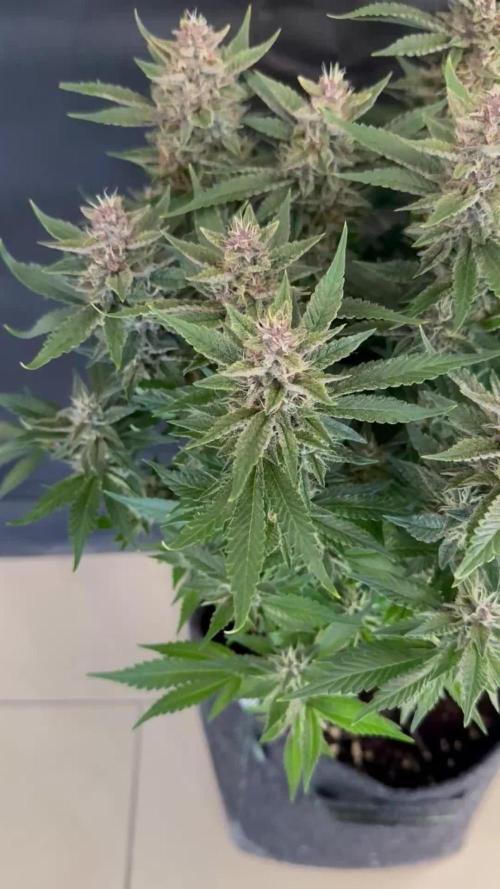
The aroma is already incredibly intense, with a strong fruity profile and a deep apricot-like sweetness filling the space. The colors are developing beautifully, showing subtle purples and frosty highlights that make the buds really stand out. Structurally, the plant is essentially one continuous cluster of flowers, with buds forming everywhere from top to bottom. Bud stacking is still progressing rather slowly at this stage, but the overall flower coverage and terpene expression are extremely promising.
Likes
35
Share


@TheBudWhisperer
Follow
6th week of veg. Is finally in the books and all systems are go for the flower show. As they’re revegged clones, their branching structure is just ridiculous. Sucker branches everywhere pulling nutrient flow away from the winners. Right before we flipped and as per videos - we gutted every single plant and crushed it down to no more than about 7 tops max per plant. The whole goal is only to flower select, top shelf bud with every opportunity (and space) to grow to its fullest potential. So far, Druid nutrients has fit the bill for every one of em and they’re all extremely happy on this system👍.
We also couldn’t resist and snipped another run of clones off each one but the Skywalker. Not sure if the boogie nights or blueberrys will make it but u never really know do you🤷. That said, the diy aerocloner has been a beast for us and minus an aphid issue last round - she puts out a 100% success rate😉.
We’ll use the best of these as complimentary to reg. Run of some spicy bitch we’ve got coming up. Even if the pollen chuck is a failure - we won’t be losing any of the elite white widow or blueberry genetics🤞🤞🤞🤞. Other than that - it’s all wait’n on the buds now👍👌👍. Until next week.
Background
This ones tied to part 2 of the pollen chuck. They were supposed to be a clone run for pollination but the mothers all reveg’d due to a timer incident and high stupidity. These will be the inaugural flowering run of the revamped dutchy system. Growing made easy😉. Shit ton of finagling and setup but once she’s ready - sit back, relax and watch em grow😍😎. Thanks for take’n a look.


Likes
83
Share


@THcHunteR23
Follow
Super couleur qui commence à sortir!! Les trichromes sont majoritairement laiteux.
Quelque endroits avec un début de moisissure. Je part un feu inspecté enleve et brûle les parties toucher !
Elle résiste bien encore 2 jours de pluie et après le beau temp revient pour plusieurs jours.je lui donne encore 2 semaines si tout va bien


