




@Bud_vista
Follow
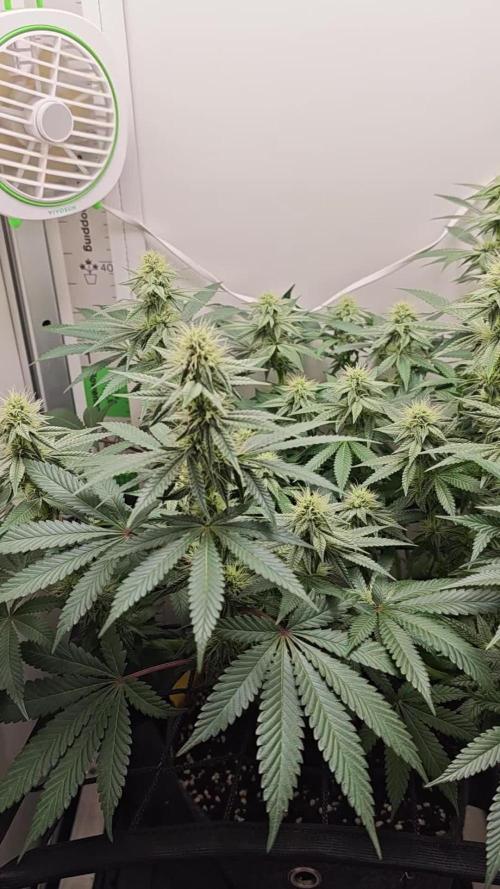
Welcome to week 11 of my white truffle grow!
I love this plant! She looks super healthy and over the weeks the buds bulking up nicely and the sugar leafs stacking up.
I've watering about 2 times a week with approx. 3 liter of water. I started to give the plant also a little bit of water from underneath.
Think she needs another 3 weeks easily.


@JeyGanesha
Follow
L'attesa si fa sempre più lunga,🤣più si avvicina il giorno del taglio netto e più sembra non passare... .. questi profumi mi fanno venire l'acquolina in bocca 😜🤤🤤🤪🤣😂 beh dai ancora poco e la gustero per bene😂👍🙏






@Roberts
Follow
Bubba Kush Mintz Autoflower is growing great. She is starting her bulking stage and is looking great. Everything has been growing good. Thank you Athena, Spider Farmer, and Aeque Genetics. 🤜🏻🤛🏻🌱🌱🌱
Thank you grow diaries community for the 👇likes👇, follows, comments, and subscriptions on my YouTube channel👇. ❄️🌱🍻
Happy Growing 🌱🌱🌱
https://youtube.com/channel/UCAhN7yRzWLpcaRHhMIQ7X4g


@Ukfarmer420
Follow
Hi guys
Week 7 day 49 🌼 flower!
So last week the blue cheese recovered well with a emergency rinse now there all on a pk boost week starting today 😅 wish me luck.
Nugs are frosty and smell mental! The blue cheese smells like 2006. 💚
Cant wait for harvest.
Happy growing guys


@Canna96
Follow
solid fruity nugs. Second only to the Durban Nights as far as this grow goes.....fruity and fairly dense....



@DogDoctorOfficial
Follow
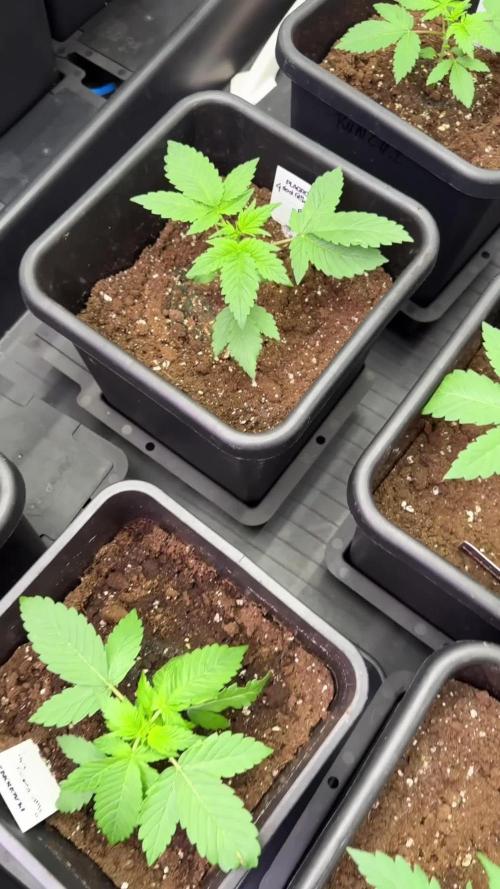
🌱 Folder 10A | Guava Auto
Week 2 – Compact Beauty, Unlimited Potential
Welcome back to another chapter of the 8×8 Adventure, where every plant tells its own story.
This diary follows Frosted Guava Auto 10A, one of the most compact ladies in the room and, without question, one of the most beautifully structured plants we’ve seen so far.
Growing under exactly the same environmental conditions as every other cultivar in this project allows us to appreciate something fascinating: genetics truly have their own personalities. While some plants race upwards searching for the light, Guava has chosen a completely different strategy.
She builds.
Every node arrives tightly stacked.
Every branch develops with purpose.
Every new leaf seems larger than the last.
Rather than stretching, she is constructing the foundation of what promises to become an incredibly dense canopy.
Sometimes the strongest plants aren’t the tallest ones.
⸻
🌿 Growing Conditions
As with every plant inside the 8×8 Adventure, Guava Auto benefits from a carefully controlled environment designed to provide consistency throughout every stage of development.
Environmental Conditions
* 🌡️ Day Temperature: 27°C
* 🌙 Night Temperature: 25°C
* 💧 Relative Humidity: 55%
* 🌱 Root Zone Temperature: 21°C
* 💦 Nutrient Solution Temperature: 20°C
* ⚡ EC: 1.3
* pH: 6.0
* 💨 CO₂: 666 ppm
* 💡 Light Schedule: 12/12 From Seed
* ? Pot Size: 15 Litres
Maintaining identical conditions across the entire room allows each phenotype to reveal its natural growth pattern without environmental variables influencing the comparison.
⸻
🌿 Feeding Program
This week Guava continued receiving the complete Plagron Terra nutrition program.
Weekly Feeding
* Terra Grow — 1.8 ml/L
* Power Roots — 1 ml/L
* Pure Zym — 1 ml/L
* Sugar Royal — 1 ml/L
* pH Plus — when required
* Lemon Kick — when required
The emphasis remains on supporting vigorous root expansion while encouraging steady vegetative growth without forcing excessive vertical stretch.
Healthy roots build healthy harvests.
⸻
🌱 Plant Development
This has been one of my favourite plants to watch this week.
From the very beginning she displayed extremely tight internodal spacing, giving her a naturally compact appearance. Instead of reaching upward, she concentrated on strengthening her central stem while producing large, healthy fan leaves that quickly shaded the lower growth.
That was the perfect opportunity to introduce gentle leaf tucking together with a small amount of low-stress training.
The transformation over only a few days was remarkable.
Branches that had previously been hidden beneath the canopy suddenly found the light.
The centre of the plant opened beautifully.
Airflow improved.
Future flowering sites became visible almost immediately.
By the final photographs of the week, Guava looked like an entirely different plant. Still compact—but now balanced, open and full of potential.
Her architecture is becoming exactly what you hope to see before the transition into flowering.
⸻
🌿 Training Progress
One of the biggest advantages of documenting these plants individually is seeing how small adjustments influence their development.
This week wasn’t about bending the plant dramatically.
It was about working with her natural shape.
A few carefully positioned leaves were tucked away.
The canopy opened naturally.
The lower branches responded almost immediately by accelerating their growth toward the light.
Nothing aggressive.
Nothing forced.
Just gentle guidance allowing the plant to express its own structure.
Sometimes the simplest techniques produce the biggest improvements.
⸻
📸 Behind This Week’s Photos
The camera really tells the story this week.
Early images highlight a beautifully thick central stem with exceptionally short internodal spacing—a strong indication of healthy growth and excellent light intensity.
As the week progresses, the overhead shots begin revealing something even more exciting: symmetry.
Every branch appears evenly distributed around the main stem, while the large fan leaves frame the developing centre almost perfectly.
The close-up photographs of the canopy are especially rewarding. Hidden shoots are beginning to emerge from every node, quietly preparing to become future flowering branches.
It’s one of those weeks where growth isn’t measured by height.
It’s measured by potential.
⸻
🌱 Looking Ahead
The coming week should be very exciting for Guava Auto.
With the canopy now opened through gentle LST and leaf tucking, I expect the secondary branches to accelerate rapidly and begin competing with the main stem.
Rather than producing one dominant leader, she already hints at becoming a naturally bushy plant capable of supporting multiple flowering sites across an even canopy.
If she continues developing at this pace, she may become one of the most productive compact plants in the entire room.
She isn’t trying to be the tallest.
She’s quietly preparing to become one of the fullest.
⸻
💚 Thank You
As always, thank you for taking the time to follow another chapter of this adventure.
Whether you’re an experienced cultivator, someone growing their very first plant, a curious observer, a supporter, a skeptic, a silent reader, or someone who simply enjoys watching these journals unfold—you are all part of this journey.
Thank you to every grower who shares knowledge, asks questions, offers advice and helps make this community stronger every single day.
A heartfelt thank you to GrowDiaries for providing a platform where growers from every corner of the world can document their work, inspire one another and continue learning together.
A huge thank you to Plagron for supplying the complete Terra feeding program used throughout this project. Their consistency and reliability allow each genetic to express its true potential under stable conditions.
To Zamnesia and the breeders behind these incredible genetics—thank you for the years of work that make projects like this possible. Every seed carries its own character, and discovering those differences is one of the greatest joys of cultivation.
And finally…
Thank you to everyone who follows these diaries.
The supporters.
The critics.
The believers.
The skeptics.
The friends I’ve met along the way.
Every comment, every question and every conversation makes this project more meaningful.
The 8×8 Adventure continues…
One phenotype.
One lesson.
One week at a time.
Growers Love 🌱💚


@GoldenWeedGrower
Follow
14/05:
EC: 1,23
PH: 5,22
Removed all LST hooks
15/05:
EC: 1,15
PH: 5,92
16/05:
Added Nuts
EC: 1,3
PH: 6,08
17/05:
EC: 1,3
PH: 6,1
👍👍👍👍👍👍👍👍👍👍👍👍👍👍👍👍👍👍
Lesson Learned:
AS SOON AS THE MAIN BUDS RAISE UP MOVE THE LAMP ON THE CEILING TO AVOID BURNS
👍👍👍👍👍👍👍👍👍👍👍👍👍👍👍👍👍👍
18/05:
Changed Grow Box SetUp .
I had burning lights problem and I moved the lamps on the grow box ceiling
EC: 1,42
PH: 5,99
19/05:
EC: 1,25
PH: 5,46
20/05:
EC: 1,25
PH: 6,03


@Lady_NugWitch
Follow
So we are ready for harvest on the middle girl...maybe this weekend I'll do the chop. The other girls are right behind. I will have to harvest them on a weekly basis as my herb dryer machine can only, hopefully, hold one plant.


@RDWCGrowing
Follow
Week2 Day 1- 08/19/2023
Weekly Maintenance- Non-Water change week
Added
.5mil/gal of TPS SILICA Gold = 39 gallons X .5 = 19.5mil = 20mil add
She really does look great today. More roots are finding their way out of the basket and into the water, looks like where I topped her the side stems are growing out nicely. Humidity is still running just a little low, I am making sure I keep a close eye on the humidifiers and added more water as needed.
Week2 Day 2- 08/20/2023
She is doing Amazing!! Her roots are in the water and she is starting to form a little ball, the leaves are doubling in size and spreading out. Overall happy with how this grow is going thus far. Lots of Prayers for it staying this way the entire grow.
Week2 Day 3 - 08/21/2023
I am very happy with her growth she is absolutely exploding, the main leaves are almost as big as my palms now, and the root ball is starting to form very nicely.
She overall looks really happy to me.
Week2 Day 4 - 08/22/2023
WoW!! Checked on her today and she looks like she doubled in size she is doing amazing in the environment. I had did do some Topping today and that was about it.
Week2 Day 5 - 08/23/2023
She is looking amazing to me. Really proud of her and her growth.
Week2 Day 6 - 08/24/2023
Not much to report today, her growth is going great. I topped her in three spots. Looks nice and comfortable, Saturday Water Change Day. Tomorrow I will get all of her end of week measurements for height and all.
Week2 Day 7 - 08/25/2023
Week 2 is officially in the bag, she is already at 8 inches. 4-6 weeks left depending on continued growth until we switch her to flower.. we will see how it goes but she is looking amazing and the root structure is looking great! Humidity is still a little low I added water to the Humidifiers and adjusted the input air flow down slightly. I also turned on the 4th fan to increase circulation in the tent.


@Suemchen
Follow
Sanlight EVO 3-60 at 80%
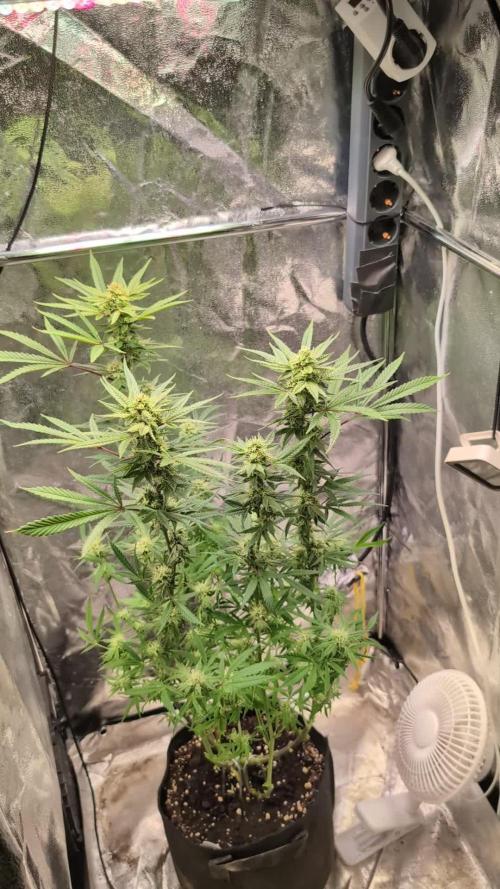
Day 106: looking good and watered again🌊. Watered with rain water and 1ml/l Powerzyme, 2 ml/l Hesi Boost, 1 ml/l Cal Mag, 1 ml/l Alg a mic, 1 ml/l root Juice, 0.5 ml/l Bloom Complex and 1 ml/l Green Sensation. EC at 2.0 and a pH of 6.4 .
Day 108: looking really good 🤗 watered with out supplements 👌🏻 Just rain water 👍🏻 Defoliated a little 👍🏻
Day 111: looking good and watered again🌊. Watered with rain water, 1 ml/l Cal Mag, and 1 ml/l Green Sensation.





@Ultraviolet_
Follow
67 days since April 16th, 2026
We become aware at such times of man's wonderful ability to bring seemingly unrelated elements into harmonic balance, and receive a glimpse into a world where everything exists in conscious sympathetic attunement to everything else. When we listen to a piece of music that seems to strike a beautiful chord somewhere inside us, or view a painting that simply glows with harmonic awareness well executed, we probably do not spare much time to contemplate the wonderfully intricate combination of vibrations that our sensors make it possible for us to perceive. We tend to appreciate the relationship between the parts of something by an awareness of the harmony or dissonance of the whole. This ability enables us to say "what a beautiful house!" instead of "analysis has proven that this collection of building materials exhibits certain elements of harmonic proportion." While this ability to instinctively appreciate the beauty of true harmony has an important role to play in evolution, a more analytical understanding of the laws involved can be most useful. This is especially so if we wish to create works of art where each part exists in true harmony, not only with the other part of that particular whole, but with the universe within which the creator and the created exist.
Everything vibrates. From the most dense matter to the most subtle cosmic rays, everything which our senses allow our thoughts to become aware of, can be specified in terms of wavelength or frequency of vibration. These two terms define the same thing, but from different points of view.
The following are the approximate wavelengths of various energy carriers:
Cosmic rays 0.000,000,001 mm
Gamma rays 0.000,000,1 mm
X rays 0.000,500 mm
Ultraviolet rays 0.003 mm
Visible light 0.006 mm
Infrared 0.01 mm
Sound waves 1 meter
Radio waves 300 meters
Violet light 400 nm to 450 nm
Blue light 450 nm to 500 nm
Green light 500 nm to 570 nm
Yellow light 570 nm to 590 nm
Orange light 590 nm to 610 nm
Red light 610 to 700 nm
1 nanometer (nm) = 0.000,000,1 cm = 1/10,000,000 cm
If a guitar string is plucked and we hear a sound, it is not too difficult for the human mind to associate this sound with the vibration of the guitar string. With color it is quite different. It is difficult for us to conceive that the color of a substance is not an inherent property of the substance itself, but an indication picked up by our senses of that substance's ability to absorb or reflect the light which happens to be shining on it at that moment. Neither the matter nor the light is colored. What happens is that the brain learns to differentiate between the frequencies reflected or transmitted by the substance the eyes are focused on. The same thing happens with sound. When we say "Oh! Listen, they're playing my favorite song," what we really mean is: "My brain has stored within it a particular pattern of frequencies. I have compared the new information being received with this stored pattern and have deduced the answer that the two patterns are similar within certain specified tolerances." The 'pleasure' involved could have something to do with our running the pre-recorded pattern at the same time, in 'sympathy' with the new pattern as it is received.
The word sympathy describes very well our ability to appreciate color and sound. It also describes the reason behind certain elements of harmony. For instance, if a substance vibrating at 100 cycles per second (tone 1) is in the proximity of another substance vibrating at 200 cycles per second (tone 2), we could perceive, if we had the right equipment, a certain sympathetic relationship between the two.
We will see from this that there is a uniform doubling of the first tone seen in the second. At various points along the waves, the two are the same in amplitude. At other points, they are at opposite poles to each other. This doubled frequency has more points of similarity to the original than any other frequency except the original itself. If the equipment we had available for measuring these two frequencies was a soundboard amplifier and a pair of ears, then we would hear what would sound to us like one tone. If we had the opportunity to hear one at a time, we would hear that although they sound the same, one is higher in pitch than the other. This characteristic of 'the same but different in pitch', musicians have called the octave. Any two tones produced where one has exactly doubled the frequency of the other is called an octave. Speaking in ratios, an octave would appear then as the ratio 2:1 or 1:2, depending on whether we are talking of an octave up or down.
A single note produced by almost any instrument will contain more than one wavelength or frequency. It will have a dominant frequency, the wavelength of which we would call the note's 'fundamental' or 1st harmonic. It will also have a varying number of upper harmonics, gradually fading in intensity into infinity or silence.
Natural harmonics always have the same pattern of intervals between them. The interval between the 1st and 2nd harmonic is a perfect octave; between the 2nd and 3rd a perfect fifth; between the 3rd and 4th a perfect 4th; and so on, the intervals becoming smaller and smaller until they lose any relationship with the western 12 tone scale as it exists at the moment. Just as an octave has certain elements of sympathy with its fundamental, so some intervals have been noted to be more perfectly in sympathy with the fundamental than others. The ratio of the 'perfect 5th' or interval of 7 semitones, as it occurs in the harmonic series, is 3:2 or 2:3, while that of the 'perfect fourth" is 4:3 or 3:4. All the tones in the western 12 tone scale can be expressed in terms of the ratio between the upper tone and its fundamental. This would seem to be an ideal way of generating a scale from any given fundamental and several attempts have been made to do this, the Pythagorean system being probably the most well known. Although when working with a single tone instrument playing on its own, the Pythagorean formula works wonderfully well, if we had several instruments tuned this way together and asked them to play almost any western music, we would find that at times they sounded quite out of tune to each other.
The lack of flexibility of the various scale systems based on the harmonic series has led to what is known as the 'tempered' scale. This uses as its primary unit of interval the ratio of the octave or 2:1. It then proceeds to divide the interval between any fundamental and its upper octave into 12 smaller intervals by applying the ratio: two to the one-twelfth power, to one (21/12:1). This equals 1.059463094, so by multiplying any frequency by this number, we will obtain the tempered semitone next up from our fundamental. We will also find that any tone twelve semitones up from any other tone, in a scale generated in this way, will have exactly double the frequency.
If we took the note middle C on a piano and halved the wavelength, we would have the note C one octave above. If we halved this, we would have the C above, and so on. However, within about 6 octaves, we would find that although a 'sound' was being produced, no human ear could perceive it. If we kept on going, halving and producing upper octaves of our fundamental C, we would proceed through the infrared band, into the visible light spectrum. If we happened to be outside during the day, we would, for one octave only, see the note C with our eyes. The next octave above would already be in the ultraviolet band, and outside the eye's sensitivity range. If we can think of color as being an indication of a substance's vibratory rate or wavelength, we may begin to see a relationship that could exist between the color and sound spectrums.
The logical extension of what has so far been said is that there exists a scale in the color spectrum that corresponds exactly to the scale in the sound spectrum, each color tone being an octave of the equivalent note in the sound range.
This is not the end of the story but only the beginning. If we can for the moment accept that any wavelength in one band has upper and lower octave stretching out to infinity, then the next question is 'fine, but what shall we use as our fundamental? A particular color? A particular sound frequency?' The musicians among us will probably say 'A 440'. This means that the note A should vibrate at 440 Hertz, or 440 times per second. They would tell us that this is standard pitch has been adopted by most orchestras around the world; pianos are tuned to it, instruments are constructed to formulas based on it, and so to them it would probably seem the most appropriate place to begin. Some of these musicians may know of the battle that is still raging with regards to this being the standard, but few would know why A = 440 Hz was chosen except that it worked when it was set to be a suitable compromise between the many different pitches in use at the time.
432 Hz is said to be mathematically consistent with the patterns of the universe. Studies reveal that 432 Hz tuning vibrates with the universe’s golden mean PHI and unifies the properties of light, time, space, matter, gravity, and magnetism with biology, the DNA code, and consciousness. When our atoms and DNA start to resonate in harmony with the spiraling pattern of nature, our sense of connection to nature is said to be magnified.
Another interesting factor to consider is that the A=432 Hz tuning correlates with the color spectrum, while the A=440 Hz is off. Audiophiles have also stated that A = 432 Hz music seems to be non-local and can fill an entire room, whereas A=440 Hz can be perceived as directional or linear in sound propagation.
Once you adopt the idea that sound (or vibration in general) can have an equalizing and harmonizing effect (as well as a disturbing effect), the science of harmony can be applied to bring greater harmony into one's life or tune to specific energies. There is a form of absolute and relative harmony. Absolute harmony can, for example, be determined by the tuning of an instrument. The ancients tuned their instruments at an A of 432 Hz instead of 440 Hz - and for a good reason. There are plenty of music examples on the internet that you can listen to in order to establish the difference for yourself.
Attuning the instrument to 432 Hz results in a more relaxing sound, while 440 Hz slightly tenses up the body. This is because 440 Hz is out of tune with both macro and micro cosmos. On the contrary, 432 Hz is in tune. To give an example of how this is manifested microcosmically: our breath (0,3 Hz) and our pulse (1,2 Hz) relate to the frequency of the lower octave of an A of 432 Hz (108 Hz) as 1:360 and 1:90.
It is interesting to note that 432 Hz was the standard pitch of many old instruments and that it was only recently (19th and 20th century) the standard pitch was increased. This was done in order to be able to play for bigger audiences. Bigger audiences (more bodies) absorb more of the lower frequencies, so the higher pitch was more likely to “cut through”. One of the oldest instruments of the world is the bell ensemble of Yi Zeng (dated 423 BC), tuned to a standard F4 of 345 Hz, which gives an A= 432 Hz. The frequency of 345 Hz is that of the platonic year! Similarly, many old organs are tuned in A=432 as well; for example, St. Peter’s Capella Gregoriana, St. Peter’s Capella Giulia, S. Maria Maggiore in Rome.
Maria Renold’s book “Intervals Scales Tones and the Concert Pitch C=128 Hz” claims conclusive evidence that 440 Hz and raising concert pitch above scientific “C” Prime=128 Hz (Concert A=432 Hz) disassociates the connection of consciousness to the body and creates anti-social conditions in humanity.
The difference between concert pitch A=440 Hz and Concert A=432 Hz is only 8 cycles per second, but it is a perceptible difference of awareness in the human consciousness experience of the dream we share called existence.


@TricoGhost
Follow
Para ser la primera vez que cultivo no puedo quejarme, pero si alguien me pudiese ayudar


@SelfmadeRu
Follow
another big day for pHresh Farms 001. moving into mid-veg (week 4) with the family and all of them are now in 5-gallon pots with 70/30 coco perlite, fed on GH trio plus calmag. Calmag has been lower then ideal, grape stomper has been affected by nitrogen toxicity due to an early experiment with worm castings in the coco.
leaving the coco amendments for another time, going with what I know now which is the GH trio.
runtz Grape stomper and black ice gelato are older then the rest (gorilla zkittles, bubblegum, amnesia haze), and our topping efforts are bearing fruit.
Will continue to optimize this juice mix for mid veg.
oh yeah. we're now using our GrowGen 720W LED. intended for flower only but as this is batch 001, it deserves some luxury. Runtz Muffins, Blueberry, White Widow coming soon... will upload gd for batch 002 when they're germed and in 1-gals.
we continue on this journey. happy to see these beautiful plants happy. till next week ...


@SkunkyDog
Follow
Hallo zusammen 🤙.
Sie wächst sehr schön und macht keine Probleme.
Nachts hole ich sie jetzt immer rein.


@AsNoriu
Follow
Day 82.
Its 81 day from seed touched soil ! If leaves would be healthier, i would run them at least one more week, but it is, what it is.
They spent 24 hours in darkness and now its Trim Jail !!! ;)))
Harvest Day !
Day 88. Tried bud from each, clearest weed straight from drying rack ! Only 3 feeds makes huge difference to harshness at the beggining. Still Queen is pure Tangie, can it be seed mistake ? ;)))
Day 89. Boy i am f@ckingly surprised !!! Heather - I love You, Your team, Your strains !!!! I still don't get how, but numbers are amazing, Thank You very much !!!!
Will update this diary as cure goes, but i feel so many nice words were unspoken, felt that FB will change my view about Autos - and they DID !!!
Amazing house !
Happy Growing !


@BruWeed
Follow
🍀21/07 - Ya se encuentra en etapa de secado.
🍀El lunes le agregue 30L de agua y 10ml de Top Wash.
🍀Esta planta se encuentra mas resinosa y densa que la otra que también cultive.
🍀Todo fue perfecto desde el momento uno, no tuvo ningún problema en toda su etapa de vida.
🍀Tiene mucho olor, a caramelo o crema, todos sus cocos son densos y gordos.
🍀En total dio 163g.
🍀En estos días seguiré subiendo mas imágenes de como viene.
😶🌫️🇦🇷🍀Podes seguirme en Insta gram como @bruweed_arg🍀😶🌫️🇦🇷


@Kersche
Follow
Zu viel Regen zu wenig Sonne. Aber die Ladys schlagen sich tapfer. Ich hoffe es wird jetz mal wieder trockener. Ein wenig Schimmel gab es. Aber nicht der Rede wert. Für's Wetter können sie nix. Ein paar Blüten die ich zum Probieren herunter genommen habe sind schön dick und klebrig. Jetzt kann ich langsam anfangen die Trichome zu monitoren.


@420_liquidsun
Follow
Day 34...
I bought organic fertilizer from a local vendor last week. I gave a cup of to each plant and fed it twice with tea which I made from this fertilizer. (EC 950ppm) It's rocks.. . Includes, NPK15-15-15, mychorazee, 15 type bacteria, micro and macro elements,enzymes and so on.. And ıts like 10$ for 12 kg dry compost, a cup makes more than 15lt solution💯🌱🤘
FBT29, They were under a lot of stress by my dog. They're packing, but they're a little behind their sisters.
FBT32 is going really well, nothing to say..
Tangie lost a few leaves during this feeding and Mexican Airlines had some light stress cause It's getting hot in here. . So these two plants are the most sensitive...
Now they're only going to feed with tea, this is all organic from now....
