


@Hollywood
Follow
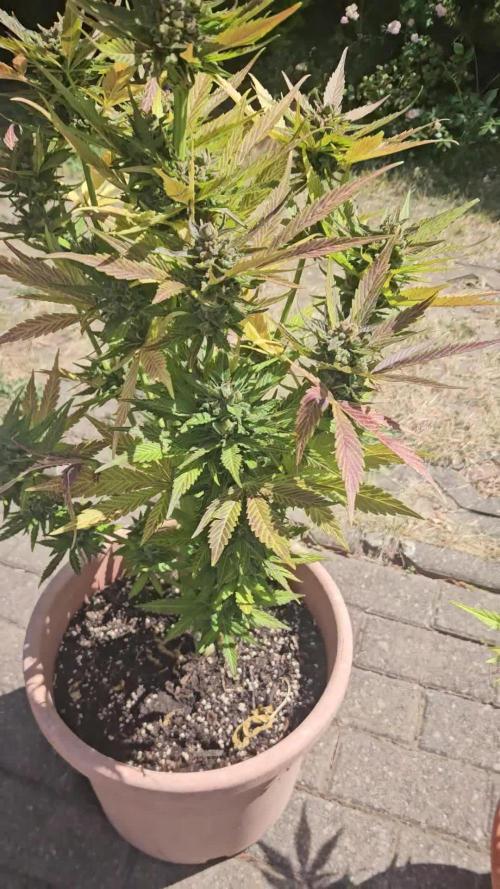
Diese Woche wurde kein Dünger mehr hinzugefügt sondern mit angepassten Wasser auf 6 ph und 60 Liter gespült. Lieber etwas früher spülen als dann später nicht alles raus zu bekommen. Kann es echt nur jedem empfehlen so ca 2 Wochen vor der Ernte mindestens 2 mal zu spülen. Später beim rauchen null kratzen im Hals.




@Mannirumpel420
Follow
Diese Sorte hat bei beiden phenotypen eine sehr Dichte blütenstruktur gehabt. Ich bin von dieser Champion Linie echt überzeugt und freue mich bereits darauf, die nächsten Sorten zu testen.
Ich hatte draußen mit Blattläusen und schimmel zu tun. Wegen den Läusen die auf den Trichomen kleben,möchte ich es nicht rauchen.Deswegen friere ich es ein und mache bubble hasch aus den Material.


@PalmaGrow
Follow
Hermosa floración mucha resina
Defoliación para permitir mejor ingreso de luz
25 - 31 agosto


@Dreadnug
Follow
Two phenotypes - one purple and one white/green. The purple was very difficult to train and resulted in a couple inadvertent breaks - luckily it was repairable. The other trained very well, very flexible and worked very good for SCROG. Both produced heavily and are beautiful. The purple tends to be much more fluffy, with very long pistil hairs - the longest of any grow I have done. The white was super dense, very crystally and sticky. It will be very interesting to see how they smoke. Also, the purple tended to do very well with some nute mistakes I made as well as fluctuating pH in my water feeding. The white did not do as well in this regard but was able to get to harvest fine.
Wet bud weight is prior to trimming. The buds off of these plants were HUGE!!!!
Plant #1: (Purple): Wet weight - 76.58oz prior to trim; 15 colas; Terps: White - 60%, Clear - 20%, Amber - 20%
Plant #2: (White): Wet weight - 71.65oz prior to trim; 16 colas; Terps: White - 70%, Clear - 30%,
After 3 days of drying, took them down to trim for my jars.
After a few hours filled mostly quart jars 3/4 full but also tried an Infinity jar and a gallon mason jar to minimize the number of smaller jars.
Dry weights into jars:
Plant #1: 14.79 oz
Plant #2: 11.76oz
I did pull them after a day to dry rack them for 12 hours due to a little bit higher moisture content then I would have liked ( 70%rH). Re-jarred on 6/1/23 and now holding steady at around 60% rH.
Cure Check In (Week 2): 6/10 - 6/12/23: rH ~ 63 - 66%. Daily air exposure & fanning. Very smelly. Looking good - another couple weeks and will be ready.


@Schnabeldino
Follow
_____ Week 10 | Day 71 - 77 | 3rd week of Flower ______
Day 71 🌞
- I mounted a fan below the net for more air circulation i need more defoliation 😅
Day 72 🌞💧
- 24 liters were mixed and distributed among the 8 plants / each plant 3 liter, at the moment I can water them every 4 days
Day 76 🌞💧
- It remains every 4 days 3 liters of water each plant
____________________________________________________________________________________________
Light - 12/12 h - 560 Watt
- 2x 200 Watt Toplight
- 4 x 40 Watt Lightbars
PPFD - 900 - 1000 µmol
Temp. avg. - 22,9°
Hum. avg. - 61 % RLH



@Salokin
Follow
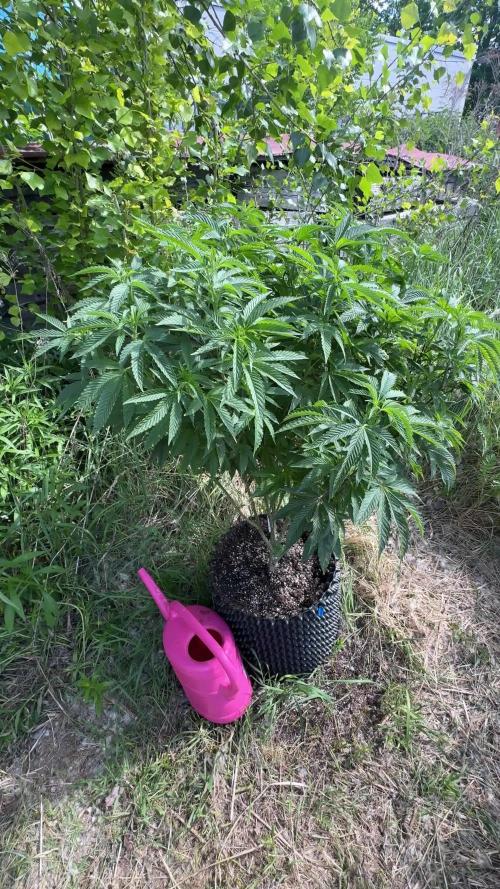
GMO × Triangle Mints BX – Week 13 Veg | Recovery, Defoliation, Pushing On
She’s bounced back well. The CalMag correction from last week has done its job — foliage is looking dark green and healthy across the canopy, no progression of the deficiency symptoms. Good to see the recovery was as quick as the diagnosis.
Did a defoliation this week to open up airflow and light penetration through the increasingly dense canopy. At 115cm and still in veg she’s building a serious frame — the LST continues to keep the tops even and spread wide.
Feed schedule unchanged: two feeds with CANNA Aqua Vega 4ml/l, CalMag Agent 1.1ml/l and Aptus Regulator 0.1ml/l, one feed plain water. pH locked at 6.2, EC at 1.5 mS/cm, 3L per feed.
The coming week looks warm but unsettled — temperatures staying around 24–25°C with a chance of showers and possibly some thunderstorm activity later in the week. The warmth is welcome, the shelter of her spot will do its job if things get rough.
Updates every Sunday. Stay tuned. 🌿


@Mrs_Larimar
Follow
February, 6th
The Plants are entering the second Week of Flower.
All Plants looking very Good.
Nice and green.
Its o much fun to grow in that small vessels....
I measured and its only 10g of Soil in the Sheeps
Only the candleholders got more Volume
Iam watering the Sheeps 2-3 Times daily , in letting them "dive" into the Feedingsolution
Iam very happy to be challengend by this, Ima feeling prepped to Grow
Soilless or Hydro
Have Fun with my " EGGHUNT"-Grows


@SweetheartOG
Follow
Girls are doing well with the LST. Kosher cake was topped last week and now has what looks like 8 heads.
3rd of June have given the girls living soil veg.


@Ultraviolet
Follow
Once again she passes my expectations, late to the show with trichome production. I'm surprised there is purple on the bud, maybe Purpinator does work. I thought I could see hints under the grow lights and thought my eyes were deceiving me, I was just being hopeful. But nah 2 of the 3(under the UV) have developed a beautiful tone of purple. I was never going to bother with a deep freeze but maybe the whole bud will change given conditions, that would be something, fingers crossed. 🤔 was a little skeptical that reducing temps humidity would change density, but it does, buds are solid something I've not been able to achieve before.
Rule of thumb is never to surpass 60% RH in the flowering phase and try to progressively reduce it down to 40% in the last 2–3 weeks before harvest. The plant will react as it seeks to protect its flowers, responding by producing denser buds and a higher concentration of resin. Cannabis plants are sensitive to sudden temperature changes, especially in the flowering stage. Extreme heat or cold can impact bud density and overall yields. In nature as a defense mechanism from cold, the plant sensing sudden dips in temperature will attempt to remove the pockets of air within the bud, it achieves this by compacting itself in doing so to better protect itself from cold snaps which are normally indicators in nature that worse weather is on the way.
Terpene levels are the highest just before the sun comes out. Ideally, you want as many terpenes present in your plants as possible when you harvest. Cannabis plants soak up the sun during the day and produce resin and other goodies at night. The plant is at its emptiest from "harvest undesirables" so to speak right before the lights on. Boiling cannabis roots during harvesting slows down the drying process. When you boil cannabis roots, it shocks the plant, closing the stomata on the leaves. This prevents massive moisture loss through the leaves, leaving only the floral clusters actively losing moisture at a reduced pace. I've always run a strict 60/60 and it took almost twice as long to dry to a snap than previous grows where I didn't boil for what it's worth.
Chlorophyll is good for the plant but not for you. When you harvest the buds, even after you flush them, if you flush them, they’re still filled with chlorophyll. Freshly cut buds are greener than dried buds because they still contain loads of chlorophyll. However, when rushed through the drying process, the buds dry but retain some chlorophyll, and when you smoke it, you will taste it. Chlorophyll-filled buds are smokable, but they aren’t clean. Slow drying gives the buds enough time and favorable conditions to lose the chlorophyll and sugars, giving you a smoother smoke. How the plant disposes of the chlorophyll and sugars by a process of chemically breaking them down and attaching the decomposed matter once small enough to water molecules which then evaporate back into the ether. Time must be given to the process to break down the chlorophyll and sugars. Think of it like optimizing the environment for decay.
All the nutrients it could ever need are in abundance, it eats nutrients based on its demand for growth, which is dictated primarily by available light.
Plant growth and geographic distribution (where the plant can grow) are greatly affected by the environment. If any environmental factor is less than ideal, it limits a plant's growth and/or distribution. For example, only plants adapted to limited amounts of water can live in deserts. Either directly or indirectly, most plant problems are caused by environmental stress. In some cases, poor environmental conditions (e.g., too little water) damage a plant directly. In other cases, environmental stress weakens a plant and makes it more susceptible to disease or insect attack. Environmental factors that affect plant growth include light, temperature, water, humidity, and nutrition. It's important to understand how these factors affect plant growth and development. With a basic understanding of these factors, you may be able to manipulate plants to meet your needs, whether for increased leaf, flower, or fruit production. By recognizing the roles of these factors, you'll also be better able to diagnose plant problems caused by environmental stress.
Water and humidity
*Most growing plants contain about 90 percent water. Water plays many roles in plants. It is:*
A primary component in photosynthesis and respiration
Responsible for turgor pressure in cells (Like the air in an inflated balloon, water is responsible for the fullness and firmness of plant tissue. Turgor is needed to maintain cell shape and ensure cell growth.)
A solvent for minerals and carbohydrates moving through the plant
Responsible for cooling leaves as it evaporates from leaf tissue during transpiration
A regulator of stomatal opening and closing, thus controlling transpiration and, to some degree, photosynthesis
The source of pressure to move roots through the soil
The medium in which most biochemical reactions take place
Relative humidity is the ratio of water vapor in the air to the amount of water the air could hold at the current temperature and pressure. Warm air can hold more water vapor than cold air. Relative humidity (RH) is expressed by the following equation:
RH = water in air ÷ water air could hold (at constant temperature and pressure)
The relative humidity is given as a percent. For example, if a pound of air at 75°F could hold 4 grams of water vapor, and there are only 3 grams of water in the air, then the relative humidity (RH) is:
3 ÷ 4 = 0.75 = 75%
Water vapor moves from an area of high relative humidity to one of low relative humidity. The greater the difference in humidity, the faster water moves. This factor is important because the rate of water movement directly affects a plant's transpiration rate.
The relative humidity in the air spaces between leaf cells approaches 100 percent. When a stoma opens, water vapor inside the leaf rushes out into the surrounding air (Figure 2), and a bubble of high humidity forms around the stoma. By saturating this small area of air, the bubble reduces the difference in relative humidity between the air spaces within the leaf and the air adjacent to the leaf. As a result, transpiration slows down.
If the wind blows the humidity bubble away, however, transpiration increases. Thus, transpiration usually is at its peak on hot, dry, windy days. On the other hand, transpiration generally is quite slow when temperatures are cool, humidity is high, and there is no wind.
Hot, dry conditions generally occur during the summer, which partially explains why plants wilt quickly in the summer. If a constant supply of water is not available to be absorbed by the roots and moved to the leaves, turgor pressure is lost and leaves go limp.
Plant Nutrition
Plant nutrition often is confused with fertilization. Plant nutrition refers to a plant's need for and use of basic chemical elements. Fertilization is the term used when these materials are added to the environment around a plant. A lot must happen before a chemical element in a fertilizer can be used by a plant.
Plants need 17 elements for normal growth. Three of them--carbon, hydrogen, and oxygen--are found in air and water. The rest are found in the soil.
Six soil elements are called macronutrients because they are used in relatively large amounts by plants. They are nitrogen, potassium, magnesium, calcium, phosphorus, and sulfur.
Eight other soil elements are used in much smaller amounts and are called micronutrients or trace elements. They are iron, zinc, molybdenum, manganese, boron, copper, cobalt, and chlorine. They make up less than 1% of total but are none the less vital.
Most of the nutrients a plant needs are dissolved in water and then absorbed by its roots. In fact, 98 percent are absorbed from the soil-water solution, and only about 2 percent are actually extracted from soil particles.
Fertilizers
Fertilizers are materials containing plant nutrients that are added to the environment around a plant. Generally, they are added to the water or soil, but some can be sprayed on leaves. This method is called foliar fertilization. It should be done carefully with a dilute solution because a high fertilizer concentration can injure leaf cells. The nutrient, however, does need to pass through the thin layer of wax (cutin) on the leaf surface.
It is to be noted applying a immobile nutrient via foliar application it will remain immobile within the leaf it was absorbed through.
Fertilizers are not plant food! Plants produce their own food from water, carbon dioxide, and solar energy through photosynthesis. This food (sugars and carbohydrates) is combined with plant nutrients to produce proteins, enzymes, vitamins, and other elements essential to growth.
Nutrient absorption
Anything that reduces or stops sugar production in leaves can lower nutrient absorption. Thus, if a plant is under stress because of low light or extreme temperatures, nutrient deficiency may develop.
A plant's developmental stage or rate of growth also may affect the amount of nutrients absorbed. Many plants have a rest (dormant) period during part of the year. During this time, few nutrients are absorbed. Plants also may absorb different nutrients as flower buds begin to develop than they do during periods of rapid vegetative growth.
432 Hz is said to be mathematically consistent with the patterns of the universe. Studies reveal that 432 Hz tuning vibrates with the universe’s golden mean PHI and unifies the properties of light, time, space, matter, gravity and magnetism with biology, the DNA code and consciousness. When our atoms and DNA start to resonate in harmony with the spiraling pattern of nature, our sense of connection to nature is said to be magnified.
Another interesting factor to consider is that the A=432 Hz tuning correlates with the color spectrum while the A=440 Hz is off.
Audiophiles have also stated that A = 432 Hz music seems to be non-local and can fill an entire room, whereas A=440 Hz can be perceived as directional or linear in sound propagation.
Once you adopt the idea that sound (or vibration in general) can have an equalizing and harmonizing effect (as well as a disturbing effect), the science of harmony can be applied to bring greater harmony into ones life or a tune to specific energies. There is a form of absolute and of relative harmony. Absolute harmony can for example be determined by the tuning of an instrument. The ancients tuned their instruments at an A of 432 Hz instead of 440 Hz - and for a good reason. There are plenty of music examples on the internet that you can listen to in order to establish the difference for yourself. Attuning the instrument to 432 Hz results in a more relaxing sound, while 440 Hz slightly tenses up to body. This is because 440 Hz is out of tune with both macro and micro cosmos. On the contrary, 432 Hz is in tune. To give an example of how this is manifested micro cosmically: our breath (0,3 Hz) and our pulse (1,2 Hz) relate to the frequency of the lower octave of an A of 432 Hz (108 Hz) as 1:360 and 1:90.
It is interesting to note that 432 Hz was the standard pitch of many old instruments, and that it was only recently (19th and 20th century) the standard pitch was increased. This was done in order to be able to play for bigger audiences. Bigger audiences (more bodies) absorb more of the lower frequencies, so the higher pitch was more likely to “cut through”. One of the oldest instruments of the world is the bell ensemble of Yi Zeng (dated 423 BC), tuned to a standard F4 of 345 Hz which gives an A= 432 Hz. The frequency of 345 Hz is that of the platonic year! Similarly many old organs are tuned in an A=432 as well; for example: St. Peter’s Capella Gregoriana, St. Peter’s Capella Giulia, S. Maria Maggiore in Rome.
Maria Renold’s book “Intervals Scales Tones and the Concert Pitch C=128 Hz” claims conclusive evidence that 440 Hz and raising concert pitch above scientific “C” Prime=128 Hz (Concert A=432 Hz) disassociates the connection of consciousness to the body and creates anti-social conditions in humanity.
The difference between concert pitch A=440 Hz and Concert A=432 Hz is only 8 cycles per second, but it is a perceptible difference of awareness in the human consciousness experience of the dream we share called existence.


@Hipichic
Follow
June 7th: We had a Thunderstorm roll through our neighborhood yesterday afternoon, with forty mph gusts and it almost knocked over a few plants, managed to grab what we had and prop up the stems for support. Hoping they weren't too stressed after it all!


@DWCpaqy
Follow
Are just in day 5 and two of them seems to enjoy.
Ph 5.8
Ppm 720
Ec 1340
****
First time growing, and first time with dwc. I chose to build my own dwc tank!
First week was alright, I think I put the seed to early in coco coir and then into leca in dwc tank.
Tap water is around 200 ppm and 7.6ph, I boil the water because of kalk.
First 2-3 days I was starting with 7.2 - 6.6 ph and 520 - 640 ppm
D. 4-5
640-790 ppm 5.8-.5.6 adding more terra Aquatica
D. 5-7
790-980 ppm 5.6-6.2 ph 23c tent 19c w.


@nonick123
Follow
Día 50 (09/12) Busy time
Solo riego!
Día 51 (10/12) CBD Auto 20:1 #1 no para de crecer! ¿Parará el stretch? 💥
OG Kush Auto avanzan las manchas en las hojas... ¿Será deficiencia o carencia?
Día 52 (11/12) CBD Auto 20:1 #1 está demandado más agua. Subo a 1500 ml / día de H2O RO
CBD Auto #2 está relentizando el consumo de agua (el top se muestra húmedo). ¿Estará entrando en la fase final de floración?. Según FastBuds le quedan 11 a 18 días!
OG Kush Auto también demanda más agua! Subo a 1250 ml / día de H2O RO
Día 53 (12/12) CBD Auto 20:1 #1 es increible como no para de estirarse y de formar nudos y hojas! Parece una Sativa pura que nunca para de crecer en floración!
CBD Auto #2 empieza a mostrar algunas hojas con senescencia. Se acerca la cosecha!
LSD-25 Auto está haciendo unos cogollos densos y duros como rocas 😍💥 No está tampoco lejos de la cosecha! 💥💨😁
OG Kush Auto produciendo una resina brutal en las hojas de azúcar! 😍
Día 54 (13/12) CBD Auto 20:1 #1 no para el stretch. Le hago una poda de bajos y ligera defoliación
OG Kush Auto está generando una cantidad de tricomas increíble. Además huele a Kush deliciosamente 😍😍😍
Día 55 (14/12) CBD Auto 20:1 #1 para un poco el consumo de agua en ¿Fin del stretch? Casi toca la lámpara de nuevo!
CBD Auto 20:1 #2 empieza a mostrar la senescencia.
Reviso los tricomas con muchos turbios y alguno transparente. ¿Estará en una semana más aproximadamente? 🤔
Día 56 (15/12) OG Kush Auto ha bajado un poco el consumo de agua
La cantidad de tricomas que está haciendo es insana e increíble. Y como huele! 😍
LSD-25 Auto muestra los tricomas trasparentes y algunos turbios. ¿Quizás dos semanas para la cosecha?
💦Nutrients by Bio Tabs - www.biotabs.nl/en/
🌱Substrate PRO-MIX HP BACILLUS + MYCORRHIZAE - www.pthorticulture.com/en-us/products/pro-mix-hp-biofungicide-plus-mycorrhizae
"GDBT420" 15% DISCOUNT code for the BIOTABS Webshop https://biotabs.nl/en/shop/
shorts_status_processing


@CharasKush
Follow
These days it managed to have some nice sun light, but most days the sky is cloudy.. Had to bend several branches to make it fit in the greenhouse, but she's still growing strong!



@Sobreruedas
Follow
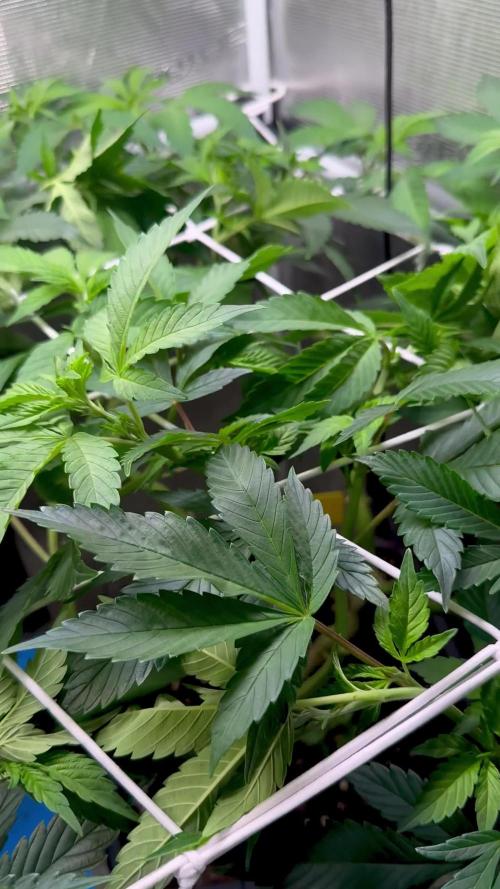
This week I focused only on bending and tucking the branches under the scrog net, trying to fill the entire space as evenly as possible.
No other changes were made — just guiding the growth and keeping the canopy level.
If everything continues like this, I might flip to flower next week 🌿💪


@Salokin
Follow
Love Glookies, Glookies is loving the ScrOG ;) super vigorous plant, that handled and repaired more than a few broken branches amazingly. The pheno is awesome, with buds being light green with a ton of purple hues in them. A powerhouse that I can highly recommend. Took a bunch of clones so that I can grow her again right away. She is a stretcher so beware and factor that in when growing her.


@HeartStrong_Garden
Follow
Plant two is doing a little better color wise. Something is going on with the leaves of plant one mostly. Maybe it is because i was using overflow water straight from the air conditioning unit instead of the tap? I'm having to pull a lot of dead leaves off


@RussianGrower
Follow
So it's time to harvest Russian machine guns. The plants were high because we pulled them with a lamp and did not use LST. The final product was removed on the shelf of the refrigerator.00

shorts_status_processing


@Jack_Greenstalk
Follow
the plants shown may be a little off exact age, I vegged for total of 34 days this grow from seed sprout, now i am just going back and uploading pics in bunches knowing when i flipped to flower.More accurate documentation of timeframe shown on instagram @jackgreenstalk this is more for data sharing then just photos for me


@DD_420
Follow
Pretty much the same as last week. Just putting on weight bulking up. No leaves changing yet either. Should start seeing leaves changing any day now.....
