


Likes
Comments
Share

@RanTanPlan_69
Follow
Beginning of the 7th week. Watering every ~3 days. Switching with and without fertiliser.
Gigi is gar in the flower Production
Bella is a bit later, but starting to give a lot of Energy to her Flowers too.
I try to keep humidity between 45 and 55%. Temperature oscillates between 20 and 26 degrees .
Let’s keep going on the Track ! 🔥👌💪
Update 1 :
Bella is starting to have a dark purple Color which makes her Look wonderful !! She has started to produce her Flowers and takes it very seriously. She was Talking her time compared to Gigi but is catching up !
Gigi is giving Energy to gain more and more flower density. I am a very proud dad !

Likes
7
Share


@Athos_GD
Follow
The buds are really sticky and smell super strong. This stuff gives you a head high followed by relaxation. I dried for 14 days at 60 degrees Fahrenheit and 60 % RH.

Likes
56
Share


@Prilyfe13
Follow
February 23, 2024 Day 8
Both babies got 250 ml top water today. I'll check on them in a couple hours and see how they are. Other than that. Nothing else to do.
I did want to mention how very similar these two are. I think they're the same phenome. Although, it may be a bit early to really tell. That would be cool though.
Beautiful green color and perfect little stalk. The true fan leaves are starting to show themselves now, so I can officially move them into the Veg Stage.
So for this week, the focus will be watering and ensuring the light intensity is at the right level. I'll probably wait another few days before I think about introducing some nutrients. I'd like to start when the true fan leaves are fully showing. As I've said before, the soil is used, so I think a bit of recharge and Advanced Nutrients 3 Part Base solution would be a good idea. At a minimum of course. I'm counting more on the recharge to really kickstart the soil back to life. I'm definitely going to need to do a full watering when the first node starts and with the nutrient solution. However, I feel like I may need to do that sooner rather than later. Based on my last grow, the biggest plant had the most water in the second week of growth. I even thought I overwatered, but nope.
So I'm going to try to replicate that. Especially because this is a super fast strain. They'll need all the water they can get. I'll start that on my next watering. I'll bump it up to 500 ml and focus mainly on the outer rim to help the rest of the soil get to the right moisture level without disturbing the environment they already have at the base.
The light is still the same distance from the plants with the same PPFD. I'll start to focus more on DLI in the coming days as they grow. I have my light schedule for the week and plan to stick to it, letting the intensity slowly increase for the start of the next week and so on. I was considering increasing the power to 40% when I need to increase the intensity, but I have so much distance to play with, I might as well keep it at the same level until I get some nodes going. By flower, I'm hoping to have a perfect DLI of 45 by flowering. And hoping to be able to bring the light up to 100% for super deep penetration by then. I'd also like to get the light down to 24" for the veg stage. It seems to be the sweet spot for the coverage footprint.
Also, I think I got the Tent Environment down for once. The night temp drops to around 68° while the day temp, although slow to climb, stays around 77°. I'm hoping that doesn't cause a stunting issue with the temp swing at such a young age. I think it will be fine. We shall see. The average temp is a bit low though. I may increase the night temp to 72°. That should put the average over 75°. The RH is pretty steady across the board around 72% with it dropping a little bit to 68% and up a bit higher at night to 74%. The VPD is also spot on averaging around 0.82 kPa. During the day it climbs up to 1.03 and at night drops down to 0.77 kPa. It's a bit low for my taste, but with the increased temp, I should see a nice round 0.83 kPa at night.
Someday I'll get an automatic humidifier.
Anyway, I know it was a lot, but it's a new week.
See you tomorrow:
Grow System Environment:
Temp: 74.6°
RH: 71.8%
VPD: 0.82 kPa
February 24, 2024
Kind of a big deal today for both ladies. So I in have a pair of Tropicana Cookies sharing the tent with these plants. The TC is showing signs of deficiencies. So to combat that, I added a 1/4 tsp of Recharge to a gallon of water. As I'm growing both strains as similarly as possible, I fed 250 ml to all 4 plants. Hopefully the packaging is correct and it won't burn these little babies. They are definitely hitting Veg already. But to be on the safe side, I covered them with a Starbucks cup and then watered them. It kept the soil from getting saturated at the base and will also help promote outward growth.
As for watering itself, I feel like I should be watering more to prep the soil for when the veg stage really hits and the roots start to search more. I'd like to get to the point of runoff by the end of the week. Maybe I'll add another 250 ml with the cup in place again tomorrow. I will also need to water at the base in the next day or so.
They are both growing the exact same still. I know it's only been a day, but a lot can change in that time, so nothing yet. Plus, what else am I supposed to document?
Stems are strong. Leaves are a beautiful green color and the true leaves are starting to spread more. Lookin good.
I'd also like to mention that it is 16° outside today, so even with the heat cranked, it's not really doing much. So low temps for a bit today. Around 70° much too low, but not much I can do until the heat catches up.
Grow System Environment:
Temp: 73.4°
RH: 67.6%
VPD: 0.90 kPa
February 25, 2024
Not much to do today. I'll either water 250ml today or 500 ml tomorrow. Either way, it's time to start wetting the whole container. I'm starting to think I should have done this the day before planting them. Oh well, I'll try that next time. For now, I'll stick with the gradual watering. It'll be increased again next week if needed.
These babies look great. The leaves are getting longer and seem to be a medium width. Much like a true hybrid. So far at least. It's still pretty early to tell. We shall see.
The light intensity is pretty good as well. No changes needed at the moment. However, I have a feeling I'll be dropping it an inch or two in a couple of days to match the schedule. I don't think I need to increase the power yet. I'll start increasing the power when I start training. It makes sense. I'll be pulling the tops down, so the DLI will be off a bit. But instead of dropping the light, increase the intensity so it can penetrate the new canopy right away. And if I can hover between 22" and 24" light distance, it should be perfect. I feel like that has the best footprint for this setup.
Interesting Theory: Mostly for My Records:
I may be slow on the info, but I think I figured out how brightness and distance make a difference in PAR and Brightness as well as footprint.
The light distance defines the footprint. And the light power defines the brightness. Combining the two makes for a PAR reading.
However I feel that the higher the brightness, the deeper the canopy penetration. Distance doesn't really change the brightness. It does change the PAR, but we can fix that with Distance. As long as we match the PAR reading to the proper level, there's no difference, correct? Maybe not. A less bright light even super close to a canopy would not be strong enough to penetrate the canopy because the power isn't strong enough. Even at the same PAR reading, it still wouldn't be powerful enough to penetrate. On the other hand a brighter light with the same PAR reading would work differently. Same PAR reading at a higher distance. But the power would also be higher. I feel that the light will penetrate deeper as long as the PAR remains the same.
An example is a too large plant for the setup. Light distance was under 9" and power was down to 30% the PAR reading was much too high even with such low power. The light however couldn't penetrate below the first set of leaves and buds very well. But, in a smaller tent with a 100 watt light, I grew a wonderful plant where the light penetrated the canopy deeper because it was brighter and the distance was deeper. The plant wasn't nearly as big as it was in a 2x2 tent and 1 gallon container compared to the 3x3 tent and a 5 gallon container. But it had dense buds almost all three way down to the base. The larger plant had bud as far down as I allowed, as it mostly came out as popcorn, loose buds and some larf.
This all brings me to believe that light power directly affects the canopy penetration and not necessarily distance. Distance plays a role with footprint and brightness, but not power. I also believe light heat makes a difference as well. A brighter light is warmer and plants like to be warm. So they will stretch to the warmth of the light as well. Less power means a cooler light and a less happy plant. My opinion of course.
As I'm keeping this for my records, if anyone has any extra info, or correcting facts, please let me know. I'd rather have a theory be corrected or supported so I have the correct information. Doesn't matter how old this Diary is as I check all comments. Thanks in advance!
Update: I decided to water in 250 ml of Recharge without the domes. I'll do another 250 ml tomorrow with the domes on and so forth until they get too big to fit under the dome. Then it will be normal watering.
Grow System Environment:
Temp: 76.1°
RH: 74.4%
VPD: 0.57 kPa (a bit low, but I'm measuring 2 different probes)
February 26, 2024
Mid-week update:
Both ladies are looking great! Still wonderful green and growing nice and steady.
They are about 6 cm tall or 2 3/4".
DLI: 18.1 mol/m²/d
PAR: 280 ppfd.
I also watered in another 250 ml with the domes on today. I'll run the 250 ml daily until week 3 and then I'll change it up to 500 ml every other day for that week. After that, everything should be good to go for the flowering stage. I'll also install the basins after week 3. It should be excellent timing. They are 1 gallon basins. So refilling should be every other day or so. The goal with this run is to not have to top water at all. The basins should work perfectly as long as I set them up properly.
Grow System Environment:
Temp: 75.8°
RH: 70%
VPD: 0.83 kPa
February 27, 2024
So major problem in my opinion. My humidifier is blanketing the whole tent with the white powder they give off. I wasn't running my exhaust fan as I didn't need it at all. So I turned it on as low as possible and started one of my circular fans. Hopefully that solves the problem. I had to carefully wipe it off of Banana PP B. However, regardless of the powder, these two are growing quite nicely. Maybe a little slower than I was hoping, but still nice steady growth.
They both got a little misting today as well as will be getting the 250 ml watering after the water comes up to room temp. This watering will be PHed to 6.0 and will be dome free. There was still about 400 ml of Recharge left, so I let it stay and just won't add more til next week when I start the base nutrients. I'll also be adding Cal/Mag.
Other than that, they are still super green and super healthy. Hopefully they take off when the base nutrients kick in as well as the container soil being properly moistened.
Grow System Environment:
Temp: 74.7°
RH: 60.6%
VPD: 1.16 kPa
February 28, 2024
Not much going on today. They both got their daily 250 ml watering PHed at 5.95. I didn't go near the base though. So it's kinda like having the dome, but not as precise.
They are slightly reaching and the first set of true leaves are finally starting to pop out. The node is also growing at what seems to be a wonderful pace. Still a beautiful green and the stalk is nice and strong. Very straight as well. They do have a bit of a lettuce structure on the single fan leaves. It'll be fine. The true leaves look spectacular.
Lighting is still pretty spot on. 2 more days and I'll be either lowering the light or increasing the intensity. At this stage I don't think I need to increase the power. The light distance is pretty far away. That gives me a good 6 inches of wiggle room. I'll increase the intensity when they start to grow a second node. On the other hand, I could keep the light where it's at for now and let the plants grow into it. Then I can increase the intensity when they get to that point. Week 3 from seed starts in 2 days. Which should be the true first week of Veg. I'll evaluate on what to do tomorrow. I'm pretty sure I need a DLI of 20 mol/m²/d starting next week. So I'll run the light at 350 ppfd or DLI of 22.7 mol/m²/d. Just above. It seems to be the perfect spot for these ladies.
I'd also like to add that I've had zero issues with the 250 ml per day. It keeps the soil moisture just around 50%. Not sure if that means I'm not getting any deeper, but that's why I'll be starting 500 ml every other day next week. I feel that adding the extra 250 will help penetrate the soil better and a bit faster. Especially because those roots are going to start stretching past the dome width. And it's time for the roots to start growing down.
Grow System Environment:
Temp: 75.4°
RH: 62.9%
VPD: 1.09 kPa
February 29, 2024
Today is the last day of the first week of plant life. Week 2 from seed. Both plants got the 250 ml top water without dome.
Lighting looks great. Although, I noticed that a couple hours before lights out, they were both standing straight up like there was no light, but they still had a good 3 hours left. Strange or good? Either way, it'll be adjusted tomorrow to a DLI of 22.7 mol/m²/d. PAR will be 350 ppfd.
I'm also going to try and lower the light a smidge. Maybe down to 26". We shall see what works best.
Both plants are super healthy and right on track. Maybe a little slower than I'd hoped, but still steady growing. I feel like this will be a 4 week veg time. Greens are beautiful and she looks very strong. Leaves are growing nicely and I can only imagine they will take off when I start the Advanced Nutrients regimen tomorrow.
At least I hope they take off. They should though. Tomorrow is around the time when they really start taking root. That in turn speeds up growth so I think I'm right on point here.
I'm also going to be posting a video every week. Once the 2 start to show their differences and greater size, then they will each get a video every week.
Update:
I realized my plants were reaching a bit too much and leaning in toward the light. That being said, they definitely need more light, so I lowered it until I hit a DLI of 19.8 mol/m²/d. That way when I bring it up to 22.7 mol/m²/d it won't be hit so hard immediately. I should have dropped the light down a day or two ago, but oh well. It will be on point for the rest of the grow.
Grow System Environment:
Temp: 73.0°
RH: 62.3%
VPD: 1.03 kPa
The temp slammed down over 50° last night and I'm having a bit of trouble combating it. It'll definitely take a decent amount of the day to re-acclimate. However, it should be fine. I have the temp in my room set to 80° so that should combat the sudden cold.

Likes
37
Share


@GODSGIFT_2005
Follow
For LIQUIDS & NUTES ******GREEN BUZZ NUTRIENTS***** organic.
Also i’m using their LIVING SOIL CULTURE in powder form!
MARSHYDRO ⛺️ has large openings on the sides which is useful for mid section groom room work. 🤩
☀️ MARSHYDRO FC 3000 LED 300W
💨MARSHYDRO 6” in-line EXTRACTOR with speed-variation knob, comes complete with ducting and carbon filter.


Likes
105
Share


@Natrona
Follow
Frostbanger Plants 1-6
Week 9 May 18– 24
FLOWER 5
Nutrients : 3 gal
GH Micro 20 ml
GH Gro 10 ml
GH Bloom 30ml
CalMag 15 ml
Recharge 10ml
Green sensation 15ml
Power buds 7.5 ml
5/18 PH 6.67, PPM 935, temp 68.5 1 ltr each
5/20 PH 6.67, PPM 1330, temp 68.5 2ltr each
5/23 PH 6.6, PPM 1570, temp 68.5 2ltr each
5/24 pics & vid
Since all 6 gals are getting frosty, I did some trichome pics. The statistics on Frostbanger indicate 50-day flower. Pics show mostly clear and milky.
There are a few with amber trichs and many orange pistils indicating maturation. At least 3 more weeks for maturity on these gals.
I continue manual control of the environment and using 3 circulating fans and the 4” exhaust vent from my 3x3.
I have the AC pushing air in and the exhaust pulling air out. This creates a neutral pressure tent environment-neither positive nor negative.
It looks like growth has stopped and plant height has been reached. Now is the time for buds to fatten and frost up. All 6 of them are short remaining less than 3 ft. They range from 15 to 31 inches. #4, 5 &6 are showing some fade, particularly #4.
Upon opening the tent, a melon smell comes off the buds if I get close, and more stickiness was observed during the process of defoliation. They are living up to the new strain’s name. #5 is the frostiest followed by #2. Wow week 3 of flower and that much frost already. Before FastBuds announced the strain name and characteristics, I was disappointed that FBA2502 could be an indica sleepy strain but the universe provides what you need at the time. The new strain profile indicates a whopping 29%THC with mainly sativa uplifting, euphoric, social effects with sweet fruity flavors which I love and enjoy. In addition, I recently bought a dap press and this strain is frosty and resinous. She will be great to press for live rosin.
FBA2502 is FROSTBANGER. Meet Frostbanger Auto, an autoflowering and Indica-leaning hybrid packing a staggeringly high THC content averaging 29%, making this one of the most potent strains on the market. It was created by Fast Buds through crossbreeding Gorilla Glue and Chemdawg, two equally iconic strains. Growers must know that these difficult-to-grow plants will pose specific challenges in terms of environmental control and nutrition, making them best suited for cultivators with some experience under their belt. The flowering cycle is short, averaging only 50 days, and yields are usually around 300g/m². The Frostbanger Auto flavor and aroma are both mouthwatering with a delightful combination of sweet, fruity, and flowery notes. The high is mainly Sativa-driven with uplifting and happiness-inducing effects that lead to euphoria and a general sense of well-being. You might feel sociable and talkative, but too spacey to say something. Following this surge of energy comes a deepening sense of relaxation, leaving you sedated and completely at ease with the world. Due to its potency and these long-lasting effects, medical patients hail Frostbanger Auto for treating chronic pain, stress, and even depression.
Measurements:
#1 15”
#2 20”
#3 17”
#4 30”
#5 31”
#6 24”
P.S I added a no churn ice cream recipe in week 4 of Natronas recipes. It is easy 3 ingredients. I bought Mango puree instead of fresh and reduced that to reduce water content. Try it. 😋
Your likes and comments are appreciated. Thanks for stopping by.
Growers love 💚🌿
💫Natrona💫




Likes
55
Share


@pifflestikkz
Follow
Day 64
05/07/24 Friday
Start of week
Big feed today 4L pH 6.2 only 20% run off.
So I have done final LST on her, I'm proud of what she has grown into over this veg period.
What a BEAST 🙌💪🤯💚
I'm allowing this week to be final veg week before I flip her.
She has so many tops I'll count them and add to diary tomorrow ✌️💚
Day 65
06/07/24 Saturday
The day after LST, she has bounced straight back 💪, she's a damn beast 👌
Picture update
Day 66
07/07/24 Sunday
Watering with De-chlorinated tap water, pH 6.0 and added cal-mag 7ml for 5L.
No run off but bottom of fabric pot is lovely and moist so will leave it there today 😁
Day 67
08/07/24 Monday
De-chlorinated tap watering today 5L with DyNoMyCo. Hoping this will help root zone uptake more nutrients during flush- we will see.
Updated short video
Day 69
10/07/24 Wednesday
Feed today! De-chlorinated tap water pH 6.0. did a 3L run through had about 1ltr run off due to high humidity this week, she never needed it I guess. But just wanted something to pull fresh oxygen through substrate.
She's getting so damn big, have to flip her tomorrow else she'll never fit under 600w hps in tent 🤦♂️😍

Likes
25
Share

@pifflestikkz
Follow
Day 85
25/09/24 Wednesday
Feed today using de-chlorinated tap water pH 6 only.
Day 87
27/09/24 Friday
De-chlorinated tap water pH 6 with Plagron PK13-14 today.
Picture and video update 😎
Day 89
29/09/24 Sunday
De-chlorinated tap water pH 6 only today. Will start only water next week 👌💚 pictures 😁
Day 91
01/10/24 Tuesday (End of Week)

Likes
75
Share


@Pungolian
Follow
What can i say, growing into a beastly beauty! Still dry amendments only every other watering. Went quickly from a gallon every other day to 2 1/2 gallons a day. Video is one of about 5 thunderstorms this week

Likes
34
Share


@Bluntblazer66
Follow
I am in the process of cutting and trimming
OS = 115g wet
OS#2 = 80g
OS#3 = 130g
Total dry = 130g
Unfortunately after trimming all I was left with was a pile of popcorn, very few really nice buds. All stalls and with a lot of sugar leaves
Overall I am disappointed

Likes
7
Share


@Kendog420
Follow
This is technically what I call week one, the first week of germination doesn't count! LOL Anyway 13/14 germinated and 12 of them are right on track, Little Baby Super Glue came out of the gate stunted and is slowly making a comeback. I also added a video of my little happy place!

Northern Lights XTRM Auto · Amsterdam Marijuana Seeds AMS
AK47 Xtrm · Amsterdam Marijuana Seeds AMS
White Widow · Amsterdam Marijuana Seeds AMS
Blueberry 420 Auto · Amsterdam Marijuana Seeds AMS

Super Glue feminized seeds · WeedSeedsExpress
Blue Dream feminized seeds · WeedSeedsExpress
Borderliner XTRM · Amsterdam Marijuana Seeds AMS
Likes
85
Share


@Organic_G
Follow
Die Babys haben die 10. Woche abgeschlossen und den Tag 71 erreicht.
Die meisten Trichome waren Milchig, eher wenig Amber, ich wollte einfach mal die Wirkung testen und Sie nicht noch weiter reifen lassen, beim nächsten mal warte ich auf einen 20/80 mix.
Geruch ist super, süß, Fruchtig, Creamy echt was besonderes.
Die Ladys haben 5 h Dunkelheit vor der Ernte bekommen.
Sind nun als ganze Pflanzen für die nächsten 10 Tage bei 18-20 C und 60 % RH am trocknen, bevor Sie in die GrooveBags kommen.

Likes
59
Share


@Mastr
Follow
Bud fatten up and smell and look so nice
😍
So happy to grow such beautiful plant she is mazing with lots off branches but bit short only 60cm
Every day going she get darker purple
Because she so bushy some bud won't get air and light so every time I feed her I have to remove some top leaves or middle leave s to get ligh and airflow I hate popcorn nugs and she seems have alot popcorn nug but bud still growing and fatten up I won't rush to harvest her I let her grow atleast 3 or 4 weeks more
Likes
14
Share

@Bncgrower
Follow
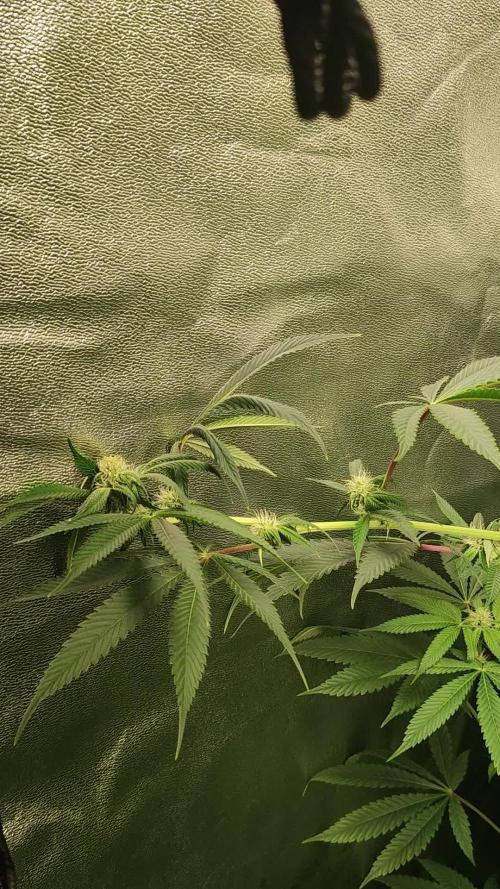
This girl went beyond the height limit, stretched too far, hitting the top of the tent. I had to do a hst on two buds; I'm not a big fan of high-stress techniques and I've never needed to do this before, so I hope everything goes well and this girl doesn't become a hermaphrodite...🤞


Likes
53
Share


@Hempface86
Follow
Ladies and gentlemen today is the day! Day 64 and she is officially chopped.. now, I will admit that the very bottom buds are not one hundred percent matured, but 90% of the plant is exactly where I want it.. a little bit of amber with at least 75% cloudy .. thank you Zamnesia Seeds for sponsoring this grow, it has been an absolute breeze from beginning to end and she smells and looks like some exotic flower.. Also a good yielding plant as well.I'm expecting over 6 oz of dried flower.. hope everyone is doing well with their ladies.God bless and happy growing ✌️

Likes
67
Share


@Basementganja
Follow
Day 91 from seed! She's been fed/watered every 4 days (when media is 90% dry) with 2.5 gallons flood-and-drain style of the above listed nutes.
Other than that, I have only been plucking the occasional leaf that looks at me funny! :)
Next week is flush week! I'll start next week by dragging her into the bathtub, to flow 50 gallons of tap water through the roots.
Then she will be on plain tap water(2.5 gallons every 4 days) for two waterings - She should be dry on day 100, and ready for harvest!
Likes
6
Share


@GuerillaGorilla
Follow
Sept 10th
This week was windy and finally some decent shower.
Nature was begging for it but as we all know it was a headache for me personally.
I went to visit the girls and noticed how the wind was taking its toll.
Killer Kush (the biggest) was banking 15 degrees and the Outdoor Grapefruit was acting as a windscreen for Maroc.
She needed some more defoliating to prevent moisture getting stuck in tight places. I pulled the net further down to improve airflow...a little to much. When i pinned the lower ring to the ground a big branch snapped😪
Emergency repair was done and I believe she will be all right.
She was reinforced and i build a nice tent over the wound to prevent water coming in. Open from the bottom still alowing air to pass underneath.

Likes
43
Share


@Esoteric_growing
Follow
Really happy with the quality, only had three plants so yield was down on usual.
The THC content was absolutely insane, two of the phenos had a zkittlez terpene and the other was more gelato leaning.
This is my favourite strain of barneys to date👍