


Likes
Comments
Share

@Borberad
Follow
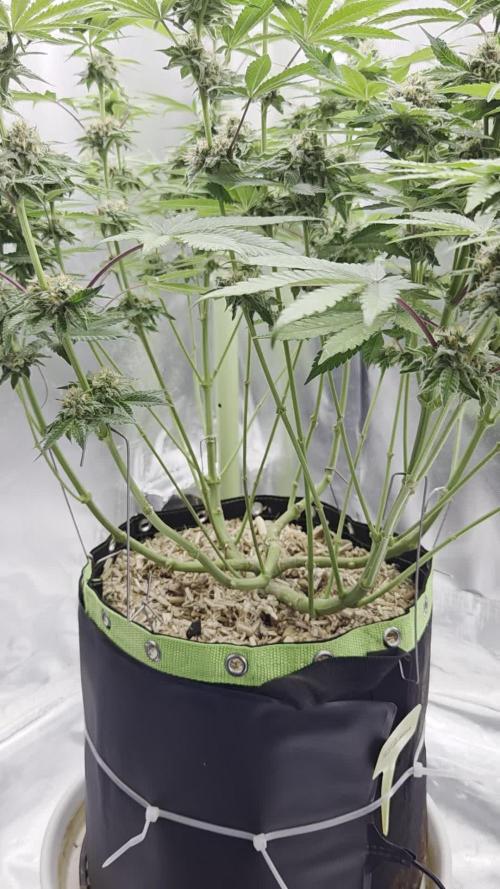
Woche 12
Solangsam wird sie bunt und es es deutet sich an das sie aus dem Soil nicht mehr viel rausholt. Da sie noch gut 20 bis 30 Tage stehen soll gibt es zur Unterstützung etwas Hesi Boost und ab und an etwas Plagron Green Sensation.

Likes
8
Share

@Dameon0803
Follow
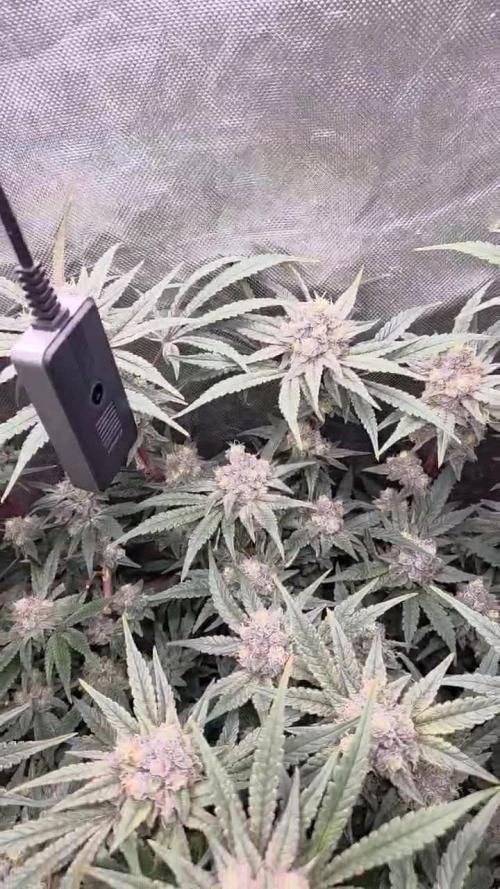
Another smooth week with the continued issues ive previously addressed. Trichomes are multiplying and buds have grown some. With the dehumidifier running pretty much constantly, it has bypassed my carbon filter. (I have my dehumidifier extract from outside the so I'm not adding additional, unwanted, heat.) Smell is very evident within the entire room. Final week of feeding and I have turned my reds down to 50%. Took trichome shots for fun around the front of the plant.

Likes
11
Share


@DixTheReal
Follow
É stato il mio primo ciclo di coltivazione e purtroppo ho fatto molti errori che mi serviranno da esperienza. Ho sbagliato inizialmente la distanza della lampada e le piccole si sono allungate troppo, poi ho iniziato LST forse troppo presto e non sono riuscito a orientare bene i rami per farle crescere tutte alla stessa altezza infatti alcuni fiori sono proprio piccolo rispetto ad altri, altro errore quello di non misurare il PH e questo mi ha portato ad avere inizialmente carenze di fosforo e potassio per poi continuare con calcio. Ho sbagliato le dosi di fertilizzanti che dal prossimo ciclo alzerò per provare ad avere risultati maggiori in termini di quantità e infine come ultimo errore riconosco di aver iniziato il flush troppo presto (17 giorni di flush) quando avrei potuto dargli almeno ancora un’altra irrigata di fertilizzanti per far gonfiare i fiori. Nonostante tutto sono contento ed é stato molto divertente e istruttivo, ora le piante stanno seccando e poi le passerò in concia per provare finalmente il sapore. Ho fatto una pesata a umido solo di una pianta perché tutte e due insieme non ci stavano ma credo sia sballata come misurazione quindi peserò direttamente a secco.
A secco sono risultati puliti 68g, ho fatto una concia di 3 settimane e il sapore é davvero buono. Sballo da divano, molto potente come effetto. Sono molto soddisfatto

Likes
9
Share


@Krissci
Follow
Day 3
1st bit of training this week.
Looking healthy.
My aim is to allow lowest bud sites to keep up with the main heads..
LST LST LST LST LST
During this stage is most important to train Ur plant into the shape u want.

Likes
44
Share


@GODSGIFT_2005_JM
Follow
For LIQUIDS & NUTES ******GREEN BUZZ NUTRIENTS***** organic.
Also i’m using their LIVING SOIL CULTURE in powder form!
MARSHYDRO ⛺️ has large openings on the sides which is useful for mid section groom room work. 🤩
☀️ MARSHYDRO FC 3000 LED 300W
💨MARSHYDRO 6” in-line EXTRACTOR with speed-variation knob, comes complete with ducting and carbon filter.

Likes
36
Share


@valiotoro
Follow
Super frosty & rock hard buds💥
Delicious terps🤤
Perfect buds leaf ratio
Processing
Likes
10
Share


@Greenwizhun
Follow
I have bought 400W 3050k 41000 ceramic metal halide
(Best Than hps
Hps 56000lm for human eye
Cmh’s 41000 lm in par range


Likes
2
Share


@DrBud420
Follow
02.11.'24
After 5 days of drying, this little girl who was a little bigger than a meter gave 950 grams and a little bit of popcorn...this picking was 870 and a little bit of popcorn, and 4-5 weeks ago during a storm, one branch broke, which yielded about 100, but let's say 80 for sure, a total of 950 grams of beautiful, huge, potent buds

Likes
16
Share

@valiotoro
Follow
Hello everyone 👋
Week 1 has passed
She’s doing very well growing at fast pace with a beautiful green color on the leaves🔥
For the nutrient 1/2 plagron terra grow & B.A.C foliar spray 4ml/L once a week💦
See you next weed😎
Processing
Likes
43
Share


@Jack_Greenstalk
Follow
week 3, at day 21 I started to defoliate. needs more airflow around colas. This is the start of defol, will clean and prune as needed next week. Stretching has slowed and colas are starting to stack. Ran a sort of modified manafold into the scrog. "V" on the left has 15 tops from 4 main stalks, she was topped to 4th node early on. "Blue nemo" was topped to the 3rd node early, she has 18 tops after the week 3 prune of the week lowers who couldnt make it up to the canopy. I left some popcorn buds down low that have began to develop, will throw these in the ice water hash after harvest.

Likes
17
Share


@Bobo_Zion
Follow
This is the first week of the plants being above soil, we did lose one but we are germinating another to replace that. I think the one we lost was due to heat stress, the others are holding up pretty well, there is another one that showed signs of heat stress, we just moved it a little deeper in the tent and it seems to be doing okay.
Likes
19
Share

@RDWCGrowing
Follow
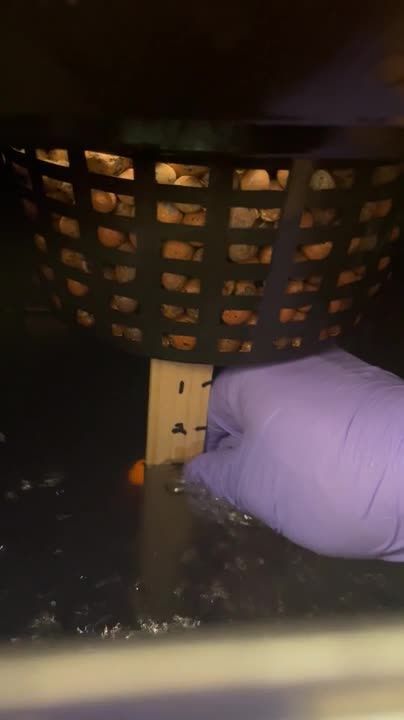
Week 1 Day 1 - 8/12/2023
1st Water change Day! Such a special time it is when you remove the little bit of Nutes that you gave them as an appetizer and you give them their first real meal.
Added
39 Gallons of Water to my system
SILICA= .5mil/Gal = 19.5 = 20mil
Root Drip = 1mil/Gal = 39mil
Cal Mag= .25mil/Gal = 9.75 = 10mil
FLoraMicro= 3.0mil/Gal = 114mil
FloraGro = 2.0mil/Gal = 78mil
FloraBloom = 2.0mil/Gal =78mil
ORCA= .5mil/Gal = 19.5 = 20mil
Week 1 Day 2 - 8/13/2023
Everything is looking good the roots are making thier way to the water and the new grow is looking nice and green.
Week 1 Day 3- 8/14/2023
Everything is right on track, they are looking beautiful and in the praying postition all leaves happily lifting towards the light.
Week 1 Day 4- 8/15/2023
Looking beautiful today and looked like she could use her first haircut.. gave her a TOP off. Roots are laying in the water everything is looking right on track..
Week 1 Day 5- 8/16/2023
walked in and the humidity was under 60.... ohh noooooo.. So I added 2 humidifiers to the tent and attached them to my InkBird controller which is set to 62. She had roots nicely in the water.. this grow is on!!!
Week 1 Day 6- 8/17/2023
Humidity was a little low this morning, so I refilled the humidifiers. Other than that, the temp looks great, the PH looks great, the PPM looks good the plant is in the praying position and all damage from the little drowning seems to have been fixed. Happy Happy.
Week 1 Day 7- 8/18/2023
Yay.. week 1 in the books, roots in the water growth has started first hair cut given and both side nodes are growing. Everything is looking good and on track.. A lot better than week one of the last grow when I had them drowning week 1.
Really excited on how this grow is going to come out.


Likes
1
Share


@MindFlowers68
Follow
Some of the plants showing more signs of yellowing from watering issues and ph issues. Luckily I was able to get a nice strong batch of Boogie Brew compost tea made and gave them all a nice soak and bath with it. Within two days all but one of the plants bounced back. Now that the plants are able to fend for themselves a little better was a good opportunity to try to harden them off the ones going outside to the elements outside. I did so by placing on a shaded part of my deck for a few hours. I was also able to get my tent inside ready and they were moved from the small cool grows tent to my 4x8 tent with my big lights. I adjusted the light to be around 500 PPFD at canopy.
Likes
7
Share


@Jays_Not_Here_Man
Follow
Overall, the Girls are doing great. #2 is still showing some nitrogen excess, but is doing well. I’ve adjusted her feeding specifically in hopes to correct. #1 is not showing the same issue, and is motoring along. Both are stacking nicely, and are bringing on some smell now, and are sticky to the touch. I estimate about 3 weeks more, but who really knows with Autoflowers? Happy Gardening 🇨🇦❤️🌱😎💨

Likes
13
Share

@Arcadium
Follow
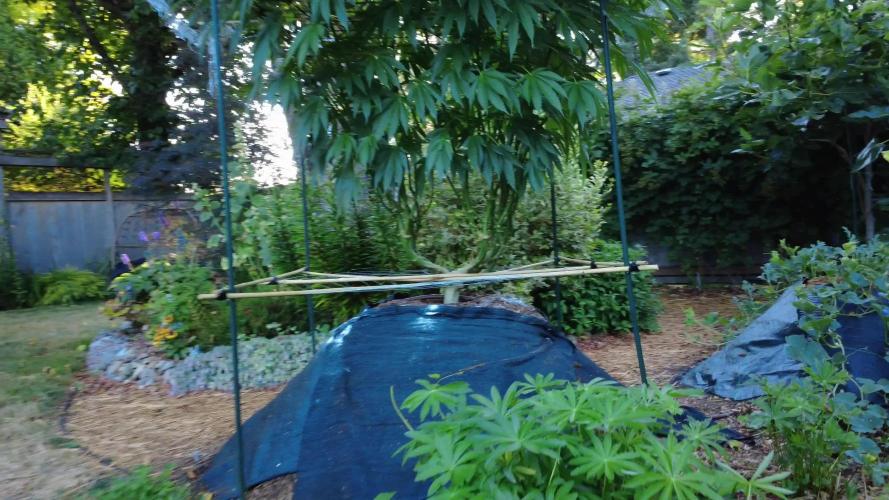
Well, marking the first week of flower. Lots of pistils, flower has begun. Just wildly hot weather, 33c days, full sun every day, we've had 6mm of rain in 2 months, average rainfall for June / July should be 60mm. As much as I love the weather, climate change / water scarcity worries me. Luckily we have a good clean glacier fed reservoir with strict water restrictions in summer.
Made a compost tea in 5g bucket, compost, molasses, kelp, Epsom, some coir, and aerate for 24hrs.
Removed some inner nodes not catching up to the cannopy, and some lst clips for the tallest nodes. Cannopy is looking really great and FLAT! Drones the only way I can get up there to see, must be pushing 7ft easy by now. Stalk is insane, biggest i've ever grown, going to need a chainsaw to remove it!
Fingers crossed for a dry August / September.
Hoping weekly spray of LCPT will keep Botrytis away, last fall we had 98% humidity, not much hope with that!

Processing
Likes
2
Share


@Jxymoney
Follow
Some smelling stronger than others all alr pretty strong though
Likes
4
Share


@iopiopiop
Follow
This is my first week of flush!
Day 1 of week 13: Today I first watered 0.5l of tap water with a ph of around 8. Since there is minimal runoff I decided to water another 0.5l of decholrinated water with a ph of 7 for a total of 10% of the pot volume. Runoff was around 10% of that litre. From now on I think I will be watering less often at around 0.5-1 litre at a time. (with enough time for the medium to dry out in between PS: The sun will definitly help with that). I also water twice to keep the ph value of the medium in check without needing to use up all of my destilled water.
Day 2: Plant was way to wet to water so I left her.
Day 3: Earth has already dried out completely and I watered with 0.5 litres of distilled water.
Day 4: 50/50 mix of distilled/tap water (250ml/250ml)
Day 5: Plain tap water (1.25 litres) [todays temp: 37 degrees]
Day 6: No water
Day 7: Plain tap water (1.25 litres) [todays temp: 32 degrees]

Processing
Likes
11
Share


@TheGreenTouch
Follow
Last day of week 5 I been high asf I almost forgot about this lately lol but you see the results