


Likes
Comments
Share


@DogDoctorOfficial
Follow
Ghost Train Haze · Week 12 From Seed
Catching The Ghost Train Haze @ Zamnesia 👻
Week 12 from seed, and this one is still all momentum.
While the room as a whole is beginning to slow, this plant still carries forward motion — not in stretch, not in structure, but in sheer flower mass. The frame is already built. The architecture is done. What remains now is density, resin, and finish.
And in true Ghost Train fashion, she is doing all of it at full scale.
This is not a subtle plant.
Not in height.
Not in width.
Not in flower.
Not in presence.
She has become one of those plants that changes the feel of the room just by standing in it.
⸻
From Seed to Here
From the beginning, this one showed a very different kind of energy.
Where some plants stayed compact and conservative, Ghost Train Haze never really asked for permission. She moved with intent early, built fast, stacked hard, and never gave much reason to doubt what she wanted to become.
This was never a small-frame cultivar.
Even early on, the message was clear:
longer frame, stronger reach, larger vertical push, heavier terminal expression.
She wanted space.
She wanted support.
She wanted structure.
And she got all three.
LST helped guide the shape, but the real work here was not controlling her — it was supporting her.
Because once she committed to flower, this became less about training and more about load management.
That is where we are now.
The structure is built.
The weight is here.
And now the room is no longer shaping her.
It is holding her up.
⸻
Week 12 — Same Room, Same Rules
Even an outlier still finishes inside the ecosystem.
And that matters here.
Ghost Train may still have more runway left than some of the others in the room, but she does not flower in isolation. She flowers inside a shared environment, shared rhythm, and shared finish window.
That means she moves with the room.
So while she may still have another two weeks — maybe three — of true finish left in her, she is now on the same simplified path as the rest of the garden:
less input, less push, less bottle, more observation.
Which means this week she also moves into water-only irrigation with Pure Zym staying in rotation.
Not because she is finished.
Because the room is.
And now we get to watch how far the biology carries her from here.
⸻
Why Pure Zym Still Stays
This is where late flower becomes more interesting than people think.
Yes, the nutrient stack is stripped back.
Yes, the EC is down.
Yes, the pH has drifted higher and we are no longer forcing correction.
That is not neglect.
That is transition.
At this stage, we are no longer trying to push aggressive uptake through bottled input.
We are leaning on what the medium still holds and what the biology is still able to process.
And in a living medium, that matters.
Pure Zym stays because even when the feed is reduced, the soil is still active.
Root turnover is still happening.
Organic matter is still breaking down.
Microbial life is still cycling what remains in the pot.
The plant may be receiving less from the bottle,
but it is not receiving nothing.
It is still being fed by the medium.
Still being supported by microbial activity.
Still pulling from what is already present.
And for a plant this large, late-flower access matters more than late-flower force.
We are not trying to make her bigger now.
We are trying to help her finish clean.
⸻
The Plant Right Now
Massive.
That is the only honest place to begin.
This is one of those plants that stops looking like a “large auto” and starts looking like a full structural problem.
The main cola is no longer just oversized.
It is arm-thick.
Baseball-bat territory.
A true terminal flower with enough mass that support is no longer optional.
And the support tells the story as clearly as the flowers do.
This is not one yo-yo on one top.
This is multiple yo-yos across the plant because this is no longer about holding a cola upright — it is about distributing load across a living structure carrying more than it was ever meant to hold alone.
That is always a good sign.
When support becomes structural, the plant has done its job.
And she has.
Top to bottom, this plant is carrying serious weight.
The primary colas are dense, heavy, and fully formed.
The secondary sites are not filler.
Even the lower flowers — the ones that often end up loose, airy, or forgettable on lesser runs — are dense, firm, and fully worth keeping.
No fluff.
No waste.
No real popcorn to speak of.
Just smaller flowers with the same intent.
That is the mark of a properly loaded plant.
⸻
Resin, Density & Finish
And now she is frosting properly.
The structure was always there.
Now the resin is catching up to the weight.
Trichome production is climbing harder this week, and it shows across the full flower surface — not just on sugar leaf edges, but across the bracts themselves, where it matters most.
The frost is no longer isolated.
It is spreading.
And that changes the whole look of the plant.
The flowers are tightening.
The resin is thickening.
The surfaces are becoming brighter, stickier, and more defined.
And underneath that frost is the part that matters most:
density.
This plant is not just large.
She is solid.
Not visually dense.
Physically dense.
Firm flowers.
Hard lowers.
Heavy tops.
No softness anywhere.
That is the kind of late flower you want to see.
⸻
Conditions & Late Flower Response
Room conditions remain stable and in line with the rest of the garden.
Temperature remains unchanged from the previous week.
Humidity remains steady.
The environment stays consistent because the room is still reading correctly at leaf level.
What has changed is the input.
EC is down.
The feed is simplified.
The pH has drifted higher and is no longer being forced into correction.
And that is fine.
At this stage, the room is no longer being steered through numbers alone.
It is being steered through response.
Leaf posture.
Water demand.
Flower tension.
Resin development.
Overall plant rhythm.
And the response remains strong.
So the room stays steady.
⸻
What to Expect Next
Now we watch how far she wants to carry herself.
Over the next stretch, expect:
* continued resin push
* stronger aroma development
* slower but heavier calyx swelling
* more visible trichome maturity
* reduced water demand
* increased support demand
* deeper finish expression across the flower surface
What not to expect:
* much more stretch
* explosive new vertical growth
* dramatic structural change
* a fast finish just because the room is slowing
She may still have another week.
She may still have three.
That depends entirely on how well the root zone and stored energy carry her through the final phase.
And that is exactly what makes this stage worth watching.
Now we find out how much of the finish was in the bottle —
and how much was already in the plant.
⸻
Gratitude
A plant like this is never the work of one hand alone.
Respect to Zamnesia for the genetics.
Respect to Plagron for supporting the root zone to the finish.
Respect to the LEDs for driving the room start to end.
Respect to the gear holding the weight when the branches no longer can.
Respect to the platform for letting growers document the process honestly.
Respect to everyone following, supporting, questioning, learning, sharing, and watching.
To the day ones.
To the growers.
To the curious.
To the skeptics.
To the old heads.
To the new eyes.
To the ones here for the data.
To the ones here for the beauty.
To the ones still learning how to read a plant.
And to the ones who already can.
Grow with love.
📡 DELETED @ 1K Please stay tuned.we never quit https://www.youtube.com/@TheDogDoctorOfficial NEW 🙏 Thank you for your patience and continued support.
FOR DISCOUNT CODES AND MORE JUST FOLLOW THE LINK https://website.beacons.ai/dogdoctorofficial
📲 Don’t forget to Subscribe and follow me on Instagram and YouTube @DogDoctorOfficial for exclusive content, real-time updates, and behind-the-scenes magic. We’ve got so much more coming, including transplanting and all the amazing techniques that go along with it. You won’t want to miss it.
GrowDiaries Journal: https://growdiaries.com/grower/dogdoctorofficial
Instagram: https://www.instagram.com/dogdoctorofficial/
YouTube: https://www.youtube.com/@dogdoctorofficial Deleted by Youtube - https://www.youtube.com/@TheDogDoctorOfficial NEW
Vimeo : https://vimeo.com/dogdoctorofficial Under construction stay tuned ⸻
Explore the Gear that Powers My Grow
If you’re curious about the tech I’m using, check out these links:
🔆 Lighting & Environmental Control
• Future of Grow — Advanced LED lighting technology
https://www.futureofgrow.com/
DISCOUNT CODE: DOG20
• Lumiflora — Under-canopy LED lighting
https://lumiflorade.com/
• TrollMaster — Environmental controllers and automation gear (past collaboration)
⸻
Genetics
• Zamnesia Seeds — Genetics used in this project
https://www.zamnesia.com/
⸻
🌱 Soil, Substrates, Boosters & Root Support
• Plagron — Substrates, bio mixes, and supportive products
https://plagron.com/en/
⸻
🎒 Storage, Curing & Preservation
• Grove Bags — Curing and storage solutions
https://grovebags.com/
⸻
📸 Photography Equipment & Tools
(Not sponsors, but part of my creative toolkit)
• Sony A6700
• Sony full-frame macro lens + few more
• Stacking photography workflow - learning
• iPhone (for behind-the-scenes shots)
We’ve got much more coming as we move through the grow cycles. Trust me, you won’t want to miss the next steps, let’s push the boundaries of indoor horticulture together!
As always, this is shared for educational purposes, aiming to spread understanding and appreciation for this plant. Let’s celebrate it responsibly and continue to learn and grow together.
With true love comes happiness. Always believe in yourself, and always do things expecting nothing and with an open heart. Be a giver, and the universe will give back in ways you could never imagine.
💚 Growers love to all 💚
📸 P.S. – The Eye Behind the Lens
All photos in this diary (for now — except for the ones showing the camera, which I took with an iPhone) are taken with a Sony A6700 paired with a Sony full-frame macro lens and a few more.
Photography is part of the story — it’s how we share the fine textures, the glow, and the quiet details that words can’t always capture.
I’ve also started experimenting with photo stacking — a technique where multiple images, each taken at a slightly different focus point, are layered together to create one perfectly sharp image from front to back.
It’s not digital enhancement or AI; it’s pure photography — a way to reveal the plant’s beauty in microscopic depth, from trichome to petal.
You’ll even see a few shots of "ghost me" capturing the shots — camera, lens, setup — because every grow deserves not just to be cultivated, but documented like art.
FOR DISCOUNT CODES AND MORE JUST FOLLOW THE LINK https://website.beacons.ai/dogdoctorofficial
NEW DISCORD - Official Server Invite Link : https://discord.gg/ksjAkA5T74

Likes
17
Share


@ScouseCityLX
Follow
Seen some good growth. Lots of leafs to dispose of with defoliating 5 plants.


Likes
21
Share


@TechDCo
Follow
When i run i train with no breaks!
Nobody likes a train with-no breaks; coming at you on the tracks!
21/04/2025
TF n her clone 🙄 i have spread the branches out a little ready for flower next week!
22/04/2025
Midday!
I have officially switched to 12/12 it's flower time fan'dingos ⏲️
Actually scratch that WITH having a second look, they aren't ready to switch yet. The fan leaves need to be bigger! 3days hopefully from now!
23/04/2025
Midday!
TF I Defolled the last of the "half cut" fan leaves that she used during training process.
Shes looking upset!
Dimmed light back to 306watts
That's it!
Time to grow bigger leaves and adapt lighting as shes goes and she's in her final form for vegging!
Thanks guys for the advice 🙏
1-2weeeks should do it before the switch!
I’ve got a strong feeling this one’s goiing to blow up — wayy bigger than the last time I ran this strain. Just looking at where she’s at right now compared to my previous grow, it’s night and day. Last round, I flipped her into Flower at aboout the 5-week mark (265gram yeild i got) and she was noticeably smaller at this stage. This time, though? She’s reallly stavking up early.
I'm holdiing off on cranking the lights just yet — currently keeping things underpowered on purpose. As soon as her fan leaves hit that ideal span I’m watching for — nice and wide, signaling she’s ready to really photosynthesize efficiently — I’ll bump the light up to 500 watts. But right now, she’s showing a bit of stress. Doesn’t seem like she’s vibing with something in the environment, maybe a slight imbalance or just needing time to adjust. So I’m letting her settle in before I hit her with more intensity.
Thanks Guys for ya help!
"I do apologise in advance"
It never lets me choose the answers to the grow questions i flick at you guys.
But hey guys, ladies, and fellow growies—I'll be switching in a week! Appreciate all the replies and the support, honestly. I’m always torn on decisions and need to get the most out of my medicine yields.
In just 4 months, I’ve gone from barely making it up a hill to running a 6-minute mile—no joke. Big thanks to cannabis, and even more so to adding H2O2 into my routine. Every morning I take a tiny 0.005% dose of food-grade 12% hydrogen peroxide, then head out for a run with my dog.
I know I’ve been back and forth a lot, unsure of myself, stuck with anxiety and some self-hate I’m still working through. But hey, I’m human. I’ve been living with schizophrenia for 8 years now. All mental illnesses are caused by bacteria/parasites/fungi. But hey 👋 let's not hold grudges; againstthe mentalhealthgovernmentstystem being flawed.
But the last 2 years have been different—everything changed when I finally got my dog. She pulled me out of my own head. Looking after her means looking after myself too—no room for slipping. If I’m not well, she feels it, and that’s not fair to her. She's not just my companion—she’s my emotional rock and protector.
24/04/2025
Midday!
TF is alot happier after removing the training fan leaves.
Increased light: 340watts
25/04/2025
Midday!
They have enough food to last 3days to be untouched and undisturbed.
The Legend of the
6 Blind Men and the Elephant
There once were 6 blind men who, upon
encountering an elephant, gave their own indi-
vidual assessments of the elephant. The first one
happened to fall against the broad and sturdy side
of the elephant, and concluded that the elephant is
very much like a wall. The second one, feeling the
tusk, said the elephant was very much like a spear.
The third one happened to take the squirming
trunk in his hands, and said the elephant was very
much like a snake. The fourth one, reached out and
touched the elephant’s knee, and concluded that
the elephant is very much like a tree. The fifth one
happened to touch the ear, and insisted that the
elephant is very much like a fan. And the sixth one
seized the swinging tail, and said the elephant is
very much like a rope. Each of the blind men was
partly right based on his own subjective perception
—but at the same time, mostly wrong. The comical
part of it all is that their dispute stemmed from utter
ignorance because none had ever seen the elephant!
The field of medicine, with its compartmentalized
theories about what causes disease and how to eradicate it
from the human body, actually perceives only a small
snapshot of the larger picture, a localized subset of the larger
workings of the human body.
One would think that because the medical and
pharmaceutical industries have grown as large as they have,
that we would have less sick people in the world. But the
opposite is actually true. There are more sick people in the
U.S., for instance, than at any other time in history—not
just in actual numbers but as a percentage of the population.
This, in no way, is intended to discredit doctors,
medical practitioners and institutions that have genuinely
good intentions of helping to heal people and eradicate
disease. It simply points to an ineffective medical system
that is focused on illness rather than wellness, that promotes
expensive (i.e., profit-driven), invasive and potentially
dangerous (or even deadly) medical procedures, drugs or
treatments rather than simple, natural, inexpensive,
effective treatments or therapies that have no side effects.
There’s a Chinese proverb which says:
The superior doctor prevents illness.
The mediocre doctor attends to impending sickness.
The inferior doctor treats actual illness.
According to the above definition, traditional (allo-
pathic) doctors are either mediocre or inferior! However,
they are so, not necessarily because of their mediocre or
inferior dedication to the healing profession, but because all
126 medical schools that provide conventional medical
education and training focus on treating actual or
impending diseases rather than preventing them.
While the majority of drugs prescribed by doctors may
seem to provide relief (or so-called “cure”) for a disease, most
of them simply relieve symptoms or the pain associated
with the disease, but don’t cure the disease. For example,
the most popular asthma medications (consisting of inhaled
beta-agonists), which relax airway muscles, may help
asthma sufferers to breathe easier, but they do NOT cure the
condition nor reduce the inflammation in the airways. The
drugs that do claim to “cure” an illness by halting the spread
of invading germs, such as bacteria and viruses; and by
killing cells as they divide or preventing them from
multiplying; do so but not without harming the body to
some extent.
Practically all drugs have side effects: that is, they cause
effects (including adverse and serious effects) other than
those that are desired. Sometimes, drugs provide relief for
one health problem, but in the process, give rise to even
more serious health problems. So we take drugs that relieve
the symptoms of osteoporosis and in turn, acquire a high
risk of breast cancer; and we trade impotence for heart
disease; or depression for diabetes; and take a pill for arthritis
at the risk of getting a heart attack. There are even drugs that
are designed primarily to alleviate the side effects caused by
other drugs or medical treatments.
And that’s only touching on the side effects of drugs.
There are also side effects and serious health consequences
that come with medical treatments like surgery, radiation or
chemotherapy, for example. And even diagnostic procedures
like X-Rays, mammograms and MRIs have their own
attendant risks and side effects.
Case in Point: Ever since mammograms were introduced, the
incidence of ductal carcinoma in situ (DCIS), a type of
breast cancer, has increased by 328%! At least 200% of this
increase is attributed to the harmful radiation of mam-
mograms. Furthermore, mammograms are also thought to
help spread existing cancer cells due to the considerable
pressure placed on the breast during the procedure.
When you consider the prevailing conditions that exist
in the medical industry, you begin to see that your best
interests are not served by relinquishing total control of your
health to doctors, medical establishments or the pharma-
ceutical industry.
What this means to you is that you must not blindly
accept medical advice as the best course of action for your
health. Neither should you be deceived by the multi-million
dollar advertising campaigns of the pharmaceutical com-
panies that promote “medicines” that do not cure and
often harm.
The Most Essential Element in the Human Body
In order to dismantle the complex healing modalities
that the medical and pharmaceutical industries have created.
—and discover the path to true healing—one needs to take a
closer look at the core of human existence. The human body
is composed of 70%-80% water—and water is 89% oxygen
by weight. Therefore, oxygen comprises 62% to 71% of the
body, and is the body’s most abundant and essential
element.
Ninety (90%) percent of all our biological energy comes
from oxygen. It is the essential element that the human
body needs in order to not only survive, but also have
optimum levels of energy, function properly and become
more productive.
Consider, for instance, that humans can survive for
weeks and even months without food, and live for many
days without water. But we cannot survive more than a few
minutes without oxygen.
It is surprising, therefore, that people find it hard to
believe that the very element, which is required by all
humans in order to live is also the secret to keeping us
disease-free. Medical professionals, in particular, would find
the notion of curing virtually all diseases with oxygen rather
simplistic, or even lacking merit.
The curious thing is that oxygen is already used in
medicine. Oxygen supplementation has been used to ease
health conditions, such as emphysema and pneumonia that
impair the body’s ability to have a sufficient intake of
gaseous oxygen. Hyperbaric (high-pressure) oxygen has been
used to treat carbon monoxide poisoning, gas gangrene and
decompression sickness. Oxygen has also been used for life.
support situations and on patients who require mechanical
ventilation. Patients on their deathbed who are given extra
doses of oxygen are often kept alive long after they would
otherwise have died.
However, because oxygen has seldom been used in the
medical setting as a first line of defense for preventing, let
alone “curing” diseases, it has never been accorded its
rightful place as the cure for virtually all diseases.
The world of science and medicine has always known
that oxygen is the basis of human life, without which
humans die. This fundamental truth has become so overlaid
with centuries’ worth of extraneous matter that its essence
has become completely obscured by the ‘Tower of Babel’
created by the field of medicine.
This book will provide solid proof that the primary
physical cause of all diseases is linked in one way or
another to oxygen deficiency. In fact, many of the elaborate
(and expensive) therapies offered by organized medicine
take advantage of oxygen's effect on diseased cells. Most
conventional cancer therapies, for instance, including
chemotherapy and radiation therapy, produce oxygen-
activated events that kill cancer cells. Another new cancer
drug, verteporfin, increases the amount of oxygen within
cancerous tumors, and this kills tumors more effectively
than radiation alone. Interferon drugs, which are vastly
prescribed for the treatment of multiple sclerosis, owe their
efficacy to the fact that they raise the body’s oxygen level.
One could draw the conclusion that many drugs basically
work on the same principle of oxygenation described in this book, but those drugs cost tens of thousands times more
than the pennies-a-day self-administered therapy I present
herein. Furthermore, the therapy I present does not come
with any of the adverse effects typically associated with toxic
drugs and other radical medical therapies.
In the following chapters, you will discover …
• how dozens of AIDS patients have reversed their
death sentences and are now living normal lives as
a result of this little-known therapy involving
oxygen;
• how all disease-causing microorganisms, viruses,
bacteria, toxins and pathogens are eradicated in
the presence of sufficient amounts of oxygen in the
blood and cells;
• how a great number of diseases ranging from colds
and the common flu to malaria and cholera have
been cured as far back as 170 years ago in India
using this same therapy;
• why the handful of U.S. doctors who employ this
therapy to cure a wide variety of so-called
“incurable” diseases, or endorse the therapy in any
way, come under heavy attack by the medical
establishment and are threatened with the revo-
cation of their medical licenses; and
• how you can oxygenate your body using a
remarkably simple procedure without the aid of a
doctor—and duplicate the spectacular healing
results of institutional oxygen therapy at home in
one minute or less.
Although the fundamental concept behind the one-
minute oxygen therapy is based on a centuries-old truth, it
has just been rediscovered and repurposed for use in today’s
world. As with any newly discovered truth, it must neces-
sarily pass through 3 stages: First, it is ridiculed. Then, it is
violently opposed. Finally, it is accepted as self-evident.
The truth contained in this book is already self-evident
to people in many parts of the world. Many people have
awakened to the fact that a simple at-home procedure
involving an oxygenating substance represents the “cutting
edge” of a new healing paradigm. As more people discover
this safe, effective, natural and low cost healing modality for
treating both minor health problems as well as the most
devastating diseases facing mankind today, including AIDS,
cancer, heart disease, Alzheimer’s and Parkinson’s disease, it
may not only improve the quality of people’s lives but also
help to solve our national health care crisis.
I’ve written this book in hopes that this therapy will
become accepted by more doctors not only in the U.S. but
all over the world, and that it will become a valuable part of
mainstream medical practice. It is also my vision that more
people will take control of their own health and healing by
using this therapy, and that we will finally have a world free
of virtually all diseases.
Welcome H202 Hydrogen Peroxide Food Grade.
I'll continue later on!


Likes
Comments
Share

@chrizzle
Follow
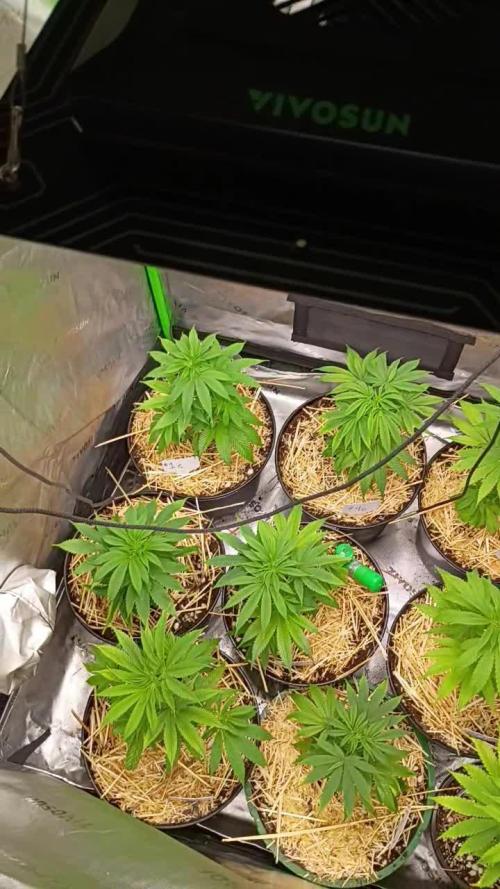
she‘s filling out the tent (0,36 square meters) nicely. She‘ll be put into a bigger tent later on (0,5 square meters) which is why I‘ll try to let her fill this one out as much as I can.
I‘ll probably flip her into flower later this week.
Switched to flower on day 60

Likes
2
Share

@Bear_Grows_Green
Follow
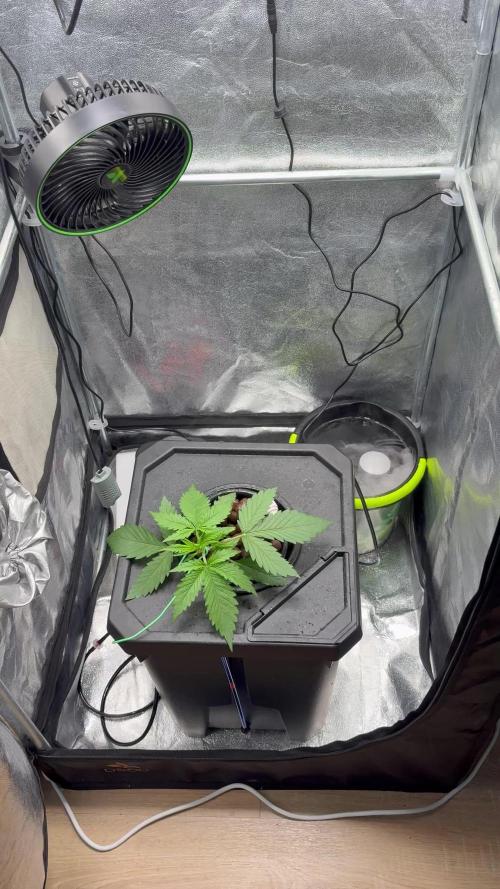
01/24 up potted everything kept 2 of each pheno other then #3 only kept 1 cus I'm not a fan of it so far. Rest got given away as gifts.
01/27 they all got watered


Likes
13
Share


@GYOweed
Follow
She is very oily velvety rub and smells very grapey.
Only downside is it's very lanky even some air and silica it's lanky lol. Whatever maybe ill clone and cross it just for its taste.

Likes
82
Share


@UnorthadoxDude
Follow
Hello growmies! Welcome to week six of An Epsilon Adventure! Massive thanks to both Shogun and Royal Queen Seeds for sponsoring this grow!
So here we are at week six and every one of these girls are at a slightly different stage, it is quite fascinating to watch them develop one after the other.
Today I made the last adjustment to the light possible. I removed the adjustable hangers and affixed a carabiner which I tightly tied to the top of the tent bar. There is about 1.5 inches of space between the top of the shade and the tallest part of the roof of the tent. Plant 1 is already taller than this, and it looks like plant 6 and maybe even plant 5 are going to join it. It's a madness. I am sure you have already looked at the photos but just in case you do what I do and read the diary first...
Here is my assessment at the beginning of week 6:
Plant 1:
Height: 1st (137cm) - what can I say about this ridiculous plant? Day 36... 137cm tall. I have had to raise the light to as high as it is physically possibly to raise it and it's still not high enough. She is done stretching now, she may add 3-5cm over the next week or so but I don't expect more than that, so her top of her main cola going to have to develop above the level of the light. Nothing I can really do, nothing wise anyway. What a monster plant.
Maturation: 4th - early into flower - bud sites developing, pistils just starting to explode.
Plant 2:
Height: 4th (111cm) - this plant has been there or there abouts as the tallest plant for most of the grow, but she has topped out at 111cm. She will gain some during flower but not much more than a few centimetres. Very impressive plant, loads of bud sites, really big strong secondary branches. This one is going to be colas galore.
Maturation: 3rd - well into flower - all white pistils
Plant 3:
Height: 6th (95cm) For some brief days the tallest plant in the room, she peaked early and is now the "shortest" at "only" 95cm for this "50-70cm" strain. She is utterly dwarfed by four of her five sisters in just about every department, being quite a bit smaller even than plant 4 (although I have removed the most lower nodes from this plant). Compared with her sisters she is almost a runt... except that she is 25cm taller than the strain top-end average and matches the maximal height of the previous tallest Epsilon F1 plant I am aware of. It's not that she is small, actually she's pretty big for an Epsilon F1, it's just that the rest of the girls are on another level altogether. Plants 1, 5 and 6 are all absolute beasts.
Maturation: 1st - well into flower - first shades of brown in some pistils.
Plant 4:
Height: 5th (98cm) although only 3cm taller than plant 3, overall she is a much larger plant. Her secondary nodes are the same height as plant 3.
Maturation: 2nd - well into flower - all white pistils
Plant 5:
Height: 3rd (113cm) - one of the two thick/short girls who have grown at a similar pace all along - she is further ahead than plant 6 but not by much and I think she will probably exceed 120cm this week, though I do not think she will outgrow plant 1 or 6.
Maturation: 5th - early into flower - bud sites developing.
Plant 6:
Height: 2nd (120cm) - my predictions were correct about this girl and her continued growth. I now think she might actually outgrow plant 1, which is quite worrying.
Maturation: 6th - early into flower - bud sites forming - by far the least mature plant of the six.
###
Week 6 Day 2 23:00 30/7
Photographed. Raised the light. Rotated the plants. Inspected, measured and reported on each plant.
###
Week 6 Day 3 23:00 31/7
It has not escaped my attention that the plants that are more advanced into flower have darkened and have some burnt tips. I need to flush them and lay off the base nutes a bit. These plants are just growing and maturing so quickly that I cannot keep up.
###
Week 6 Day 5 02:30 2/8
Fertigated 3l of nutrient mix, without either COCO A or B.
###
Week 6 Day 6 01:30 3/8
photographed
---
Thanks for reading growmies! 👊
==========
Tent: 120cm x 120cm x 180cm
Light: 600w HID Elite Dual Spectrum HPS + Angel Wing Reflector
Air: 5" duct fan system with carbon filter ~300 m3/hour + RAM 9" floor fan + 4" intake fan
Pots: Air Pruner Fabric Pots 30l - UGro XL Coco + horticultural grade perlite (~20%)
Seeds supplied by Royal Queen Seeds https://www.royalqueenseeds.com
Nutrients supplied by Shogun Fertilisers https://www.shogunfertilisers.com/en
==========

Likes
8
Share


@BruWeed
Follow
☘️ 03/11 - Hidrate la semilla 24hs con agua y 3 gotas de agua oxigenada. (Uso el mismo metodo siempre antes de germinar)
☘️ 04/11 - Coloque la semilla en papel humedo para que comience a germinar.
☘️En menos de 24 hs germino.
☘️05-11 - Ya tiene 1.5cm de crecimiento y la coloque en una maceta de 3L, utilice el producto que uso siempre "AEGIS MICORRIZAS" ya que ayuda mucho en esta etapa de germinacion.
☘️Por el momento se ve bien, su proceso fue muy rápido y hasta el momento todo perfecto.
☘️Voy a dejarla dos semanas en etapa de enraizamiento y estare utilizando cuando la plantula salga "DEEPER UNDERGROUND" de Top Crop.
☘️07/11 - Broto
☘️09/11 - Ya le agregue el estimulador de raiz, Deeper Underground. 1ml por litro de agua, obviamente no le agregue todo, solo lo suficiente.
☘️09/11 - Tiene 5 días de vida.
☘️14/11 - Cumple 10 dias de vida desde su germinacion.
☘️21/11 - Cumple 17 dias de vida.
☘️23/11 - Entra en etapa de crecimiento.
☘️En estos dias subire imagenes de como viene.
🇦🇷😶🌫️☘️Podes seguieme en Instagram como @bruweed_arg🍀🇦🇷😶🌫️

Likes
7
Share


@Nikkov
Follow
well, another week and just watering as needed, it should have yielded a lot more this strain is also not known from a local seed bank but no problem. I think the temperature, because I spent most of it being very hot, didn't let them grow, well, but I'm already starting another cycle and soon I'll start posting more here in another grow =D
Likes
33
Share


@Happygrowing
Follow
Ha mostrato grandi margini di crescita sin dall' inizio.
Questo fenotipo è molto marcato dalla parentela con la lemon skunk.
Profumo di caramelle al limone...
Mi aspetto almeno sopra 120gr da secca senza rami.
Bellissima esperienza , molto sativa con cime lunghe quanto il mio avambraccio. Pazzesco.

Likes
6
Share


@Bengrowerbr
Follow
Growing this plant was a great experience. despite the cycle being under intense heat she responded very well. 115g dry

Likes
39
Share


@Mastr
Follow
Day 50 and they are so healthy and bushy I feed them.with
4ml bloom
4ml heaven
4m acti vera
4ml top max
Been done finally defoliation yesterday guy this time I cut all lower branches and just leave top branches just want see what different coz I been speaking to someone with experience he told me you need do defoliation very very aggressive I know you get low yield but its top shelf bud you get let see its work or no
Day 54 and she is in weeks 5 flowering but still bud wont get fatten up but I know mulost sativa start fatten up week 5 to 7 in flowering let see
Likes
Comments
Share


@MrEarlyBird
Follow
Assuming there’s only a few weeks left before harvest, 2-3 weeks. More or less the same thing throughout. Didn’t deal with pests, disease…just lived a good life
Likes
11
Share


@NidoR420
Follow
All 3 plants cut and just Ozz remaining to dry and trim. Terrible outcome for #4 as I had to throw more than half of the plant away due to bud rots. I’m still really confused about what happened: the day before harvest I noticed and removed 3 bud rots from the plant - so far so good. All remaining buds were fine, but when trimming I realised every single top was maroon-ish at the base and I could clearly see a start of mold when opening some of them. Although I could clearly confirm what it was with a 30x lens, the white spots were extremely scarce and small (less than 1x1mm each time). It doesn’t seem really coherent with how it should have spread. Nonetheless, I didn’t take risk and threw away any bud where I could identify white mold with the lens, and put aside the ones where I had a doubt in pop corns (the “7g maybe”, cf below) to track the evolution.
A quick summary of the harvest so far, will edit when I have some time: - Dorel: 250g wet, 37g dry / 17g trim (54g total) - #4: 450g wet, 33g dry / 7g maybe / 29g trim (62-69g total) + a lot thrown away due to bud rots - Ozz: only weighted the two bigger canopie I cut, 162g+142g≈300g wet. It represents around half of the whole plant (probably less, but stem included), so around 5-600g wet total.
Likes
8
Share


@TegridyCal
Follow
she has grown very well so far, beautiful leaves and large branches especially the thunder. Now at the beginning of flowering it is a little worrying us because it seems a little faded and we would not like to have done something wrong but I'm not sure.

Likes
11
Share


@TheSlimeGrows
Follow
2 plants left after I harvested the first one that flowered earlier than these 2 - got 94g dry off that plant but the nugs are pretty loose.
seeing some issues on the top-most leaves on plant 3, the bigger one. plant 1, the smaller one also has some nute issues but I'll stop feeding for a week or so and see if that helps. Buds seem to be fattening up tho.
Also seeing some weird brown/rust spots on plant 3 at the top-most leaves on the buds, almost like they're drying from the inside out. Anyone help with that? is it Potassium Toxicity!

Likes
8
Share


@Pierrougarou21
Follow
Yo les amis. Les fleurs commencent a gonfler et l odeur se développe

Likes
12
Share


@HerbalBlazer
Follow
Now finished stretching and starting to put weight on, they smell very very potentially and are nice and sticky

Likes
44
Share


@Aedaone
Follow
The temperatures, humidity, height, and watering volume(if measured) in grow conditions are all averaged for the week. The pH is soil pH. Any watering done by me is well water which is 7.6 pH and 50° F. Coop Poop, molasses, Feather Meal, and Soluble Kelp are ml/gallon of soil top dressed. Everything else listed in nutrients is ml/gallon of water fed to plants without checking the solution Ph.
Day 1 we had a high temperature of 85°F with mostly sunny skies. I watered about 5 gallons of well water.
Day 2 we had a high temperature of 79°F. We missed the rain, but had a big dew and it was 90+ humidity. I watered about 5 gallons each.
Day 3 we had a high temperature of 78°F. It was mostly cloudy and super humid, but again no rain. I watered about 5 gallons each. I fed coop poop at 75ml top dressed and Soluble Kelp 50ml top dressed.
Day 4 we had a high temperature of 89° with clear sunny skies. Humidity is still up. I watered about 5 gallons each pot.
Day 5 we had a high temperature of 88°F with mostly sunny skies. I watered about 5 gallons.
Day 6 we had a high temperature of 91. Skies were clear during the day. I watered about 5 gallons of well water.
Day 7 we had a high temperature of 91°F with mostly sunny skies. I added 160ml of molasses to top of pot and washed it in with my watering wand. I watered about 5 gallons. Run off isn't an issue. The girls are rooted through the pots into the ground and the loved the K in the molasses.
This week was a success. These are turning into beautiful plants. They're easy to grow even though I had to treat for powdery mildew. They are very loud smelling and one smells like watermelon candy 🤤