





Processing
Likes
5
Share


@FlowerBloom09
Follow
Plants are growing so fast , I would say pre flower , next week should be flowering , ran into mini bugs (maybe spiders) but I added more traps so stop them , also ran into mold this week but that may of been due to the humidity so I lowered humidity from 55 down to 45, excited with my first grows!

Likes
Comments
Share


Likes
6
Share

@tsf_homegrow
Follow
🇩🇪
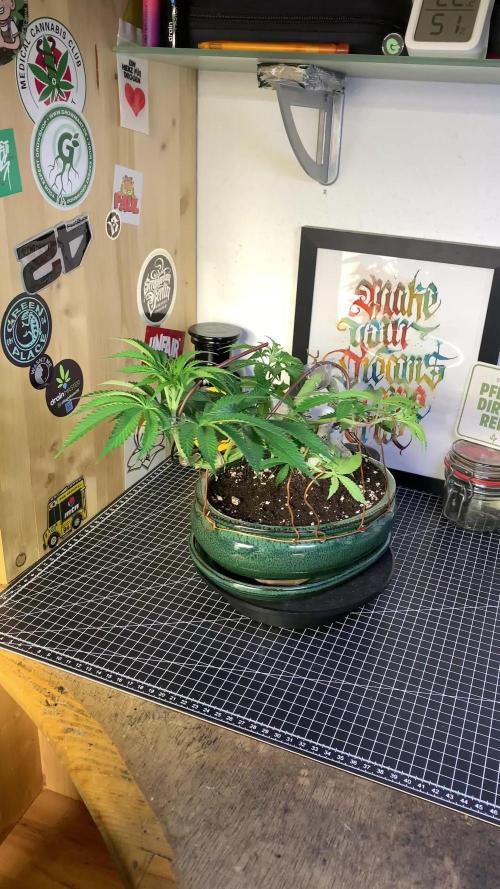
Ich war dann doch neugierig und hab mich dazu entschieden nach einer Woche einen Teil der restlichen Erde und den Rand vom Airpot zu entfernen um mal zu schauen wie sich die Wurzeln in dem Bereich machen. Und tatsächlich mehr oder wenige wie geplant und am Ende durch das verrutschen der Pflanzen oberhalb der Erde auch wie erwartet nicht ganz perfekt aber dennoch bin ich für den ersten Versuch sehr zufrieden. Auch wenn die Wurzel nicht von Fingerspitze zu Fingerspitze geht und sich der Stamm nicht mehr zur Seite sonder mehr nach oben verwachsen hat. Ist sie trotzdem sehr gelungen. Und kann sich die nächste Zeit erstmal wieder erholen und wird nur hier und da in Form gehalten.
Happy growing💛✌️
🇬🇧
I got curious and decided after a week to remove some of the remaining soil and the edge of the Airpot to see how the roots were doing in that area. And indeed, more or less as planned, and in the end, due to the plants shifting above the soil, it wasn't quite perfect, as expected, but I'm still very happy with it for the first attempt. Even though the root doesn't stretch from fingertip to fingertip and the stem has grown upwards instead of sideways, she still turned out very well and can now recover for a while and will only need occasional trimming. Happy growing! 💛✌️
Likes
28
Share


@Bongman
Follow
Into week three of flowering:
- Need to up CalMg this week cause all my last grows with this strain the plants were stressing and showing signs of Mg deficiency I think.
- The buds are stacking up pretty tight.
- The top of the plant is showing some red veins AGAIN, don't know if it is genetics? Or is it too much light? ANY SUGGESTIONS?
- Usually what happens is that after week three top of plant will show red veins and some leaves will turn light green yellow. What type of deficiency is this?
Thanks in advance for the help.
Happy growing,
BM
4TwenTee
*****Update on LIGHT STRESS:*****
Okay I think I got this figured out. Since my plant is showing the following symptoms:
- Slow yellowing of top of cannopy
- Fan leaves pointing up in a steep angle
- Leaves are tacoing up a bit with sharp pointy serrated leaves pointing up
- Veins are turning purple and some leaves are showing green veins and yellowing of outer part of the leaf
REASONS FOR THE SYMPTOMS:
- Since the light is too close to the top of the canopy, although my light is running at around 60% and it is at least a meter away from the light. I think because this was a mother and basically she is accustomed to top canopy PAR of around 180-220 and she was measuring around 600PAR so that is just too much for the plant to handle. So I've lowered the light output so the top canopy is around 420 PAR.
- Also my humidity is pretty high at around 72% so I lowered it to around 65%
- The reason why the leaves are tacoing up to the light is because the canopy cannot take the high PAR, the temp at the top of the canopy is only 76F so that is acceptable, but the plant is trying the sweat due to the high PAR, but because the humidity was also too high it was not sweating as much as it should.
- The reason why a light stressed plant shows different deficiencies eg. magnesium and phosphate is due to the "extra sweating" that takes place, cannabis plants don't choose what they intake, if they need more water to sweat, extra nutrients will be absorbed and this will lockout some of the other nutrients in the solution.
**End of week update:
Tried multiple changes but still no luck on getting rid of red leaf stem.
- Added a 1 hour sunrise and sundown light regiment
- Decreased Humidity to 65% from low 70's
- Top of canopy PAR decreased from 600 to 350.
Leaves red stems still not going away and top of canopy still trying to get rid of moisture with fan leaves pointing up.
If anyone can chime in that would be great thanks.

Likes
15
Share


@IsseyBukkake
Follow
Week 2 has gone just as well as I'd like it too!
I had an accident during the week where I had dropped a sticky bug trap on one of my girls, this led to me accidentally ripping off a fan leaf and a half, but she seems to have come out of it just fine! (Thankfully).
I have been feeding 1/3 strength nutes the past few feeds, stepping it up from 1/4.
I will be watering until I see runoff from now on to prevent nutrients from building up in the coco.
Update(day 15, 4/12/20)
Today I purchased a new oscillating fan, co2 bags and a new hygrometer that hooks up to my phone and shows me stats.
The girls have been putting in a lot of work over the past 24 hours.
I also had a Purple Punch photo seed sprout today which I may be turning into a mother plant. I will be starting a diary for this girl too.
Update (Day 16 5/12/20)
Second purple punch photo popped today, going to keep 1 inside and give the other to my mom to take care of.
The girls got their first 1/4 dose of calmag today fed at 6ph due to all the nutrients settling there.( I do have ph +/- but I'm going to try run this whole grow at 5.8-6.2.
Update (Day 17 6/12/20)
Plants seem happy today.
Fan leaves producing a the pre-existing nodes are starting to shoot out quite rapidly.
Unfortunately, my streets power went out today for ~90 minutes, I opened the tent, windows and doors to get any light in I could, thankfully the power came back on shortly after.
I fed the girls today with very little run-off(I'm trying to perfect the amount of water they need).
Update (Day 18 7/12/20)
The girls have jumped up over night!
I wont be feeding today as I'd like the coco to dry out quite a bit more.
Update (Day 19 8/12/20
Gave the girls a small feed today with very little run-off
Everything seems to be going well so far, I'm very thankful!
Update (day 20 9/12/20)
Everything is going pretty well today.
I will not be feeding as the increased humidity has kept the coco more moist than usual.
Will be feeding full strength nutes tomorrow!
Thanks for stopping by, HMU with any questions or tips you have.

Likes
14
Share


@goeser
Follow
All plants growing well , buds developing well. Fat banana much stronger against the feeding then the Bubble Kush Auto, but still both growing well and dense buds .
Likes
28
Share

@Bongman
Follow
Hi All,
Its week 6 of flowering. Things are on track and buds are bulking up.
I think I am going to conclude that the red stems on top fan leaves are just a genetic trait.
Will do one last reservoir change and start to decrease nuets next week.
Likes
12
Share


@HIAZ_urbanbudfarmer
Follow
Saturday 16-11-24 , Flowering day # 53 week 8. Harvest day!
Cut branches off plants & hung the 2 front plants off the light.
Put scrog net back in with a large flyscreen laying on top, & spread branches from the back plant over it. This allows complete air flow around the buds. Running a single oscillating fan beneath pointing to the bottom.
Temperature is around 24°C & RH is 55%
Likes
21
Share


@BLAZED
Follow
Week 18 (30-6 tm 5-7)
30-6
Temperatuur: 31.4 graden (licht aan) 22.5 graden (licht uit)
Luchtvochtigheid: 69% (hoogste) 50% (laagste)
Ik heb de trichomen bekeken en heb besloten haar nog een dagje langer laten staan.
Watergift: Geen.
1-7
Vandaag heb ik de trichomen opnieuw bekeken en die zien er goed uit! Veel cloudy en best wel wat amber.
Ik hou echt van deze trichome foto's, echt mind blowing hoe dat er uit ziet!
Dus vandaag gaat de schaar er in!
2-7
Ik heb besloten om een wet trim te doen zodat als ze droog is ze gelijk in de cure pot kan.
Geloof het of niet, maar ik ben wel 12 uur lang bezig geweest om alles te knippen 😅
Op 1-7 ben ik in de middag begonnen en in de vroege ochtend van 2-7 was ik klaar.
Het natte gewicht van de buds is 283 gram, en het natte gewicht van de trim is 61 gram.
Ik ben nu al super tevreden met het gewicht! Dit is meer dan het dubbele aan gewicht vergeleken met mijn eerste grow.
De buds zien er ook echt mooi uit. Ik schat dat het tussen de 50 en 75 gram droog gaat zijn. Ik ben benieuwd, nu een paar dagen drogen!
Droogtent:
Temperatuur: 23.4 graden (hoogste) 21.2 graden (laagste)
Luchtvochtigheid: 59% (hoogste) 42% (laagste)
3-7
Droogtent:
Temperatuur: 23.2 graden (hoogste) 21.5 graden (laagste)
Luchtvochtigheid: 50% (hoogste) 41% (laagste)
4-7
Droogtent:
Temperatuur: 23.1 graden (hoogste) 22.1 graden (laagste)
Luchtvochtigheid: 53% (hoogste) 46% (laagste)
5-7
Na 3 dagen is ze droog genoeg om te curen. Wel heb ik iets te lang gewacht want de LV in de jar geeft nu 57% aan.
Ik hoop dat dit over een dag wat om hoog gaat. Nu een paar weken curen en dan kom ik met de rook verslag 😁
Ik zal binnenkort ook even berekenen wat de gram per watt is, aangezien ik de lamp niet de gehele grow op 100% had staan.
Het droge gewicht van de buds is precies 75 gram, en het droge gewicht van de trim is 19 gram.
Samen maakt dat 94 gram! (De trim gebruik ik om een CBD cake of bubble hasj te maken)
Ik wil iedereen bedanken voor het volgen van dit avontuur! Tot de volgende keer!

Likes
42
Share


@Ultraviolet
Follow
Thank you. Gave her a cocktail to help with stress. Added 1st net for lateral support, not so much now, but for later. Blue light is absorbed by photoreceptor proteins called phototropins, which trigger a hormonal response that causes cells on the shaded side to elongate, making the plant bend toward the light. Try and fill this side a little. She is quite big already, just needs to find her stride again after the undue torture.
5 apex stems with 20-30 mini cola, let them develop a little, with the apical dominance shattered, all those 20-30 will all compete with each other as soon as that stretch is initiated. Key to a good stretch is making sure the plant is cycling efficiently, with large ATP conversions occurring lights out.
For now, I'm keeping light intensity high. A plant will slow its vertical growth in very high light intensities, leading to a more compact form with thicker stems and leaves. This response is a protective mechanism against light stress, which can damage the photosynthetic apparatus and lead to symptoms like leaf scorching, yellowing, and brittleness. Instead of growing taller, the plant invests its energy into creating a more robust, stress-tolerant structure.
Providing plants with necessary antioxidants helps protect the photosynthetic apparatus by scavenging reactive oxygen species (ROS) that cause damage from excess light.
UV light exposure can impact the xanthophyll cycle by either enhancing its photoprotective role or causing damage, depending on the intensity and type of UV radiation. UV exposure can trigger the synthesis of more xanthophyll cycle pigments to increase the plant's capacity to dissipate excess energy, but it can also cause direct damage, particularly to Photosystem II, and may lead to a decrease in the de-epoxidation state (DEPS ratio) which indicates a reduced capacity to dissipate excess energy.
Plants can respond to UV stress by increasing the synthesis of xanthophyll cycle pigments, such as violaxanthin and zeaxanthin, to improve their photoprotective capacity. UV-induced changes in xanthophyll cycle pigments can be linked to a plant's overall tolerance to high radiation stress. The xanthophyll cycle helps protect against photoinhibition, which is especially important when the plant is exposed to high levels of both UV and visible light. High doses of UV radiation can directly damage photosynthetic components, including the proteins, lipids, and pigments in the thylakoid membranes. Exposure to UV radiation can have a mixed effect on the de-epoxidation state (DEPS ratio) of the xanthophyll cycle pigments. In some cases, UV can inhibit the conversion of violaxanthin to zeaxanthin, resulting in a lower DEPS ratio and a reduced capacity for energy dissipation. However, the total pool of xanthophyll cycle pigments may increase, and this enhanced pool size could provide a greater potential for photoprotection despite a lower DEPS ratio.
The xanthophyll cycle works alongside other mechanisms, such as the accumulation of flavonoids (UV screens), to protect the plant from UV-induced damage.
Blue light repairs 100% UV-induced damage in plants through a process called photoreactivation, which uses a light-dependent enzyme called photolyase. This enzyme uses energy from blue and UV-A light to directly reverse the damaging pyrimidine dimers in the DNA caused by UV-B radiation, a key mechanism for maintaining the plant's genetic integrity.
After carbon, light, water, temperature, and nutrients, the limiting factor of a plant's growth is often its own internal factors or the amount of a key ingredient. Chlorophyll concentration is one such factor, as the amount of this pigment limits how much light can be captured for photosynthesis. Other factors include chloroplast number, respiration rate, and the concentration of carbon dioxide in the atmosphere, as plants are often in a CO2-deficient condition.
60x60x18=64800seconds x 700 = 45,360,000moles. 45DLI
Exposure to 165 µW/cm² of ultraviolet-B (UV-B) light for 3600 seconds = 1 hour, a extremely high, acute dose triggering stress responses and protective mechanisms.
.
The plant's photoreceptor protein, UVR8, senses the UV-B radiation. This triggers a signaling cascade that activates specific genes to protect the plant from damage. In response to the UV-B signal, the plant ramps up the biosynthesis of protective compounds like flavonoids, phenolic acids, and anthocyanins. These compounds absorb UV radiation and accumulate in the epidermal layers of leaves to shield inner photosynthetic tissues. The plant may increase leaf thickness or deposit more cuticular wax, creating a physical barrier to the radiation. The plant will produce more enzymatic and non-enzymatic antioxidants to neutralize the reactive oxygen species (ROS) produced by the UV-B radiation. The plant activates enzymes, including photolyases, to repair DNA damage caused by the UV-B. These repair mechanisms are critical for preventing permanent genetic mutations.
While protective measures are activated, a high dose delivered over a short period can cause stress that overwhelms the plant's defenses.
Photosynthesis is highly sensitive to UV-B. A high dose can inactivate Photosystem II (PSII), damage thylakoid membranes within the chloroplasts, and reduce chlorophyll content, which lowers the plant's overall photosynthetic capacity. Despite repair mechanisms, high UV-B doses can inflict persistent damage on the plant's DNA. One study found that acute, high-dose UV-B had a greater effect on genome stability than chronic, low-dose exposure. The overproduction of reactive oxygen species can cause oxidative stress, leading to the oxidation of lipids and proteins and disrupting cellular function.


Likes
19
Share


@cpt420
Follow
A few more days left before I start to harvest my plants. For now I'm going to start with the two on the left and work my way around to the plant that's still in reveg, shooting heads like crazy for some reason. Smells amazing and the stickyness is out of this world. Much love ❤️🍀

Likes
26
Share


@ExoticoSativo
Follow
Alr guys, this banana was my first auto ever, I experimented with her a lot, did all type of mistakes, at first she was on a window getting not light at all, I move her to a different house 3 times, transplanted her like 4 times broke the rootmass, almost burned with nutrients and on top of everything I HST her like a mofo 😂 tried to mainlining but she overcome all my mistakes and thrive like a champ she was, beautiful sweet smell and taste even tho 80% of the buds were microwaved OMG im sorry for all but I learned a lot, need to try again with her with all the experience and proper equipment that i have now


Likes
2
Share


@KEVS_BEST
Follow
Woche 2 - Weiteres Wachstum und Vorbereitung auf das finale Umtopfen
In der zweiten Woche wurde die Wassermenge schrittweise erhöht, um dem wachsenden Bedarf der Pflanzen gerecht zu werden. Ich habe die Bewässerung auf 300 ml alle zwei Tage erhöht, weiterhin ohne Düngerzugabe. Die beiden Sherbzooka Ladies ernährten sich noch vollständig von den in der Biobizz Light Mix Erde vorhandenen Nährstoffen.
Am 20.04.2024 wurde die erste Düngerladung Canna Terra verabreicht, mit einem Verhältnis von 10 ml auf 10 Liter Wasser. Der pH-Wert des Wassers lag bei 5,9 und der EC-Wert betrug 1,0. Die Pflanzen zeigten keinerlei Symptome von Mangel oder Überschuss.
Am 21.04.2024 wurden die Pflanzen abends in ihre finalen 9-Liter-Töpfe umgetopft. Die Pflanzen waren sichtbar gesund, kräftig und zeigten ein starkes Wachstum. Die durchschnittliche Temperatur blieb sehr stabil, und die Luftfeuchtigkeit wurde weiterhin manuell erhöht. Dazu habe ich täglich 500 ml Wasser in tiefen Tellern, verteilt auf vier Teller und fünf Handtücher, verwendet, um die Feuchtigkeit zu regulieren.
Die Beleuchtung war fest eingestellt: Das Licht ging um 06:40 Uhr an und schaltete sich um 00:40 Uhr aus, was den Pflanzen einen stabilen Tag-Nacht-Rhythmus gewährte. Insgesamt verlief die zweite Woche sehr erfolgreich, und die Pflanzen waren bereit, noch weiter zu gedeihen.
ENGLISH
Week 2 - Continued Growth and Preparation for Final Transplant
During the second week, I gradually increased the amount of water to match the plants' growing needs. I raised the watering amount to 300 ml every two days, still without any added nutrients. The two Sherbzooka ladies continued to thrive on the nutrients provided by the Biobizz Light Mix soil.
On April 20th, 2024, the first dose of Canna Terra nutrients was given, with a ratio of 10 ml per 10 liters of water. The pH of the water was 5.9, and the EC level was 1.0. The plants showed no signs of nutrient deficiency or excess.
On the evening of April 21st, 2024, both plants were transplanted into their final 9-liter pots. The plants remained visibly healthy, strong, and showed significant growth. The temperature stayed very stable, and I maintained the humidity manually by placing 500 ml of water daily across four plates and five towels, which helped regulate moisture levels in the room.
Lighting was kept consistent, with lights turning on at 6:40 AM and off at 12:40 AM, providing a steady day-night cycle. Overall, the second week was a great success, with the plants ready to continue thriving.

Likes
37
Share


@Hawkbo
Follow
Hey guys I am a day late on the update cuz I went away for the weekend to a buddy's bachelor party and ended up with a broken clavicle in two places and need surgery tomorrow. I dont know how I'm gunna keep things rollin here but I'll figure it out. Anyways I couldn't get the plants out of the tent tonight but when I have some help tmm I'll try and get some better individual pics. I fed them before I left Friday at 1110 ppm with the green buzz and got a little burn, which is a good thing because that kinda shows me that less is more with this line and may save you a few bucks over time. It's also nice that there isnt 11 different bottles to pour from so far I couldn't be more impressed with GBL. The planta were all pretty bone dry today but look better than ever. Pics were taken at day 29 this week, temps have been around 73°F and 58% RH. This tent is in a basement so even with the dehumidifier the rh is pretty high especially with the lights out but the plants seem to enjoy it and I have plenty of air circulating
This one might be a keeper if it fills out strong, shes a bit more structurally sound than the first pheno fatter leaves, thicker stalks but same stretch.
Edit: I fucked somethin up here in the video I put day 29 bloom, these were flipped on june 9th and got 36 hr dark period, I uploaded the video last monday so it was actually on day 22 flower not day 29 but it's a little late to edit the video so ignore that day and I'll make a new one tonight which is actually day 28
