




Likes
21
Share


@Growermina
Follow
This strain really surprises any grower in relation to yield. The plant's structure itself does not have much density. The flavor and aroma refer mostly to pine and its production of trichomes is not the best that I’ve seen.

Likes
20
Share


@Hashy
Follow
Week 3
Light cycle=18/6
Light Power=100w
Extractor controller settings
High temp= 25c
Low temp= c
Temp step=0c
High Rh= 60%
Low Rh= %
Rh step=0%
Speed max=5
Speed min=1
Smart controller settings (during lights on).
Lights on=06.00am
Radiator on= below 20c
Radiator off= above 21c
Humidifier on= not in use.
Humidifier off= not in use.
Dehumidifier on= not in use
Dehumidifier off= not in use
Smart controller settings (during lights off).
Lights off=00.00am
Radiator on= below 18c
Radiator off= above 19c
Humidifier on= not in use
Humidifier off= not in use
Dehumidifier on= not in use
Dehumidifier off= not in use
VPD aim=0.6-1.2
DLI aim=22-30
EC aim=0.8
PH aim=6.2
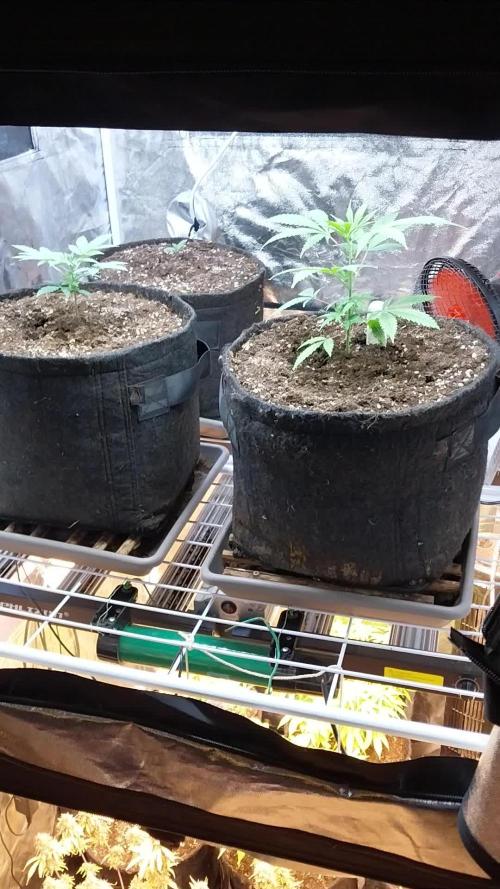
Thur 11/1/24
#2 (Day 15)
📋 little bit stressed from yesterday's topping.
Fri 12/1/24
#2 (Day 16)
📋 Turned pot 180 deg
Sat 13/1/24
#2 (Day 17)
📋 pot is getting lighter, prob water tomorrow.
Sun 14/1/24
#2 (Day 18)
📋 Removed single finger leaves and nodes.
💧💧💧💧💧💧💧💧💧💧💧💧💧💧💧💧
Method= manual
Total volume made=12L
Neutralise=0.1ml/L
Silicon=1.0ml/L
Calmag=1.0ml/L
Terra grow=2.0ml/L
Roots=0.2ml/L
Easy Ph down=0.2ml/L
Feed=nutes
Volume=2L
Ec=1.7 PH= 5.8/6.0
Time=5.00pm
Runoff.
Total runoff=small amount
Ec= PH=/
💧💧💧💧💧💧💧💧💧💧💧💧💧💧💧💧
Mon 15/1/24
#2 (Day 19)
📋 turned pot 90 deg.
Tue 16/1/24
#2 (Day 20)
📋 did nothing.
wed 17/1/24
#2 (Day 21)
📋 H=23cm D=50cm DLI=27.6
Installed the drippers.
🚿 foliar sprayed (cal-mag 5ml/L)
Turned pot 90 deg.
It's been a decent week for this girl, starting to catch up some of the others.
Back soon.
Take it easy.

Likes
10
Share


Likes
19
Share

@PapaBlob
Follow
02/11 Et voila! L'affaire est faite. Il me manque certainement quelque grammes perdu suite au blocage de l'excès de nutriment mais je suis plutôt content du résultat.

Likes
19
Share


@nonick123
Follow
Día 69 (01/07) Riego con 1 Litro sólo H20 - ph 6.2
Día 70 (02/07) ¡ Cosecha Banana Purple Punch Auto ! 😁
💦Nutrients by Aptus Holland - www.aptus-holland.com
🌱Substrate PRO-MIX HP BACILLUS + MYCORRHIZAE - www.pthorticulture.com/en/products/pro-mix-hp-biostimulant-plus-mycorrhizae
Likes
11
Share


@SteffenX
Follow
week 27
18.10.2024
near harvest
19.10.2024
2nd partial harvest
20.10.2024
ca. 4g of dry buds

Likes
97
Share


@Teamdirtbag2
Follow
These plants are liking there new home. Growth has been amazing. Everything seems to be going well. Except it's raining now. We will see how the rebuilt greenhouse holds up.


Likes
13
Share


@Leanback
Follow
Still waiting… the flowers are growing and some tricomes getting cloudy.

Likes
110
Share


@SlowpokeFuegobud
Follow
💜 💚 😍🥤💜💜 💚 😍🥤💜💜 💚 😍🥤💜💜 💚 😍🥤💜💜 💚 😍🥤💜
Dear growmies, welcome to week 8!! ❤️
We made it, yeaaa, she is a sexy meter of green delight! 💚 💜
DAY 51
Watered with 4ml growzyme + humics + big fruits 💧
DAY 53
Watered with 2ml pk + 4ml bloom + humics + growzyme + bigfruits 💧
DAY 54
Watered with 4ml growzyme + humics + big fruits 💧
DAY 56
Watered with 4ml pk + bloom + growzyme + humics + big fruits 💧
Thanks @Fast_Buds for your awesome genetics, growing Fastbuds is always a bit like riding a ferris wheel! Woohooo!! 😜 🙏 💚
Thanks to my sponsors @Green_Buzz_Nutrients, their nutes never ever let me down!! Check out my diaries on how well they work! 💚 😘 In case you want to give them a try, you can find a generous discount code in the setup description further down the road ⬇️
You can find more brand hot updates on my IG, where I share real time events from my growroom, don't miss this! 😝
_______________________________________________________________________
Purple Lemonade FF
As refreshing as cold lemonade on a hot Summer day. 🌞
• Quench your thirst. Just as good as lemonade on a hot Summer day.
• The gentle giant. Up to 550 g/m2 of gorgeous pinkish-purple buds.
• Refreshing for the mind and body. The ideal all-day strain with a perfectly balanced effect.
• Sweet n’ sour terps. Mouth-puckering lemon flavors that’ll hypnotize your taste buds.
• Properly purple. The perfect choice for purple hash and extractions. As refreshing as cold lemonade on a hot Summer day.
Arising from a cross between purple and citrus Cali genetics, Purple Lemonade FF (Fast Flowering) offers a complex high made up of perfectly balanced cerebral and body effects that are ideal for daytime use. Expect an extremely enjoyable high that boosts your mood while deeply relaxing your whole body and getting
rid of muscle pain. This meticulous cross produces up to 550 g/m2 of some of the most beautiful purple buds, with pinkish and reddish hues that will catch everyone’s attention. The beautiful purple buds are ready for harvest in 7-8 weeks and come hand-in-hand with unbelievably sugary citrus terps that are just as refreshing as a cold lemonade on a hot Summer day. It’s the ideal variety for the sweet-tooth stoner seeking strains that deliver both in quality and quantity of resin.
Bud Description 🦔
Purple Lemonade FF grows chunky, spade-shaped buds that boast a whole range of pinkish-purple hues with rich, dark orange pistils shooting out of every direction. This variety stands out for the, oftentimes, lilac trichomes that give them a gorgeous pink tint and make for outstanding purple concentrates. The buds give off a delicious tart lemon aroma that reveals a sweeter, more fruity scent as you break the buds open. Definitely a must for flavor chasers and those looking for pungent terpene profiles.
Smoke Reports 💨
Purple Lemonade FF offers an effect that’s just as unique as the flavor. Expect a potent uplifting high that gives you that energy boost you need to get things done while 100% happy and stress-free. The effect gradually transforms into a wave that works its way along the limbs and through the muscles, deeply relaxing your body and putting you in the right mindset to go through a busy day with a huge smile on your face. This is an excellent all-day smoke as it not only increases energy but can also help combat chronic pain, migraine and stress.
Plant Appearance 💄
This feminized photoperiod variety develops a thick and strong structure, growing a medium-sized main cola with multiple shorter side branches, typical of hybrid strains. Purple Lemonade FF develops fairly short internodal spacing with gorgeous purple buds growing stacked on top of each other, making it the perfect choice for growers of all levels looking to get lots and lots of top-shelf purple weed, as this variety can produce up to 550 g/m2 in a 7-8 week flower cycle.
Grow Tips 🤓
This is a super fast feminized photoperiod version that takes approximately 7-8 weeks to flower with a 5-week vegetation cycle,, this means you can have faster harvests by shortening the veg cycle or have a longer veg cycle for bigger yields. Purple Lemonade FF (Fast Flowering) makes for a great candidate for growers of all levels as it’s a vigorous strain that will thrive with basic maintenance both indoors and outdoors. This is a resin powerhouse so make sure to have your trim bin close by as all the resinous sugar leaves will make for the most mouth- watering hash and extracts.
Flavor 😋
Expect a long-lasting citrus zest that taste just like it smells. Purple Lemonade FF reeks of a delicious blend of sweet fruits and tart citrus that’ll make your mouth water. On the inhale, expect sour flavors that taste just like lemon candy with hints of orange and a really subtle earthy background. And on the exhale, the citrus flavors open up, giving place to a more sugary berry fruitiness that leaves your whole mouth tasting like an extremely sweet weed-infused lemonade.
https://2fast4buds.com/seeds/purple-lemonade-fast-flowering
_______________________________________________________________
Setup:
140x70x200 cm Spiderfarmer tent
2x Monkey 16W fans (not oscillating)
1x Secret Jardin 30W
1x box fan 50W oscillating (on lowest level)
LED
Full Spectrum 320W AGLEX AGL-320W-MA
5,6 kg
foldable, dimmable
864 pieces Samsung LH301H
864umol/s
2,7umol/J
full spectrum white + RED 660nm + IR 740nm
wavelength range 380-780nm
covering 3x4ft
Green Buzz Nutrients https://greenbuzzliquids.com/
❗ Use code GD42025 for generous 25% discount (for orders of minimum 75€)
Biobizz Lightmix + coco + wormcastings + perlite
Carbon Active Granulate Filter 125/360 cm³/h
PrimaKlima exhaust EC 125-400/240 cm³/h
Likes
7
Share


@ChitownCannaChica
Follow
So after consideration of the density of the buds and my night humidity levels— decided to chop a week early.
Buds are super dense. Concern for mold.
Very leafy lady- with massive fans
She’s 10% amber but still some white pistols on the lowers.
Very easy to grow. Stayed on the shorter side with minimal stretch—which is appreciated.
I love how the Plagron Green Sensation is nitrogen free! I used it from weeks 3-6. Super helpful as the leaves were getting a little curl— even with minimal nutes.
Will have harvest report soon. As terps can change after dry/cure.
Happy with the results of the Runtz and Plagron! 🏻💚
Likes
6
Share


@IamCy
Follow
Here we are. Week 2. On the Day 8 video, I give my method on how I produce nearly zero larf and huge buds. It's easier than most think 😉
Likes
6
Share


@Ninjabuds
Follow
My Runtz plant has some dark green leaves, and they're the most interesting of all the plants in the tent. They're really pointy and almost look like they have some old European genetics.
It's been a challenging week with the constant rain and ridiculously high humidity. Keeping things dry indoors has been a real struggle. Despite the weather, I managed to flip all my feminized photoperiod plants to flower this week. I'm hoping the switch will go smoothly, but with this humidity, it's going to be tough.
Likes
9
Share


@GrowerGaz
Follow
Striped feeding completely day 60 , stacking hard in the dwc and I'm excited to see the yield. Smell is lemon sweets , cough sweets lots of hazey aroma. Mars ts1000 is so big a great job and I think will hit over a gram a watt.
Likes
51
Share


@eldruida_lamota
Follow
Esa familia, ya hemos vuelto fumetillas, ya estoy de nuevo activo para explicaros mis métodos para cultivar vuestra yerba.
Bueno contamos esta vez con una cookies gelato de royalqueenseeds, la verdad por oídas y lo que leí, que son una cepa bastante fuerte tiene bastante thc, veremos estas semanas cómo avanzan.
Si germinación 100%, 5/5 ejemplares germinados y preparados para brotar.
.
Hasta ahora el ph lo dejamos en 5.8 la temperatura ronda los 22/24 grados y la humedad está en torno al 80%.
.
Ahora en la alimentación, gama agrobeta.
0,5 ml x L Piramid , vía radicular.
0,5 ml x L Growth black line , vía radicular.
0,1 gr x L Cancerbero , vía radicular.
0,1 ml x L Tucán , vía radicular.
0.1 ml x L Flash Root , vía radicular.
0,4 ml x L Great Green , vía foliar.
.
Empezamos con muy buen pie, espero que no surjan muchos problemas en futuras semanas, buenos humos 💨💨💨.

Likes
23
Share


@NSCanna
Follow
The Black Devil's OG is trucking along without issue, while the Northern light is a tad on the droopy side at night and is likely expecting earlier night hours. I will likely adjust my light schedule to reduce the stress.
The videos posted came out pretty well, considering they came out of a cell phone camera. 400x ends up being really blurry as the phone can't focus properly to compensate, but you can still see all the bacteria dancing around. Some nematodes and ciliates there too.


Likes
35
Share


@Paulolo03
Follow
DAY 27, most of the plants are flowering, LST works so well. I'm worried because some of them seems to have advance, I don't think the buds should be that big for their age, maybe the heat stress made them flowering faster ?
Moreover, some plants have their lower leaves turning yellow, I don't know what it is, give them nutrients once every 2 watering and I'm being very light with the amount of nutrients.
Ordered 2 cooltubes, one for each light, it will help to cool down the room, gotta pick them up at the store and use them today.
DAY 33, I followed your advices guys and added a bit of each nutrients for their deficiencies, don't know exactly if it was Ca, Mg or N deficiency but I can tell how better they are ! Water pH between 6,2 and 6,5 with 3acid down, hygro 55%.
Because of the lower hygro for flowering stage, temp is going higher, I'll try my best to take care of them because another heat wave is coming... Thinking about reducing the light time to 12/12
Likes
21
Share


@Green_Dream
Follow
Such a great week!
I’ve never seen such a fast growth before.
Since they were ready the girls got transferred in their final pots, 5l pot + 2l extra from the self watering grow box.
The soil is ca. 50% coco, 50% soil … well there’s probably about 15% perlite in there as well.
They soil mix is amended with ca. 1,5g/l green house feed biogrow. Plus ca. 6g/pot Aktivator.
And from now on they will stay in the greenhouse
Processing
Likes
Comments
Share


@MG2009
Follow
06/01/2020
Time to make the seeds!
First my Cookie Cake F1 plant is a 7 star cookies male
(Top dawg seeds) X a female Captains cake clone
(Captains connection) and will be growing TLO Style.
7 Stars Cookies Strain | Marijuana Strain Reviews
50% Sativa /50% Indica
THC: 22% - 27%
7 Stars Cookies is an evenly balanced hybrid strain (50% indica/50% sativa) created through a potent cross of the classic F1 Durban X Girl Scout Cookies strains. This potent bud is infamous among cannabis users for its super high potency and long lasting effects that are perfect for any hybrid lover. The 7 Stars Cookies high starts with a rush of cerebral effects that rush though your mind, lifting your spirits and leaving you blissfully happy and unfocused. As your mind flies higher and higher, your body will begin to slip away into a state of deep relaxation that leaves you totally stoned and out of it. A sharp pang of hunger comes next, leaving you with a ravenous case of the munchies as your mind slips in and out of calming sedation. Thanks to these effects and its super high 22-28% THC level, 7 Star Cookies is often chosen to treat those suffering from conditions such as chronic pain, insomnia, stress, depression, and migraines or headaches. This bud has a sweet citrusy flavor with hints of spicy earthy grape upon exhale. The aroma follows the same profile although with a light pungency to it. 7 Star Cookies buds have fluffy dense popcorn-shaped olive green nugs with bright orange hairs and golden crystal trichomes.
Captain's Cake Marijuana Strain Information
About Captain's Cake
Hailing from the beautiful land of Maine, Captain’s Cake is brought to us by The Captain’s Connection. This indica-dominant strain boasts two pretty incredible parents, Girl Scout Cookies and White Fire Alien OG, making her a bud that offers great effects for both recreational and medical patients. While Captain’s Cake typically acts as a true hybrid, user sensitivity may dictate that your experience comes with the roll of the dice.
A fairly potent strain in her own right, Captain’s Cake averages around 21% THC. Rumor has it that CBD levels can vary dramatically, with some reports showing a range between 1% and 15%. While that data remains to be confirmed, you can instead relish in beautiful buds that are bright green, featuring orange pistils and lovely amber trichomes. Oddly enough, flavors and scents do vary a bit with this strain, and you’ll notice it smells much worse than it tastes. A sour and earthy fragrance that includes lemon, nuts, and berries will hit you right away while your mouth enjoys a nutty vanilla cookie experience that’s slightly citrus-like.
Captain’s Cake is awesome for those times when you need a boost of energy to get through a particularly trying task. Whether you’re experiencing the three o’clock workday slump or you simply have to clean the house before it gets any worse, this strain is here to help. Users note a euphoric boost that helps you to focus on your tasks while having a huge smile on your face, but keep in mind that this joyful experience can only last so long. Soon the munchies will hit, and after you’ve had your fill of snacks, you’ll be ready to settle in during a sedating comedown.
Even if Captain’s Cake doesn’t have an astounding amount of CBD, medical patients still note that she’s a strain that is practically magical. Users find that mental woes are easily dissolved after taking a few hits, making stress and depression a thing of the past. Bodily aches and pains are also treated with a slight feeling of physical sedation, and those who struggle with their appetite will likely turn to this bud time and time again.
This plant is an ideal choice for new and experienced growers, and the ability to cultivate inside or out makes her pretty versatile. Said to be a quick flowering strain, you’ll be gifted with a nicely sized yield after 8 to 9 weeks. Plants tend to grow fairly large, so make sure you have enough space dedicated to your crop before you begin.
Depending on how you handle marijuana, Captain’s Cake may knock you out for an amazing nap or in some cases may fire you up with tons of energy. Others will experience a nice set of hybrid effects, so it’s best to know yourself before lighting this one up.
Red Sky is
Description
The (paternal P1) father is the legendary Cherry Hemmingway male. A hybrid of a landrace Bhutan, and Rez Dog’s Firecracker (Williams Wonder x NYC Diesel).
The female KOS’s own Skyanchor (Bogglegum x PSI) a cross using a prime selected male of BOG’s Bogglegum. A bad ass old-school hybrid made using a Northern Lights #5 (real deal) crossed to a Bubblegum (real deal). The female used to make the Skyanchor was my clone only PSI (Purple Salem Indica) that I was given by my good friend Keith, in Salem, OR, USA. Some kind of crazy old Purple Kush variant; potency is not only severe with this baby, but supernaturally intense.
The Cherry Hemmy is well known by me to relate large yields and incredible vigor along with increased resin production, and also usually relates cream soda, vanilla, or cherry-ish terpenes, making exotic and addictive combinations when used as part of any hybrid. So, the Red Sky yields well—very well.
Some truly legendary strains involved in this Small Batch Seed run.
Great genetics equals great end results.
I put video of Red Sky #3's brothers #2, and #4.