


Likes
31
Share


@The_Doctor_Green
Follow
Al 09/02/24 se pueden ver a las plantas bastante sanas, no han mostrado ningún síntoma de stress por el transplante.
Esta semana he aumentado la dosis de agua a 3. Litros,
El drenaje del riego me tiro un ph de 5.7 y una ec de 2000.
Likes
13
Share

@GUGU_choices
Follow
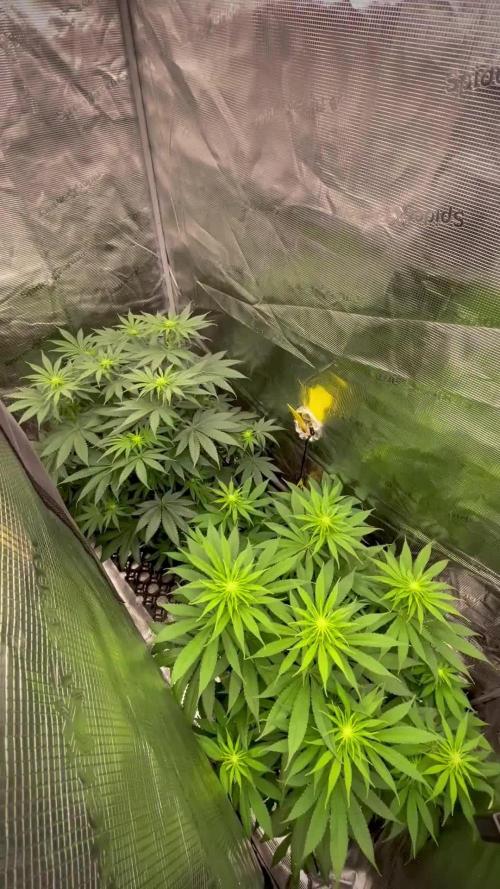
Hello growers!
The plants are in their second week of flowering. They are stretching nicely and we have started to form buds. We can expect a lot of fragrant photos in the coming weeks :) I rate their overall condition very positively and we will see how the next weeks, weeks of lush flowering, will look like. So far, Jack Herer and I are getting along well :)
-
Zdravím groweři!
Rostliny mají za sebou druhý týden kvetení. Pěkně se natahují do výšky a začala nám tvorba palic. Můžeme v dalších týdnech očekávat přísun voňavých fotografiií :) Jejich celkový stav hodnotím velmi pozitivně a uvidíme jak budou vypadat další týdny, týdny bujného kvetení. Zatím si s Jackem Hererem rozumíme dobře :)

Processing
Likes
15
Share


@ElegantBuds
Follow
Hello growers.
Bakers delight is doing it best. She has stopped growing and 100% energy in producing buds.
Small plant but very compact. Nice size of buds at the moment. Dna is living up to his name!
On the badside: ive had 2 herma’s in my tent, I hope I removed them on time!
See u next week

Likes
7
Share


@Grisly
Follow
Harvest 2024
Total Hash: 102g
Total Kief: 95g
Total Flower: 3868g/138oz/8.6lb
Total Yield: 4065g/145oz/9lb/4kilo
———-/-////////—vs———-/////————/
Sugar Diesel #1: 117g
Sugar Diesel #2: 313g
White widow Clone: 14g
Dual OG:
112g
LA Affie North Field: 248g
Granddaddy Purple N: 63g
Black Raspberry Kush N: 210g
————————————————-
Total North: 1077g/38oz/2.5lb
————————///——/—————-/
Fruity Pebbles: 184g
Granddaddy Purp S H2: 54g
Granddaddy Purp S H1: 275g
Granddaddy Purp Total: 329g/12oz
Black Rasp Kush S H1: 160g
Black RaspKush S H3: 70g
Black Rasp Kush S H2: 511g
Black Rasp Kush S H4: 17g
Black Rasp Kush S: 758g/27oz
Blue Cheese S H1: 281g
Blue Cheese S H3: 83g
Blue Cheese S H2: 285g
Blue Cheese Total: 649g/23oz
Dr Grinspoon S H1: 485g
—————————————————-
Total South: 2405g/85oz/5.3lb
————————///——/—————-/
North Popcorn: 148g
BC Popcorn: 100g
GP Popcorn: 73g
BRK Popcorn: 65g
—————————————————-
Total Popcorn : 386g/14oz/0.9lb
————————///——/—————-/
Trim: 8lb
—————————————————
————————///——/—————-/


Likes
4
Share

@Jabbamo
Follow
_______________________________________________________
Mi. 25.3.
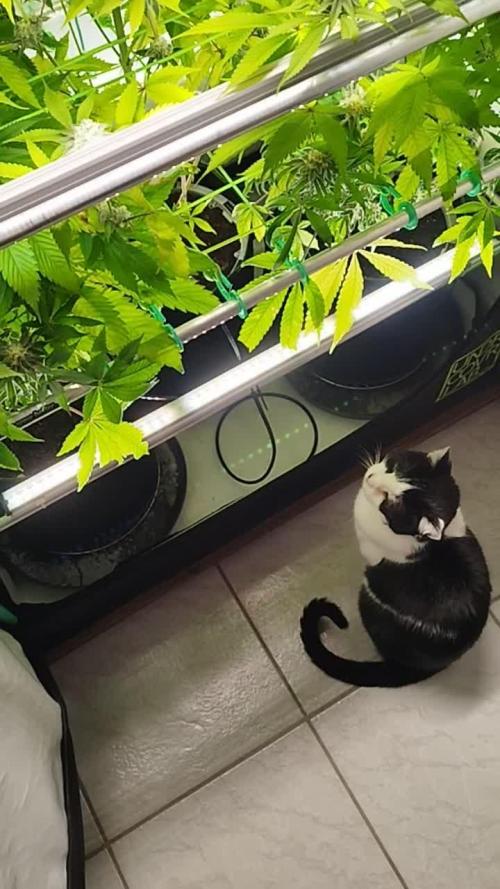
- 3,5 Liter pro Pflanze gegossen (ca. 300ml Drain)
- Rainpoint Bewässerungssystem eingesetzt
- 1L auf 3 Pflanzen Nährlösung per Hand angegossen
- Programm: 3min. ON / 3min. PAUSE / 3min. ON
- 2L pro Zyklus.
- 1L klar spülen zur Systemreinigung
1,2 ml / Liter "Calmag"
1,5 ml / Liter "Bio Grow"
4,0 ml / Liter "Bio Bloom"
4,0 ml / Liter "Top Max"
Ph 6,2 / 790 ppm
_______________________________________________________
So. 29.3.
- 3,2 Liter pro Pflanze gegossen (ca. 200ml Drain)
- 1L Nährlösung per Hand angegossen
- 8L Nährlösung per Gießsystem
- 0,5L klar spülen zur Systemreinigung
1,2 ml / Liter "Calmag"
1,5 ml / Liter "Bio Grow"
4,0 ml / Liter "Bio Bloom"
4,0 ml / Liter "Top Max"
Ph 6,2 / 770 ppm

Processing
Likes
6
Share


@macrocefalo
Follow
Third week we can say that the overtert has been solved. Vegetative growth is in full swing. G4 has recovered but is apparently 1 week late than the other 3 we will see next week.

Likes
16
Share

@MrWeeedWorld
Follow
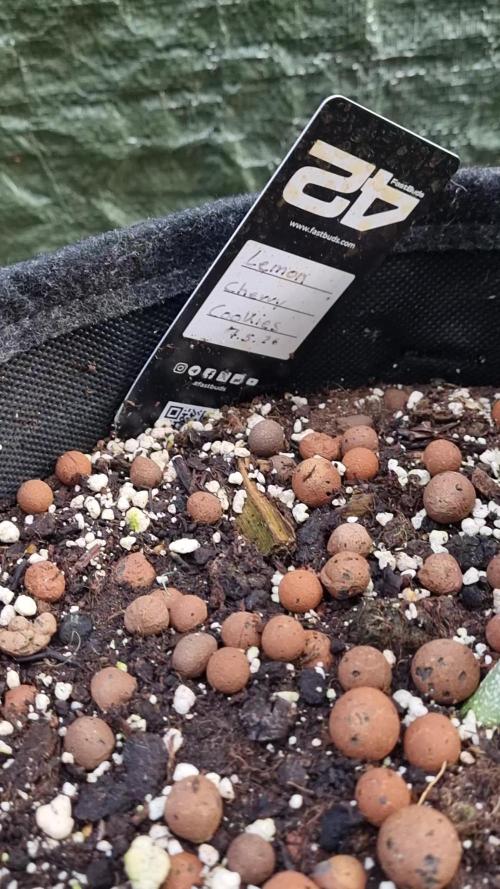
🍋🍒 Lemon Cherry Cookies Auto – Woche 14 | Der letzte Tag 🌿✂️
Und damit schließt sich heute auch bei meiner Lemon Cherry Cookies Outdoor der Kreis.
Woche 14 – und gleichzeitig ihr letzter Tag unter freiem Himmel. 🍋🍒🌿
Heute wird geerntet. ✂️
Wenn ich mir die Pflanzen jetzt noch einmal in Ruhe ansehe, bin ich vor allem davon begeistert, wie unterschiedlich sich die einzelnen Blüten entwickelt haben.
Von kräftig grünen und frostigen Buds bis hin zu wunderschönen dunkelvioletten Blüten ist wirklich alles dabei. Gerade diese Purple-Töne zusammen mit der sichtbaren Trichombedeckung machen einige der Buds für mich zu den absoluten Hinguckern dieses Outdoor-Grows. 💜❄️
Auch der gesamte Aufbau der Pflanzen gefällt mir unglaublich gut.
Die langen Haupttriebe mit ihren vielen einzelnen Blütenständen geben ihnen diesen unverwechselbaren, natürlichen Outdoor-Look. Keine perfekt kontrollierte Indoor-Umgebung, keine künstlich perfekte Form – sondern Pflanzen, die sich ihren Weg unter Sonne, Wind und Wetter selbst gesucht haben.
Und genau das erzählt man ihnen heute auch ein bisschen an. 🌞🌧️🌿
Die Lemon Cherry Cookies mussten während ihrer Reise mit den Bedingungen klarkommen, die ihnen die Natur gegeben hat. Trotzdem stehen sie heute hier mit einer ganzen Menge wunderschöner, harziger Blüten.
Auf den Nahaufnahmen wird erst richtig sichtbar, wie viel sich in den letzten Wochen getan hat.
Die Sugar Leaves sind teilweise deutlich mit Trichomen überzogen, viele Pistillen haben sich bereits orange bis braun verfärbt und zwischen den grünen Buds tauchen immer wieder diese wunderschönen dunklen Farbtöne auf.
Genau für solche Details liebe ich Outdoor-Growing.
Jede Blüte sieht ein kleines bisschen anders aus und jede Pflanze erzählt am Ende ihre eigene Geschichte.
Besonders schön finde ich, dass einige Blüten trotz der fortgeschrittenen Reife noch richtig kräftig grün wirken, während andere bereits diesen dunklen, fast beerigen Look angenommen haben. 🍒💜
Damit endet heute nach 14 Wochen auch dieses Kapitel.
Es wird nichts mehr gepusht und nichts mehr verändert.
Heute dürfen die Lemon Cherry Cookies einfach noch einmal für ihre letzten Bilder vor der Kamera stehen…
…und danach kommt die Schere. ✂️😄
Was am Ende trocken auf der Waage landet, werden wir später sehen. Aber wie schon bei der Apricot ist der Ertrag für mich nur ein Teil dieser ganzen Reise.
Vom kleinen Sämling über die ersten Outdoor-Wochen bis zu diesen harzigen, teilweise violetten Blüten durfte ich ihre komplette Entwicklung dokumentieren.
Und genau das macht so einen Grow für mich besonders. ❤️
Lemon Cherry Cookies Outdoor – Woche 14
🍋🍒 Letzter Tag
🌿 14 Wochen Outdoor
❄️ Schöne Harz- und Trichombedeckung
💜 Wunderschöne violette Phänotypen
🌱 Unterschiedliche Blütenstrukturen
🌞 Unter echtem Sonnenlicht gewachsen
🌧️ Wind und Wetter überstanden
✂️ Heute ist Erntetag
Noch ein letztes Fotoshooting.
Noch einmal die Buds im Sonnenlicht betrachten.
Und dann heißt es:
Danke, Lemon Cherry Cookies. 🍋🍒❤️
Du hast deine Geschichte erzählt.
✂️ HEUTE FÄLLT DER VORHANG – HARVEST DAY! 🏁🌿
Das nächste Update gehört nicht mehr der Pflanze…
sondern ihren Buds. 😁🍋🍒
--------------------------------------------------------------------------------------------------------------------------------------------------------------------
🍋🍒 Lemon Cherry Cookies Auto – Week 14 | The Final Day 🌿✂️
And today, another outdoor journey comes to an end.
Week 14 – and the final day outside for my Lemon Cherry Cookies. 🍋🍒🌿
Today is harvest day. ✂️
Taking one last look at these plants, one thing I really love is how differently the individual flowers have developed.
There is everything from vibrant green, frosty buds to absolutely beautiful dark purple flowers. Especially combined with the visible trichome coverage, those purple expressions have become some of my favorite flowers of this entire outdoor grow. 💜❄️
I also really enjoy the overall structure of these plants.
The long main branches covered with individual flower sites give them that unmistakable natural outdoor appearance. No perfectly controlled indoor environment and no artificially perfect structure – just plants finding their own way under real sunlight, wind and changing weather.
And today they proudly show the story of that journey. 🌞🌧️🌿
The Lemon Cherry Cookies had to deal with whatever nature decided to throw at them throughout the season.
Yet here they are after 14 weeks, carrying a beautiful collection of resin-covered flowers.
The close-up shots really show how much has happened during these final weeks.
Many of the sugar leaves are covered in visible trichomes, a large number of pistils have turned orange and brown, and between all those green flowers there are these gorgeous dark purple expressions appearing again and again.
These little differences are exactly why I love outdoor growing.
Every flower looks slightly different and every plant finishes the season with its own character.
I especially love the contrast between the flowers that have remained bright and green and those that have developed that deep, almost berry-like purple appearance. 🍒💜
And with that, after 14 weeks, this chapter comes to an end.
There is nothing left to push and nothing left to change.
Today the Lemon Cherry Cookies get one final photoshoot…
…and then the scissors come out. ✂️😄
We'll find out later what eventually ends up on the scale after drying, but just like with my Apricot grow, the final weight is only one part of this journey for me.
From tiny seedlings through their first outdoor weeks and all the way to these resin-covered, partially purple flowers, I was able to document their entire development.
And that's what makes a grow like this special to me. ❤️
Lemon Cherry Cookies Outdoor – Week 14
🍋🍒 Final day
🌿 14 weeks outdoors
❄️ Beautiful resin & trichome coverage
💜 Gorgeous purple expressions
🌱 Different flower structures
🌞 Grown under real sunlight
🌧️ Survived wind and weather
✂️ Harvest day is TODAY
One final photoshoot.
One final look at the flowers under natural light.
And then it's time to say:
Thank you, Lemon Cherry Cookies. 🍋🍒❤️
Your story has been told.
✂️ THE CURTAIN FALLS TODAY – HARVEST DAY! 🏁🌿
The next update won't belong to the plants anymore…
it will belong to their buds. 😁🍋🍒

Likes
48
Share


@xbrico
Follow
Day 15 - Fresh tank and not much new to report. pH was remaining incredibly stable through last week so skipped a fresh feed week. 300A doing its job keeping the water at a nice 19C.
As noted, girls got topped a couple of days ago. They're rebounding nicely. Will start some LST on the branches now through the week. Will be the usual balance pH at the start of the week and hopefully stabilise quickly.
Using the Botanicare kind ratios (Expert Recipe) if not the same volumes so base to grow is 2 to 3 ratio this week.
Thats about it for now (Will add some pics and last week time lapse in a bit when lights are on).
Happy growing all!!! 💪

Likes
2
Share


@Ultraviolet_
Follow
We become aware at such times of man's wonderful ability to bring seemingly unrelated elements into harmonic balance, and receive a glimpse into a world where everything exists in conscious sympathetic attunement to everything else. When we listen to a piece of music that seems to strike a beautiful chord somewhere inside us, or view a painting that simply glows with harmonic awareness well executed, we probably do not spare much time to contemplate the wonderfully intricate combination of vibrations that our sensors make it possible for us to perceive. We tend to appreciate the relationship between the parts of something by an awareness of the harmony or dissonance of the whole. This ability enables us to say "what a beautiful house!" instead of "analysis has proven that this collection of building materials exhibits certain elements of harmonic proportion." While this ability to instinctively appreciate the beauty of true harmony has an important role to play in evolution, a more analytical understanding of the laws involved can be most useful. This is especially so if we wish to create works of art where each part exists in true harmony, not only with the other part of that particular whole, but with the universe within which the creator and the created exist.
Everything vibrates. From the most dense matter to the most subtle cosmic rays, everything which our senses allow our thoughts to become aware of, can be specified in terms of wavelength or frequency of vibration. These two terms define the same thing, but from different points of view.
The following are the approximate wavelengths of various energy carriers:
Cosmic rays 0.000,000,001 mm
Gamma rays 0.000,000,1 mm
X rays 0.000,500 mm
Ultraviolet rays 0.003 mm
Visible light 0.006 mm
Infrared 0.01 mm
Sound waves 1 meter
Radio waves 300 meters
Violet light 400 nm to 450 nm
Blue light 450 nm to 500 nm
Green light 500 nm to 570 nm
Yellow light 570 nm to 590 nm
Orange light 590 nm to 610 nm
Red light 610 to 700 nm
1 nanometer (nm) = 0.000,000,1 cm = 1/10,000,000 cm
If a guitar string is plucked and we hear a sound, it is not too difficult for the human mind to associate this sound with the vibration of the guitar string. With color it is quite different. It is difficult for us to conceive that the color of a substance is not an inherent property of the substance itself, but an indication picked up by our senses of that substance's ability to absorb or reflect the light which happens to be shining on it at that moment. Neither the matter nor the light is colored. What happens is that the brain learns to differentiate between the frequencies reflected or transmitted by the substance the eyes are focused on. The same thing happens with sound. When we say "Oh! Listen, they're playing my favorite song," what we really mean is: "My brain has stored within it a particular pattern of frequencies. I have compared the new information being received with this stored pattern and have deduced the answer that the two patterns are similar within certain specified tolerances." The 'pleasure' involved could have something to do with our running the pre-recorded pattern at the same time, in 'sympathy' with the new pattern as it is received.
The word sympathy describes very well our ability to appreciate color and sound. It also describes the reason behind certain elements of harmony. For instance, if a substance vibrating at 100 cycles per second (tone 1) is in the proximity of another substance vibrating at 200 cycles per second (tone 2), we could perceive, if we had the right equipment, a certain sympathetic relationship between the two.
We will see from this that there is a uniform doubling of the first tone seen in the second. At various points along the waves, the two are the same in amplitude. At other points, they are at opposite poles to each other. This doubled frequency has more points of similarity to the original than any other frequency except the original itself. If the equipment we had available for measuring these two frequencies was a soundboard amplifier and a pair of ears, then we would hear what would sound to us like one tone. If we had the opportunity to hear one at a time, we would hear that although they sound the same, one is higher in pitch than the other. This characteristic of 'the same but different in pitch', musicians have called the octave. Any two tones produced where one has exactly doubled the frequency of the other is called an octave. Speaking in ratios, an octave would appear then as the ratio 2:1 or 1:2, depending on whether we are talking of an octave up or down.
A single note produced by almost any instrument will contain more than one wavelength or frequency. It will have a dominant frequency, the wavelength of which we would call the note's 'fundamental' or 1st harmonic. It will also have a varying number of upper harmonics, gradually fading in intensity into infinity or silence.
Natural harmonics always have the same pattern of intervals between them. The interval between the 1st and 2nd harmonic is a perfect octave; between the 2nd and 3rd a perfect fifth; between the 3rd and 4th a perfect 4th; and so on, the intervals becoming smaller and smaller until they lose any relationship with the western 12 tone scale as it exists at the moment. Just as an octave has certain elements of sympathy with its fundamental, so some intervals have been noted to be more perfectly in sympathy with the fundamental than others. The ratio of the 'perfect 5th' or interval of 7 semitones, as it occurs in the harmonic series, is 3:2 or 2:3, while that of the 'perfect fourth" is 4:3 or 3:4. All the tones in the western 12 tone scale can be expressed in terms of the ratio between the upper tone and its fundamental. This would seem to be an ideal way of generating a scale from any given fundamental and several attempts have been made to do this, the Pythagorean system being probably the most well known. Although when working with a single tone instrument playing on its own, the Pythagorean formula works wonderfully well, if we had several instruments tuned this way together and asked them to play almost any western music, we would find that at times they sounded quite out of tune to each other.
The lack of flexibility of the various scale systems based on the harmonic series has led to what is known as the 'tempered' scale. This uses as its primary unit of interval the ratio of the octave or 2:1. It then proceeds to divide the interval between any fundamental and its upper octave into 12 smaller intervals by applying the ratio: two to the one-twelfth power, to one (21/12:1). This equals 1.059463094, so by multiplying any frequency by this number, we will obtain the tempered semitone next up from our fundamental. We will also find that any tone twelve semitones up from any other tone, in a scale generated in this way, will have exactly double the frequency.
If we took the note middle C on a piano and halved the wavelength, we would have the note C one octave above. If we halved this, we would have the C above, and so on. However, within about 6 octaves, we would find that although a 'sound' was being produced, no human ear could perceive it. If we kept on going, halving and producing upper octaves of our fundamental C, we would proceed through the infrared band, into the visible light spectrum. If we happened to be outside during the day, we would, for one octave only, see the note C with our eyes. The next octave above would already be in the ultraviolet band, and outside the eye's sensitivity range. If we can think of color as being an indication of a substance's vibratory rate or wavelength, we may begin to see a relationship that could exist between the color and sound spectrums.
The logical extension of what has so far been said is that there exists a scale in the color spectrum that corresponds exactly to the scale in the sound spectrum, each color tone being an octave of the equivalent note in the sound range.
This is not the end of the story but only the beginning. If we can for the moment accept that any wavelength in one band has upper and lower octave stretching out to infinity, then the next question is 'fine, but what shall we use as our fundamental? A particular color? A particular sound frequency?' The musicians among us will probably say 'A 440'. This means that the note A should vibrate at 440 Hertz, or 440 times per second. They would tell us that this is standard pitch has been adopted by most orchestras around the world; pianos are tuned to it, instruments are constructed to formulas based on it, and so to them it would probably seem the most appropriate place to begin. Some of these musicians may know of the battle that is still raging with regards to this being the standard, but few would know why A = 440 Hz was chosen except that it worked when it was set to be a suitable compromise between the many different pitches in use at the time.
432 Hz is said to be mathematically consistent with the patterns of the universe. Studies reveal that 432 Hz tuning vibrates with the universe’s golden mean PHI and unifies the properties of light, time, space, matter, gravity, and magnetism with biology, the DNA code, and consciousness. When our atoms and DNA start to resonate in harmony with the spiraling pattern of nature, our sense of connection to nature is said to be magnified.
Another interesting factor to consider is that the A=432 Hz tuning correlates with the color spectrum, while the A=440 Hz is off. Audiophiles have also stated that A = 432 Hz music seems to be non-local and can fill an entire room, whereas A=440 Hz can be perceived as directional or linear in sound propagation.
Once you adopt the idea that sound (or vibration in general) can have an equalizing and harmonizing effect (as well as a disturbing effect), the science of harmony can be applied to bring greater harmony into one's life or tune to specific energies. There is a form of absolute and relative harmony. Absolute harmony can, for example, be determined by the tuning of an instrument. The ancients tuned their instruments at an A of 432 Hz instead of 440 Hz - and for a good reason. There are plenty of music examples on the internet that you can listen to in order to establish the difference for yourself.
Attuning the instrument to 432 Hz results in a more relaxing sound, while 440 Hz slightly tenses up the body. This is because 440 Hz is out of tune with both macro and micro cosmos. On the contrary, 432 Hz is in tune. To give an example of how this is manifested microcosmically: our breath (0,3 Hz) and our pulse (1,2 Hz) relate to the frequency of the lower octave of an A of 432 Hz (108 Hz) as 1:360 and 1:90.
It is interesting to note that 432 Hz was the standard pitch of many old instruments and that it was only recently (19th and 20th century) the standard pitch was increased. This was done in order to be able to play for bigger audiences. Bigger audiences (more bodies) absorb more of the lower frequencies, so the higher pitch was more likely to “cut through”. One of the oldest instruments of the world is the bell ensemble of Yi Zeng (dated 423 BC), tuned to a standard F4 of 345 Hz, which gives an A= 432 Hz. The frequency of 345 Hz is that of the platonic year! Similarly, many old organs are tuned in A=432 as well; for example, St. Peter’s Capella Gregoriana, St. Peter’s Capella Giulia, S. Maria Maggiore in Rome.
Maria Renold’s book “Intervals Scales Tones and the Concert Pitch C=128 Hz” claims conclusive evidence that 440 Hz and raising concert pitch above scientific “C” Prime=128 Hz (Concert A=432 Hz) disassociates the connection of consciousness to the body and creates anti-social conditions in humanity.
The difference between concert pitch A=440 Hz and Concert A=432 Hz is only 8 cycles per second, but it is a perceptible difference of awareness in the human consciousness experience of the dream we share called existence.
Likes
7
Share


@Sunstonedgrows
Follow
We are DEEP onto flower now. Buds are still developing nice and at a steady pace. I was a little worried I'd get herms since my last ILGM grow was canceled because 4 plants hermed, but so far its looking great!
This puts us right around Day 30 of flower and it can't look much healthier. One of the bottom leaves looks to be displaying a small P deficiency, so we will continue feeding at 2 tbsps here of the Flower Girl. However we'll take a break on the kelp meal.
She definitely needs to be watered a tad more frequently, but we are still doing at most one watering a day. Even still, she's doing well and I honestly can't complain. Cheers for the final 3-5 weeks as we watch her put on more weight to these buds.
Cheers til next time
-DJ sunstone

Likes
6
Share

@Elcogollosagrado
Follow
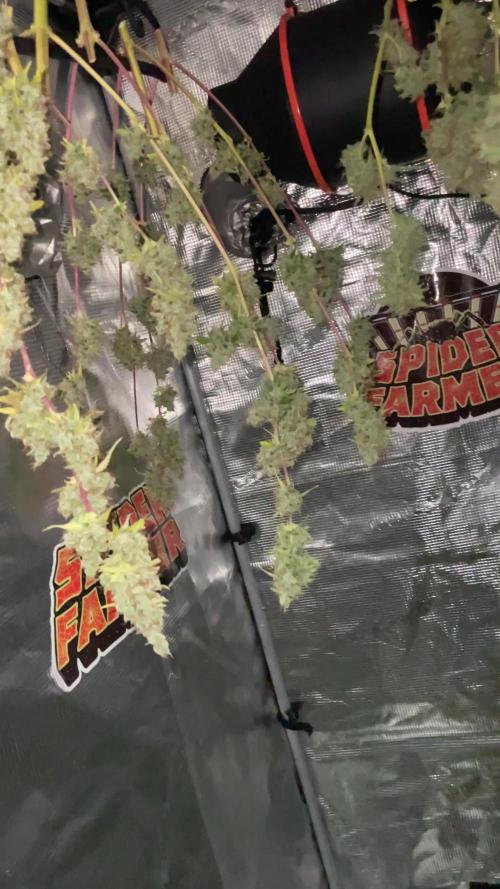
En resumen, todo ha salido bien y los productos han echo su función en el siguiente cultivo cámbiate el sustrato por un ligth mix para poder fertilizar mucho antes y estoy muy asombrado por el sistema de riego


Likes
12
Share


@Weedig_Weedigson
Follow
Sehr Harzig, riecht nach nem wilden Beerenmix mit Bluedream. Sehr schön.

Likes
Comments
Share


@smoking_hills9
Follow
Plants doing great, added 4 tea spoons of spirulina per 10L last watering.
Likes
14
Share


@Caertner
Follow
Epische Aufnahmen einer gemeinen Honigbiene beim Sammeln von Canna Honig.
Die Aufnahmen konnten gemacht werden, weil die Biene wiederholt zurückkam, um noch mehr zu sammeln...
?
Ich glaube gerade nicht was ich sehe...


Likes
42
Share


@Theia
Follow
Sad news. Due to no fault but my own the sherberts were subjected to some very badly managed environmental factors.
I have been busy building our new grow space and was not checking the plants at the back of the space. The 2 sherberts were there at the back and the RH went on a roller coaster over 4 days with temps swinging massively also due to an unmanaged dehumidifier.. the end result was both sherberts stressed out and grew some pollen sacs and I did not see so the burst and pollinated my entire flower room.
Gutted. But I will push through the last few weeks of flower with all the current grows and see what we get.
I had to chop alot of lower bud. Sacs had burst so I just did a very have clear.
Have I mentioned I'm gutted. And this is not a reflection of weedseedsexpress genetics. I have looked at the data logs for last 9 days and it's so up and down with rh and temp it's no wonder they stressed. Next round less plants and I have to stop with the clones.. no room.
Thanks for looking.
Stay safe😷
Happy grows.🌱🌱

Likes
45
Share


@PEAKYPLANTERS
Follow
good friends ...
Good evening everyone!
I was really shocked by the rarity of these sprouts! hard as diamonds and cold as ice!
we will proceed with the usual drying in the dark with dry trim

Likes
2
Share

@Dameon0803
Follow
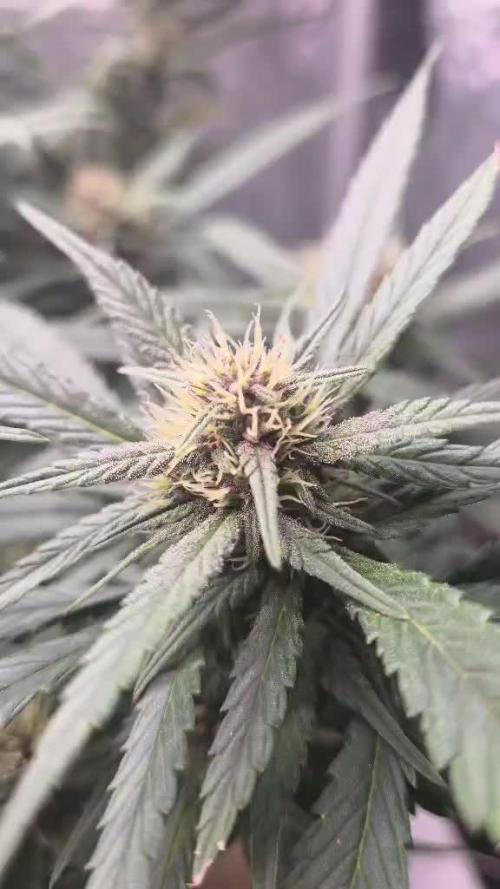
Another good week. Amazed how much purple this strain put on right away!