


Likes
Comments
Share

@rommyu
Follow
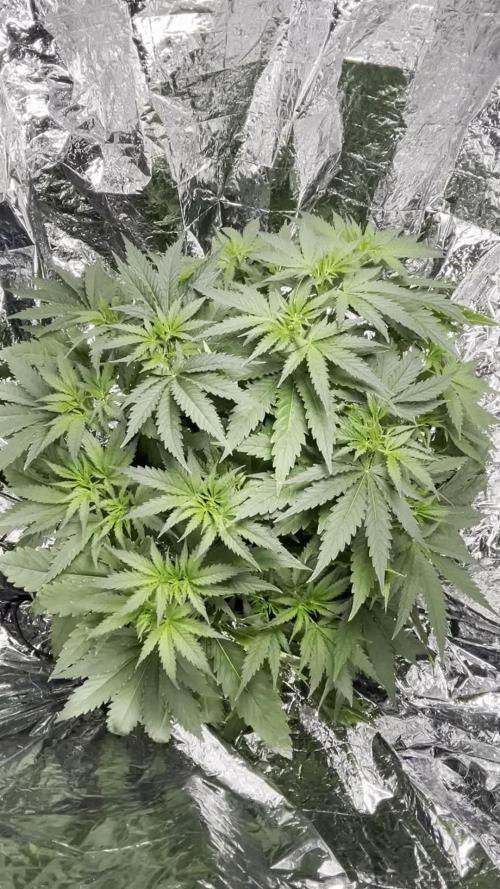
Moved to a bigger tent. My intention is since I have this tent for sawing aluminium, and not using it at the moment, that id see how a space would reduce my need to dehumidify (since i am using co2 - fans are on only at night). Its now at a stable 1.1 without a need to de-and humidify.
going to finish off this week and then start to flower next week. I plan to have 32 total apical tips. 4x4x2 = 32. and letting those grow out to about 3 nodes b4 flipping to flower or maybe in a week. we'll see.

Likes
8
Share


@4F1M6
Follow
This ladys packing on to 4 fatty colas and stacking them to the tits. She has other branches obviously lol but the 4 colas are all sharing dominance and really getting fat. Bud structre is really coming in now. Very round and dense. Lots of flowers already piled on at every bud site. Trichomes are piling on thick already. This is gunna get mighty frosty!
I reduced the nitrogen dose again. I also stopped giving her vigorous. Its a pure bloom mix now as this lady is booming with flowers. Until next update. Happy growing and stay lit fam.

Likes
44
Share


@BB_UK
Follow
Well here we are at 14 days into bloom (day14) was 2 weeks ago Monday night I started the transition! And now look at these ladies! 🙌🏽 beautifully trained of course to accommodate all the bud sites that were situated! I’ve also been daily training maybe twice three times as they stretch pulling them back down and resting the main head on the scrog so the secondaries come up and allow the younger girls to rise to the top where they’re at too! The rest are not far behind now! Excited to get to the end of this one! Going to be a HUGE yield

Likes
15
Share


@Sup3rNov4
Follow
Wonka has bounced back will lots of energy finally it’s happy not to long left on her the fattening should start any day now
The fattening has begun
Found a dam spittle bug on the bottom leaf this morning poor bugger picked the wrong plant, the little blighter was higher than me. Checked Wonka over it was just the one for now and it was located on a small leaf so no damage to worry about but spring is officially a go!

Likes
20
Share


@Bread_n_Buds
Follow
Time flies, we have arrived in a flash at day 16, it seems like the other day that the first young ladies were appearing on September 1st. "Do you remember.....nanannana Septermber"
She is the Runtz and among the Zamnesia strains she is a diamond tip. I have grown her in all versions and she has always been super, I can only advise you to try her. The two Runtz are growing very balanced, the internodal distance is medium and regular like the growth, we have no leaps or stretching, she is a very proportionate plant. She is also slightly, very but very slightly under fertilized because I went too slow. Follow the table, especially if you make the personalized one from Plagron, you can't go wrong.
--- feeding program - As I mentioned I was shy about fertilizing and the plants are slightly, very slightly faded, let's learn to notice these small signs and with the normal doses after two or three waterings we should be fine. You have to look at the plants guys.
- Power Roots - 1ml/l
- Alga Grow - 2 ml/l (instead of 4 ml/l I made this mistake)
- Pure Zym - 1 ml/l
- Sugar Royal - 1ml/l
- Vita Race - 0,5 ml/l
- The 100% Organic pack by Plagron can be found on Zamnesia at the link: https://www.zamnesia.io/it/11457-plagron-easy-pack-natural.html We are giving a lot of humidity with a humidifier and we oscillate between 65% and 70%.
// Strain Description // Guys, we have really reached a turning point! Our breeders have recreated one of the most sought-after strains by Californians: the very powerful and exquisitely delicious Runtz. This cross between Gelato and Zkittlez is everything you could want from a cannabis strain: tasty, powerful, balanced, productive and fast flowering. Buy the seeds and try it yourself!
- Get a seed of this fantastic strain --- https://www.zamnesia.io/it/6000-zamnesia-seeds-runtz-femminizzato.html
- Soil and Fertilizers entirely organic --- https://plagron.com/en buy on www.zamnesia.io
- Growbox and air sistem --- https://www.secretjardin.com/
- Light - Sp3000 - https://marshydro.eu/
- Music and sound --- I made my girls listen to 432hz frequencies and music from www.radionula.com
- Z --- You can find these seeds, much more from the world of cannabis, mushrooms and an incredible series of accessories and gadgets on the reference site not only mine but of many growers ---- https://www.zamnesia.io
Sound’n’Buds weekly with Gangstarr - “You Know my steez” from “Moment of truth” Album, go and listen!

Likes
12
Share


@Gardens_of_Of
Follow
- Streching is ended.
- Just like last week, humidity has been a very big problem in Berlin due to multiple storms and heat waves this week as it spiked between 50-85 % outside whole week.
- VPD fluctuated this week between 1,0 and 1.65 kPa , averaging at 1,29 kPa. Better than last week because of the crazy heat wave covering huge humidity.
- Tent temperature fluctuated around 24 at night and 27-28 Celsius at day time, averaging at 25.2. A lot higher than last week even though I have increased the exhaust fan speed but that’s all my exhaust fan can handle.
- Humidity fluctuated crazy between 50-85% this week, averaging at 59.8. Not much I can do other than trusting the non-stop ventilation in the tent.
- This week, I kept giving increased Ph (6.8) of water first half of the week as the medium Ph is still cruising under 6. But then I switched to 6.5 on the 2nd half of the week.
- Much more frosting can be observed on Chemical Bride.
- White pistils are slowly turning orange on both plants and the flowers are gaining mass.
- Both have a similar pleasent gummy smell.
- I believe that Kings Kush is not as capable as Chemical Bride in terms of heat and humidity resistance. My observation is that Chemical Bride is a week ahead already. But let’s see!!
- This week, I will add a dehumidifier to the setup.


Likes
4
Share


@eldruida_lamota
Follow
Que pasa familia, vamos con la cuarta semana de floracion de estas Rainbow Melon feminizadas de fastbuds.
Vamos al lío, de las 3 plantas, me quede con 2 por espacio, siempre pongo alguna semilla de más por si no abriese alguna por no perder ese hueco del indoor.
También se trasplantaron a su maceta definitiva, en este caso de 7 litros.
Tenían algo de shock por el trasplante pero ya fue solucionado.
El ph se controla en 6.2 , la temperatura la tenemos entre 20/22 grados y la humedad ronda el 50%.
Las flores empiezas a formarse y progresan a buen ritmo.
Hasta aquí todo, Buenos humos 💨💨💨

Likes
2
Share


@Altitonans_Fulmen
Follow
For most crops, a slightly acidic soil pH between 6.0 and 6.8 is ideal because it optimizes nutrient availability. When soil pH rises above 7.0 (alkaline), the concentration of hydrogen ions H+ drops significantly, and they are replaced by calcium, magnesium, or sodium ions on the clay colloid exchange sites. To naturally lower alkaline soil pH, you can add organic matter (carbon-rich materials), which produces weak organic acids as it decomposes. Maintaining this slightly acidic range stimulates a highly active, diverse microbial community; these microbes decompose organic matter and release carbon dioxide CO2, which plants absorb through their roots and leaves to boost photosynthesis and sugar production. Furthermore, the added organic carbon acts like a sponge, drastically improving the soil's water-holding capacity.
While soil biological activity does involve cellular electron transport, electrical conductivity (EC) in soil is actually a measure of dissolved mineral salts, not a voltage carried by individual microbes. Soil microorganisms secrete organic acids and chelate metallic and non-metallic minerals, transforming locked-up inorganic compounds into bioavailable organic complexes. Unlike harsh synthetic fertilizers that can dehydrate soil life in high concentrations, these naturally chelated nutrients safely nourish the plant, creating a thriving, self-sustaining ecosystem where plants can efficiently synthesize their own food.
Metal-based: Could include elements like iron, manganese, copper, or zinc, which are essential nutrients for plants but can exist in forms not readily accessible.
Non-metal-based: Examples like calcium carbonate, phosphate, or sulfur are also important for plant growth and potentially serve as building blocks for the organic salt.
Chelation in a plant medium is a chemical process where a chelating agent, a negatively charged organic compound, binds to positively charged metal ions, like iron, zinc, and manganese. This forms a stable, soluble complex that protects the micronutrient from becoming unavailable to the plant in the soil or solution. The chelate complex is then more easily absorbed by the plant's roots, preventing nutrient deficiency, improving nutrient uptake, and enhancing plant growth. Chelation is similar to how microorganisms create organic salts, as both involve using organic molecules to bind with metal ions, but chelation specifically forms ring-like structures, or chelates, while the "organic salts" of microorganisms primarily refer to metal-complexed low molecular weight organic acids like gluconic acid. Microorganisms use this process to solubilize soil phosphates by chelating cations such as iron (Fe) and calcium (Ca), increasing their availability.
Added sugars stimulate soil microbial activity, but directly applying sugar, especially in viscous form, can be tricky to dilute. Adding to the soil is generally not a beneficial practice for the plant itself and is not a substitute for fertilizer. While beneficial microbes can be encouraged by the sugar, harmful ones may also be stimulated, and the added sugar is a poor source of essential plant nutrients. Sugar in soil acts as a food source for microbes, but its effects on plants vary significantly with the sugar's form and concentration: simple sugars like glucose can quickly boost microbial activity and nutrient release. But scavenge A LOT of oxygen in the process, precious oxygen. Overly high concentrations of any sugar can attract pests, cause root rot by disrupting osmotic balance, and lead to detrimental fungal growth. If you are one who likes warm tropical high rh, dead already. Beneficial, absolutely, but only to those who don't run out of oxygen. Blackstrap is mostly glucose, iirc regular molasses is mostly sucrose. Sugars, especially sucrose, act as signaling molecules that interact with plant hormones and regulate gene expression, which are critical for triggering the floral transition. When sucrose is added to the growth medium significantly influences its effect on floral transition.
Probably wouldn't bother with blackstrap given its higher glucose content. Microbes in the soil consume the sugar and, in the process, draw nitrogen from the soil, which is the same nutrient the plant needs. Glucose is not an oxygen scavenger itself, but it acts as a substrate for the glucose oxidase (GOx) enzyme, effectively removing oxygen from a system. Regular molasses (powdered if you can), as soon as she flips to flower or a week before, the wrong form of sugar can delay flower, or worse. Wrong quantity, not great either. The timing of sucrose application is crucial. It was more complicated than I gave it credit for, that's for sure. When a medium's carbon-to-nitrogen (C:N) ratio reaches 24:1, it signifies an optimal balance for soil microbes to thrive, leading to efficient decomposition and nutrient cycling. At this ratio, soil microorganisms have enough nitrogen for their metabolic needs, allowing them to break down organic matter and release vital nutrients like phosphorus and zinc for plants. Exceeding this ratio results in slower decomposition and nitrogen immobilization, while a ratio below 24:1 leads to faster breakdown and excess nitrogen availability.
Carbon and nitrogen are two elements in soils and are required by most biology for energy. Carbon and nitrogen occur in the soil as both organic and inorganic forms. The inorganic carbon in the soil has minimal effect on soil biochemical activity, whereas the organic forms of carbon are essential for biological activity. Inorganic carbon in the soil is primarily present as carbonates, whereas organic carbon is present in many forms, including live and dead plant materials and microorganisms; some are more labile and therefore can be easily decomposed, such as sugars, amino acids, and root exudates, while others are more recalcitrant, such as lignin, humin, and humic acids. Soil nitrogen is mostly present in organic forms (usually more than 95 % of the total soil nitrogen), but also in inorganic forms, such as nitrate and ammonium. Soil biology prefers a certain ratio of carbon to nitrogen (C:N). Amino acids make up proteins and are one of the nitrogen-containing compounds in the soil that are essential for biological energy. The C:N ratio of soil microbes is about 10:1, whereas the preferred C:N ratio of their food is 24:1 (USDA Natural Resource Conservation Service 2011). Soil bacteria (3-10:1 C:N ratio) generally have a lower C:N ratio than soil fungi (4-18:1 C:N ratio) (Hoorman & Islam 2010; Zhang and Elser 2017). It is also important to mention that the ratio of carbon to other nutrients, such as sulfur (S) and phosphorous (P) also are relevant to determine net mineralization/immobilization. For example, plant material with C:S ratio smaller than 200:1 will promote mineralization of sulfate, while C:S ratio higher than 400:1 will promote immobilization (Scherer 2001).
In soil science and microbiology, the C:S ratio helps determine whether sulfur will be released (mineralized) or tied up (immobilized) by microorganisms.
A carbon-to-sulfur (C:S) ratio smaller than 200:1 promotes the mineralization of sulfate, when the C:S ratio is low, it indicates that the organic matter decomposing in the soil is rich in sulfur relative to carbon. Microorganisms require both carbon and sulfur for their metabolic processes. With an excess of sulfur, microbes take what they need and release the surplus sulfur into the soil as plant-available sulfate
A carbon-to-sulfur (C:S) ratio higher than 400:1 will promote the immobilization of sulfur from the soil. This occurs because when high-carbon, low-sulfur materials (like sawdust) are added to soil, microbes consume the carbon and pull sulfur from the soil to meet their nutritional needs, temporarily making it unavailable to plants.
200:1 C:S 400:1: In this range, both mineralization and immobilization can occur simultaneously, making the net availability of sulfur less predictable.
This dynamic is similar to how the carbon-to-nitrogen (C:N) ratio regulates the availability of nitrogen in soil. Just as microbes need a certain amount of nitrogen to process carbon, they also require a balanced amount of sulfur. Both mineralization and immobilization are driven by the metabolic needs of the soil's microbial population.
Sulfur is crucial for protein synthesis. A balanced ratio is particularly important in relation to nitrogen (N), as plants need adequate sulfur to efficiently use nitrogen. A severely imbalanced C:S ratio can hinder the efficient use of nitrogen, as seen in trials where adding nitrogen without balancing sulfur levels actually lowered crop yields.
Maintaining a balanced carbon-to-sulfur (C:S) ratio is highly beneficial for plant growth, but this happens indirectly by regulating soil microbial activity. Unlike the C:N ratio, which is widely discussed for its direct effect on nutrient availability, the C:S ratio determines whether sulfur in the soil's organic matter is released (mineralized) or temporarily locked up (immobilized).
Glucose will hinder oxygenation more than sucrose in a solution because glucose is consumed faster and has a higher oxygen demand, leading to a more rapid decrease in oxygen levels. When cells respire, they use oxygen to break down glucose, and this process requires more oxygen for glucose than for sucrose because sucrose must first be broken down into glucose and fructose before it can be metabolized.
In a growth medium, glucose is a more immediate and universal signaling molecule for unicellular and multicellular organisms because it is directly used for energy and triggers a rapid gene expression response. In contrast, sucrose primarily acts as a signaling molecule in plants to regulate specific developmental processes by being transported or broken down, which can be a more complex and slower signaling process.
Critical stuff.
Likes
75
Share

@Growbody
Follow
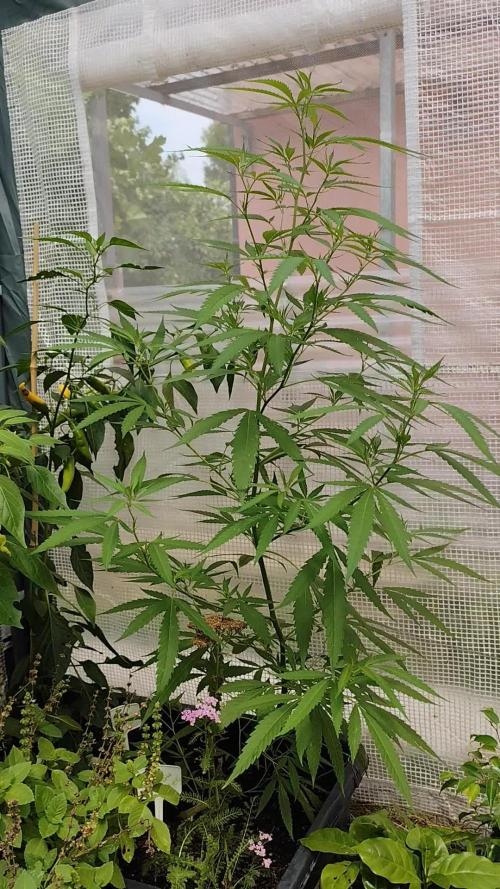
Meine lieben Freunde und Freundinnen, Brüder und Schwestern im Geistigen und Tatkräftigen, herzlich Willkommen zum Greenhouse Summer Outdoor Grow 2026.
Der erste Strain des Outdoor Grows den ich Euch vorstellen werde ist die Purple Lemonade FF von 2Fast4Buds, eine 60% Sativa die laut FastBuds etwas nebulös als eine Kreuzung aus purple und citrus Cali Genetik beschrieben wird. Egal, sie soll sehr fruchtig und zitronig schmecken und könnte schöne Farben bekommen. Außerdem soll Sie eine kurze Blütezeit haben. Hier ist die URL:
https://2fast4buds.com/de/seeds/purple-lemonade-fast-flowering#description
Der zweite Strain der im Set mit dabei ist, ist die Mimosa x Orange Punch fem. von Barney's Farm, die ihre Genetik und den Taste bereits im Namen trägt, eine 65% Indica, die laut Barney's "ein wirklich sensationelles, zitrusähnliches und mandarinenartig-süßes Aroma" haben soll. Auch sie könnte interessante Farben bekommen. Hier die URL:
https://www.barneysfarm.de/mimosa-x-orange-punch-552
Last but not least, der dritte Strain ist die Chocolate Sherbet fem. von Grower's Choice, eine 70% Sativa, deren Eltern Chocolope x Sunset Sherbet sind. Auf den Geschmack bin ich schon jetzt gespannt, cremiges Haschisch. Mit bis zu 240cm könnte sie die größte im Greenhouse werden und würde dann bis zur Decke wachsen. Hier ist die URL:
https://www.growerschoice.nl/de/chocolate-sherbet.html#description
EDIT:
Nachdem die oben aufgeführten Pflänzchen nicht so recht loslegen wollten, habe ich mich entschlossen, fertige Stecklinge von Hanfgarten aus Österreich dazuzubestellen. Die Stecklinge kommen in die Mörtelwannen, die selbst gezogenen kommen in die bereits bewährten 15 und 20 Liter ROOTiES. So kann ich die auch mal direkt in die Sonne stellen.
Der erste Steckling ist die Blueberry von Hanfgarten, eine 80% Indica, einer Kreuzung aus Afghan Indica x (Thai Sativa x Mexican Oaxacan Sativa), die nach 8 Wochen Blüte Mitte Oktober fertig sein soll. Außerdem soll sie fruchtig, beerig und süß schmecken. Auch hier gibt es eine URL:
https://www.hanfgartenshop.de/blueberry.html
Der zweite Steckling ist die Runtz, ebenfalls von Hanfgarten, ein Hybrid aus Zkittlez × Gelato, die auch nur 8-9 Wochen Blüte hat, mal sehen. Wenn sie ein ähnliches Aroma hat wie die Wurlz bin ich happy. Die URL:
https://www.hanfgartenshop.de/runtz.html
Der dritte Steckling ist die Super Lemon Haze, eine 80% Sativa von Greenhouse Seeds, deren Genetik von Lemon Skunk x Super Silver Haze stammt. Mit 9-10 Wochen Blüte steht sie wohl mit am längsten im Greenhouse. I💖Haze und hier sind die URL's:
https://www.hanfgartenshop.de/super-lemon-haze.html
https://shop.greenhouseseeds.nl/feminised-cannabis-seeds/1-seed-pack/super-lemon-haze/?variation_id=604
Auch dieses Jahr gibt es wieder etwas Neues:
Mir ist vor einigen Wochen im Baumarkt ein Foliengewächshäuschen begegnet. Die Aussicht, meine Schätzchen immer im Trockenen zu Wissen, lies mich sofort (also sofort nach einem Recall mit meiner Liebsten) zuschlagen. Danach war nur noch ein teilweiser Umbau unseres Gartens nötig, einen kleinen Weg anders verlegen, ein Fundament ausheben, Bordsteine zersägen, 2 Zentner Beton verbuddeln, Löcher bohren, verdübeln und verschrauben ohne das der Beton ausplatzt, einen haufen Astwerk vom Wein opfern und viel Rasen neu anlegen, das war's schon fast.
Neu:
Sind auch die zwei 90 Liter Maurerbottiche, in denen sich meine Pflanzen wohlfühlen dürfen, 4x soviel Platz wie im letzten Summer Outdoor Grow. Zur Drainage habe ich Rheinkiesel 9-18 verwendet. Da drauf kam mein altes Erdmischungsrezept mit frischem Kompost von Piluweris, Lehm, den die Wühlmäuse ständig in unserem Rasen aufwerfen und Sand aus'm Kieswerk mit gaaanz viel Staub drinne, praktisch Gesteinsmehl. Auch hier gab's was Neues: Hornmehl zusätzlich, hatich früher schon verwendet und ganz vergessen. Der erste Sack Sonnenerde Hanferde wurde mit der oberen Schicht meiner Mischung vermischt. Der zweite Sack kam dann blank obendrauf.
Neu:
Für mich ist auch die angewendete Keimmethode noch neu, die Samen zuerst in einem Marmeladenglas mit temperiertem Wasser mit Zusatz von Wasserstoffperoxyd keimen zu lassen.
Neu:
In die Wannen kommen zusätzlich Gäste als da wären erprobte und neue sowie überwinterte Chilisorten, verschiedene Basiliken oder -kums, Weiße Melisse, Roter Klee, paar Blumen und so.
Tag 99: Der Planet brennt wieder, sich tagsüber im Garten aufzuhalten, wird zur Tortour. Tagestemperatur im Greenhouse heute 34°C bei 33%, nachts empfindliche 11°C bei 92% RLF.
Tag 100: Die Minosa x Orange Punch ist jetzt auf 160 cm, die Seitentriebe haben sich schön entwickelt, sie geht deutlich in die Breite. Die Chocolate Sherbet von Grower's Choice, die Größte von allen, kommt auf 186 cm. Sie zeigt Ihre Herkunft mit langen Nodienabständen und spärlicher Belaubung. Die Purple Lemonade FF von 2Fast4Buds hat mit ihren 147 cm nochmal 11 cm zugelegt. Sie präsentiert sich sehr kräftig mir einem dunklen Laub. Bei der Hitze bekommen die drei Grazien 3x am Tag ~3 Liter Brunnenwasser. Die Blueberry von Hanfgarten ist diese Woche auf 156 cm geblieben. Die Runtz von Hanfgarten wächst weiter auf 126 cm. Die Super Lemon Haze Hanfgarten/Greenhousseeds ist mit 125 cm immer noch die kleinste im Greenhouse und hat jetzt bedeutend mehr Platz , die Aji Amarillo wurde kräftig eingekürzt. Die Temperatur ist heute auf 42°C bei 20% RLF, heiß und Furztrocken.
Tag 101: Die Temperaturen sind heute wieder heiß, 34°C bei 36%, nachts 15°C bei 92%. Die 3 Grazien werden 3x am Tag gegossen, das Greenhouse 2x. Der Bach nimmt immer weiter ab. Kurios, es gab eine Regenwolke und man sah deutlich, das es regnete, aber am Boden kamen nur vereinzelt Tropfen an. Das ganze Schauspiel dauerte nur 1 Minute.
Tag 102: Die Temperaturen Tags 32°C bei 39%, nachts 19°C bei 90% und ein paar Tropfen Regen.
Tag 103: Tags 36°C bei 41%, nachts 14°C bei 93%.
Eins kann ich versprechen: It will take a very, very long time 😃 Schön das du es bist, der mich begleitet 👍😎


Likes
1
Share



Likes
6
Share


@Floryx
Follow
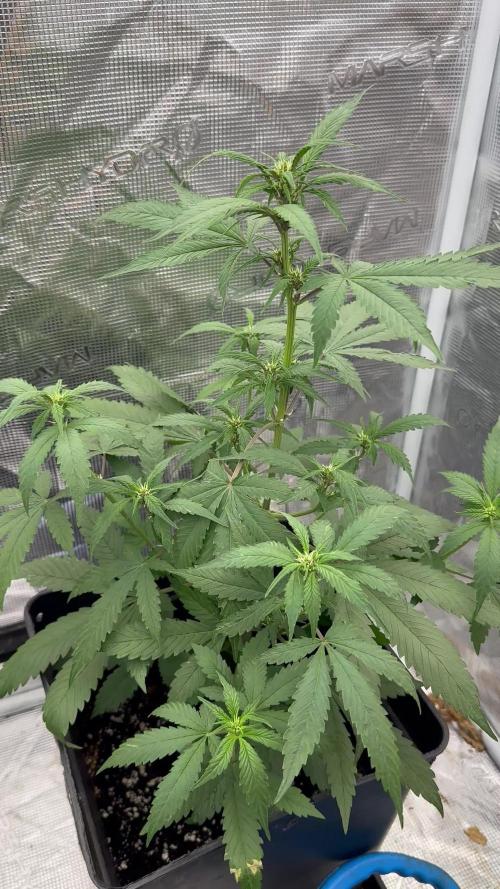
-was on vacation for a week
-plants got watered every other day by my sister
-noticed some spots on leafs as well as yellow leafs
-defoliated some yellow leafs and leafs that didnt get enough light
-put the light on 12/12 today and will start with biobizz in a few days
-Whats does the spots on the leafs mean?
Happy about every comment :)

Likes
27
Share


@RDWCGrowing
Follow
5/16/2023
Week 6- Day 1 of Flower (Day 103 overall)
I just watched them grow!!! Sometimes you really can sit back and enjoy the fruits of your Labors and just enjoy watching them Bud...
5/17/2023
Week 6- Day 2 of Flower (Day 104 overall)
Ground Hogs Day!
5/18/2023
Week 6- Day 3 of Flower (Day 105 overall)
Ground Hogs Day! Just let them grow and enjoying the fruits of my work upfront. I am keeping an eye on the Humidity. It was at 68 today I am currently running 2 dehumidifiers in the tent so will just keep a close eye on it.
5/19/2023
Week 6- Day 4 of Flower (Day 106 overall)
I found a couple Sucker buds trying to form so I plucked them out of existence. Other than that Water Change Day tomorrow.
5/20/2023
Week 6- Day 5 of Flower (Day 107 overall)
Water Change Day!! Since I am changing the water today I decided to do some heavy defoliation and make sure I take a really good swipe at all the sucker buds lower than the first net forming.
I added 36 gallons
Mammoth Silica = .5Mil/Gal= 18Mil
Root DRIP = 1Mil/Gal= 36Mil
CalMag= .5Mil/Gal= 18Mil
FloraMicro = 4.3Mil/Gal= 155Mil
FloraGro= 4.3Mil/Gal= 155Mil
FLoraBloom= 6.5Mil/Gal= 234Mil
LiquidKoolBloom= 2.5Mil/Gal= 90Mil
TPS SIGNAL= 4.0Mil/Gal= 144Mil
ORCA = .5Mil/Gal= 18Mil
Water Temp= 69.5
Tent Temp= 74
Humidity =66 ** I have two dehumidifiers running on Ink bird controllers to try and keep the humidity down as well as I did a heavy defoliation today. In late in flower I like to keep the humidity above 45 but below 60.
5/21/2023
Week 6- Day 6 of Flower (Day 108 overall)
They are looking Great!! Frost is coming in everywhere buds are developing nicely!! Brown hairs everywhere! I didn't do anything I just looked at them and apricated the ability to be able to grow today..
5/22/2023
Week 6- Day 7 of Flower (Day 109 overall)
Auto Pilot engaged.. Just sit back take a few pics and enjoy the Grow!!!!!
Got to do a whole bunch of nothing today but enjoy...

Likes
4
Share


@LittleBigTrees
Follow
After a weeks growth in four litre pots I defoliated them ready to go into flower.
Started feeding them full strength with coir feed even though they are in soil.
Looking happy so far, I'm tight on space so will keep them in check if I can as they flower.


Likes
65
Share


@Dendegrow
Follow
Week 2 of the flowering phase flew by 🌱💨. Unfortunately, I may have overdone it with potassium or kept the water level too high – the classic signs of clawing leaves were evident. Thankfully, they seem to be recovering now and are back under control 💪🍃.
My IR night experiment is showing clear results 🌌: The plants exposed to infrared radiation at night stretched significantly more. This might be especially beneficial for this indica-dominant strain as it leads to better canopy distribution, improved airflow, and reduced risks of mold and disease. Plus, the light distribution is much more efficient now, which I’m excited to see pay off.
On the downside, my Orange Sherbert turned hermaphroditic 😔. It’s hard to pinpoint the cause – overfertilization seems unlikely since I’m using only organic nutrients. I suspect it might be linked to an E-field experiment I’ve been running. To confirm this theory, I’ll conduct a new grow with a similar strain next year to see if the electric field negatively impacts cannabis development.
Stay tuned for updates! Drop a like and follow along for more grow insights 🌿✨. See you next week!
Woche 2 der Blütephase ist wie im Flug vergangen 🌱💨. Leider habe ich wohl etwas zu viel Kalium gegeben oder den Wasserstand zu hoch gehalten – die typischen Anzeichen von Adlerkrallen waren sichtbar. Zum Glück scheinen sich diese jetzt zurückzubilden und sind wieder unter Kontrolle 💪🍃.
Mein IR-Nachtexperiment zeigt bereits deutliche Ergebnisse 🌌: Die Pflanzen, die nachts mit Infrarotstrahlung bestrahlt wurden, haben deutlich stärker gestretcht. Das ist besonders bei dieser indica-dominanten Sorte wahrscheinlich von Vorteil, da es zu einer besseren Verteilung des Blätterdachs führt. Dadurch verbessert sich die Luftzirkulation, das Risiko von Schimmel und Krankheiten wird minimiert, und die Lichtverteilung wird effizienter. Ich bin gespannt, wie sich das weiter auswirkt!
Leider hat meine Orange Sherbert gezwittert 😔. Woran das genau liegt, kann ich schwer sagen. Eine Überdüngung halte ich für unwahrscheinlich, da ich nur biologischen Dünger verwendet habe. Ich vermute, dass mein E-Feld-Experiment eine Rolle spielt. Um das zu bestätigen, werde ich nächstes Jahr einen neuen Durchlauf mit einer ähnlichen Sorte machen und prüfen, ob das elektrische Feld tatsächlich eine ungünstige Rückentwicklung der Pflanze verursacht.
Bleibt dran, lasst ein Like da und folgt mir für weitere Updates 🌿✨. Bis nächste Woche!
Likes
1
Share

@burnbae420
Follow
*🌸 Flip / Day 1 of 12/12: Sept 12, 2026
* 📅 Today: Oct 3, 2026
* 🔢 Day 22 from flip — Week 4, Day 1
* 🌱 Week 1: Sept 12–18
* 🌱 Week 2: Sept 19–25
* 🌱 Week 3: Sept 26–Oct 2
* 🌸 Week 4 starts: Oct 3 📌📌
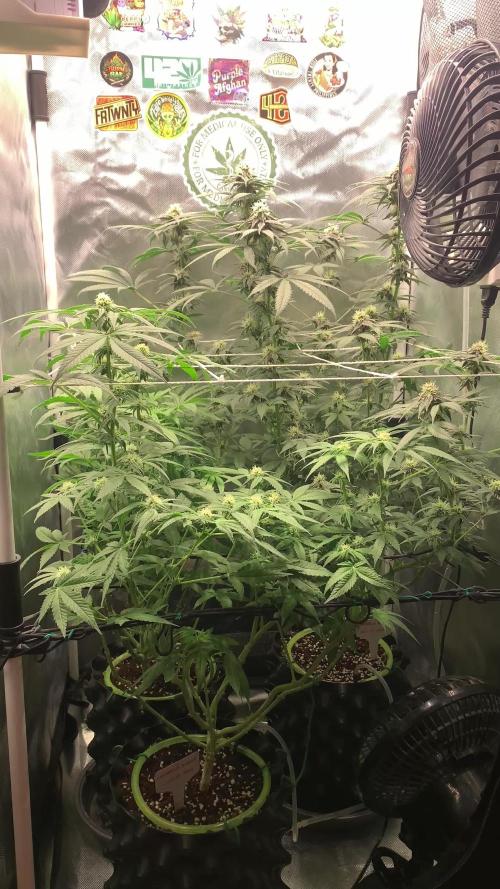
* CP #1: bushier/taller; I did the major strip/defoliation at Day 21 (Oct 2).
* CP #2: smaller, but developing visible bud sites.
* 1× Purple Afghan
* Smaller/leafier and developing more slowly; still showing mostly pistils compared with the CPs.

