Likes
Comments
Share


@Ultraviolet_
Follow
Wakíŋyaŋ, I am who I am, the salt of the earth.
Thunderbird is an allegory; his conflicts with other forces in nature are then an attempt to allegorize relationships observed in the natural order, such as the changing of the weather. He is essentially an attempt to represent the patterns of activity of a powerful, mysterious force in a way that can be understood simply and easily – sort of the way in which a weather map functions today.
Moving from18x60x60 = 64,800 seconds in 18 hours.
64800x860(ppfd) = 55,728,000 umol per daylight.
Into Flower
12x60x60 = 43,200 seconds in 12 hours.
43200x1145(ppfd) = 49,464,000 umol per daylight.
It's asking a lot of Rubisco regeneration to maintain 50 DLI in the 12 instead of 18. Raised the ambient CO2 to 1200 to 1500 ppm to achieve efficient gas exchange.
I don't recommend.
Adding sugar to an indoor growing medium is a highly effective way to stimulate microbial activity, which rapidly breaks down the sugars and releases CO2 through cellular respiration. You can safely capture this CO2 to fertilize indoor crops and boost photosynthesis. While this process works, the setup requires precise management to avoid common indoor growing hazards.
The plant Carbon to Nitrogen C:N ratio defines the balance between structural carbon (sugars/cellulose) and nitrogen (proteins/enzymes). It acts as a master regulator of plant health, growth, and metabolism.
Rubisco (Ribulose-1,5-bisphosphate carboxylase/oxygenase) is the engine of photosynthesis responsible for fixing atmospheric CO2 into sugars. It is intimately tied to the C:N ratio for three primary reasons. It is the Plant’s Biggest Nitrogen Sink, Drives the Carbon Side, and it is the Nitrogen Control Knob. Understanding this relationship allows you to predict how plants respond to environmental stress or fertilizer.
Rubisco acts as the primary storage sink for leaf nitrogen, accounting for up to 30% to 50% of a C3 plant's soluble protein. Deep Green Leaves signal a rich abundance of both chlorophyll and Rubisco proteins. The plant possesses the heavy enzymatic machinery required to handle 1145 PPFD. Pale or yellowing leaves indicate a nitrogen deficiency. The plant is actively breaking down its own Rubisco to salvage nitrogen for newer growth, drastically reducing its light-tolerance threshold. Subtle difference, but understanding is important in order to be able to judge when to dial light intensity up and light intensity down, when to push, and when to back off. An extra dose of magnesium is vital if a plant is going to push through the growing pains of high-intensity lighting.
Foliar application of magnesium is an excellent and rapid way to assist with Rubisco regeneration within a plant, so long as it is applied correctly.
Spray strictly in the early morning or late evening, mixing your magnesium with a little fulvic acid or chelator, but only when she gets a little limey on top.
This, for me, is the experience of growing, akin to "riding the surf" maintaining efficient Rubisco regeneration through visual identification of the shade of green. Surf a razor-thin wave when balancing light intensity, nutrient availability, and transpiration to maximize Rubisco enzyme efficiency. Keeping the Calvin cycle fully charged without tipping into nutrient toxicity, light stress, or the dreaded chlorosis requires paying close attention to the visual cues the plant provides. By monitoring these subtle shifts in color, turgor pressure, and leaf posture, you adjust your environmental controls and surf that exact razor-thin wave.
They operate in tandem; nute recycling acts as the vital execution mechanism for autophagy, which defines senescence. Natural senescence is a genetically programmed developmental stage aimed at nutrient recycling, whereas triggered autophagy is a rapid survival response activated by environmental stress. While both processes utilize the vacuole to break down cellular material, their triggers, selectivity, and overall goals are entirely different. Cannabis plant senescence is not separate from nutrient recycling protocols; rather, nutrient recycling is the primary physiological purpose of senescence, and autophagy serves as the core switch mechanism executing both processes.
Takes about 24 to 48 hours to notice visible changes once the signals have initiated the autophagic response. Not too late at all. A little bit of fade from senescence 2 weeks from harvest is normal and genetically expected. Send the C:N 32:1 signal 1 week from harvest for the best effect in your organic grow.
Understanding what makes leaves fade is not always senescence, but also strongly linked to Rubisco regeneration. That's a whole other subject. Vital to understand the differences if you want a correct diagnosis and to transition from hobby grower to master stoner, differentiating between a true genetic fade and a decline in photosynthetic proteins.
Nitrate is nitrate, whether it oxidizes or not is not up for debate. If it's not sunk by the plant you are smoking some if not all of, it's regardless of what your feelings are on the matter. Senescence is highly critical. It is the natural end-of-life stage where the plant redirects energy to ripen flowers. Properly managed, it breaks down harsh chlorophyll, allowing the terpenes (which provide taste and aroma) to peak. Harvesting outside this window leads to an "unripe" or degraded flavor comparable to going without.
Now that we've got that out of the way.
To initiate the response you seek, you can trigger it multiple ways, when growing synthetically its triggered by nutrient starvation, generally when the entire medium is flushed. This is more to do with N starvation than being entirely empty. Nonetheless. PK boosters are N starvation through maximizing P and K. (Generally only works for synthetic grows)
Because you are using organic nutes and you want to maintain the rhizosphere, what you want to do is add carbon in the form of sugars (powdered molasses). It's almost impossible to empty a medium enough when microorganisms are constantly releasing nutrients into the direct EC. Very difficult to initiate starvation responses with ammoniacal nitrogen.
Manipulating the C:N ratio is the master key to triggering an autophagic response and resulting nutrient recycling in the last days using organic nutes and without having to flush.
Generally not recommended for new growers. So do what you want. But if you don't trigger the plant to dump its nitrates into root zones, you will smoke nitrates as NO3- does not oxidize during the dry and cure no matter what you do or how long you dry or cure. Doesn't matter what anyone "feels" about it, how many grows they had with no fade. That's just how it works. If you are a purist, this is the way to go.
"clover steals valuable nutrients."
Crop and drop the clover come flipping to flower, its benefit comes from creating an airy and porous rootzone. I don't need to crop and drop once the plant fills the canopy, she blotches out the light, and the clovers die. This is the nitrogen the microorganisms use to convert carbon for respiration throughout the flowering stage.

Likes
150
Share


@Ferenc
Follow
Day 106, 17th of November 2020:
We need to say goodbye to her very soon. The judgement is harvest.
Time has come and she is old enough to be cut. I have checked trichomes all good some days darkness and no more water also and she will be just outside on the table for some days.
Really nice little plant not strong smell. I really wanna try the smoke the ratio 1:1 CBD:THC and only 7.5% CBD and 7.5% THC haha :)

Likes
14
Share


@ConspiracyFly
Follow
Week 8 Amnesia
Amnesia 1 (Seedstockers)
With LST
4 weeks of flowering
It has 55 centimeters
14L
LED 25 cm
Lux 60.000
Amnesia 2 (Seedstockers)
Without LST
2 week of flowering
It has 60 centimeters
14L
LED 20 cm
Lux 85.000
Gorilla Cookies Auto (Fast Buds)
(24 days) 3 Week
It has 8 centimeters
16L
LED 56 cm
Lux 23.000
Godzilla Cookies (Herbies)
(14 days) 2 Week
It has 6 centimeters
15L
LED 60 cm
Lux 20.000


Likes
42
Share


@Ganjagrandaddy
Follow
DAY 7: Hi all. A nice steady week for the girls finding their feet in the pots and without their domes. I have the pota a good soaking to start them off on the right foot and get those roots busy too. The Girl scout cookies are both doing really good with their 3rd nodes happily springing to life. I managed to start l.s.t as soon as the 5th node is workable on them. Plan is to hold the 5th nodes horizontal while the other nodes reach an even canopy height. Then I will let the 5th node continue vertical to join the party as an equal to the others.
The Amnesia Haze are also very happy looking in their new homes and domeless. Not as developed as the Gsc but looking a nice shade of green. They are about 1.5 inches and on 3rd node growth too.
So far so good. Let's see what another 7 days can add.
Be well growmies.

Processing
Likes
13
Share


@Xelxz
Follow
ºDay 78 (24Jan) - 11th video;
ºDay 79 (25Jan) - 22th watering (3rd nuteMix);
ºDay 82 (28Jan) - 23th watering (1st flush);
ºDay 84 (30Jan) - End of week 12;


Likes
72
Share


@BodyByVio
Follow
After 14 days drying, 7 days hanging and another 7 days on cardboard boxes 📦 at a temp between 61 and 65 degrees F and a humidity between 52-55 % I trimmed all the buds and jar them with Boveda 62. After 2 days in jars ( 16 days from cutting the plant down) I weighed in everything. I got 434g of grade A buds and 685g of Grade B ( perfectly smokable ) buds plus a lot of trim that I didn’t weight.
I’m very pleased with everything and I enjoyed every single step along the way. Probably next time I will lollipop/defoliate more aggressively so I can get more top bud and less grade b bud.

Likes
7
Share


@Naujas
Follow
I cut a girl this week, it was my first more normal haircut:) maybe I overdid it a bit, but she continues to grow and I'm happy about that :) today she will get food 2x in a row :)

Likes
2
Share


@Bread_n_Buds
Follow
Our Zamnesia Tropicanna Cookies #1 is one of those girls that entered flowering a bit earlier than the others and is now around the third week of flowering and looking magnificent.
It's very large and developing beautiful flowers and a majestic main cola.
We're in a standard 11-liter plastic pot.
Techniques chosen: The plant was left to grow and simply trimmed at the bottom.
We're 100% organic and 1000% Plagron, as always.
The soil we've chosen is the recently launched Plagron Bio LightMix, which will allow us to get the grow started more smoothly and reliably, without the sudden changes that liquid fertilizers can cause. A week is more than enough, so let's not overdo it.
We're in the early stages of flowering but are well-equipped with fertilizers and additives. We've added:
- Pure Zym 1 ml/l
- Silic Rock 1 ml/l
- CalMag Pro 1 ml/l
- Sugar Royal 1 ml/l
- Alga Bloom 4 ml/l
- Power Buds 1 ml/l
Choose your favorite style and calculate your results on the website:
www.plagron.com
Our new 720W Spider King lamp from Vanguard Hydroponics is now at 80%
Z - https://www.zamnesia.io/en/531-growshop
Our Tropicana Cookies is now in great shape, give it a try!
Z - https://www.zamnesia.io/en/10921-zamnesia-tropicana-cookies-semi.html
Z - The award-winning Girl Scout Cookies is a cannabis strain that lends itself very well to breeding projects. That's why we boldly experimented by combining its genetics with a fruity Tangie. The result is Tropicana Cookies, a fast and potent hybrid with 22% THC. This strain is highly productive, and its buds are not only rich in sweet and spicy terpenes but also covered in a layer of sticky trichomes (which facilitate the extraction of high-potency concentrates). Tropicana Cookies' genetic makeup is 60% sativa and 40% indica, a blend that produces a balanced and euphoric effect.
Although easy to grow both indoors and outdoors, Tropicana Cookies thrives outdoors in warm climates. If you have enough space and good sunlight, the plants can reach heights of 180 cm. Wait until mid-October and, in optimal conditions, you can harvest a whopping 700 g/plant. A result well worth the effort. This strain also impresses indoors, reaching heights of 150 cm and producing 500 g/m². Tropicana Cookies also stands out for its rapid flowering. After just 7-8 weeks of indoor flowering, it will be ready for harvest.
You know it, but I recommend it: here you can find so many beautiful things, essentially "the best that nature has to offer."
Z - www.zamnesia.com
Music //
www.radionula.com
+ Feng Shui Music
+ 432 Hz Frequencies
Likes
10
Share


@Cauli
Follow
So far nothing special, everything seems to be fine.
She had some sunny days at the beginning, but weather got cloudy and relatively cold – this has slowed her growth for sure.
But want her to adapt well to her conditions, so only put her inside in really cold nights.
She got her endpoint directly on day 3, it's a 9L airpot. root was already at the bottom of the small starting pot. so maybe this stressed and slowed her too.
Let's see how she will grow the next days.
Video for this week will follow. Filming quality of my phone is not as good as would have liked it.
But working on it.
Likes
15
Share

@SouthGermanGrowGirl
Follow
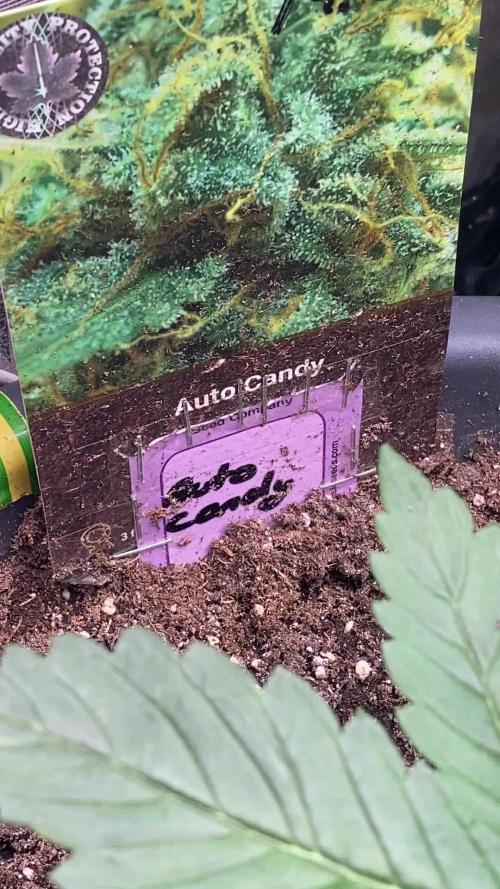
Candy grows slowly because of this weather here in South germany :-(
but we will see, it seems it will be better in few days

Processing
Likes
15
Share


Likes
48
Share


@TheCannaProphet
Follow
~ WEDDING CHEESECAKE FAST FLOWER by FastBuds ~
Well fam, here we go again with another epic strain from FastBuds Fast Flowering stable. After having such tremendous success growing their Gorilla Cookies Fast Flower outdoors last year, I've decided to run another of their fast flowering strains outdoors this year... Wedding Cheesecake Fast Flower!
The best description of this awesome cultivar comes directly from my friends at FastBuds which is as follows:
"A delight for the mind and body: Wedding Cheesecake FF (Fast-Flowering) is a delicious strain that offers XXL yields in a 7-8 weeks flowering cycle. This terpene powerhouse produces loads and loads of mouth-watering vanilla-creamy-cookie-scented terps with hints of citrus and cinnamon. In addition to its delicious aromas, this variety grows very well in both indoor and outdoor setups, yielding up to 650 g/m2 without extra maintenance, making it the ideal strain for beginners as it allows you to maximize yields while minimizing work. This super-fast feminized photoperiod version offers upbeat and energetic yet deeply relaxing effects that are perfect for consumers looking for a heavily focused, motivating, and creative high. It’s the ideal strain for those needing that extra energy boost to start a busy day on the right foot.
Wedding Cheesecake FF boasts chunky, large-sized buds with a thick layer of silvery-white resin and bright orange hairs scattered all over: that just screams ‘quality’. The lime-green flowers sparkle with an array of hues ranging from dark to light green, to magenta and purple, and reek of a delicious aroma that’ll remind you of fresh store-bought cheesecake.
This is an XXL hybrid that grows extremely tall in height, reaching up to 3m with one huge main cola and multiple long side branches that can withstand enormous yields of up to 650 g/m2 with ease. Wedding Cheesecake FF is extremely resilient to the elements and can be grown in almost every climate as long as you’ve got the space and basics covered, making her an excellent choice for those looking for large-scale harvests with a quick turnaround time without much effort."
________________________________________________________________________________________________________________________________________________________________________________________________________________________________________________________________________________________________________________________
The Setup:
This is going to be an outdoor grow, but I have started the Wedding Cheesecake FF indoors as our weather is still too cold to put her outside (nighttime temp's dipping regularly into the 30's℉).
The plan is simple... let her grow inside under a 19/5 light schedule until the nighttime temperatures stay above the mid 40's℉, at which point she'll be moved outside and transplanted into the soil which I have already setup and inoculated with beneficial microbes, and then let the fun begin!🤪💚
________________________________________________________________________________________________________________________________________________________________________________________________________________________________________________________________________________________________________________________
Weekly Updates:
6/1- Ten weeks from seed and the FastBuds Wedding Cheesecake Fast Flower has the pedal to the firewall now!
Today I top dressed the Wedding Cheesecake Fast Flower with 2 cups of Gaia Green 4-4-4, 1 cup of Down to Earth Bio Fish along with 1/2 gallon of worm castings. After top dressing and working the amendments into the soil by hand, I watered it in via garden hose with straight well water.
6/3- Rained hard today so I skipped watering the Wedding Cheesecake FF.
6/5- Today was sunny and warm. I watered the Wedding Cheesecake Fast Flower with straight well water from the garden hose.
6/7- There goes another week for the Wedding Cheesecake Fast Flower from FastBuds and she continues to impress and amaze me. I hope to see you next week!
Thank you for checking out my diary, your positive comments and support make it all worthwhile! 💚Growers Love!💚😎🙏
Likes
195
Share

@yan402
Follow
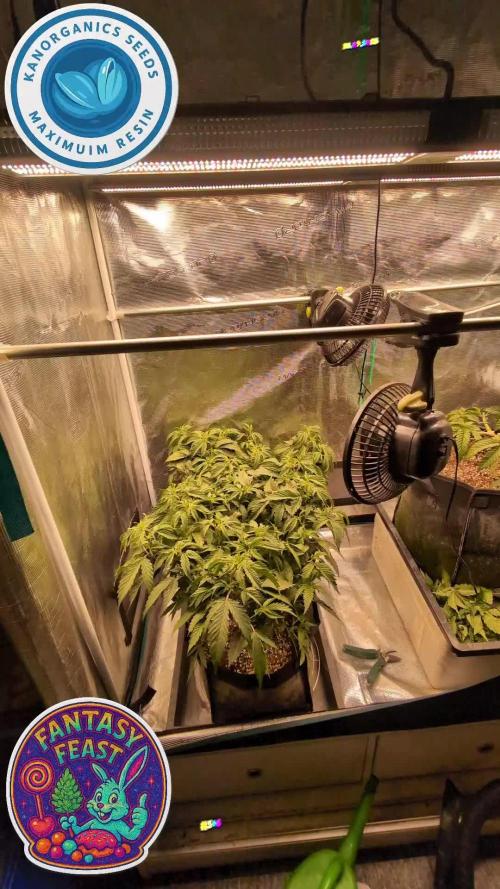
This two were part of another diary and got moved out due to space reasons at VW8 and moved back indoors at VW20
https://growdiaries.com/diaries/218151-auto-god-s-glue-grow-journal-by-yan402
13.09.25 VW21 Both are looking good and are developing tighter nodes than when they were outside, I'm going to have to keep cutting them back every once and a while I also applied nematodes against thrips and fungus gnats.
20.09.25 VW22 some spots and some yellow leafs, I think it's a root problem, probably root bound, but both seem healthy and are getting thicker so maybe just top up with Coco coir and give a slight different nutrient schedule less Tri Part Bloom could do the trick MAYBE lol.
🌱💦🌱💦🌱💦🌱💦🌱💦🌱
Day to day tasks & actions 🌿
🌱💦🌱💦🌱💦🌱💦🌱💦🌱
27.09.25 VW22 – Fed 3l of #1 → 2l runoff
(*RUNOFF reused for tomato plants)
🍶💧🍶💧🍶💧🍶💧🍶
💧 Nutrients in 30L #1
🍶💧🍶💧🍶💧🍶💧🍶
💧 TriPart Micro:
10ml
= 0.33ml/L
🍶 TriPart Grow:
0ml
= 0.00ml/L
💧 TriPart Bloom:
10ml
= 0.33ml/L
💧 Cal-Mag:
60ml
= 2.00ml/L
🍶 Home-made FFJ/FPJ (new batch):
30ml
= 1.00ml/L
💧 pH Down:
Citric acid (BuxXtrade) — adjust to ~pH 6.0
📦 TOTAL:
120ml per 30L
🔬 4.00ml/L
🍶💧🍶💧🍶💧🍶💧🍶
⚙️✂️⚙️✂️⚙️✂️⚙️✂️⚙️
✂️ Tools & equipment ✂️
⚙️✂️⚙️✂️⚙️✂️⚙️✂️⚙️
✂️ 2× MarsHydro SP3000
⚙️ MarsHydro 150mm ACF Ventilator
✂️ Trotec dehumidifier (big unit)
⚙️ Mini no-name dehumidifier
✂️ Kebab skewers (LST – stainless)
⚙️ Wire + roast skewers (LST assist)
✂️ Scissors (HST)
⚙️ Vacuum (for spills & cleanup)
✂️⚙️✂️⚙️✂️⚙️⚙️✂️⚙️✂️⚙️✂️⚙️
🍒🍭🍬🌈🍒🍭🍬🌈🍒🍭🍬🌈🍒
🦄Fantasy Feast ( Seeds)🦄
🌈🍒🍭🍬🌈🍒🍭🍬🌈🍒🍭🍬🌈🍒
Species: Hybrid (Regular)
Genetics: The mother is Unicorn Whip by Dirty Bird Genetics. The father is Charcuterie by Cannarado Genetics.
Effect: Unknown Mixed effect body and head high
Flavor: Some phenos are Skunky gassy fruity, some are fruity sour citrus with a chemical touch and a touch of skunk
Flowering: Estimated 8–10 weeks
Resistance: Strong — Testing phase done
Likes
40
Share


@GYOweed
Follow
Kill off the gg4 ibl it seems degraded from old seed maybe just didn't push anything.
The natural stims and cytokinin I used really made these crazy looking for now but they are sticky af and already dense! Can't imagine them in 4 weeks 😛


Likes
20
Share


@Donkeybuds
Follow
Lots of growth this week really started to bulk up, the smell is starting to come thought very fruity and sweet, already super sticky
Just started with the hydroplex hopefully makes them really bulk up over the next few weeks

Likes
43
Share


@GrowerGaz
Follow
I turned the autopots on Monday and the plants are really thriving. They are growing super fast and the soil mix seems to be performing well. They have just had pH 6.4 water from the water reservoir. I have tied and bent them twice since Monday but they bouce back so fast. I have also turned in th airdomes , buried at the bottom of the pots this week, so let's see what they can do. Plenty of defoliation to expose lower branches , it always amazes me how quick the removed leaves are replaced by little tops.
Day two flower more pictures added. Loads of defoliating this week and tied them all down again yesterday.


Likes
27
Share


@GODSGIFT_2005_JM
Follow
🥊
🍼Greenhouse Feeding BioGrow & Bio Enhancer
⛺️MARSHYDRO
The ⛺️ has a small door 🚪 on the sides which is useful for mid section groom room work. 🤩
☀️ MARSHYDRO FC 3000 LED 300W
☀️Also special thanks to VIPERSPECTRA P2000 (200W) & XS2000(240w) LED growlights
🌱 FASTBUDS 420