Likes
Comments
Share
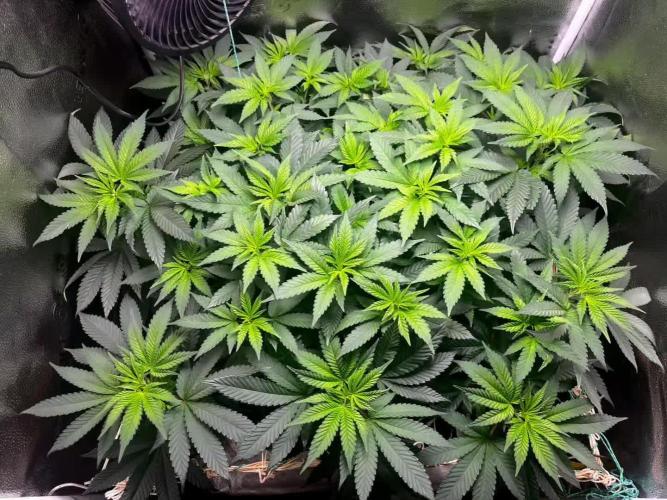
Woche 12 | Laughing Buddha | Der Umzug ins Hobbit-Megaprojekt Diese Woche stand ein Meilenstein an. Die Autos sind geerntet und gecurt, die Gorilla 720W hängt endlich an ihrem Platz und die Laughing Buddha durfte in ihr neues Zuhause umziehen. Und was soll ich sagen? Sie scheint den Umzug nicht nur gut verkraftet zu haben… …sie scheint darauf gewartet zu haben. 😅 Das neue Zuhause In den letzten Tagen wurde der große Growbereich aufgebaut. * 120 × 120 cm SCROG-Fläche * Zwei Netze (später zur Blüte sogar drei) * Gorilla 720W LED Gen II * Controller mit Sensorik * Klimaanlage * Luftbefeuchter * Mehrere Umluftventilatoren Auf den ersten Blick wirkt das Setup fast absurd groß für eine einzelne Pflanze. Als die Buddha frisch eingezogen war, wirkte das Netz riesig und die Pflanze fast verloren. Keine 24 Stunden später sah die Sache schon ganz anders aus. Test der “Billig-Lampe” Bevor die Laughing Buddha endgültig ihren Platz bekam, wurde noch eine günstige LED getestet. Das Ergebnis war überraschend positiv. Für eine preiswerte Lampe lieferte sie deutlich mehr Licht als erwartet und könnte für Anzucht, Stecklinge oder kleine Projekte durchaus interessant sein. Trotzdem wurde schnell klar: Für dieses Projekt spielt die Gorilla in einer ganz anderen Liga. Der Unterschied in der Lichtverteilung ist enorm. Erste Messungen mit der Gorilla 720W Natürlich musste die neue Lampe ausführlich getestet werden. Aktuell läuft die Gorilla auf: * 50 % Leistung * 50 cm Abstand Gemessen wurden dabei rund: 374 PPFD Das klingt zunächst wenig für eine 720W-Lampe. Man darf aber nicht vergessen: Die Fläche ist riesig und die Pflanze befindet sich noch mitten in der Vegetationsphase. Der Vorteil liegt aktuell nicht in maximaler Intensität, sondern in der unglaublich gleichmäßigen Ausleuchtung. Die Buddha bekommt jetzt Licht auf die komplette Krone statt nur auf die obersten Spitzen. Klima läuft erstaunlich stabil Die ersten 24 Stunden nach dem Umzug wurden genau beobachtet. Temperatur: * Nacht: etwa 21–22 °C * Tag: etwa 23–24 °C Luftfeuchtigkeit: * meist zwischen 60–65 % VPD: * überwiegend zwischen 0,8 und 1,2 kPa Genau der Bereich, den ich aktuell sehen möchte. Besonders interessant: Die stärksten Wachstumsschübe fielen genau in die Zeit, in der Temperatur, Luftfeuchtigkeit und VPD optimal zusammenarbeiteten. Die Buddha scheint sich unter diesen Bedingungen ausgesprochen wohlzufühlen. Die Reaktion der Pflanze Und jetzt wird es verrückt. Die Triebspitzen lagen nach dem Umzug vollständig unter dem Netz. Nur etwa 24 Stunden später drückten sie bereits wieder nach oben. Das Wachstum ist aktuell beeindruckend. Die Krone wird breiter, dichter und gleichmäßiger. Der Stamm hat mittlerweile eher die Dimension eines kleinen Baumes als die einer Zimmerpflanze. Besonders erfreulich: Die Mitte arbeitet genauso aktiv mit wie die äußeren Bereiche. Genau das möchte man bei einem großen SCROG sehen. Der Plan bis zum Urlaub In zehn Tagen geht es für zehn Tage in den Urlaub. Ursprünglich stand die Frage im Raum, ob die Buddha vorher noch in die Blüte geschickt werden soll. Nach reiflicher Überlegung fiel die Entscheidung dagegen. Der neue Plan: * Weiter wachsen lassen * Netz 1 füllen * Etwa 10 cm Höhe gewinnen lassen * Die Spitzen ins nächste Netz wachsen lassen * Bis zum Urlaub weiter verteilen Während des Urlaubs wird lediglich gegossen. Nach der Rückkehr folgt: * Große Bestandsaufnahme * Triebe neu verteilen * Alles auf eine Höhe bringen * Unterhalb der Netze gründlich aufräumen * Kurze Erholungsphase Erst danach erfolgt der Wechsel auf 12/12. Kontrolle statt Rekorde Ursprünglich stand die Idee im Raum, etwa 72 Tops unter den 720 Watt zu platzieren. Das bleibt weiterhin ein spannendes Ziel. Allerdings wird die Kontrolle über das Blätterdach wichtiger genommen als eine möglichst hohe Anzahl an Trieben. Lieber 50 bis 60 perfekt positionierte Speere als ein völlig überfülltes Netz. Alles, was später nicht sauber ins Konzept passt, wird konsequent entfernt. Am Ende zählt nicht die Anzahl der Triebe, sondern die Qualität des Canopys. Fazit der Woche Diese Woche hat gezeigt, welches Potenzial in dieser Pflanze steckt. Der Umzug verlief problemlos. Die Gorilla liefert exakt das, was ich mir erhofft hatte. Das Klima arbeitet stabil. Und die Laughing Buddha scheint gerade erst richtig in Fahrt zu kommen. Noch steht sie mitten in der Vegetationsphase. Noch laufen lediglich 50 % Lampenleistung. Noch ist nicht einmal das erste Netz vollständig gefüllt. Aber zum ersten Mal habe ich das Gefühl, dass dieses Projekt etwas ganz Besonderes werden könnte. Die nächsten Wochen werden zeigen, wie weit die Buddha dieses Netz tatsächlich erobern möchte. Eines steht fest: Langweilig wird es definitiv nicht. 😎
Likes
9
Share
Budding phase , Scorg angepasst Dünger erhöht - Blüte / 1-0-1 -0 immer um turn Verschiedene phenos , Duftet stark Super Kondition Kleiner Fehler beim defoiling Also im ganzen bis jetzt zufrieden , bin noch vorsichtig und ein Tag mal net und schwups ausversehen ein bis geköpft … Naja man lernt ja aus Fehlern
Processing
Likes
48
Share
All defolated and flipped today into flower 💚😊🌱
Processing
Likes
6
Share
@Treemos
Follow
Hi guys, sorry if I posted this week so late, but I was sooo busy! This week, I began to give two first doses of Flawless Finish, to start clean the soil (and unlock Indra from its nutrient burn). Aurora is growing really great, has a powerful smell and a white color when I get photo of her at night 😍 Indra began to grow again, after the use of Flawless Finish, the flowers are getting bigger and the smell is growing day by day, I will post her trichomes the next week! Enjoy the photos guys, and thank you all for the help :)
Likes
36
Share
This week went great she is supposed to be an auto but still hasn't followed so I'm setting up my 4*2 tent and flip her see if she is a photo
Likes
17
Share
Week 7 begins. Removed some dead leaves and big leaves that were blocking light to the lower parts of the plant. Buds are getting big and frosty! Very happy with the plants development up to this point.
Likes
30
Share
@RakonGrow
Follow
Note : + jegliches Zubehör wird in der GermniationsWoche aufgelistet . Ich hab keine Ahnung was es wiegt , da ich keine Zugwage hatte. Warten wir also ab was es an trockengewicht wirklich wird. Aber da ist viel Drann , bei 116cm größe ist selbst der kleinste Bud noch groß :)) Es sind nach 5 Tagen Trocknung bei 22°C und 55%rH genau 204g
Likes
175
Share
Day 22 First day of the 4th week of veg and time to start training. Today I lightly defoliated the girls for the first time. I simply removed the first node from each plant and the second node on the left plant. I watered the plants with 2 liters of water (pH 6.4) right after pruning to minimize any shock. I'll give them a couple of days and then I'll top the right girl for sure but I'll see about the left one considering how much smaller she is. Last night I spotted one single fungus gnat in the tent. The first one I've seen so maybe the tomatoes did bring in something after all. I inspected the girls for any other infestation but I couldn't spot anything. I put up a couple of small sticky traps to check if the gnats are there and if they are, then out with the nematodes. I've had great success with nemos in the past so they are my go-to when it comes to fungus gnats. Day 23 So... I fucked up yesterday. I moved around some of the power plugs and forgot to start the extractor fan again after I was done. DOH! I noticed my mistake as soon as opened the tent today and was hit by a wall of heat and humidity. It felt like stepping into a jungle, hot and wet. I guess I need to regularly check the App which monitors my temps and RH. Gotten a bit lazy about it so yeah, that's when fuckups happen. After all, what is the point of having a remote monitoring system if you don't monitor it? As for the plants they are doing their thing. Not much to report. I found one gnat stuck to the left sticky trap. Hardly a huge problem at the moment but need to stay on top of it. I am hoping that the weather improves soon so I can move out the tomatoes and then hit the plants with nematodes. Day 24 Today was a busy day in the tent. I started with cutting back the cover crops as they were getting a bit unruly. I then topped and did some low-stress training to the right girl but am holding off a few days for the left one as she is a bit smaller. My girlfriend suggested that I'd save the top and try to turn it into a clone. I never considered it as I don't have any space really for a third plant but hey, since it was her idea I'll give it a go. This is the first time I ever try to clone so I'm kinda clueless and am just winging it as I go along. I'm not too worried though as this is more an experiment in seeing if I can turn the top into a clone with the means I have at hand. I cut some aloe vera and put the top directly into it. I then blended the aloe with some water in my mixer and now the top is sitting in that aloe tea. I have no idea what to plant the top in next. Maybe some peat moss (as I have some) and continue feeding it aloe tea until root appears...?  It's all an experiment. lol For the low-stress training, I used some wire that I gently put around each branch and then attached the wire to a binder clip that is clipped onto the edge of the fabric pots. I also moved out some tomatoes out of the tent but swapped in some Bishop's Crown and Saltillo hot peppers instead. Finally, I watered everything with nematodes as I today found another four gnats stuck to the right sticky trap. Still, not a huge problem, and I was planning on waiting until the tomatoes and peppers are out of the tent but better to be proactive and nip the problem in the bud than letting it fester. I used 10 million Steinernema feltiae nematodes and I know that 10 million is maybe overkilling it but hey, as they said in Fear and Loathing in Las Vegas - Anything worth doing, is worth overdoing. Besides, I already had those nemos at hand. I gave each girl around 2.5 liters of water (ph 6.7). Day 25 Alright, so I almost died in a heart attack today as I opened my tent and saw several spots of white residue on the leaves - "Fuuuuuuuuu... Did I get Powdery Mildew now after that one day of high humidity?!" After checking more thoroughly it certainly didn't look like PM and then it finally dawned on me. It was simply dried nematodes as I yesterday had spilled a bit of water on a few leaves. Phew! Other than that, not much to report. The right plant looks strong after topping and I re-tightened a couple of the LST wires. The left plant is coming along nicely so I will top her in a couple of days I think. The top is chilling in a glass of aloe vera tea and later today I will put it in a peat tab which will go under a humidity dome. Day 26 Pretty uneventful as all I really did was to water the girls, each got about 2 liters of ph 6.5 water. The right girl is bouncing back strong after topping and the top itself is doing pretty ok, nestled between the girls, in a propagation tray at the back of the tent. It's quite cramped in my small tray but hey, that's all I can fit so let's see if it works out anyway. I also prepared some fresh aloe vera tea by blending an aloe very filet with a bit of water and then fed the tea to the top. I haven’t seen any more gnats, not flying around nor in the sticky traps so let’s hope that they are gone. Day 27 Nothing too exciting today. I gave the top a little more aloe tea, cut back the cover crop a bit to increase air circulation around the plants, and tweaked the LST wires a bit. That's it. Day 28 Today it was time to top and train the left girl. I also put this top in aloe tea together with the other top in the propagation tray. I figured that I might as well try to clone this one as well even though I have NO clue what to do with them in case cloning is successful. lol. I also started brewing some compost tea using the same ingredients as last time (worm castings, rock dust, biochar, lime, bentonite, neem meal, kelp meal) but as I'm planning to foliar feed this round I put all the ingredients in a large teabag. Helps to avoid clogging up the spray nozzle. I was hoping to put off watering until tomorrow as they are getting tea then but the girls were really thirsty so I gave each around 2 liters of ph 6.2 water. Oh, I saw another 3 gnats stuck to the right sticky trap so obviously, there are some still around but that isn't unexpected as the nematodes don't help against already adult gnats. In any case, the population seems small considering how few have been stuck to the traps and I haven't seen any flying around.
Likes
7
Share
@fabialien
Follow
Lunes 11 de marzo 7 am de 2024: Se dejaran hidratando las semillas por 24 hrs. Martes 12 de marzo 7 am de 2024: pasamos a papel dejamos por 24 hrs. Miércoles 13 de marzo 10 am de 2024: revisamos las semillas y vamos preparando macetas pequeñas para transplante. Miercoles 13 de Marzo 3:30 pm se traspasa a tierra. Viernes 15 de marzo 11:47 pm 2024, ya que abrieron bien se pone bajo lámpara 100w a 30 cm de distancia, tienen domo protector! El lunes en la nueva semana subimos el avance, hasta el Lunes... Sábado 16 de marzo 2024, de las 3 semillas la 1 ya abrió completamente, 2 y 3 están por abrir completamente.
Likes
11
Share
Mise en route des graines pour ce test Jour 1 : mise en pot 24/09/24 13graines ont germer Recette du living soil pour 10l 5litre terreau compost équin bovin ovin végétal 5litre terreau intérieur 500gr biochar 900gr lombric 50gr luzerne 5gr micro granulée it45 5gr pollen d’abeille 5gr levure de bière 50gr tourteau karanja 10gr bactérie soluble 200 zeolith chabasit 10gr Levures Saccharomyces Cerevisiae 2gr Endomycorhizes RHIZOPHAGUS IRREGULARIS 2gr Bacillus IT35 Amyloliquefaciens Il est actuellement en maturation depuis 2semaine j’attends que les graines germes et développe bien leur racines Ensuite je rempoterai dans des pots de 300/400ml que je garderais pour une végétation de 3/4/5 semaines le temps que je récolte ce qui a dans la tente Ça s’annonce beau ! Le terreau Terralba ou terre 4 composts est un terreau naturel exceptionnel. Il s'utilise tel quel en extérieur pour stimuler la vie de vos sols, planches de cultures, grands pots... Augmente le stock d'humus dans le sol, la rétention d'eau et d'air. De la germination à la récolte. Sans risque de brûlure. Ce terreau universel peur s'utiliser dans tous les cycles de cultures extérieures. Nous vous conseillons un mélange à 50/50 avec notre terreau Horticole INNT pour une base de culture durable et réutilisable en intérieur. Composition : composts équin, bovin, ovin et végétal maturés 24 mois minimum. Composition : 1% (N) total 0,7% (P205) 0,9% (K20) 0,5% (MgO) 3,6 (CaO) 24% de MO C/N : 11 PH : 8 Le terreau Terralba est un terreau universel exceptionnel. Ce terreau innovant très drainant avec innovation fibre de mousse et fibre textile recyclées est comparable à un substrat de type fibre de coco. Il est aussi enrichi en compost. Il peut servir de la germination jusqu'à la récolte. Nous vous conseillons un mélange à 50/50 avec notre terreau 4Xcomposts EXT&INT pour une base de culture durable et réutilisable. Écologique, restructurant, la terreau enrichie et aère le sol durablement - notamment les sols argileux - tout en lui redonnant jeunesse ! Composition : • 1,2% (N) total • 0,4% (P205) • 0,8% (K20) • 49% de MO • C/N : 22,4 • PH : 7,3 Le charbon végétal actif est capable d’absorber jusqu’à cinq fois son poids propre en eau ainsi que les éléments nutritifs qui s’y trouvent. Il joue ainsi le rôle de catalyseur et d'amplificateur pour les fertilisants traditionnels, qu'ils soient d'origine organique ou minérale. Ce pourquoi il est idéal pour activer un sol et pour les thés de compost oxygénés. Le charbon végétal améliore la diffusion et la disponibilité des éléments nutritifs dans le sol et offre des conditions propices au développement des micro-organismes. Le Biochar peut être introduit dans une grande variété de sols. Il est particulièrement efficace dans les sols pauvres, difficiles et acides. Pour faire agir rapidement et efficacement sa capacité d’amendement, le charbon végétal est enrichi et biologiquement activé avec des micro-organismes. Le Biochar se comporte ainsi comme un structurateur et un activateur dans le but de valoriser les sols. Composition : • Charbon végétal actif 31% • Matière organique 33% • Matière sèche 75% • C/N : 17 • PH : 7,2 • Azote (N) : 2,1 % dont 1,2 % azote organique • Phosphore (P205) : 0,74% • Potassium (K20) : 1,18% • Calcium (Ca) : 6,8% • Magnésium (MgO) : 0,65% Le lombricompost apporte à la plante des éléments nutritifs tels que l'azote, le phosphore et le potassium, qui sont essentiels à sa croissance. En outre, il contient de nombreux oligo-éléments et micro-organismes qui peuvent être bénéfiques pour la plante. Le lombricompost a également une forte capacité de rétention d'eau et peut améliorer la structure du sol, ce qui peut être bénéfique pour les plantes. En utilisant du lombricompost, vous pouvez ainsi favoriser la croissance de vos plantes de manière naturelle et écologique. Le lombricompost est un fertilisant, amendement organique à la formule haut de gamme. Totalement naturel, il résulte de la digestion de fumier bovin et équin par des vers de terre. Les lombrics transforment ces déchets en un compost riche en nutriments et en micro-organismes bénéfiques pour les plantes. Le lombricompost présente une texture fine et friable, regorgeant de nutriments essentiels tels que l’azote, le phosphore, le potassium et d’autres micro-organismes bénéfiques pour les plantes. Son utilisation améliore la qualité du sol, favorise la croissance des plantes et contribue à la conservation de l’environnement en réduisant les déchets organiques. Le lombricompost est donc une source naturelle de nutriments et de matière organique pour les plantes, et peut être utilisé comme engrais ou comme amendement du sol. Il surpasse ainsi le compost, grâce au travail du lombric (E. Foetida) qui transforme le fumier en un super compost ! 10kg de fumier sont nécessaire pour obtenir 1kg de lombricompost. Composition : • Matière sèche 65,3% • Matière organique 48,7% • Ph 7,9 CE 5,98dS/m • Azote (N) 2,4% dont NO3 0,28% • Phosphore (P205) 3,2% • Potasse (K2O) 3,8% • Acides Humiques 6,2% • Acides Fulviques 0,9% • C/N 11,8 La luzerne fait un excellent paillis, c'est un inoculum de bactéries et de champignons ! Elle contient des niveaux élevés de protéines. Elle fournit de nombreux minéraux importants, dont l'azote, le potassium, le calcium, le fer, l’acide folique, etc. Elle stimule la croissance saine des racines et elle contient des hormones naturelles qui aident à prévenir les maladies des racines. Idéal pour les thés de compost oxygénés (TCO) Protéines : 16%. Naturellement riche en protéines, minéraux, vitamines, enzymes et acides aminés. Micro granules it45 Amendement calcaire, dolomie et gypse avec préparation microbienne à base de Bacillus Amyloliquefaciens IT45 et Saccharomyces cerevisiae LYCC6420 Formulation : micro granulés (1 – 1,6 mm) à base de rhizobactéries favorisant la croissance des plantes qui se multiplient et colonisent rapidement la zone des racines, et de levures Saccharomyces cerevisiae souche LYCC ayant un effet probiotique. Les PGPR produisent des enzymes qui solubilisent le phosphore à partir de complexes inorganiques et organiques dans le sol et stimulent la croissance des racines efficaces augmentant ainsi la zone d'interception des éléments nutritifs. Les levures LYCC permettent une occupation de la rhizosphère par une flore bénéfique. Composition : • Matière sèche : 96,8% • Matière organique : 91,5% • N total : 6,6% dont N soluble dans l'eau 0,17% • P total : 2% • K total : 1,7% Micro-granulés : • Oxyde de calcium (CaO) total : 30% • Oxyde de magnesium (MgO) total : 7% • Anhydride sulfurique (SO3) : 13% Le pollen d’abeille est l'ingrédient de base de la fabrication du miel par les abeilles. Riche en vitamines et minéraux, il est qualifié « d'aliment parfait », y compris pour les plantes ! La levure de bière est une matière vivante qui permet un meilleur fermentation pour les thés de compost oxygénés notamment conseillé pour accompagner les croissances ou apporter un gros coup de pousse pendant la floraisons. La levure de bière stimule la vie des sols également à l'arrosage direct en apportant tout aussi bien que dans le TCO sa population l'espèce micro-bactérienne positive pour votre sols ainsi que des oligo-éléments et diverse vitamines. Composition : • 2,8% (N) total dont 1% (Norg), • 2,3% (P205) • 1,6% (K20) • 35% de MO • C/N : 8. PH : 8,4. Le tourteau de Karanja est un complexe absorbant (argilo humique) qui renforce et stimule la vie microbienne du sol. Riche en éléments fertilisants, il permet une assimilation lente et progressive de l'Azote et donc une régularité de l'apport. Composition : • 4,3% (N-Azote) • 5,2% (P205-Phosphore) • 2% (K2O-Potasse) Matières Organiques : 67,3% Carbone Organique : 33,7% Les bactéries solubles sont utiles pour enrichir les sols, activer le processus de compostage et favoriser la création d'humus. Avec plus de 55 éléments nutritifs, ce produit concentre un mélange de vie microbienne bénéfique à tous types de sols. Véritable concentré de matières végétales et minérales, et d'une sélection de végétaux naturels compostés, nos bactéries solubles permettent une libération immédiate des nutriments. • 2,8% (N) total dont 1% (Norg), • 2,3% (P205) • 1,6% (K20) • 35% de MO • C/N : 8. PH : 8,4. Une zéolithe se comporte comme une « Super Argile » perméable qui retient l’Azote et les éléments minéraux nutritifs au voisinage des racines et les relâche lentement en fonction des besoins de la plante. Cela se traduit par une croissance constante mais rapide du végétal. La zéolithe permet de réduire à la fois le nombre d’arrosages et la consommation en fertilisants car ces derniers sont moins soumis aux effets du lessivage et de l’évaporation. Améliore durablement la fertilité foncière des sols. Peut s’utiliser en mélange à tous types de substrats. Récolte les surplus d’eau et réagit à la chaleur en suintant. Diffuse lentement les éléments minéraux nutritifs et l’azote retenus dans l’eau (évite l’acidification des sols. Riche en oligo-éléments, permet un développement racinaire soutenu. Retiens les pollutions des sols (nitrate, mercure). Se mélange à tous types de substrats et toutes les cultures. Idéal bonsaïs, plantes arides Accroit la capacité d’échange globale du « complexe argilo-humique ». Agit comme anti-mottant. Allège les sols lourds et bloquants trop argileux en améliorant le drainage et le ressuyage en surface. Volume poral de 47%. Améliore la structure des sols en s’opposant à l’acidification de ceux-ci par son effet tampon et par le retard de la nitrification de l’azote ammoniacal. Apporte des oligo-éléments. Augmente la résistance au piétinement. Diminue la fréquence des rempotages. Empêche le pourrissement des racines. Favorise la ramification. Modère le développement des mousses. Permet des économies d’eaux et d’engrais. Résiste au dessèchement et diminue la formation de « feutres ». Retient l’eau sans changement de volume. Sert de support aux microorganismes, ce qui contribue à la dégradation des déchets de coupes. Les zéolithes sont des roches cristallines, présentant des capacités d'adsorption particulièrement importantes vis à vis des polluants que l'on rencontre dans l'eau et dans certains liquides, ainsi que dans l'air et les gaz. Elles sont extrêmement poreuses comme les charbons activés et elles peuvent être chargées électriquement pour opérer comme des échangeurs d'ions. La zéolithe est un produit naturel qui respecte notre environnement. Utilisé dans le milieu industriel depuis de longues années déjà, ce minerai aux propriétés filtrantes particulières commence à se vulgariser dans le domaine de la piscine privée, de l'aquariophilie, des bassins d'agrément, de la récupération des eaux de pluie, ou encore de la culture des bonsaïs et autres plantations diverses par exemple... 4 points techniques majeurs : - Grâce à leur propriété hydrophile, les zéolithes peuvent adsorber l'eau jusqu'à 30% de leur poids total et sans aucune variation de volume : pas de gonflement en présence d'eau ni de craquement en cas de déshydratation comme certaines argiles. Les zéolithes sont d'ailleurs de puissants agents anti-mottant (anti-agglomérant). Cette propriété est très appréciée dans le cas des terrains de golf et autres aires de jeux. - Les zéolithes ne captent pas l'eau de façon irréversible, elles se comportent comme une réserve au voisinage des racines. Celles-ci peuvent capter l'eau en fonction de leur besoin. Les zéolithes permettent ainsi de réduire les besoins d'arrosage jusqu'à 35 %. - Une zéolithe se comporte comme une "Zone de Stockage" qui retient l'azote et les éléments minéraux nutritifs au voisinage des racines et les relâche lentement en fonction des besoins de la plante. Cela se traduit par une croissance harmonieuse mais rapide du végétal. - La capacité d'adsorption et l'énorme rapport surface/volume des zéolithes, vont permettre à la fois la rétention de la solution du sol et une bonne oxygénation au voisinage du système racinaire. Les zéolithes favorisent donc l'organisation biologique des sols en contribuant au développement de la micropopulation. L'apport en nutriments (N, P, K) est réduit de 20 à 25 %. Ces derniers, adsorbés par la zéolithe, sont beaucoup moins sensibles au lessivage et à l'évaporation. Composition minéralogique : Chabasite 70 % Phillipsite 2 % Feldspath 5 % Augite 3 % Illite - Mica 2% Analyse atomique: Sio2 52 % AL2o3 17 % CaO 5,7 % K2O 6,1 % MgO 2 %, Na2O 0,6 % Fe2O3 3,6 % Cerevisiae Souche LYCC 6420 STIMULE LA VIE DU SOL PAR DÉCOMPOSITION 100% naturel, sans OGM et sans additifs, il a une action rapide qui permet la libération d'éléments nutritifs et la stabilisation des agrégats. Conséquences ? Les besoins de la plante sont synchronisés, meilleur rendement et qualité à la clé ! • Stimule les population de micro-organismes « décomposeurs » : +32% de population 24 heures après apport • Libère les éléments nutritifs fixés sur la matière organique : 40 à 50 U d’N, 5 à 15 U de P, 15 à 30 U de S libérées 1 à 3 mois après apport • Améliore la structure du sol : stabilisation des agrégats • Réduction de la fertilisation minérale et préservation de l’environnement Sous forme de poudre mouillable. Il contient des spores du champignon mycorhizien Rhizophagus Irregularis MUCL57891 avec des levures inactivées spécifiques. 2000 spores/gramme d’endomycorhize Rhizophagus Irregularis MUCL57891 et Saccharomyces Cerevisiae LYC6420 inactivée. Se connecte efficacement au système racinaire et forme un vaste réseau souterrain de filaments, qui agissent comme des extensions pour atteindre les nutriments et l’eau au-delà de la rhizosphère La bactérie Bacillus Amyloliquefaciens se fixe dans la rhizosphère en se nourrissant des exsudats racinaires. En contrepartie, elle stimule la croissance racinaire en sécrétant des métabolites de croissance et solubilise le phosphore en sécrétant des phytases (enzymes). Effet probiotique consistant en l’utilisation de micro-organismes bénéfiques pour la nutrition et la santé des plantes.
Likes
19
Share
Привет садоводы началась 2 неделя растение потихоньку растет (не очень быстро) но через 2-3 недели будет видно какой она имеет потенциал будем наблюдать дальше и ухаживать сегодня произвел пересадку
Likes
6
Share
@Bud_vista
Follow
I tried budwashing for the first time. Went quite good. The buds are drying for the next 2 week
Likes
2
Share
Welcome to Veg Week 4-5 of Divine Seeds Auto Black Opium I'm excited to share my grow journey with you all as part of the Divine Seeds Autoflowering Competition 2025. It's going to be an incredible ride, full of learning, growing, and connecting with fellow growers from all around the world! For this competition, I’ve chosen the Feminized Automatic strain: Auto Black Opium Here’s what I’m working with: • 🌱 Tent: 120x60x80 • 🧑‍🌾 Breeder Company: Divine Seeds • 💧 Humidity Range: 50 • ⏳ Flowering Time: 60-63 Days • Strain Info: 25%THC • 🌡️ Temperature: 26 • 🍵 Pot Size: 0.5l • Nutrient Brand: Narcos • ⚡ Lights : 200W x 2 A huge thank you to Divine Seeds for allowing me to be a part of this amazing competition and Sponsoring the Strains. Big thanks for supporting the grower community worldwide! Your genetics and passion speak for themselves! I would truly appreciate every bit of feedback, help, questions, or discussions – and of course, your likes and interactions mean the world to me as I try to stand out in this exciting competition! Let’s grow together – and don’t forget to stop by again to see the latest updates! Happy growing! Stay lifted and stay curious! Peace & Buds!
Likes
13
Share
@Canadian
Follow
The plant is monster even though I topper at the 6th note she is 51in tall and smell nice fantastic today I brought them outside the tent to give them a good water down in order to drain out any excessive buildup in the soil. I will continue to update but thank you for reading have a happy grow.
Likes
14
Share
@Canna96
Follow
This week went well for the Durban Nights. Not much to report, she hit day 14 today and is working on her 3rd node, I will transplant her in 48 hours, then hopefully top her in about a week or less. I will wait for her to grow at least 7 nodes so I am sure her roots are solid before the topping, but she will absolutely explode after transplanted into coco coir so that shouldnt be a problem. I will also complete the first two sets of toppings at the 3rd node, so that should shave a little time off as well as I previously completed the 2nd and 3rd toppings at the 5th and 3rd node to further spread out the plant. Super excited for this strain as it is a cross of Durban Thai and Jack Herer which are two of my favorite Sative Strains. I hope everyone has a safe weekend. Thanks for stopping by, Stay Safe and Blaze On!!! 💪 Website: https://medicgrow.com/ https://growdiaries.com/grower/medicgrowled
Likes
28
Share
Info: Unfortunately, I had to find out that my account is used for fake pages in social media. I am only active here on growdiaries. I am not on facebook instagram twitter etc All accounts except this one are fake. Have fun with the update. Flowering day 40 since time change to 12/12. Hey everyone 😊. It gets more beautiful from week to week 😍. The buds are getting thicker and thicker and already smell very good :-). The time has come when she no longer puts her strength into growth but into the flowers :-). It was poured 3 times this week with 1.2 l each time. When watering, there was 1 g of GHSC enhancer per liter of water as every 2 weeks 👍. Of course, as always, the tent was cleaned every day and the humidifier refilled. The complete filter system was also checked again. I filled the tank with fresh osmosis water for the coming week. I wish you all a nice week. Stay healthy and let it grow 🙏🏻👍 You can buy this Strain at : https://www.royalqueenseeds.de/feminisierte-hanfsamen/220-pineapple-kush.html Type: Pineapple Kush ☝️🏼 Genetics: Pineapple x O.G. Kush 👍 Vega lamp: 2 x Todogrow Led Quantum Board 100 W 💡 Bloom Lamp : 2 x Todogrow Led Cxb 3590 COB 3500 K 205W 💡💡☝️🏼 Soil : Canna Coco Professional + ☝️🏼 Fertilizer: GHSC Powder Feeding Bio ☝️🏼🌱 Water: Osmosis water mixed with normal water (24 hours stale that the chlorine evaporates) to 0.2 EC. Add Cal / Mag to 0.4 Ec Ph with Organic Ph - to 5.5 - 5.8 .
Processing
Likes
10
Share
Woop happy with how the grow is coming along had fun trimming the girls down shitting myself at the same time though😝 still on an 18/6 schedule as I didn’t want to over stress the plants following defoliation and scrog . Scrog setting up wasn’t too bad hope I done it right 😅 the screen is slowly becoming very green haha .. I’ll keep looking around on the web to widen my knowledge but for now it seems all is good my plan is to switch to 12/12 starting week 6 and around this time I should look into adding bloom to feed the autos as I’m sure they’re in pre flower stage right now but if ever in doubt I shall ask Some cool photos to look at as well Happy growing ☠️