


Processing
Likes
Comments
Share


@Wollywinkah
Follow
Hope to get some feedback about nutrition :
After 1 plant developed a small brown tip, I started feeding. A total of 116.6 liters of water goes into my system. The feeding schedule says that you should give 4 ml of root juice per liter of water. So: 116.6 x 4 = 466 in total for week 1. So, 466/7 = 66.5 ml per day.
Despite this, the differences in root growth per container seem very different. 1 bin was so far behind that I changed them. However, after 1 day a brown mass developed in the roots. The others are still nice and white. Is this already the bereft root rot?
I've made some pictures and a video. The first plant in the video was first in the container of the third plant in the video.
EC value = 0.6
PH = 6.6
Update 3-5 : After adding more air, problem solved.
Need to keep an eye on plant #3. I've put sticks on top of the startblock. 1 stick is plant #1 etc.
Plant 3 is behind the rest. Root development also differs from the rest. Instead of a long (about 50 cm) long carrot, they are a few short (10/15 cm).
The plant is also significantly smaller than the rest.
Can't do much now so, let's hope and see she can catch up.

Likes
8
Share


@Northern_Ent
Follow
June 14: this Sunday Punch EV is a very fast growing plant that can handle some cool weather. The ruderalis genetics from the autoflower used to create this fast flowering (Early Version) add some toughness that make it well suited to short season areas. Likes to stretch too. 😎
it was to be a 16 cola manifold but it has grown so fast i realized I can also match another 8 colas from the next lower node. So i did that final round of topping this morning and we’ll see how it goes. Added second layer of Scrog net to stabilize it and keep the fan leaves from shading the growth tips.
June 15: did the weekly foliar spray with Extreme Blend this morning. Rained last couple days which cleared the air of smoke and now it’s a nice sunny Sunday.

Likes
10
Share

@sellem
Follow
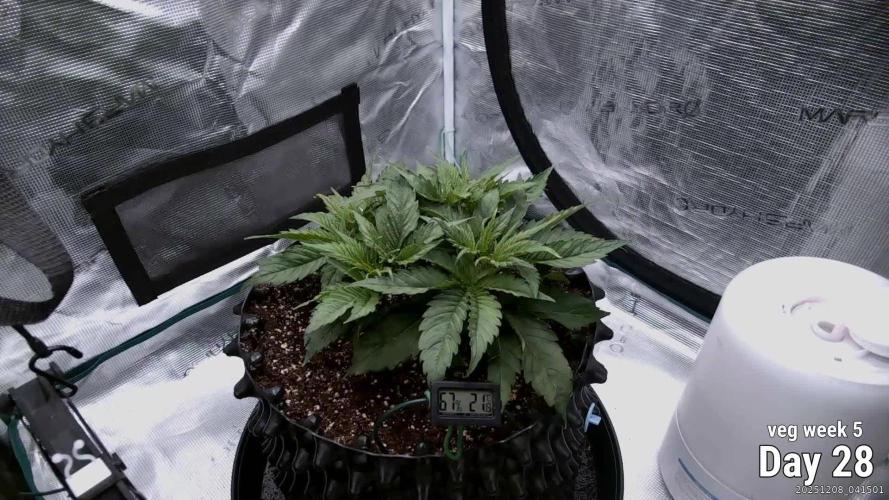
Week 5, nothing much, i actually let her chill for a bit.
Watered with 5L, 5.9 PH, 1ml/L PowerRoots and 3ml/L Terra Grow. She is doing great!
Some light defoliation of the crowded lower half, and some slight LST readjustments. Her cracks from the training week 3/4 are healing nicely!
Planning to flip to flower during late week 6 or beginning week 7.

Likes
55
Share


@BodyByVio
Follow
Just got done with trimming the 4x4 @greenhouseseedco Super Silver Haze / @blimburnseeds Silver Surfer Haze tent.
The final yield is exactly 1000g plus some (kind of a lot)that I smoke in the last 2 weeks 😃
Also got 6, gallon size ziploc bags filled with good quality trim for concentrate.
To be honest I was expecting a little more but keeping in mind that this grow I did not supplemented with bottled CO2 I think I’m good with the results.
Definitely I enjoyed a lot this grow and I’ve learned even more.

Likes
55
Share


@Vincent_Van_Grogh
Follow
This is our beagle. She’s 10 yrs old now.
Been with me across three continents.
She likes medicating on trim sometimes.
Starting a journal of her twilight years.
I update my plant diary weekly.
Might as well do one for her too. :)
To healthy dogs and fat buds! 🐶🌱😎
Likes
Comments
Share


@Shoeless31
Follow
All caught up. Transplanted into 3 gallon pots. Lightly watered with some calmag and recharge
Roots were good and just about ready for the upgrade. No pics but I’ll keep this in mind for my next grow and take some. I know I looked on here and watched YouTube videos to see how was done and it has been very helpful

Likes
24
Share


@Spazmagi
Follow
12/8 - Here we are at the beginning of week 10. Her buds are starting to frost up and she is definitely bulking up more than her sister, but her sister has a longer projected flowering time-frame (Heavy Sativa vs Indica). Anyways, did some minor pruning for airflow optimization and to remove some unhappy leaves from her undergrowth. They weren't yellow, but they weren't getting enough light and it was showing. Haven't done much to her this week other than top her off with Tap every other day. Seems like her feed from last week was on point as her pH and EC were solid as the water level lowered. After her first top-off, her EC started to fall as she ate more (reflected in the lower ec in the res after topping off with tap). Tapered her down to 80% strength as she is moving further along in flower and should hopefully finish sooner than her sister. If she needs a bump in her EC, I may top off with full strength nutes, but I'm going to just wait and see how she responds.
Breeder's timeline reflects a ~65 day seed-to-harvest, but I can assure anyone out there growing this strain in DWC that she will not be ready in that time-frame. Currently she is sitting on day 67 and still looks like she has another 2 weeks or more. I grew her in soil before and she was ready pretty darn close to her expected time-frame (~70 days), but this strain responds to DWC differently. She didn't have slow growth or anything; just seems like she will veg longer in hydro than in soil. Not sure why.
Thanks for stopping by the garden, and, as always, Happy Growing!

Likes
14
Share


@GoldenWeedGrower
Follow
D85/F41 - 24/06/23 - She's almost ready, I think I'll start the flush soon
D86/F42 - 25/06/23 - Temp is still too high, I'm trying to refresh the environment with air conditioning
D87/F43 - 26/06/23 - First Thricomes Video. I'm going to start the flush today and I'll arwest next WE
D88/F44 - 27/06/23 - Flushing
D89/F45 - 28/06/23 - Flushing
D90/F46 - 29/06/23 - Flushing
D91/F47 - 30/06/23 - She's ready. Tomorrow I'll cut her

Likes
2
Share


@Bandit600
Follow
Wachstum ist gut 👍. Wie immer bei zamnesia bin noch nicht enttäuscht worden. Danke


Likes
46
Share


@Roberts
Follow
Drunken Bitch slap is looking really good. She is growing great under the Hortibloom Solux 350. I defoliated a little, and pruned roots up. She should be ready to switch times to flowering in about a week. Thank you Hortibloom, and Aeque Genetics. 🤜🏻🤛🏻🌱🌱🌱
Thank you grow diaries community for the 👇likes👇, follows, comments, and subscriptions on my YouTube channel👇. ❄️🌱🍻
Happy Growing 🌱🌱🌱
https://youtube.com/channel/UCAhN7yRzWLpcaRHhMIQ7X4g

Likes
7
Share


@Greenthumbs420
Follow
Slowed massively trichomes turning Amber turning inwards not dri king near as much now boy she stinks


Processing
Likes
24
Share


@MadeInGermany
Follow
Hey everyone 🤗.
This week the buds have continued to swell and smell better and better every day 😍.
Since rinsing, she has only received Ph and Ec adjusted water to 0.4.
otherwise there is nothing more to report this week :-).
Stay healthy and let it grow 🍀🌱
You can buy this Strain at :
www.Zamnesia.com
Type:
Runtz
☝️🏼
Genetics:
Zkittlez x Gelato
👍
Vega lamp: 2 x Todogrow Led
Quantum Board 100 W
💡
Bloom Lamp : 2 x Todogrow Led
Cxb 3590 COB 3500 K 205 W
💡💡☝️🏼
Soil : Canna Bio
☝️🏼
Nutrients : Canna Bio
☝️🏼🌱
Water: Osmosis water mixed with normal water (24 hours stale that the chlorine evaporates) to 0.2 EC. Add Cal / Mag to 0.4 Ec Ph with Organic Ph - to 6.0 - 6.3
Likes
79
Share


@Salokin
Follow
Salutations, Growmies,
As we venture into week 13 with our Epic Buzz siblings, we're greeted with a sight of awe-inspiring development. Epic Buzz #1, with her colas frosting over like a midwinter forest, signals a pinnacle of resin production. The surface of each bud resembles a miniature landscape, crystalline and vibrant, basking in the glow of our attentively managed lights.
Epic Buzz #2 doesn't shy away from the spotlight either, flaunting massive colas that are a spectacle of horticultural excellence. The density of the flowers is remarkable, each bract swelling with potential, hinting at the hefty harvest that's almost within reach.
Epic Buzz #3, the enigmatic one, maintains her pace, a steady climb of trichome-laden flowers ascending towards their peak. There's a symphony in her silhouette, a harmonious blend of sativa stretch and indica girth.
The ambience within the grow space is serene, a steady symphony of fans and filters that weave a tale of controlled conditions – a steady 25.3°C and 65.8% humidity, without a hint of fluctuation. Such stability is the cornerstone of our thriving terpene tapestry.
Lighting, now set to an impeccable 55% intensity, avoids any undue stress while bathing our ladies in the luminescent embrace they crave. The IR and UV additions to our light regimen pay homage to the sun's natural spectrum, promoting a bounty that is not only bountiful but also rich in cannabinoids and terpenes.
The watering schedule remains unchanged, a testament to the rhythmic routine that our plants have come to expect. This is the beat to which they grow, and their response is nothing short of spectacular.
The Epic Buzz trio is a testament to the rewards of resilience, the bounty that beckons when you sync with nature's pulse. We watch, with bated breath, as they edge closer to harvest – a celebration of cultivation, patience, and the green-thumbed dance between grower and plant.
Looking forward to the near future, we anticipate a harvest that will encapsulate the essence of care, skill, and a little bit of magic that has been poured into every moment of their growth.
Until the next update, keep the vibes high and the lights bright.
Stay lifted,
Salokin
P.S.
Since the TrolMaster contest has concluded, I'll deposit my concise reflection here:
The Tent-X has revolutionized my growing experience. Intuitive graphs and controls led to a near-perfect environment and flourishing plants over 13 weeks, deeply enhancing my plant care knowledge. It's a game-changer for any grower.

Likes
4
Share


@LoganatorDude
Follow
I did her second tie-down on day 22 actually.
Day 24- I’m okay with the fan leaf laying on the surface for *now.* Just because I live in a high, dry desert with a consistent RH at around 20-25%. And also, because the top quarter inch of soil is dry. However I will probably be propping it up with something tomorrow morning.
Day 25- finally I decided to fold down the rim of the pot for more light!

Likes
6
Share


@Kendoda
Follow
It’s the second week of flower and I’ve got her spread across the net.
I’m going to do a foliage feed of fish mix and alg a mic in a around 4 days as well as another 4 ml of alg a mic in 2L.


Likes
32
Share


@GODSGIFT_2005_JM
Follow
🍼Greenhouse Feeding BioGrow & BioBloom
⛺️MARSHYDRO
The ⛺️ has a small door 🚪 on the sides which is useful for mid section groom room work. 🤩
☀️ by VIPARSPECTRA (models: P2000 & XS 2000)
🌱 DUTCH HEADSHOP SEEDS:
www.dutch-headshop.eu
www.dutch-headshop.nl
ONE STOP SHOP
. 100% germination success on first try! with HUGE seed selection!
. Very friendly customer service
. Best bio-seed packaging
. Sells other products @ best prices:
. Nutrients
. Vaporizers
. Smoking accessories (grinders, cones)
. CBD Tinctures
. Resin Extracts
. Boveda humidity packs
. Ziplock bags
. Other health supplements such as:
. Lion’s Mane Organic Capsules
. Hemp Seed coffee


