

@DogDoctorOfficial
Follow
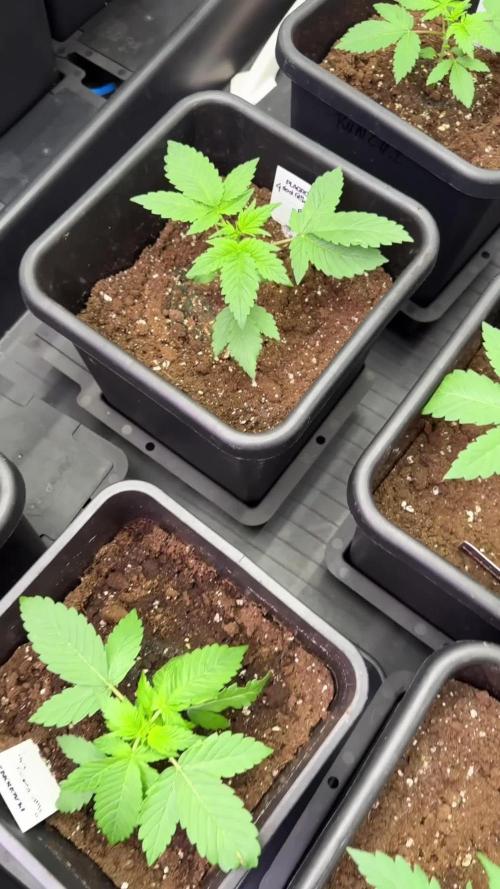
🌱 Week 3 | Purple Haze Photo | Folder 7B | Growing at Her Own Pace
Welcome back to another chapter of Project Blue, where every Purple Haze phenotype receives its own dedicated diary. Although every plant shares the same genetics, environment, nutrients, and lighting schedule, each one expresses its own unique growth pattern, making every folder a story of its own.
This diary is part of my ongoing exploration of 12/12 From Seed, a cultivation technique that has become one of my favourites. From the day these seeds emerged from the soil, they have grown under a 12-hour light cycle, encouraging compact development, excellent internodal spacing, and allowing every phenotype to reveal its natural structure without excessive vegetative growth.
Purple Haze 7B reminds us of one of the most important lessons in growing:
Not every healthy plant develops at the same speed.
She entered Week 3 slightly behind some of her sisters, but she never showed signs of stress or weakness. Instead, she quietly focused on building a strong foundation. Comparing the first photographs with those taken at the end of the week, the improvement is obvious. New nodes are stacking, the stem has thickened, and the canopy is beginning to take shape beautifully.
Sometimes patience is the best nutrient we can provide.
⸻
🌡️ Week 3 Growing Environment
Every phenotype in Project Blue benefits from the same carefully controlled environment.
During this week the room remained stable with the following conditions:
• 🌡️ Day Temperature: 27°C
• 🌙 Night Temperature: 25°C
• 💧 Relative Humidity: 55%
• 🌱 Root Zone Temperature: 21°C
• 🚰 Nutrient Solution Temperature: 20°C
• ⚖️ pH: 6.0
• ⚡ EC: 1.3
• 🌬️ CO₂: approximately 666 ppm
• 💡 Photoperiod: 12 Hours ON / 12 Hours OFF
• ☀️ Average PPFD: 600–700
Providing identical environmental conditions across every plant allows each phenotype to express its own genetic potential, making differences in growth much easier to observe and document.
⸻
🌿 Feeding Schedule
Purple Haze 7B continues receiving the complete Plagron Terra vegetative feeding program:
• Terra Grow — 1.8 ml/L
• Power Roots — 1 ml/L
• Pure Zym — 1 ml/L
• Sugar Royal — 1 ml/L
Rather than increasing nutrients simply because another plant grows faster, I prefer feeding according to overall health. She has shown excellent colour, healthy new growth, and no indication that she needs anything beyond a consistent and balanced feeding schedule.
Healthy roots always come before explosive growth.
⸻
🍃 Letting the Plant Set the Tempo
One thing I enjoy about phenotype hunts is learning to respect each plant’s individual pace.
It’s tempting to compare sisters growing side by side, but plants don’t read calendars.
Purple Haze 7B may have started the week slightly behind, yet every day she added another piece to the puzzle. Her leaves gradually became larger, her stem gained strength, and fresh shoots began emerging confidently from each node.
Rather than chasing rapid vertical growth, she invested her energy into creating a sturdy framework for the weeks ahead.
That’s exactly the kind of patience I like to see.
⸻
🌱 Preparing for Future Training
With several healthy nodes now established, this phenotype is approaching the point where gentle canopy management will begin.
For now, the focus remains simple.
Allow every branch to develop naturally.
Maintain strong root growth.
Keep the environment stable.
As the side branches continue to elongate over the coming days, they’ll become excellent candidates for gentle leaf tucking and Low Stress Training (LST), helping open the canopy without interrupting the plant’s natural momentum.
There’s no need to rush the process.
Every training technique works best when the plant tells you she’s ready.
⸻
🌿 Quiet Progress Is Still Progress
One of my favourite things about Purple Haze 7B is her balance.
The leaves remain a beautiful healthy green.
Internodal spacing is nice and compact.
New growth appears vibrant and vigorous.
The stem continues to strengthen with each passing day.
Although she’s one of the smaller ladies in the room, she carries herself with confidence, and every new set of leaves suggests she’s finding her rhythm.
She may not be leading the race today.
But healthy, steady plants often become some of the biggest surprises later in flower.
⸻
🔭 Looking Ahead
Week 3 has given Purple Haze 7B exactly what she needed: time.
Time to establish healthy roots.
Time to strengthen her stem.
Time to build the structural foundation that will support future flowering.
As she enters the coming week, I expect her side branches to accelerate, her canopy to become fuller, and her compact frame to transform into a well-balanced flowering structure. With stable environmental conditions and consistent nutrition, she’s now perfectly positioned to continue catching up naturally.
Some phenotypes sprint.
Others build quietly before showing what they’re truly capable of.
Growers Love and I have a feeling 7B belongs to the second group.
A massive thank you to Plagron for providing the outstanding Terra nutrient line that keeps Project Blue thriving, to Zamnesia for making this incredible journey possible, and to everyone following these individual phenotype diaries. Every comment, question, and bit of encouragement makes this adventure even more rewarding.A massive thank you to Plagron for providing the outstanding Terra nutrient line that keeps Project Blue thriving, to Zamnesia for making this incredible journey possible, and to everyone following these individual phenotype diaries. Every comment, question, and bit of encouragement makes this adventure even more rewarding.



@Jack_Greenstalk
Follow
week 2 of flower, been able to line up compost teas with feeds so they get nutes, nutes, RO+TEA, Repeat. foliar last times this week, I stop spraying anything on week 3! showed how i like to shake them up with the scrog a bit in last vid. I do that to essentially simulate a wind storm, strengthen stalks and roots, also helps reorganizing the canopy as you sorta shake things into place that were bunched up next to neighboring leaves. next week will do a fairly heavy defoliation to allow better airflow around colas




@Altitonans_Fulmen
Follow
For most crops, a slightly acidic soil pH between 6.0 and 6.8 is ideal because it optimizes nutrient availability. When soil pH rises above 7.0 (alkaline), the concentration of hydrogen ions H+ drops significantly, and they are replaced by calcium, magnesium, or sodium ions on the clay colloid exchange sites. To naturally lower alkaline soil pH, you can add organic matter (carbon-rich materials), which produces weak organic acids as it decomposes. Maintaining this slightly acidic range stimulates a highly active, diverse microbial community; these microbes decompose organic matter and release carbon dioxide CO2, which plants absorb through their roots and leaves to boost photosynthesis and sugar production. Furthermore, the added organic carbon acts like a sponge, drastically improving the soil's water-holding capacity.
While soil biological activity does involve cellular electron transport, electrical conductivity (EC) in soil is actually a measure of dissolved mineral salts, not a voltage carried by individual microbes. Soil microorganisms secrete organic acids and chelate metallic and non-metallic minerals, transforming locked-up inorganic compounds into bioavailable organic complexes. Unlike harsh synthetic fertilizers that can dehydrate soil life in high concentrations, these naturally chelated nutrients safely nourish the plant, creating a thriving, self-sustaining ecosystem where plants can efficiently synthesize their own food.
Metal-based: Could include elements like iron, manganese, copper, or zinc, which are essential nutrients for plants but can exist in forms not readily accessible.
Non-metal-based: Examples like calcium carbonate, phosphate, or sulfur are also important for plant growth and potentially serve as building blocks for the organic salt.
Chelation in a plant medium is a chemical process where a chelating agent, a negatively charged organic compound, binds to positively charged metal ions, like iron, zinc, and manganese. This forms a stable, soluble complex that protects the micronutrient from becoming unavailable to the plant in the soil or solution. The chelate complex is then more easily absorbed by the plant's roots, preventing nutrient deficiency, improving nutrient uptake, and enhancing plant growth. Chelation is similar to how microorganisms create organic salts, as both involve using organic molecules to bind with metal ions, but chelation specifically forms ring-like structures, or chelates, while the "organic salts" of microorganisms primarily refer to metal-complexed low molecular weight organic acids like gluconic acid. Microorganisms use this process to solubilize soil phosphates by chelating cations such as iron (Fe) and calcium (Ca), increasing their availability.
Added sugars stimulate soil microbial activity, but directly applying sugar, especially in viscous form, can be tricky to dilute. Adding to the soil is generally not a beneficial practice for the plant itself and is not a substitute for fertilizer. While beneficial microbes can be encouraged by the sugar, harmful ones may also be stimulated, and the added sugar is a poor source of essential plant nutrients. Sugar in soil acts as a food source for microbes, but its effects on plants vary significantly with the sugar's form and concentration: simple sugars like glucose can quickly boost microbial activity and nutrient release. But scavenge A LOT of oxygen in the process, precious oxygen. Overly high concentrations of any sugar can attract pests, cause root rot by disrupting osmotic balance, and lead to detrimental fungal growth. If you are one who likes warm tropical high rh, dead already. Beneficial, absolutely, but only to those who don't run out of oxygen. Blackstrap is mostly glucose, iirc regular molasses is mostly sucrose. Sugars, especially sucrose, act as signaling molecules that interact with plant hormones and regulate gene expression, which are critical for triggering the floral transition. When sucrose is added to the growth medium significantly influences its effect on floral transition.
Probably wouldn't bother with blackstrap given its higher glucose content. Microbes in the soil consume the sugar and, in the process, draw nitrogen from the soil, which is the same nutrient the plant needs. Glucose is not an oxygen scavenger itself, but it acts as a substrate for the glucose oxidase (GOx) enzyme, effectively removing oxygen from a system. Regular molasses (powdered if you can), as soon as she flips to flower or a week before, the wrong form of sugar can delay flower, or worse. Wrong quantity, not great either. The timing of sucrose application is crucial. It was more complicated than I gave it credit for, that's for sure. When a medium's carbon-to-nitrogen (C:N) ratio reaches 24:1, it signifies an optimal balance for soil microbes to thrive, leading to efficient decomposition and nutrient cycling. At this ratio, soil microorganisms have enough nitrogen for their metabolic needs, allowing them to break down organic matter and release vital nutrients like phosphorus and zinc for plants. Exceeding this ratio results in slower decomposition and nitrogen immobilization, while a ratio below 24:1 leads to faster breakdown and excess nitrogen availability.
Carbon and nitrogen are two elements in soils and are required by most biology for energy. Carbon and nitrogen occur in the soil as both organic and inorganic forms. The inorganic carbon in the soil has minimal effect on soil biochemical activity, whereas the organic forms of carbon are essential for biological activity. Inorganic carbon in the soil is primarily present as carbonates, whereas organic carbon is present in many forms, including live and dead plant materials and microorganisms; some are more labile and therefore can be easily decomposed, such as sugars, amino acids, and root exudates, while others are more recalcitrant, such as lignin, humin, and humic acids. Soil nitrogen is mostly present in organic forms (usually more than 95 % of the total soil nitrogen), but also in inorganic forms, such as nitrate and ammonium. Soil biology prefers a certain ratio of carbon to nitrogen (C:N). Amino acids make up proteins and are one of the nitrogen-containing compounds in the soil that are essential for biological energy. The C:N ratio of soil microbes is about 10:1, whereas the preferred C:N ratio of their food is 24:1 (USDA Natural Resource Conservation Service 2011). Soil bacteria (3-10:1 C:N ratio) generally have a lower C:N ratio than soil fungi (4-18:1 C:N ratio) (Hoorman & Islam 2010; Zhang and Elser 2017). It is also important to mention that the ratio of carbon to other nutrients, such as sulfur (S) and phosphorous (P) also are relevant to determine net mineralization/immobilization. For example, plant material with C:S ratio smaller than 200:1 will promote mineralization of sulfate, while C:S ratio higher than 400:1 will promote immobilization (Scherer 2001).
In soil science and microbiology, the C:S ratio helps determine whether sulfur will be released (mineralized) or tied up (immobilized) by microorganisms.
A carbon-to-sulfur (C:S) ratio smaller than 200:1 promotes the mineralization of sulfate, when the C:S ratio is low, it indicates that the organic matter decomposing in the soil is rich in sulfur relative to carbon. Microorganisms require both carbon and sulfur for their metabolic processes. With an excess of sulfur, microbes take what they need and release the surplus sulfur into the soil as plant-available sulfate
A carbon-to-sulfur (C:S) ratio higher than 400:1 will promote the immobilization of sulfur from the soil. This occurs because when high-carbon, low-sulfur materials (like sawdust) are added to soil, microbes consume the carbon and pull sulfur from the soil to meet their nutritional needs, temporarily making it unavailable to plants.
200:1 C:S 400:1: In this range, both mineralization and immobilization can occur simultaneously, making the net availability of sulfur less predictable.
This dynamic is similar to how the carbon-to-nitrogen (C:N) ratio regulates the availability of nitrogen in soil. Just as microbes need a certain amount of nitrogen to process carbon, they also require a balanced amount of sulfur. Both mineralization and immobilization are driven by the metabolic needs of the soil's microbial population.
Sulfur is crucial for protein synthesis. A balanced ratio is particularly important in relation to nitrogen (N), as plants need adequate sulfur to efficiently use nitrogen. A severely imbalanced C:S ratio can hinder the efficient use of nitrogen, as seen in trials where adding nitrogen without balancing sulfur levels actually lowered crop yields.
Maintaining a balanced carbon-to-sulfur (C:S) ratio is highly beneficial for plant growth, but this happens indirectly by regulating soil microbial activity. Unlike the C:N ratio, which is widely discussed for its direct effect on nutrient availability, the C:S ratio determines whether sulfur in the soil's organic matter is released (mineralized) or temporarily locked up (immobilized).
Glucose will hinder oxygenation more than sucrose in a solution because glucose is consumed faster and has a higher oxygen demand, leading to a more rapid decrease in oxygen levels. When cells respire, they use oxygen to break down glucose, and this process requires more oxygen for glucose than for sucrose because sucrose must first be broken down into glucose and fructose before it can be metabolized.
In a growth medium, glucose is a more immediate and universal signaling molecule for unicellular and multicellular organisms because it is directly used for energy and triggers a rapid gene expression response. In contrast, sucrose primarily acts as a signaling molecule in plants to regulate specific developmental processes by being transported or broken down, which can be a more complex and slower signaling process.
Critical stuff.


shorts_status_processing


@Eddjack
Follow
Questa settimana è andata abbastanza bene, levando una piccola carenza di zinco che è stata recuperata in 2 giorni, e cresciuta molto ha un bel colore e inizia a profumare !! Questa baby crescerà senza tecniche o allenamenti giusto una piccola defogliazione....iniziamo la fioritura molto bene 🙏💪🥦


@Mr_nugs_lover_David
Follow
Stunning looking ladies, beautiful stretch, this ladies are ready to give their best in flower, I'm starting to feel a very pungent smell on the bud sides and some resin production so far, let's see how this ladies keep developing, this is a really good strain, I expect top quality flowrs from this couple of girls! Stay tuned everybody! ❤️💛💚


@Mr_nugs_lover_David
Follow
This lady has been Transplanted on day 39 since she was planted and she will be grown with the complete biotabs organic line, I have applied for this 50L pot: 25g of startrex for every 5L of soil so I've used 250g of startrex in total, then I've dropped a spoon of mycotrex in the planting hole and when I finished I finally added 5 slow release tabs for this 50L pot, and then I watered right after the transplant with 1g of bactrex per liter of water and 1ml/L of orgatrex, this is gonna be a fun season, stay tuned everybody!!


@love_2_grow
Follow
FD36 - True to form I completely forgot to take any pics before the lights were out. The third week in a row. I'm detecting a pattern... lol
FD37 - Pics!
FD38 - Today, I was proactive in trying to prevent botrytis (budrot) since I have had problems in the past when temperatures and humidity get too high in late flower.
I started with defoliating hard by removing fan leaves. That should lower the humidity in the tent as there are fewer leaves to transpire moisture, and also increase the airflow around the buds.
Finally, I put my small humidifier in the tent to further lower the humidity.
FD41 - The anti-humidity measures are working. The tent went from an average RH in the high 60s to the high 40s. (The average RH in the last 24 hours was 48.9%.) I'm happy with that, which should be enough to avoid budrot. Better safe than sorry, so I did additional LST to open up the plants and thus increase the airflow around the buds. It's also helpful to increase light penetration, so win-win.
FD42 - We're at the end of the sixth week of flower, and things are chugging along in the tent. The buds are slowly fattening up, but it will take some time before they are done.
There isn't much to do in the tent this late in flower besides watering. Today, each girl got 2.5-liters of water @ pH 6.5.


@Budhunter
Follow
Week 8 of flowering, Biscotti mints 2 looks more close to the end than Biscotti mints 1.
Both very frosty, smelling really good. It’s been 1 week since I flushed them 😍
Looking at the trichomes they are close to the stage I like(around 20-30% amber) so I will harvest them.. probably 1 more week.
Overall really happy with what I am seeing 🤩 can’t wait to smoke it 🤪


@dancingshrubbery
Follow
Things are going good, I am beginning to think about when to harvest. I have tried capturing some microscope shots of the trichomes with a 15x macro lens (BlitzWolf), but they turned out awful. They still look transparent and glasslike, and I did not see many, if any, amber trichomes.
I am going on vacation next week, and wonder if plant will be fine with not being harvested before the 8th of July, two weeks from now.
Day 3: Watered
Day 4: Macro shots. Trichomes look transparent and glasslike, but since this is my first grow, any input from experienced growers is very welcome :-)
Day 7: Watered. No amber trichomes in sight, I will wait one more week before the harvest.


@Groweedo
Follow
Tout se deroule à merveille ! Temperature entre 21 et 22.5 led alumée. 18 19 eteinte. J’ai acheté un chauffage pour l’hiver au cas-où


@AsNoriu
Follow
Day 85. All is good, watering with molasses or pure PHed water. My ppm from tap is 150 , ph 7.4-7.6 , really good water.
Girls are runing nice, checked trich, still clear and cloudy, but on Fattest Tangie i spotted today first few ambers , max a week left for her. All other still far from.
See some purpling starting on top colas of couple plants, end is soon !
Strawbery recovers well, think to give her like 5 days more max and switch to 12/12 on 7 of January latest..
Checked how high are them, still dont get how half of 2 unces + are achieved on this site ....
They will be good, but just so little ... Honestly think that only late fast diesel, early tangie will reach 50g plank. Sad result for so much love, i smoke more in four month than that garden will bring in that time ...
Day 86. Time is changed to 12/12. Late FastDiesel and StrawberyCough got heavy feeding, all other girls on pure Phed water diet ;)
Smell is so fruity and sweet , cant wait till its over ...
Added extra 2liters of soil for late FastDiesel, pot had too much space and i want to water her every 3 days, not every 2 like now.
Day 90. Cant hold Strawbery cough surounded by other girls if i want her to be massive ;)
And i really really want it ;)))
So today Fatty Tangie had last 12 hours sleep and now she is choped.
Tomorrow Early bigest FastDiesel falls, other girls still have a week or two.
In anycase January 23 is last day for all of them except late FD and SC.
Fatty had some amber, but like 5% max, she could go for a week aswell, but i need space and best light for Strawbery girl.
I still think that 90 days for auto is too much ... Buds are very dence, i mean VERY, sticky but cant tell anything decent about smell, have cold again and nose doesnt work. She smells, but cant separate smells, feel fruityness 4sure. Guess after cure is more important then now anyway ;)
Day 91. Strawberry started flowering quick, thats good and today is last day for Early big FastDiesel. No i have space for all of them to bloom till my holidays ! No more molasses, just pure phed water, my ppm is about 150.


@Mon_monde_onirique
Follow
Semaine 2 de la végétation, purple shine arrivé à 4étage de feuilles , ça va être le moment de lui appliquer la première taille.
Dans son air pot 1L purple shine développe un joli réseau de racinaires.
Le 15/04 première taille application+ application foliaire de geisha, au lendemain de la taille purple shine semblait aller très bien l'apport foliaire geisha lui a fait un grand bien.
Cette seconde semaine de végétation purple shine a commencé a profiter de tout les nutriments de croissance contenu dans la gamme terra samouraï de @shogun(terragrow, katanaroot, silicon, calmag, geisha foliar)


@JoeGrows420
Follow
Removed so many leaves because the thrips ate em.
Shes kicked into flowering and theres already trichromes on the buds, its the 5th of march so summer has ended and autumn has started in australia thank glob, will be spraying neem oil once more to make sure i killed all the thrips and mites then thats it straight watering as the soil is amended with dr greenthumbs, just might need to top dress a little.