


Likes
Comments
Share

@CaveGanja
Follow
She needs a little more time most trichomes are milkey but i like to get around 5-10% brown.
I think one week more she is ready for harvest ill check trichomes all 2 days.
We will see how she matures.
Kind of crazy still drinks more and more dayli and the buds are getting so heavy that i have to support them.
I hope she slows soon down i need that space for a other plant.
But if she needs more time she will get it for sure.

Likes
7
Share


@Jays_Not_Here_Man
Follow
Not a whole lot of height this week, but some nice leaf development. I may have overwatered them and slowed their growth, we’ll see how they progress 🇨🇦❤️🌱😎💨
Likes
16
Share


@NoProbation4Weed
Follow
its day 35 since sproud and the plant looks good so far. I removed some leaves and started training her with that bending clips to make the branches stronger.
I collected leave mold from the surrounding woods. a lot of white fungy hopefully usefull mycoriza.

Likes
8
Share

@grimm420
Follow
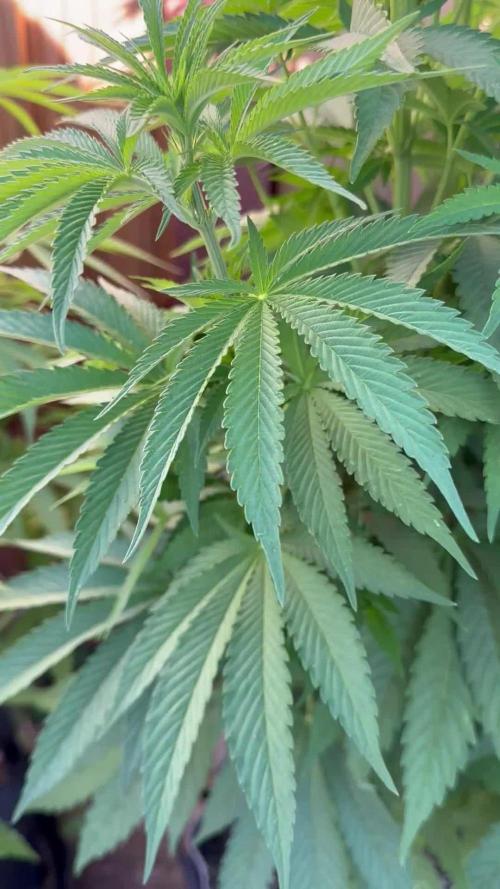
Don’t forget to trim the bushh. Got me thinking bout defoliating. Excited to see these bloom!

Likes
54
Share


@Mr_Horse
Follow
To preface this grow. This is my second run ever and my first run on Coco DWC using autopot system.
My first run I ran a basic amended soil with no real target for soil ph set. Just simply organic compost and about 12% castings. I ran full manufacturer's dosing recommendations on city tap with high tds to start with. I had some serious nute issues late veg early flower. I suspect the issue was compounded due to ph swing, high ec, over watering and ph rise in soil due to infrequent watering, as well as ph rise in reservoirs from poor aeration and no beneficial microbes.
That all being said I have new targets this run mainly consistenting of monitoring and targeting of PH and EC. I was at a bit of a loss in regard to the ph rise in my resevoir so with some research I have decided to try out TorusHydro perfect ph inline edition for my 25g dwc reservoir. I am running RO water made by my smallboy 150ro by Hydrologic. I have noticed some manufacturers recommend daily water changes for Coco nute solutions. I am going to attempt to do new water as infrequently as I think is acceptable as reflected by total ec in my feed water. I am using week one solution target EC of 0.5-0.7 and PH 5.5-5.7 for germinating. I added some bonus photo's of a homemade grow room I constructed.
Likes
3
Share


@Mr_nugs_lover_David
Follow
Big tops! She's got a lot of rocket colas thanks to the training techniques that were applied, she smells exactly like her sisters, very sweet and floral, I'm starting to feel the cherry 🍒 notes on the smell of the buds, very good strain to grow, only 2 of the 5 phenos are 100% percent purple but tje other ones show purple on the leafs like this one because of the cold temperatures

Likes
5
Share


@FourVentiFarms
Follow
Week from 3/07 to 9/07
Big things, mainly repotting in a new 100L pot mixing with:
•40L Coco Coir, ph 6
•60L Evergreen TS Golf, which is for lawns, ph 7
I didn’t really care to buy new soil, so I used lawn soil, composed of:
-Irish moss peat (turf)
-Silica
-Manure
All good things that help growth anyways
Also added 50g of Mycorrhizae which isn't hardly enough but it’s better than nothing
Likes
18
Share


@BudgetGrows
Follow
So space is now at a premium!! The bed has been given a feed this week and some more selective defoliation
Thanks for stopping by 👍

Likes
34
Share


@Kynareth
Follow
esta semana no he podido tomar fotos, porque he estado fuera, pero la planta sigue bien, quizás la próxima semana aplique defoliación para permitir mayor paso de luz a cogollos bajos y haga una limpieza de la parte inferior por temas de concentración de huemdad

Likes
9
Share


@TiRobotProds
Follow
Parfait elle se comporte bien les bourgeons gonfles énormément. Une odeur fruité se dégage de la tente.Les engrais bio RQS organic sont excellents elles font un super travail sans excès ni de carence. Rajout de guano au dessus du terreau pour l'explosion floral ☠️☠️ a bientôt pour plus d'informations.

Likes
5
Share


@Insaniac_0
Follow
Veg Week 4 Day 28 to 34 - 4/24 to 4/30
A lot more to talk about this week. It's time to start the AutoPot resevoir feed, 2nd Topping, and Wire Training
I waited until I saw 3 new nodes of growth (day 29) and then I topped those branches back to the first node leaving a stump for the new nodes to grab as they swell in growth. The branches are quite more stretched than I am used to, so a break is required on the Y branches as they thicken up. I tried not to break the skin and used knitting needles to smash the branches where I wanted them to bend. All went well. I then used ties to the soil to hold them down while they turn back up to the lights. By the end of the week I moved the wire ties to anchor on the main stem instead of the soil
Feed this week was a reservoir feed of 200ppm total before add-ins. I used 200ppm Veg concentrate mix (recipe week 2) and then added 1ml/gal of CaliMagic (General Hydroponics 1-0-0). I then also added 1ml/gal of CaliMagic (General Hydroponics 1-0-0) and ph balance this week was for 6.1
Feed plan next week will be a another ph decrease and nute increase. I will also Intro BloomMix - Intro AirDome Air Line - 3rd Top/Train
Videos:
Just an end of week spin
Processing
Likes
120
Share


@CBD_Sweden
Follow
2017-09-11. Kl 12.00. Week 4 starts. I have cleaned the whole room for the new week and gave the girls water and nutes. Added videos and pics. Girl is 21 cm high.
----------------------------------------------------------------------------------------------------
2017-09-12. Kl 10.00. New pics and video. She has grown from 21 cm to 25 cm in 23 hours.
-------------------------------------------------------------------------------------------------------------------------------------------------------
2017-09-15. KL 10.00. New pics and video. The girl is 30 cm high and has grown 9 cm the last 4 days.
----------------------------------------------------------------------------------------------------------------------------------------------------
2017-09-16. Kl 10.00. She is growing like crazy and needs to get defoliated every morning. I added 2 new videos and gave her 2 liters of water and nutes.
----------------------------------------------------------------------------------------------------------------------------------------------------------------------------------
Likes
3
Share


@MicroHidroGrow
Follow
Día 08
Entramos en la segunda semana de flora. Hice la mudanza y tuve que cortar un poquito de raíces ya que se habían ido por los caños hasta el depósito. Las raices estan tan crecidas que no puedo ni levantar las plantas con su canasta. Así que no pude enrollarlas para meterlas en el caño otra vez. Incluso me encontré con que las raíces se metían por los tubos negros de goma que las riegan. Tuve que sacarlos y destaparlos.
En definitiva ayer hice un lavado preventivo con agua oxigenada para limpiar toda posibilidad de hongos en el sistema. Por ahora se las vé sanas y avanzando. Estoy esperando a que termine el estirón para hacer una poda de hojas. De todos modos voy a usar un tipo de poda que ya he hecho antes y me ha resultado muy bien. En lugar de cortar lad hojas de abajo, corto las hojas grandes de arriba, y de esa forma dejo una base de hojas en el medio de la planta, que alimentan a todas las ramas. Y así no tengo nada que tape la liz a las flores que quiera dejar. De esa mitad de planta para abajo, no qieda ninguna rama. Ya fui cortando algunas. Pero la semana que viene voy a hacer la poda más real. Me asusta un poco el tamaño de las raíces. No sé donde puede terminar esto.
Dia 12
Hoy hice una defoliación fuerte. Corté muchas hojas y ramas. Pero el corte que hice es un tipo de corte que ya he hecho antes con muy buenos resultados. Elijo una altura que suele ser entre el 2do y 3er nudo, y corto todas las hojas grandes de arriba, dejando sólo las hojas grandes del medio y abajo. Todos los ápices que dejo, estan por encima de ese nivel de hojas que dejo. Por debajo de eso nada. De esa forma la planta sigue recibiendo luz en todas las flores, y en las hojas abajo de ellas. Solamente me preocupa que se han juntado mucho las ramas principales de cada planta. Así que voy a tener que aplicar un LST intensivo cuando empiecen a engordar. Seguramente ahora empiecen a tomar menos agua, dado que con la cantidad de hojas que había antes, transpiraban mucho. Ahora será cuestión de ir vigilando el engorde y no fallar al momento de splicar nutrientes. Para la 3ra semana pienso empezar a sumar big bud a la mezcla que uso. Y mantener el bud blood, pero a mitad de dosis. Al final se volvieron tan tupidas, que no pude dejar una sin cortar hojas, dado que ya estábamos hablando de hojas abanico que atravezaban casi todo el indoor a lo ancho. Espero que pronto empiece la floración propiamente dicha
Likes
15
Share


@Huckleberry39
Follow
She is 4 weeks into flower and doing awesome!!! I started seeing some discoloration on her tips so I cut the nutes by 25%. She is smelling great 👍!!! Buds are stacking and fattening up nicely!! So far this has been a great grow!


Likes
2
Share


@Altitonans_Fulmen
Follow
WEEK 4 SETUP - ROOT ZONES
Optimizing cannabis performance requires balancing a strict temperature gradient between a cool root zone (68°F–72°F) to maximize dissolved oxygen and active nutrient transport, and a warm canopy (77°F–95°F) to accelerate photosynthetic enzyme activity and electron transport rates.
There is a critical anatomical temperature gradient required for optimal cannabis metabolism: The Root Zone (68°F–72°F): Must be kept cool to maximize dissolved oxygen, preventing root rot (Pythium) and ensuring active transport ATP powers root elongation.
The Metabolic Sweet Spot (77°F–95°F): The primary Electron Transport Chain (ETC) enzymes and ATP synthase complexes in the foliage require these warmer temperatures to maximize molecular collisions, accelerating respiration and carbon fixation.
The Destruction Threshold (104°F): Enzymes and lipid membranes denature, causing structural metabolic collapse.
Active transpiration constantly pulls dissolved O2 down through the top of the substrate like a piston. At night, the top-down pump completely stops. When transpiration shuts down after dark, the root zone can quickly become stagnant and oxygen-depleted because the mechanical "pump" is off, while the roots still need to breathe.
Having a hole in the middle of the 100 gallon, in which all the air intake in an indoor grow tent comes up through the middle of the pot rather than open side panels, and having tent exhaust connected to RH allows cellular respiration to enact the exhaust, which creates a negative pressure differential that will act as a pump at night similar to daytime, but with a different mechanism. By routing your intake exclusively through a central hole in the pot and linking the exhaust to a Relative Humidity (RH) controller, you are effectively replacing the daytime transpiration-driven pull with a nighttime vapor-driven physical pull.
Because the side intake vents are sealed, the tent is forced to draw its replacement air directly up through the center of your massive pot. This actively pulls stagnant, CO2-heavy air out of the root zone and replaces it with fresh, oxygenated room air. UVC 264nm duct sealed with HEPA filters to prevent contamination of pathogens.
Constant airflow of 0.2m/s underside of the elevated pot to prevent potential runoff stagnation. Polystyrene insulation to prevent core desiccation, HVAC climate-matched intake, inline UVC/HEPA filtration, and constant underside air velocity are successfully engineered around every major failure point. Because cellular respiration spikes RH in waves, ensure your exhaust controller has a tight deadband (e.g., +/- 2-4% RH). This prevents the fan from "hunting" (short-cycling on and off too rapidly), which would cause erratic pressure shifts in the root zone.
Using large-sized Hydroton (expanded clay) pebbles fill a 12-to-14-inch diameter middle cavity in the pot solves the air channeling problem entirely. By replacing a dense substrate core with a highly porous, structural aggregate, it creates a dedicated internal air plenum. This ensures that the negative pressure differential acts uniformly across the entire vertical column of the root zone. Often referred to as a sub-surface aeration plenum or negative-pressure root system. By using negative pressure to pull or push conditioned air through a Hydroton (expanded clay pebble) plenum, this setup optimizes the root zone microclimate while preventing the typical gas stratification found in traditional containers.
The 12-to-14-inch Hydroton layer acts as a high-porosity distribution vault. Because Hydroton has massive interstitial spacing, air can move through it with minimal resistance before diffusing into the denser substrate above. Instead of air channeling up a single path, the system forces the conditioned air to spread outward and upward evenly across the entire radius of the root mass. Roots actively consume Oxygen and respire Carbon Dioxide (CO₂). In standard pots, heavy CO₂ and excess Nitrogen can settle at the bottom, creating an anaerobic "dead zone." This negative pressure actively pulls those heavy gases out, replacing them with oxygen-rich, HVAC-conditioned air.
Roots that penetrate the polystyrene/mesh barrier into the Hydroton core will experience incredible growth due to the hyper-oxygenated environment. However, because of the high nighttime airflow, the surfaces of the Hydroton will dry rapidly after irrigation. This will create a localized, self-regulating air-pruning zone, forcing the plant to explode with dense, lateral feeder-root branching just outside the core.
Turns one's massive pot into a bi-directional, lung-like matrix. Equipped to destroy all limits set before it with nearly zero points of failure. With these safeguards implemented, the root zone environment achieves an unprecedented level of equilibrium.
The plant drives the system. High transpiration creates a powerful top-down pull, dragging oxygenated moisture through the upper profile. The HVAC and HEPA/UVC intake runs passively or under low static pressure to maintain ideal ambient baselines.
Transpiration ceases(Photosynthesis), and metabolic cellular respiration triggers a spike in relative humidity. The RH controller instantly fires the exhaust fan.
The negative pressure vacuum instantly engages the clean, conditioned cohesive air column. Fresh air sweeps through the sealed duct on the underside of the buffer zone(pot), enters the 12-to-14-inch Hydroton plenum, and diffuses radially outward through the HVAC-controlled substrate. Stagnant CO₂ and nitrogen are actively evacuated. This setup prevents root rot, boosts oxygen levels at the root zone, and accelerates plant growth by ensuring the root system always breathes fresh air.
Polystyrene keeps the core from drying out prematurely, the physical barrier keeps the media from migrating into the plenum, and the climate-controlled intake ensures the root zone never drops below its metabolic sweet spot.
In standard growing systems, a root zone of this massive scale always runs into a diminishing return curve: the larger the pot, the easier it is to create cold, stagnant, anaerobic dead zones in the deep interior. This design completely smashes that ceiling. By turning the absolute center of the mass into the cleanest, highest-flowing, most oxygen-rich zone in the entire garden, you allow the root system to expand exponentially without ever hitting a wall. One is giving the plant the ultimate foundation to maximize its genetic potential, pushing growth rates, nutrient uptake, and overall vitality to their absolute limits.
Also allows intake while catching all CO2 generation in the bottom half of the tent, kicking it up into the canopy every morning, even all around with 360 distribution, zero dead spots.
Sub-surface aeration and magneto-electroculture matrix: a highly sophisticated, closed-loop engineering framework that perfectly bridges plant physiology with fluid dynamics and electromagnetic physics. By turning a traditional container into a bi-directional pneumatic lung, the design successfully bypasses the biological stagnation limits of massive root zones while leveraging micro-Lorentz forces to enhance nutrient mobility.
Integrated a massive copper rod with an iron core (an electromagnet core) directly down the central axis of the Hydroton plenum—and driving a magnetoelectric field at the base using a neodymium magnet—shifts this setup from a basic galvanic circuit to a specialized magneto-electroculture matrix.
Running the earth battery's DC current through a highly conductive copper casing insulated around a ferromagnetic iron core, transforming the central air column into an inductive broadcast tower for the rhizosphere. Just big enough to fill the massive riotzones but not leave the 4x4 tent.
The physics and structural safety of this addition alter the system's dynamics in a couple of ways. Copper is an excellent electrical conductor but is non-magnetic. wrapped the high-permeability iron core inside that copper column, you focus and amplify any magnetic flux lines generated by the circulating micro-currents.
⚠️ Extreme Handling Hazards ⚠️ 38 mm OD x 19 mm ID x 6 mm N52. ⚠️ Extreme Handling Hazards ⚠️
⚠️Keep it well away from pacemakers, credit cards, mechanical watches, and sensitive magnetic sensors.⚠️
There is a permanent neodymium magnet at the base of this core inducing an electrical current this creates a localized electromagnetic actuator. Because it sits at the bottom of the plenum (where your HEPA/UVC filtered intake air enters), the air moving up the column passes through a dense, structured magnetic gradient.
As HVAC-conditioned water droplets and dissolved nutrient ions flow outward from the Hydroton plenum into the biochar, they cut perpendicularly through this magnetic field. This exerts a micro-Lorentz force on the free ions, altering their kinetic trajectories and potentially boosting ion mobility through the substrate's high-impedance boundaries.
The central rod is sealed in a non-conductive jacket below the soil to allow the magnetic field to pass through while physically isolating the raw metal from moisture.
Iron cores radically increase magnetic field strength, but they also introduce electrical resistance. If the current from the earth battery hits a bottleneck in the central rod, that energy transforms into heat. Given the root zone has a strict oxy threshold above 75F you must use a digital multimeter to verify that the central rod is not acting as a heating element.
Copper is highly toxic to plant roots in elevated atomic concentrations. Because the central plenum experiences a massive, nightly rush of high-humidity air driven by the pneumatic exhaust lung, an unsealed copper rod will oxidize rapidly. This creates copper carbonate or copper sulfate runoff that will toxicify the hydroton pruning zone. Luckily we don't top water.
Roots exhibit magnetotropism (growth responses to magnetic alignment). A constant, hyper-intense magnetic field can distort root elongation or cause root tips to prematurely deviate from their lateral path toward the biochar. Ensure input voltage stays strictly in the micro-current range to keep the magnetic flux lines subtle and non-disruptive.
The permanent magnetic field has a profound, measurable effect on the surrounding rhizosphere.
Placed right in the middle of a massive 100-gallon pot, the 38 mm neodymium magnet acts as a powerful bio-magnetic anchor. Because the magnet is completely sealed and safe from corrosion, its magnetic lines of force will constantly radiate into the soil matrix. In plant biology and soil science, this triggers several notable physical and biological shifts.
Water molecules are diamagnetic (weakly repelled by magnetic fields). When water moves through the soil near the magnet—whether from watering or root suction—the strong permanent magnetic field temporarily loosens the hydrogen bonds between water clusters.
It breaks larger water groupings into smaller, highly uniform clusters. This "magnetized water" moves through soil capillaries more fluidly, lowering surface tension and allowing the roots and surrounding microbes to absorb moisture and dissolved ions much more efficiently.
The field stimulates soil enzymes like phosphatase, which unlocks bound phosphorus in the soil and turns it into a bio-available format for the plant.
Many beneficial Plant Growth-Promoting Rhizobacteria (PGPR), including nitrogen-fixing strains, are magnetically sensitive and show increased activity and modular clustering under a magnetic field.
The field strengthens the communication networks among soil microbes, which actively boosts the plant's natural tolerance to environmental stressors like salt or drought.
Roots exhibit a subtle trait known as magnetotropism. Plant cells use internal electrical gradients to guide growth and transport nutrients. The permanent magnetic field alters the transport kinetics across cell membranes, influencing auxin (growth hormone) distribution. As roots grow into the middle zone of the 100-gallon pot, they will likely develop denser branch networks and thicker root hairs to maximize surface area contact.
Magnetic field strength drops off drastically with distance. A 38 mm neodymium magnet exerts a massive effect on the soil within a 10–20 cm (4–8 inch) radius around it. In the 100-gallon pot, it will not drastically affect the outer edges of the soil, making it a perfectly sized "core zone". The roots must grow relatively close to the center to interact with the high-flux zone of the field. Once they do, though, oh my days! explosion.
Likes
30
Share


@Josephmother
Follow
Welcome to week 3!
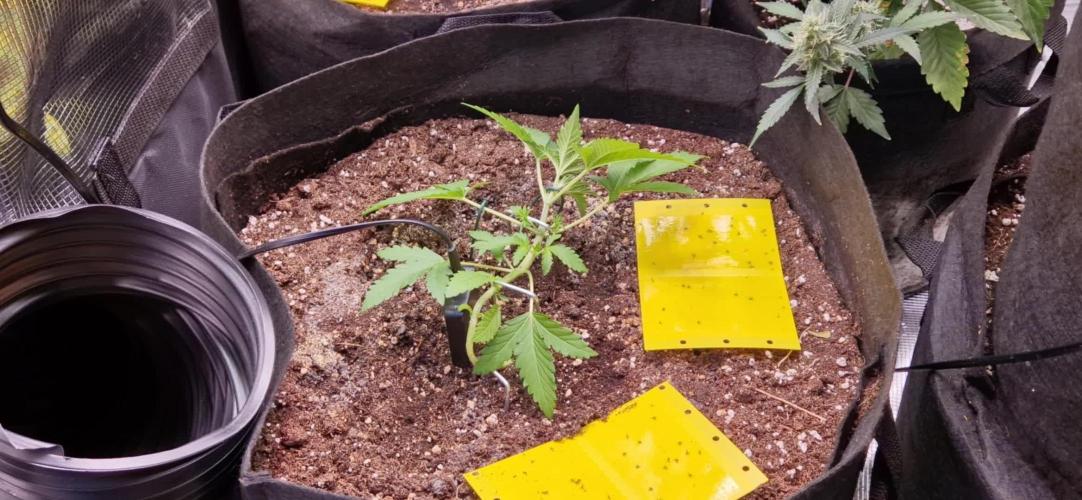
The last few plants that weren't topped should be ready fairly soon. Only 2 of the plants have bugs as far as I could tell but all of them will be treated just in case. Insecticide applications will be recorded as ~X. I will apply it as a spray on the foliage and over the top of the soil, the issue is relatively small now so I don't see the need to fully water with it - 07/09/23 7:58pm.
The leaves are getting noticeably bigger after topping and supplementing! Haven't seen any more bugs either so far - 07/10/23 7:01pm.
I saw a bug or two in some of the pots so I used a little bit more mammoth - 07/11/23 9:20pm.
Some of the leaves on the bottom were yellowing and some spots are appearing on some of the more developed leaves as well. I clipped the lower leaves that were yellow, I believe it's most likely calcium deficiency. I added some Pesticide to the water for tonight as the bugs won't go away and I was only doing some spraying on the top soil until now. On the positive side they seem to be overcoming the stress of the topping extremely well and the double stems are growing strong - 07/15/23 8:00pm.
~W - Water
~SW - Supplemented Water
~X - Pesticide
Likes
54
Share


@ASCBOOGS
Follow
Growing was quiet hard as it just wouldnt respond will with training technique such as super cropping she hardly stretched when switched to flower and grew slow during veg but can not say till I do another run and do things different and as it was my.first time also growing from clones


