Likes
Comments
Share
@Chucky324
Follow
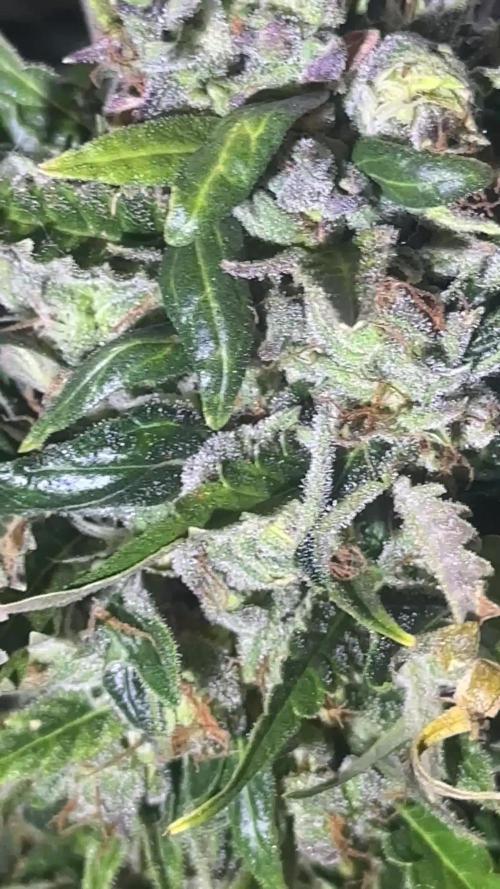
Hello. This is the end of week 1 and the beginning of week 2 of flowering. The plant is doing good and growing well. It's stretched a bit last week being week 1 of flowering. And she will stretch more this week too. The next trim-up will be, before the end of week 2, before the resin starts flowing, around week 3. Be Great. Chuck.
Likes
3
Share
@CalGonJim
Follow
3/16 234AM MONDAY POTATO N WEEK CELEBRATIONS! The plants in your photos look like healthy, vigorous **RF3 autoflower seedlings** (likely Banana Purple Punch Auto RF3 or similar from Fast Buds' upgraded RF3 line, based on the context of your previous grows with their genetics). They're in early vegetative stage at around 3 weeks from seed—nice bushy structure, good node spacing, dark green leaves, no major deficiencies or burn yet. The coco medium shows some perlite mix, and they're in small pots with what looks like a well-draining setup. Solid start **RF3 autos** from Fast Buds are bred for stability, vigor, and resilience (often with heavy resin, dense buds, and good yields), but like most modern autos, they're sensitive to overfeeding early on—especially in coco, where salts build fast if not managed. ### Recommended EC at 3 Weeks (Early Veg/Pre-Flower Transition) At week 3, autos are usually ramping up vegetative growth and may start showing pre-flower signs soon (pistils around nodes). Fast Buds' general autoflower feeding advice (from their guides and nutrient articles) emphasizes starting low and going slow: - **Target EC: 0.8–1.2 (800–1200 µS/cm)** in the feed solution. - Start at the lower end (~0.8–1.0 EC) if your plants are still very young-looking or if you've had any tip issues before. - Push toward 1.0–1.2 EC if they're hungry (rapid growth, pale lower leaves) and responding well—no burn. - This is often ~400–600 PPM (500 scale) or ~560–840 PPM (700 scale), but always go by EC meter for accuracy in coco. - Always measure **runoff EC** too—aim for it to be no more than +200–300 above input to avoid salt buildup. If runoff is much higher, do a light flush with FloraKleen (like your 4 mL/gal plan) before bumping up. - pH the feed to **5.8–6.2** (coco sweet spot), and water to 15–20%+ runoff every feed to prevent the issues you've seen with Purpinator/salts. Many growers with Fast Buds autos (including RF3 lines like Banana Purple Punch or Cherry Cola RF3) report week 3 feeds around 0.9–1.1 EC in coco/hydro setups, starting lighter if using tap/soft water like yours. Your previous success with lighter Maxi feeds post-flush at ~900–1300 EC later on fits well—don't jump straight to 1.3 yet at week 3; build gradually. ### Recommended PPFD (Light Intensity) at 3 Weeks PPFD (Photosynthetic Photon Flux Density, in µmol/m²/s) measures usable light for photosynthesis. For autos in early veg: - **Target PPFD: 300–500 µmol/m²/s** at canopy level. - 300–400 is safe and conservative for week 3—prevents stretch or light stress while encouraging compact, bushy growth. - 400–500 if plants are stretching a bit or you want faster veg (RF3s are vigorous, so they can handle it). - Avoid over 600 early—autos can bleach or foxtail if blasted too hard young. - Measure at the top of the canopy with a good PAR meter (or app like Photone if calibrated). In Indio's setup (likely LED or HPS?), hang lights higher early (18–24" for LEDs) and lower gradually as they grow. - Keep 18/6 or 20/4 light schedule—autos thrive on consistent long days. General tips for your RF3 at this stage: - If using Maxi series (like your previous grows), mix a light bloom/veg combo—e.g., mostly MaxiGro early, transition to MaxiBloom as pre-flower hits. - Watch for clawing (N excess😂) or tip burn (high EC)—flush lightly if needed. - These RF3 upgrades are forgiving but love good airflow and moderate feeds for those dense, resinous buds. Your plants look primed for a strong run—keep that intuition going! How's the light distance/setup right now, and what's your current feed EC looking like? Any pre-flower signs yet? Drop more pics if they stretch or change post-week 3. You're killing it in coco—keep observing runoff and leaves. 🌿🚀 3/19 330am 👨‍🔬 **Adding L-Proline (the amino acid supplement growers use) to plants on soft water can provide some helpful support against the stresses you're dealing with, but it's not a full fix—think of it as a stress-buffer rather than a mineral replacement.** Soft water (low in calcium and magnesium) often triggers **Ca/Mg deficiencies** in bloom stage (especially with Cha Ching or MaxiBloom, which don't supply much Ca/Mg on their own). This leads to issues like tip burn, leaf curl, weak cell walls, nutrient lockouts, oxidative damage (ROS buildup), and overall plant stress that feels like "the plant is struggling to hold it together." Proline steps in here as an **osmoprotectant**—it's one of the compounds plants naturally ramp up under stress. ### What Proline Actually Does in This Situation - **Helps with osmotic/water balance** — Soft water can disrupt turgor pressure and water movement inside cells (similar to mild drought or salinity stress). Proline stabilizes cell membranes and helps the plant retain water better, reducing wilting or limpness. - **Reduces oxidative stress** — Ca/Mg shortages cause free radical damage. Proline acts as an antioxidant and protects proteins/enzymes, so deficiency symptoms (yellowing, spotting, slowed bud development) don't spiral as fast. - **Improves overall resilience** — In cannabis and general hydro/soil grows, L-proline (or full amino acid mixes containing it) has been shown to boost stress tolerance, speed recovery, and even support better nutrient uptake indirectly. Studies and grower reports note it helps under nutrient imbalance, drought-like conditions, and environmental swings—exactly the secondary stresses soft water creates. - **Bloom-stage bonus** — Since you're already in late flower with Cha Ching/MaxiBloom, proline can support resin/terpene production and bud density without pushing excessive veg growth. It won't magically add the missing Ca or Mg (those are still critical—soft water + high-P bloom nutes often screams for CalMag), but it can make the plant more tolerant while you correct the root issue. ### How Much Effect to Expect Right Now - **Positive but moderate** — Many hydro/RO growers add amino acids (including proline) specifically for soft water setups and report less burn, better leaf health, and stronger finishes. It won't turn a severe deficiency around overnight, but it can slow the damage and give your plants a fighting chance in the final weeks. - **No downside at proper doses** — It's very safe and plants use it quickly. ### How to Add It (Practical Dosing) - **Source**: Pure L-Proline powder (available cheap online—make sure it's the plant-grade L-form, not human supplements). - **Root feed** (with your Cha Ching/MaxiBloom): Start at 0.5–1 g per gallon (about 100–200 ppm). Mix into your res or feed water once a week. pH as normal. - **Foliar spray** (often more effective for quick stress relief): 0.25–0.5 g per gallon + a drop of surfactant. Spray lightly every 5–7 days in the dark period. - **With your current nutes**: Yes, it layers fine—reduce if you see any tip burn. Many run it alongside MaxiBloom + Cha Ching in soft water without issues. - **Best timing**: Now through harvest is perfect, especially if you're noticing stress signs already. **Real talk**: The biggest win will still come from adding a proper CalMag supplement (like Botanicare or General Hydro's) at 0.5–1 ml/gal or whatever your PPM tests call for. Proline + CalMag together is a strong combo for soft water grows. If you're running pure RO/soft, most experienced growers treat this as standard.""👨‍🔬 3/19 10:09PM RF3 X 2 =6 fail? I have TWO 2 gallon pots filled with coco from the last grow. I can plant a NEW BPP RF3 OR!!! I can top the 3 RF3's and make cuttings and grow the cuttings? It worked before!. FAST turnaround time, not much prep just refresh the coco and transplant the tops! 3/19 10:59PM NO WORK FOR NOW.. HIT WITH MASSIVE WAVES OF NAUSEA AND SHARP PAIN, DIZZY, RUPTURED NECK CYST BLEEDING, PAIN FROM MOVING TOO MUCH LAST FEW DAYS, RINIGNG EARS BAD, SKIN PRONE TO MASSIVE INFLAMMATION ATTACKS NOW, WEAKENING GUT LINING,. LUNGS ..GRIP AND BALANCE OFF, SO PERFECTLY NORMAL!!! THANK THE WEED GODS FOR WEED. 3/21 3:30 AM I think I’m gonna top all three of them. I got lucky all three seem to be different ones. I don’t know which is which one of them is really tall. The other one has really tight in her note spacing it’s really good and the other one is also good little bit different so I think I got three different RF three seeds and I think if I do top them I’m gonna put the top in another 2 gallon and then grow that as a cutting usually works I’m not sure👍🌿 3/23 3:08 PM I cut them all in half today a transplanted the top of the tallest one into one that was still growing just to see if it would work. They’re all doing really good.👍 326 237am Remember how your local ss cant prevent or solve a single problem you pay taxes for. unless you're really really sick and the cowards decide that the most important and pressing issue is to raid weed users and farms and seeds...what a country of fuqs
Likes
3
Share
@sellem
Follow
All sprouted and broke through soil! Disclaimer for the whole run: I started naming them for my ease of documenting, "BPP #2" also sounds kinda whack. Three are named after Valkyries, not because of any whacky political affiliation, just because i like the sound of the names. One is named after someone special :) Also, from here on out, BPP = Banana Purple Punch, LCC = Lemon Cherry Cookies Stay tuned for more! 11/02 First Watering, 100ml with 4 ml/L of rootjuice. will ramp up dosage quickly once the dome comes off, hopefully in the evening when my humidifier arrives! 13/02 Watering! 300 ml with 4ml/L of rootjuice 14/02 VPD dialed in at around ~0,62-0,65 kPa. Size: Cara, Eir, Herja = 5 cm, Gunnr 7 cm 15/02 Watering, 500 ml, 4ml/L rootjuice, 1ml/L Grow
Likes
2
Share
@bbs42
Follow
Starting to get some real buds now. Color in leaves changed within 3days. Had me super nervous I screwed up the plant. Thought I was dealing with a ph issue because of how early the leaves changed colors. Green spots on leaves are from me not turing down the light fast enough.
Likes
23
Share
So looking like it's getting very close to harvest going by breeders advice and others i've sen with this variety. Mostly orange hairs nw only a few whites and they're starting to receed into the buds so i wanna flush well for a week or so and see how it go's
Likes
11
Share
End of week 10 in bloom (day 70) and the time for harvest is approaching. Not all the plants are the same so they will finish gradually and they will be cut gradually. So i will start from Bangi Haze that is almost ready, needs few days more.
Likes
5
Share
🌱: Partial harvest on day 76, 97g untrimmed 💧 : 12l, flush on day 72 💡 : Dli: 45 mol/m²/d 🤔: Switch to Spider Farmer equipment on day 75
Likes
14
Share
against better judgement i topped each of the main branches on day 4 of flower. we will see if she responds negatively but i didn’t want to risk the height
Processing
Likes
21
Share
pbk has started a little stretch shes started to grow well will be keeping her on calmag and silicon for the next week or 2 untill can see signs of flowers appearing stripped some of her nodes and didn't effect her sshes getting 2l every 2days and is starting to ask for more nothing else to report thanks for reading happy growing guys
Likes
2
Share
@Snooks
Follow
She’s SUPER STICKY! 🤤
Likes
8
Share
Hello everyone, fellow growers! welcome to peaky's gardens I had so much fun growing this little girl in a small pot and with a frame around which I twisted my plant I wanted to test her resistance and my experience
Likes
19
Share
@Flavors
Follow
🌸 Week 20 Update (Flower – Week 3) The tent’s alive with energy this week 🌞🌿! Red Hot Violet is absolutely thriving 🔥💜 — strong structure, healthy stretch, and bud sites forming beautifully 🌸💎.On the flip side, Amaretto Sour 🍋 seems to be getting a bit choked out 😕🌱 — growth has slowed and she’s fighting for space and light 🌤️. Planning a careful separation this week 🧤💧 by filling a tote with water and gently working the soil apart
Likes
4
Share
Hallo liebe Growfreunde, Diese Woche verläuft sehr angenehm, keine Mängel oder sonstige Beschwerden 😁. Die automatische Bewässerung wurde angeschaltet nachdem ich erstmal von oben gegossen habe. 1l Wasser pro Pflanze mit dem Enhancer von Greenhouse. Werde dass alle 2 Wochen so machen aber sonst gibt's nur PH korrigiertes Wasser. Dünger wurde ja der Erde untergemischt. Ach ja, CalMag kommt immer mit ins Wasser bei mir. Wie man gut sehen kann entwickeln sie sich toll soweit. Die Peyote Critical ist um einiges langsamer im Wachstum als die anderen, aber sie sieht sehr gesund aus. Die Gorilla Zkittlez entwickelt sich auch gut, aber liegt eben fast 10 Tage hinterher. Aber was solls, dann bleibt sie eben etwas kleiner wie die anderen😅. Ich denke am Sonntag nächste Woche geht's für alle in die Blütephase. Naja, mal schauen... mach am Sonntag nochmal ein Update.😉 Bis dahin euch allen einen guten Zeit. Ciaoiiiii
Processing
Likes
6
Share
@Fumiselo
Follow
So I finally got myself a EC meter and I'm thankful sice I was watering with a very high EC (3.2) and I've been lowering it down up to 1.6, and also I've watering them every day with plenty of runoff. Hopefully everything with run smother now!
Likes
2
Share
Hola a todos!!, esta semana he regado con AMAZONIA ROOTS de Namaste 1ml x litro de agua. Hice un corte apical en la rama principal, y el resto de los días he regado solo con agua. Feliz navidad amigos!!!🙌🙌🙌🎄🎄🎄😉😉😉
Likes
35
Share
Bonjour à tous les padawans et les maîtres jedis Pour cette semaine je prévoit de pratiquer comme technique spéciale le LST et juste un arrosage. Pour cela comme à mon habitude j'attend le cinquième noeud ou que je juge la plante robuste. Je profite que cette semaine qui va être relativement calme pour faire un LST appliqué et vous faire un rappel de ce qui est pour moi la meilleure technique pour arroser une autofloraison et la façon dont je pratique le LST. En suivant ces quelques simples conseils vous obtiendrez un résultat optimal tout au long de votre culture : Le cannabis est une plante qui n’aime pas recevoir un léger arrosage en continu. Il est impératif de l’arroser en grosse quantité, puis d’attendre que la terre soit bien sèche avant d’arroser à nouveau! Pour calculer la quantité d’eau nécessaire à chaque plante, suivez cette règle : Le volume d’eau à donner lors de chaque arrosage doit représenter au moins environ un quart du volume du pot !! Exemples : pour un pot d’1L, donnez 0,25L d’eau à chaque arrosage pour un pot de 4L, donnez 1L d’eau à chaque arrosage pour un pot de 12L, donnez 3L d’eau à chaque arrosage pour un pot de 30L, donnez 7,5L d’eau à chaque arrosage !etc… Pour donner un tel volume d’eau, il est souvent nécessaire d’arroser en deux (voir trois) fois, lentement et uniformément sur toute la surface. Disposez de bonnes coupelles sous les pots, celles ci se rempliront d’eau qui remontera dans le pot par capillarité en moins d’une journée. Il est également très important d’utiliser un bon terreau de qualité, avec une bonne capacité de rétention d’eau mais qui assure également un bon drainage (celui ci doit contenir de la perlite, et/ou de la coco, etc..) Il vous faut alors maintenant attendre quelques jours en sous-pesant régulièrement les pot avec vos bras. Quand ils seront redevenus très légers, vous pourrez arroser à nouveau !! En effet, comme l’eau pèse beaucoup plus lourd que la terre, un pot gorgé d’eau pèse plusieurs fois le poids d’un pot d’une plante prête à être arrosée. Avec un peu d’entraînement, vous apprendrez donc très rapidement à sous-peser vos pots pour savoir quand une plante a soif. C’est une technique à la fois très facile et très efficace, et qui peut être appliquée à toutes les plantes en pots ! En arrosant de cette façon, en général vous devrez arroser vos plantes tous les 3 à 6 jours. Pour cette semaine 3 au jour 17 ma plante fais 12 centimètres et son cinquième noeud apparaît je décide donc de pratiquer un LST sur ma plante. Pour ce j'utilise du fil de fer galvanisé que je plante directement dans le substrat en faisant attention de ne pas endommagé les racines car n'oublions pas que ce qui pousse dessus pousse aussi dessous. Jour 17 je pulvérise du une solution composé d'une cuillère à café de savon noir mou dilué dans un litre d'eau en prévention d'éventuels nuisibles. Je corrige mon LST suivant la pousse de ma plante ... Pour ma par c'est la manière dont je procède. Comme promis petit rapel de: Quand commencer à appliquer la technique LST De nombreux cultivateurs commencent la manipulation dés que les plantes possèdent entre 3 et 6 nœuds ou une paire de feuilles. Durant cette première étape de la croissance, le tronc encore flexible est pliable sans risque qu’il ne se casse, même si au fur et à mesure du développement de la plante il sera de plus en plus difficile de le plier. Nous pouvons continuer à guider la croissance des branches durant toute la culture, même durant la floraison, ce qui pour cette étape représente un grand avantage face à la taille, qui n’est pas du tout recommandé une fois que la formation des têtes commence, cela stressera en effet la plante, ce qui aura pour effet de retarder la récolte. Comment appliquer la technique de guidage LST Si nous sommes prudents, la flexibilité naturelle des fibres du cannabis permet de plier leur tronc et branches avec une relative facilitée, même durant la floraison des plantes. En utilisant une corde fine, nous pouvons accrocher la pointe de la plante à la base du pot par exemple ou à un tuteur que nous aurons planté dans le substrat. Nous plierons le tronc avec précaution et nous le fixerons avec la corde, à partir de là, nous pouvons augmenter progressivement la tension de la corde, chaque jour un peu plus, jusqu’à obtenir la position souhaitée. Soyez attentif à la réaction de la plante, essayez de ne pas appliquer trop de pression sur la corde et rappelez-vous que la flexibilité des branches peut varier d’une plante à l’autre. Pour obtenir de meilleurs résultats, il suffit de suivre quelques règles simples. Pour commencer, nous devons choisir une corde fine mais pas trop pour ne pas blesser les troncs au fur et à mesure qu’ils grandissent et qu’ils deviennent plus gros. Nous pouvons utiliser des crochets en plastique souple ou de n’importe quelle autre matière flexible pour éviter d’endommager les plantes. Spécialement en intérieur, utiliser des cordons en plastique de couleur (voir les diaries de @Silky) est très pratique pour voir facilement les accroches et faciliter le travail au milieu du réseau formés par les cordes, les tuteurs, les mailles ou les supports que nous aurons dans la culture. Bien entendu, en culture extérieure et surtout en guerilla nous ferons juste le contraire et nous utiliserons des matériaux de couleur qui n’attirent pas l’attention pour que notre jardin reste discret. Pour stresser les plantes au minimum, la mieux est de réaliser ces manipulations le soir ou juste après que les lampes en intérieur s’éteignent, ce qui leur permettra de se remettre durant la nuit. Normalement, le jour suivant nous pourrons observer comme les pointes des branches que nous avons pliées se dressent de nouveau vers le haut à la recherche d’une source de lumière. Que la force soit avec vous
Likes
53
Share
Growing really well upto now just transplanted them into there forever homes now they are 2 weeks old excited to watch them grow and see the results in a few months time, have not fed any nutrients yet but will now start commencing week 3 i will be using Canna products again on this grow
Likes
33
Share
@Damonkey
Follow
It’s awesome it likes to be away from the light the one that was off to the side far out performed the one that was directly beneath. Both are nice though and have the same smell, taste and bud structure. After proper drying and curing it honestly can’t be beaten. Fantastic aroma and flavour and a really good strong stone. Calming, relaxing and meditative.😍😍😍😍😍😍
Likes
7
Share