


Likes
Comments
Share

@bkickstand
Follow
Week 14: Northern Lights Sisters Update
The Northern Lights sisters are progressing beautifully into their flowering stage. Charlotte, the tall phenotype, continues to hold a strong Christmas tree structure, while Makayla, the low-profile phenotype, remains compact with dense bud development.
The buds on both plants are thickening up nicely, and the pistils are beginning to show that classic change in appearance as they mature. The overall health of both plants is strong, and I am closely monitoring the bud development on both the main colas and the lower sites to ensure they continue to fill out as expected for this stage of the cycle.
I'm excited to put my new digital microscope to use for a more granular view of their progress as they move further into the final phases of flowering. Everything is looking steady and on track.


Likes
27
Share


@Salokin
Follow
Hi Growmies,
Again another very uneventful week. The plant is doing what she is supposed to do, getting ready to bulk :) For the coming week PK 13/14 will be added so she can use that to fatten and ripen properly. So far I am quite happy with the results, she is much leaner than her mother and basically only consists of stems and buds.
Strangely enough some friends of mine who took cuttings are actually tickling out a bunch of purple hues on the leaves and buds, wonder if this could be temperature related. Guess I will see once have a temp controlled fan …

Likes
1
Share


@2Stones1Bird
Follow
Start of week 5 - days 9 to 15 April
9/4/2020 - She's reacting better to LST
12/4/2020 - After 6 days I gave her 1L RO water with:
GHE Terra Aquatics Cal -Mag - 60 PPM
Biobizz Acti-Vera - 30 PPM
Biobizz Heaven - 30 PPM
Biobizz Top-Max - 10 PPM
Biobizz Grow - 10 PPM
Biobizz Bloom - 10 PPM
Biobizz PH Up
RO Water - 4 PPM
About 154 PPM
PH 6.6
15/4/2020 - Raised the Light to 60cm she reacted positively, also turned on the oscilating fan.

Likes
15
Share


@GroLife
Follow
Did some low stress training this week that was interesting just wish I wold of started earlier

Likes
10
Share


@barlobruz
Follow
6/21/2021:
- Transplanted to final pot. Next cycle, will germinate seed straight into the soil/final pot.
- Bought a pump sprayer for even irrigation.
- Fed soil a kelp, karanja, neem & coconut water tea. No adverse reactions as of yet.
- Soil went hydrophobic before transplant, will water as necessary.
- Branch on first node bent from stalk upon transplant, currently being supported by a stake.
- Noticing red/purple stalks and branches, very stoked!
- Need to re-feed lacto/wild yeast starter.
- Need to brew up more kelp tea.
6/23/2021
- Took off support early, split seemed to heal, but has separated once again. Going to manifold, so not too concerned.
- Had to water about .7g of water to keep soil moist for duration of day.
- 6th node growing vigorously, birth of leaves for 7th node showing.
6/27/2021
- Topped plant for quadlining at the 5th node, cleared all growth under 3rd.
- Watered with a mix of coconut water, DIY neem, karanja & kelp extract.
- Foliar fed with DIY kelp extract.
- Trimmed leaves already giving off great grapefruit aromas.
- Pressing trim for framing.

Likes
28
Share


@Adkguerrilla44
Follow
I cannot talk up wicked genetics enough man,they are strong and stable plants and honestly since the temps have been continuing to drop these suckers have been LOVING IT!!! I am going to start some boston kreme pie S1s very shortly for my indoor grow. I have so many amazing strains from wicked I can't wait for this winter it's going to be insanity 🤯😵😵💫😎
Likes
14
Share


@BoNz4i
Follow
16.05.
- PL - 1.5 Liter water, 0,5ml calmag, 1.0ml Grow, 3,0ml Bio Bloom, 1,0ml Top Max, 4,0ml Acti Vera (ml/l).
- G14 - 1.5 Liter water, 0,5 calmag, 1,0 Grow, 3,0 Bio Bloom, 1,0 Top Max, 4,0 Acti Vera (ml/l).
- Defoliation
18.05.
- PL - 1.5 Liter water, 0,7ml calmag, 1.0ml Grow, 3,0ml Bio Bloom, 1,0ml Top Max, 4,0ml Acti Vera (ml/l).
- G14 - 1.5 Liter water, 0,7 calmag, 1,0 Grow, 3,0 Bio Bloom, 1,0 Top Max, 4,0 Acti Vera (ml/l).
- BPP - Pre Flowering First Sign
19.05.
- BPP - 500 ml water + 1ml/l Alga-Mic + 1ml/l Acti-Vera + Spray leafs
20.05.
- PL - 1.5 Liter water, No Calmag, 1.0ml Grow, 3,0ml Bio Bloom, 1,0ml Top Max, 4,0ml Acti-Vera (ml/l), 3,0ml Alga-Mic.
21.05
- G14 - 1.5 Liter water, 0,5ml CalMag, 1.0ml Grow, 3,0ml Bio Bloom, 1,0ml Top Max, 4,0ml Acti-Vera (ml/l), 3,0ml Alga-Mic + 0,25ml Atami Bloombastic
- A lot of defoliation

Processing
Likes
3
Share


@CityFarmer
Follow
Hello everyone,
Not much to say about this girl. This week I started giving her some nutrients so lets see how she turns out now...
See you guys next week.. 🤘🤘👊👊👊
Likes
22
Share


@bypado_farm
Follow
Day 43:
Watered each plant with 1L with nuts
1589 ppm, 3380 us/cm, 3.3 EC (purple punch and wedding cheesecake)
1563 ppm 3325 us/cm 3.3 EC (strawberry banana)
1476 ppm 3180 us/cm 3.1 EC (gorilla cookies)
I have 3 different feedings for the 10 plants
They look healthy
Day 45:
Watered each plant with 1L with nuts
1563 ppm, 3325 us/cm, 3.3 EC (purple punch, strawberry banana, wedding Cheesecake)
1286 ppm, 2765 us/cm, 2.7 EC
(gorilla cookies)
2 different feedings for the 10 plants
Day 47:
Watered each plant with 1L with nuts
1584 ppm, 3380 us/cm, 3.3 EC (purple punch, strawberry banana, wedding Cheesecake)
1481 ppm, 3180 us/cm, 3.1 EC
(gorilla cookies)
2 different feedings for the 10 plants
Likes
48
Share


@Aleks555
Follow
Hello, everyone. This week went great. We pruned our girl and took clones from her. Once the clones take root, we'll transition our girl to the flowering stage. Thanks to everyone who follows my diary, and thanks to those who don't forget to leave likes and comments.💪

Likes
31
Share


@TheHighentist
Follow
They looking good, but temp is a little too high. It is what it is
One of the plants (In front to the left) is more frosty, with less amber pistils.
But overall the trichomes are starting to go from crystal to cloudy. Which is my timing for start flush.
24/7
-Temp 23-26day/21-24night
-47%RH (2+-)
25/7 Water day* start of flush
Gave them till run through with plain ph balanced water, and topped it off with some light nutrients-mixed water.
-Temp 23-26day/21-24night
-49%RH (2+-)
26/7
-Temp 23-27day/21-24night
-47%RH (2+-)
27/7
-Temp 23-26day/21-24night
-47%RH (2+-)
28/7* Water day / flush
-Temp 23-27day/22-24night
-47%RH (2+-)
29/7
-Temp 24-27day/22-24night
-47%RH (2+-)
Likes
3
Share


@SebastianFastBuds
Follow
As you can see now I am batteling crazy hot temperatures. She is already crazy sticky and has this typical Guava smell. Strwaberry with Pear. I am proud of this plant which has been moved around all over the place and she still will give me a nice yield of yummy Nuggets.
Likes
2
Share


@Mondolibero
Follow
Fine della 8 settimana le piante mi i sembra che stiano abbastanza bene alcune mostrano qualche carenza di nutrimenti,ma nel complesso nulla di grave continuerò a fertilizzare massimo due volte a settimana il restante darò solo acqua. Tra un paio di settimane scarse pensavo di cominciare a mettere le piante a 12/12 magari nell'ultima settimana inizio a scalare le ore piano piano fino ad arrivare a 12 senza troppi stress...Buona giornata a tutti e buona medicazione.💚🌱💜🏴☠️🆓🇵🇸🇵🇸🆓🏴☠️🔥


Likes
12
Share


@Smokwiri
Follow
welcome to my seedstockers blackberry gum diary
only growcaps feeding
you should read first couple of weeks to get an overview of how this bud has been fighting for it's life since day 1.
This one managed to survive and give us some small but beautifull trichome packed dark purple coloured bud.
She seems to be finishing already, so when she's ready I'll cut the stem

Likes
26
Share


@BlackDragon22
Follow
Benissimo questa settimana, ultima di nutrienti poi flush. Le foglie sono sempre meno a causa degli insetti golosi nella foresta
Likes
5
Share

@TrickzGrowz
Follow
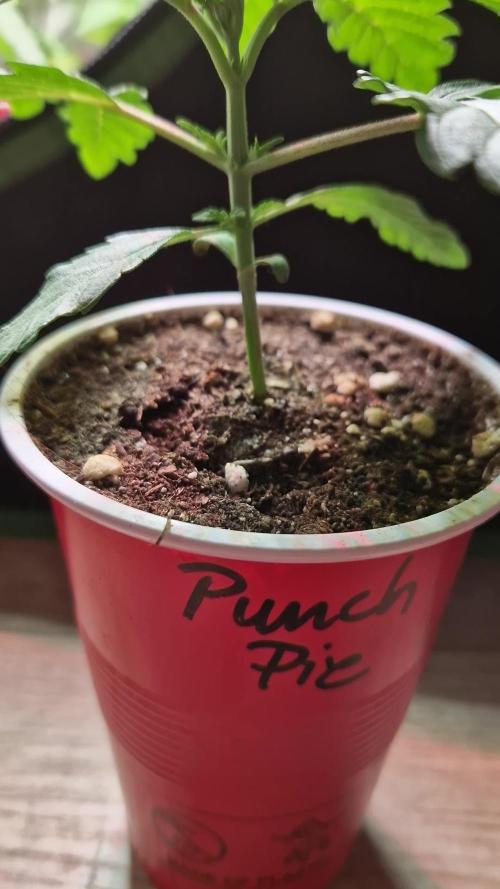
Sie wächst super und bekommt endlich diese Woche ihren ersten Dünger. Diesmal Dünge ich wieder mit meinen Favoriten vom MaryJanes Growshop.
Likes
29
Share


@GrownwithLED
Follow
The plants had been a little root-bound before transplanting them into the bigger pots, this showed in a yellowing of the leaves and a slowed growth. During week 5, now in the bigger pots, the plants are recovering quickly. The start to grow in a nice healthy green color and quickly get bigger in size. Since the light-mix has nutrients in it for appr. 2 weeks, I only add a little BIO NOVA Roots and BN-Zym to my 'FLEXITANK' reservoir. After adding the nutrients I measure the ph-value and see its 6,6. That is too high for cannabis-plant on soil, they cannot take up all nutrients at that ph-level. Therefore I use ph-min from BIO NOVA to decrease the value of the 100 liter nutrient solution in my reservoir to ph=6,0. At this ph-level the plants can take up all nutrients they need for a healthy growth. My two SANlight EVO4-120 LED-fixtures are hanging 75 cm above the plants and are tilted inwards by 11 degrees, following the recommendations of the lights manufacturer. The fixtures are dimmed to 60% of power (=1 green light ON on the dimmer) at this stage, so they plants get a nice stretch and grow into bigger plants fast.


Likes
13
Share


@tresplantes
Follow
Day 32 and the Girls looking just amazing the smell is unbeleavable
Bluezy has a chemical Berry Kind of smell like a shampoo
Dantes Inferno ist straight juice Candy Sweet af
Tomb Rider is really Sweet with a earthy kushy Note in the end
They Are swelling up the last days like hell
This terps are gona Taste amazing no doubt


Likes
35
Share


@bioaccessory
Follow
Hey!
The seeds sprouted almost simultaneously, and by the end of the week all three plants were showing good growth.
Thank you for stopping by, and be healthy! 🙏
To be continued... 😶
