


Likes
Comments
Share

@MrWeeedWorld
Follow
Hallo zusammen! 👋
Eine weitere Woche liegt hinter meinen Outdoor-Mädels und langsam wird richtig deutlich, in welche Richtung sich dieses Projekt entwickelt.
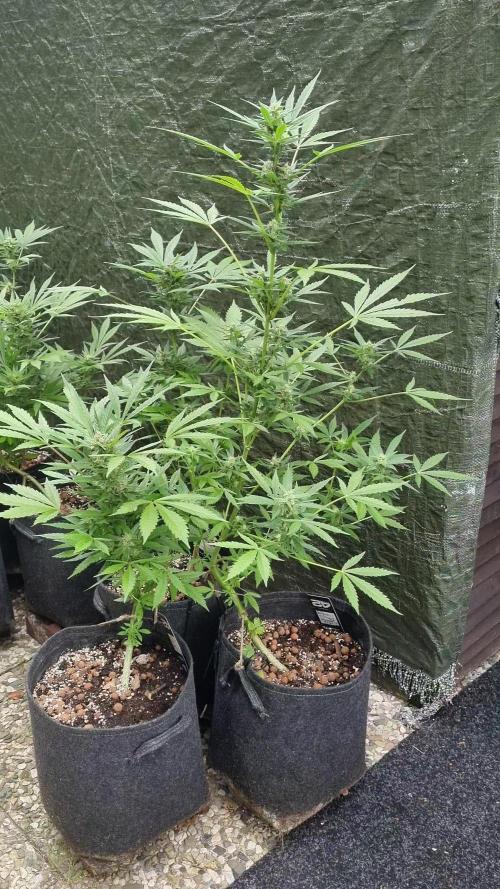
Die drei Pflanzen, die ich zu einer einzigen trainiert habe, wachsen inzwischen erstaunlich harmonisch zusammen. Jede von ihnen trägt ihren Teil zum Gesamtbild bei und genau das macht dieses Projekt für mich so spannend.
In den letzten Tagen haben die Blüten sichtbar an Volumen gewonnen. Besonders die Hauptcolas beginnen jetzt richtig aufzubauen und werden Woche für Woche kompakter. Gleichzeitig entwickeln sich auch die vielen kleineren Seitentriebe hervorragend und füllen sich immer weiter mit Blüten.
Besonders freut mich die zunehmende Harzproduktion. Die Sugar Leaves sind inzwischen ordentlich mit Trichomen überzogen und die Blüten beginnen bereits schön zu funkeln. Man merkt, dass die Pflanzen jetzt langsam in ihre produktivste Blütephase kommen.
Die größte der drei Pflanzen streckt sich weiterhin deutlich nach oben und bildet eine beeindruckende Main Cola. Die beiden anderen Pflanzen investieren ihre Energie dagegen stärker in die zahlreichen Seitentriebe, wodurch eine sehr gleichmäßige Verteilung der Blüten entsteht. Genau diese unterschiedlichen Wuchsformen machen das Projekt so interessant.
Auch gesundheitlich bin ich sehr zufrieden. Das Laub präsentiert sich überwiegend kräftig und vital. Trotz des wechselhaften Wetters entwickeln sich die Pflanzen kontinuierlich weiter und zeigen eine schöne Blütenentwicklung.
Was mir besonders gefällt, ist die Struktur der gesamten Pflanze. Durch das Training gelangt viel Licht bis in die unteren Bereiche, wodurch auch kleinere Budsites ordentlich zulegen können. Ich bin gespannt, wie dicht die Blüten in den nächsten Wochen noch werden.
Jetzt beginnt langsam die Phase, auf die sich jeder Grower freut. Die Buds werden von Woche zu Woche dicker, die Harzproduktion nimmt sichtbar zu und die Pflanzen legen jeden Tag noch einmal ein kleines Stück nach.
Ich freue mich schon auf das nächste Update und bin gespannt, wie sich die Blüten bis zur Ernte noch entwickeln werden.
Vielen Dank fürs Vorbeischauen und viel Erfolg euch allen bei euren Grows! 💚🌱
--------------------------------------------------------------------------------------------------------------------------------------------------------------------
Hello everyone! 👋
Another week has passed, and it's becoming more and more exciting to watch how these plants continue to develop.
The three plants that I trained into one structure are now growing together surprisingly well. Each one contributes something different, making this project even more interesting every week.
Over the last few days the flowers have noticeably increased in size. The main colas are finally starting to bulk up, becoming denser week after week. At the same time, the numerous side branches are filling out nicely and producing more and more well-developed bud sites.
One of the highlights this week is definitely the resin production. The sugar leaves are now heavily covered in trichomes, and the buds are beginning to sparkle beautifully. It's obvious that the plants are entering their most productive flowering stage.
The tallest plant continues to dominate the canopy with an impressive central cola, while the other two focus more on building multiple side branches. This creates a very balanced plant structure with flowers developing across the entire canopy.
Overall, I'm very happy with their health. The foliage remains healthy and vigorous, and despite changing outdoor weather conditions, the plants continue to progress steadily without slowing down.
Another thing I'm really pleased with is the overall canopy structure. Thanks to the training, plenty of light reaches the lower branches, allowing even the smaller bud sites to develop much better than I initially expected.
Now comes the stage every grower looks forward to. The buds are swelling week by week, resin production keeps increasing, and every day the plants seem to make another small step toward their full potential.
I'm really looking forward to seeing how much they can still develop over the coming weeks.
Thanks for stopping by, and I wish everyone a successful growing season! 💚🌱

Processing
Likes
10
Share


@samadhi
Follow
Week 9 concluded with great progress and minor issues! She continues to stack on inflorescence and is frosting up nicely in the heat of the summer sun here. There hasn't been rain here for some time and the days are well into the 90's Fahrenheit. She spends most of the day outside and still comes into to bask in the 400W HPS while it's dark out. I try to give her a 4 hour lights-out immediately after bringing her inside for the day.
I'm seeing leafhopper damage here and there but inspections haven't turned up any culprits recently. I saw them daily back in the spring when she was in veg but they seem to have moved on. I've ordered some spinosad soap in case they continue to damage the plant.
As always, I overfed N during flower and she's clawing up a bit on me. Since then, I've been hitting her with plain water only to try and flush out some of the excess. Following manufacturer recommendations for nutrients always seems to bite me. Especially since all say not to stop with Grow, Part A, etc.. once flower begins. Clearly, I'll need to dial back the amount in the future.
She seems to be progressing nicely in spite of these few issues though and overall I'm very happy with the genetics Dinafem has lovingly created.
Thanks for following along and please click "Like" below if you dig what I'm doing here. Cheers! 👊🌱☮️✌️

Likes
Comments
Share

@Vet_J
Follow
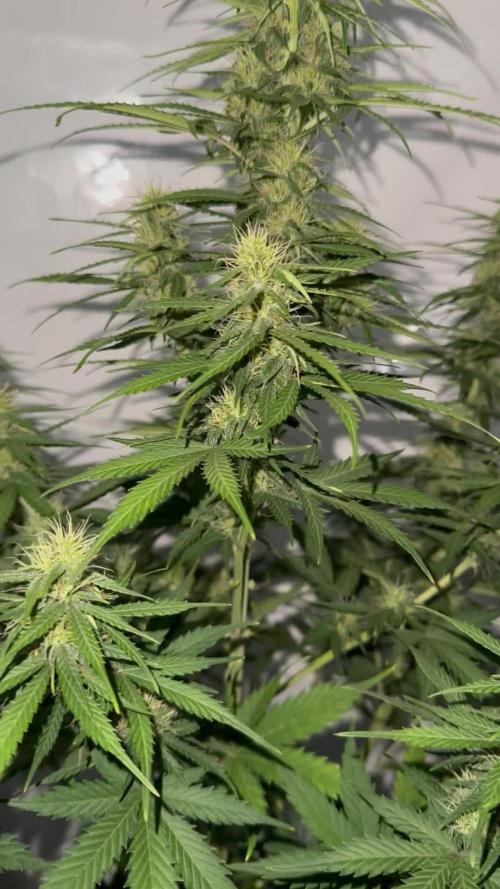
Growth is going great again
The previous problem has been resolved. The yellowing of the leaves has not spread upwards
I did a final defoliation this week. I didn't want to do an aggressive defoliation, I just removed the damaged leaves and those that were directly on the buds.
This week it looks healthy, the buds are slowly thickening, I will slightly increase the dose of flowering fertilizer at the end of the week.
It already absorbs three liters of water quite quickly and there is no water coming out of the pot, so I will increase it to four liters.

Processing
Likes
9
Share


@JerMeds
Follow
These 2 girls are looking and smelling good, canopy is almost full. I'm glad they are staying smaller and not over running my grow box.
Had to LST the first girl again. She recovered well and now fully spread out and shes finishing up stretch. She has some yellowing leafs at the bottom so I upgraded her nutrients to 5ml/gal. I will see how she reacts to it and adjust accordingly.
The second girl was just a big bundle of leafs, I took off about 10-15 big leafs, now more bud sites are exposed. (See Pictures) Maybe I can get a little bit more LTS out of her. I'm not sure she is going to stretch anymore. Time will tell.


Likes
3
Share


@PalmaGrow
Follow
Segunda semana de floración mostrando preflora en todos los cálices y nodos esperando con ansias para ver el potencial de esta planta
30 - 6 septiembre
Likes
7
Share


@eldruida_lamota
Follow
Que pasa familia, vamos con la cosecha de estas Black Muffin F1 de Sweetseeds.
Esta variedad me resultó bastante sencilla de cultivary es bastante resistente, si no la maltratáis crece mucho y bien sana, la flor se ve increíble, tiene una cantidad de resina considerable y unos tonos rojos oscuros muy peculiares, se ven genial.
El olor que desprende es bastante frutal con toques cítricos, no pinta nada mal, las flores están prietas.
No da mayores problemas, el ciclo no es largo, cuiden con la altura ya que se desmadran un poco.
IMPORTANTE destacar: En las fotos comprobaréis que ya no hay botes de cristal con sobres de bóveda, ahora hay Grovebags.
Que son una especie de sobres o bolsas que retienen el peso, previene la aparición de moho y mantiene intacto el terpeno, para que el curado sea más óptimo.
Hasta aquí todo, Buenos humos 💨💨💨

Processing
Likes
1
Share


@UKGuy2020
Follow
Currently day 23 of my purple punch auto grow by barneys farm.
I have topped at the 3rd node and now starting to tuck and tie down bigger fan leaves. Progress is good so far.
Decided to hold back on the bloom until I start the flowering faze.
Nute Feed
Mixed to 5L of water
Calmag 2ML
Micro 2.5ML
Grow 2.5ML
Voodoo 2.5ML
INBETWEEN EACH NUTRIENTS FEED I ALSO FEED WITH ONLY PH ADJUSTED WATER
Growing in a 60x60 tent with a philzon 1000w cob led sat 15 inch from canopy
Day temp 25 c
Humidity around 55-60
Night temp around 19 c

Likes
14
Share


@Cannibalgardens
Follow
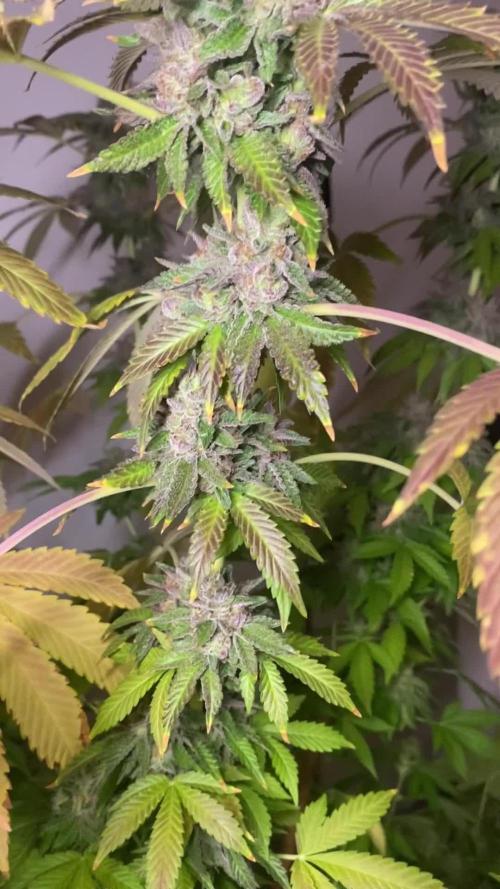
You guys this lady is doing great since the first day she took it really well with the environment and the hot soil . The frost is thick and she smells so dam musky it's the classic gorilla glue smell. The tricohmes are showing more amber and the flush had started so looking forward to the end of this run ... Harvest times are coming ....


Likes
99
Share


@BudXs
Follow
The temperature is dirty!!!!
Cant keep it below thirty
what the trich July?, like this it hard to keep em purdy
I got the lights cranked down low
I got the fan on high, bro
But sunny days and constant rays are making me go psycho.
Got that chin held hi tho
Xs aint gon cry, no
Soon my only worry will be: "from which jar of hydro?"


Likes
12
Share


@Slurpy_Terpy
Follow
stretching nicely!
she is filling up a bit more than 1/3 of the tent
she is stretching pretty evenly, easy so far :D
the buds are developing early! (compared to the rest, she is in advance)

Likes
10
Share


@GoodTimesOrganics
Follow
Hi liebe Community and Welcome Back! 🌿💚
🖍️Permanent Marker von Seed Junky Genetics x Doja Exklusiv!
Wir befinden uns in Wachstumswoche 9 seit dem Eintopfen (Tag 54 + Tag 7 Blüte).
Die erste Blütewoche ist nun vorbei.
Die Pflanze geht auch ordentlich in den Stretch und hat in dieser Woche nochmal 17cm zugelegt
Die Pflanze hat einen wundervoll geschwungenen Wuchs. Sie ist schön Breit und dennoch kompakt. Ihre Höhe schätze ich als Moderrat ein.
Die Pflanze legt insgesamt eine top Performance hin.
Bildet allerdings viel Blattwerk aus, daher habe ich nochmal ordentlich defoliert und die unteren Triebe Rausgeschnitten.
Auch habe ich nun die oberen Triebe nochmal etwas runtergebunden um eine bessere Homogenität hinein zu bekommen.
Gegrowt wird wie immer rein Organisch, daher kam nun für die Blüte 10ml PK - Booster von Bio Tabs NL hinzu.
Die Bedingungen sind aktuell gut!
—————
🌞 Temp: 26
🌚 Temp: 18°C bis 19°C
💨 RH: 68%
VPD: 0,7 kPa
💡ppfd: 630 mpm
—————
Grüne Grüße 💚🌱

Likes
4
Share


@badirama
Follow
So i went for quick vacation/holidays to Georgia (love it!) and asked a friend of mine that lives nearby to take care of me babies 😊 so he watered the girls every 3,5 days on average (4 times during 14 days) with just as little as 100 ml per plant. Now I come back yesterday and I’m very happy with my girls - they look super thriving and eager to grow! I’m surprised as so very different they look from my previous grow in same setup except hydroponics - this time in soil in same day of vegetation they look much more dense and just thriving! Wow soil makes huge difference indoors.
I saw 2 top leaves (on pictures & on video) with light nutrients burn (no idea why - I just added root juice). Also I know for sure that my light timer has broken - there were days when light was 24h on...I don’t know what might that cause... but now is all good - light timer fixed. I think that I will just keep feeding them water. What do you think guys? Would love some advice!
Oh and pictures and videos are from yesterday. Before topping and after topping. On 2 girls I have used new topping technique.
Thanks!

Likes
10
Share


@LittleManGrow
Follow
Plants are doing well, The 84" inch tent is a must if your not training or topping. I removed all the sacks that appeared last week and I haven't seen anymore show up so fingers cross, I check daily. Bigger tent also helps with heat control as the air has more room to rise. Hope you all like the pictures, I started to take videos as they provide more detail with less work.

Likes
Comments
Share


Likes
1
Share


@Green_Peace
Follow
Added some cheap organic feed I bought from Wilkinsons a while back. Both plants looking happy, healthy and green. These plants are at the front and to the right in the timelapses.
Likes
28
Share


@DreamIT
Follow
Sponsored by:
🎭ZAMNESIA SEEDS🎭-💡VIPARSPECTRA💡-💐GREEN BUZZ LIQUIDS💐-🛠️WEDRYER🛠️
4/9 hello growrez, I'm back with the updates. unfortunately it was another shitty summer and the heat is not over yet, but even if slowly here we are. My bell runtz has stretched out of proportion. the branches I held have stretched a lot and are starting to bloom. today I bathe with fertilizer in the fourth week of flowering
__________________________________________
Personal advertising (contains affiliate links)
__________________________________________
🦄Zamnesia boasts the most complete and accurate site where you can find everything related to cannabis and the "psychedelic" world. Autoflowering, feminized seeds, mushrooms, salvia divinorum, afrodisiacim of everything, and more! ( no affiliate link)
✅https://bit.ly/Zamnesiaseeds
__________________________________________
Did you know that Green Buzz Liquids fertilizers are 100% vegan? A complete line of products ready to give the best to each of your plants! Visit the site and see my journals to see how they work 🦄
🤯 And with the code "dreami t" you will immediately receive a 15% discount on your purchases
✅https: //bit.ly/GreenBuzzLiquidsPro
__________________________________________
👀 Are you looking for a good lamp to start with? 👀
🌞Viparspectra has something more than the others, take a look at their site.
⏩ Use "GDVIP" for an extra discount or "DREAMIT3" for an extra 5 %% discount
👀 Search for it on Amazon
✅Amazon USA: https://amzn.to/30xSTVq
✅Amazon Canada: https://amzn.to/38udUVe
✅Viparspectra UE: bit.ly/ViparspectraUE
✅Viparspectra USA: bit.ly/ViparspectraUS
______________________________________________
🌈 Tired of blowing on your weed hoping it dries quickly? Check out the Wedryer website! You will find a well-made accessory that will help your weed dry in just 8-10 days without the annoying risk of finding mold or other annoyances! (no affiliate links)
✅https: //bit.ly/Wedryer_
______________________________________________
📷🥇Follow the best photos on Instagram 🥇📷
https://www.instagram.com/dreamit420/
Backup
https://www.instagram.com/dreamit4200/
🔻🔻Leave a comment with your opinion if you pass by here🔻🔻
🤟🦄💚 Thank you and good growth 💚🦄🤟

Likes
18
Share


@thenotillwizard
Follow
At day 20, I can see that the strech phase is almost over.
The girls are now expressing a more specific nose, even if they share a similar aromatic profile of exotic fruits.
They all share that same tropical funk back ground (myrcene/terpinolene), but some of them (#2 and 4) got a solid punch of sour lemon.
Pheno #1
65%Indica
Bushy/compact structure
Smaller buds, tightly disposed on the branches
Sweet/tropical/Pine
Pheno #2
65%Sativa
Sturdy structure/ Very fat branches
Good size buds, medium internodes
Sweet/tropical/Sour citrus
Pheno #3
65%Sativa
Sturdy structure/ good size branches
Good size buds, medium internodes
Sweet/tropical/skunk
Pheno #4
65%Sativa
Sturdy structure/ medium size branches
Good size buds, short internodes
Sweet/tropical/Sour citrus
Pheno #5
80%Sativa
leggy structure/small size and long branches
Good size buds, long internodes, it stacks
Sweet/tropical