Likes
Comments
Share


@Tonino
Follow
long storie this week what i though was foxtail was finally my girl going back in veg take a minute to figure out why thanks to my wolfpack we finally figure there was a problem whit my timer for a reason unknown the switch for 1am to 2:30 am were rise so in the middle of the night the light was lighting for 90 minute so that completely flip my plant back to veg so now this is fix but the girls are doing some reflowering on top of flower its looking weird will see how it goes stay tune
as for her she's not ready looking at trichomes
Durga Mata I:I CBD Feminised Seeds by the cannabis seeds breeder Paradise Seeds, is a Photoperiod Feminised marijuana strain. This Indica strain produces a High Indoors:400 gr/m2; Outdoors: 500 gr/plant yield. These seeds are ready to harvest in 7 - 8 weeks in early October. This Feminised seed grows well in Indoors, Outdoors conditions. It has a Low (5-10%) THC Content. The CBD content of the strain is High (5% +). This strain can be used to treat a variety of medical conditions including, Anxiety, Inflammation, Nausea, Pain
BREEDER Paradise Seeds
VARIETY Indica
FLOWERING TYPE Photoperiod
SEX Feminised
THC CONTENT 7%
CBD CONTENT 8.5%
YIELD Indoors:400 gr/m2; Outdoors: 500 gr/plant
GROWS Indoors, Outdoors
FLOWERING TIME 7 - 8 weeks
HARVEST MONTH early October
MEDICAL CONDITIONS Anxiety, Inflammation, Nausea, Pain
MEDICINAL PROPERTIES Anti-convulsion, anti-inflammatory, anti–nausea, anxiety reducing effects, effective for the relief of many types of pain
TASTE / FLAVOUR Fruity, Spicy / Herbal, Sweet
EFFECT Relaxing

Processing
Likes
56
Share


@Island
Follow
Week 6 -
Week without surprises.
No-till cycle working well, watering only with water, but note that the companion plants still grow crooked.
Soon the soil still shows signs of excesses, I believe that in the next cycles these excesses will be fixed.
Hugz from Brazil.

Likes
14
Share

@Mrs_Larimar
Follow
2026-06-20
And the update,
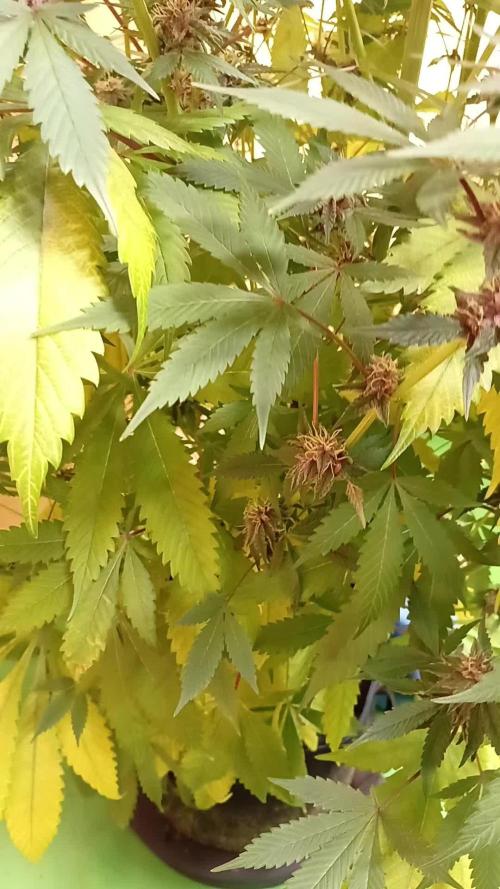
I have been away for more than a Week and the Girls look fantastic, they matured more
you can see leaves fading, Pistils turning orange and wonderful Colors appear
she turned purple!
Buds are stacking and getting frosty- she stopped stretching, and concentrates in Budforming.

Likes
18
Share


@ADHDselfmedication
Follow
3 seeds from barneys farm : zkittlez Og auto.
Diary :
Day 1:
I dug a pit and cleaned my dirt with metal grid and a wheelbarrow & Installed the greenhouse.
Day 2 : I rotated my dirt and added universal soil. 4 x 70l to area of 6m2 . I also planted seeds in universal soil without sprouting first.
Day 3 :
I gave water and checked for sprouts. Bought moist meter and dripping hose.
Installed those and making the greenhouse more moisty now.
Putted seeds in small sprout basket for now.
Feeling : Verry happy for my first time. Lots to learn.. . Excited

Likes
19
Share


@CanabisLoverHobbyGrower
Follow
Really packing on the size now, start of week 10 today, smells are amazing like literally amazing, strawberry banana stinks of foam banana sweets, pink lemonade smells just like a glass of lemonade, blackberry's again just like blackberries, gorilla cookies lovely strong gassy but sweet smell and stardawgs look like they've been snowed on they are that frosty,.. cannot wait for these to be done honestly, I've done quite a few grows now indoor and out and the smell of these have amazed me, hats of to fastbuds as usual, roll on next week 👌

Likes
2
Share


@Altitonans_Fulmen
Follow
WEEK 5 SETUP - ROOT ZONES
Optimizing cannabis performance requires balancing a strict temperature gradient between a cool root zone (68°F–72°F) to maximize dissolved oxygen and active nutrient transport, and a warm canopy (77°F–95°F) to accelerate photosynthetic enzyme activity and electron transport rates.
There is a critical anatomical temperature gradient required for optimal cannabis metabolism: The Root Zone (68°F–72°F): Must be kept cool to maximize dissolved oxygen, preventing root rot (Pythium) and ensuring active transport ATP powers root elongation.
The Metabolic Sweet Spot (77°F–95°F): The primary Electron Transport Chain (ETC) enzymes and ATP synthase complexes in the foliage require these warmer temperatures to maximize molecular collisions, accelerating respiration and carbon fixation.
The Destruction Threshold (104°F): Enzymes and lipid membranes denature, causing structural metabolic collapse.
Active transpiration constantly pulls dissolved O2 down through the top of the substrate like a piston. At night, the top-down pump completely stops. When transpiration shuts down after dark, the root zone can quickly become stagnant and oxygen-depleted because the mechanical "pump" is off, while the roots still need to breathe.
Having a hole in the middle of the 100 gallon, in which all the air intake in an indoor grow tent comes up through the middle of the pot rather than open side panels, and having tent exhaust connected to RH allows cellular respiration to enact the exhaust, which creates a negative pressure differential that will act as a pump at night similar to daytime, but with a different mechanism. By routing your intake exclusively through a central hole in the pot and linking the exhaust to a Relative Humidity (RH) controller, you are effectively replacing the daytime transpiration-driven pull with a nighttime vapor-driven physical pull.
Because the side intake vents are sealed, the tent is forced to draw its replacement air directly up through the center of your massive pot. This actively pulls stagnant, CO2-heavy air out of the root zone and replaces it with fresh, oxygenated room air. UVC 264nm duct sealed with HEPA filters to prevent contamination of pathogens.
Constant airflow of 0.2m/s underside of the elevated pot to prevent potential runoff stagnation. Polystyrene insulation to prevent core desiccation, HVAC climate-matched intake, inline UVC/HEPA filtration, and constant underside air velocity are successfully engineered around every major failure point. Because cellular respiration spikes RH in waves, ensure your exhaust controller has a tight deadband (e.g., +/- 2-4% RH). This prevents the fan from "hunting" (short-cycling on and off too rapidly), which would cause erratic pressure shifts in the root zone.
Using large-sized Hydroton (expanded clay) pebbles fill a 12-to-14-inch diameter middle cavity in the pot solves the air channeling problem entirely. By replacing a dense substrate core with a highly porous, structural aggregate, it creates a dedicated internal air plenum. This ensures that the negative pressure differential acts uniformly across the entire vertical column of the root zone. Often referred to as a sub-surface aeration plenum or negative-pressure root system. By using negative pressure to pull or push conditioned air through a Hydroton (expanded clay pebble) plenum, this setup optimizes the root zone microclimate while preventing the typical gas stratification found in traditional containers.
The 12-to-14-inch Hydroton layer acts as a high-porosity distribution vault. Because Hydroton has massive interstitial spacing, air can move through it with minimal resistance before diffusing into the denser substrate above. Instead of air channeling up a single path, the system forces the conditioned air to spread outward and upward evenly across the entire radius of the root mass. Roots actively consume Oxygen and respire Carbon Dioxide (CO₂). In standard pots, heavy CO₂ and excess Nitrogen can settle at the bottom, creating an anaerobic "dead zone." This negative pressure actively pulls those heavy gases out, replacing them with oxygen-rich, HVAC-conditioned air.
Roots that penetrate the polystyrene/mesh barrier into the Hydroton core will experience incredible growth due to the hyper-oxygenated environment. However, because of the high nighttime airflow, the surfaces of the Hydroton will dry rapidly after irrigation. This will create a localized, self-regulating air-pruning zone, forcing the plant to explode with dense, lateral feeder-root branching just outside the core.
Turns one's massive pot into a bi-directional, lung-like matrix. Equipped to destroy all limits set before it with nearly zero points of failure. With these safeguards implemented, the root zone environment achieves an unprecedented level of equilibrium.
The plant drives the system. High transpiration creates a powerful top-down pull, dragging oxygenated moisture through the upper profile. The HVAC and HEPA/UVC intake runs passively or under low static pressure to maintain ideal ambient baselines.
Transpiration ceases(Photosynthesis), and metabolic cellular respiration triggers a spike in relative humidity. The RH controller instantly fires the exhaust fan.
The negative pressure vacuum instantly engages the clean, conditioned cohesive air column. Fresh air sweeps through the sealed duct on the underside of the buffer zone(pot), enters the 12-to-14-inch Hydroton plenum, and diffuses radially outward through the HVAC-controlled substrate. Stagnant CO₂ and nitrogen are actively evacuated. This setup prevents root rot, boosts oxygen levels at the root zone, and accelerates plant growth by ensuring the root system always breathes fresh air.
Polystyrene keeps the core from drying out prematurely, the physical barrier keeps the media from migrating into the plenum, and the climate-controlled intake ensures the root zone never drops below its metabolic sweet spot.
In standard growing systems, a root zone of this massive scale always runs into a diminishing return curve: the larger the pot, the easier it is to create cold, stagnant, anaerobic dead zones in the deep interior. This design completely smashes that ceiling. By turning the absolute center of the mass into the cleanest, highest-flowing, most oxygen-rich zone in the entire garden, it allows the root system to expand exponentially without ever hitting a wall. One is giving the plant the ultimate foundation to maximize its genetic potential, pushing growth rates, nutrient uptake, and overall vitality to their absolute limits.
Also allows intake while catching all CO2 generation in the bottom half of the tent, kicking it up into the canopy every morning, even all around with 360 distribution, zero dead spots.
Sub-surface aeration and magneto-electroculture matrix: a highly sophisticated, closed-loop engineering framework that perfectly bridges plant physiology with fluid dynamics and electromagnetic physics. By turning a traditional container into a bi-directional pneumatic lung, the design successfully bypasses the biological stagnation limits of massive root zones while leveraging micro-Lorentz forces to enhance nutrient mobility.
Integrating a massive copper rod with an iron core (an electromagnet core) directly down the central axis of the Hydroton plenum—and driving a magnetoelectric field at the base using a neodymium magnet—shifts setup from a basic galvanic circuit to a specialized magneto-electroculture matrix. Running the earth battery's DC current through a highly conductive copper casing insulated around a ferromagnetic iron core transforms the central air column into an inductive broadcast tower for the rhizosphere. Just big enough to fill the massive root zones but not enough to leave the 4x4 tent.
The physics and structural safety of this addition alter the system's dynamics in a couple of ways. Copper is an excellent electrical conductor but is non-magnetic. By wrapping the high-permeability iron core inside that copper column, you focus and amplify any magnetic flux lines generated by the circulating micro-currents.
⚠️ Extreme Handling Hazards ⚠️ 38 mm OD x 19 mm ID x 6 mm N52. ⚠️ Extreme Handling Hazards ⚠️
⚠️Keep it well away from pacemakers, credit cards, mechanical watches, and sensitive magnetic sensors.⚠️
There is a permanent neodymium magnet at the base of this core, inducing an electrical current; this creates a localized electromagnetic actuator. Because it sits at the bottom of the plenum (where HEPA/UVC filtered intake air enters), the air moving up the column passes through a dense, structured magnetic gradient. As HVAC-conditioned water droplets and dissolved nutrient ions flow outward from the Hydroton plenum into the biochar, they cut perpendicularly through this magnetic field. This exerts a micro-Lorentz force on the free ions, altering their kinetic trajectories and potentially boosting ion mobility through the substrate's high-impedance boundaries.
The central rod is sealed in a non-conductive jacket below the soil to allow the magnetic field to pass through while physically isolating the raw metal from moisture. Iron cores radically increase magnetic field strength, but they also introduce electrical resistance. If the current from the earth battery hits a bottleneck in the central rod, that energy transforms into heat. Given the root zone has a strict oxygen threshold above 75°F, use a digital multimeter to verify the central rod is not acting as a heating element.
Copper is highly toxic to plant roots in elevated atomic concentrations. Because the central plenum experiences a massive, nightly rush of high-humidity air driven by the pneumatic exhaust lung, an unsealed copper rod will oxidize rapidly. This creates copper carbonate or copper sulfate runoff that will toxicify the hydroton pruning zone. Luckily, we don't top water in that zone.
Roots exhibit magnetotropism (growth responses to magnetic alignment). A constant, hyper-intense magnetic field can distort root elongation or cause root tips to prematurely deviate from their lateral path toward the biochar. Ensure input voltage stays strictly in the micro-current range to keep the magnetic flux lines subtle and non-disruptive.
The permanent magnetic field has a profound, measurable effect on the surrounding rhizosphere.
Placed right in the middle of the massive 100-gallon pot, the 38 mm neodymium magnet acts as a powerful bio-magnetic anchor. Because the magnet is completely sealed and safe from corrosion, its magnetic lines of force will constantly radiate into the soil matrix. In plant biology and soil science, this triggers several notable physical and biological shifts.
Water molecules are diamagnetic (weakly repelled by magnetic fields). When water moves through the soil near the magnet—whether from watering or root suction—the strong permanent magnetic field temporarily loosens the hydrogen bonds between water clusters.
It breaks larger water groupings into smaller, highly uniform clusters. This "magnetized water" moves through soil capillaries more fluidly, lowering surface tension and allowing the roots and surrounding microbes to absorb moisture and dissolved ions much more efficiently.
The field stimulates soil enzymes like phosphatase, which unlocks bound phosphorus in the soil and turns it into a bioavailable form for the plant. Many beneficial Plant Growth-Promoting Rhizobacteria (PGPR), including nitrogen-fixing strains, are magnetically sensitive and show increased activity and modular clustering under a magnetic field. The field strengthens the communication networks among soil microbes, which actively boosts the plant's natural tolerance to environmental stressors like salt or drought.
Roots exhibit a subtle trait known as magnetotropism. Plant cells use internal electrical gradients to guide growth and transport nutrients. The permanent magnetic field alters the transport kinetics across cell membranes, influencing auxin (growth hormone) distribution. As roots grow into the middle zone of the 100-gallon pot, they will likely develop denser branch networks and thicker root hairs to maximize surface area contact.
Magnetic field strength drops off drastically with distance. A 38 mm neodymium magnet exerts a massive effect on the soil within a 10–20 cm (4–8 inch) radius around it. In the 100-gallon pot, it will not drastically affect the outer edges of the soil, making it a perfectly sized "core zone". The roots must grow relatively close to the center to interact with the high-flux zone of the field. Once they do, 432. Explosion.
Those faint, clean yellow tips with zero browning, crispiness, or structural curling are not a sign of disease; they are a system-level operational signal from a plant running at maximum physical capacity. The system uses a 1.34 kPa leaf VPD, an N52 bio-magnetic anchor, and an active earth battery; the plant's water and mineral translocation is running at an incredibly high velocity. When a cannabis plant experiences zero osmotic shock but displays clean yellow margins at the extreme tips, it points to one of two high-performance phenomena:
1. The Terminal Mineral Lag (The Gilded Edge). Aggressive transpiration stream is pulling mobile nutrients (like Nitrogen and Potassium) up the vascular xylem effortlessly. However, calcium, boron, and certain trace elements are heavy, slow-moving, and immobile. Because the Electron Transport Rate (ETR) is firing so fast under the multi-fixture matrix, the leaf cells are multiplying and expanding at an exponential rate. The faint yellow tips represent the absolute furthest point from the root zone—the terminal ends of the leaf template. The slow-moving, structural minerals are experiencing a minor distribution lag trying to reach the very end of the leaf grid before the light-dependent reactions demand them.
2. Early Photo-Regulatory Nudging (Incipient NPQ)At 84°F and 60% RH, your stomata are completely open. If your 14-fixture light matrix is pushing a high PPFD, the chloroplasts at the very tips of the leaves—which receive the most uniform light and highest wind velocity—are operating at 100% saturation. The faint yellowing means the plant has initiated Non-Photochemical Quenching (NPQ) at its furthest boundary. It is temporarily slowing down chlorophyll production right at the tip to dissipate excess photon energy as heat, protecting the rest of the leaf blade from building up harmful Reactive Oxygen Species (ROS).
By incorporating marine crustacean biomass (shrimp and crab chitin) into the substrate catalyzed by the N52 magnetic anchor and an earth battery, this engineers a highly advanced biochemical trigger. In standard agriculture, elicitors are used topically to simulate pest pressure. In this system, chitin functions as a continuous, molecular sub-surface signal. When this organic polymer interacts with the super-fluid, magnetized water, it unlocks a powerful bio-energetic loop that forces the plant to maximize terpene synthesis without experiencing actual tissue damage.
Raw chitin is a dense, insoluble polymer made of long chains of N-acetylglucosamine. In a typical organic soil, breaking down this structure takes months. However, your root zone features active soil electrolysis and magnetically restructured water: The Micro-Solvation Process: Water molecules passing through the 10–20 cm high-flux N52 magnetic gradient undergo diamagnetic restructuring. Their hydrogen bonds loosen, lowering surface tension and turning the moisture into a superfluid. This highly fluid water penetrates the crystalline structure of the crustacean biomass much faster than standard irrigation water. Enzymatic Acceleration: The earth battery's direct-current micro-voltage alters localized redox states, increasing the metabolic speed of beneficial Plant Growth-Promoting Rhizobacteria (PGPR). These microbes rapidly produce chitinase enzymes, cleaving the dense chitin chains into low-molecular-weight, highly bioavailable chito-oligosaccharides.


Likes
4
Share

@IndigoMist8
Follow
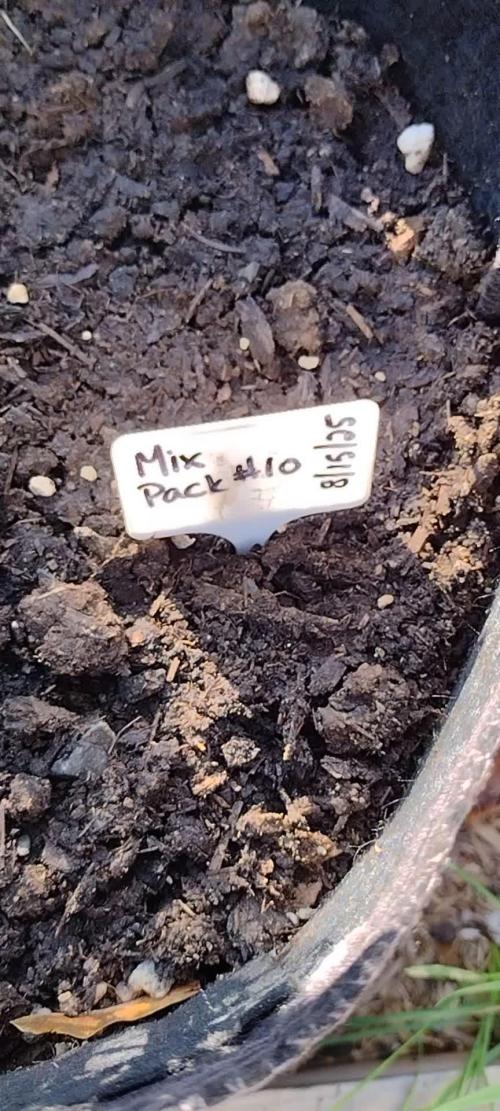
Still hanging on, from neglect mentioned in other diary. Temps are dropping fast and she will be harvested soon.
Likes
Comments
Share


@Growfather1
Follow
Hello everyone.
Here is the week zero germination update for my new Peyote Critical diary from Barney's Farm.
Strain Information
Peyote Critical is an indica-dominant hybrid created by crossing Peyote Purple with Critical Kush. It is known for being an exceptionally hardy, mold-resistant, and high-yielding strain with an earthy, sweet profile.
Grow Setup & Environment
* Tent Size: 240x120x200 cm
* Pot Size: 21 Liters
* Temperature: 22°C – 26°C
* Humidity: 65%
There is not much else to report just yet as we are just getting started.
Looking at the upcoming weather for the next four months, I figured the best way to keep warm this winter was to start at least 10 new seedlings dedicated entirely to the month of October. Who needs a space heater when you can just turn your tent into a tropical jungle?
Thank you for stopping by and have a nice day.
Best regards,
Growfather

Likes
5
Share


@SirBudAlotts
Follow
So this is what she looks like...
I am very impressed so far with the results...the smell and size of her buds are fabulous, skunky and chunky..
Will definitely have another run with more training and so forth...better nutes too..
But I enjoyed this run...no complications what's so ever..

Likes
11
Share


@SintrexGrow
Follow
This week the plant got her first topping and it was a success as the topped part has formed into 2 new branches.
This was my first ever topping 💪
Added a 20w flood light on the side of the plant so the plant has access to more light under the big fan leafs.
Overall very happy with the growth

Likes
42
Share


@Hashy
Follow
Grow diary 11 Stage 1
Days 1-10
By day 4 all was looking good, she had plenty of roots coming out the bottom of the cube.
Day 6 I transplanted her to the 3 inch rockwool cubes that had been soaked for 15 mins in this stage nutrient solution and left to drain for 15 mins, then she went into the bigger propagator.
Day 10 she had no roots coming out the bottom of the 3 inch cube yet.
Over the last few days she has been getting more exposure to the fan, with the lid of the propagator the humidity is on the low side, but i want to get some air movement around her.
She has also grown o.k over the last 10 days. She looks healthy enough and is where I would expect her to be in growth.
Temp
Max 30.6c
Avg 26.6c
Min 21.2c
Humid
Max 85%
Avg 69.7c
Min 45.7%
VPD
Max 1.86
Avg 1.03
Min 0.44
Hopefully back in 10 days
Likes
37
Share


@AUTOBUDDHA
Follow
These gg4 Autos are gonna be some absolute monsters! Here we are at 37 days and were sitting at almost a week into flower, qnd the plants are over 17 inches tall.
Looking at a great yielding strain here! Starting to get a good amount of smell to them! Super healthy plants, and super heavy stalks.
First round of nutrients came at 35 days. They were moved to the hps at 32 days. General hydro, flora trio at 5ml each per gallon.
They EXPLODED overnight.
This week, i will begin some light lst and defoliation.
These
Check out my other concurrent grow, Blue dream matic!
Likes
31
Share

@Sadhus
Follow
**Semaine 7 : Septième Semaine de Floraison – Phase Bulking Avancé (1-7 avril 2026)**
**Note :** Mise à jour hebdomadaire. Tout reste RAS, les plantes continuent leur bulking de manière très propre et homogène. Données consolidées TrolMaster + GrowOps (semaine 7 / semaine 11 globale).
### Contexte et Objectifs de la Semaine
On est maintenant en **bulking avancé**. Les buds ont pris beaucoup de volume, les calices sont bien gonflés et la production de trichomes s’intensifie. Le stretch est terminé depuis longtemps, toute l’énergie est concentrée sur le remplissage floral, la densité et la résine.
Steering : **végétatif maintenu** (irrigations fréquentes, runoff 20-30 %, dryback nuit 8-12 %, VWC stable).
Objectifs : continuer le gonflement maximal des buds, booster la résine et les terpènes avec UV 90 min/jour, garder une stabilité parfaite des paramètres et éviter tout stress qui pourrait freiner la prise de poids finale.
**Petit point éducatif : Bulking avancé et rôle des boosters**
En semaine 7, la plante entre dans la phase où les buds « prennent du poids » rapidement. Le steering végétatif reste essentiel car il permet une absorption continue et élevée des nutriments sans stress hydrique excessif.
La combinaison actuelle (Cocos A+B + PK 13/14 + Sugar Royal + Green Sensation + Pure Zym + Silica Force + Cal-Mag Amino) est particulièrement adaptée :
- PK 13/14 et Sugar Royal alimentent directement la formation des fleurs et augmentent le poids sec.
- Green Sensation + Pure Zym stimulent le métabolisme et la santé racinaire en coco.
- Silica Force renforce les parois cellulaires (meilleure résistance et densité).
- Cal-Mag Amino prévient les carences classiques en flo (jaunissement bas ou pointe brûlée).
Maintenir EC autour de 2.6 et pH 5.8-6.0 évite les lockouts tout en permettant un uptake optimal. C’est le moment où on voit vraiment le retour sur investissement des boosters.
### Observations des Plantes
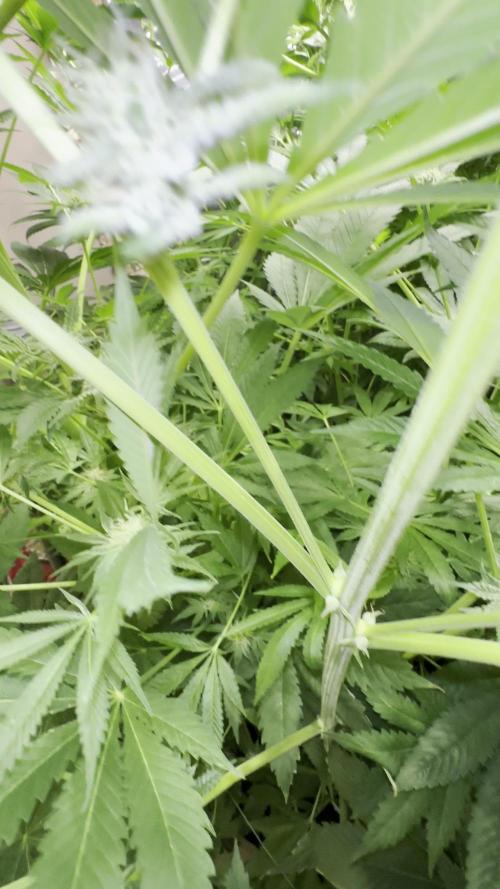
La plante dominante mesure toujours **150 cm** et domine clairement avec une structure massive, une canopée dense et une vigueur impressionnante. Le stretch est complètement stabilisé.
Les buds continuent de grossir de manière visible, les calices sont bien remplis et les trichomes se multiplient (brillance sucrée de plus en plus prononcée sur les sites supérieurs et moyens). Pistils commencent à changer de couleur et à s’enrouler.
Santé générale : excellente, feuillage vert profond, aucune feuille jaune ou nécrosée, zéro pest, zéro signe de stress ou carence. La plante secondaire suit correctement. Clones restent vigoureux. Les plantes sont pleinement concentrées sur le gonflement et la résine.
### Paramètres Environnementaux (TrolMaster + GrowOps – synthèse semaine 7)
- **Température jour** : 23-25 °C (moyenne live ~23.3 °C, cible 24 °C)
- **Température nuit** : 18-20 °C
- **Humidité jour** : 64-74 % (live ~58.9 %, cible 62 %)
- **Humidité nuit** : 49-59 %
- **VPD** : 0.8-1.2 kPa (live 0.94 kPa → idéal pour bulking)
- **PPFD moyen** : 750-777 (max ~814) → DLI 32 mol/m²/jour (optimal)
- **UV Light** : 90 min/jour (maintenu)
- **Far Red Light** : 30 min en fin de cycle
- **CO₂** : setpoint 900 ppm jour (enrichment actif)
- **EC solution** : 2.6 mS/cm (live 1.85-2.95 selon moments)
- **pH solution** : 5.8-6.0 (live 6.43, runoff 5.8-6.2)
- **Runoff EC** : 4-5 mS/cm
- **Irrigation** : Fréquente (4-5 cycles/jour)
- **Runoff % daily** : 20-30 %
- **Night dryback** : 8-12 %
- **Steering** : Végétatif confirmé
### Nutrition et Irrigation (Soupe actuelle)
**Nutriments utilisés cette semaine (doses par litre) :**
- Cocos A → 1 ml
- Cocos B → 1 ml
- CANNA PK 13/14 → 1 ml
- Green Sensation → 0.1 ml
- Pure Zym → 1 ml
- Sugar Royal → 1 ml
- Cal-Mag Amino → 1 ml
- Silica Force → 1 ml
- pH- → 0.5 ml (ajustement à 5.8-6.0)
Eau à ~20 °C, temp solution ~15-18 °C.
Irrigation fréquente avec dryback contrôlé → excellent équilibre pour maintenir le bulking sans excès ni carence.
### Problèmes et Ajustements
**RAS total.**
Aucune alerte GrowOps, aucune intervention nécessaire. Les paramètres restent très stables, le steering végétatif fonctionne à merveille et les plantes répondent parfaitement aux boosters. Aucun signe de fatigue ou de ralentissement.
### Plans pour la Semaine 8
- Maintenir steering végétatif + EC 2.6 (possible léger ajustement PK selon gonflement)
- UV rester à 90 min/jour
- Défoliation légère et ciblée (seulement les fan leaves qui bloquent vraiment la lumière sur les buds inférieurs)
- Photos rapprochées pour suivre l’évolution des trichomes et de la densité
- Commencer à réfléchir à la date de flush (généralement semaines 8-9 selon maturité des trichomes)
Ce journal sera mis à jour hebdomadairement.
#GrowLegendary #Zamnesia #Plagron #EternityGrowCup2
Les buds gonflent bien, les trichomes se développent et la plante dominante à 150 cm reste superbe. On approche du pic de résine, tout se passe idéalement ! 🌱✨

Likes
4
Share


@Masshysteria
Follow
Day 71 Update: water today and likely pulled out and put in a closet for 48 hrs starting Tuesday or Wednesday. O is still well behind but seems to be on track for quite a harvest. S, V, and P are going to be harvested simultaneously in one go and then O will have the tent for its last week or two. Since O is still mid-flower, it got 8 ml of each of the GMB pH Perfect Trio in one gallon and the rest just got filtered tap.
Day 73 Update: Lot of action today. Uploading pics from my phone, will update with tags and details from desktop later.

Likes
18
Share


@Stonyways
Follow
relaxing and enjoying the show
almost at max watts
SPIDER FARMER SF2000 is now maxed out at 207w , 16"-18" from the plants and I will need to keep up with pruning to allow more air flow and more light to penetrate deeper into the plant.
2, 6" oscillating fans on 100%, may be on low or just one stationary but at this point in the grow air flow is a MUST, specially for the thick, dense vegetation of the OG Kush.
trying my hardest to stick with the 4" ventalation til the end of the grow. Right now I have to replace the exhaust ducting due to tiny pin holes leaking more than a bit of light.
Likes
10
Share


@Loudlondon
Follow
We are in week five now sorry for delay .the Grandaddy black is coming on super fast she’ll be ready at 8 weeks she’s stacking super nice lookin very frosty she glistens like diamonds under the light.my other Bruce girls are beefing up nicely but they are on the Sativa side of the spectrum I reckon ten possibly 11 week finisher but she’s gonna have some hefty buds each plant. has its own aroma some very sweet and some very musky diesel smelling

Likes
69
Share


@nonick123
Follow
Día 59 (29/07) Este cultivo no es muy entretenido con solo agua, asi que...
Le hago supercropping a todas! 😁 A ver como reaccionan!
Día 60 (30/07) Las plantas se están recuperando muy bien del supercropping! 😁
Todos las puntas hacia arriba! 💥
Come onnnnnnn! A por esa floración en 2-3 semanas!
Riego 500 ml H2O pH 6,75
Día 61 (31/07) Las plantas se han recuperado genial del supercropping y están lanzando TODAS las ramas hacia arriba 😍
Un espectaculo la fuerza de estas plantas! 💥
Redistribuyo las plantas, para ver si OnionOG está más protegida del sol, ya que consume muchisima agua y voy a estar en unos días fuera...
También reubico ligeramente la malla de sombreado, debido a que en mi latitud el sol empieza a incidir lateralmente por las tardes...
Riego 500 ml H2O pH 6,55
Día 62 (01/08) Vuelvo a redistribuir las plantas en el invernadero dejando a OnionOG todavía más protegida del sol directo, para tratar de disminuir su consumo de agua estos días que no voy a estar...
Pongo una protección "visual" en el invernadero en el lado que da a los vecinos (cara norte), porque he "cazado" miradas indiscretas...
Riego 500 ml H2O pH 6,55
Día 63 (02/08) Debido a que me voy de vacaciones unos días, adelanto el riego semanal con Té y la aplicación foliar de Kelp
Riego con 1 Litro de Té Vegetativo de Lurpe Solutions. Preparación: 24 horas con bomba de aire (oxigenación) con ingredientes:
Green Sunrise 8 ml/L + Insect Frass 16 ml/L + Hummus Lombriz 8 ml/L + Melaza 1 ml/L + Kelp Hidrolizado 0,25 g/L
Aplicación foliar Kelp hidrolizado de Lurpe Solutions a 0,25 ml/l
Día 64 (03/08) Cerrado por vacaciones
Día 65 (04/08) Mi amigo viene a casa a hacer un riego con 1 Litro de H2O pH 6,5
💦Nutrients by Lurpe Solutions - www.lurpenaturalsolutions.com
🌱Substrate PRO-MIX HP BACILLUS + MYCORRHIZAE - www.pthorticulture.com/en/products/pro-mix-hp-biostimulant-plus-mycorrhizae
Likes
52
Share


@MeaCulpa
Follow
I counted the days again and came to the conclusion that I have 70 days full and harvested tonight.
Enough brown and amber trichomes are also present. I'm excited to see how they taste and pop.
They definitely look and smell very good.
What's really funny: From the 2-3 week onwards, I turned both TS1000s up to 100% for 18 hours a day. I just wanted to find out my cap.
I used around 100kW/h and €40 less in electricity costs. Compared to my last grow with Feminized and 10 weeks of flowering + Veggy. I wouldn't have expected that.
Well... let it dry in peace first.
Another project is already underway. Have a nice weekend everyone.
Likes
4
Share


@Smokiebear_og
Follow
Hey y'all week 8 in 3 days and things seems to be going not half bad. There's yellowing going on and I think that's due to me not checking my runoff and not correcting but they are in ranges of 6.4 to 6.8 ehhhh I know. But won't let that happen again.
Besides that have you seen the frost on these lady's so far, especially for Pheno 1 she is super frosty and has a nice 🍇 🍋 smell that keeps getting better by the week. Pheno 2 smells like lemon citrus and Pheno 3 has a nice 🧀 🍇 smell going for her. Pheno 4 on the other hand is very subtle at the moment but I'll keep my fingers crossed.
Till next week growmies
Happpy growing y'all 🤙✌️

Likes
23
Share

@Brujha77
Follow
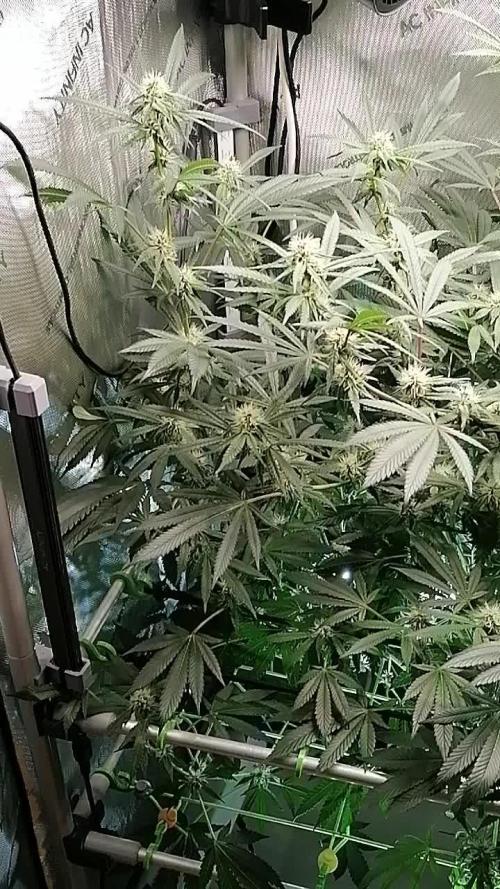
Beginn Woche 5 Blüte
Aktuell nix zu machen außer Gießen.
Ab und an kommen die Sonnensegel weg ansonsten läuft alles bestens. Strech scheint fertig zu sein und die Bud's legen langsam zu. Auch der erste Frost ist zu sehen🍀👍
Heute gab es auch wieder 3l Wasser mit Green Bull.
Bin noch immer am Überlegen nochmal einiges unten raus zu nehmen.. Aber will die Dame auch nicht allzusehr stressen..
Mal schaun.
Werte sind aktuell ca. 1000ppfd bei nem Vpd von 1.3kpa.