


Likes
Comments
Share


@CanadianFillmore
Follow
Start of week 7! Week 6 went really well. The Blue Dream has show the most signs of nute deficiency, but it hasn't gotten any worse. She's also very sticky, with dense buds that are starting to fatten up. This lady is on an 8 week schedule, removed big bud and added overdrive to the nute lineup.

Likes
3
Share


@zulya
Follow
j'ai commencé a ajouter des engrais à l'eau, en petite quantité. les feuilles commence à sentir légérement (un vrai plaisir 😀). Le climat est plutôt simple à maintenir, contrairement à ce que je croyais 1 l dans l'humidificateur sufit pour 1 journée. la Nothern light a un léger retard.
J'augmente doucement la quantité d'eau. Sur la stress killer il y a un bout de feuille qui est jaune, sans autre preuve de carence. pas d'insecte pas de moissisure 😃. ça a l'air de bien s'annoncer pour le moment.

Likes
4
Share

@Colonel_oCoQ
Follow
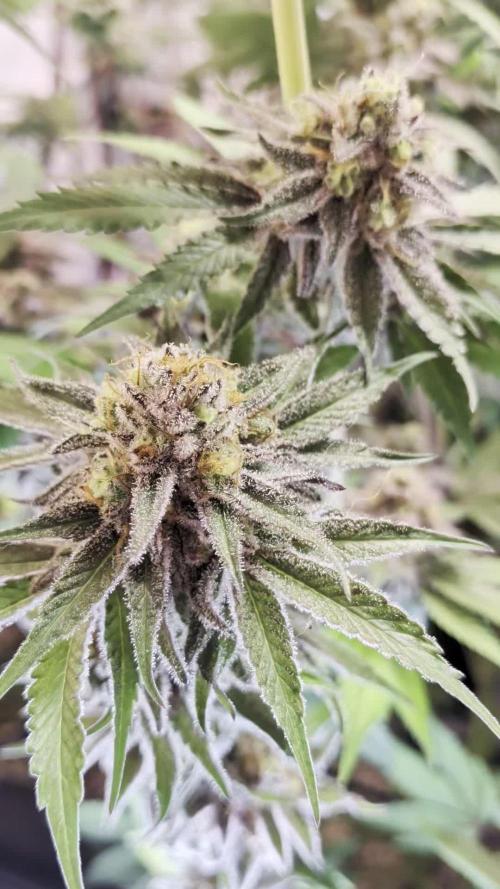
So the finals weeks for the Zillions and Cookie Casket. I already had to harvest 3 top- colas, they were ready. The rest needs a bit more days. After the AN Overdrive switch typically the flowers got new light pestilles, the second level 😅!
I let the PH drift now a lit bit more to 5.8- 6.0 for the last weeks. EC is around 1800-1850. Mimosa Evo will needs at least 2 weeks, maybe 3.😇
EC now down to 1722 as they are getting ready.

Processing
Likes
27
Share


@Silverback_Guerilla
Follow
2/4:
Photo session day!
The squattier of the two picked up a lot less of the sativa genes. She's gonna be shorter, but she's in a big hurry compared to her lankier sister.
The taller one, like most other sativa dominant strains I've grown, really doesn't like being fed so often. At this point, I'll probably just feed her every other feeding day, and on plain watering days I'll give her cal-mag and flavor/terpene enhancers, and maybe a little beastie bloomz.
I had a total infestation of Cattus (felis) which I documented in my photos. Eradication seems impossible, so I'm opting to allow a degree of predation, but hoping trichome production will, at least, deter them soon.😁
2/5:
I fed everybody today except these girls and my two #3's..they usually protest after a full-strength feeding.
I just gave them water with cal-mag, bembe, signal, humic acid, and a little Open Sesame. I also sprayed everybody down with Axiom harpin proteins for the last time today.
I made a DIY CO2 generator today using a 5 gallon cat litter bucket, a small aquarium pump, some air line tubing, and a bubble stone, plus
6 cups of sugar and 30 grams of wine yeast in 2 gallons of warm water. I put the tube where the CO2 is exhausted up against the back of the oscillating fan that aims down over the plants so they are being constantly forcefully bombarded with high levels of CO2(1300+ppm) from above.
I set the ac infinity controller to allow the temps to climb up to 89f before the fan turns on.
2/6:
These girls are a much lighter shade of green than anybody else in the garden.
I bought some Gro-Pro pot risers to elevate the pots so that they will dry out faster..seem pretty effective.
2/7:
Now they look deficient in N and K...ffs!
I'll go back to feeding them with everyone else, but will make up a batch of weaker nutes for them.
I foliar fed with big bloom and tiger bloom.
2/8:
I ordered a second 6" AC Infinity fan to connect to my controller, some ducting, and a diffuser which I'll mount to the wall, down near the floor. The fan unit will be in another closet, adjacent to the garden closet, and I'll run ducting up through that closet ceiling into the attic, with a filter on the end to keep bugs and particulates out.
For the next 6 weeks or so, it will provide a supply of colder fresh air. I did the math, and it will now only take about 1 minute and 40 seconds to completely exchange the air in the closet. Depending on the outside air temp at the time, it should take anywhere between 8 and 20 minutes for the closet to heat back up to 80f and the fans to kick back on again. This Spring, on days when it's not cooler than 72f, I'll disconnect the duct in the closet and stretch it into that bedroom, clipped to the window unit air conditioner output, cranked down as low as it will go. This Summer, I'm gonna just run a pair of the quantum boards and grow 4 or 5 autos in there, but this should help keep the temps cooler in summer as well, without dedicating an air conditioner to the grow op.🙏
2/9:
I foliar fed them with grow big, big bloom, and tiger bloom and checked moisture in their pots. They're due for a good watering tomorrow.


Likes
2
Share

@hinterhofgrower
Follow
.
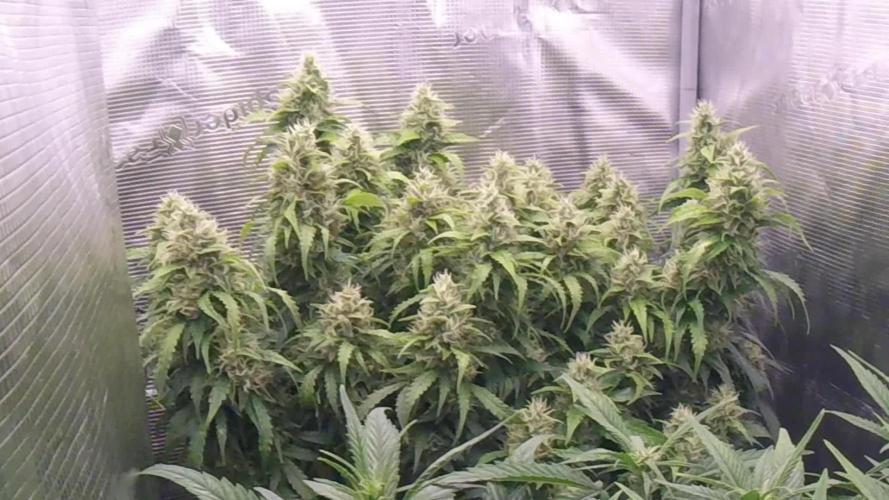
🌱 : test harvest on day 86, 40,3g, day 88 44,5g, day 90 54g, day 92, 60,6g, day 93 22,4g, final harvest on day 96 562,7g
💧 :
💡 :
🤔 :

Likes
18
Share


@FatCobra
Follow
The week went pretty well. I cut off a couple more fan leaves that were just looking pretty sad and were blacking the branches anyways.
Also, I transplanted it to the 2.2 gallon Airpot on Friday. It seems to be taking to its new home well. I think it was rootbound and that was part of the problem I’ve been having.
The plant grew 2 inches this week so despite the issues I’ve been having the plant is still growing and is actually looking pretty good again.
My main concern now is that the tent is too small. I have the light as high as the pulley allows and it is now about 12 inches away from the plant. I should have been training this sideways and topping it earlier. Lesson learned for next time, if I can’t control the height I may need to force flowering early.

Likes
13
Share


@KirbyFarm
Follow
The thickness on the stems is impressive this week. White hairs have started to show, and the top from last week started to form two main stems. I’m wondering if I topped them too late as I’m not sure how much taller they will become. I’m going to lst the split if they get taller.
Likes
6
Share

@ControlledChaos
Follow
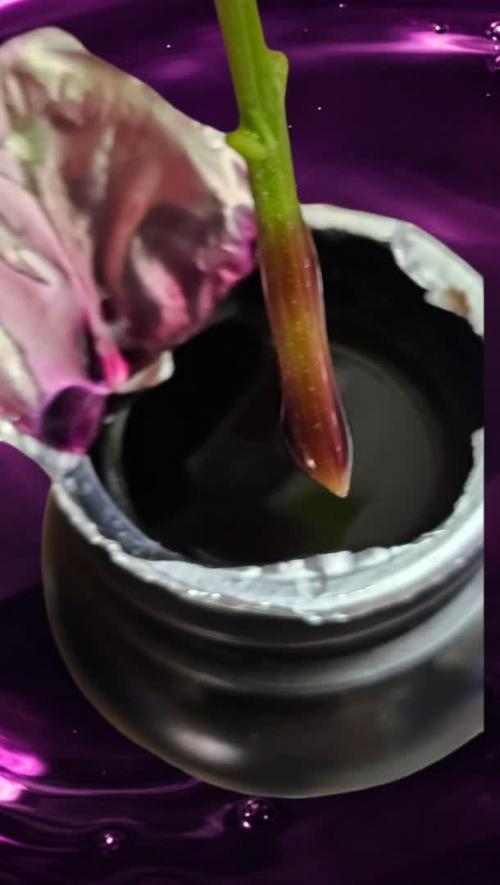
So this week we flipped to flower. Before I took some cuts. 2 from the most vigorous and one from the rest. At first they were ok. Then I turned on the heat map and opened the vent. They collapsed but not fully. I turned off mat and closed vent. I then put low nutrient water in my sprayer and missed the dome and them very lightly. They bounced back hard and are thriving! The plants from Pheno 1 which is at the last pic is most vigorous on the left. Has good spacing is a bit of a stretcher but I like that(more airflow). Pheno 2 which in last pic is back middle is somewhere between squat and a stretcher(we will see what she does this week. Stacking nodes well though. Pheno 3 is the one on the right the stretchiest and not as many nodes but we will see what she does(if she doesnt produce well I may not run her again(we will see maybe at least one more run with the clone I have but we will see). Pheno 4 is the runt of the litter but stacking nodes heavily! I think this may be the Rosin lady right here. Seems already a bit greasier then the others(not sure if that will translate into Rosin or if it may be too greasy?) Any way enjoy the pics. I am having so much fun. Hope you all are too in whatever you do. Thanks for stopping by!
Likes
4
Share


@Ajgrowsroom
Follow
Every thing is looking great. I didn’t get rid of all the nats but I got most I’ve been bottom watering and been replacing the sticky pad every couple days and it’s been working well. Thank god my wife talked me into these pots at the dollar tree. I can’t wait to see what’s next

Likes
4
Share


@DoItBigGrows
Follow
Waiting on my new Opulent Systems 3x3 to come in so I can get these two out of the 4x4.


Likes
9
Share


@PlumpPelican
Follow
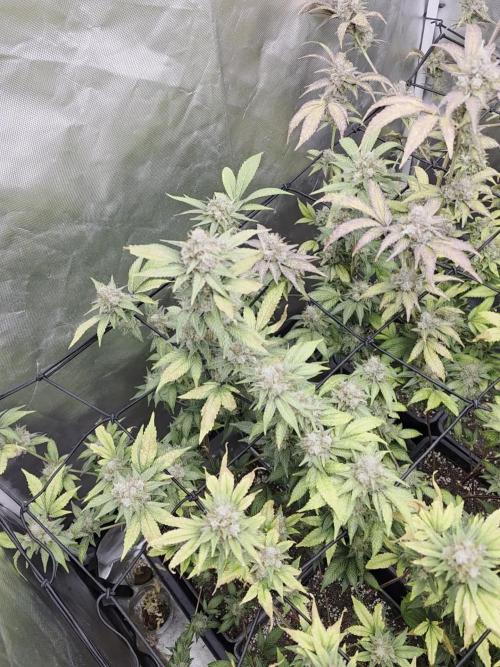
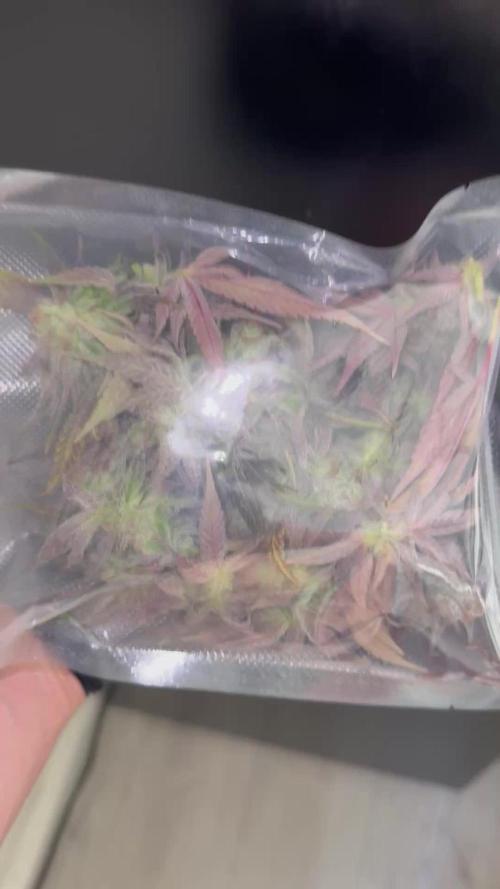
2-3 weeks left of flowering.
Buds are starting to bulge out on the sides and are very dense.
Only been getting a pine scent up until now, slightly skunky sweet smell starting to come through as well.





Likes
14
Share

@Erik99
Follow
Ya se puede ver el inicio de la preflora, se ha aumentado muy levemente la dosis de fertilizante y estimulador de flora, se puede empezar a ver el estirón de preflora.

Likes
26
Share


@olli0420
Follow
soo one was way more photogenic than the other,AGAIN. 😅 I'm proud of me😁😁
oh and how DOPE is the timelapse? 🤯🔥🔥🔥
Likes
28
Share


@DudeGrowsWeed
Follow
November 6, 2021
They are both still going. The Blackberry is starting to foxtail. I still don't see any amber trichomes and I have not seen the calyx's swell yet. These plants have 2 more weeks max. As soon as the photos are ready to flip to flower, I'm harvesting these autos - ready or not.

Likes
22
Share


@Unbreaker
Follow
In this week i had a very big problem. When trying to trellis a main branch too strongly, it broke. I immediately took zip ties to directly prevent the air from drying the trunk. I also had to put cling film to optimize the insulation. after days of stress for fear that ALL of its work will be lost, my plant has not said its last word and is still as vigorous as ever. It's amazing how a plant can regenerate despite problems like this!!!