


Likes
Comments
Share

@00000000000001c
Follow
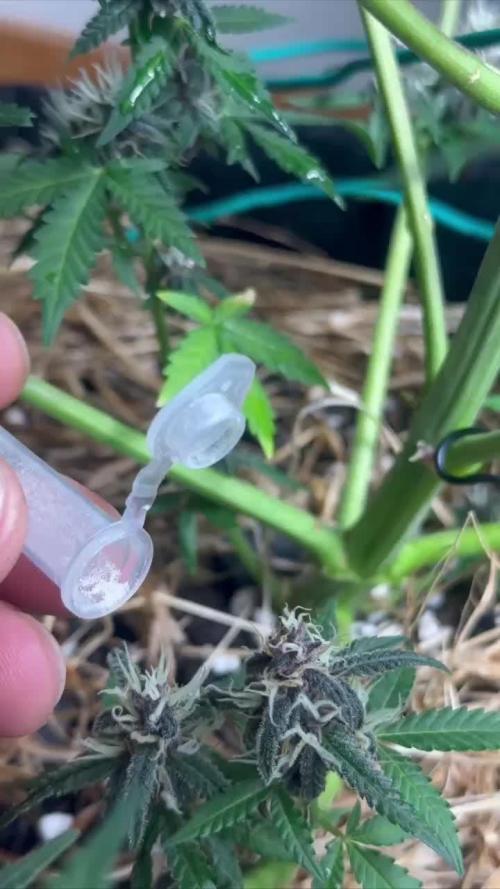
конец 6-й неджели цветения. Растения выглядят лучше чем я ожидал))) сначала про Soure Rot Candy, соцветия огромные и плотные, запах фурктовый, прям ярко выраженный. теперь про Frost banger, соцветия, не такие плотные, но они по своему прекрасны, фиолеттовыйц оттенок это нечто)) запах сейчас уже такой резко ядовитый, в целом растение выглядит тоже отлично, Это растение я решил немного опылить, проццес и развитие видно на фото/видео, были опыленны только нижние несколько соцветий.
так же последний полив удобрениями произошел, дальше чисто водой. 😍😍😍

Likes
2
Share


@SamDo
Follow
Journal de culture – Semaine 4 de croissance (fin)
Je ne suis vraiment pas satisfait de la plante, que je trouve faiblarde et manquant de vitalité. Son développement est lent, et je suspecte que la température, qui descend peut-être trop bas la nuit, pourrait en être la cause. Cependant, même le pied-mère de cette variété n’a pas une croissance exceptionnelle, ce qui me fait penser que le phénotype de cette variété n’est peut-être pas très bon.
Pour ne pas perdre trop de temps, j’ai décidé de la passer en floraison aujourd’hui, avec un cycle de lumière 12-12. J’ai également changé la soupe et préparé 20 litres avec les nutriments nécessaires à la floraison. Sachant que cette variété a tendance à beaucoup stretcher, j’ai pratiqué du LST (Low Stress Training) pour recourber les sommités. Cependant, j’ai accidentellement cassé un apex, laissant seulement trois apex au lieu de quatre.
Bien que je ne sois pas satisfait de cette plante ni du pied-mère, je vais finaliser cette culture et passer à une autre variété ensuite.
🇺🇸Cultivation Journal – Week 4 of Vegetative Growth (End)
I’m really not satisfied with the plant; it seems weak and lacks vitality. Its development is quite slow, and I suspect the nighttime temperatures might be dropping too low. However, even the mother plant of this strain doesn’t show great growth, so I’m thinking the phenotype might not be very good.
To avoid wasting more time, I’ve decided to switch it to flowering today, setting the light cycle to 12-12. I also replaced the nutrient solution, preparing 20 liters with the ingredients required for flowering. Knowing this strain stretches a lot, I applied LST (Low Stress Training) to bend the tops. Unfortunately, I broke one of the four apexes, so now there are only three left.
Even though I’m not happy with this plant or the mother plant, I’ll finish this grow and move on to another strain afterward.

Likes
16
Share


@Mrg7667
Follow
Major defoliation/ lollipoping that happened this week right on day 20 my main concern was looking for more hermies (due to stem cracks from lst) and also cut out any lower branches that where going to make larfy buds.
I only cut up the branches untill the point that the budsites where at least a nice pistil cluster (10and up ) some branches got a good 6-7 inches shaved off some more like 2-3 just depends on the plant with so much variety. Also my plants are like touching the lights it just wont let me mark less then 4inches i have the ability to raise my light another 2inches so i will definitely be doing that. For now i have the taller branches off to the sides so the can outgrow the light without burning.
Smells finally starting to come in with more gassy earth coming from DD and devine chocolate GG4 smell coming from the mellows
Still see some nitrogen toxicity not sure if should cut all nutes in half considerIng week three biogrow increases to 3ml/L

Likes
40
Share


@xbrico
Follow
Day 50 - All still ticking along nicely. Tank topped up the other night...think I am starting to see the 1st signs of Stretch, 1 week in to 12/12 (well, for the 1st few days it was more 12.25/11.75 but its adjusted now.
Now just tucking and weaving the canopy and attempting to keep things even(ish).
Refreshed the CO2 Milk Jug and thats about it for today.
Enjoy the time lapse of last week (!st week of 12/12).


Likes
19
Share


@Yessi_squeeze
Follow
All same strain but growing differently due to different environments. Humidity issues resolved with dehumidifier. Runt had to be pruned and still so many buds. Single GG in tent is short and stocky ... Nice crystals. They smell wonderful.


Likes
27
Share


@Ganjagrandaddy
Follow
Day 76 Flowering: Ir seems we have a longer flowering pheno of the mimosa Lemon !!.
She is a huge bushy, heavy calyx laden monster!!.
It has been a roller coaster so far with this pheno of the strain. Watching the huge explosion of growth in the stretch period was amazing and I expected huge thick donkey dick colas like grows of others had shown so i was dissapointed for the majority of the flowering period with how she was progressing. Loose, Berry like patterns were all over the long stems so i knew it would be a "wait and see" ending but I now see the potency and beauty of these ripening classy looking queens. Up close ,her colours are really varied and bright with purples, reds, greens and the ripening fire brown pistils. I do not begrudge her another week flowering now and expect she will benefit from it .
Her smell is potent lemon/fuel now and very strong. Hopefully she will finish soon.
Be safe and well ..
Likes
50
Share


@crimsonecho
Follow
well everything is going alright.
nothing to complain about.
destroyers are getting a lighter shade in the new growth but still pretty much healthy, just a more natural sativa color.
maybe around this time i could have thought about topdressing but i’m more inclined to let them go on with straight water just to see how this mix runs till finish with just water and no extra inputs. though who knows i may just decide to topdress tomorrow haha
others seem happy and healthy as well. watered the dinachem pot yesterday with about 4l of distilled water and destroyers got 4l each 2 days before that. caribe and cannalope pot is still pretty heavy.
see y’all next week
edit; yesterday we had a blackout so timers were set back an hour so i guess when i opened the tent today light had just turned on because they were holding a less intense praying pose so just checked back 3 hrs later now and looks fine now. added those photos as well.


Likes
2
Share


@UrbanBoer
Follow
The most difficult strain to grow this cycle, I do not know whether it’s due to the irrigation of the pot she resides in, causes this slow growth, and making matters worse nearly fried her with nutrients, so I flush but it turned out I was overwatering with the flushing, so I have allow it dry up a bit and incrementally flush due to the slow drainage from this pot, though she revegged I will not add nutrients, since she’s this far in her flowering phase, I don’t want to risk not having enough time to flush before harvest.
Likes
52
Share


@UnorthadoxDude
Follow
Hello all and welcome to the much anticipated beginning of vegetation for these five Epsilon F1 Autos from Royal Queen Seeds.
Allow me to introduce Ally, Normani, Lauren, Dinah, and Camila. All five girls have pushed put their 2nd node (3 fingers) and node 3 is on the way out. I expect all five girls to take off from here, and so the next seven days are going to be big.
I will start fertigation today.
For comparison purposes the Day 1 here means Day 1 of veg. For Ally, Normani, and Lauren this is day 11 since breaking ground, for Dinah day 10, and for Camila it is day 9. For the rest of this grow I will increment days from here but it's really easy to work out days since breaking ground as it is a simple matter of day + 10, 9, or 8 respectively.
Day 1: Fertigated 2l.
Day 2: Right ok. Can you actually believe this response in 24h? The poor girls were STARVING. Wow look at the change in color! Wow look at the growth!! Ally is most advanced, Camila least. It is fascinating so see them develop! They are growing faster and faster now.
So let us talk about the elephant in the room a little bit. Phenotypes. At the moment there is absolutely no evidence to suggest that this crop will be anything other than uniform. Nevertheless there are some clear differences in some of the girls. So let's have a look shall we:
Ally (center), Normani (closest to the middle purple basil), and Lauren (opposite side to Normani): These three girls are not quite identical, but it is a pretty challenging game of spot the difference.
Dinah: Okay so Dinah is coming in noticeably darker than her sisters, with a little more tendency to claw, and with quite a bit larger and more angular serrations. Her first leaves are also a different shape.
Camila: Little Camila had a twin, but I killed her with some overzealous tweezing before I realised what I had. She came in with only one cotyledon, and she came in last. Her first leaves are quite different to the rest of Fifth Harmony. She is also showing slighty more narrow leaves. She is lastly also very slightly more pale than her sisters.
Are these phenotype differences? I mean in terms of the environment, feeding, watering, substrate, temperature, light, airflow... well these girls are all in the same pot, so unless I am particularly haphazard in my mixing and fertigation (which I can assure you I am not) I do not think it likely that these ladies have significant enough environmental difference to account for these quite clear visual differences. I am absolutely fascinated to continue to witness this, and it has only now occurred to me what a great privilege it is to be able to grow the world first F1 cannabis hybrids, and what an astounding honor to be one of the very first hobby growers to do so! The fact that RQS made this happen by not only supplying the seeds and other merch and goodies, but also sending expedited international shipping so as to fit within my arbitrary timescales is almost unbelievable. When these guys (on their website) say that it is their belief and mission to forge the path to worldwide legalisation, they are not hollow corporate whispers, it is their core of being. Cannabis everywhere is truly blessed to have such a worthy and proactive ambassador. Bravo RQS!
I have adjusted the timer such that the main tent is now getting 20/4 upped from 18/6. After monitoring DLI at 18/6 for a week I am unhappy with the overall level but because of the varying heights of the plants I am limited in what I can do in adjusting the light height. Some areas were only getting 20 DLI. So I have rearranged to have the taller plants on the edges and the lowest in the middle and doing it this way all plants are getting between 35 and 50 DLI at 20/4 - although one or two cola tips here and there are getting 55. Will monitor for a week.
Day 3: Well look at this growth again!! These ladies have responded to feeding really well. Fertigated 3l.
Day 4: Growth is accelerating fast, these ladies will be ready for their first training soon. I am starting to formulate an idea what to do. I am thinking of topping Ally and LST on the rest.
Day 6: Fertigated 3l. Ladies growing fast now. Will soon be time to start training. However! The secondary nodes are developing strongly. Hmmm
Day 7: Fertigated 3l. Defoliated the three fingered leaves from Ally and tucked the five fingered under other plants.
End if week summary: Well when they said "hybrid vigour" they were not joking. Look at day 1 and day 7 side by side after approx 6 days into veg growth. Wow.


Likes
7
Share


@Skull
Follow
Flipped them to flower approximately 6-7dsys throwing hairs shitty camera on my phone never grown Auto before but these two ladies are performing more like photo period the older they get. Gave up on them automatically going to flower switch to 18/6 six days ago finally seeing signs of flowering from the research I've done I believe because I'm growing DWC format which atones to there size any comments would be appreciated

Likes
179
Share


@Grow3rPT
Follow
Total de dias 29 - 31/08/2021 ( Mais um dia e vou mudar para floração.) Faco 30 dias de vegetação
Total de dias 30 - 01/09/2021 / Rega ( mudança de horário para 12/12 fase de Floração )
( Fase de Pre-Floração )
Total de dias 31 (F 01) - 02/09/2021
Total de dias 32 (F 02) - 03/09/2021 / Rega com 1ml de Bloom
Total de dias 33 (F 03) - 04/09/2021
Total de dias 34 (F 04) - 05/09/2021 / Rega apenas com agua
Total de dias 35 (F 05) - 06/09/2021

Likes
31
Share


@Dirty_Hippy
Follow
Sherbert Creamsicle is down!!!
Small buds, but lots of them.
BMX is just BEASTING away with arms of power. The resin is insane on these ladies.
She's beginning to slow and ripen now. No more nutrients, just a weekly worm casting/molasses tea to keep my soil healthy.
Likes
17
Share


@Elpicor
Follow
D15
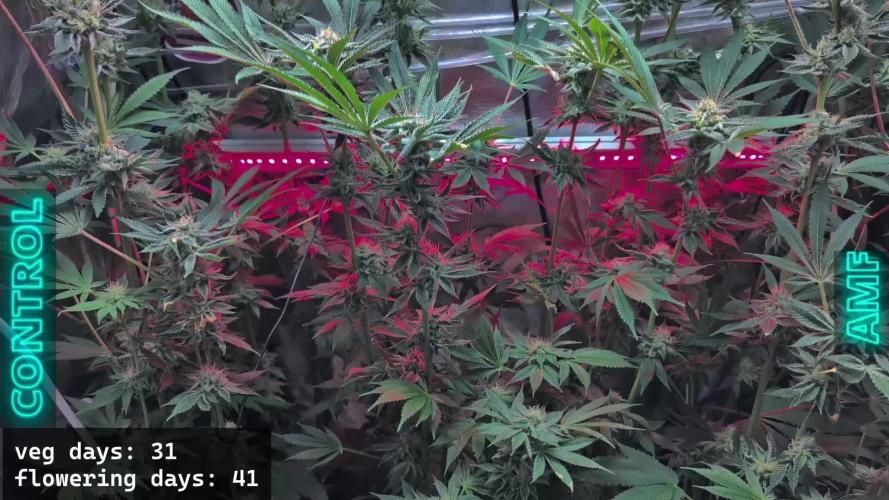
Today I come back home after 24 hours and found the living room foggy, I had to open the windows wide, the temperature in the growbox was 32 degrees and the humidity at 79%... -> ( temperature and umidity was set to all time range, so values is not of this season).
-> I will follow your advice and only apply LST to keep them low THANKS GROWERS!
D 17
I've feed all plants with 1 ml of Algamic/Activera and 0.5 ml of bio heaven.
I do love stress training 😂 for orange sherbet which is the tallest one
D 18
Orange Sherbet loves training, today LST also for Purple Lemonade and Strawberry Gorilla
D 20
Future space problems are expected, I think I have to switch to the 1x1x2 MT growbox, spring is upon us I could always put a couple outside, we'll see what I feel like doing


Likes
8
Share


@Growin_Ish
Follow
Candace hasn't recovered from overwatering. The pot is very light / dry, but the leaves still droop. They aren't crispy, discolored, curling, or taco, just droopy. I'm concerned if I let the pot dry completely it will force the microbes to go dormant and the short flower cycle may never catch up. She has the perfect structure to be a monster but this leaf drooping is not helping at all! She doesn't even need LST!
Sheryl looks to have recovered fine but is much smaller and bushier than Candace.
I skipped the preflower top dress because this strain has a 4 week flower cycle. I'll keep feeding them SimPro once a week. If I top dress, I'll never be able to get a good fade on these.
Day 36
Bottom watered both with plain PH water.
Day 37 - Both liked the bottom watering. Candace is 9" Sheryl is 11.25".
LST the side branches on both.
Day 41
The leaves had bounced back, but are now droopy again, which tells me they're thirsty. I have two small lower leaves on both plants show PK deficiency, so they're hungry too.
Whipped up a tea using Roots Organics Terp Tea Bloom, Azoz, & Simpro Bloom. Each got 1Ml of Fish Sh!t & CalMag.

Likes
10
Share

@Jardin33ro
Follow
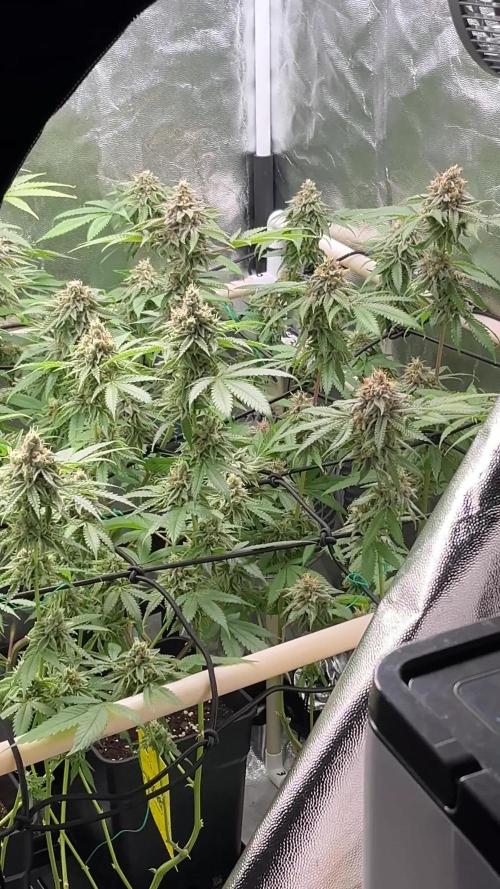
Buenas! Ultimas semanas, ya pasamos al overdrive y tratare de ir bajando la fertilizacion de a poco. Se ve el engorde, se ve el aumento de resina y el olor va cambiando un poco con respecto a semanas anteriores. Vamos a tratar de mantener temp baja y humedad controlada ( 24° C y 60-65 HR) pero no es tan facil, se acerca el verano y sin aire acondicionado todo el dia encendido es complicadisimo. Pero yo soy casero, hacemos lo que podemos con lo que tenemos. Disfruten de las toronjaz como yo lo hago, deleitense


