Likes
Comments
Share
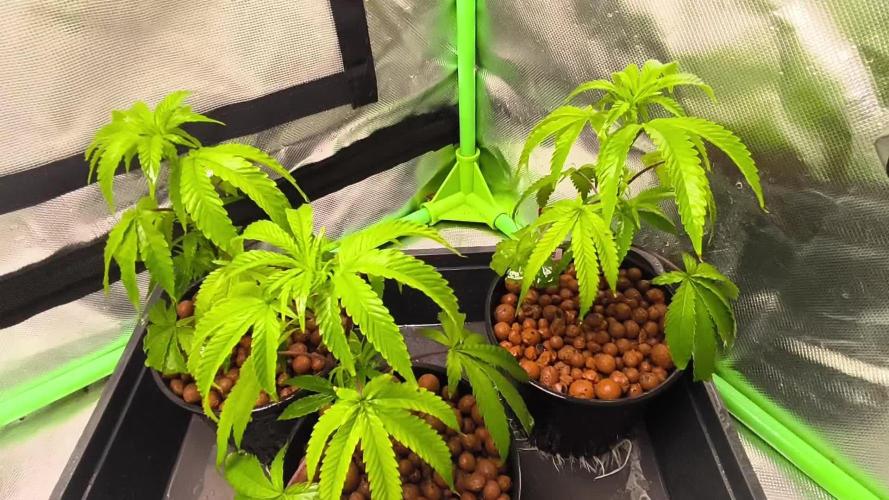
Die Lemon-Cherry-Mintz-Steckis von Manny entwickeln sich prĂ€chtig und fĂŒllen ihre Töpfe mit weißen Wurzeln. Das DĂŒngeschema der Vegetationswoche 3+ haben sie dankbar angenommen und sind jetzt fleißig am Wachsen. Seitentriebe und Wuchshöhe sind etwa gleich wie bei den anderen Sorten, ausgenommen der Ice Cream Runtz. đŸ‘» Gegossen und gesprĂŒht wird 2 bis 3 Mal am Tag. Die Pflanzen haben Bock endlich loszulegen, daher steht der Umzug kurz bevor. NĂ€chste Woche geht's in die Aeroponik-Anlage. Um den erneuten Transplant-Stress zu nutzen, werde ich ihnen wohl zeitgleich den Kopf abschneiden (Topping). 😇
Likes
65
Share
@Dedon
Follow
Hi everyone ! Everything's is OK. Roots are still growing for second Tank. Plants in First tank have nice roots, i think they are ready to switch in bloom. i give a few day for the second tank and i'll start flowering 😁
Likes
4
Share
@Hommero75
Follow
This week the ladies are doing great they are still stretching. The Blooming process is going well.. the smell coming out of the tent is great. Is a combination of sweet and sour between all three. Tropicana Cookie smell a little woody Banana Purple smell sweet Forbidden Runtz smell a little citrus
Likes
371
Share
D43. The first day in the first week of flower, and everything is great in the tent. The girls both look healthy, vibrant, and strong. I transplanted the clones into small pots, and they are now waiting to go to new homes as I won't keep any of them due to lack of space. ------------------------------ D45. All is well in the tent, and the girls are already stretching after flipping. I moved the fans to get them out of the way. Space is always an issue. #JustSmallTentProblems I am still dialing in the drip system, so it's working correctly before I go on vacation. I also removed the mushroom growkit from the tent as no mushrooms have grown so far. I'll wet it again and see what happens. ------------------------------ D47. The girls are looking fantastic. They are vibrant and healthy, and pray hard with their leaves toward the light. They have already stretched a fair bit, and the branches are also fattening up. I did medium defoliation below the scrog by removing most leaves and branches that won't make it up to the light. I left a few shorter branches to see if they'll make it up into the light. Finally, I gave them a fulvic foliar spray just before lights out. As we're heading into flower, I suspect this was their last foliar feed. Though I might do one preventative IPM foliar spray. I haven't had any problems so far, but just in case. Easier to prevent a problem, than to solve the problem. ------------------------------ D49. The end of the first week of flower, and the girls are just rocking the tent. However, I need to address the RH, as it is a bit high for flower. Yesterday, the entire tent was without power for five hours, so there was no light or exhaust. Fortunately, one of the circulation fans has a built-in battery and at least kept moving the air around. ------------------------------
Likes
22
Share
@Kirsten
Follow
Northern lights is looking a little bit sorry for itself. Unfortunately, she was leaning really heavily towards the ground. So I decided that I was going to use some metal garden pegs to prop her up with. She seems to be doing well in that respect now. The leaves are looking a little bit crazy. I'm not sure what's going on with that, but hopefully, she'll start growing, and she'll grow out of it. I guess we'll have to wait. And see what happens. I have added an additional 100Watt UVA/UVB lamp, as the uppermost canopy of Acapulco Gold is blocking pretty much everything in the tent. Hopefully, this will aid the shorter plants in surviving until I can harvest it. There will be so much more space and lighting. Can't wait! 😅 Here is what I did this week. 25.9.25: I watered with 1.5L of dechlorinated water PH'd to 6.5 with; 💜 Sea K PH: 6.5 PPM: 565 The fungus gnats have really increased since I did a watering of the whole tent. I have some more sticky traps set out, and I will not water for several days. Once it has dried the top soil, I will add some more Diatomaceous Earth to the top 5cm. Thanks for checking in this week, and see you in the comments 👌💚🙌🧡😁
Likes
9
Share
End of week 1 veg and the Strudel is looking good!!! Strong healthy growth. She's a little ripper! Have done nothing so far except add some nutrient water to the base.
Likes
11
Share
Welcome back in the 8th week of flowering with Dutch Passion’s Colorado Cookies. She is ripening good, buds are rock solid and covered in trichomes, such a beauty. The smell is exactly what I hoped for, the Cookies characteristic as we all know from the GSC. Last Sunday I gave her the last bits of nutrients, so this week is flushing till Sunday, Sunday will be harvest day!! I noticed that this one Colorado Cookies less to almost non purple than the rest, since most of the GSC genetics do have purple in them. But it doesn’t matter im happy with how the buds look and smell. Cant wait to have a taste! After this one is cut down ill put the other 2 cookies straight in the flower room for at least 1 week maby 2 depends on how well they will perform in there. My next grow will take place first or second week of December, in the meantime I will chooce a new strain to grow and prepare the next grow. This time I will perfom my first real ScrOG and combine it with the airdome underneath my pot (they say you can improves your yield by 20-30%). So it got my attention and im very curious about the results. That’s it for now see you all back on Sunday harvest day!!
Likes
18
Share
Chopped her wet trimmed her now waiting till it dries lil nugs that I cut off to dry faster to get a taste and effect test she smokes beautifully ands she tastes like mango
Likes
32
Share
@Borberad
Follow
Die erste Woche der BlĂŒte beginnt. Habe die Clips entfernt und wir versuchen uns mal mit unserem selbst geknoteten Netz. Mal sehen wie wir damit zurecht kommen. Die Pflanzen erscheinen noch recht klein fĂŒr die FlĂ€che, gehe aber davon aus, das Netz noch in der ersten Woche fast vollstĂ€ndig zu fĂŒllen.
Likes
12
Share
Day one of the 14th week was October 24th. The trichomes on the small bud leafs are still clear resin. The hairs are about 70% dark and many are receding back toward the bud. Harvest time is getting close.
Likes
6
Share
Cash Express 03.01.2025 Tag 51/ 26.2.2025 FĂŒr die zwei Cash Express hat die 7 Woche begonnen. Heute, werde ich sie neu zurecht Binden (LST), damit sie ihre gewĂŒnschte Form erhalten. Feedback: Cash Express um 9:00 Uhr gebunden!
Likes
172
Share
Laughing Buddha – Woche 22 | BlĂŒtewoche 7 Diese Woche stand ganz klar unter dem Motto: ZurĂŒck zu den Wurzeln – beziehungsweise zurĂŒck zu Hesi. 😅 Nachdem sich die Probleme mit dem Green House Feeding inzwischen lange genug durch den Grow gezogen haben und ich bei meinen Autos ein sehr Ă€hnliches Bild gesehen habe, ist fĂŒr mich die Sache mittlerweile ziemlich eindeutig. Unter meinen Bedingungen scheint das Zeug einfach nicht schnell genug verfĂŒgbar zu werden. Die Buddha hat zwar ordentlich Futter im Topf, aber offenbar nicht dann, wenn sie es braucht. FĂŒr mich war damit endgĂŒltig Schluss mit dem Experiment – Hesi kommt zurĂŒck ins Spiel. Beim Gießen war zuletzt durch unsere Renovierung außerdem etwas der Rhythmus durcheinander geraten. Eigentlich hatte ich den 45 Liter-Topf mit tĂ€glich etwa 5–6 Litern ziemlich gut im Griff. Diese Woche bekam sie dann wieder eine ordentliche Ladung und der Bodensensor zeigte schön, wie sich das Wasser anschließend im Topf verteilt hat. Direkt nach dem Gießen war die obere Zone erwartungsgemĂ€ĂŸ deutlich feuchter, einige Stunden spĂ€ter hatte sich das Ganze wesentlich gleichmĂ€ĂŸiger nach unten verteilt. Auch der gemessene EC im Substrat ist nach der Hesi-Gabe etwas angestiegen – genau das wollte ich erstmal sehen. Und trotz des ziemlich mitgenommenen Blattkleids macht die Buddha einfach weiter. 😅 Von oben sieht das Dach inzwischen zwar ziemlich hell aus und gerade weiter unten verabschiedet sich einiges an Laub, aber die BlĂŒten erzĂ€hlen eine ganz andere Geschichte. Die Colas legen sichtbar weiter zu. Mittlerweile stehen ĂŒber die komplette FlĂ€che unzĂ€hlige kleine und grĂ¶ĂŸere TĂŒrme, viele davon schön kompakt und ordentlich mit Harz ĂŒberzogen. Gerade aus niedriger Perspektive sieht man inzwischen richtig gut, wie weit die Buds teilweise am Trieb herunterreichen. Einige der grĂ¶ĂŸeren Colas entwickeln sich langsam zu richtig schönen Kloppern. đŸ€€ Was mich dabei momentan am meisten beruhigt: Die Pflanze wirkt trotz ihrer Vorgeschichte nicht so, als wĂŒrde sie gerade zusammenbrechen. Die verbliebene Blattmasse arbeitet, die Buds entwickeln sich weiter und ĂŒber das gesamte 120×120-GerĂŒst ist weiterhin ordentlich Leben vorhanden. Nach all dem Theater der vergangenen Wochen hĂ€tte das definitiv auch anders aussehen können. Damit ist meine Aufgabe fĂŒr die nĂ€chsten Wochen eigentlich ziemlich simpel: Nicht mehr experimentieren. BewĂ€sserung wieder sauber im Rhythmus halten, mit Hesi kontrolliert weiterfĂŒttern und die Buddha möglichst störungsfrei ihren Job machen lassen. Denn auch wenn sie vielleicht keinen Schönheitspreis mehr fĂŒr ihr Laub gewinnt – beim Blick zwischen die Netze wird langsam ziemlich deutlich, wofĂŒr die ganze Arbeit draufgegangen ist. 😅 Eine Pflanze. 45 Liter. 120×120 cm. Und mittlerweile ein verdammter kleiner Wald aus Buds. 🌳😎 Mal schauen, wie fett die TĂŒrmchen in den nĂ€chsten Wochen noch werden. đŸ€—
Processing
Likes
24
Share
Ya tenemos esta segunda semana de la Purple Kush Feminizada del banco de KannabiaSeeds y la verdad es que va super bien, esta creciendo de lujo y espero que siga asi đŸ’Ș😍
Likes
5
Share
@Mattyice
Follow
Man. 12 hours trimming fuck man and I'm moving on to photos now lmao I don't even know what I'm getting myself into. My goal into this venture was to learn how to grow weed ,not only for myself, but just as good as dispensaries do too. And with the way this plant turned out I gotta say I'm really getting somewhere. The resin on the plant was incredible. I kept scraping off my pruning shears with a razor and making little hash balls I'm gonna throw in a blunt later. And the smell! Oh God it's so strong when I was trimming I swear I was getting a temporary buzz just inhaling it constantly I loved it and the smell. Almost like a fruity cat piss type of smell wonderful. Will be adding a pic of root ball in the morning after a well earned night's sleep lmao
Likes
21
Share
Fun little grow, but battled with WPM early on. I'm sure the flavors are buzz is similar to last grow of this strain.
Likes
44
Share
For LIQUIDS & NUTES ******GREEN BUZZ NUTRIENTS***** organic. Also i’m using their LIVING SOIL CULTURE in powder form! MARSHYDRO â›ș has large openings on the sides which is useful for mid section groom room work. đŸ€© ☀ MARSHYDRO FC 3000 LED 300W 💹MARSHYDRO 6” in-line EXTRACTOR with speed-variation knob, comes complete with ducting and carbon filter.
Likes
2
Share
? Blueberry Muffin – Pheno A Week 5 | The Beginning of Automation Some weeks are about explosive growth. Others are about building the foundation for everything that comes next. This week was definitely the second. Blueberry Muffin Pheno A has officially entered that fascinating transition where vegetative growth begins to merge with the first signs of flowering. The structure is now well established, side branches are reaching confidently toward the canopy, and every day she looks a little less like a seedling and a little more like the productive plant she’s destined to become. One of the biggest milestones this week wasn’t something the plant did
 It was something I changed. âž» đŸ€– Welcome to the AutoPot System This week Pheno A officially moved onto the AutoPot irrigation system. For anyone unfamiliar with it, an AutoPot is a passive watering system that feeds plants from the bottom rather than from the top. Instead of watering every day, a reservoir supplies nutrient solution through tubing to an AquaValve located underneath each pot. The AquaValve is actually the clever part of the entire system. Rather than continuously flooding the tray, it works like a mechanical float valve. As the tray empties and the plant consumes the nutrient solution, the valve automatically opens and refills the tray to a precise level before closing again. No electricity. No timers. No programming. Just simple engineering allowing the plant to decide when it’s ready for another drink. The result is a much more consistent root environment while eliminating daily hand watering. âž» đŸŒ± Learning a New Way to Grow Whenever I introduce a new piece of equipment, I don’t simply install it and hope for the best. I observe. I adapt. I learn. Because the nutrient solution now remains inside a shared reservoir, I also adjusted the feeding program. Some additives that perform wonderfully during hand watering aren’t ideal when they remain sitting in a reservoir for several days. For that reason, Sugar Royal and Power Roots were removed from the reservoir while continuing to use the remaining Plagron nutrients that are perfectly suited for AutoPot cultivation. It’s a small adjustment
 
but one that helps keep the nutrient solution cleaner and more stable throughout the week. âž» 🌿 Growth Update Blueberry Muffin has responded beautifully. Internode spacing remains tight, the branching continues to develop evenly, and the canopy is beginning to spread naturally without forcing the plant into shape. The side branches that only recently sat beneath the canopy are now confidently pushing upward, creating the framework that should support numerous flowering sites over the coming weeks. The bird’s-eye photographs really show how symmetrical she’s becoming, while the side profiles reveal just how quickly those secondary branches are catching up. It’s one of those moments where you stop looking at individual leaves and start seeing the architecture of the plant itself. âž» đŸŒĄïž Environment The room continues running intentionally warm. Day temperatures reached around 31°C while relative humidity averaged approximately 72%. Normally those humidity numbers might raise eyebrows during flowering. However, this is still the very beginning of bloom, where maintaining higher humidity encourages vigorous growth, active transpiration and continued expansion before the flowers begin stacking seriously. As flowering progresses, humidity will gradually be reduced to create a safer environment for dense buds while maintaining an appropriate VPD. Everything is part of the plan. Nothing is accidental. âž» đŸœïž Feeding This week’s reservoir was prepared using: ‱ Terra Grow – 1.8 ml/L ‱ Terra Bloom – 1.9 ml/L ‱ Pure Zym – 1 ml/L ‱ Power Buds – 1 ml/L ‱ pH adjusted to approximately 6.05 ‱ EC around 1.83 mS/cm By keeping the solution simple and reservoir-friendly, the AutoPot system can do exactly what it’s designed to do—deliver a consistent nutrient profile every time the AquaValve opens. âž» 📾 This Week Behind the Lens The photographs this week tell the story perfectly. Bird’s-eye shots reveal a beautifully balanced canopy beginning to fill its space, while the side views highlight strong vertical development and excellent branch formation. One image captures the AquaValve itself—the tiny mechanical heart of the AutoPot system quietly doing its job. Another shows the reservoir that now feeds the plant automatically, reminding us that successful growing isn’t always about adding complexity. Sometimes it’s about making things simpler. âž» 🔍 Looking Ahead Next week should be incredibly exciting. With the AutoPot system now fully active and Blueberry Muffin comfortably settled into automated feeding, I expect vertical growth to accelerate as flowering becomes more established. The coming days should reveal the first real stretch, increased flower development, and an even more defined canopy. The real show is only just beginning. âž» 💚 Thank You A huge thank you to everyone following this adventure—from day one supporters to those who have only recently joined. Whether you’re here to learn, share ideas, ask questions, cheer the plants on, or even challenge my methods, every interaction helps make this diary a better place for growers around the world. Special thanks to: 💚 GrowDiaries for providing a platform where growers can document their journeys openly. Zamnesia for the incredible Blueberry Muffin genetics that continue to impress with their vigor and structure. đŸŒ± Plagron for supplying the nutrition and soil that keep these plants thriving. 💡 Future of Grow LED for delivering the light that drives every stage of development. And finally
 Thank you for taking the time to follow along. Every comment, every question, every bit of encouragement—and yes, even every constructive criticism—helps this project grow alongside the plants themselves. Growers Love and see you next week, where I hope Blueberry Muffin begins to show us exactly why she’s earned her place in this 8×8 adventure. đŸŒ±đŸ’š
Likes
45
Share
My homework. Rubisco regeneration is intrinsically linked to nitrogen supply because Rubisco is a major sink for nitrogen in plants, typically accounting for 15% to over 25% of total leaf nitrogen. The regeneration phase itself consumes nitrogen through the synthesis of the Rubisco enzyme and associated proteins (like Rubisco activase), and overall nitrogen status heavily influences the efficiency of RuBP regeneration.Structural Component: Nitrogen is an essential building block for all proteins, and the sheer abundance of the Rubisco protein makes it the single largest storage of nitrogen in the leaf. Synthesis and Activity: Adequate nitrogen supply is crucial for the synthesis and maintenance of sufficient Rubisco enzyme and Rubisco activase (Rca), the regulatory protein responsible for maintaining Rubisco's active state. Nitrogen deficiency leads to a decrease in the content and activity of both Rubisco and Rca, which in turn limits the maximum carboxylation rate, Vmax, and the rate of RuBP regeneration Jmax, thus reducing overall photosynthetic capacity. Nitrogen Storage and Remobilization: Rubisco can act as a temporary nitrogen storage protein, which is degraded to remobilize nitrogen to other growing parts of the plant, especially under conditions of nitrogen deficiency or senescence. Nitrogen Use Efficiency (NUE): The allocation of nitrogen to Rubisco is a key determinant of a plant's photosynthetic nitrogen use efficiency (PNUE). In high-nitrogen conditions, plants may accumulate a surplus of Rubisco, which may not be fully activated, leading to a lower PNUE. Optimizing the amount and activity of Rubisco relative to nitrogen availability is a target for improving crop NUE. Photorespiration and Nitrogen Metabolism: Nitrogen metabolism is also linked to the photorespiration pathway (which competes with carboxylation at the Rubisco active site), particularly in the reassimilation of ammonia released during the process. To increase RuBisCO regeneration, which refers to the process of forming the CO2 acceptor molecule Ribulose-1,5-bisphosphate (RuBP) during photosynthesis, the primary methods involve optimizing the levels and activity of Rubisco activase (Rca) and enhancing the performance of other Calvin-Benson-Bassham (CBB) cycle enzymes. Biochemical and Environmental Approaches: Optimize Rubisco Activase (Rca) activity: Rca is a crucial chaperone protein that removes inhibitory sugar phosphates, such as CA1P (2-carboxy-D-arabinitol 1-phosphate), from the Rubisco active site, thus maintaining its catalytic competence. ‱Ensure optimal light conditions: Rca is light-activated via the chloroplast's redox status. Adequate light intensity ensures Rca can effectively maintain Rubisco in its active, carbamylated state. ‱Maintain optimal temperature: Rca is highly temperature-sensitive and can become unstable at moderately high temperatures (e.g., above 35°C/95F° in many C3 plants), which decreases its ability to activate Rubisco. Maintaining temperatures within the optimal range for a specific plant species is important. ‱Optimize Mg2+ concentration: Mg2+ is a key cofactor for both Rubisco carbamylation and Rca activity. In the light, Mg2+ concentration in the chloroplast stroma increases, promoting activation. ‱Manage ATP/ADP ratio: Rca activity depends on ATP hydrolysis and is inhibited by ADP. Conditions that maintain a high ATP/ADP ratio in the chloroplast stroma favor Rca activity. Enhance Calvin-Benson-Bassham (CBB) cycle enzyme activity: The overall rate of RuBP regeneration can be limited by other enzymes in the cycle. ‱Increase SBPase activity: Sedoheptulose-1,7-bisphosphatase (SBPase) is a key regulatory enzyme in the regeneration pathway, and increasing its activity can enhance RuBP regeneration and overall photosynthesis. ‱Optimize other enzymes: Overexpression of other CBB cycle enzymes such as fructose-1,6-bisphosphate aldolase (FBA) and triose phosphate isomerase (TPI) can also help to balance the metabolic flux and improve RuBP regeneration capacity. Magnesium ions, Mg2+, are specifically required for Rubisco activation because the cation plays a critical structural and chemical role in forming the active site: A specific lysine residue in the active site must be carbamylated by a CO2 molecule to activate the enzyme. The resulting negatively charged carbamyl group then facilitates the binding of the positively charged Mg2+ion. While other divalent metal ions like Mn2+ can bind to Rubisco, they alter the enzyme's substrate specificity and lead to dramatically lower activity or a higher rate of the non-productive oxygenation reaction compared to Mg2+, making them biologically unfavorable in the context of efficient carbon fixation. The concentration of Mg2+ in the chloroplast stroma naturally increases in the light due to ion potential balancing during ATP synthesis, providing a physiological mechanism to ensure the enzyme is activated when photosynthesis is possible. At the center of the porphyrin ring, nestled within its nitrogen atoms, is a Magnesium ion (Mg2+). This magnesium ion is crucial for the function of chlorophyll, and without it, the pigment cannot effectively capture and transfer light energy. Mg acts as a cofactor: Mg2+ binds to Rubisco after an activator CO2 molecule, forming a catalytically competent complex (Enzyme-CO2-Mg2+). High light + CO2) increases demand: Under high light (60 DLI is a very high intensity, potentially saturating) and high CO2, the plant's capacity for photosynthesis is high, and thus the demand for activated Rubisco and the necessary Mg2+ cofactor increases. Mg deficiency becomes limiting: If Mg2+ is deficient under these conditions, the higher levels of Rubisco and Rubisco activase produced cannot be fully activated, leading to lower photosynthetic rates and potential photo-oxidative damage. Optimal range: Studies show that adequate Mg2+ application can enhance Rubisco activation and stabilize net photosynthetic rates under stress conditions, but the required concentration is specific to the experimental setup. Monitoring is key: The most effective approach in a controlled environment is to monitor the plant's physiological responses e.g., leaf Mg2+ concentration, photosynthetic rate, Rubisco activation state, and adjust the nutrient solution/fertilizer to maintain adequate levels, rather than supplementing a fixed "extra" amount. In practice, this means ensuring that Mg2+ is not a limiting factor in the plant's standard nutrient solution when pushing the limits with high light and CO2. Applying Mg2+ through foliar spray is beneficial to Rubisco regeneration, particularly in alleviating the negative effects of magnesium (Mg) deficiency and high-temperature stress (HTS). While Mg can be leached from soil, within the plant it is considered a mobile nutrient, particularly in the phloem. Foliar-applied Mg is quickly absorbed by the leaves and can be translocate to other plant parts, including new growth and sink organs. Foliar application of: NATURES VERY OWN MgSO4 @ 15.0g L-1 in a spray bottle. Foliar sprays are often recommended as a rapid rescue measure for existing deficiencies or as a supplement during critical growth stages, when demand for Mg is high. Application in the early morning or late evening can improve absorption and prevent leaf burn. The starting point [of creativity] is curiosity: pondering why the default exists in the first place. We’re driven to question defaults when we experience vuja de, the opposite of dĂ©jĂ  vu. DĂ©jĂ  vu occurs when we encounter something new, but it feels as if we’ve seen it before. Vuja de is the reverse—we face something familiar, but we see it with a fresh perspective that enables us to gain new insights into old problems.
Likes
6
Share
@Raz666
Follow
dear beautiful old Lady... ... your time has come...
Likes
15
Share