Likes
Comments
Share

@DogDoctorOfficial
Follow
🚂 8×8 Adventure – Week 12
🌿 Cash Express – Pheno B
🚨 When Trouble Knocks: Bud Rot, Staying Calm & Learning From It
Hello everyone, and welcome back to another chapter of the 8×8 Adventure! 🌱💚
And this week...
Well...
Trouble ate the house.
😂🚨
But before anyone starts panicking...
NO.
That's not how we're going to handle this.
Because in a room with this many different cultivars and phenotypes, sometimes something happens.
And this time...
Cash Express Pheno B gave us a little lesson.
We found bud rot.
😬🌸
Am I happy about it?
Absolutely not.
Did I panic?
Absolutely not.
And that's Rule Number One.
────────────────────────
🚨 Rule Number One: Don't Panic
When you discover something like bud rot in a flowering room, the first reaction can very easily be:
"Oh shit."
😂
And yes...
that's a completely understandable reaction.
But panic doesn't help.
You need to stop.
Look carefully.
Confirm what you're actually seeing.
And then act.
That's exactly what happened here.
This was not immediately obvious from the outside.
It was hiding.
The flower looked perfectly capable of blending into the rest of the plant.
But after looking...
and looking...
and looking again...
something didn't feel right.
And eventually, experience kicked in.
Maybe it's because I've seen enough plants by now.
Maybe my eye has become trained.
Maybe I'm simply getting better at noticing the little things.
Whatever it was...
I noticed it.
And once I knew something was wrong?
There was no hesitation.
────────────────────────
✂️ Rule Number Two: Get It Out
The affected cola was removed.
Straight away.
I didn't stand there wondering what might happen.
I didn't leave it for another day.
I didn't say:
"Let's see what it looks like tomorrow."
Nope.
Out it came.
🚨✂️🌸
The goal at that moment was simple:
Remove the affected material and prevent the problem from becoming a bigger problem.
And once it was removed, I opened it up.
That's when the real lesson began.
Because from the outside...
it wasn't nearly as obvious as it became once the flower was opened.
And that's exactly why I wanted to document this.
Not because bud rot is fun.
It isn't.
But because if we're going to document the 8×8 Adventure honestly, we have to document the bad moments too.
Not just the beautiful frost.
Not just the giant flowers.
Not just the perfect photographs.
Sometimes...
we show the ugly stuff.
Because that's where people can learn.
────────────────────────
🔍 What Is Bud Rot?
Bud rot is commonly associated with the fungal pathogen Botrytis cinerea.
It can develop in dense flowering structures, particularly when moisture becomes trapped inside areas where airflow and drying are limited.
And here's the important part:
You don't necessarily need to look at your room and think:
"Wow, it's extremely humid."
for this to happen.
A room can have relatively controlled environmental conditions while a dense flower creates its own little microclimate.
Inside a thick flower...
things can be very different from what your room sensor is telling you.
That's why the plant itself still needs to be inspected.
The room sensor tells you about the room.
The flower tells you about the flower.
And sometimes...
those are two very different stories.
────────────────────────
🌸 What Did I See?
This is where I really want to use the photographs from this week.
Because the first thing you might notice from the outside isn't necessarily some huge obvious patch of mould.
Sometimes the warning signs can be subtle.
In this case, there were brownish/discoloured areas that didn't look quite right.
The flower wasn't simply progressing uniformly.
There was something different happening within the structure.
And that is one of the things I want everyone following this diary to take away:
LOOK.
Actually look at your flowers.
Don't just look at the whole plant from three metres away.
Don't just look at the beautiful tops.
Don't just look at the trichomes.
Get your eyes into the structure.
Look between flowers.
Look at areas that are unusually discoloured.
Look for tissue that doesn't seem to fit with the normal progression of the plant.
Look for anything that makes you think:
"That's not how the rest of this flower looks."
That little thought can be important.
────────────────────────
👀 The Outside Doesn't Always Tell The Whole Story
This was probably the most interesting part for me.
From the outside, this problem was surprisingly well disguised.
The flower still looked like a flower.
It still had its normal structure.
It still had all the visual complexity that makes these plants so beautiful.
But something was happening inside.
Once I opened it...
the story became much clearer.
And that's why I decided to photograph it.
I want people to see both sides.
What you might notice with the naked eye...
and what you can discover when you investigate further.
Because bud rot doesn't always arrive with a giant flashing sign saying:
"HELLO, I'M MOULD."
😂
Sometimes it whispers.
And that's why observation matters.
────────────────────────
🔬 Let's Go Deeper
Once the affected cola was opened, the difference became much easier to understand.
Healthy flower tissue has a certain consistency and appearance.
Rotten tissue doesn't.
You may see brown or greyish areas, damaged-looking plant material, unusual discoloration, tissue that appears to be breaking down, or fungal growth associated with the damaged area.
And sometimes you'll see something that simply doesn't look like healthy flower anymore.
That's the important part.
You don't need to become a laboratory scientist.
You need to learn what YOUR healthy plants normally look like.
Because once you know normal...
abnormal becomes much easier to spot.
That's something experience teaches you.
You look at hundreds of flowers.
You photograph them.
You handle them.
You inspect them.
And eventually your brain starts saying:
"Wait..."
That's what happened here.
────────────────────────
❌ What Bud Rot Is NOT
This is also extremely important.
Not every brown pistil is bud rot.
Not every colour change is mould.
Not every damaged leaf means there's an infection.
Not every flower that looks different is automatically rotten.
Flowers naturally change as they mature.
Pistils change colour.
Leaves age.
Plant tissue can become damaged.
Flowers can become darker.
Some cultivars naturally develop unusual colours and structures.
And photographs can make perfectly normal things look much more dramatic than they really are.
So...
don't panic at the first brown hair you see.
😂
Look at the whole structure.
Compare it with the rest of the flower.
Look for tissue damage.
Look for unusual discoloration.
Look for signs that don't fit the normal maturation pattern.
And if you're genuinely unsure?
Investigate carefully rather than immediately assuming the worst.
────────────────────────
🚨 But When You KNOW It's Rot...
That's when we stop debating.
Once I was confident that this was a genuine problem...
out it came.
✂️🌸
No emotional attachment.
No:
"But it's such a beautiful cola."
No:
"Maybe she'll recover."
Nope.
She's gone.
Because once a flower is affected, keeping it attached simply because we don't want to lose it isn't a sensible trade.
One damaged cola is frustrating.
A larger problem spreading through the room is much worse.
So the decision was easy.
Remove.
Remove carefully.
Remove immediately.
And then inspect what was around it.
────────────────────────
After Removal — Don't Forget The Basics
Once the affected material is removed, cleanliness matters.
Tools should be cleaned appropriately.
Hands should be clean.
The removed material shouldn't be left sitting around in the grow space.
And the affected material?
That's waste.
Not medicine.
Not something to save.
Not something to experiment with.
If plant material is visibly affected by mould or rot, it isn't something I would consider suitable for consumption.
That's an important line.
We can be relaxed about a lot of things in this hobby.
Mould isn't one of them.
🚫🌸
────────────────────────
🌬️ How Can Bud Rot Happen In A "Good" Room?
This is where things get particularly interesting for the 8×8 Adventure.
Because this room is not some uncontrolled jungle.
We're monitoring temperature.
We're monitoring humidity.
We're managing airflow.
We're managing lighting.
We're watching the plants.
And we're still pushing the environment toward strong flowering conditions.
But the room environment is not the same thing as the microenvironment inside a giant flower.
A dense flower can contain tiny spaces where air movement is lower.
Moisture can linger.
Plant material can be packed tightly together.
And the interior can behave differently from the surrounding room.
That's why even growers who monitor their environment carefully can still encounter bud rot.
It doesn't automatically mean:
"Everything was done wrong."
Sometimes biology simply finds an opportunity.
And this is exactly why inspection remains important.
────────────────────────
🌡️ The Current Room
The room this week is sitting around:
🌡️ Day temperature: ~27°C
🌙 Night temperature: ~25°C
💧 Relative humidity: ~60%
⚗️ pH: ~6.04
⚡ EC: ~2.05 mS/cm
🌡️ Solution temperature: ~25.2°C
🌱 Substrate temperature: ~26°C
🌬️ CO₂: ~693 ppm
💡 Light schedule: 12/12
💦 Irrigation: ~1.4 L/plant/24h
🌱 Pot size: 15 L
We're also continuing with the upgraded Future of Grow lighting setup.
Two additional Black Series 600W fixtures are now part of the experiment, currently being controlled at approximately 59% power from the plug.
The upper canopy is around the ~1,500 PPFD range.
And this is important:
I'm not saying these numbers "caused" the problem.
I'm saying that even in a carefully managed room, problems can still happen.
That's the reality of growing living organisms.
────────────────────────
💨 VPD, Humidity & Reality
This is another area where I think it's important not to oversimplify things.
We can talk about VPD.
We can talk about relative humidity.
We can talk about temperature.
We can monitor everything.
And we absolutely should.
But no environmental number guarantees that a dense flower will never develop a problem.
The inside of the flower can have a different microclimate.
That's why I don't believe in saying:
"My humidity is X, therefore bud rot is impossible."
Nothing is impossible.
Especially when you're growing dense flowers.
The bigger and tighter the flower structure becomes, the more important physical inspection becomes.
And that's a lesson I'm happy to repeat.
────────────────────────
👁️ Prevention Starts With Observation
For me, one of the biggest prevention tools is simply knowing your plants.
Look at them regularly.
Learn what healthy flowers look like.
Learn how your particular genetics develop.
Know what normal pistil colour changes look like.
Know what normal late-flowering leaf changes look like.
And then pay attention when something doesn't match.
Because prevention isn't only about numbers on a controller.
It's also about your eyes.
Your nose.
Your experience.
Your photographs.
Your memory.
And your willingness to investigate.
The more familiar you become with your plants, the easier it becomes to notice when something doesn't belong.
────────────────────────
🌬️ Airflow Still Matters
Dense flowers benefit from good airflow around the plant and through the room.
Not because airflow magically makes plants immune to fungal problems...
but because stagnant, damp microclimates are exactly the sort of conditions we don't want around dense flowers.
So we keep paying attention to airflow.
We keep the room moving.
We avoid unnecessarily wet conditions around the flowers.
We monitor environmental changes.
And we inspect.
That's the combination.
Not one magic trick.
Not one number.
Not one piece of equipment.
A whole system.
────────────────────────
🧠 Don't Turn One Problem Into Ten Problems
This is another important lesson.
When something goes wrong, don't suddenly change everything.
One cola has a problem?
Don't immediately decide the entire room is failing.
Don't panic and start changing five environmental variables at once.
Don't start throwing random solutions at the plants.
Stop.
Identify the problem.
Remove the affected material.
Inspect the surrounding area.
Clean up properly.
Then continue monitoring.
That's what I did here.
One problem.
One response.
And then back to watching the room.
Because the other eleven girls don't suddenly become guilty just because one flower had a problem.
😂
────────────────────────
🌿 And What About Cash Express Pheno B?
Well...
this is where we have to give this girl a little respect.
Because despite this little incident...
she is still beautiful.
She's still developing.
She's still flowering.
She's still doing what Cash Express Pheno B has been doing throughout this entire journey.
Growing tall.
Building flowers.
Occupying her space.
Doing things her own way.
And yes...
she gave me one little headache.
😂🚨
But one affected cola doesn't erase everything else this plant has done.
This is still a beautiful phenotype.
And now she's also taught us something.
That's part of the adventure.
────────────────────────
🌸 One Cola Doesn't Define The Plant
I think this is important to say.
When you see photographs of the affected flower, it can be easy to let that become the entire story.
But it isn't.
The 8×8 Adventure isn't about pretending everything is perfect.
It's about documenting reality.
And reality contains both:
😍 Beautiful flowers
and
😬 Problems.
That's growing.
Sometimes you get incredible frost.
Sometimes you get a plant that surprises you.
Sometimes you get a beautiful phenotype.
And sometimes...
bud rot decides to pay you a visit.
You deal with it.
You learn from it.
And you keep going.
────────────────────────
📸 Why I Took These Photos
I deliberately photographed this because I think it's valuable education.
Not to scare anyone.
Not to create drama.
And certainly not to say:
"Look how bad things can get!"
No.
Quite the opposite.
I want someone looking at this diary six months from now to see these photographs and think:
"Okay... THAT is the kind of thing I should be looking for."
That's useful.
The beautiful photographs are inspiring.
But the ugly photographs can be educational.
And sometimes...
the ugly ones are the ones people remember.
────────────────────────
🔬 The 8×8 Adventure Isn't A Perfect-Grow Competition
This is not a showroom.
It's a living room full of living plants.
Twelve individual phenotypes.
Different genetics.
Different flower structures.
Different densities.
Different responses.
And sometimes...
different problems.
That's why I'm not embarrassed to show this.
If anything, I think it's important.
Because if we only show perfect plants, people can get the impression that experienced growers never have problems.
That's simply not reality.
Experienced growers have problems too.
The difference is often how quickly they recognize them...
and how calmly they respond.
────────────────────────
🚨 What To Do If You Find It
My approach here was simple:
1️⃣ Stay calm.
2️⃣ Confirm that what you're seeing is actually abnormal.
3️⃣ Inspect the flower carefully.
4️⃣ Remove the affected material promptly.
5️⃣ Keep affected material out of the grow space.
6️⃣ Clean the tools and anything that contacted the affected material.
7️⃣ Inspect nearby flowers and dense areas carefully.
8️⃣ Continue monitoring the room and the plants closely.
9️⃣ Don't panic and start changing everything at once.
🔟 Keep documenting.
That's what this diary is for.
We're learning as we go.
────────────────────────
💚 The Rest Of The Room Keeps Moving
And this is the important part.
The rest of the 8×8 is still doing what the 8×8 does.
Growing.
Flowering.
Developing.
Different girls are moving at different speeds.
Some are faster.
Some are slower.
Some are compact.
Some are huge.
And now we've had our reminder that even a beautiful flowering room can throw you a curveball.
That's okay.
We deal with it.
And we continue.
Because the adventure doesn't stop because one cola decided to misbehave.
😂🚂🌿
────────────────────────
💡 The Photons Keep Coming
The Future of Grow Black Series lighting continues providing the artificial sun for this room.
We're still working with the additional two 600W fixtures.
We're still controlling their output rather than simply running everything flat out.
We're still watching how the different plants respond.
And we're still using Lumiflora to add another layer of light deeper into the canopy.
Nothing about one affected cola changes the larger experiment.
If anything...
it gives us another variable to observe.
That's what real grows are.
Not controlled laboratory experiments where nothing unexpected ever happens.
Real plants.
Real rooms.
Real environmental changes.
Real genetics.
Real problems.
Real learning.
────────────────────────
🌸 And Yes... We're Still Going To Make Her Shine
Absolutely.
Because this girl deserves it.
Even with the little bit of trouble she gave us.
😂💚
Cash Express Pheno B is still beautiful.
She's still tall.
She's still developing.
She's still building flowers.
She's still showing us her own expression.
And now she's also given us an opportunity to talk about something that every flowering grower should understand:
Sometimes things go wrong.
The important part is what you do next.
So I'm not going to hide the ugly side.
I'm going to put it right here beside the beautiful side.
This is the plant.
This is the journey.
This is growing.
────────────────────────
🔮 Looking Ahead
From here...
we continue.
We'll keep watching Cash Express Pheno B closely.
We'll keep inspecting the flowers.
We'll keep monitoring the environment.
We'll keep paying attention to the dense areas.
We'll keep providing stable conditions.
And we'll see where the rest of her flowers take us.
The affected cola is gone.
The lesson remains.
And the plant?
She's still here.
Still growing.
Still flowering.
Still beautiful.
So let's see what she does next.
────────────────────────
❤️ Final Thoughts – A Lesson Hidden Inside The Flower
This week wasn't the update I expected to write.
😂
But honestly?
I'm glad I can write it.
Because this is the part of growing that doesn't always make it into the pretty photographs.
Bud rot can happen.
Even in a room where you're monitoring your environment.
Even when the plants look beautiful.
Even when you're doing everything you can to keep the room stable.
Dense flowers can create their own little microclimates.
And sometimes...
fungal problems find an opportunity.
The important thing is not to panic.
That's Rule Number One.
Rule Number Two?
Get it out.
✂️🚨
That's what we did.
I noticed something that didn't look right.
I investigated.
I found the problem.
I removed the affected cola.
I opened it.
I photographed it.
And now we're using that experience to help educate everyone following along.
What does it look like?
What should you pay attention to?
What is normal?
What isn't?
And what should you do when you find it?
That's the value of documenting the entire journey.
Not just the wins.
Not just the frost.
Not just the beautiful macro shots.
Everything.
And Cash Express Pheno B?
She's still shining.
One bad cola doesn't define a beautiful plant.
It simply gives us one more lesson from her story.
🚂🌸💚
So...
no panic.
No drama.
No hiding.
Just learn.
Observe.
Act when necessary.
And keep going.
That's growing.
And that's the 8×8 Adventure.
────────────────────────
🙏 Thank You
A huge thank you to Zamnesia for giving us these genetics and allowing us to follow these individual phenotypes throughout this entire adventure.
Thank you to Plagron for supporting the room with the nutrition we're using throughout flowering.
A massive thank you to Future of Grow for providing the Black Series lighting and especially the two additional 600W fixtures we're now testing in the 8×8 Adventure.
Thank you to Lumiflora for helping us bring additional light deeper into the canopy.
Thank you to TrolMaster for helping us monitor and manage the environment behind the scenes.
And thank you to everyone following this crazy experiment here on GrowDiaries.
This week, you're getting something a little different.
Not just beautiful flowers.
Not just frost.
Not just another perfect macro photograph.
You're getting a lesson.
You're getting the reality of growing.
Because sometimes...
Trouble eats the house.
😂🚨
But we don't burn the house down.
We stay calm.
We find the problem.
We deal with it.
We learn.
And we keep growing.
Cash Express Pheno B is still here.
She's still beautiful.
She's still developing.
And she's still writing her story.
One cola gave us a headache.
The rest of the plant?
Still shining.
🚂🌸💚
And if there is one thing I hope people take from this week's report:
Don't be afraid of problems.
Respect them.
Learn to recognize them.
Act quickly when you need to.
And never let one problem convince you that the whole grow is lost.
Growing is not about never having problems.
It's about learning how to deal with them.
And this week...
Cash Express Pheno B taught us exactly that.
Until next week...
Keep your eyes open.
Keep your plants close.
Keep learning.
And let's keep this beautiful girl shining.
Growers Love & Happy Growing! 🌱💚🚂

Likes
4
Share


@XoticGROW666
Follow
Happy wk for this gelato41 (pheno small busy)
All organic grown compost tea & SST TEA

Processing
Likes
16
Share


@HisHope
Follow
3/11 Week 11 a day early due to visitors day 28 of Flower
Her buds building and coning as any proud female would like. No signs of any deficiencies and the tips are ok so leaving all nuets as is.
Halfway to projected harvest date according to Fast Buds, we believe them.
Having some humidity issues due to our funky weather.
Humidity running higher than is safe on lights out , 60-70%, so installed one small dehumidifier but getting a larger one today to add to it.
That is pretty much it, hope for better pics later!
Good growing out there!
3/12 Vid and Pics of her
We fouled up and miscalculated days in flower today should be 29 as she obviously into flower on 2/12. Hubby just looked at the calendar wrong 😏
Fix what I can sorry folks thought it looked further along than that.
pics

Likes
87
Share


@Mrs_Larimar
Follow
2021-11-26
The Pudding is a real Growmonster!
Shes supersturdy and has big thick Branches, and leaves like Sandpaper.
She reminds me in a Superskunk Plant
She is barely to tame, and weare shortening the planned 12 Weeks of Vegetation to 10 Weeks Vegetation
So only looking to get 16 Colas .
I managed it to break 2 Tops, 😰, but she looks as if she dont Care
2021-11-28
I made some more Training on the Puddin- to reach the 16 Colas
I managed it , without hurting her Iam proud to myself
Her stems are so strong and sturdy
@Silky_smooth told me to let her dry out a little, then shes easier to tame
But i prefer it that way, as always Iam learning by doing
so we are coming closer, 3 more Weeks for her in vegetation
Big Shout- Out to @urban_chili
For sending this wonderful complete Growbox named „urban Chili 3.0“ for our CHARITY GROWOFF
@mrs.larimar and me, are using the same Equipment for this entire Grow.
We are having space 45x60 cm and 130 cm in Hight.
The lights are supereffective 85 Watt Quantum LED, made in Austria.
We are using the same Strain, the same Growbox.
So it will really just come down to Skill and Mastery of the Grower....
With this Event, we want to be there for Woman in Need of Help.
And Support those ,who are less Fortunate than us.
We feel like, we are so Blessed for what we have, that we feel Obliged to give a bit back to the Community that we so dearly Love...
During the „GROW OFF FOR CHARITY“, @Weedseedsexpress will Donate 100 Euro per Month to our Charity Goal and an additional 500 euro's by the End of he Contest, if we reach at least 2000 Likes on our weekly Posts
on Instagram.
The other Companies who are Sponsoring our „ GROWOFF FOR CHARITY“
are giving us Products and Merchandise from their Companies. And they help Promote our „ Growoff“
There are coming some AUCTIONS and GIVEAWAYS fort Horticultists
The „GROW OFF FOR CHARITY“ is Sponsored by:
( Named in Order of Appearance)
@weedseedsexpress
@urban_chili
@greenbuzzliquids
@Herbiesheadshop_com
@genoneeleven_nutrients
@zamnesiaxseeds
@spilffseeds
@Inseediousseeds
@sgreenlab
@viparspectraled
@cannabonsai_¬manny
·
PLS FOLLOW OUR SPONSORS!
·
LIKE AND SHARE This Posting!
·
To Reach the 2000 Likes per Week!
Likes
16
Share


@Raizativa
Follow
250ml c/u
0.5 Micorizas @colectivo
1ml Calmag @biobizz
1ml Bio Grow
1ml Bio Heaven
Riego día 21
250ml c/u
1ml calmag

Likes
55
Share


@MadeInGermany
Follow
Info:
Unfortunately, I had to find out that my account is used for fake pages in social media.
I am only active here on growdiaries.
I am not on facebook instagram twitter etc All accounts except this one are fake.
Hi everyone :-) .
This week she continued to develop very well 😊.
It was poured twice with 1 l each time.
She got training again (topping) and will get it a few more times so that she becomes a real bush :-).
Otherwise everything was cleaned and checked.
Until then, have fun and stay healthy 🙏🏻
You can buy this Nutrients at :
https://greenbuzzliquids.com/en/shop/
With the discount code: Made_in_Germany you get a discount of 15% on all products from an order value of 100 euros.
You can buy This Strain at :
www.Zamnesia.com
☝️🏼☝️🏼☝️🏼☝️🏼☝️🏼☝️🏼
Strain
Gelato clone from mother (Zamnesia )
☝️
Genetics: Wedding Cake x Gelato x Gelato 33
Vega lamp:
2 x Todogrow Led
Quantum Board 100 W
💡
Bloom Lamp :
2 x Todogrow Led
Cxb 3590 COB 3500 K 205W
💡💡☝️🏼
Soil :
Canna Coco Professional +
☝️🏼
Nutrients :
Green Buzz Liquids :
Organic Grow Liquid
Organic Bloom Liquid
Organic more PK
More Roots
Fast Buds
Humic Acid Plus
Growzyme Big Fruits
Clean Fruits
Cal / Mag
Organic Ph - Pulver
☝️🏼🌱
Water: Osmosis water mixed with normal water (24 hours stale that the chlorine evaporates) to 0.2 EC. Add Cal / Mag to 0.4 Ec Ph with Organic Ph - to 5.8

Likes
1
Share


@Francuzzo
Follow
Die erste Blütewoche ist beendet und start frei für woche zwei.
Wie erwartet ist der stretch in vollen gange !!!

Likes
19
Share


@theplantdaddy
Follow
Temps at 78-84 f, humidity inside dome around 68-76 depending on temps. Direct planting into coco jiffy plugs, charged with a light seaweed extract. Took 2 days exactly for seed to pop out of plugs. Another day to remove its shell, will start counting as day 1 from here on out. Check out my other diaries for the other strains. 1 gelat.og auto (seedsman) and 2 extreme impact auto (heavyweight seeds)

Likes
25
Share

@Susquihanna
Follow
Whew, I am a few days late in posting but I have been MIA. Glad to be back to my plants and gardening. My faithful follower @hindugod even reached out to me to see why I was late in posting my pictures.
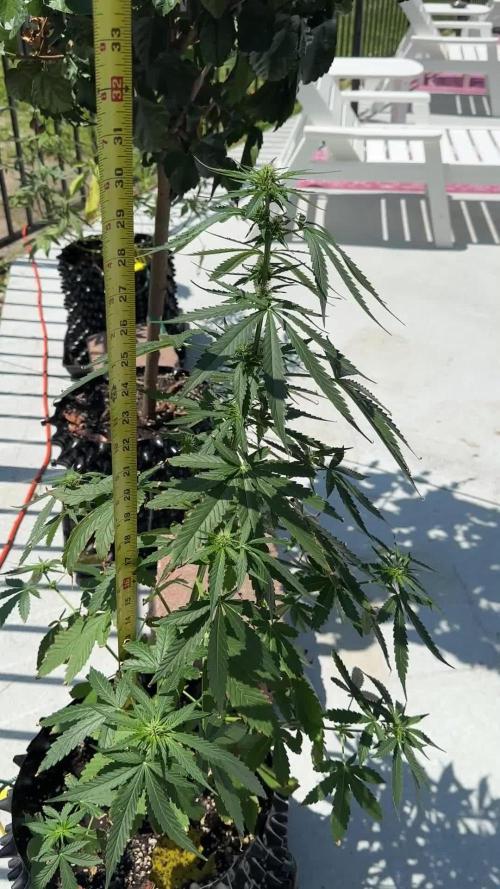
A Disney Vacation was good for me but not so much for my plants. I also left my husband and two livestock in charge of feeding and protecting my plants from the elements of nature. Miss Mango Kush continues to grow tall. According to Zamnesia Seeds, she could reach a height of 38 inches outdoor. Our weather has been kinda crazy and hellish- as in HOT- and her leaves are getting burned on the edges even though I have a pool umbrella protecting her from the direct sun.
Miss Mango Kush is NOT a bushy plant but rather a tall, lean plant. If you look at her pictures, you can see a lot of buds forming.
It has been quite hot this past week, but hopefully we will get a break in the weather. Please continue to enjoy my diary and let's chat it up friends.
Likes
68
Share


@Ferenc
Follow
Day 22, 8th of October 2020:
Ajjjjjjjjj.....
Smthg happened to me that never before. Tricky story.
2 days ago I watered her more a bit also placed closer to the lamp.
Yesterday I saw the leaves started wilting and the lowest ones yellowing. I thought I overwatered her so let her all night and today checked seeing she looks worse ... I was like what the fuck....
I removed her from the pot it was not overwatering problem it was underwatering problem. The soil was like the desert ...
But how?
Just watered her recently may be because I have placed closer to the lamp.
It was also suspicious because this pot has no holes at all so thought not able to drain. No....She is very thirsty
..😅
I just gave her a lot and wahoo she has woken up! That is the reason of those yellow leaves are at the bottom. The girl in the picture just recovered 3 hours ago she looked like a dead wilting plant.... omg...
I wanted to do main-lining today but need to be delayed she needs to recover 😩 so I will do it 2 days later ...
Apart from that she is totally cool 😎
Beautiful :)
And yes everything continues the same way :)
Day 23, 9th of October 2020:
Alright... she is cool today I managed to do Main-lining. :)
Likes
46
Share


@DogDoctorOfficial
Follow
Hey there, green warriors and cannabis lovers! 🌱🔥 We’re now in week 3 of the flowering stage in our Runtz Battle, and things are really starting to heat up! This week brought an interesting twist as we had to make a strategic adjustment to ensure all our plants are on the same page. Let’s dive into the details and explore how things are progressing.
Week 3 Flowering Progress 🌿✨
Our Runtz plants continue to flourish, and here’s what’s been happening:
• Bud Development 🌸:
• The buds are filling out beautifully, with each day bringing more growth and resin production. The plants are stacking up nicely, with dense flowers forming at multiple sites. The F1 strain remains compact and uniform, showcasing tight, resin-packed bud sites.
• Environmental Stability 🌡️:
• We’re maintaining consistent environmental conditions with a room temperature of 30.3°C, water temperature at 18°C, and humidity at 51%. These stable conditions are key to supporting strong bud growth and overall plant health.
Switching to 12/12: The Light Adjustment 🌟💡
This week, we made a crucial adjustment to our lighting schedule:
• Why the Change? 🌞🌙:
• One of our plants hadn’t yet started flowering, so we made the decision to switch all plants to a 12/12 light cycle. This change is essential to trigger flowering in the plant that was lagging, ensuring it joins the rest of the group in producing those beautiful buds.
• How 12/12 Helps 🌿💡:
• The 12/12 light cycle mimics the natural change in daylight hours as summer transitions to fall, signaling to the plants that it’s time to focus on reproduction (flowering). This shift is a classic technique to ensure all plants in the garden synchronize their flowering process. The reduction in light hours encourages the production of flowering hormones, which will now help the plant that was behind to catch up and start forming buds.
• Impact on the Runtz Plants 🌸:
• The Runtz strains that were already flowering won’t be negatively affected by this change. In fact, the consistent 12/12 cycle can help to further boost their flowering intensity, ensuring that the buds continue to develop fully and evenly.
Nutrient and Care Strategy 🌱💧
Our focus on proper nutrition and environmental care remains a top priority:
• Watering and Nutrients 💧:
• With the Autopots still running smoothly, we’re continuing with Regulator and CaMg Boost in the reservoir. The nutrient-rich soil and organic inputs are keeping the plants well-fed, and the consistent hydration is ensuring steady growth and flower development.
• Lighting and Environmental Control 🌡️:
• The Lumatek Zeus 465 Compact Pro continues to provide powerful, full-spectrum light that supports the flowering process. With the 12/12 schedule in place, the plants are receiving the perfect balance of light and dark, critical for flower development.
• The TrolMaster Hydro-X controller remains essential in managing these conditions, keeping everything dialed in for optimal plant health.
Looking Ahead 🌟🌿
As we move deeper into flowering, the anticipation only grows. The 12/12 light cycle is now in full effect, ensuring all our plants are flowering together. The Runtz strains are on track to produce a stunning harvest, with each plant showcasing its unique strengths.
Stay tuned for more updates as we continue this green journey. The next few weeks are going to be thrilling as we watch these buds fatten up and reach their full potential! 🌟💚
#RuntzBattle #Week3Flower #CannabisCommunity #FloweringStage #LightCycle #12and12 #GreenMagic #LumatekZeus #TrolMasterHydroX #GrowStrong #StayPositive
Germination method 🌱 @thecannakan
Genetics Runtz F1 @zam.nesia Runtz auto @kannabiaglobal
Nutrition
@aptusholland 🌿
@aptus_world 🌎
@aptus_es 🌍
@aptusbrasil 🌱
@aptus_thailand 🌿
@aptus_portugal 🌳
@aptususa_official 🍀
@aptusplanttechnz 🌺
@aptusplanttechaus 🍃
Ambient controls🎮
@trolmaster.eu @trolmaster.eu.support @trolmaster.support @trolmaster.agro
Soil @promix_growers_eur @promix_cannabis
LED - @lumatekeu
Watering- @autopot_usa @autopot_global
Love and attention- @dogdoctorofficial
#aptus #aptusplanttech #aptusgang #aptusfamily #aptustrueplantscience #inbalancewithnature #trolmaster #trolmastereurope #trolmastersecrets #Autopots #RuntzBattle #KannabiaVsZamnesia #GreenJoy
As always thank you all for stopping by, for the love and for it all , this journey of mine wold just not be the same without you guys, the love and support is very much appreciated and i fell honored and so joyful with you all in my life 🙏
With true love comes happiness 💚🙏 Always believe in your self and always do things expecting nothing and with an open heart , be a giver and the universe will give back to you in ways you could not even imagine so 💚
More info and complete updates from all my adventures can be found ⬆️ link in the profile description ⬆️
Friendly reminder all you see here is pure research and for educational purposes only
💚Growers Love To you All 💚

Likes
7
Share


@Lucyfer
Follow
Site is broken, can barely upload anything and it's sad because I'm really proud, of what we've achived here and i tought this may be the place to sahre it but it seems this palce is more for self promotions for brands and so on.
regardless, with all the effort that it took to select pictures heres some of a PARTIAL harvest, i did not harvest the whole plant as the cannopy did not allow lower bud sites to have light and i mean, theres at least 700 grams more waiting from those 2 plants (and thatsd a low ball estimate), currently "only" harvested 672 grams from the top colas, and not all of them were chopped, left some of the auxiliary bud sites that the MASSIVE colas had, im honestly shoked at one of them that weighted on its own 145.4 grams, and still had 4 auxiliary bud sites that i decided to leave for them to rippen, alltogether pretty sure this cola wouldve been 250 g's with all the other bud sites that it developed.
yesterday i decided to chop based on the fact that i felt nugs were moist and was afraid of them developing botrytis. none did and while im suspisicious on some of the nugs no definite answer as of right no nug shows it, but they were moist and better be safe than sorry, still would've given them another week if it was possible, but also i need GMO to rippen, so thats why i decided to do a stage chop, in one week will be chopping everything or maybe more, perhaps 2 weeks more, who knows now. one thing I know is that my house smells DANK, that it was 700 g's a partial harvest and that I still have more than half to chop and harvest, this will be plenty, im really happy with how they're turning out, ocne they dry I'll write here how they smoke and add some nug photos.
THERES STILL WORK TO DO, THIS IS NOT OVER YET. and I'm all for it :)

Likes
2
Share


@KeemBboomin
Follow
Remember, when I said I was having a little fun, I was not kidding don’t do you see that nice looking Pringles can it took a lot of work, but I’m not gonna leave her in there with her entire life. She’s most likely going to get transplanted when it’s time to put her to flower other than that you see the others. They look good as well. Even the one my friend gave me I brought it back to life and man I thought I was doing something wrong because she has a major purple stem and her genetics I guess.
Likes
40
Share


@Totogrowuk
Follow
Well the amnesia Zkittles took a lot longer in veg and so is much taller than the others.
We’ve had a lot of wind and rain but bits of sunshine too. Could definitely be worse

Likes
10
Share


@DeepRootsGrowTrees
Follow
ROYAL QUEEN CBG AUTO
ROYAL QUEEN SEEDS
Week #3 Overall June 19th-26th
Week #2 Veg
This week no issues she's growing well medical CBD grow so it's a all organic grow. Stay Growing!!
ROYAL QUEEN SEEDS
ROYAL QUEEN CBG AUTO

Likes
91
Share


@Salokin
Follow
Gu Guys,
she is continuing to develop as she should, however doesn't seem to be stretching all to much even with lower light intensities. I have therefore decided to push the ppfd to roughly 600 and let her finish her pre flower, no matter if she will fill the entire scrog or not. the roots are bit stained, however, this seems to be nutrient related, no slime or smelly roots thus far and it seems like she is constantly shooting out new ones from the net pot. She is going to be a nice little bonsai bush :)

Likes
12
Share


@Ziggs
Follow
Well I'm 7 weeks behind, been busy with work, family, maintenance on house and been busy with plants. But anways, I had to harvest a plant 6 days ago as there were to many nanners that showed up over night. Had some nanners on a couple other plants that I was able to keep up on plucking. The temperature is a lot cooler than I would like but that's because I'm maxed out on my breaker and I've been trying to keep my garage at a constant 60 degrees with a wood stove to help heat the grow room. Other than that, the buds smell super dank, they look bomb as shit and harvest is right around the corner! I did mess up on mixing nutrients this whole entire grow as I might have ended up with some sort of nutrient lock-out. I never got the nets put up and so far I only had to stake 1 plant. Harvest is looking like it might be this weekend!
Any suggestions or thoughts for the next grow as I did start 10 more seeds 12/08/23...?
As Always, Happy Growing!
Likes
10
Share


@CookiesAndCake
Follow
Week 14
Day 92 | 22/07/2022:
No time today
Day 93 | 23/07/2022:
Watered the girls today with just 1.5L of water. The temperatures have dropped thankfully so it's not too hot for them now
Day 94 | 24/07/2022:
So many trichomes on these girls, the buds are looking white! Just a few days left!
Day 95 | 25/07/2022:
The trichomes are looking amazing on these girls! Shame they won't be able to get to their full potential since most of the hairs are still white and the trichomes are still mostly cloudy, but I am really looking forward to trying them! They smell like a fruit juice or something :D
Also I decided not to water them anymore so they can dry up a bit before harvest in 3 days!
Day 96 | 26/07/2022:
Day 97 | 27/07/2022:
Day 98 | 28/07/2022:
Today was the big day! (for the girls and for myself) So the only thing I did was tidied up the foliage by removing all the fan leaves, cutting the girls at the base and handing them in the tent. I find that the remaining leaves really help keep the moisture at a higher level and they tend to smell less like hay. I will be leaving the girls to dry for about 10 days, and then I always put them into glass jars to cure! I really wish I could have kept these girls growing just for another week because most of their hairs are still white, but unfortunately i had no choice and this is still more than good enough. Let's hope the genetics make up for it in the smoke!


Likes
82
Share


@mcflow
Follow
The strain is fantastic! While my yield was slightly less than anticipated, I'm not complaining because I truly appreciate the quality.