


Likes
76
Share


@Natrona
Follow
First attempt LST tie down stems on Gelato 41. I decided to try lst on Gelato 41 since she charged out of the gate full force and was taller than the other sprouts.
From the side view, the node structure is very close. I thought since she was shooting up so quickly, there would be more space between them.
Week4 I was using thin wire pins for the last. I had to switch to 1/2 garden pins to hold down the stems. As you can see she is very short and bushy. The tight node
Structive is indicative of indica dominance. Lots of leaves. Looks like an afro hair do. Pic 5/24, 5/27, 6/2. Put mirrors under the canopy to add more light
6/5. Start week 5
water feed. Check pins as her stems are strong and push the pins up.
6/7 water & feed
6/9 water & feed
6/11 water & feed
6/13 water & feed light deformation
6/16 1 gal flush Gelato 41 She's the last gal in the tent to start flower. Nothing yet.
6/25 pics
6/26 took her out of the tent today and put her outside. She is one of my Afro girls. I See flowers today. 2 months after the seed popped the soil.
I thought she was an auto but maybe fast photo. I will say that she is very bushy. Because of the LST, she has an even canopy with at least 20 or more tops.
7/9 pics. She has acclimated to outside very well. It's hot and humid and we have had lots of rain. Her colas have shot up in bud formation. This plant has thin leaves.much different from most other strains I've grown
7/12 more pics showing LST tie down and bud development
7/22 more pics
7/30 outside girls.
Likes
20
Share


@Boomdrawfyah
Follow
Dia 134 y semana 6 de floración,ultimo dia de vida de las plantas.
Este año ha sido un poco raro las plantas han crecido como monstruos tuvieron un crecimiento espectacular un tallo muy grande y junto con sus ramas flexibles y muy resistentes. Pero al llegar el engorde de floración no se porque les falto el empujon final para hinchar el cogollo, tiene muy buena pinta , mucha resina y muy fuerte buen olor pero me esperaba mas en la fase final. Cortamos ya que tambien habian orugas y no terminaba de eliminarlas por completo, la semana que viene era entera de lluvias así que decidi cortar un poco mas temprano para poder prevenir cualquier mal mayor, hay mucha gente que le gusta cortar antes de tiempo ya que el efecto es muy diferente, este año probaremos que tal.


Likes
162
Share


@DutchFarmer
Follow
🌿 GrowDiaries Harvest Review Runtz by Zamnesia Seeds 🌿
Participating in this contest has been an incredible journey! A massive shoutout to Plagron and Zamnesia for making this possible. Growing Runtz in a 1-liter pot was an experiment that exceeded all expectations yielding a whopping 2 ounces! 😱
Aroma & Flavor:
The scent is absolutely intoxicating: fruity candy haze with a gassy undertone that fills the room. Each puff delivers a smooth smoke, leaving behind a clean white ash, a testament to its quality.
Bud Structure:
The buds are dense and chunky, resembling big, oily nuggets. Their vibrant colors and resin coated appearance make them a visual delight.
Effects:
This strain hits hard with a potent and euphoric high, perfect for evening relaxation.
The balance between indica and sativa effects provides a creative uplift followed by a soothing body relaxation.
Final Thoughts:
From seed to harvest, this grow was a rewarding experience.
The combination of top-tier genetics and quality nutrients from Plagron made all the difference. I'm thrilled with the results and proud of what I've achieved in such a compact setup.
Thank you once again to the GrowDiaries community, Plagron, and Zamnesia for this opportunity.
Here's to more successful grows ahead! 🌱🔥
DIARY COMPLETE

Likes
28
Share
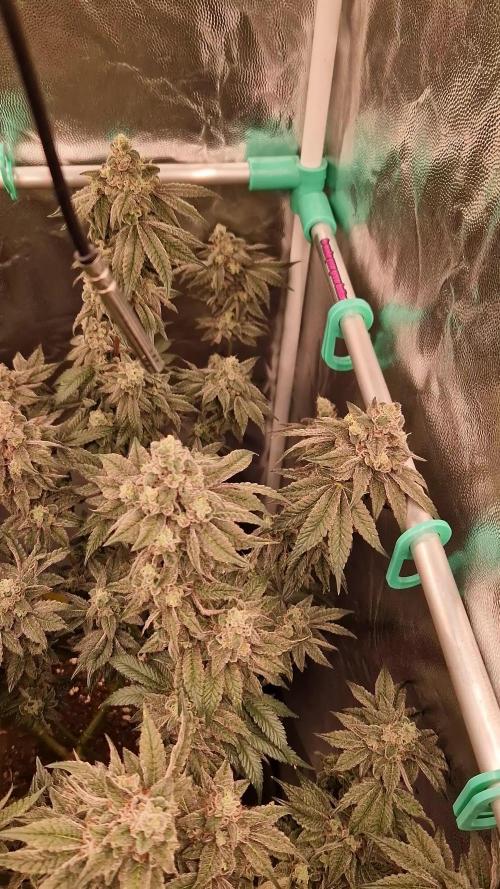

@TrickzGrowz
Follow
Servus Moin!
Die Purple Punch kann sich echt zeigen lassen, obwohl sie ein paar Zwitter Anzeichen durch Stress hatte. Die Buds sind richtig mächtig und fest geworden.

Likes
38
Share


Processing
Likes
280
Share


@love_2_grow
Follow
D22.
The girls look so much better at the start of the fourth week of veg — vibrant colors without interveinal chlorosis and no more twisted leaves.
I hope they have enough veg time to fill in before starting to flower.
I installed the rest of the blumat drip system but haven't turned it on since I still need to hand-water in the SF nematodes to combat the fungus gnats.
I will start with LST this week, and I attached binder clips around each pot to prepare.
------------------------------
D24.
I gave each one liter of water @ pH 6.8, mixed with SF nematodes, humic acid, fulvic acid, sprouted seed tea, and bokashi juice.
I also put half an avocado on the soil in each pot to keep the worm buddies fed and happy.
Tomorrow, I'll start LST.
------------------------------
D26.
The first girl is showing variegation on one leaf. I started with LST yesterday, and the DLI was bumped up to 36.
------------------------------
D28.
We're at the end of the fourth week of veg, and I think they are heading into flower soon as they have started to smell.
More LST to spread them out, although I suspect that the second girl will stay small.
------------------------------

Likes
6
Share


@Bread_n_Buds
Follow
Lemon Cherry Gelato F1 – Zamnesia Seeds | Germination & Early Growth
Starting another grow diary with Lemon Cherry Gelato F1 from Zamnesia Seeds
The beginning has been smooth and uncomplicated, with the seedlings establishing themselves well and showing healthy early growth. Lemon Cherry Gelato F1 is listed as an easy-to-grow, feminized photoperiod strain, with a balanced 60% Indica / 40% Sativa genetic profile.
What makes this one particularly interesting is the F1 photoperiod genetics. F1 varieties are created by crossing selected parent lines with the aim of combining desirable traits while increasing genetic uniformity and stability in the resulting generation. In practical terms, this can mean more consistent plants from seed, with greater predictability in characteristics such as structure, growth pattern and overall development. Of course, individual plants can still show some natural variation.
The listed parents are Sunset Sherbet × Girl Scout Cookies, with a reported terpene profile built around myrcene, limonene and pinene. The expected aroma combines sweet and fruity notes with pine, sour and tropical nuances.
With an expected indoor height of around 100 cm, Lemon Cherry Gelato F1 should remain relatively compact compared with more Sativa-dominant varieties. The flowering period is listed at 9–10 weeks, with the strain also described as resistant to both diseases and pests.
For this grow, I’m using the Zamnesia Ecosystem grow box, including its ventilation system, together with the Zamnesia Phytonaut LED 480W. Nutrition is provided by Zamnesia Vegan Grow.
At this stage, the main goal is to follow how consistently the F1 genetics express themselves throughout the cycle and to see how the plants develop from early growth into the flowering phase. With the combination of Sunset Sherbet and Girl Scout Cookies genetics, the terpene development will also be something worth keeping an eye on as the plants mature.
**Strain:** Lemon Cherry Gelato F1
**Breeder:** Zamnesia Seeds
**Genetics:** Sunset Sherbet × Girl Scout Cookies
**Genotype:** 60% Indica / 40% Sativa
**Type:** Feminized, photoperiod F1
**Difficulty:** Easy
**Terpenes:** Myrcene, Limonene, Pinene
**Flowering time:** 9–10 weeks
**Indoor height:** up to 100 cm
**Outdoor height:** up to 200 cm
**Reported THC:** up to 26%
**Reported CBD:** 0–1%
**Resistance:** Disease and pest resistant
**Aroma:** Sweet, fruity, pine, sour, tropical
**Reported effects:** Relaxing, energizing, euphoric, balanced
Grow setup:
🌱 Zamnesia Ecosystem Grow Box
💡 Zamnesia Phytonaut LED – 480W
💨 Integrated ventilation system
Zamnesia Vegan Grow
All the products used in this grow are available at
www.zamnesia.com

Likes
109
Share


@MadeInGermany
Follow
Welcome to the Green House Seeds Company Cup 🏆.
Day 34 since time change to 12 / 12h.
Hey everyone 😎.
This week she took on an incredible smell 😍.
Nothing has to be attached to support as it has very stable branches and everything holds by itself 🤗.
The buds clearly increase in volume, which shows me that the GHSC Powder Feeding is still working perfectly 👍.
Their colors are beautiful 👏🏼.
A genetic perfection 😘.
I can't wait to see what she'll do this week 😍.
I wish you all a lot of fun with the update, stay healthy 🙏🏻 and let it grow 🌱
You can buy this Strain at :
https://greenhouseseeds.nl/
☝️🏼☝️🏼☝️🏼☝️🏼☝️🏼☝️🏼☝️🏼☝️🏼☝️🏼☝️🏼☝️🏼☝️🏼
Green House Seeds Company Cup 🏆
Type:
Wonder Pie
☝️🏼
Genetics:
Wedding Cake x OG Kush
👍😍
Vega lamp: 2 x Todogrow Led
Quantum Board 100 W
💡
Flower Lamp : 2 x Todogrow Led
Cxb 3590 COB 3500 K 205 W
💡💡☝️🏼
Earth: Canna Bio
☝️🏼
Fertilizer: Bio Grow Feeding ( GHSC ) , Enhancer ( GHSC ) , Bio Bloom ( GHSC)
☝️🏼🌱
Water: Osmosis water mixed with normal water (24 hours stale that the chlorine evaporates) to 0.2 EC. Add Cal / Mag to 0.4 Ec Ph with Organic Ph - to 6.0

Likes
6
Share


@Lymegrow
Follow
Smell is starting to get very noticeable with the tent open. This is the last week of fert I'm going to do.

Likes
4
Share


@AcidBurn_40
Follow
30.09.24 BT# 10
Nabend zusammen 😁✌️
Der Pineapple Express geht es hervorragend. Sie Bilden immer mehr Blütenkelche😍
Heute gab es wieder Nährstoffe von Biobizz Juju Royal die Dosis für Grow Soldier ist auf 2ml/L runter gegangen, Green Mystic 2ml/L und Flowa Bloom sind 3ml/L.
Sie wird ihren strech bald einstellen dann ist ihr Hauptziel die Blütenkelche zu vermehren und dann geht es in die Phase die wir alle Lieben die Buds schwellen an.
Freue mich sehr das ihr ein stop eingelegt habt, Update kommt wie gewohnt nächste Woche Growmie's.
Mögen all eure Ladys Gesund und prächtig wachsen und euch mit schmackhaften Stuff versorgen 🍀💪🏻
■■■■■■■■■■■■■■■■■■■■■■■■■
30.09.24 BT# 10
Hello everyone 😁✌️
The Pineapple Express is doing very well. They are forming more and more calyxes😍
Today I gave her nutrients from Biobizz Juju Royal again, the dose for Grow Soldier has gone down to 2ml/L, Green Mystic 2ml/L and Flowa Bloom is 3ml/L.
She will stop her stretch soon then her main goal is to increase the calyxes and then it goes into the phase we all love the buds swell.
I am very pleased that you have put in a stop, update will come as usual next week Growmie's.
May all your ladies grow healthy and splendid and provide you with tasty stuff 🍀💪🏻

Likes
16
Share


@JJs_Js
Follow
Was another easy week - lots of healthy growth. Simply watered when dry, did some daily LST and leaf tucking. The green crack is definitely the fastest growing out of all the plants, and the one runt LSD25 is a bit smaller but still chugging along.

Likes
55
Share


@Ultraviolet
Follow
What's in the soil? What's not in the soil would be an easier question to answer. 16-18 DLI @ the minute. +++ as she grows.
Probably not recommended, but to get to where it needs to be, I need to start now.
Vegetative @1400ppm 0.8–1.2 kPa 80–86°F (26.7–30°C) 65–75%, LST Day 10, Fim'd Day 11
CEC (Cation Exchange Capacity):
This is a measure of a soil's ability to hold and exchange positively charged nutrients, like calcium, magnesium, and potassium. Soils with high CEC (more clay and organic matter) have more negative charges that attract and hold these essential nutrients, preventing them from leaching away.
Biochar is highly efficient at increasing cation exchange capacity (CEC) compared to many other amendments. Biochar's high CEC potential stems from its negatively charged functional groups, and studies show it can increase CEC by over 90%. Amendments like compost also increase CEC but are often more prone to rapid biodegradation, which can make biochar's effect more long-lasting. biochar acts as a long-lasting Cation Exchange Capacity (CEC) enhancer because its porous, carbon-rich structure provides sites for nutrients to bind to, effectively improving nutrient retention in soil without relying on the short-term benefits of fresh organic matter like compost or manure. Biochar's stability means these benefits last much longer than those from traditional organic amendments, making it a sustainable way to improve soil fertility, water retention, and structure over time. Needs to be charged first, similar to Coco, or it will immobilize cations, but at a much higher ratio.
a high cation exchange capacity (CEC) results in a high buffer protection, meaning the soil can better resist changes in pH and nutrient availability. This is because a high CEC soil has more negatively charged sites to hold onto essential positively charged nutrients, like calcium and magnesium, and to buffer against acid ions, such as hydrogen.
EC (Electrical Conductivity):
This measures the amount of soluble salts in the soil. High EC levels indicate a high concentration of dissolved salts and can be a sign of potential salinity issues that can harm plants.
The stored cations associated with a medium's cation exchange capacity (CEC) do not directly contribute to a real-time electrical conductivity (EC) reading. A real-time EC measurement reflects only the concentration of free, dissolved salt ions in the water solution within the medium.
98% of a plants nutrients comes directly from the water solution.
2% come directly from soil particles.
CEC is a mediums storage capacity for cations. These stored cations do not contribute to a mediums EC directly.
Electrical Conductivity (EC) does not measure salt ions adsorbed (stored) onto a Cation Exchange Capacity (CEC) site, as EC measures the conductivity of ions in solution within a soil or water sample, not those held on soil particles.
A medium releases stored cations to water by ion exchange, where a new, more desirable ion from the water solution temporarily displaces the stored cation from the medium's surface, a process also seen in plants absorbing nutrients via mass flow. For example, in water softeners, sodium ions are released from resin beads to bond with the medium's surface, displacing calcium and magnesium ions which then enter the water. This same principle applies when plants take up nutrients from the soil solution: the cations are released from the soil particles into the water in response to a concentration equilibrium, and then moved to the root surface via mass flow.
An example of ion exchange within the context of Cation Exchange Capacity (CEC) is a soil particle with a negative charge attracting and holding positively charged nutrient ions, like potassium (K+) or calcium (Ca2+), and then exchanging them for other positive ions present in the soil solution. For instance, a negatively charged clay particle in soil can hold a K+ ion and later release it to a plant's roots when a different cation, such as calcium (Ca2+), is abundant and replaces the potassium. This process of holding and swapping positively charged ions is fundamental to soil fertility, as it provides plants with essential nutrients.
Negative charges on soil particles: Soil particles, particularly clay and organic matter, have negatively charged surfaces due to their chemical structure.
Attraction of cations: These negative charges attract and hold positively charged ions, or cations, such as:
Potassium (K+)
Calcium (Ca2+)
Magnesium (Mg2+)
Sodium (Na+)
Ammonium (NH4+)
Plant roots excrete hydrogen ions (H+) through the action of proton pumps embedded in the root cell membranes, which use ATP (energy) to actively transport H+ ions from inside the root cell into the surrounding soil. This process lowers the pH of the soil, which helps to make certain mineral nutrients, such as iron, more available for uptake by the plant.
Mechanism of H+ Excretion
Proton Pumps: Root cells contain specialized proteins called proton pumps (H+-ATPases) in their cell membranes.
Active Transport: These proton pumps use energy from ATP to actively move H+ ions from the cytoplasm of the root cell into the soil, against their concentration gradient.
Role in pH Regulation: This active excretion of H+ is a major way plants regulate their internal cytoplasmic pH.
Nutrient Availability: The resulting decrease in soil pH makes certain essential mineral nutrients, like iron, more soluble and available for the root cells to absorb.
Ion Exchange: The H+ ions also displace positively charged mineral cations from the soil particles, making them available for uptake.
Iron Uptake: In response to iron deficiency stress, plants enhance H+ excretion and reductant release to lower the pH and convert Fe3+ to the more available form Fe2+. The altered pH can influence the activity and composition of beneficial microbes in the soil. The H+ gradient created by the proton pumps can also be used for other vital cell functions, such as ATP synthesis and the transport of other solutes. The hydrogen ions (H+) excreted during photosynthesis come from the splitting of water molecules. This splitting, called photolysis, occurs in Photosystem II to replace the electrons used in the light-dependent reactions. The released hydrogen ions are then pumped into the thylakoid lumen, creating a proton gradient that drives ATP synthesis.
Plants release hydrogen ions (H+) from their roots into the soil, a process that occurs in conjunction with nutrient uptake and photosynthesis. These H+ ions compete with mineral cations for the negatively charged sites on soil particles, a phenomenon known as cation exchange. By displacing beneficial mineral cations, the excreted H+ ions make these nutrients available for the plant to absorb, which can also lower the soil pH and indirectly affect its Cation Exchange Capacity (CEC) by altering the pool of exchangeable cations in the soil solution.
Plants use proton (H+) exudation, driven by the H+-ATPase enzyme, to release H+ ions into the soil, creating a more acidic rhizosphere, which enhances nutrient availability and influences nutrient cycling processes. This acidification mobilizes insoluble nutrients like iron (Fe) by breaking them down, while also facilitating the activity of beneficial microbes involved in the nutrient cycle. Therefore, H+ exudation is a critical plant strategy for nutrient acquisition and management, allowing plants to improve their access to essential elements from the soil.
A lack of water splitting during photosynthesis can affect iron uptake because the resulting energy imbalance disrupts the plant's ability to produce ATP and NADPH, which are crucial for overall photosynthetic energy conversion and can trigger a deficiency in iron homeostasis pathways. While photosynthesis uses hydrogen ions produced from water splitting for the Calvin cycle, not to create a hydrogen gas deficiency, the overall process is sensitive to nutrient availability, and iron is essential for chloroplast function.
In photosynthesis, water is split to provide electrons to replace those lost in Photosystem II, which is triggered by light absorption. These electrons then travel along a transport chain to generate ATP (energy currency) and NADPH (reducing power). Carbon Fixation: The generated ATP and NADPH are then used to convert carbon dioxide into carbohydrates in the Calvin cycle. Impaired water splitting (via water in or out) breaks the chain reaction of photosynthesis. This leads to an imbalance in ATP and NADPH levels, which disrupts the Calvin cycle and overall energy production in the plant. Plants require a sufficient supply of essential mineral elements like iron for photosynthesis. Iron is vital for chlorophyll formation and plays a crucial role in electron transport within the chloroplasts. The complex relationship between nutrient status and photosynthesis is evident when iron deficiency can be reverted by depleting other micronutrients like manganese. This highlights how nutrient homeostasis influences photosynthetic function. A lack of adequate energy and reducing power from photosynthesis, which is directly linked to water splitting, can trigger complex adaptive responses in the plant's iron uptake and distribution systems.
Plants possess receptors called transceptors that can directly detect specific nutrient concentrations in the soil or within the plant's tissues. These receptors trigger signaling pathways, sometimes involving calcium influx or changes in protein complex activity, that then influence nutrient uptake by the roots. Plants use this information to make long-term adjustments, such as Increasing root biomass to explore more soil for nutrients. Modifying metabolic pathways to make better use of available resources. Adjusting the rate of nutrient transport into the roots. That's why I keep a high EC. Abundance resonates Abundance.
Likes
23
Share
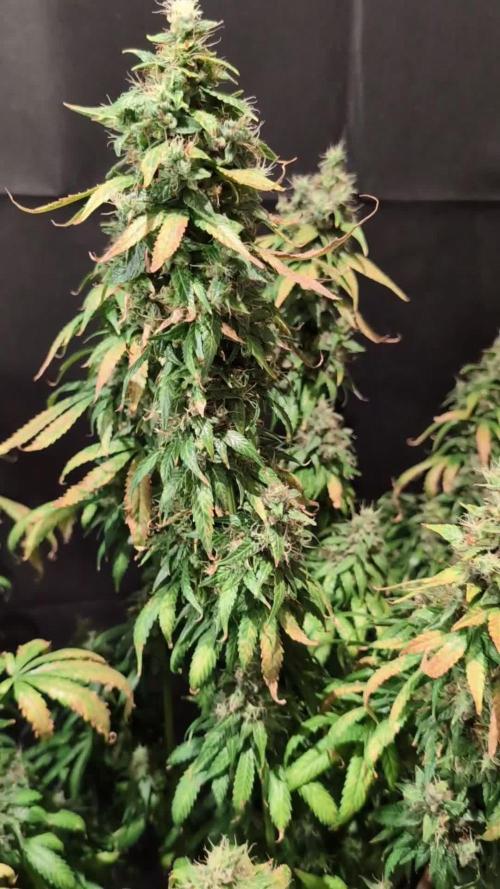

@GoodTimesOrganics
Follow
Welcome Back!💚
Nach der zehnten Blütewoche kommen wir endlich in die finale Blütewoche!
Daher war es erneut Zeit diese unter die Lupe zu nehmen.
Fast alle Trichome sind milchig und es sind auch allmählich bärensteinfarbene Trichome zu sehen.
Daher ist es nächste Woche Zeit für die Ernte
Die Pflanze entwickelt einen eher würzigen und von Kräuternoten geprägten Geruch.
Die Pflanze ist von der Beschreibung her nicht darauf getrimmt viele Trichome auszubilden, da dass Hauptaugenmerk ja auf die THCV Produktion gelegt wurde.
Die Umgebungsgegebenheiten sind trocken und warm
—————
🌞 Temp: 27°C
🌚 Temp: 18°C bis 19°C
💨 RH: 56%
VPD: 1,42 kPa
😎 PPFd: 830 mqm
—————
Viele Grüße 👋



Likes
Comments
Share


@BIYEI
Follow
Plantula 12-11-2024 a 21-11-2024
Semana 1
12-11-2024 Se mantiene en rehidratacion constante y vigilancia ya que son los dias mas vulnerables de la plantula.
15-11-2024 Se coloca por la tarde en el recipiente hidroponico ya que la plantula ya tiene la madurez necesaria, y se colocan nutrientes en dosis muy baja.
16-11-2024 Primer Contacto de raizes en agua.
18-11-2024 Se nota la evolucion radicular de la planta y se observa mejoria.
Parametros Utilizados
Temperatura del ambiente 24 C°
Extraccion de aire 4 pulgadas
Humedad 75% a 90%
Potencia de la lampara 50%
Ec Original 0.4
Ec Nutriente 1.0
Ph 6.5


Processing
Likes
9
Share


@GrowLegend
Follow
Tercera semana de floración, y aun sigue creciendo esta plata, sus pistilos cada día son mas notables, esta planta debe nutrientes en abundancia la debo regar cada dos días con fertilizantes NPK cuando la observo la tierra ya esta seca, por ende cada semana desarrolla masa foliar. Nos vemos amigos la otra semana. Saludos!

Likes
17
Share


@420DeepGrow
Follow
Gracias al equipo de AnesiaSeeds, Marshydro, XpertNutrients y Trolmaster sin ellos esto no sería posible.
💐🍁 Violet Face:
Esta variedad feminizada es como un dream team de la realeza del cannabis, que mezcla la majestuosa Blue Face con las frías vibraciones de la Frozen Black Cherry. Es como el perfecto día de verano: vibraciones soleadas con una brisa fresca.
Blue Face aporta esa refinada magia Z, con notas cremosas de naranja y pastel de plátano que te harán sentir como si estuvieras en un paraíso tropical. A continuación, Frozen Black Cherry entra en escena con su aspecto escarchado y su aroma a cereza dulce y ácida que es sencillamente adictivo.
Sube el volumen porque Violet Face golpea fuerte con niveles de THC que se disparan hasta el 35%. Cada calada es un billete al paraíso, que combina los lujosos aromas de la cereza con una embriagadora mezcla de dulzura y sabor afrutado.
Violet Face no es sólo un estilo de vida relajado; también es una campeona de peso pesado, con rendimientos de 600 g/m² en interior y unos exuberantes 900 - 1200 g por planta en exterior. Esta belleza florece en 8-9 semanas, y está lista para la cosecha a finales de septiembre. Tanto si la mantienes acogedora en interior como si la extiendes bajo el cielo, Violet Face se extiende con alturas de 80-120 cm en interior y 160-200 cm en exterior.
🌻🚀 Consigue aqui tus semillas:
💡TS-3000 + TS-1000: se usaran dos de las lámparas de la serie TS de Marshydro, para cubrir todas las necesidades de las plantas durante el ciclo de cultivo, uso las dos lámparas en floracion para llegar a toda la carpa de 1.50 x 1.50 x 1.80.
https://marshydro.eu/products/mars-hydro-ts-3000-led-grow-light/
🏠 : Marshydro 1.50 x 1.50 x 1.80, carpa 100% estanca con ventanas laterales para llegar a todos los lugares durante el grow
https://marshydro.eu/products/diy-150x150x200cm-grow-tent-kit
🌬️💨 Marshydro 6inch + filtro carbon para evitar olores indeseables.
https://marshydro.eu/products/ifresh-smart-6inch-filter-kits/
💻 Trolmaster Tent-X TCS-1 como controlador de luz, optimiza tu cultivo con la última tecnología del mercado, desde donde puedes controlar todos los parametros.
https://www.trolmaster.com/Products/Details/TCS-1
🍣🍦🌴 Xpert Nutrients es una empresa especializada en la producción y comercialización de fertilizantes líquidos y tierras, que garantizan excelentes cosechas y un crecimiento activo para sus plantas durante todas las fases de cultivo.
Consigue aqui tus Nutrientes:
https://xpertnutrients.com/es/shop/
📆 Semana 3:
Ha sido una buena semana, ella ha dado un gran cambio en su lugar definitivo 😎.
Se le ha aplicado un tratamiento insecticida con agua + tierra de diatomeas ( 1 cucharadita por litro de agua), también se le aplica un tratamiento fungicida con una infusión de cola de caballo para evitar futuro moho.
A partir de ahora se riega manualmente con las dosis recomendadas por el fabricante.

Likes
2
Share


@eldruida_lamota
Follow
Que pasa familia, vamos con la segunda semana de floración de estas Kiwi x Papaya feminizadas de Mavericks .
Vamos al lío ,se trasplantaron en macetas de 7 litros definitivamente.
El ph se controla en 6.0 , la temperatura la tenemos entre 24/20 grados y la humedad ronda el 50%.
El ciclo de crecimiento puse 12h de luz, el foco está al 50% de potencia.
De momento van creciendo a buen ritmo y tienen un buen color.
Gracias a Agrobeta de nuevo por el kit para esta temporada, unos grandes 🙌.
- os dejo por aquí un CÓDIGO: Eldruida
Descuento para la tienda de MARS HYDRO.
https://www.mars-hydro.com
Hasta aquí todo, Buenos humos 💨💨💨
