


Likes
Comments
Share


@DogDoctorOfficial
Follow
💎🌿 8×8 Adventure – Week 14
Black Diamond Auto by Zamnesia – Pheno B
👑 Big Mama's Next Chapter: From Beast to Frozen Treasure! ?💎🌸
Welcome back to another chapter of the 8×8 Adventure! 🌱💚
And today, my friends…
We need to talk about Big Mama.
😂😂😂💎👑
Our other Black Diamond.
Our heavyweight.
Our beautiful beast.
The girl who never really needed to be the tallest, the prettiest, or the most delicate plant in the room to make herself noticed.
She simply showed up, built herself into a magnificent plant, and made sure we knew she was there.
And now…
Her time in the tent is over.
💎🌿✂️
Just like her sister, Black Diamond Auto Pheno A, Big Mama reached the point where it was time to move into the next chapter.
Two sisters.
Two different seeds.
Two different expressions.
One genetic family.
And, in the end…
TWO ABSOLUTE BEASTS.
😂😂😂👑💎
But although their stories are similar, they haven't been identical.
And that's exactly why I wanted to document them separately.
Today, we're looking back at Big Mama's journey, explaining what happened after harvest, showing some of the photographs and statistics we managed to capture, and introducing the next stage of her adventure.
Because this girl hasn't disappeared.
She's simply moving into a different chapter.
And this time, we're taking a little detour into the world of ice, water, and bubble hash.
?💎🌿
But before anybody gets too excited…
Let's start at the beginning.
────────────────────────
📢 FIRST, A LITTLE EXPLANATION ABOUT THIS REPORT
You might notice that this update is still being published under a flowering week rather than as a dedicated harvest report.
And you might also notice something else…
There aren't as many photographs of Big Mama as there were of her sister.
😂📸
Both things have an explanation.
First, GrowDiaries has a limit of 30 photographs per update, and our harvest documentation can quickly go beyond that limit when we include the final plant photographs, trimming, drying, weighing, and smoke review.
Second, GrowDiaries doesn't provide a dedicated section specifically for documenting the extraction process we're planning to follow with Big Mama.
So, rather than trying to squeeze everything into one update or leave out important parts of the story, we're using the available diary structure to keep documenting the journey.
Depending on how many photographs and details we have to share, we may continue this story in the current week or create another update to give the next stage enough room.
The goal is simple:
Keep the documentation clear.
Keep the photographs.
Keep the story together.
And don't leave out the interesting bits just because the platform's categories don't perfectly match what we're doing.
💚🌱
As for the smaller collection of photographs…
Well, I have a confession.
😂😂😂
It was late.
Actually, it was almost morning by the time I got around to her sister's harvest work, and by the time I reached Big Mama, the photographic energy was not quite what it had been earlier.
The girl still got her attention.
The work still got done.
But the camera didn't get quite as much attention as it did with Pheno A.
So yes, we have fewer photographs.
That's the honest explanation.
Sometimes the grower has a plan, the plants have their own schedule, and the clock decides to join the experiment.
😂📸🌙
But fewer photographs don't mean a less important story.
Big Mama deserves her own report, her own explanation, and her own spotlight.
And that's exactly what we're doing.
────────────────────────
💎 TWO SISTERS, TWO SEEDS, TWO BEASTS
Let's take a moment to look back at how we got here.
Black Diamond Auto Pheno B was part of our 8×8 Adventure, where twelve plants shared the same general environment, lighting schedule, and overall approach to care.
She grew under a 12/12 light schedule from seed, just like the other plants in this experiment.
And throughout the journey, she developed her own personality.
Her sister, Pheno A, had that striking appearance that kept making me stop and take another photograph.
Big Mama?
She brought her own kind of presence.
😂👑💎
She became a substantial plant, carrying beautiful flowers throughout her structure and eventually requiring support to help manage the weight.
The yo-yos became part of the story.
The flowers continued to develop.
The plant kept making herself noticed.
And week after week, she showed us that she wasn't simply going to be a copy of her sister.
They may share the same genetic name, but they have their own individual expressions.
And that's one of the things I love most about following individual phenotypes.
You start with seeds.
You provide a shared environment.
You document the journey.
And then you watch the plants show you who they are.
Pheno A gave us one beautiful story.
Pheno B gave us another.
And now both girls have reached the end of their time in the tent.
💎💎🌿
Two Black Diamonds.
Two different personalities.
Two beautiful plants.
And two harvest stories worth documenting.
────────────────────────
👑 GOODBYE, BIG MAMA — THE TENT CHAPTER IS OVER
If you've been following her diary, you'll know that Big Mama wasn't exactly a shy girl.
😂😂😂
She had presence.
She had structure.
She had beautiful flowers.
And she had enough weight to keep the yo-yo department employed.
Her story was never just about how tall she grew or how much space she occupied.
It was about how she developed, how her flowers formed, and how differently she expressed herself compared with her sister.
That's what made her interesting.
And when it was time to harvest, we moved into the next stage.
We took her down, broke her down, and prepared the material for the direction we wanted to take with this particular harvest.
But unlike her sister's report, which focused heavily on the studio photography and photo stacking, Big Mama's next chapter is going to explore something different.
We're preparing her material for a planned bubble hash project.
?🌿💎
And that's where things get interesting.
────────────────────────
✂️ WHAT HAPPENED AFTER HARVEST?
Once Big Mama was harvested, I broke the plant down and removed the unwanted leaves.
The aim was to separate the material we wanted to keep from the leaves and other parts we didn't want included in the next stage.
I then bagged the prepared material, vacuum-sealed it, and placed it in the freezer.
Yes…
Big Mama is currently enjoying a little holiday in the freezer.
😂?👑
Not quite the luxurious spa treatment she might have imagined, but that's where she is while we prepare for the next chapter.
The material is frozen and waiting for the colder days ahead, when we'll continue with the planned ice-water extraction project.
This is a different direction from simply following the traditional dried-flower route, and I'm looking forward to documenting the process properly.
For now, the preparation has been done.
The material has been bagged.
It's vacuum-sealed.
It's frozen.
And we're waiting for the next stage.
?💎🌿
We haven't completed the extraction yet, so this report isn't going to pretend that we have a final result.
Instead, we're showing what we've done so far and explaining what comes next.
That's how I like to document these projects.
One step at a time.
────────────────────────
? WHAT IS BUBBLE HASH, AND WHY ARE WE GOING THIS ROUTE?
For anyone unfamiliar with the term, bubble hash is a type of cannabis concentrate made by separating resin-rich trichome material from plant material using ice water and filtration.
The name comes from the way well-made material can bubble when exposed to heat, although the quality and behaviour depend on the starting material and the final product.
The basic concept is that trichomes are separated from the plant material, and the resulting material is collected through filtration.
It isn't the same thing as simply drying and trimming flowers.
It isn't the same thing as collecting resin from a glove.
And it isn't automatically the same thing as charas.
These are different materials made through different processes, even though they all relate to the resin produced by the plant.
💎🌿
In Big Mama's case, the next stage we're planning is an ice-water extraction using water, ice, and a washing setup.
We'll document the actual process in the next report, including the equipment, what we observe, the collected material, and how the results look.
We'll also show how we handle the drying stage for the collected hash and discuss what happens afterwards.
For now, we're introducing the project rather than jumping ahead to results we haven't produced yet.
And honestly, I think that's the best way to do it.
You get to follow the story from the preparation through to the final outcome.
────────────────────────
🌿 BUBBLE HASH IS NOT JUST ANOTHER NAME FOR RESIN
I want to make this distinction clear because the terminology can sometimes get mixed together.
The sticky resin we saw on the glove during Big Mama's breakdown was a visible reminder of the resin on the freshly harvested plant.
That doesn't automatically make the material on the glove finished bubble hash, nor does it mean that every kind of collected resin is the same product.
Bubble hash refers to a specific type of concentrate produced through ice-water separation and filtration.
The material we have frozen right now is the prepared starting material for the project.
The washing and filtration have not happened yet.
So we're not calling it finished bubble hash at this stage.
We're simply preparing for that next chapter.
?💎🌱
And when we get there, we'll show you what happened rather than asking you to take our word for it.
That's the whole point of documenting the process.
────────────────────────
📸 FEWER PHOTOS, BUT STILL A STORY WORTH TELLING
I know there aren't as many photographs of Big Mama's harvest as there were of her sister.
And yes, I would have loved to capture more.
But sometimes the timing simply doesn't work out the way we planned.
By the time I got to Big Mama, it was almost morning.
😂🌙
The important thing is that we still have photographs showing parts of the process, including the prepared material, the vacuum-sealed bags, and the weighing.
Those images help us document what happened rather than simply writing that we did it.
We also have photographs from earlier in her journey that show the beautiful plant she became.
Together, they tell the story.
The flowering photographs show the plant.
The harvest photographs show the transition.
The bagging and weighing photographs document the preparation.
And the next set will show what happens when we move into the ice-water extraction project.
📸🌿💎
Not every chapter needs the same number of photographs.
What matters is that we capture the details that help explain the journey.
And Big Mama's story is still very much worth telling.
────────────────────────
⚖️ THE NUMBERS MATTER TOO
Alongside the photographs, we've included some of the measurements and weighing information we managed to capture during this stage.
Those details are useful because they help us keep a record of what happened rather than relying entirely on memory.
The photographs give us the visual story.
The numbers add another piece of the record.
And as the project continues, we'll have more information to add.
For now, I don't want to invent or estimate figures that aren't clearly established in the available documentation.
We'll use the recorded values where they're available and keep the next report focused on the actual results of the process.
That's how I want these diaries to work.
Show what happened.
Share what we observed.
Keep the record honest.
And let the results speak for themselves.
💚📸⚖️
────────────────────────
? THE FREEZER IS JUST THE BEGINNING
At the moment, Big Mama's prepared material is vacuum-sealed and frozen.
The next planned chapter is the ice-water washing process, where we'll document the separation and collection stage.
After that, we'll have the collected material to assess and the drying stage to document.
And later, we'll discuss what happens with the finished result.
So there's still plenty to come.
This isn't a finished extraction report.
It isn't a final yield report.
And it certainly isn't the smoke review.
😂💎
We're at the preparation stage.
The next chapter will cover the actual washing project, and we'll explain the process as it happens, including the filtration, the collected material, and the drying.
We'll also share what we learn along the way.
Because that's what makes these experiments interesting.
We don't need to pretend we know the result before we begin.
We can prepare, document, observe, and report what actually happens.
And that's exactly what we're going to do with Big Mama.
────────────────────────
💡 A QUICK LOOK BACK AT THE 8×8 ENVIRONMENT
Before we move on, let's remember the environment in which Big Mama grew.
She was part of the 8×8 Adventure, where the plants shared the same general room conditions and the 12/12 schedule from seed.
The expanded lighting setup included the two additional Future of Grow Black Series 600W fixtures, with the output controlled rather than simply running everything at maximum.
We were targeting approximately 1,500 PPFD across the upper canopy, with actual intensity varying according to canopy position and plant height.
Lumiflora provided additional lighting deeper in the canopy, while TrolMaster helped us monitor and manage the room environment.
The room's general conditions during the recent flowering updates were around:
🌡️ Day temperature: approximately 26.5°C
🌙 Night temperature: approximately 26°C
💧 Relative humidity: approximately 61%
🌱 Substrate temperature: approximately 25°C
⚗️ Nutrient solution pH: approximately 6.02
⚡ Nutrient solution EC: approximately 2.14 mS/cm
💨 CO₂: approximately 693 ppm
💡 Light schedule: 12/12
These are the recent room references from the flowering stage, not the conditions of the separate drying space.
Big Mama has now moved out of that room, and her next stage is being documented separately.
The rest of the 8×8 is still going.
The other plants are continuing their own journeys.
And we're not changing their stories just because Big Mama has reached harvest.
🌿💎
────────────────────────
🌱 SAME GENETIC FAMILY, DIFFERENT EXPRESSIONS
This is another reason I wanted to give Big Mama her own report.
If you followed Pheno A, you saw one expression of Black Diamond Auto.
If you follow Pheno B, you see another.
They shared the same general growing environment, but they didn't become identical plants.
One caught my eye more visually.
The other became Big Mama, with her own substantial structure and personality.
And that's perfectly fine.
I don't need every plant to look the same.
I don't need every phenotype to be my favourite.
I want to see the differences.
I want to document them.
I want to learn from them.
And I want to be honest about what I see.
😂💎👑
Two seeds.
Two sisters.
Two beasts.
Two different stories.
And now, two different harvest journeys.
Pheno A has her own harvest and photography story.
Pheno B has her own preparation and planned bubble hash project.
Both deserve to be documented properly.
────────────────────────
💚 THE REST OF THE ROOM IS STILL GROWING
One more important point before we close this update.
Big Mama has been harvested, but the rest of the room has not.
The other plants are still growing, developing, and following their own timelines.
The 8×8 Adventure continues.
We'll keep sharing their individual updates, their differences, their progress, and their own milestones.
That's the beauty of this project.
We don't force every plant into the same schedule just because they're sharing a room.
Each plant gets to show us what she does.
And when she's ready for the next stage, we document that too.
Big Mama has reached her moment.
Now we'll follow her through the next part of the journey while the others continue to shine in the tent.
🌿💎🌱
────────────────────────
🔮 WHAT COMES NEXT FOR BIG MAMA?
The next chapter is all about the ice-water extraction project.
We'll be documenting the washing process, the separation and filtration, the collected material, and the drying stage.
We'll also discuss the results and what we decide to do with the finished material afterwards.
The actual outcome will determine what we can honestly report.
For now, the material is bagged, vacuum-sealed, and waiting in the freezer.
The next stage hasn't happened yet.
And I'm looking forward to showing you how it unfolds.
?💎🌿
This is another side of the growing journey that I enjoy documenting.
The plant doesn't stop being interesting when it leaves the tent.
There are still decisions to make, things to observe, and plenty to learn.
So stay tuned.
Big Mama's story has moved beyond flowering, but it isn't finished.
Not even close.
😂👑💎
────────────────────────
💭 FINAL THOUGHTS — BIG MAMA HAS LEFT THE TENT, BUT SHE'S NOT DONE WITH US
Black Diamond Auto by Zamnesia – Pheno B.
Our Big Mama.
Our heavyweight.
Our beautiful beast.
💎👑🌿
I must confess that I would have liked to take more photographs during her harvest.
It was late.
Almost morning, actually.
And by the time I got to her, the photographic session wasn't quite as extensive as the one I had done with her sister.
But the work was done.
The material was prepared.
The unwanted leaves were removed.
Everything was bagged, vacuum-sealed, and placed in the freezer, ready for the next stage.
And now we're preparing to document a different part of her journey.
The planned ice-water washing process.
The filtration.
The collected material.
The drying.
And eventually, what comes after.
?💎
We still have plenty to share.
So please don't consider this the end of Big Mama's story.
It's simply the end of her time in the flowering tent.
Two Black Diamond sisters.
Two different seeds.
Two completely different expressions.
And two beasts that have given us plenty to talk about.
😂😂😂👑💎
Her sister might have received more photographs.
Her sister might have stolen a little more of my photographic attention.
But Big Mama?
She has her own story.
And she's getting her own spotlight.
We're going to keep documenting the process, share the results honestly, and make sure her journey doesn't disappear simply because she's no longer standing in the tent.
Thank you for following along.
And stay tuned, because the next chapter is going to be a little different from our usual flowering updates.
Big Mama is ready for her next adventure.
?🌿💎
────────────────────────
🙏 THANK YOU — AND COME JOIN OUR COMMUNITY!
As always, a massive thank you to everyone following the 8×8 Adventure. 💚🌱
Thank you to GrowDiaries for giving us a place to document the journey, share the photographs, and keep these individual plant stories alive.
Thank you to Zamnesia for the Black Diamond genetics and for giving us the opportunity to discover and follow these two beautiful phenotypes.
Thank you to Plagron for supporting the garden with the growing media and nutrition used throughout this run.
A huge thank you to Future of Grow for supplying the additional Black Series 600W fixtures and allowing us to explore the expanded lighting setup in the 8×8.
Thank you to Lumiflora for helping bring additional light into the deeper areas of the canopy.
Thank you to TrolMaster for helping us monitor and manage the flowering room behind the scenes.
And a shoutout to SmallRig for the LED lighting equipment that helps me create the studio setup for my photography.
💡📸💚
But I also want to give a special invitation to everyone reading this.
Come and join us on Discord!
💚🌱🤝
https://discord.gg/dogdoctorofficial
We're building a beautiful community there, and everyone is welcome.
We have growers with different levels of experience, different setups, different interests, and different ways of approaching this plant.
And that's exactly how we like it.
You don't need to be an expert.
You don't need to have the biggest garden.
You don't need to know every technical term.
You don't even need to be the person who talks the most.
😂💚
You can ask questions.
You can share your experiences.
You can show your projects.
You can learn from other people.
Or you can simply join, listen, and enjoy being part of the community.
There's no experience level you need to reach before you're welcome.
You just need to be respectful and be yourself.
We love talking about this plant, sharing knowledge, comparing experiences, and learning from one another.
And above all, we want this to feel like a community.
Almost like family.
🌱💚🤝
We also have discount codes available for the community, competitions where members can win prizes, and giveaways along the way.
But honestly, the best part isn't a discount or a prize.
It's the people.
The conversations.
The laughs.
The questions.
The willingness to help one another.
And the feeling that you can join in without needing to prove anything.
Everyone is more than welcome.
So if you're looking for a friendly place to talk about growing, learn something new, share your own experiences, or simply hang out with people who understand why we can spend hours talking about plants…
Come say hello!
💚🌿
👉 Join the DogDoctorOfficial Discord community:
https://discord.gg/dogdoctorofficial
We'd love to see you there.
────────────────────────
💎 TWO SISTERS. TWO BEASTS. ONE CONTINUING ADVENTURE.
Big Mama has left the tent.
Her material is prepared and frozen.
The next chapter will take us into the planned ice-water washing project, with the process and results documented as they happen.
Meanwhile, the rest of the 8×8 Adventure continues.
Different plants.
Different timelines.
Different stories.
And plenty more to learn.
Thank you for being here, my friends.
Thank you for following the journey.
Thank you for supporting the diaries and the community.
Let's keep growing, learning, sharing, and having fun along the way.
Growers Love, my friends. 💚🌱
Big Mama…
you may have left the tent, but we're not finished telling your story yet.
😂👑💎?
See you in the next chapter! 🌿📸💚



Likes
11
Share


@Jays_Not_Here_Man
Follow
This girl has had a great week. She has put on some good leaf growth, and has rebounded from the light stress. I had been doing bending her top over to expose the lower branches, no ties just repeating the process.
She got transplanted near the end of the week into a 2 gallon pot, and got her first real dose of nutrients. RH has been steady at about 65% and temps are consistent at 78-79 degrees. The 2x4 tent is super easy to manage with the AC in-line fan/controller and a small 250 watt heater outside the tent at the fresh air draw. 😊
I think my plan for this one is to veg it out long enough, to do a single plant SCROG in my 2x4 tent. Happy Gardening.

Likes
6
Share

@Psykixx
Follow
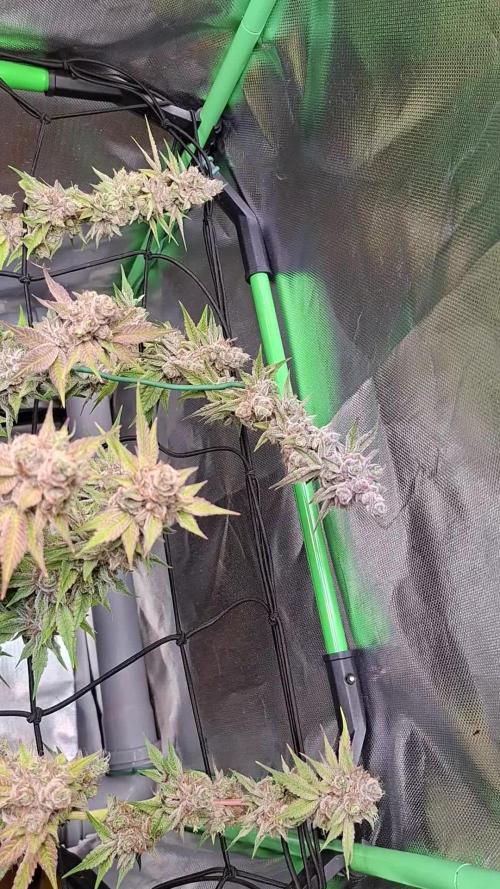
An Blütetag 75 fand sie ihr Ende. Am Vortag entlaube ich immer schon und sobald das Licht aus ist ziehe ich den Stecker. Am nächsten Tag ein paar Stunden nachdem das Licht normal angegangen wäre schneide ich sie dann ab und hänge das was ich mir raussortiere in den Trockenschranck. Der Rest muss leider auf den Kompost... Da blutet einem immer das Herz...


Likes
11
Share


@LapsekiliTayfur
Follow
Day in and exit fan 15 min off 15 min on Van is full on
Night in and exit fan 30 min off 15 min on Van is full on
10 ML Rhizitonic 5 ML Humic 5 ML Cannazym 5 ML Cal Mag 3 Gr Grow @ 5 Liter Day 22
10 ML Rhizitonic 5 ML Humic 5 ML Cannazym 5 ML Cal Mag 3 Gr Grow @ 5 Liter Day 24
22 ML Rhizitonic 22 ML Humic 20 ML Cannazym 11 ML Cal Mag 7 Gr Grow @ 11 Litre Day 26

Likes
1
Share


@Cannerd
Follow
How ya doing mates?? Awesome week last week - all photos and logs have been added so be sure to check it out! This week is going great so far! I've switched to an early vegetative state nutrient system. As you'll see in the daily logs early this week, this bumps up the micro and grow nutes, and keeps the bloom at 0.6ml/gal. A quick note about last week - I'm unable to update the measurements, but please note that those nutrient amounts are measured in ml/gal, NOT ml/l.
Anyhow, this week I'm just waiting to get my order of diatomaceous earth so that I can make up another batch of soil. I'm still debating between topping this week before repotting or letting them take root in the new pots first. Decisions decisions lol. I think at the very least I'll clean up some of the lower growth to make sure the energy is being spent at the right places. I've been switching back and forth between just LST and mainlining in the past - but I think I really like the ease and cleanliness of mainlining. The draw back is the recovery time they take in the process haha.
UPDATE:
The D.E. has come in, and I repotted the girls this week. I mixed in about 1.5-2 cups D.E. for the whole pot, as well as some Bat Guano and Kelp Meal for micro and macro nutrients to use on dry cycles.
I've also included some photos of the mother plant to give an idea of what's to come! I've just started to flower it, which is the first time for this strain - so I'm pumped!
Day 15:
M.C. 01-21 After reviewing the last set of photos from last week, I figured I'd play it safe and dimmed the light back down to 25% strength. The mother plant is almost ready for flower, and I'm down some tents so she'll be taking this one over shortly. These photos were taken shortly after the lights went off, and they look quite happy! You can see some of the side branch developement in today's photo for MC-01. The pots are fairly dry now, and I've decided to move to the next stage in the nutrient regime. This kicks up the Micro and Grow nutes, while maintaining the Bloom amounts.
M.C. 02-21 A nice top photo for MC-02, you can really see the lighter green in this photo. Not to worry though, as these will darken back to a vibrant green as long as I give her what she needs shortly! The pots are fairly dry now, and I've decided to move to the next stage in the nutrient regime. This kicks up the Micro and Grow nutes, while maintaining the Bloom amounts.
M.C. 03-21 Look at that little leaf poking out from the 2nd node! Some slight yellowing you can see too, but again, not to worry. The new mix should rectify that. I've decided to move to the next stage in the nutrient regime. This kicks up the Micro and Grow nutes, while maintaining the Bloom amounts.
Day 16:
M.C. 01-21 Today is the day - for the mother! I've cleared out some space and moved plants around. So back out to the grow room these girls go! MC-01 seems much better today with the reduction in light. The 5th node is almost flattened out and the 6th coming through still. Most notably though, you can really see the work she's put into the side branches! The branches at nodes 2 and 3 are starting to produce more leaves - great sign! The new growth at the top is also a nice dark green. Added 500ml water to the tray.
M.C. 02-21 MC-02 seems to have liked the adjustment of light as well. She's got nice dark green growth at the top, and the little branches at the 2nd node seem to have a full leaf! Added 500ml water to the tray.
M.C. 03-21 The photo from today is cool, because you can see how close MC-01 & 03 are, even though there's almost a full node difference. MC-03 is stretch out a bit to compete with her sister for the light haha. She's also put some more effort into the side branches that you can see. Added 500 ml water to the tray.
Day 17:
M.C. 01-21 I figured a video would be the best way to illustrate the changes today! They've been back in the grow room under the Veg dedicated light for a day now and seem to be loving it! MC-01 has its' 5th node out, splitting the 6th node, and I can JUST see the 7th node coming in. I don't think they'll get too much more height, as you can see that the side branches are starting to stretch now! She's definitely going to be well tangled in the roots by the end of the week when I hope to repot her.
M.C. 02-21 MC-02 is doing great despite the difference in height! You'll notice the side branches stretching out at nodes 2 & 3. The pots are also still fairly wet at their center, so I'll hold off on water most likely. At least this clone will have time to root more while we wait for the supplies!
M.C. 03-21 MC-03 also has great side branching! If you take a look at the group photo from today, you'll see that both MC-01 & 03 are practically the same height, but MC-03 snuck in there by the stretch haha.
Day 18:
M.C. 01-21 My order of D.E. came in last night, perfect timing! As you can see, her roots have fully reached the bottom, and have started to migrate upwards with the water that's absorbed. The soil was a little dry for my liking, which made things a little difficult/dusty but still no mishaps! Watered around the root-zone before covering with more soil to keep the gnats down.
M.C. 02-21 Not quite as much lateral root growth as MC-01, but still plenty enough for a repotting! Her soil was a little dry as well. Ideally I should have given them a light misting from the top of the soil and let is drip down to keep the dusty bits together haha.
M.C. 03-21 Nice and thick root growth, no issues with repotting, and strong stalk. The extra spacing in the nodes may prove to be helpful during the training phase.
Day 19:
M.C. 01-21 Some nice top shots today as they slowly get acclimated to their new homes. Once I see them push out a new node, I'll probably top them. This is to make sure that they're taking to the new pot without causing any extra stress before they can take it. Today I watered them with an early veg nutrient. I like to stay cautious with nutrient boosts since they're in soil - not to mention the added nutrients from the repotting.
M.C. 02-21 Top shots for the girls today. Not much change, but also no immediate signs of shock either, so I'll take it.
M.C. 03-21 You can't really see it in this angled shot, but the small branch at the second node is coming along nicely! I think the girls are happy that they each have their own tray not haha.
Day 20:
M.C. 01-21 Definitely noticing some slow changes to the top nodes when comparing the pictures from the previous day. The leaves are slowly starting to separate, and I'm not noticing too much yellowing yet which is good. Watered with 500ml water to keep water migrating upwards to meet the roots.
M.C. 02-21 Not noticing much change in this girl today, but that's okay. She's most likely focusing on the root developement instead which I can't complain about! Watered from the bottom.
M.C. 03-21 Maybe seeing some separation in the top leaves, however more notably are the small branches at the 2nd node that you can see better here. Still a bit of stretching with them as they get longer. I might even keep them on for clones later on. Watered from the bottom.
Day 21:
M.C. 01-21 Looks like she gained some distance last night, as the top node is now above the fan leaves, unlike 2 days ago. I'm really getting eager to top them, as I don't want them to waste too much time and energy growing tissue that I'll just end up cutting off. I'll be bumping the nutrients up starting next week to keep the progress going, moving to a mid-veg stage shortly. I'm going to let things dry up tonight for a fresh boost of water tomorrow to give it a dry cycle as the pot is still a bit heavy.
M.C. 02-21 MC-02 really worked hard last night it seems, as she almost completely flatted out her top leaves! I think she's ready for a topping, but I'll let her benefit from the headstart and let the other two catch up and root before. dry cycle for her tonight as well.
M.C. 03-21 MC-03 was busy last night too and is now slowly flattening out the top node as well! Maybe tonight they'll have enough progress to go topless afterall haha. Dry cycle in prep for watering tomorrow.



Likes
21
Share


@NoProbation4Weed
Follow
The beautiful Lady comes close to its end.
I removed some crumbly leaves.
It was an absolute pleasure growing this plant. She took the stress like a champ and seems to bring the best Bud from Autoflower yet.
The Smell is absolutely amazing and strong. Fruit-Berry Mix combined with Gelato 😍.
Buds seem to be pretty dense.
last 3-4 days she wont get any water.
Cant wait to harvest 😇

Likes
18
Share


@balansa
Follow
she is starting to flower she has firs signs so i am starting an experiment. cutting off all the fan leaves she has lets see how will she respond wish me luck <3

Likes
62
Share


@Roberts
Follow
I am dropping a Do-si-Dos auto from Zamnesia seeds. I lightly scuffed both ends, and dropped it in a glass of water.in 24 to 48 hours when it starts a tap root. I will then drop it in rockwool, and dome till sprout. 🤞🏻 for a great grow. Thank you Medic Grow, and Zamnesia seeds. 🤜🏻🤛🏻🌱🌱🌱
Thank you grow diaries community for the 👇likes👇, follows, comments, and subscriptions on my YouTube channel👇.
❄️🌱🍻 Happy Growing 🌱🌱🌱
https://youtube.com/channel/UCAhN7yRzWLpcaRHhMIQ7X4g

Likes
5
Share
@MmaJunkie420
Follow
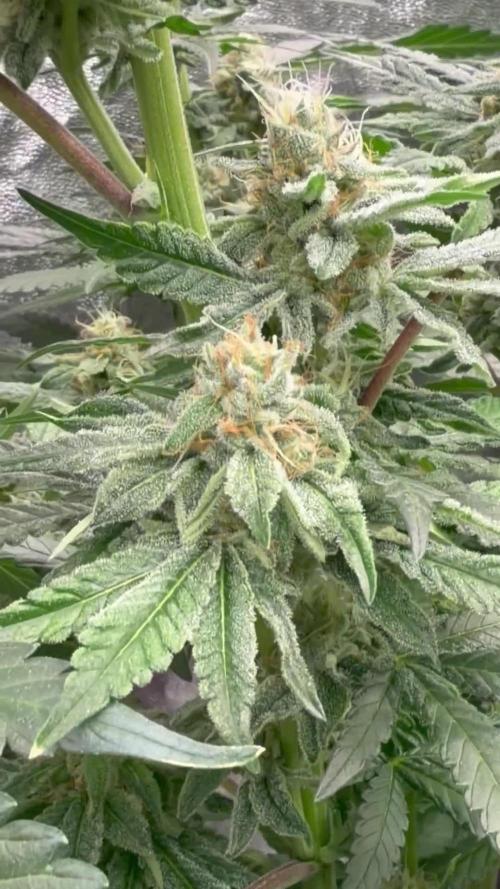
Week6 F start. A lot can happen in a week frozen biscotti #1 Hermied and had to get culled midweek luckily I have FB #2 & #3 and they looking fire smelling like straight vanilla cookies. plucked a few nanners from the zkittlez spread the remaining ladies into centre of the canopy and all looks good to finish. Papaya will be off first in roughly 3 weeks then the FB and Z last in around 4 weeks. Will be stopping pk dead mid week and upping a and b to reach target EC honestly losing 1 plant has been a blessing in disguise humidity is right on track lights are maxed out airflows better and the remaining plants have enjoyed the extra coverage starting to really bulk up now.


Likes
35
Share


@Kirsten
Follow
16.6.25:
Today is Harvest Day!
Well this has certainly been a fun one! Really pleased with how she turned out, when I cut her down, it was actually heavy. I'll be interested to see what we yielded here!
I did take all of the fan leaves off and some of the sugar leaves too. Just to make the trimming easier, and also help prevent mould during the drying process.
The trichomes were very hard for me to tell, but they have quite a lot of amber. So I may have grown some sleeping potion. We will soon find out I guess! 😅
I decided to leave the plant longer than I usually would, I did this to see the difference in effects.
This is a low THC strain, so in theory shouldn't produce a couch lock effect. So if it does, it will give me a better idea of the harvest windows.
Some of you helped choose this strain to grow, so if you've followed along, I hope you enjoyed this journey. Thank you, it was a great choice
Will update when I've finished drying, and then the smoke report!
😊💚✌️🌱👌🍃
Likes
32
Share


@Bread_n_Buds
Follow
We are talking about the harvest day of the first of our two fantastic TEST #2 that have a wonderful strain name, a genetic line still top secret but world-class, Zamnesia created it with love and we tested it before the release.
Wonderful, I'll start by telling you that if I didn't have to try many strains I would probably do entire grows only of this strain. It is truly of the highest level, I grew two plants of an almost ideal phenotype, one left to grow straight and grew out of all proportion and another with a single topping as soon as I noticed that they were becoming immense.
The one you see in the photos is the one with the single topping, lots of cleaning underneath and other lateral brunches that gave us flowers that were nothing short of spectacular. Very long, hard and heavy and you have to see how much resin. I was starting to fear mold but there is no trace of it, for this reason I harvested the plant at the beginning of the harvest window. It's a little early this time but the plant is very indica we can say this and we don't want to make it too soporific so I harvest it very early in the harvest window, very cloudy/milky trichomes, I must admit still something too transparent (when it's a little too much I don't struggle to say it guys but often you exaggerate with the application to the letter of all amber and the plants become soporific, even the sativas, I recommend finding your happy medium and adapting to the characteristics of the plant. Zamnesia has made some very interesting, short and exhaustive posts on instagram).
We also have a lot of body, I did everything to keep these very heavy flowers upright with cotton ropes that held the plant up anchored here and there where I could, I'm 185 cm and it's practically as tall as me, look at what a beautiful monkey face I have in the photo where I demonstrate it.
If I were you I would try it as soon as it comes out. pure TNT, the techniques are highly recommended, next time I grow it I will topping it endlessly and keep it lower. I risk making 200 grams per plant. Do it yourself, doing the math is worth it. And badly.
Once again I have to tell you that I was impressed by how Plagron fertilizers work combined with Plagron soil and all the recommended additives. Do it and I repeat, do not neglect soil and additives.
The plant has eaten the 100% Organic feeding of Plagron: Alga Grow and Alga Bloom as basic nutrients, the rooting Power Roots, the amino acids of Sugar Royal, the Enzymes of Pure Zym that eat the dead parts in the soil, Power Buds that always gives us immense satisfaction with rapidity of start of flowering and composition of the buds, the legendary Green Sensation that now needs no introduction, a name a guarantee. Also the foliar Vita Race used for the first time with success.
The fertilizer kits that you can find on the Zamnesia website are perfect for this purpose, there is everything. Choose them based on their mineral/organic composition and the soil you have chosen.
Zamnesia Strain Description // Strain Coming Soon!
- Get a seed of this fantastic strain --- The strain is a Test check the site for others until the release www.zamnesia.com
at the link --- https://www.zamnesia.io/it/11457-plagron-easy-pack-natural.html
The quantity was measured using the sheet prepared on purpose on the Plagron website based on the soil chosen: Plagron Pro Mix + Perlite.
at the link --- https://plagron.com/en
Air system is the DS120w by Secret Jardin as well as the DF16 ventilation system and all the fans
at the link --- https://www.secretjardin.com/it/
The growbox and The light SP3000 were supplied in the past by MarsHydro and it went crazy but it came back to me to produce very well too...
at the link --- https://marshydro.eu/
A fantastic selection of seeds, a headshop and a selection of exceptional accessories on the world of cannabis, many other things about mushrooms, health, well-being and all the beautiful things that nature offers only on the Zamnesia website
at the link --- www.zamnesia.com
Instagram ----
@zam.nesia - @zamnesiawebshop - @zamnesia_usa - @bread_n_buds
Likes
19
Share


@Lazuli
Follow
She put on the weight very fast once she started flowering, at the harvest there was many amber trichomes at day 84. If u love kush u really have to give her a go, very loud terpines
Processing
Likes
23
Share


@GreenISR
Follow
Day 37 - At last it happened we in flowering stage .
*Added 1L water each one.
*Changing to light to 150W UPLUX
E27
17,200Lm
32,000h
*Light schedule 12/12 -
6AM-6PM DARK
6PM-6AM light
Dy
*Added filtlizer's to the set .
Day 38 - added water with filtlizer 0.5L .
Day 39 - added water 0.5 L
Day 40 - added water with filtlizer 0.5L .
Day 41 - added water 0.5 L
Well It just pass by me to lolipop so I did it :)
Hope it will turn good . .
Day 42 - added 2 L water with filtlizer's ,I have cut some thin brenches .


Likes
21
Share


@Ultraviolet
Follow
Heyókȟa
I desire naught but the study of nature, to find my way back home.
12x12=144, A dodecahedron is a polyhedron with 12 faces, and in coordination chemistry, it refers to a geometry where ligands surround a central metal atom (in this case, Magnesium) in a specific, 8-coordinate arrangement. Dodecahedrane is a hydrocarbon, meaning it's composed solely of carbon and hydrogen atoms. The carbon atoms are arranged at the corners of a dodecahedron, a 3D shape with 12 pentagonal faces. The water molecules in the dodecahedron form hydrogen bonds that are individually slightly weaker than in either the dimer or the tetramer. However, because three-quarters of the O -H groups in the dodecahedron form hydrogen bonds, it has a more negative energy per molecule than has either the dimer or the tetramer. Magnesium (Mg2+) is the essential, central metal ion in the chlorophyll molecule, crucial for photosynthesis by enabling light absorption and energy transfer. It is chelated by four nitrogen atoms within the porphyrin (or chlorin) ring structure. Chlorophyll appears green because it reflects light in the green region of the visible spectrum, specifically between 490 and 570 nm. The main resonance electronic frequency of a neutral Magnesium (Mg) atom corresponds to the transition from the ground state to the first excited state. Resonance Line Wavelength of Mg2+: 285.1nm (UVB light). The central atom of the chlorophyll molecule is Magnesium (Mg2+), which is coordinated within a porphyrin ring. The electronic "resonance frequency" of this central atom—meaning the frequency at which its electrons absorb energy—is primarily driven by the electronic transitions (ETR) of the surrounding conjugated chlorin ring structure, rather than a discrete atomic transition of the Magnesium atom itself. The resonant electronic frequencies of the chlorophyll porphyrin (technically, a chlorin) ring are determined by the energy required to promote π-electrons within its conjugated system, primarily appearing in the blue and red regions of the visible spectrum.
In standard physics, Chloryphyll b has peak absorption at 460nm (Blue). If we take the peak wavelength 460nm and a UV-B, UVR8 peak absorption wavelength 285nm Tryptophan-285 (W285) Sensing protein. 460/285=1.618 Φ, "natural harmony" and the "structure of light". The cryptochrome photoreceptor (CRY) is a UV-A/blue light receptor that shares this dual sensitivity with several other biological structures and functions, including significant sequence similarity and a common evolutionary ancestor with DNA photolyase enzymes. These are light-activated enzymes that use blue/UV-A light to repair DNA damage caused by UV-B radiation in plants.
Dodecahedrane (C20H20) is a hydrocarbon with a cage-like structure where carbon atoms form 12 pentagonal faces (a regular dodecahedron). It is highly symmetric (icosahedral), contains no delocalized electrons (no aromaticity), and has minimal angle strain, but significant torsional strain. Water Dodecahedron (H2O) forms hydrogen-bonded cages. While individual hydrogen bonds in this structure are weaker than in the linear dimer or tetramer, it has a more negative total energy per molecule. This is because three-quarters (75%) of the groups are involved in hydrogen bonding, creating a very stable, closed-shell configuration. a 3D carbon hydrocarbon (C20H20) to stable water clusters in hydrate, while the Magnesium ion acts as the central activator within a conjugated ring in biological systems, with its electronic absorption dominated by the ring, not the atom itself.
Effective quantum efficiency of photosystem II, often denoted as ΦPSII
In horticultural lighting, adding 730 nm (far-red) LEDs alongside standard red/blue lights has been shown to increase canopy photosynthesis by 20–30% in several crops by acting synergistically with shorter wavelengths. However, the limitation is that excessive, pure IR/Far-red light (without accompanying red light) can trigger the "shade avoidance response," causing plants to grow tall, weak, and spindly rather than robust. Knowing is half the battle however, engineering or utilizing infrared light (specifically the 700-750 nm far-red range) is a viable method to boost photosynthetic efficiency. It acts as a bridge to allow PSII to utilize a broader spectrum of light, breaking the traditional 700 nm barrier.
Extend, then multiply.
UVR8-mediated signaling (often in conjunction with CRY proteins) triggers protective mechanisms that maintain the stability of the photosynthetic apparatus (including LHCII and reaction center proteins), thus ensuring that the efficiency of Photosystem II remains higher in UV-B-exposed plants compared to plants lacking this receptor. ΦPSII indictates the rate of electron transfer from water to plastoquinone, which drives the production of ATP and NADPH. There is a close link between ΦPSII and the true rate of CO2 fixation (Φ*co2), particularly in C4 plants.
Effective quantum efficiency of photosystem II, often denoted as ΦPSII, represents the proportion of light absorbed by Photosystem II (ΦPSII) that is actually used in photosynthetic electron transport. It is a key indicator of how efficiently a plant is using light for photosynthesis, as opposed to losing it as heat or fluorescence. ΦPSII (effective quantum yield of photosystem II) functions primarily as a "multiplier" (a coefficient of efficiency) rather than an additive factor when estimating the overall photosynthetic electron transport rate (ETR). Multipliers are considered far more beneficial than additions because they generate exponential growth, leverage existing resources to their full potential, and create sustainable, self-multiplying capacity, rather than just incremental, linear increases.
Humans, and most other mammals, rely on other mechanisms, such as nucleotide excision repair, to manage and repair UV-induced DNA damage. As such, humans do not have the direct, light-driven repair mechanism that photolyase offers in plants.

Likes
39
Share


@dancingshrubbery
Follow
Things are going good, I am beginning to think about when to harvest. I have tried capturing some microscope shots of the trichomes with a 15x macro lens (BlitzWolf), but they turned out awful. They still look transparent and glasslike, and I did not see many, if any, amber trichomes.
I am going on vacation next week, and wonder if plant will be fine with not being harvested before the 8th of July, two weeks from now.
Day 3: Watered
Day 4: Macro shots. Trichomes look transparent and glasslike, but since this is my first grow, any input from experienced growers is very welcome :-)
Day 7: Watered. No amber trichomes in sight, I will wait one more week before the harvest.

Likes
92
Share


@Hou_Stone
Follow
I preferred to remove my net this week, to more easily access my plants and water them. I hope the branches will hold
I cut a lot of leaf this week. I hear different opinions that say it's beneficial others not... At least it will have the advantage of lowering the humidity.
---------------------------------------------------------------------------
- Water: tap water at 300 PPM, I add 0.7G of Hybrid powder and 0.3g of booster PK+ per liter to reach 950PPM and I adjust the PH to 5.8. I watered daily until water drained from the pot (to release nutrients from previous waterings) and I take a 3-4 day watering break to let it dry out before resuming a daily watering schedule.
-Daytime temperature: 22-26°C
-Night temperature: 20-24°C
-Humidity: 50-75% ( Too high but it's hard to lower it... I need advice please contact me if you have :) )
-Lamp: Mars Hydro FC3000. intensity 90% at 35cm from the top leaves
-Room: Mars Hydro 100x100x180cm
-Extractor: Mars hydro 402 CFM Max. power 3/10
-Substrate : 70% coco, 25% perlite, 5% vermiculite.
My instagram : https://www.instagram.com/p/CuMhQ_BsjRP/?utm_source=ig_web_copy_link&igshid=MzRlODBiNWFlZA==
Looking for MarsHydro equipment for your crop? 🔥
You can use my promo codes! 🙏😻
3% off with "houstone3" for: TS LED Grow Light, Tent, Ventilation
5% off with "houstone5" for: FC&FC-E&SP LED Grow Lights; Grow Tent Kits
https://www.mars-hydro.com/?acc=hou-stone

Likes
2
Share


@Dico29
Follow
Finally coming to a close. I started this thing almost 5 months ago in the middle of the woods... the nugs are the densest I have grown so I’m excited to see how it finishes.
I also have this northern light auto next to it with a nice layer of trichomes