




@DogDoctorOfficial
Follow
💙 Project Blue Tent – Week 13 💙
🥒 Pickle Lemon Haze F1 – Pheno B
🌸 OH MY GOD, SHE'S BEAUTIFUL! Frost, White Pistils, and Another Girl Approaching the Finish! ❄️😂
Hello everyone, and welcome back to another chapter of Project Blue Tent! 💙🌱
My friends, seriously...
IS SHE BEAUTIFUL, OR IS SHE BEAUTIFUL?! 😂❄️
Every week, I walk into this room thinking I already know what to expect. Four girls, two cultivars, the same environment, the same equipment, and the same general approach.
And then I look at the flowers again.
And there I go, grabbing the camera and spending another ridiculous amount of time admiring these girls!
😂📸💙
This week, we're giving Pickle Lemon Haze F1 – Pheno B her own spotlight.
And what a beautiful girl she is!
She's dense, compact, seriously frosty, and carrying plenty of those beautiful white pistils. Her colours are developing towards lighter shades, and much like her Pickle Lemon Haze sister, she's showing a different finishing progression from our Blue Waffle F1 girls.
The flowers are looking fantastic, the aroma is amazing, and I'm genuinely curious to see how everything develops from here.
Will the Pickle Lemon Haze girls need more time than the Blue Waffles?
Will we end up harvesting some plants before the others?
Or will the entire room surprise us and finish closer together than we're expecting?
Let's see, my friends!
We're not going to decide the ending before the plants show us what's happening.
For now, we're keeping the ecosystem running, making our latest environmental adjustments, reducing the nutrient concentration, and observing each plant individually.
Same room. Same equipment. Same passion.
But every girl has her own story.
And today, Pickle Lemon Haze F1 Pheno B is the star of the show!
💙🥒🌸
🌿 SAME TENT, SAME ECOSYSTEM – FOUR PLANTS, TWO CULTIVARS
Let's begin with the bigger picture.
Project Blue Tent brings together four plants sharing the same growing environment.
We have two Blue Waffle F1 plants and two Pickle Lemon Haze F1 plants.
They're sharing the tent, the irrigation system, the reservoir, the overhead lighting, the supplemental under-canopy lighting, and the general environmental conditions.
We're maintaining a consistent approach across the room while documenting each plant separately.
And this is where things get interesting.
Even when plants share the same environment, their individual development doesn't have to be identical.
Different cultivars can express different characteristics, and individual plants can show their own variations as flowering progresses.
That's exactly why we're keeping separate diaries.
We want to document what we actually observe rather than treating all four girls as one identical group.
And Pickle Lemon Haze F1 Pheno B has plenty of individual characteristics worth documenting.
She's compact and dense, with beautiful flowers, impressive frost, lighter colours, and plenty of white pistils still showing.
She's looking fantastic, but her progression appears a little different from the Blue Waffle girls.
We're not going to assume that means we know her exact harvest date.
Instead, we'll continue observing her development alongside her sisters and see where the journey takes us.
That's what makes this project so enjoyable.
Four plants. Two cultivars. One ecosystem.
And four individual stories unfolding side by side!
💙🌱
🌸 PICKLE LEMON HAZE F1 PHENO B – DENSE, COMPACT, AND ABSOLUTELY FROSTY!
Let's talk about this beautiful girl!
One of the first things that catches my attention is her flower development.
The flowers are looking dense and compact, with an impressive amount of visible frost across the developing buds and surrounding sugar leaves.
The structure is established, the flowering sites are developing throughout the plant, and we're now concentrating on observing how everything progresses towards the finish.
This is the stage where I love comparing the photographs from different weeks.
Earlier in the project, our attention was focused on building the structure.
We were topping, training, managing the canopy, performing defoliation, and supporting the branches through the flowering stretch.
Now, we can appreciate the results of that earlier work while giving the flowers the attention they deserve.
And Pheno B certainly deserves it!
She's beautiful from a distance, but the close-up photographs reveal another level of detail.
The trichomes, the pistils, the flower structure, and all those little details that make macro photography so rewarding.
Honestly, my friends, I could spend hours looking at these photographs.
And knowing me, I probably will!
😂📸❄️
? WHITE PISTILS – SHE'S STILL WRITING HER STORY
One of the most noticeable things about Pheno B this week is the number of white pistils still visible across her flowers.
They're giving the buds a beautiful appearance, and they're one of the characteristics that stand out when we compare her with the Blue Waffle girls.
The Pickle Lemon Haze plants are showing lighter colours and still have plenty of white pistils, while the Blue Waffles appear to be progressing towards the finish a little faster.
At least, that's what we're observing at the moment.
And I find that fascinating!
We're keeping the same general environment and nutritional approach across the room, yet the plants are showing differences in their development.
Of course, white pistils alone don't determine whether a plant is ready for harvest. Their appearance can vary throughout flowering, and different parts of the same plant can mature at different rates.
So we're looking at the complete picture.
The flowers, the trichomes, the pistils, and the overall development of each individual plant all matter when we're assessing maturity.
For now, Pheno B is still showing plenty of white pistils, and we're going to keep watching her closely.
There's no need to rush.
She'll tell us more as the weeks progress, and we'll document what we see.
💙🌸
🎨 LIGHTER COLOURS – ANOTHER INTERESTING DIFFERENCE
Something else I'm enjoying observing is the colour development.
Pickle Lemon Haze F1 Pheno B is showing lighter colours as she progresses through flowering.
Compared with the Blue Waffle girls, her appearance is taking a different direction.
And that's one of the things that makes growing different cultivars in the same environment so interesting.
The same room doesn't mean every plant will express the same colours or follow precisely the same visual progression.
Genetics, plant development, and environmental conditions can all influence what we see.
We're not going to attribute every difference to one particular cause without enough evidence.
Instead, we're recording the observations and comparing the plants as the project continues.
Right now, Pheno B is looking beautiful with her lighter colours, dense flowers, and impressive frost.
And if she continues developing in the direction we're seeing now, I'm very curious to see how her appearance changes over the coming weeks.
The Blue Waffles are showing their own characteristics, while the Pickle Lemon Haze girls are giving us another expression to appreciate.
Same ecosystem, different expressions.
That's the beauty of documenting the individual plants!
💙🥒🌿
❄️ THE FROST – AN ABSOLUTE PLEASURE TO PHOTOGRAPH
I know, I know.
I keep talking about the frost.
But look at her!
😂❄️
The close-up photographs reveal beautiful details across the flowers and sugar leaves, giving us another opportunity to appreciate the plant beyond what we can see from a normal viewing distance.
This is why I enjoy macro photography so much.
When you're looking at an entire plant, your attention naturally goes towards the overall structure, the canopy, and the distribution of the flowering sites.
But when you get closer, the details become the main attraction.
The trichomes.
The pistils.
The textures of the flowers.
The small features that make every close-up worth examining.
And Pheno B is giving us plenty to work with!
The visible frost is impressive, and I'm genuinely happy with the photographs we've managed to capture.
We're not simply taking pictures to fill the diary.
We're creating a visual record of the plant's development, allowing everyone following Project Blue Tent to see more of what we're observing inside the tent.
And honestly, I think that's one of the best parts of documenting a grow.
We can share the experience with the community, even when everyone can't be standing beside us looking at the flowers.
So, my friends, enjoy the photographs!
Because this girl deserves every bit of attention she's getting.
💙📸❄️
📸 THREE PHOTO STACKS – 664 PHOTOGRAPHS COMBINED!
And now, let's talk about the photography!
For Pickle Lemon Haze F1 Pheno B, we created three separate photo stacks.
Here's the breakdown:
Photo stack 1 – 204 photographs.
Photo stack 2 – 213 photographs.
Photo stack 3 – 247 photographs.
That's a combined total of 664 individual photographs across the three stacks!
😂📸
Now, that's a considerable amount of work for a few final images.
But that's part of the fun.
Focus stacking allows us to combine photographs taken at different focus distances to create a final image with greater depth of field.
When we're photographing small details, the area in focus can be extremely narrow.
One part of a flower might be perfectly sharp, while another section just a little further away falls outside the focus plane.
By combining multiple frames, we can bring more of those details into focus in the finished image.
Of course, the quality of the result depends on the original photographs, the shooting conditions, and how well the stacking process handles the images.
But when everything comes together, the results can be beautiful.
And that's what we're trying to achieve with these stacks.
We created three different views of Pheno B, each giving us another opportunity to appreciate the flower structure and visible frost.
Some of the other girls have more stacks this week, while Pheno B has three.
That's simply how the photography worked out.
Every plant presents different opportunities, and we're working with the time and conditions available to us.
The goal isn't to produce the same number of photographs for every diary.
It's to document every plant as well as we can.
Three stacks. Hundreds of frames. One beautiful Pickle Lemon Haze F1 Pheno B!
And I'm delighted to have them included in her diary.
💙📸🌸
💡 OVERHEAD LEDS – GRADUALLY REDUCING THE OUTPUT
Now, let's move back to the shared room setup.
We're continuing to adjust the overhead lighting as the plants approach the final stage.
The current approach is to run the main LEDs at approximately 90% and gradually reduce the output by around one or two percentage points per day.
We're taking a measured approach rather than making sudden changes.
The objective is to manage the lighting while observing the plants and maintaining a balanced environment.
More light doesn't automatically guarantee a better result, and maximum output isn't necessarily the goal at this stage.
We've already established the canopy and completed the major structural work.
Now we're concentrating on the final stage of development, making deliberate adjustments and observing the plants' responses.
The lighting is one part of the system, but it doesn't work in isolation.
Temperature, humidity, airflow, irrigation, and the condition of the plants all matter too.
So we're continuing to look at the complete environment rather than focusing on one setting alone.
And, as always, we're documenting what happens rather than promising a particular outcome.
💡🌿
💡 TWO LUMIFLORA 150W FIXTURES – UNDER-CANOPY LIGHTING
The two LumiFlora 150W full-spectrum under-canopy fixtures remain part of our setup.
They're arranged in an X-cross configuration beneath the canopy, supplementing the primary lighting from above.
For now, we're keeping their output around 90–95%, with the possibility of reducing it closer to the end.
The purpose of this experiment is to explore supplemental lighting beneath the canopy and observe how the lower flowering sites develop.
With a substantial plant structure, the amount of light reaching different parts of the canopy naturally varies.
That's why we're interested in seeing how the lower portions of the plants develop under this arrangement.
We're not assuming that the additional lighting automatically produces a particular result.
Instead, we're documenting the setup, keeping the other conditions as consistent as possible, and observing the plants as they progress.
This is one of the interesting aspects of Project Blue Tent.
We have the equipment, we have the plants, and we have the opportunity to follow the development over time.
And now we're watching the results unfold.
💙💡🌿
🌡️ TEMPERATURE AND HUMIDITY – PREPARING FOR THE FINISH
The temperature adjustments apply to the entire room, so Pheno B is sharing the same general environmental conditions as her sisters.
Our current approach is to maintain a daytime air temperature around 25°C and bring nighttime temperatures down to approximately 19–20°C.
The solution and substrate temperatures are being kept around 21°C.
We're also maintaining our normal relative humidity target of approximately 55%.
These adjustments form part of our approach as the plants move towards the final stage.
We're looking at the relationship between temperature, humidity, lighting, and plant development rather than treating each parameter separately.
We want to maintain a balanced environment and observe how the different cultivars respond.
One interesting detail is that the Pickle Lemon Haze girls are showing a different visual progression from the Blue Waffles.
However, we're not assuming that the temperature adjustments alone explain those differences.
We're recording what we see and allowing the individual plants to show us how they develop.
If the room conditions remain stable while the plants continue progressing, we'll have a clearer record of what happened throughout this stage.
And that's exactly what we want from this project.
Consistent records, individual observations, and no unnecessary assumptions.
💧 IRRIGATION AND DRAINAGE – THE SAME SYSTEM FOR ALL FOUR GIRLS
The automatic irrigation and drainage system continues supporting the four plants.
All four girls share the reservoir, which allows us to maintain the same general nutritional approach across the tent.
The recorded watering volume is approximately 1.6 litres per plant over 24 hours.
That's the reference value in the diary, although actual demand can still vary between individual plants.
We continue monitoring the system and observing the plants rather than assuming that every plant will behave identically.
The irrigation setup is an important part of the overall ecosystem, but when everything is running as intended, we don't need to make unnecessary changes.
The goal is to maintain consistency while allowing us to concentrate on the plants themselves.
And that's what we're continuing to do this week.
The system remains established, the plants are progressing, and our attention is increasingly focused on the flowers and the approaching finish.
💧🌱
⚗️ NUTRITION UPDATE – LOWER EC, GREEN SENSATION DISCONTINUED
Now, let's document the current nutrient program correctly.
As explained in the previous Project Blue Tent reports, we've stopped using PLAGRON Green Sensation.
We've also reduced both Hydro A and Hydro B, while keeping Power Buds in the recipe for the moment.
This is an important change because it explains why the EC has come down.
We're not simply reducing the A and B components while leaving the entire previous recipe untouched.
Green Sensation has been removed from the current mixture as well.
At this late stage, I've decided that I don't need to continue adding the PK product to the reservoir.
The current recorded recipe is:
PLAGRON Hydro A – 1.8 ml/L
PLAGRON Hydro B – 1.8 ml/L
PLAGRON Power Buds – 1 ml/L
PLAGRON Green Sensation – discontinued
PLAGRON pH Plus and pH Minus – used as required for pH adjustment
The current diary readings show a pH of approximately 6.0 and an EC of 1.86 mS/cm.
We're continuing with the lower nutrient concentration and monitoring the plants as they progress.
The pH target remains close to 6, with small variations being acceptable within our intended range.
We don't need to chase an absolutely fixed number throughout the day if the reading is already where we want it.
We monitor, adjust when necessary, and keep the records accurate.
Because all four plants share the same reservoir, this nutritional adjustment applies to the entire tent.
That consistency is an important part of our approach.
And just as importantly, the written diary needs to reflect what we're actually using.
From this week onward, we're recording Green Sensation as discontinued, Hydro A and B at the reduced rates, and Power Buds as remaining in the recipe for now.
That's the current situation, and that's what we'll continue documenting.
💙🌱
🥒 PICKLE LEMON HAZE VS. BLUE WAFFLE – WHO WILL FINISH FIRST?
This is the question I'm really looking forward to answering!
We have two different cultivars growing side by side in the same tent.
The Blue Waffle girls appear to be progressing towards the finish faster, while the Pickle Lemon Haze girls are still showing plenty of white pistils and lighter colours.
Both Pickle Lemon Haze plants are looking beautiful, dense, compact, and frosty.
But their visual progression appears to be a little slower than that of the Blue Waffles.
And now I'm curious to see what happens next.
Will the Blue Waffles be ready first?
Will the Pickle Lemon Haze girls need additional time?
Will we have a staggered harvest, or will the plants come closer together as flowering progresses?
I genuinely don't know.
And I don't want to pretend that I do!
The appearance of the pistils and the colours of the flowers are useful observations, but they don't tell us everything about maturity.
We'll continue checking the trichomes, observing the flowers, and looking at the overall condition of each individual plant.
The decision will be based on the plants themselves, not simply on the fact that they're sharing the same room.
If some girls are ready before the others, we'll have to decide how to manage that.
If they all finish together, fantastic!
Either way, I'm looking forward to seeing how the four individual stories come together.
This is exactly why keeping separate diaries is worthwhile.
We can follow each plant individually and compare their progress without assuming that they'll all follow the same timeline.
Let's see what the next chapter brings!
😂💙🌸
🔭 WHAT I'M WATCHING NEXT
As we move closer to the finish, my attention is on the details.
I'm watching the flower development and the changing appearance of the pistils.
I'm monitoring the trichomes and the overall maturity of Pheno B.
I'm observing how the lighter colours develop and whether her appearance continues changing over the coming weeks.
I'm also watching the effects of our gradually reduced overhead lighting output, the supplemental under-canopy lighting, and the lower nutrient concentration.
And, of course, I'm comparing her progress with that of her Pickle Lemon Haze sister and the two Blue Waffle girls.
Will the differences in their development become more noticeable?
Will the Pickle Lemon Haze plants continue taking their time?
Will the Blue Waffles be ready first?
We'll keep documenting the journey and let the plants answer those questions.
No rushing.
No assumptions.
Just observation, patience, and plenty of photographs!
💙📸🌿
💙 FINAL THOUGHTS – OH MY GOD, SHE'S BEAUTIFUL!
My friends, what a pleasure it is to document this girl!
Pickle Lemon Haze F1 Pheno B is looking absolutely fantastic.
She's dense, compact, seriously frosty, and carrying plenty of beautiful white pistils.
Her colours are moving towards lighter shades, and her overall progression appears a little slower than that of the Blue Waffle girls.
But that's exactly what makes this stage so interesting.
We have four plants sharing the same room and the same general conditions, yet we're seeing differences in their development.
The lighting setup remains established, the under-canopy fixtures continue supplementing the main LEDs, and the irrigation system keeps supporting the plants.
We've reduced the nutrient concentration, stopped using Green Sensation, and kept Power Buds in the recipe for now.
We're also gradually lowering the overhead LED output and maintaining the cooler environmental conditions we've established for this stage.
And through all of this, Pheno B is continuing to give us plenty to admire.
The photographs are beautiful.
The frost is impressive.
The aroma is amazing.
And I'm genuinely curious to see how she develops from here.
Will she finish after the Blue Waffles?
Will the Pickle Lemon Haze girls need a little more time?
Will we harvest the room in stages?
Let's see!
For now, I'm happy to keep observing, keep documenting, and give every girl the time she needs.
Because that's what this project has always been about.
Learning, experimenting, appreciating the individual plants, and sharing the journey with the community.
Same tent.
Same ecosystem.
Same passion.
Same love.
But every plant deserves her own moment in the spotlight.
And today, that moment belongs to Pickle Lemon Haze F1 Pheno B.
She's beautiful, my friends.
Simply beautiful!
😂💙🥒🌸❄️
💬 COME JOIN THE DOGDOCTOROFFICIAL DISCORD COMMUNITY!
And before we finish, the invitation remains open to everyone!
If you're already part of our Discord family, you know how much fun we have together.
And if you haven't joined yet, come and say hello!
We welcome growers of all experience levels who want to share their gardens, exchange ideas, discuss equipment, share photographs, and learn from one another.
It's a place to meet people who enjoy the same hobby, ask questions, and become part of the community.
We also organize giveaways and photo championships, with prizes for the winners!
So don't be shy.
Come introduce yourself, share what you're working on, and join the conversation.
💙 DogDoctorOfficial Discord:
https://discord.gg/dogdoctorofficial
Everybody is welcome!
🙏 A HUGE THANK YOU
A huge thank you to Zamnesia for making Project Blue Tent possible and giving us the opportunity to document these beautiful Blue Waffle F1 and Pickle Lemon Haze F1 plants individually.
Thank you to PLAGRON for the Hydro nutrient line supporting this project and helping us document the nutritional changes throughout the journey.
A massive thank you to Zamnesia for the Phytonaut LED lighting, curved scissors, and clip fans that have become important parts of this ecosystem.
Thank you to Mars Hydro for the irrigation and drainage equipment helping us maintain consistency throughout the tent.
And a special thank you to LumiFlora for the 150W full-spectrum under-canopy fixtures that we're using to explore supplemental lighting beneath the canopy.
Thank you to GrowDiaries for giving us a platform where we can document the plants, share our photographs, record our observations, and learn from the entire process.
And, of course, thank you to everyone following Project Blue Tent!
Your support makes sharing every individual chapter even more enjoyable.
Four plants. Two cultivars. One beautiful ecosystem.
We're getting closer to the finish, but there's still plenty to observe, photograph, and appreciate.
Until next week, my friends...
Keep growing.
Keep learning.
Keep taking photographs.
And keep enjoying the journey!
Growers Love, happy growing, and take care everyone! 🌱💙🥒🌸❄️



@Jef79
Follow
SWEETSEEDS
JACK47
Variety SWS31
Indica: 20% / Sativa: 76,9% / Ruderalis: 3,1%
THC: 18-21% · CBD: 1,1%
Indoor Yield: 450-600 gr/m2
Outdoor Yield: 50-200 gr/plant
Indoor/Outdoor Harvest: 9 weeks from germination
Height: 50-120 cm
Excellent auto strain.. Had a bit of problem with excess light and under watering but that is growers error on my side.. Great experience growing her and she helped me learn more about automatic strains.. Beautiful sativa dominant strain with fluffy flowers with big bulbous buds as tops.. Very nice clean high that will keep you happy and focused..
https://www.viparspectra.com/?aff=454&utm_source=affiliate
https://partners.viparspectra.com/create-account?ref=454
Coupons -
code: Itxsgdvip
code: JEF
https://www.amazon.com/dp/B08CHCFCG1?ref_=ast_sto_dp


@Canadian_Bud
Follow
26-11-2022
Off to a good start, She is a little high in the cube but I'll fixer up once she getts further on in her cycle.
Starting off with a small deep water culture 2 gal with airstone. Going to make it a lot easier to just pass her into the Aeroponic envirnment. Less shock and gives me a chance to put her in a 5 gal bucket with clean fresh temperater adjusted water prior to her switch in a few weeks.
She's got her first wings!😎
1-12-2022
This one is getting a little stem strength help for now. increased light intensity to 80%. Showing her first wings with a little dance. 😎


@Reaper
Follow
week 3 veg
doing some lst, branches should grow a bit more instead of the middle stem so far its going well

shorts_status_processing


@Barcelona_Farmers710
Follow
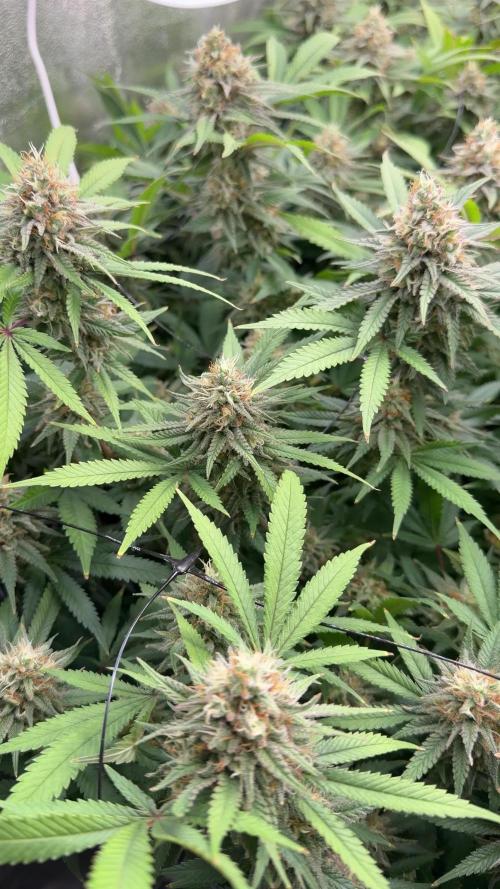
Mientras yo me divertía en la spannabis las niñas se ponian cada vez mas resinosas farmers!! Solo basta ver la shining haze para darse cuenta que el mammoth p es brutal!!👌🏻




@bigsmoke42069
Follow
Week 7 (1.11.26--1.18.26)
took photos on 1.12.26
1.11.26
Transitioned to ripen at 1x1


@Calveeno
Follow
Happy Monday Folks!
Branches are starting to sway from the weight of the growing buds.
Topping up every other day with Week 8.
Hands down, Bloom is my favorite phase to watch.
I've uploaded a couple of videos for your viewing pleasure.
'til next time, Stay Tuned and Stay Blessed! 🙏


@GoldenWeedGrower
Follow
Legend
Timestamp: 📅
EC - pH: ⚗️
Temp - Hum: 🌡️
Water: 🌊
Food: 🍗
pH Correction: 💧
Actions: 💼
Thoughts: 🧠
Events: 🚀
Media: 🎬
D: DAY, G: GERMINATION, V: VEGETATIVE, B: BLOOMING, R: RIPENING, D: DRYING, C: CURING
______________
📅 D08/V04 - 23/04/24
⚗️ EC: 0.8 pH: 6
🌡️ T: 24 °C H: 55%
🌊 6L
🍗 Calmag - Grow A-B - B52
💧
💼
🧠
🚀
🎬
______________
📅 D09/V05 - 24/04/24
⚗️ EC: 1.0 pH: 6.2
🌡️ T: 22 °C H: 65%
🌊
🍗
💧
💼
🧠
🚀
🎬
______________
📅 D10/V06 - 25/04/24
⚗️ EC: 1.1 pH: 6.3
🌡️ T: 21 °C H: 60%
🌊
🍗
💧
💼
🧠
🚀
🎬
______________
📅 D11/V07 - 26/04/24
⚗️ EC: 0.8 pH: 6.1
🌡️ T: 21 °C H: 55%
🌊 3L
🍗
💧
💼
🧠
🚀
🎬 1 TL video
______________
📅 D12/V08 - 27/04/24
⚗️ EC: 0.7 pH: 6.0
🌡️ T: 21 °C H: 50%
🌊
🍗
💧
💼
🧠
🚀
🎬 1 TL video
______________
📅 D13/V09 - 28/04/24
⚗️ EC: 0.7 pH: 6.0
🌡️ T: 21 °C H: 50%
🌊
🍗
💧
💼
🧠
🚀
🎬 1 TL video
______________
📅 D14/V10 - 29/04/24
⚗️ EC: 0.7 pH: 6.0
🌡️ T: 21 °C H: 50%
🌊
🍗
💧
💼
🧠
🚀
🎬 1 TL video


@McGrowin
Follow
72 grams of dried and semi-cured creamy buds. smooth smoke already despite the need to drop humidity below 59% fully. not much larf surprisingly but will be fun to see how much hash each strain gets considering others in the tent had way more.
Harvest: somewhat early, but solid nugs and yield - easy trimming and quick to dry compared to other leafy varieties
terps: creamy dough mostly with hint of sweet cinnamon sugar vanilla - just like the pack says, but still not impressed really
Drama about these seeds: got store credit on the pack of 3 seeds just because of website change to outdoor only after purchase date. excited to grow other HSC strains next year.






@AsNoriu
Follow
Added first time molasses during feeding will be doing it for last 3 weeks before flush.
For couple plants with redish leaves stems gave epsom salt. Thinking to give it to all of them.
To me they look too skinny, but its aftermath of strech i quess ...
Would love to have one more hlg 240 ...


@Mr_nugs_lover_David
Follow
The 5 seedlings are looking very healthy and developing at a very very fast pace, I'm happy with their development so far, the 5 seeds have turned into gorgeous little seedlings with a perfect development, I Can't wait to see this ladies produce their flowrs and see what we find in this autoflowering version of lemon cream kush by spliff seeds, 100% organic grown using FLO (living soil blend and water)


@HideAndFly420
Follow
This week was really great except for some weather problem, cold is came a little bit earlier and i m still fixing something in the grow box. Roots are really large and strenght.
Flowering started exactly in the 28 day.
Let's go!


@Major
Follow
muy, muy buena semana, las flores se están formando cada vez más y cada vez más grande. Tenía una docena de hojas que se han vuelto amarillas. Creo que espero demasiado para que la tierra se seque. 110 cm en algunas plantas hasta ahora está bien va


@Greensoul920
Follow
Lady are grow bigger and bigger! Today I will defoliate for the last time. Nothing to say they are perfect and very happy!!🍁







@XII_XII_EarlyRaver
Follow
This past week nothing strange happend, she has a new home the marshydro 100x100x180 and new light from vipar the p2000 and she really loved the new gear so happy days !! She is going strong so lets continue like this 💪💪


@The_Doctor_Green
Follow
Volvi a transplantar esta planta a una maceta mas grande (de 3 litros) , regue con micorrizas,y por ahora se la ve bien.
Todavía estoy pensando si mas adelante no la paso a tierra de forma definitiva porque hacer eso requiere de más dedicación y cuidados.
Para aquellos que seguian los diarios de la amnesia y og kush, les comento que en la última semana me atacaron los plantines algun bicho que destruyeron por completo dichos plantines.🤦♂️🤦♂️