Likes
Comments
Share
You can find tbe first week of all girls on my profile, second week is missing coz its just boring and now i start week 3 so its day 15 today from placing seeds to germination. Uploaded a video of their habitat, i still wont name each one indifidually coz i still didnt choose winners / keepers. Unfortunatelly i have a bit low RH for this stage of growth but they obviously dont mind, i spray them twice a day, no burns from spraying with lights on, no electroshocks caused by spraying so all good now. I tried it all enough to be able to say i cant be assed anymore :D Since @growdiaries are not keen on resolving a problem with uploading each pic individually on androids, i will keep one diary for all girls, dont even mind not being able to compete in dom. Stay tuned these girls will rock.
Likes
11
Share
@WIKETFOLE
Follow
She has very nice smell already, I think his bloom will be very sticky and satisfying ,Already Its 5th week and she’s getting bigger and bigger.
Likes
16
Share
This week made a few oopsies . I gave un-ph’d water to one of the plants “moving to fast” . Started defoliation during this week to attempt to redirect plant energy into establishing a full canopy since flowering has initiated. Whilst defoliating I broke a branch that had to be taped to save it. Humidity went out of whack when I stored 4 prepped 5 gal pots for transplant in the tent sooo I’ve got to buy a dehumidifier bc at one point all my plants fell out in a fit . STILL haven’t filled these pots out, & I’m kinda sure/unsure it’s time to re-amend the soil for flowering. I’m conflicting on waiting until beginning/middle of week 7 so I can flush week 11 & 12 . I think that covers it pretty well Week 5 in the 📚 📕 📖.
Likes
12
Share
@Siriuz
Follow
Sorry for the delay on the updates guys I am a daddy of a newborn baby boy and it's really time consuming plus the Mary ladies but we keep on the great work nothing wont stop us we go all the way up! Alright here you go Day 87 Starting week 13 Day 88 Gorgeous grapefruit smells like heaven Day 89 Again sorry for the late update but being a first time daddy leaves you without time Day 90 She's gorgeous isn't she? (alright guys so what happened here was that I started flushing too early and took advise from other canngrower and instantly added again all nutes, that's why I left her a lil longer until week 14 when I started to flush again, we are going to show you very well what we did, since it was our first time we were unsure if flushing at week 11 was alright but then we decided at week 12 that she could stay longer and she did) You might say we wasted some nutes but in terms of reality we did not, because we have a full bottle of 3.7gal mix with flora nova grow and flora nova bloom in the other, measuring ppm always to make sure we got the correct amount, otherwise we add more water or more nutes depending on the plant needs but we never waste away all precious nutes are precious resources, in this part of Latin America is really hard to find anything good, so we got to bring everything from Europe or United States that's why we doing the best we can with the money we got. Hey any donations are more than welcome if you guys like what we do, yeah it's risky around here but we don't give a F. You know that patients need their medical cannabis and Id say I'm one of them And by the way very proud Peace and love canna growers We will continue to fill the grow diaries
Likes
2
Share
@xipo86
Follow
Day 70 RS11 on there last days... planning to chop by friday.. BFO still has some way to go... easy another 2 weeks. Loud Terps comming when i open the tent...
Likes
2
Share
@youdan
Follow
siamo nella seconda settimana e tutto va velocissimo, prossima settimana iniziero l'allenamento, vorrei poter fare 8 apicali perfetti sperando di farcela.
Likes
2
Share
We become aware at such times of man's wonderful ability to bring seemingly unrelated elements into harmonic balance, and receive a glimpse into a world where everything exists in conscious sympathetic attunement to everything else. When we listen to a piece of music that seems to strike a beautiful chord somewhere inside us, or view a painting that simply glows with harmonic awareness well executed, we probably do not spare much time to contemplate the wonderfully intricate combination of vibrations that our sensors make it possible for us to perceive. We tend to appreciate the relationship between the parts of something by an awareness of the harmony or dissonance of the whole. This ability enables us to say "what a beautiful house!" instead of "analysis has proven that this collection of building materials exhibits certain elements of harmonic proportion." While this ability to instinctively appreciate the beauty of true harmony has an important role to play in evolution, a more analytical understanding of the laws involved can be most useful. This is especially so if we wish to create works of art where each part exists in true harmony, not only with the other part of that particular whole, but with the universe within which the creator and the created exist. Everything vibrates. From the most dense matter to the most subtle cosmic rays, everything which our senses allow our thoughts to become aware of, can be specified in terms of wavelength or frequency of vibration. These two terms define the same thing, but from different points of view. The following are the approximate wavelengths of various energy carriers: Cosmic rays 0.000,000,001 mm Gamma rays 0.000,000,1 mm X rays 0.000,500 mm Ultraviolet rays 0.003 mm Visible light 0.006 mm Infrared 0.01 mm Sound waves 1 meter Radio waves 300 meters Violet light 400 nm to 450 nm Blue light 450 nm to 500 nm Green light 500 nm to 570 nm Yellow light 570 nm to 590 nm Orange light 590 nm to 610 nm Red light 610 to 700 nm 1 nanometer (nm) = 0.000,000,1 cm = 1/10,000,000 cm If a guitar string is plucked and we hear a sound, it is not too difficult for the human mind to associate this sound with the vibration of the guitar string. With color it is quite different. It is difficult for us to conceive that the color of a substance is not an inherent property of the substance itself, but an indication picked up by our senses of that substance's ability to absorb or reflect the light which happens to be shining on it at that moment. Neither the matter nor the light is colored. What happens is that the brain learns to differentiate between the frequencies reflected or transmitted by the substance the eyes are focused on. The same thing happens with sound. When we say "Oh! Listen, they're playing my favorite song," what we really mean is: "My brain has stored within it a particular pattern of frequencies. I have compared the new information being received with this stored pattern and have deduced the answer that the two patterns are similar within certain specified tolerances." The 'pleasure' involved could have something to do with our running the pre-recorded pattern at the same time, in 'sympathy' with the new pattern as it is received. The word sympathy describes very well our ability to appreciate color and sound. It also describes the reason behind certain elements of harmony. For instance, if a substance vibrating at 100 cycles per second (tone 1) is in the proximity of another substance vibrating at 200 cycles per second (tone 2), we could perceive, if we had the right equipment, a certain sympathetic relationship between the two. We will see from this that there is a uniform doubling of the first tone seen in the second. At various points along the waves, the two are the same in amplitude. At other points, they are at opposite poles to each other. This doubled frequency has more points of similarity to the original than any other frequency except the original itself. If the equipment we had available for measuring these two frequencies was a soundboard amplifier and a pair of ears, then we would hear what would sound to us like one tone. If we had the opportunity to hear one at a time, we would hear that although they sound the same, one is higher in pitch than the other. This characteristic of 'the same but different in pitch', musicians have called the octave. Any two tones produced where one has exactly doubled the frequency of the other is called an octave. Speaking in ratios, an octave would appear then as the ratio 2:1 or 1:2, depending on whether we are talking of an octave up or down. A single note produced by almost any instrument will contain more than one wavelength or frequency. It will have a dominant frequency, the wavelength of which we would call the note's 'fundamental' or 1st harmonic. It will also have a varying number of upper harmonics, gradually fading in intensity into infinity or silence. Natural harmonics always have the same pattern of intervals between them. The interval between the 1st and 2nd harmonic is a perfect octave; between the 2nd and 3rd a perfect fifth; between the 3rd and 4th a perfect 4th; and so on, the intervals becoming smaller and smaller until they lose any relationship with the western 12 tone scale as it exists at the moment. Just as an octave has certain elements of sympathy with its fundamental, so some intervals have been noted to be more perfectly in sympathy with the fundamental than others. The ratio of the 'perfect 5th' or interval of 7 semitones, as it occurs in the harmonic series, is 3:2 or 2:3, while that of the 'perfect fourth" is 4:3 or 3:4. All the tones in the western 12 tone scale can be expressed in terms of the ratio between the upper tone and its fundamental. This would seem to be an ideal way of generating a scale from any given fundamental and several attempts have been made to do this, the Pythagorean system being probably the most well known. Although when working with a single tone instrument playing on its own, the Pythagorean formula works wonderfully well, if we had several instruments tuned this way together and asked them to play almost any western music, we would find that at times they sounded quite out of tune to each other. The lack of flexibility of the various scale systems based on the harmonic series has led to what is known as the 'tempered' scale. This uses as its primary unit of interval the ratio of the octave or 2:1. It then proceeds to divide the interval between any fundamental and its upper octave into 12 smaller intervals by applying the ratio: two to the one-twelfth power, to one (21/12:1). This equals 1.059463094, so by multiplying any frequency by this number, we will obtain the tempered semitone next up from our fundamental. We will also find that any tone twelve semitones up from any other tone, in a scale generated in this way, will have exactly double the frequency. If we took the note middle C on a piano and halved the wavelength, we would have the note C one octave above. If we halved this, we would have the C above, and so on. However, within about 6 octaves, we would find that although a 'sound' was being produced, no human ear could perceive it. If we kept on going, halving and producing upper octaves of our fundamental C, we would proceed through the infrared band, into the visible light spectrum. If we happened to be outside during the day, we would, for one octave only, see the note C with our eyes. The next octave above would already be in the ultraviolet band, and outside the eye's sensitivity range. If we can think of color as being an indication of a substance's vibratory rate or wavelength, we may begin to see a relationship that could exist between the color and sound spectrums. The logical extension of what has so far been said is that there exists a scale in the color spectrum that corresponds exactly to the scale in the sound spectrum, each color tone being an octave of the equivalent note in the sound range. This is not the end of the story but only the beginning. If we can for the moment accept that any wavelength in one band has upper and lower octave stretching out to infinity, then the next question is 'fine, but what shall we use as our fundamental? A particular color? A particular sound frequency?' The musicians among us will probably say 'A 440'. This means that the note A should vibrate at 440 Hertz, or 440 times per second. They would tell us that this is standard pitch has been adopted by most orchestras around the world; pianos are tuned to it, instruments are constructed to formulas based on it, and so to them it would probably seem the most appropriate place to begin. Some of these musicians may know of the battle that is still raging with regards to this being the standard, but few would know why A = 440 Hz was chosen except that it worked when it was set to be a suitable compromise between the many different pitches in use at the time. 432 Hz is said to be mathematically consistent with the patterns of the universe. Studies reveal that 432 Hz tuning vibrates with the universe’s golden mean PHI and unifies the properties of light, time, space, matter, gravity, and magnetism with biology, the DNA code, and consciousness. When our atoms and DNA start to resonate in harmony with the spiraling pattern of nature, our sense of connection to nature is said to be magnified. Another interesting factor to consider is that the A=432 Hz tuning correlates with the color spectrum, while the A=440 Hz is off. Audiophiles have also stated that A = 432 Hz music seems to be non-local and can fill an entire room, whereas A=440 Hz can be perceived as directional or linear in sound propagation. Once you adopt the idea that sound (or vibration in general) can have an equalizing and harmonizing effect (as well as a disturbing effect), the science of harmony can be applied to bring greater harmony into one's life or tune to specific energies. There is a form of absolute and relative harmony. Absolute harmony can, for example, be determined by the tuning of an instrument. The ancients tuned their instruments at an A of 432 Hz instead of 440 Hz - and for a good reason. There are plenty of music examples on the internet that you can listen to in order to establish the difference for yourself. Attuning the instrument to 432 Hz results in a more relaxing sound, while 440 Hz slightly tenses up the body. This is because 440 Hz is out of tune with both macro and micro cosmos. On the contrary, 432 Hz is in tune. To give an example of how this is manifested microcosmically: our breath (0,3 Hz) and our pulse (1,2 Hz) relate to the frequency of the lower octave of an A of 432 Hz (108 Hz) as 1:360 and 1:90. It is interesting to note that 432 Hz was the standard pitch of many old instruments and that it was only recently (19th and 20th century) the standard pitch was increased. This was done in order to be able to play for bigger audiences. Bigger audiences (more bodies) absorb more of the lower frequencies, so the higher pitch was more likely to “cut through”. One of the oldest instruments of the world is the bell ensemble of Yi Zeng (dated 423 BC), tuned to a standard F4 of 345 Hz, which gives an A= 432 Hz. The frequency of 345 Hz is that of the platonic year! Similarly, many old organs are tuned in A=432 as well; for example, St. Peter’s Capella Gregoriana, St. Peter’s Capella Giulia, S. Maria Maggiore in Rome. Maria Renold’s book “Intervals Scales Tones and the Concert Pitch C=128 Hz” claims conclusive evidence that 440 Hz and raising concert pitch above scientific “C” Prime=128 Hz (Concert A=432 Hz) disassociates the connection of consciousness to the body and creates anti-social conditions in humanity. The difference between concert pitch A=440 Hz and Concert A=432 Hz is only 8 cycles per second, but it is a perceptible difference of awareness in the human consciousness experience of the dream we share called existence.
Likes
18
Share
Gorilla glue#4 x CookieWreck! Too excited can’t wait to see how she grows. Good healthy fast growing plant has already began to take off and I do mean quickly.
Likes
24
Share
Zweite Blütewoche. Diese Woche gibt es das erste mal Blütedünger. Bio PK 5-8 von Biotabs. Ich habe mich mit 8ml leicht unterhalb der Angabe des Herstellers (10ml) orientiert. Außerdem habe ich einige Blätter entfernt um Platz für verdeckte Triebe zu schaffen. Die Blüten fangen an sich zu bilden. Ich hoffe das Höhenwachstum ist zuende.
Likes
16
Share
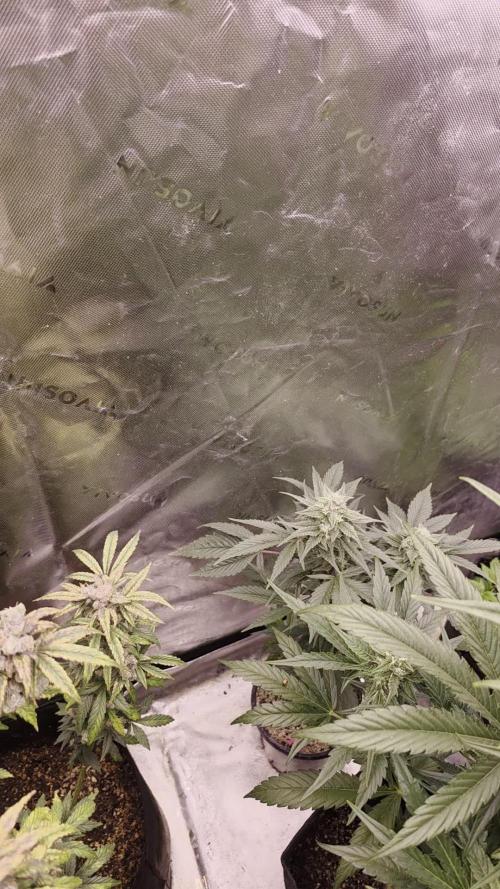
Plants are getting really top heavy, added bamboo support, I aim to cut in a couple weeks or so.
Likes
25
Share
Welcome to my Crocketts Confidential diary. I am currently week 5-6 with 5 plants in a smaller 2x3 grow tent. I currently have a 150 true watt LED light about 20 inchs overtop. These girls are something different. Very short distance between nodes. The smell is also unlike anything I have experienced. These girls are putting off a smell stronger than my flowering tent, its crazy! Almost a earthy/skunky smell. Im excited to see how these will respond once we hit the 12/12 cycle. Before that though I want there to be a somewhat significant stretch in veg. UPDATE: I changed out the blurple blue/red LED for a one with more of a fuller spectrum, and honest to god they exploded within hours. Excited/anxious/nervous to see what happens over the next few days, I'm sure this tent will be full very soon now.
Likes
23
Share
This week has been great ,today is day 78 and the girls are just doin their thang , 1 looks ready for flush already and the rest look about another longer then flush for them aswell,, can’t wait to see how these girls finish out over the next couple of weeks 😍!! Y’all keep them eyes peeled an stay tuned for next week! Peace love an positive vibes to y’all Cheers.💨💨💨
Likes
15
Share
From now on, I shall update my diary everyday. I used some rosemary oil spray for the remaining spider mites. Worked like a charm Day 40: the buds are still developing new pistils. The weather these days has been sunny to cloudy with some rain.
Likes
16
Share
Hello everyone, Not much to say about this girl. This week I started giving her some nutrients so lets see how she turns out now... See you guys next week.. 🤘🤘👊👊👊
Likes
7
Share
@Hommero75
Follow
End of week 4 for the Purple Lemonade. She just got fed with Goldleaf feterlizer and cal-mag. So far no new changes. She keep growing slow, no signs of pre- flower. She's been a hand full. Leave are still getting the brown spots and dying even with cal-mag added to the feeding. Let's see how week 5 goes.
Likes
151
Share
Hi guys, What's up? Welcome back to Queen Peaky's Flower Gardens After decapitating the apical bud we will give another week to recover from the shock suffered and then we will spend them in the flowering phase . Stay updated 😝m
Likes
42
Share
Info: Unfortunately, I had to find out that my account is used for fake pages in social media. I am only active here on growdiaries. I am not on facebook instagram twitter etc All accounts except this one are fake. Flowering day 8 since time change to 12/12 h. Hey guys :-) . The lady develops incredibly beautifully with GreenBuzzLiquids . Fast Plant and Bio Bloom were added this week. This week it was poured twice with 1.2 l each (nutrients see table above). The lady was checked for her health and it seems as if the last trips in the tent have also disappeared 🙏🏻. The entire tent was cleaned. For the next two weeks I filled canisters with fresh osmosis water. Otherwise, as always, she was watched for a while every day as she blows in the wind 😊👍. I wish you all a nice start to the week. Stay healthy 🙏🏻 You can buy this Nutrients at : https://greenbuzzliquids.com/en/shop/ With the discount code: Made_in_Germany you get a discount of 15% on all products from an order value of 100 euros. You can buy this Strain at : https://sweetseeds.es/de/cream-caramel/ Type: Cream Caramel ☝️🏼 Genetics: Blue Black x Maple Leaf Indica x White Rhino 👍 Vega lamp: 2 x Todogrow Led Quantum Board 100 W 💡 Bloom Lamp : 2 x Todogrow Led Cxb 3590 COB 3500 K 205W 💡💡☝️🏼 Soil : Canna Coco Professional + ☝️🏼 Nutrients : Green Buzz Liquids : Organic Grow Liquid Organic Bloom Liquid Organic more PK More Roots Fast Buds Humic Acid Plus Growzyme Big Fruits Clean Fruits Cal / Mag Organic Ph - Pulver ☝️🏼🌱 Water: Osmosis water mixed with normal water (24 hours stale that the chlorine evaporates) to 0.2 EC. Add Cal / Mag to 0.4 Ec Ph with Organic Ph - to 5.8 .
Likes
Comments
Share
@BabyBilly
Follow
Buds beginning to appear. I will perform a defoliation on day 21.