


Likes
Comments
Share



Likes
8
Share

@MindFlowers68
Follow
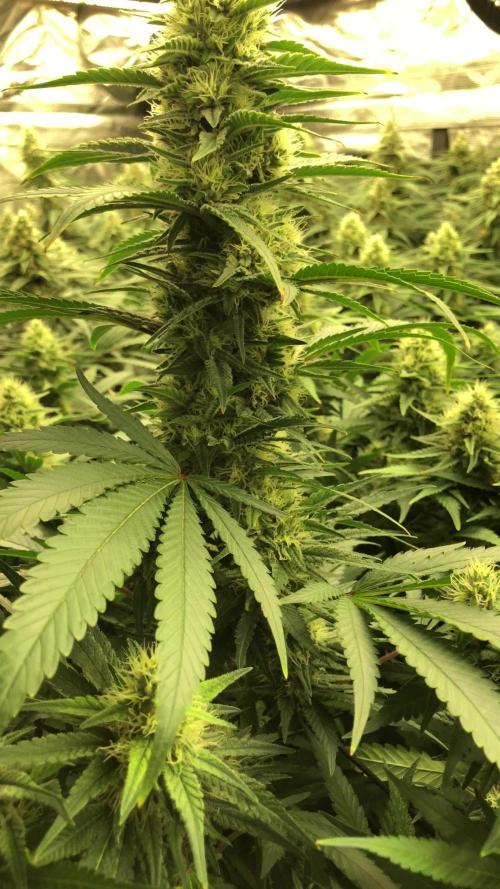
White Domina is covered in white hairs with a few starting to change color. Seems like it shows no other signs of wanting to slow down. Buds are still stacking a few nodes up top and the lower ones are starting to cover the stem. Getting really smelly this week too.
Flowers stacking hard and Still drinking 6-8 gallons of water every 3 days. Getting oranges hairs and resin production is ramping up. I was able to get a batch of boogie brew in this week. I also went ahead and added the bee pollen I was curious about. It has lots of ammino acids, and so does the fish fertilizer i have but I don't like using that in flower so maybe this could help. Its been sitting around for years and says its expired in 2019 though i don't think it ever really goes bad unless it moldy or something. I figure at worst I piss off some people for being curious. So i dissolved it in some water and added about a cup to about 40 gallons of water. Each plant got roughly 1/4 cup.
I been pushing these plants to the limit. I haven't been wanting to turn my lights down because they are helping to keep my humidity in check. Even been running the de-humidifier day and night now. Also been trying to go an extra day between watering to keep the humidity down as well. it was over 90 percent humidity much of the weeks outside. The thermostat got messed with mid week and temps in the tents got to 92 again a few hours at the end of their day cycle. I think this week I will adjust the lights to turn off 30 minutes sooner, and try to get them to start drinking a little less water.

Likes
104
Share


@Lordshiva83
Follow
Olá amigos mais uma semana, a minha árvore está com 2 metros de altura e continua a crescer bem forte, esta semana acrescentei a rega 2ml de growth-c e 2ml de alga-c e a princesa adora , as pragas estão controladas 🌲🌲 tudo está excelente, a árvore está no seu máximo esplendor 💪💪💯😍

Processing
Likes
25
Share


@rainman
Follow
So start of the week is very good. Plant got some nice smell, but not very strong. Will start to give bigger amount of nutrients, and also will add calmag and maybe diamond nectar. Will see.
Day 16 - 1L with nutrients.
Day 18 - 1.5L water.
Day 20 - 2L with nutrients.
Peace.

Likes
17
Share


@MG2009
Follow
08/23/2023
Starting week 2 flowering
AK #1 is now 17" tall
AK #2 is now 12.5" tall
Bruce Banner is 16" tall
All going well no more bug issues fed a little bit of nitrogen this week in the form of
(901 C release) 1/4 strength
trying to push some Carbon on her, no more Nitrogen will be used after week 2 of flowering, only P-K will be from Fox Farms Big Bloom
0-0.5-0.7 mixed with Bio-Remedy
Hope that they have more stretch in them but time will tell. Either way flower are exploding all over her!
Going to give them some Fresh Aloe Vera water, there loaded with Amino acids other good stuff.
08/27/2022
Not sure if auto flower goes through different flowering stages, if they do phase one is fleeting first flush of pistils fading and fresh ones popping up everywhere . Bruce Banner is a resin monster even some bigger leaves getting resin rails.

Likes
2
Share


@WinnieThePooh
Follow
Well, I think we're almost done here 😄
The buds looks amazing and they smell so good!!! In the next two weeks I'll give her just water so she can flush well and the buds could mature a little bit more.
What do you guys think?? It's important to me to read your opinions and advices so don't bem shine 😋
Keep on grow!!

Likes
13
Share


@Medmandan420
Follow
Incredible growth
def gonna be wide lady
incredible the first week always the slowest lol ( week one was germination)
Likes
13
Share


@Krautbauern
Follow
The Ztrawberriez Auto is very resistant has a great sweet strawberry smell throughout the garden.
As you can easily see from my grow question, I was initially afraid for the plants due to the high temperature in the greenhouse (as soon as the sun shone ~40 degrees).
It turned out that the plant seemed to like it and rewarded me with beautiful buds with purple tips. Growdiaries won't let me delete the question otherwise this would have happened long ago...
She finished very quickly and took just 70 days from seed to harvest. All this confirms that fastbuds is the right address for autoflowers. I'm already looking forward to the next run.
Make sure to follow out instgram channel Krautbauern420


Likes
25
Share


@Hashy
Follow
😎
********************************************
Week 15 Ripen(week 11 flower)
********************************************
Light cycle=12/12
Light Power=110w 47%
Extractor controller settings (during lights on).
High temp= 26c
Temp step=0c
High Rh= 46%
Rh step=0%
Speed max=10
Speed min=3
Extractor controller settings (during lights off).
High temp= 20c
Temp step=0c
High Rh= 50%
Rh step=0%
Speed max=10
Speed min=3
Smart controller settings (during lights on).
Lights on=9.00am
Smart controller settings (during lights off).
Lights off=9.00pm
VPD aim=1.0-1.5
DLI aim=40-45
EC aim=1.0-1.8
PH aim=6.0-6.5
💧💧💧💧💧💧💧💧💧💧💧💧💧💧💧💧
NPK= 0-9-10
Method= Automatic
Feed=Ripen nutes
Neutralise=0.1ml/L
Plagron Power buds=1ml/L
Green Sensation=1ml/L
Easy Ph down=0ml/L
(1ml=24 drops, 1 drop=0.04ml)
Easy Ph Up=0.0ml/L
(1ml=24 drops, each drop is 0.04ml)
Ec=0.7 PH=6.5/6.2
Runs=10
Run times=3mins (0.75L/0.375L each)
Gap times= 17mins
Total runtime=24mins(6.0L/3.0L each)
Total flowrate= 0.25L/min(0.125L/min each)
Auto start time=10.00am
Auto stop time=1.03pm
💧💧💧💧💧💧💧💧💧💧💧💧💧💧💧💧
********************************************
********************************************
📅17/5/25 Saturday(Day 99)
📋
📅18/5/25 Sunday(Day 100)
📋
📅19/5/25 Monday(Day 101)
📋
💧
Manually Ripen nutes
Ec=0.7 PH=6.5/6.4
Volume=6L
Volume left=1.5L
Volume used=4.5L
Total runoff=0.6L
Ec=2.0 PH=/6.7
💧
📅20/5/25 Tuesday(Day 102)
📋
📅21/5/25 Wednesday(Day 103)
📋
📅22/5/25 Thursday(Day 104)
📋
📅23/5/25 Friday(Day 105)
📋 Day 77 of flower
💧
Manually Ripen nutes
Ec=0.7 PH=6.5/6.4
Volume=6L
Volume left=2L
Volume used=4L
Total runoff=0.5L
Ec=2.7 PH=/6.9
💧
********************************************
Weekly roundup.
📋 This girl is massive, I've not had a plant produce flowers this big for a long time. The other strain is finished and Fat bastard still has a bit more maturing to do. She will have the tent to herself for the remainder of the grow.
Back soon.
Take it easy.
********************************************

Likes
4
Share


@MaestroBud
Follow
Slow, precise, solemn.
The Acapulco Gold doesn't run. Don't elbow.
It just... takes its space. And he does it with authority.
At the sixth week of vegetative, it began to show that calm power typical of true sative: slender branches, sharp leaves, and a structure that is being composed as a natural work of art.
It doesn't make the noise of the most flashy, but those who cultivate with heart know it:
This is a genetics that knows exactly what it wants to become.
⸻
💧 Irrigation routine managed with precision:
After the forced pause of the timer, I let the plant speak.
Just one minute of irrigation a day did its job.
The ground breathed, drained well, and she replied:
No sign of stress, just balance.
⸻
Weekly nutritional formula:
In the 50L tank I kept the flow constant with:
• Grow / Micro / Bloom – Advanced Nutrients for the complete base
• Sensizym, to keep the root system active and clean
• B-52, which gives tone to each leaf and supports the push
• ATA Clean, silent but essential for the health of the plant
⸻
🧠 Growth impressions:
The Acapulco is not growing.
It's maturing.
It's taking its form, like a rebellious bonsai that doesn't want to be contained.
The SCROG network is waiting for you... and you will arrive when the time is right.
The beautiful one?
Every day it gets closer.
His pace is slow, but he leaves his mark.
⸻
🎯 Next goal:
Guide her in the quadrants of the net with patience, while the rest of the team closes the vegetable carpet.
When he shoots on 12/12, he won't need to chase anyone:
The Acapulco Gold will arrive straight to the heart of the flowering, long, tall, intense.
⸻

Likes
202
Share


@CrazyHorse
Follow
Good afternoon everybody 😊
It's getting wild, really wild 😇 From last week everything start to be hmm... massive 🤔 😜
Update:
Day 38
Original Cinderella 108 cm
Bruce Banner 83 cm
Purple Lemonade 78 cm
Day 40
I have to provide a defoliation as girls start expanding wildly 😇
Original Cinderella 114 cm
Bruce Banner 86 cm
Purple Lemonade 79 cm
All the best, You Lovely Girls Growers 💪 💪 💪
Likes
3
Share


@Cannabis_Sativa
Follow
In the mid flowering stage smells are amazing like citrus. The roots are full fill in soil, its hard rooted on the top on soil


Likes
1
Share


@BlackBear833
Follow
This week I trimmed each plant still struggling with one of my plants still holding off on culling it but the other one is doing well nice green growth so no real complaints yet


Likes
29
Share


@cherokee
Follow
Привет всем 👋😋 !
Ребята предлагаю всем желающим подписаться на мои социальные сети где я делаю еще больше контента о каннабисе.
Подписывайтесь пожалуйста буду рад всем 😜 !!!
👽 Instagram - https://www.instagram.com/jedi_genetics/?hl=ru
👻 YouTube - https://www.youtube.com/channel/UCRFN2LzgQ4gxDj-6CIIr82g
________________________________________________________________________________________________________________________________________
На этой неделе была зачистка кустов и удаление от листьев, мелких веток. Куст почти оправился от светового стресса.
Likes
4
Share


@Growin_Ish
Follow
NY Diesel Auto Feminised is an auto-flowering version of the celebrated New York City Diesel. It is mostly indica while also displaying some sativa-like cerebral effects to accompany the deep relaxation that it provides.
NY Diesel Auto grows to a height of 60 – 100 cm. tall and develops plenty of side-branches that produce nice, dense buds. Growers can harvest yields of yields of around 600 gr/m2 in just 60 - 70 days from germination. This strain can also be grown successfully outdoors due to the hardy ruderalis genetics.
The scent is very dank with notes of diesel fuel. THC production is in the region of 14 – 16% while CBD levels are around 2%. The overall effect has an initial cerebral quality leading into bodily relaxation and a sense of wellbeing while not being physically incapacitating
10/5
Dropped two NY Diesel Auto seeds into a shotglass of room temp spring water. Placed the shotglass in a dark warm cupboard.
I will be preparing the medium today as well. The plan is 24 hours in the shotglass, 24 hours in a wet paper towel, then straight into 3gal fabric pots that have already been cooking for 2 days. They'll go under 18/6 with RH at 60% to 70%.
10/6
One seed has a tiny tap root and is still floating in the glass. The other seed fell to the bottom but has no taproot. Letting them stay in the shotglass another 12 hours.
10/7
Diesel #2
Half inch tap root and she sank to the bottom of the shotglass finally. I wet the coco-perl with PH 6.35 room temp water with Fish Sh!t in it. Let's grow Diesel #3 without Fish Sh!t for comparison.
Diesel #3
She has a miniscule taproot and it's black. Could just be film from the seed case where it cracked. I put her in a damp paper towel and stuck her in the dish washer. We'll check back in 12 hours.
12 hours later, no change. Then I realized I forgot to put it in a zip lock. The paper towel was still wet tho. Put it in a zip lock, will check in the morning.
10/8
We have a taproot on NY Diesel #3. Put some Azos in the drop site and sowed the seed. Half a shot glass of water to seal it in. 18/6, 67% RH, 80°f
Likes
8
Share

@Ruthlez
Follow
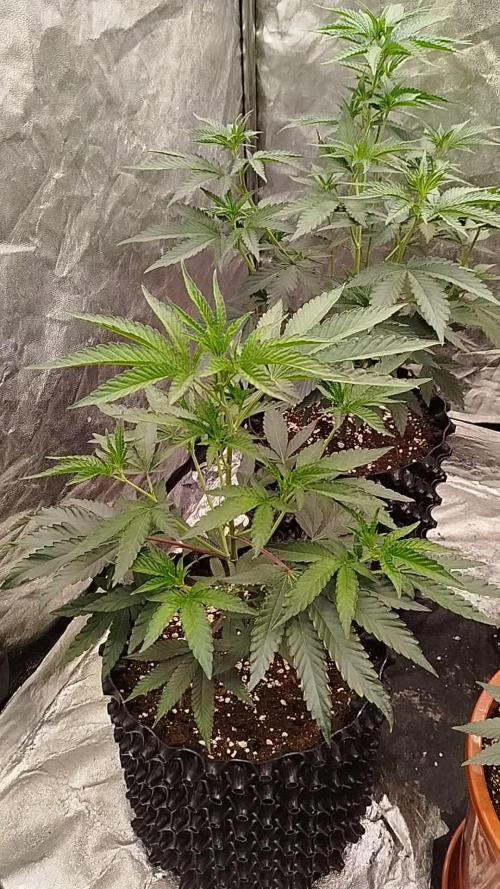
Woche 4 – Blüte beginnt 🌱
Mit dem Start der 4. Woche habe ich die Beleuchtung auf 12/12 umgestellt. Damit ist jetzt endgültig die Blütephase eingeläutet.
Bei der Z42 und der Biscotti ist bereits ein deutlich stärkerer Stretch zu beobachten. Beide legen ordentlich an Höhe zu und entwickeln sich momentan ziemlich dynamisch.
Die Papayton macht ebenfalls einen guten Eindruck. Sie bekommt immer kräftigere und ordentlich entwickelte Triebe und füllt langsam ihren Platz aus.
Insgesamt wirkt die Entwicklung sehr vielversprechend. Jetzt bin ich gespannt, wie sich der Stretch in den nächsten Tagen weiter entwickelt und wie schnell sich die ersten richtigen Blütenansätze zeigen.

