


Likes
Comments
Share


@AgroCultiveta
Follow
Son fotos y videos de múltiples cultivos debido a que nunca e realizado un seguimiento como tal, espero realizar uno ahora!
Nutrientes Utilizados en general Trybac y Trypack biobizz.
Las criticas siempre serán bien recibidas!😋
Espero les guste el contenido!




Processing
Likes
11
Share


@Guerilla_Jack
Follow
Hello growers and breeders.its end of 8week of flowering.. the smeell is so tense , buds are hard like rock and full of resin..this week only watering my plants with flawless finish and then harvest...


Likes
38
Share


@PrairieFrostGrow
Follow
******** Week 10 - Feb 10 to 16/20 (Days 64 - 70 from seed popping out)
It’s flush week so not much to update really. This week you anticipate the outcome with great hopes and also think about missed opportunities......no different here 😂 😂 😂
Last feed given last week. First good flush and finishing agent used this week. Gave her Flawless Finish in the morning and 8 hours later flushed her with 8L of RO water. Given she has been very green and tips were burnt a fair bit, I used Flawless Finish to flush the medium. The medium is pretty good with going into the week in mid 300’s ppm. Seeing nice amount of orange in her and the bud is a nice light colour right now as well.
She squished out bud very well over the weekend and has swelled quite a bit. She is getting fat and happy.......putting on the weight and frost this week girl!! Dropped the night temps to 60 degrees and the humidity to roughly 40% at night. Stripped more of her leaves and down to just bud, haha. Some are still left where I don’t want to remove the leaves for fear of bruising the bud trying to get it off. 😧
Sweet Seeds is impressing me on this girl with her growth. More trimming earlier on in the grow and she would have filled out all of those colas. The dry and cure are next on the radar very soon and I am sure she will continue impress there as well. Her frost is coming on quite well so expect it be in the high teens anyway for THC.
Yup......keep her on the radar again for a seed sale😳👍
Little more detail:
Feb 10/20 - Day 64
- Flushed with agent in late morning.
- 2L Flawless Finish @ 2ml/L = 125ppm and 6.1pH
- Flushed with plain water in evening.
- 6L plain water, 20ppm and 5.8pH.
- 2L plain water with Rezin & Liquid Weight, 100ppm and 5.8pH
- runoff water was 200ppm and 6.1pH.
- The agent seemed to have cleaned up the medium a fair bit and things look in good shape.
- Some fox tails forming but the colour is lightening and buds are swelling.
Feb 11/20 - Day 65
- pot is light.
- 2L water with Rezin & LW8 = 100ppm and 5.7pH.
Feb 12/20 - Day 66
- 2L water with Rezin & LW8 = 80ppm and 5.95pH.
- fattening and swelling nicely.
Feb 13/20 - Day 67
- 2L water with Rezin & LW8 = 90ppm and 6.15pH.
- More red hairs forming.
Feb 14/20 - Day 68
- pot still had some weight.
- day out day.
Feb 15/20 - Day 69
- 3L water with Rezin & LW8 = 100ppm and 6.1pH.
- cleaves getting lighter green.
- Bud looking more “white” in appearance at a distance.
Feb 16/20 - Day 70
- 3L water with Rezin & LW8 = 100ppm and 6.0pH.
- brought down temps further to 73 degrees and humidity at daytime max of 50%.
Have a great week all and may your gardens be full of colour and shine!!🙏

Likes
4
Share

@Jabbamo
Follow
_______________________________________________________
Mo. 9.3.
- 3 Liter pro Pflanze gegossen (ca. 200ml Drain)
1,2 ml / Liter "Calmag"
1,0 ml / Liter "Bio Grow"
3,0 ml / Liter "Bio Bloom"
1,0 ml / Liter "Top Max"
Ph 6,3 / 600 qqm
_______________________________________________________



Likes
14
Share


@Naujas
Follow
79 days!!!!! and the harvest is already harvested :) The whole growth until week 6 went very well, then the girl got a little worse, (I think it's my mistake, which I described in previous weeks), but besides all that she managed to ripen perfectly, matured stiff flowers, full of shiny sticky trichomes with a very, very sweet aroma ;) 210 gr of wet buds, I also collected a lot of sugar leaves from which I will make bubble hash :) I can't wait to taste it :) this is my first trip with Sweetseeds Looking at the flowers I understand that I will definitely repeat it :) I will leave more feedback after the smoke review:) good luck to everyone.
Likes
42
Share


@GanjaReaper
Follow
End of week 22:
Overal it was a good run with the Shamans from @DutchPassion_Official . Didn't had mayor problems besides having to harvest them earlyer. I really wanted to flower them another 2 weeks but the weather/climate didn't allow me to.
Still the buds came out decent as you can see for an early harvest.
I will cure those buds for some time in my pots before they get smoked and will update how much weight I got out of the two plants.
As you can see I made the bigger buds smaller. There is no use for me to keep big buds for showing off. Big buds just have big long stems in it, harder to dry and to fill your cure pots with.

Processing
Likes
154
Share


@CBD_Sweden
Follow
@FAST_BUDS,
Hi all the happy people here in GrowDiaries.
This is my second cultivation ever and it will be fun to try a bigger space than my closet grow.
First, I'm just going to say I'm done with the construction of my new growroom.
I put some pictures on the construction here in week one.
The room is 2.14 meters by 1.7 meters and has a ceiling height of 2 meters.
It provides a floor area of 3.6 square meters.
I use a 54 Watt Lightwawe T5 for germination and 2 Pcs 400 Watt HPS lamps.
I have a channel fan that replaces the room air about 40 times an hour to get a comfortable environment in the room, the air enters a fresh air intake from the outside.
The air is purified through a carbon filter to then leave the room to the rest of the basement.
Then I use that heat to heat the rest of the basement.
I will use 8 pcs 15 liter Autopots to grow with and a 100 liter water tank that supplies the pots of water and nutrition.
I will grow completely organically in soil and will watercure my buds to get the best possible medicine for me.
But there are no cultivation rooms to be displayed here, so I continue with what is most important.
Today I have put my seeds in my moisture dome and hope the seeds have germinated within a few days.
I am very excited to see how the new growroom will work and how this new secret CBD plant from @FAST_BUDS, will turn out.
..............................................................................................................................................................................................................................................................................................................................................
2017-09-11. Kl 12.00. Week 4 starts. I have cleaned the whole room for the new week and gave the girls water and nutes. Added videos and pics. Girl nr 1 is 27 cm high and girl nr 2 is 22 cm high.
-----------------------------------------------------------------------------------------
2017-09-12. Kl 10.00. New pics and video. Girl Nr1 has grown 5 cm in 23 hours, from 27 to 32 cm.😍
-------------------------------------------------------------------------------------
2017-09-13. Kl 22.00. Everything is looking great in the garden right now. Added new video.
--------------------------------------------------------------------------------------------------
2017-09-15. KL 10.00. New video added. Girls are looking great and they got 3 liters of water and nutes this morning. Girl Nr 1 is 38 cm high and Nr 2 is 28.
-----------------------------------------------------------------------------------------------------------------------------------------------------------------------------
2017-09-16. Kl 10.00. The girls grow like crazy, i have to defoliate about 20 leafs a day. Added 2 liters of water and nutes this morning and 2 new videos.
-------------------------------------------------------------------------------------------------------------
2017-09-17. This is the last day of week 4. Added a time laps from germ to week 4.
Likes
3
Share


@High_Grade_Dadli
Follow
Girls resting in their final home getting settled in before the decor
Processing
Likes
11
Share


@Blacksheep
Follow
WOW!!! It’s legal!!!! 50 years of hiding is over! WOW! 12 plants now, next grow 18 plants. 7 Dutch Passion Glueberrys, 2 Dutch Passion Colorado Cookies, 1 Think Different, 1 Dutch Passion Blueberry, & 1 Dinafem Sour Diesel. I have grown before inside from 1982 to 1992 - outdoors a bunch. Now I can check on my ladies everyday!


Likes
183
Share


@OrganicNature420
Follow
Germination date 🌱 12/07/2021
Day 64 16/09/2021
Strain 🍁 Ethos Genetics Banana Hammock R1
(Mandarin Sunset x Grapegod)
THC% • Unknown
💡 Mars Hydro FC4800
• Power draw 480W + 5%
• Max coverage 5 x 5
• LED 2070pcsSamsungLM30B1&Osram660nm
• Max Yield 2.5g / watt
• Noise level 0 DB
• Removable Driver +2m cable
• Daisy chain (multiple lights)
https://marshydroled.co.uk/products/mars-hydro-fc-4800-led-grow-light-samsunglm301b-commercial-greenhouse-medical-indoor-kit 🇬🇧
https://www.mars-hydro.com/buy-fc-4800-480w-4x4-energy-saving-full-spectrum-commercial-led-grow-light-mars-hydro-for-sale 🇺🇸
PROMO CODE • (ORG420) DISCOUNT 👍🏻 marshydroled.com
⛺ Mars Hydro 120 x 120 x 200cm
📤📥 AC infinity 6inch
💧 10lt dehumidifier
❄️ 3.1kw air con system
💉 Nutrients GreenBuzzLiquids
Organic Grow Liquid • 1-4ml until 2wk flower
Organic Bloom Liquid • 2-4ml flower stage
Organic More PK • 2-4ml +wk3 of flower
Organic Calmag • 1-2ml/lt whole grow
Fast Plants Spray • first 3days at night lights off
More Roots • 2-5ml veg +2wks flower
Fast Buds • 5ml +wk2 of veg until 1wk flower
Humic Acid Plus • 2-5ml whole grow
Growzyme • 2-5ml whole grow
Big Fruits • 2-5ml flower stage
Clean Fruits • 5ml flush 1wk
Ph powder
Root Gel
Living Organics
PROMO CODE • organicnature420 15%off ✌️🏼
https://greenbuzzliquids.com/
🥥 Growing Media • Coco Coir
Notes 📝
Girls look healthy and still only feeding every 2days. They are becoming more thirsty so will up water intake next week. Onelove GD 💚🌱🍁
Remember PROMO codes for both GreenBuzzLiquids and MarsHydro.com in the grow bio above 🖕🏼
Happy growing fam ❤️🌱🍁👍🏻

Likes
4
Share

@Krisis
Follow
Hi again. 3rd times a charm 😀
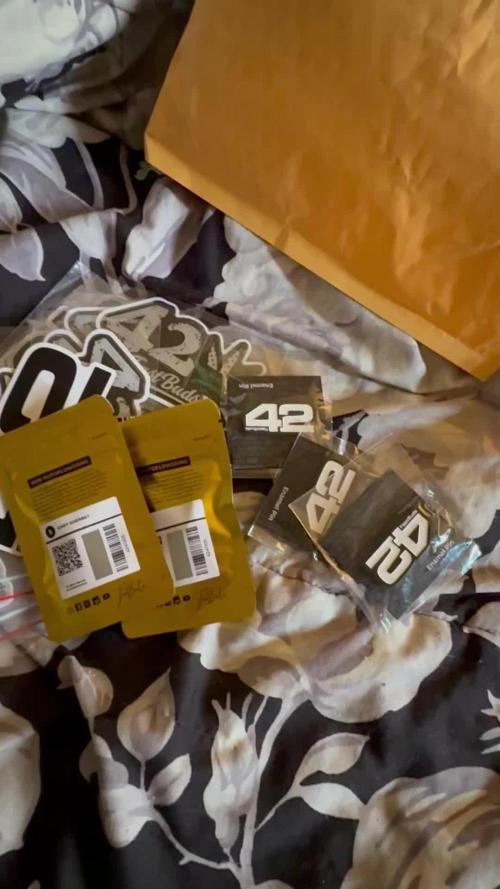
06-27-26. Put the little baby (not deep enough) into a cup of happy frog soil. Sprayed with water and then sprayed a sandwich baggie with water and covered the cup. She came through today with seed stuck just a bit but cracked apart. I took it off the rest of the way.
I’ll be using 2 soils. Happy frog was the for seed starting because it’s not hot enough to burn babies. On transplanting I’ll be using Coast of Maine for the first time. I’ve included some information down below for you.
Gary Sherbet is built around a single concept: stacking Sherbet-driven genetics across multiple layers to deepen terpene expression while maintaining the strength and structure of Gary Payton.
The base starts with Gary Payton (Cookies Seed Bank) crossed into Sunset Sherbet, already softening its profile and bringing in a more rounded, creamy character. This foundation was then further developed by introducing Sherbanger (Sunset Sherbet × Headbanger) from Boston Roots Seed Co, reinforcing the same terpene direction while adding extra depth and a subtle fuel edge.
For this project, we worked each line from seed, running large in-house selections across multiple plants to identify the phenotypes that best matched our criteria in terms of vigor, structure, and terpene expression. The final cross was made using only the plants selected through this process, ensuring a consistent and well-defined direction.What comes out of this is a clear Sherbet-dominant stack, where the same terpene backbone runs through multiple generations.
The terpene profile is deep, layered, and complex, built around creamy dessert notes, sweet citrus, and a sharper gassy finish that develops over time rather than hitting all at once.
Structurally, the line keeps the influence of Gary Payton: strong growth, solid branching, and reliable flower production, with dense, well-formed buds. At the same time, the Sherbet side enhances resin production and pushes the aromatic depth further. Gary Sherbet is less about combining unrelated traits and more about reinforcing a single genetic direction, layering Sherbet influence over a Gary Payton base to create a line with serious output, strong structure, and a terpene profile with real depth.

Likes
9
Share


@RolandRoss
Follow
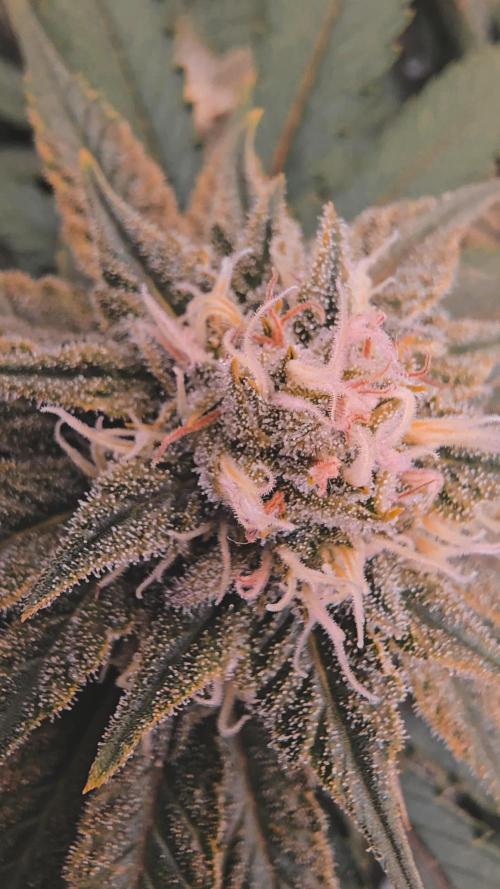
This plant is growing well. Its getting far bushier than the Autoflower planted next to it. Seems to have shorter branches, causing far more overlap of the leaves and a lot less light penetration. It'll likely require defoliating at some point fairly early. Its also far more sensitive to watering and tends to droop when watered, but bounces up a couple days later. I'm spreading the watering out even further at this point, to roughly every 5 days until it starts drinking more.
Likes
4
Share


@Crwfz1
Follow
She’s done. That’s it for This Bruce banner original sensible always is on point this plant is gorgeous and so stinky has flowery diesel notes and tons of tricomes can’t wait to get this dried looking about 3 oz dry I would assume from my experience on to the next ones now !

Likes
57
Share

@squalino
Follow
🌿 Journal de Culture : Cherry Cola (Auto)
Date : 25/03/2026
Âge : 62 jours (Semaine 9)
Phase : Maturation (Gonflement et sénescence précoce)
📊 Paramètres de mon espace
Température : 24,5°C (Jour) / 20°C (Nuit).
Humidité : 50%.
Éclairage : Pure LED 240W réglée à 75% d'intensité, maintenue à 75 cm de distance.
💧 Nutrition & Arrosage
J'ai ajusté le dosage pour accompagner la fin de floraison :
Apport : 4 ml de PK 5-8 (BioTabs).
Le phosphore et le potassium sont essentiels maintenant pour durcir les têtes et maximiser le poids final.
📏 Suivi des Plantes & Évolution
Plante #1 (Celle aux pistils orangés)
Taille : 41 cm (+1 cm depuis le 18/03).
État : Elle est la plus avancée dans son cycle. Presque tous ses pistils sont devenus orangés/bruns, ce qui est un signe clair que la plante approche de la fin de sa production de nouvelles calices. Ses feuilles commencent à montrer des signes de sénescence (jaunissement naturel), ce qui signifie qu'elle puise ses dernières réserves pour finir les fleurs.
Plante #2 (La Petite)
Taille : 33 cm (+3 cm depuis le 18/03).
État : Bien que plus compacte, elle est extrêmement dense. Ses pistils sont encore majoritairement blancs et longs, ce qui indique qu'elle a encore un peu de temps pour gonfler par rapport à sa voisine.
🔍 Mes observations
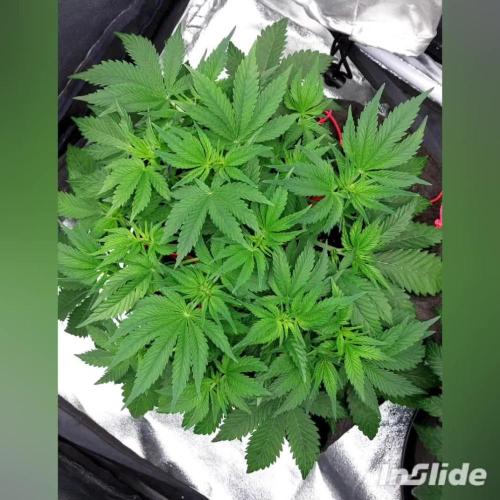
Le filet de SCROG est maintenant totalement rempli. La production de résine est impressionnante, les têtes sont littéralement givrées et la couche de trichomes descend jusque sur les grandes feuilles.
L'odeur sucrée de bonbon devient plus complexe et lourde. La Plante #1 semble prête à entamer sa phase de rinçage très bientôt, tandis que la Plante #2 profite encore pleinement du PK pour épaissir sa structure. On sent que la récolte approche à grands pas .
Likes
87
Share


@JKent19
Follow
Went to do some lst on the girls a couple of days ago and they have really started to become pungent! Will have to hook up my carbon filter asap. The left plant is 17 inches, while the right is 14. She is also looking a few days ahead in terms of bud development, but at this point they're close enough where I should be able to harvest them together. I am thinking it is because the left plant has the 200w light, while the right has the 100w. In theory, I could either move them together or swap positions every couple of days, but I am interested to see how the wattage affects each plant. I keep posting a few days early, but today is day 48 of the grow, so almost 7 weeks in. I feel like they are on track to finish in about 5 more weeks, but who knows? Hopefully they continue to progress, and I will have another positive update for you next week!


Likes
1
Share


@Daniel_Tri95
Follow
I love this strain definitely more of the ak coming out in her LOVE IT Remember nerds
It’s 420 somewhere
Likes
4
Share


@Big0zGrower420
Follow
Learned a lot from this grow and am very happy with the results. Pulled 2.8 Oz and 1.1 Oz of trim/popcorn buds in a one gallon pot. Definitely wont be doing that again, but had a lot of fun throughout the entire process. Going to be starting another grow soon! Very excited for that.
