


Processing
Likes
Comments
Share


@eldruida_lamota
Follow
Hola familia, siento la ausencia estos últimos 8 días, pero estoy de vuelta, estás misty gorilla auto de Zambezaseeds, están fenómeno, ya empiezan a desprender aromas, y eso es agradable, espero que engorden más estas flores por lo demás va bien, entonces la temperatura la mantenemos por debajo de 26 la humedad por debajo del 40% , sigo alimentando las con Agrobeta, por supuesto, os voy adelantando que va a ver muchos cambios cara al futuro y para bien, os iré diciendo poco a poco.
Un saludo fumetillas y buenos humos.


Processing
Likes
4
Share


@Ageddd
Follow
Switching to full flower nutrients, she loved the transplant, starting with half the recommended doses, growing some hairs so its te perfect moment to apply some Big One 1ml/l + TopBloom 2ml/l twice a week, to boost hairs growing and to create more bud spots.
She really is turning in to a little bush i really like the structure ^^

Likes
6
Share


@DogDoctorOfficial
Follow
🍒 Lemon Cherry Gelato — Week 4 Update
Autoflower · 12/12 from seed
Quick recap (for anyone joining here)
This Lemon Cherry Gelato has been grown 12/12 from seed, alongside photoperiod plants, under the same exact conditions.
At this stage, we’re still observing how modern autoflower genetics can blur traditional lines — and once again, this plant is behaving more like a classic photoperiod in structure and rhythm.
No rush. No force. Just observation.
⸻
🌿 Plant Development
She’s doing beautifully:
• Currently at 6–7 nodes
• Strong, even branching
• Internodal spacing is balanced
• Leaf color is a lush, healthy green
• Structure is open and expressive
No real training has been applied:
• Only very light leaf bending here and there
• No topping, no LST, no stress
• The plant is shaping herself naturally — and doing a great job at it
She looks calm, confident, and full of potential.
⸻
🌡️ Environment Log — Week 4 (Shared Conditions)
Same conditions as logged for all plants this week:
• Temperature: ~25.7 °C
• Relative Humidity: ~60%
• CO₂: ~666 ppm
• PPFD: 600–700 (adjusted naturally based on plant size and distance to light)
• Nutrition & watering: unchanged, consistent, identical across the room
This consistency is key — it allows us to clearly see genetic expression, not environmental noise.
⸻
🧠 Observations & Notes
What’s especially interesting here is how stable and photoperiod-like this autoflower appears:
• No sudden flowering push yet
• Vegetative structure continues to build
• Growth rhythm matches the non-autoflowers closely
At this point, labels matter less than behavior — and her behavior is excellent.
⸻
🙏 Thank You
A big thank-you to everyone following along, supporting, and appreciating the process.
This diary is about learning together, observing without ego, and letting the plant speak.
She’s shining — quietly, confidently, beautifully 💚
FOR DISCOUNT CODES AND MORE JUST FOLLOW THE LINK https://website.beacons.ai/dogdoctorofficial
📲 Don’t forget to Subscribe and follow me on Instagram and YouTube @DogDoctorOfficial for exclusive content, real-time updates, and behind-the-scenes magic. We’ve got so much more coming, including transplanting and all the amazing techniques that go along with it. You won’t want to miss it.
GrowDiaries Journal: https://growdiaries.com/grower/dogdoctorofficialInstagram: https://www.instagram.com/dogdoctorofficial/
YouTube: https://www.youtube.com/@dogdoctorofficial
⸻
Explore the Gear that Powers My Grow
If you’re curious about the tech I’m using, check out these links:
🔆 Lighting & Environmental Control
• Future of Grow — Advanced LED lighting technology
https://www.futureofgrow.com/
DISCOUNT CODE: DOG20
• Lumiflora — Under-canopy LED lighting
https://lumiflorade.com/
• TrollMaster — Environmental controllers and automation gear (past collaboration)
⸻
Genetics
• Zamnesia Seeds — Genetics used in this project
https://www.zamnesia.com/
⸻
🌱 Soil, Substrates, Boosters & Root Support
• Plagron — Substrates, bio mixes, and supportive products
https://plagron.com/en/
⸻
🎒 Storage, Curing & Preservation
• Grove Bags — Curing and storage solutions
https://grovebags.com/
⸻
📸 Photography Equipment & Tools
(Not sponsors, but part of my creative toolkit)
• Sony A6700
• Sony full-frame macro lens + few more
• Stacking photography workflow - learning
• iPhone (for behind-the-scenes shots)
We’ve got much more coming as we move through the grow cycles. Trust me, you won’t want to miss the next steps, let’s push the boundaries of indoor horticulture together!
As always, this is shared for educational purposes, aiming to spread understanding and appreciation for this plant. Let’s celebrate it responsibly and continue to learn and grow together.
With true love comes happiness. Always believe in yourself, and always do things expecting nothing and with an open heart. Be a giver, and the universe will give back in ways you could never imagine.
💚 Growers love to all 💚
📸 P.S. – The Eye Behind the Lens
All photos in this diary (for now — except for the ones showing the camera, which I took with an iPhone) are taken with a Sony A6700 paired with a Sony full-frame macro lens and a few more.
Photography is part of the story — it’s how we share the fine textures, the glow, and the quiet details that words can’t always capture.
I’ve also started experimenting with photo stacking — a technique where multiple images, each taken at a slightly different focus point, are layered together to create one perfectly sharp image from front to back.
It’s not digital enhancement or AI; it’s pure photography — a way to reveal the plant’s beauty in microscopic depth, from trichome to petal.
You’ll even see a few shots of "ghost me" capturing the shots — camera, lens, setup — because every grow deserves not just to be cultivated, but documented like art.
FOR DISCOUNT CODES AND MORE JUST FOLLOW THE LINK https://website.beacons.ai/dogdoctorofficial
NEW DISCORD - Official Server Invite Link : https://discord.gg/ksjAkA5T74
PS: A small heads-up — a few files didn’t make it into this update due to upload limits on Growdiaries (or simply her being a bit moody today 😄). We’ll try to upload the remaining photos next week. If possible, we’ll add them alongside the weekly update and clearly mark them as extra images.
Plenty of photos are already live though, so we hope you enjoy the update as it is. Thank you for your understanding and support.

Likes
94
Share


@PapaNugs
Follow
Was an amazing experience overall. The girls all did great. No complaints. Training went well. Topped twice and lollipopped the lower growth. All the buds, even the lower growth, are large. So frosty too. Amazing overall and will have to grow again as long as I like the smoke.

Likes
38
Share


@PolishFarmer
Follow
Hi! Really awesome week behind us! Girls are growing soo quicke. Every day are higher and higher :) im trying be gently with nutriens and looks like its very enough for them :)will Back with some more pictures tomorrow. I thinking to do defoliation. I want to get rid of all leafs below net. From monday girls get canna booster for first time then week after i planning to start with pk 13/14. Also im order Terpinator so its its another powder for my ladies from new week :) my friend just love this product and recommend highly so i found to try :) fingers crossed i will back to you soon :) piece guys!
Day 40 i found a mutations on jack herer leaf. In the centre of the leaf is growing new bud :) look on the last picture :)
Likes
17
Share


@FatalFarmer
Follow
Pistils are starting to turn orange/brown, the buds are getting large and smell so sweet (and dank!) at this point, maybe because of the sweet candy? I'm pleased. Can't wait for harvest, hopefully 4 weeks left, going to start flushing around the 23rd when the trichs are starting to turn cloudy/amber

Likes
58
Share


@biggreens420
Follow
She's coming on nicely buds coming all the way up the branches she's gonna be short an stocky still no frost but loads of nodes closely stacking with buds not much else to report just bud watching thanks for reading happy growing

Likes
16
Share


@Joehydro
Follow
3/10/2019. Start of week 8 and the Tangerine Dream is fattening up it’s buds and kicking out more frost every day. Even though the NYC Diesel is exactly the same age as the Tangerine Dream it looks about a week behind in flower but it’s also a far bigger plant and will definitely take longer to flower out. Final defoliation was done to both girls. I willl update through the week as always . Happy growing everyone ✌️!!!
3/15/2019.. The tangerine dream is really beefing up her buds this week. The room smells like sweet orange candy mixed with skunk fuel from the nyc diesel. For sure this tangerine dream is gonna be a very frosty pheno. The nyc diesel is finally starting to really grow out it’s bud sights so really not much to report on her. Overall everything is looks perfect with both girls. 👍


Likes
9
Share


@Doctor_Gonzo
Follow
-4/16/23 Start of week
--Week 4
-4/16/23 (Day 29)
--Observations: roots around the outside of soil, branches growing quickly
--Changes: transplanted from one gallon pot into a three gallon pot, increased light cycle duration to 18 hours, distance from light slightly changed
--Comments: forgot to take photo after transplant
-4/18/23 (Day 31)
--Observations: still not having problems with nutrient spray multiple times every day.
--Comments: first photos in new pot, will start training tomorrow near the end of the light cycle (less than 6h light left). will be trying an experimental grow training where the plant is forced to create multiple vertical branches coming off the main stem that will be forced to grow horizontally. should end with more symmetrical and uniform colas.
-4/19/23 (Day 32)
--Observations: branches are big enough to start training
--Changes: started LST today. removed one spade leaf and the branch node it had, also removed one shade leaf from the second set.
--Comments: today is the day to start training, had to remove some parts so that they would not be toughing the soil. should recover and start having branches grow vertically. was thinking about trying the FIMing technique, looks like it may be the perfect time for it. will decide tomorrow after it tries to correct itself, if all goes well it shouldn't be able to pull the tie downs up.
-4/20/23 (Day 33)
--Observations: slightly pulling up tie downs, branches correcting direction and growing vertically.
--Changes: removed another shade leaf that was covering several branch nodes, pushed tie downs back into soil.
--Comments: may need to find a better way to tie down or find a new way because it seems like they keep pulling up and not holding where I want them to.
-4/21/23 (Day 34)
--Changes: removed shade leave on both second level branches, tried FIMing the top. also changed placement of tie downs.
--Comments: doing good with training, removed some shade leaves to open up space for other growth. tried to do the FIMing technique but I'm not sure if it was done right, if not them I may just top this plant.
-4/22/23 (Day 35)
--Observations: still trying to pull out tie downs, branches growing quickly
--Changes: started watering with nutrients
--Comments: continues to fight the tie downs but is still taking to training. giving nutrients in the watering now and not just spraying with them, may start adding molasses to future waterings. still not sure if I did FIMing properly but if it isn't right then I will be topping this plant.
-4/22/23 End of Week
Processing
Likes
4
Share


@ReelEyezEnt
Follow
Still have these ladies in there Solo cups will most likely pot these girls this week
Finally moved these ladies over to there pots looking good for now
Oh yea no nuts just yet still going with PH bal water

Likes
33
Share


@Southwest_budders21
Follow
She's packing on some weight now shocked how chunky she is after the shock of the transplant. She's definitely a strong girl that's for sure
Likes
15
Share


@MrJones
Follow
MrJones Ztrawberriez Auto
🍓╰⊰🍓´🍓⊱╮🍓╰⊰🍓´🍓⊱╮🍓╰⊰🍓´🍓⊱╮🍓╰⊰🍓´🍓⊱╮🍓
💧 Feeding - Using Gaia Green Grow / Bloom and Compost Teas
🍃Training / LST-Defoliation-Topping TBA
🕷️ IPM - Will be using Green Cleaner" 1 OZ per Gallon, and CannControl from Mammoth alternating between products each month for Integrated Pest
🍓╰⊰🍓´🍓⊱╮🍓╰⊰🍓´🍓⊱╮🍓╰⊰🍓´🍓⊱╮🍓╰⊰🍓´🍓⊱╮🍓
▶️Saturday 11.18.23 - These girls are just blowing up, always like the flower stretch of FastBuds strains, the smells are nice and they are starting to drink more, the closet is filling up, did another PPM treatment with CanControl.
🍓´🍓⊱╮🍓╰⊰🍓´🍓⊱╮🍓╰⊰🍓´🍓⊱╮🍓╰⊰🍓´🍓⊱╮🍓
▶️Bud Description Ztrawberriez Auto produces long and fat buds with a beautiful light green shade with oftentimes purplish hues and a thick layer of resin that starts at the top of the flowers and continues all the way to the tip of the sugar leaves. It’s the typical bud structure you would expect from hybrid varieties topped with an explosion of fruity terps that’ll hit you in the face with a blend of creamy, fruity, and sweet aromas as soon as you break the buds open. Definitely a must for terp heads and extractors looking for exaggerated flavors and aromas
🍓╰⊰🍓´🍓⊱╮🍓╰⊰🍓´🍓⊱╮🍓╰⊰🍓´🍓⊱╮🍓╰⊰🍓´🍓⊱╮🍓
▶️SOIL MIX
40% ProMix HP
40% Coco Coir 70/30
15% Worm Castings
05% Malibu Compost
🍓╰⊰🍓´🍓⊱╮🍓╰⊰🍓´🍓⊱╮🍓╰⊰🍓´🍓⊱╮🍓╰⊰🍓´🍓⊱╮🍓
Processing
Likes
4
Share


@Nookandplant42o
Follow
watered with nutrient-free rainwater, pH 6.4, a moisture absorption level of 56%, water was sprayed without ppm lights off temperature the night is around 23 ° to 24 ° I will take with water and nutrients from the soil itself with a little light down, to make the plant smaller, which was not getting much light, although 86 watts for each of them are beautiful and healthy, by photos it is visible how cold they are

Likes
19
Share


@Naturalist
Follow
Trimmed a little more & started LST on day 67 with clips, first time using these, I'm pretty happy with them, even bent one stem to HST breaking & the clips supported the break.
Runoff PPM is 2828 average, it will only go to 2000 on here.


Likes
19
Share

@SkunkyDog420
Follow
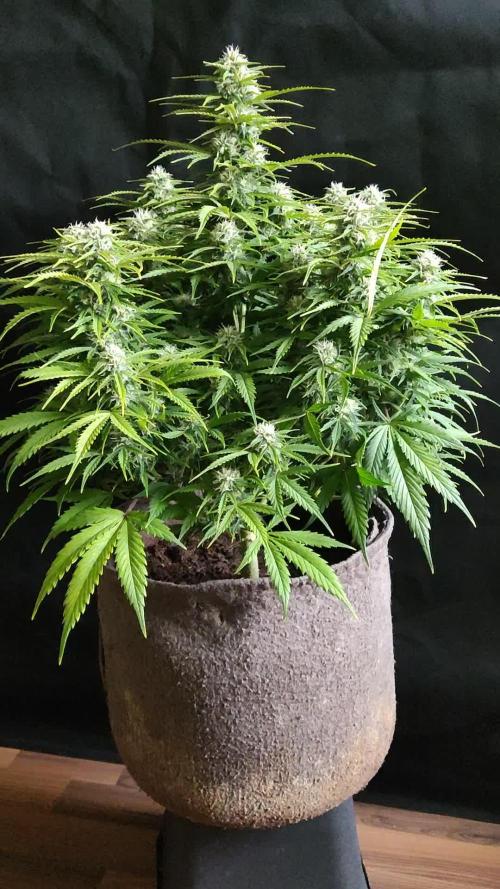
Hallo zusammen 🤙.
Habe diese Woche 25 g Silicium Flash gegeben.
Sie wächst sehr schön und macht keine Umstände

Likes
1
Share


@Weedwithwes
Follow
Went on a ski trip didn’t get to upload last week.
Flipped Pineapple Express Pheno 3 today so it got 77 days of veg compared to all the others that got 60 days of veg.


