The Grow Awards 2026 🏆
Likes
Comments
Share
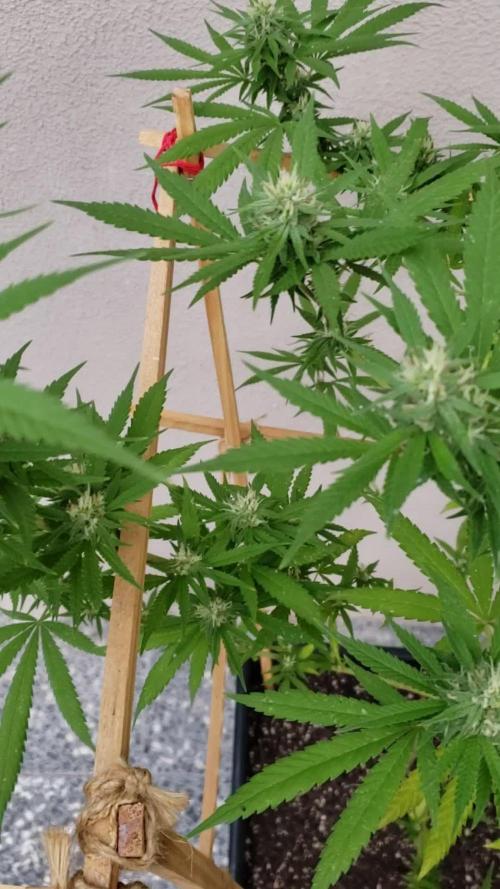
Start of flowering week 1. This girl is already bigger then her round 1 sister and she's starting to stretch after just a few days of 12/12 light. The only nutrient difference this grow, will be the addition of sensizym, hopefully it helps pack on a few more grams per plant.
Likes
120
Share
These ladies are really starting to stretch their limbs. I have reduced the indoor light to 17.5 hours and will continue to reduce the light 1/2 hour every ten days to match the 16 hour day on June 20th when I have scheduled to put them outside for good. On warm days here I try to get them outside in the sunlight as much as possible. They are busy and beautiful.
Likes
9
Share
So far, so good. The buds are really bulking up. Struggling with knowing when to harvest. I still have white hairs but many have turned. This could be because I had some watering issues and might have introduced some stress causing them to mature early. The Trichomes seem to be all cloudy and I have some that are amber. The agony of a first grow.
Likes
2
Share
@Ninjabuds
Follow
Man, that Skunk Apple runtz plant is giving me some trouble. It's still really small and hasn't grown much at all. I think I might've messed up a little because the leaves are looking kinda rough. Hopefully it can bounce back. Well, it's Christmas again. This year feels a little different, though. Maybe it's the snow blanketing everything, or the way the tree lights up the whole living room. Either way, it's cozy and warm, even when it's freezing outside. I'm really looking forward to seeing what Santa brings. I hope I get that new video game I've been wanting. But most of all, I can't wait to spend time with my family. We always have so much fun This past week was a good one for the plants. They started the first week of their stretch, and they've already grown a decent amount. I can really see them filling out. It's cool to watch them grow so fast. I can't wait to see how big they get by the end I always get a little worried at this stage, like they're not gonna get as big as I want them to. But then I remember how they always end up surprising me. By the end, they're always perfect.
Processing
Likes
12
Share
Buenas noches familia, sorpresa, jueves noche por aquí , actualizamos las power plant xL. Es la última semana antes de nuestra cosecha, el tiempo se nos echó encima y las Flores ya están echas, se preparó un lavado de raíces y tijeretazo,para sucesivamente colgarlas.( PRIMERA VEZ que se me echa el tiempo encima con la floración, jurao) Me habría gustado darles algo de estrés hídrico, pero lo veremos con las lemon kush y las northern light xL. -power plant xL es una cepa con predominancia sativa, con una corta floración,es un ejemplar fácil de cultivar, fuerte, y vigoroso. Estos ejemplares se cultivaron en 7L en sustrato light MIX de plagrOn, controlando en todo momento el PH de nuestras plantas, y dándoles de comer una gama advanced nutrients bastante básica. -PROS: facil cultivar, flores llenas de resina , flores compactas, ramas laterales largas. -CONTRAS: hay que tutorar por el peso de la flor, floración demasiado rápida a mi gusto (no te das ni cuenta). *Aquí ya me despido hasta la cosecha familia.
Likes
7
Share
Eccoci qui... Finalmente dopo uno stop per il lavoro torno ad aggiornare il diario con il capitolo finale... Queste due bimbe mi hanno sorpreso per il forte odore tropicale e fruttato che hanno, sono molto entusiasta di poter usufruire dei loro frutti!! Verrà riproposta sicuramente!! Grazie a @JhonSSSC e ad @Xpertnutrients per la collab e a tutti per il supporto🔥🌲❤️ NE VERRANNO DELLE BELLE
Likes
118
Share
I provided you with a close up video of each plant and one video where i go through tent and try to focus some nice buds individually. Flushing her for 5 days already with a mild 400 ppm solution of terpinator and mammoth. There she is, the prima donna of my tent, biggest and densest buds, check week one, i thought she was a rotten seed.. Smell is very interesting undescribeable to me i will wait some more time, maybe the moment when i grind her to give the best description.. I rate her 10 days to 2 weeks until harvest, all plants but one automatica are more less coming down in the same time.
Likes
19
Share
30-06-2020 defoliation preparation for flowering . Today i defoliate and clean them up good. looking for just toops. Any tips or comments are aprecviated and i will respond asap. Stay safe , Peace out D
Likes
2
Share
@Ganjaking
Follow
WHITE AMNESIA WEEK 4 FLOWERING COMING ON WELL.
Likes
21
Share
@OGTrauma
Follow
Ok Niggas this can be the first month of the plants since germination - and the start of the fourth vegging week, plants overall growth is savage, even for the plants that still presents Ca Mg carencies , as they tend to have a pale green colour compared to their siblings. The lack of green makes that one plant highlight a purple hue prominent on the leaves & stem, it can be confused with cold through . But i'm discarding that reason as .cl winter is finishing and temperatures are above 0°c. Did a Barrier spray on the mix, just with CaMg on soil to attend the previous urge, as this substrate is very light, yet i can still fuck it up and misdiagnose a nutrient block if i go too heavy. Plus that i found a munched leaf and that barrier has a moderate nutrient amount besides try to half the pest advances. I want to finish this week to count 30 officially days and probably do a topping cut , and try to get on the level of the net on day 45 / finishing on 6 week in order to fill the space, as if this strain is stable it stretch and node space should be on the short side, but nod that some og kush relatives can be stretchy because there'sslight sativas phenotypes as well. Finishing this text wall homies, as plants has the same age, i can notice that this substrate is fast to colonize as the one that stay on 'pot on pot' are way smaller that the ones that are on its final containers. I will consider lollypop too, as i want to try to check before signals that vertical growth light reinforcement with the fan shaped bulbs is viable on all growty , as if i saw that they underdevelop just on veg stage should be a big no & discard that stupid idea. But at the moment is going fine. Just having a nice cri to inspectionate the plants is a good advantage to be assimilated on frankenstein's indoor setup. 🦄 Big gas Leakz !!! & Big dick Energy!!!
Likes
65
Share
@Dendegrow
Follow
Week 4 of the flowering phase has arrived, and last week flew by 🌬️🌱. The ladies are thriving, and the buds are now clearly visible! ✨ The flowers are starting to turn darker, which is an exciting sign 🍒. The first trichomes are already forming, hinting at a very potent strain 💎🔥. While the cherry aroma hasn’t come through yet, removing some leaves revealed an intense, waxy scent – very intriguing! 🌿👃 I’ll keep you updated with daily posts. Drop a like and stay tuned to see how the ladies develop 🌺📸. See you next week! Woche 4 der Blütephase ist da, und die letzte Woche ist wirklich wie im Flug vergangen 🌬️🌱. Die Ladies haben sich prächtig entwickelt, und jetzt kann man die Buds schon richtig gut erkennen! ✨ Die Blüten beginnen langsam, sich dunkel zu verfärben – ein vielversprechendes Zeichen 🍒. Auch die ersten Trichome sind schon sichtbar, was definitiv auf einen sehr potenten Strain hindeutet 💎🔥. Das Kirscharoma ist zwar noch nicht zu erkennen, aber beim Entfernen der Blätter wurde ein intensiver, wachsähnlicher Duft wahrgenommen – super spannend! 🌿👃 Ich halte euch weiterhin mit täglichen Updates auf dem Laufenden. Lasst ein Like da und bleibt dran, um zu sehen, wie sich die Mädels entwickeln 🌺📸. Bis nächste Woche!
Likes
24
Share
I would try growing this strain again if It was giving for free and this time I would attempt outdoor to see the difference. Im not sure if I had bad luck with my seed pack of if this strain just need to work on its quality in terms of resistance.
Likes
4
Share
Primera semana de plantula, inicio con 3 plantas, una semilla regular y las otras dos Fem, por el momento la regular muestra mayor avance en comparación de las otras dos Fem ya que tiene 4 días más. Por el momento no aplique ningún fertilizante ni enraizante, solo aplico micorrizas en cada una directo al sustrato. Desde la Primera semana noté un decaimiento en Space cookies en relación al desarrollo de las otras dos.
Likes
4
Share
Week 4 Last week was good gave the last defoliation for day 21. Adding a higher feed for her. This one got crazy pistil produced & it’s going all the way down the plant it’s the shortest out of the 3 but has the 2nd most pistil producing on it Check out my IG for more content @therealterpio & check out my other dairies (jungle verde & Gelato Cake)
Likes
2
Share
Apple strudel what can I say checking all the boxes for me cannot wait to see her buds her she is a chunky girl. The video you guys have on YouTube of the plant is absolutely amazing. Had my mouth watering every second 🔥
Likes
4
Share
@Bud_vista
Follow
At day 18 i topped her. I’m really curious how she’s handle the stress. In the next few days I will bend her down a little and installing a net to hold the plant small. We are ending week 3 shortly! She handled the topping very good. No signs of slowing down her grow or any deficiency. I did some LST after topping but one of the main branches snapped half through. She damaged side still performs exactly like the intact one. I try to be patient and careful with the bending of this branch. I taped the location and try to not bend it hardly anymore.
Likes
52
Share
Lacewings seemed to have mostly killed themselves by flying into hot light fixtures. I may have left the UV on which was smart of me :) Done very little to combat if anything but make a sea of carcasses, on the bright side its good nutrition for the soil. Made a concoction of ethanol 70%, equal parts water, and cayenne pepper with a couple of squirts of dish soap. Took around an hour of good scrubbing the entire canopy. Worked a lot more effectively and way cheaper. Scorched earth right now, but it seems to have wiped them out almost entirely very pleased. Attempted a "Fudge I Missed" for the topping. So just time to wait and see how it goes. Question? If I attached a plant to two separate pots but it was connected by rootzone, one has a pH of 7.5 ish the other has 4.5. Would the Intelligence of the plant able to dictate each pot separately to uptake the nutrients best suited to pH or would it still try to draw nitrogen from a pot with a pH where nitrogen struggles to uptake? Food for stoner thought experiments! Another was on my mind. What happens when a plant gets too much light? Well, it burns and curls up leaves. That's the heat radiation, let's remove excess heat, now what? I've always read it's just bad, or not good, but when I look for an explanation on a deeper level it's just bad and you shouldn't do it. So I did. How much can a cannabis plant absorb, 40 moles in a day, ok I'll give it 60 moles. 80 nothing bad ever happened. The answer, finally. Oh great........more questions........ Reactive oxygen species (ROS) are molecules capable of independent existence, containing at least one oxygen atom and one or more unpaired electrons. "Sunlight is the essential source of energy for most photosynthetic organisms, yet sunlight in excess of the organism’s photosynthetic capacity can generate reactive oxygen species (ROS) that lead to cellular damage. To avoid damage, plants respond to high light (HL) by activating photophysical pathways that safely convert excess energy to heat, which is known as nonphotochemical quenching (NPQ) (Rochaix, 2014). While NPQ allows for healthy growth, it also limits the overall photosynthetic efficiency under many conditions. If NPQ were optimized for biomass, yields would improve dramatically, potentially by up to 30% (Kromdijk et al., 2016; Zhu et al., 2010). However, critical information to guide optimization is still lacking, including the molecular origin of NPQ and the mechanism of regulation." What I found most interesting was research pointing out that pH is linked to this defense mechanism. The organism can better facilitate "quenching" when oversaturated with light in a low pH. Now I Know during photosynthesis plants naturally produce exudates (chemicals that are secreted through their roots). Do they have the ability to alter pH themselves using these excretions? Or is that done by the beneficial bacteria? If I can prevent reactive oxygen species from causing damage by "too much light". The extra water needed to keep this level of burn cooled though, I must learn to crawl before I can run. Reactive oxygen species (ROS) are key signaling molecules that enable cells to rapidly respond to different stimuli. In plants, ROS plays a crucial role in abiotic and biotic stress sensing, integration of different environmental signals, and activation of stress-response networks, thus contributing to the establishment of defense mechanisms and plant resilience. Recent advances in the study of ROS signaling in plants include the identification of ROS receptors and key regulatory hubs that connect ROS signaling with other important stress-response signal transduction pathways and hormones, as well as new roles for ROS in organelle-to-organelle and cell-to-cell signaling. Our understanding of how ROS are regulated in cells by balancing production, scavenging, and transport has also increased. In this Review, we discuss these promising developments and how they might be used to increase plant resilience to environmental stress. Temperature stress is one of the major abiotic stresses that adversely affect agricultural productivity worldwide. Temperatures beyond a plant's physiological optimum can trigger significant physiological and biochemical perturbations, reducing plant growth and tolerance to stress. Improving a plant's tolerance to these temperature fluctuations requires a deep understanding of its responses to environmental change. To adapt to temperature fluctuations, plants tailor their acclimatory signal transduction events, specifically, cellular redox state, that are governed by plant hormones, reactive oxygen species (ROS) regulatory systems, and other molecular components. The role of ROS in plants as important signaling molecules during stress acclimation has recently been established. Here, hormone-triggered ROS produced by NADPH oxidases, feedback regulation, and integrated signaling events during temperature stress activate stress-response pathways and induce acclimation or defense mechanisms. At the other extreme, excess ROS accumulation, following temperature-induced oxidative stress, can have negative consequences on plant growth and stress acclimation. The excessive ROS is regulated by the ROS scavenging system, which subsequently promotes plant tolerance. All these signaling events, including crosstalk between hormones and ROS, modify the plant's transcriptomic, metabolomic, and biochemical states and promote plant acclimation, tolerance, and survival. Here, we provide a comprehensive review of the ROS, hormones, and their joint role in shaping a plant's responses to high and low temperatures, and we conclude by outlining hormone/ROS-regulated plant-responsive strategies for developing stress-tolerant crops to combat temperature changes. Onward upward for now. Next! Adenosine triphosphate (ATP) is an energy-carrying molecule known as "the energy currency of life" or "the fuel of life," because it's the universal energy source for all living cells.1 Every living organism consists of cells that rely on ATP for their energy needs. ATP is made by converting the food we eat into energy. It's an essential building block for all life forms. Without ATP, cells wouldn't have the fuel or power to perform functions necessary to stay alive, and they would eventually die. All forms of life rely on ATP to do the things they must do to survive.2 ATP is made of a nitrogen base (adenine) and a sugar molecule (ribose), which create adenosine, plus three phosphate molecules. If adenosine only has one phosphate molecule, it’s called adenosine monophosphate (AMP). If it has two phosphates, it’s called adenosine diphosphate (ADP). Although adenosine is a fundamental part of ATP, when it comes to providing energy to a cell and fueling cellular processes, the phosphate molecules are what really matter. The most energy-loaded composition for adenosine is ATP, which has three phosphates.3 ATP was first discovered in the 1920s. In 1929, Karl Lohmann—a German chemist studying muscle contractions—isolated what we now call adenosine triphosphate in a laboratory. At the time, Lohmann called ATP by a different name. It wasn't until a decade later, in 1939, that Nobel Prize–-winner Fritz Lipmann established that ATP is the universal carrier of energy in all living cells and coined the term "energy-rich phosphate bonds."45 Lipmann focused on phosphate bonds as the key to ATP being the universal energy source for all living cells, because adenosine triphosphate releases energy when one of its three phosphate bonds breaks off to form ADP. ATP is a high-energy molecule with three phosphate bonds; ADP is low-energy with only two phosphate bonds. The Twos and Threes of ATP and ADP Adenosine triphosphate (ATP) becomes adenosine diphosphate (ADP) when one of its three phosphate molecules breaks free and releases energy (“tri” means “three,” while “di” means “two”). Conversely, ADP becomes ATP when a phosphate molecule is added. As part of an ongoing energy cycle, ADP is constantly recycled back into ATP.3 Much like a rechargeable battery with a fluctuating state of charge, ATP represents a fully charged battery, and ADP represents a "low-power mode." Every time a fully charged ATP molecule loses a phosphate bond, it becomes ADP; energy is released via the process of ATP becoming ADP. On the flip side, when a phosphate bond is added, ADP becomes ATP. When ADP becomes ATP, what was previously a low-charged energy adenosine molecule (ADP) becomes fully charged ATP. This energy-creation and energy-depletion cycle happens time and time again, much like your smartphone battery can be recharged countless times during its lifespan. The human body uses molecules held in the fats, proteins, and carbohydrates we eat or drink as sources of energy to make ATP. This happens through a process called hydrolysis . After food is digested, it's synthesized into glucose, which is a form of sugar. Glucose is the main source of fuel that our cells' mitochondria use to convert caloric energy from food into ATP, which is an energy form that can be used by cells. ATP is made via a process called cellular respiration that occurs in the mitochondria of a cell. Mitochondria are tiny subunits within a cell that specialize in extracting energy from the foods we eat and converting it into ATP. Mitochondria can convert glucose into ATP via two different types of cellular respiration: Aerobic (with oxygen) Anaerobic (without oxygen) Aerobic cellular respiration transforms glucose into ATP in a three-step process, as follows: Step 1: Glycolysis Step 2: The Krebs cycle (also called the citric acid cycle) Step 3: Electron transport chain During glycolysis, glucose (i.e., sugar) from food sources is broken down into pyruvate molecules. This is followed by the Krebs cycle, which is an aerobic process that uses oxygen to finish breaking down sugar and harnesses energy into electron carriers that fuel the synthesis of ATP. Lastly, the electron transport chain (ETC) pumps positively charged protons that drive ATP production throughout the mitochondria’s inner membrane.2 ATP can also be produced without oxygen (i.e., anaerobic), which is something plants, algae, and some bacteria do by converting the energy held in sunlight into energy that can be used by a cell via photosynthesis. Anaerobic exercise means that your body is working out "without oxygen." Anaerobic glycolysis occurs in human cells when there isn't enough oxygen available during an anaerobic workout. If no oxygen is present during cellular respiration, pyruvate can't enter the Krebs cycle and is oxidized into lactic acid. In the absence of oxygen, lactic acid fermentation makes ATP anaerobically. The burning sensation you feel in your muscles when you're huffing and puffing during anaerobic high-intensity interval training (HIIT) that maxes out your aerobic capacity or during a strenuous weight-lifting workout is lactic acid, which is used to make ATP via anaerobic glycolysis. During aerobic exercise, mitochondria have enough oxygen to make ATP aerobically. However, when you're out of breath and your cells don’t have enough oxygen to perform cellular respiration aerobically, the process can still happen anaerobically, but it creates a temporary burning sensation in your skeletal muscles. Why ATP Is So Important? ATP is essential for life and makes it possible for us to do the things we do. Without ATP, cells wouldn't be able to use the energy held in food to fuel cellular processes, and an organism couldn't stay alive. As a real-world example, when a car runs out of gas and is parked on the side of the road, the only thing that will make the car drivable again is putting some gasoline back in the tank. For all living cells, ATP is like the gas in a car's fuel tank. Without ATP, cells wouldn't have a source of usable energy, and the organism would die. Eating a well-balanced diet and staying hydrated should give your body all the resources it needs to produce plenty of ATP. Although some athletes may slightly improve their performance by taking supplements or ergonomic aids designed to increase ATP production, it's debatable that oral adenosine triphosphate supplementation actually increases energy. An average cell in the human body uses about 10 million ATP molecules per second and can recycle all of its ATP in less than a minute. Over 24 hours, the human body turns over its weight in ATP. You can last weeks without food. You can last days without water. You can last minutes without oxygen. You can last 16 seconds at most without ATP. Food amounts to one-third of ATP production within the human body.