


Likes
Comments
Share


@Kush_T_Big_Nugz
Follow
She was a pleasure to grow from start to finish. Took well to topping and lst. Would recommend this exotic strain to anyone... rock hard covered colourful frosty nugs And gassy af


Likes
20
Share


@LockDownGrow
Follow
So I managed too lst this little lady sideways very early on and she is now starting too form a little Bush,
The next week or two will surely provide something very special judging on who her sister lemon pie is now 2 weeks ahead of this one,
It seems this little lady is the purple
I really pumped the nutrients this week as you can see,
At the end of this week a stopped giving the plant these addavitves
More roots,
Humic acid,
Growzyime,
Fast bud folar spray,
And big buds,
And have now started too raise the house & Garden A&B soil feed and also there budXL
I also started off early but as a trace amount of there top shooter,
By the end of week I intend on giving them the full recommended of each and only be giving them the house and garden range at full streingh,
I will then wait for the first Amber tricomb then instant flush feeds,
Hopefully I get two weeks from that stage but it is often genetic so as long as I get at least one week and at least 3 feeds of water only then I'm happy

Likes
10
Share


@Jozef_Balcerek
Follow
PH ziemi się rozjechało i nie wiem dlaczego? za mało , za dużo, za często podlewane? poczekam aż wyschną i zrobię delikatny przelew wodą o PH 7, będziemy obserwować i zobaczymy...

Likes
12
Share


@GeekSayWhat
Follow
Nothing much to report. Its growing nicely. Tricombs are already showing...and loads of them!
Tomorrow is watering day, going to up the feed a little but use fizzy water instead of plane.
I only take leaves away that are blocking bud sites... only 2/3 per 7-8 days.


Likes
51
Share


@Organic_LarF
Follow
Hello,
Both ladies doing very well now. Wheater changed for now, and there is much more humidity in the air, as less dry burning sun.
Had a quick communication with Dutch Passion about the leafs that tend to fold up. They are never nice flat out. But they assured me there is nothing wrong going on. And the plant looks very healthy!!
Working on the lady in the greenhouse-ish shed, i wanted to bend the top of the plant, but its allready very stiff. So i managed to break it. 😅👈🤪👈😒👈
There was luckely allready a support attached. And it didnt break all the way. See pics. Its a FIBI, fuck i broke it. 🙌🤣
So its restoring good and the top hasnt started to faint down. So, all good!!!
The lady outside is doing very good now, she starts to bush-up.
Shes free to grow so, i only did a few chiroprac on the main stem, she can flourish as she supposed to by nature.
Thats about it, for this week.
Did some succeeded bends as well, so check out the other diaries 2.
Grow safe
🍀🍀🍀

Likes
107
Share


@TheFoxFarmer
Follow
Week 10 Flower
After 4 whole weeks of flush this girl has finally met the scissors ✂️
It took her quite some time to fade out, but after cutting down the most faded half of the plant that was closest to the light on Day 65, and then the rest on Day 70 it was long enough.
I'm very impressed with how fat and chunky this girl has become. I wasn't expecting quite this size from first look at her thinner stems and branchy structure earlier in flower, but her buds have swelled up nonetheless and she's stacked well.
I always cut my girls down around half an hour (or a bit more) before the lights are due to turn on. This prevents her from starting any chlorophyll production in order to maintain the best flavour and burn. Only a few fans were taken off before being left to hang dry as she's absolutely covered in trichomes! Don't throw away your sugar trim (leaves with trichomes) as this can later be used for dry sift, which can then be pressed for some dank rosin. Harvest update coming soon!
Thanks for following and happy growing! 🐺

Likes
9
Share


@Grileon
Follow
Hello there.
Got a powerful strain from Super Sativa Seed Club for their ongoing contest.
It's honor to be one of the participants. Thanks a lot to the SSSC team.
Will be growing it in 20 l hydroponics, with some GHE nutrients.
Also have some new amazing led light: TS 1000 from Mars Hydro.

Likes
80
Share


@Qlimax
Follow
Day 30-had some electricity problems for 12hours so put them front of the window so they had some little daylight without sun :( guess this will not be so big problem since is autoflower. I hope...
Day 31- i freaking love how they explode... they grow like 3+cm every day :) and biggest plant is lke 6cm every day lol... i belive they are now full in flowering stage cus alot pistals comming out ! Oney like 40 more days till harvest jeeeej :p
Day 32- saw some brown spots on leafs i foud out is calcium deficiency,so i made calcium from egg shells..i boiled for 20min then baked for 10min and mixed in fine powder (1g/350mg) calcium and add 0.1g/l into wather ...also did some extra LST...
Day 33- Some flowers hight info ... biggest plant is now 62cm then 52cm,39cm,37cm,35cm......they are in diffrent size of pot so i expected something like that.... well 50cm plant is in smallest pot,alot higher but 2main colas and alot less side stems then others plants(also made pic week 5)
Day 34- I was looking and thinking and i noticated if plants keep growing like this i will have to make tent bigger so i going to make width and length of tent bigger for 20cm, from 100=120...biggest plant is alredy 65cm so i start bend her down slowly so doesn go to close to light....also i raised small plants so they are all olmost the same height.
Owerall all is good did tons of LST little bit deformatiation and had little bit of calcium/deficienty also alredy made tent bigger so looks all good now :)
!!!till next week!! Goodbye :)
Likes
13
Share
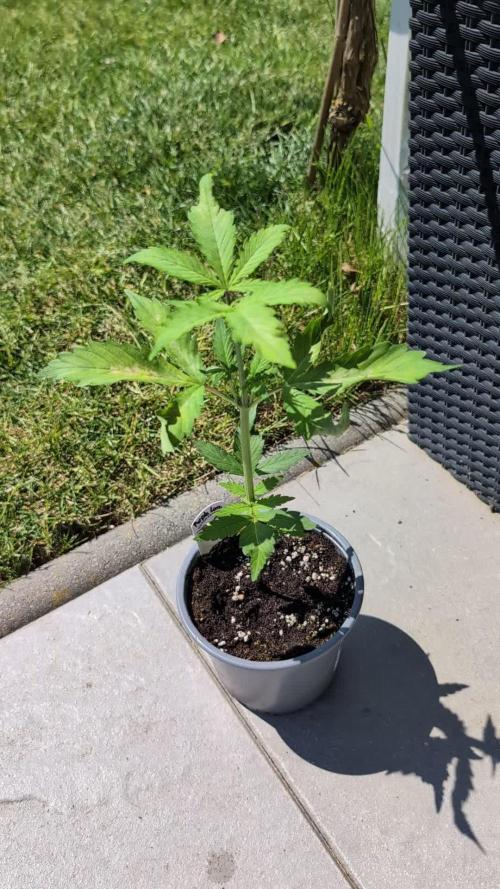

@Suemchen
Follow
Outside during the day, INSIDE during the night
Day 22: Looks good 👍🏻 watered with supplements: rain water and 1ml/l Root Juice + 1 ml/l Powerzyme 👌🏻
Day 23: looking good 👍🏻 did nothing today 🤗
Day 24: also today, nothing was done👌🏻
Day 18: Looking really promising 👍🏻 watered with supplements: rain water and 1ml/l Root Juice + 1 ml/l Powerzyme 👌🏻Topped her today👌🏻
Day 27: looking good 👍🏻 letting her grow 🤗 leaves got a little burnt from the sun: sun hast been quite strong the Last couple of days...🌞
Day 28: looking good 🤗 watered with supplements: rain water and 1ml/l Root Juice + 1 ml/l Powerzyme 👌🏻did a little Lst
Likes
5
Share


@Deli_Weed
Follow
En general me encanto cultivar esta genética, siempre fue la primer genética que quise cultivar desde que empecé en esto y no me decepciono en lo absoluto, de una sola semilla obtuve 106 gramos de flores de gran calidad 😃 increíble para ser mi primer cosecha con semillas de bancos, ya quiero ver que resulta en la próxima cosecha ya con más experiencia y mejor equipo 🤩


Likes
1
Share


Likes
16
Share


@Mrg7667
Follow
Bomb week!! All pictures/ video was takken on day 9 and i gotta say its looking wild. I Didnt expect them both to start growing so crazy. Lst really seemed to help some of these just explode with tops.
I feel like compared to my first indoor run these are like a week ahead, as far flowering goes. Wich is also interesting because Double Ds can go for 9-10 weeks! Cant wait to see how these babies do there thang
One problem actually i found a little bit of aphids nothing crazy but im going to continue using the growsafe insecticide/fungicide/pesticides.

Likes
14
Share


@CampaCavallo
Follow
8ª Settimana di Fioritura 💐
Guardate che bellezza la Sweet Amnesia Haze 🤩😋 si SweetSeeds 🐘💚
È quasi giunta a piena maturazione e ci piacciono molto i suoi bud pieni di tricomi🏔️😍
Likes
54
Share


@MistaOC
Follow
06.05. Day 100
60 Days of flowering
Harvestday
May 6th — what a day. Back from vacation in the afternoon and wrapped up the Grow Cup in the evening. It was a long, exhausting day, but one I’ll never forget. Those five legendary ladies made it truly unforgettable!

Likes
3
Share


@Earthsower
Follow
She has received a little water this week a gave her 100 ml of phd balanced water she has been recovering steadily under the natural sunlight so I will keep her there and play it by sight. I will wait until the pot drys a bit before I feed h

Likes
8
Share


@bauergrows
Follow
The usual maturing of buds. Unfortunately, they're still a bit small but smell really good.
Observation: The premature yellowing seems to have stopped after green sensation was introduced and the amount of water was reduced. So we could think that my previous hypothesis was not so wrong.

Likes
27
Share


@420DeepGrow
Follow
Gracias al equipo de Zamnesia Marshydro XpertNutrients y Trolmaster sin ellos esto no sería posible.
💐🍜 Cosmic Noodles:
Orgullosa descendiente de Alien OG y Rollercoaster Haze, la Cosmic Noodles ofrece cosechas excelentes y una experiencia de fumar fragante. Esta variedad es muy potente, tiene un 25% de THC y produce efectos intensos y duraderos. Edificante y relajante, fumar Cosmic Noodles catalizará un colocón cerebral energizante que luego disminuirá hasta convertirse en un relajante colocón corporal.
Aquí se pueden detectar las influencias de ambas cepas parentales y las flores son notablemente cítricas, con la lima en primer plano. También disfrutarás de notas especiadas y terrosas con delicados matices florales.
🌻🚀 Consigue aqui tus semillas:
https://www.zamnesia.com/10777-zamnesia-seeds-cosmic-noodles.html
Código Descuento 20%: ZAMMIGD2023
💡TS-3000 + TS-1000: se usaran dos de las lámparas de la serie TS de Marshydro, para cubrir todas las necesidades de las plantas durante el ciclo de cultivo, uso las dos lámparas en floracion para llegar a toda la carpa de 1.50 x 1.50 x 1.80.
https://marshydro.eu/products/mars-hydro-ts-3000-led-grow-light/
🏠 : Marshydro 1.50 x 1.50 x 1.80, carpa 100% estanca con ventanas laterales para llegar a todos los lugares durante el grow
https://marshydro.eu/products/diy-150x150x200cm-grow-tent-kit
🌬️💨 Marshydro 6inch + filtro carbon para evitar olores indeseables.
https://marshydro.eu/products/ifresh-smart-6inch-filter-kits/
💻 Trolmaster Tent-X TCS-1 como controlador de luz, optimiza tu cultivo con la última tecnología del mercado, desde donde puedes controlar todos los parametros.
https://www.trolmaster.com/Products/Details/TCS-1
🍣🍦🌴 Xpert Nutrients es una empresa especializada en la producción y comercialización de fertilizantes líquidos y tierras, que garantizan excelentes cosechas y un crecimiento activo para sus plantas durante todas las fases de cultivo.
Consigue aqui tus Nutrientes:
https://xpertnutrients.com/es/shop/
📆 Semana 4:
Aparecieron un monton de erizos esta semana, el temporal ha hecho algo de mella en la carpa al bajar las temperaturas aunque todo sigue correcto.
Continuamos con las dosis de nutrientes recomendadas por el fabricante.
Likes
25
Share


@Gutismoke102
Follow
The girls are growing great a lot better than I expected so I guess that’s a good thing. Switching to flower in couple weeks this shall be exciting stay tuned
