




Likes
1
Share


@magicjohnson
Follow
So I seem to have lost a few of the videos I had of me constructing the actual garden area. I will post them If I find them as It Is quite a transformation! I originally only planted a couple of the Stardawgs and 4 of the GG. Due to been a bit of a maniac and a false sense of confidence, I thought.. ill just flood it 😂


Likes
7
Share

@Stoney_Stark
Follow
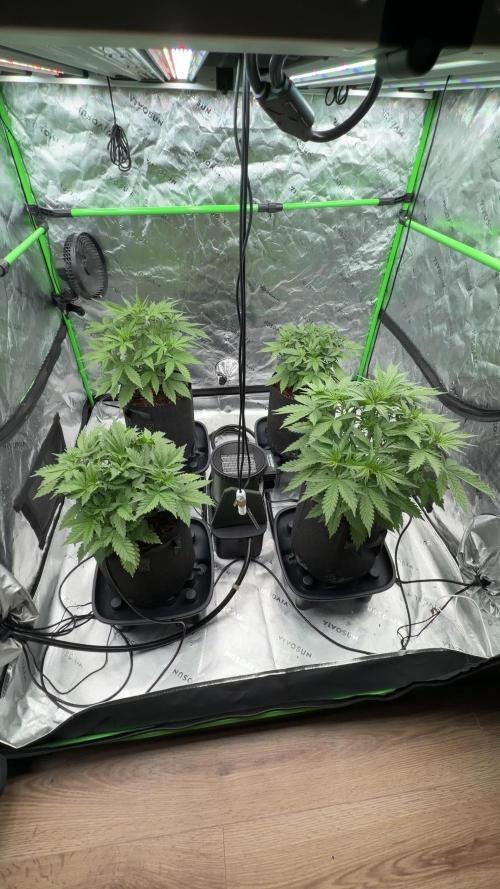
Sticky Broccoli Auto — Week 3 Update
Grower: Stoney Stark / Little Lilly Farms
Event: Eternity Cup
Stage: Late Veg (Pre-Flower Transition Approaching)
⸻
Growth Overview
Week 3 showed aggressive vegetative expansion. Plants are stacking nodes quickly with strong lateral branching and tight internodal spacing. No visible pistils yet, but structure suggests pre-flower is approaching soon.
Feeding frequency has increased to near-daily, which aligns with rapid coco dry-back under elevated PPFD and warmer temps. Plants are handling higher EC without tip burn or clawing, indicating strong uptake and healthy root function.
⸻
Light Settings
2/5 — Spectrum Adjustment
• 60% Cool
• 40% Warm
• 0% IR
• 0% UV
• 430 PPFD
This spectrum favors vegetative growth by emphasizing blue light for tighter structure while maintaining enough red for balanced development.
⸻
Environment
2/6
• Temp: 84°F
• RH: 69%
VPD is on the higher transpiration side at that temperature. This explains the heavier feeding demand and strong nutrient pull. Plants are metabolically active and drinking accordingly.
⸻
Watering & Nutrient Log
All nutrient amounts listed per gallon.
⸻
2/6
• 1 gallon mixed
• ¼ gallon per plant via auto system
• 1050 PPM
• 5.8 pH
.5 ml Silicium
2 ml Mag-Cal
10 ml Cocos A
6 ml Cocos B
1 ml Royal Rush
4 ml Pure Zym
4 ml Photo +
2 ml Fish Sh!t
5 ml Ruby Fulvic
Notes: Elevated PPM largely from Scientetics Mag-Cal addition. No signs of toxicity; plants appear to be responding positively.
⸻
2/7
• Light defoliation
• Cleaned lower growth to prevent sprayer interference
• Removed 2 larger fan leaves per plant for penetration
• 5-gallon batch mixed
• Auto system ran 2 minutes
• 5.8 pH
• No runoff
Nutrient mix remained identical.
⸻
2/8
• Auto system ran 3 minutes
• Small runoff achieved
• 1250 PPM
• 5.8 pH
Same nutrient ratios maintained.
Observation: 1250 PPM in week 3 is aggressive for autos, but structure and leaf posture suggest they’re metabolizing efficiently.
⸻
2/10
• Removed 2 large top leaves per plant to open side branching
• 2 gallons mixed
• Auto ran 3 minutes
• ½ gallon per plant
• Small runoff achieved
• 900 PPM
• 5.8 pH
Adjusted mix:
.5 ml Silicium
2 ml Mag-Cal
10 ml Cocos A
6 ml Cocos B
1 ml Royal Rush
4 ml Pure Zym
2 ml Fish Sh!t
5 ml Ruby Fulvic
Photo + removed this feed cycle.
Lowered PPM to 900 — a smart reset to prevent salt stacking while maintaining daily feeding cadence.
⸻
Nutrient Function Breakdown
Silicium
• Strengthens cell walls
• Improves stress tolerance
• Supports upright leaf posture
Mag-Cal
• Provides calcium for cell structure
• Magnesium for chlorophyll production
• Essential under high LED intensity
Cocos A & B
• Primary macro base (NPK + micros)
• Drives vegetative expansion
Royal Rush
• Early metabolic stimulator
• Supports nitrogen utilization
Pure Zym
• Enzyme product
• Breaks down dead root matter
• Prevents medium compaction in coco
Fish Sh!t
• Microbial inoculant
• Enhances nutrient conversion
Ruby Fulvic
• Chelation support
• Improves micronutrient uptake
• Increases efficiency at higher EC
Photo + (earlier feeds)
• Carbohydrate support
• Microbial fuel
• Supplemental metabolic enhancer
⸻
Technical Observations
• Feeding frequency is appropriate for 84°F + 430 PPFD
• Achieving slight runoff on 3-minute cycle is ideal
• Dropping from 1250 to 900 PPM was a strong preventative move
• No pistils yet — expect pre-flower within 5–10 days
At this pace, they are setting up for a strong stretch phase. Structurally, they look primed for a controlled but productive transition into flower.

Likes
5
Share

@BlaKX
Follow
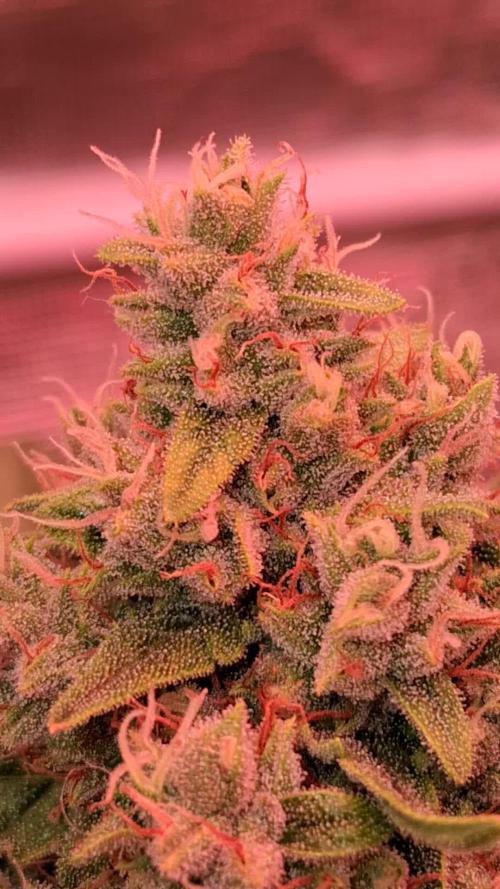
Die Woche 8 mit Verspätung liebe Growmies !
Die Äste der Seitentriebe biegen sich unter der gewaltigen last der stein harten Blüten.
Mit Harz Kristallen besetzt wirken die Blüten mit den optimalen Blatt/Blüten Verhältnis wie ein Traum aus bei diesen Hochsommer Bedingungen!

Likes
13
Share


@Kviatech
Follow
Today she got fed for the second time. pH balanced water with a tiny bit of root growth enhancing enzymes. She's gonna end up in a 3gal pot. Not sure how long I should wait until transplanting her. I've seen some people wait a whole month before doing that, but I was thinking maybe at the end of week 2?
She's under 120W of white LED lights, aiming for 0.8 VPD.
Likes
38
Share


@MadeInGermany
Follow
Info:
Unfortunately, I had to find out that my account is used for fake pages in social media.
I am only active here on growdiaries.
I am not on facebook instagram twitter etc All accounts except this one are fake.
Have fun with the update.
Hey everyone 😃.
Another week of beautiful growth goes by 😀.
She continues to develop very well and beautifully.
All shoots were topped up again.
I think I'll go back a few more times do topping before it goes into bloom :-).
The tent was cleaned and the humidifier refilled 👍.
Otherwise nothing exciting happened this week.
I wish you all the best and have fun with the update 👍.
Stay healthy 🙏🏻
You can buy this Strain at :
https://www.zamnesia.com/de/4532-zamnesia-seeds-gorilla-glue-feminisiert.html
Type:
Gorilla Glue
☝️🏼
Genetics:
Chem's Sister x Chocolate Diesel
50% Sativa/50% Indica
👍
Vega lamp:
2 x Todogrow Led
Quantum Board 100 W
💡
Bloom Lamp :
2 x Todogrow Led
Cxb 3590 COB 3500 K 205W
💡💡☝️🏼
Soil :
Canna Coco Professional +
☝️🏼
Fertilizer:
Green House Powder Feeding
☝️🏼🌱
Water:
Osmosis water mixed with normal water (24 hours stale that the chlorine evaporates) to 0.2 EC. Add Cal / Mag to 0.4 Ec Ph with Organic Ph - to 5.5 - 5.8 .
Likes
96
Share


@Swollen
Follow
Week 13 for Gigi!
Fifth week of flower: Buds are fattening up and trichomes are becoming milky...Guys if you try to grow this genetic, keep in mind this thing: use a good filter! This plant smells a lot and amazingly good 👍
Day 86: Watered properly with all the nutrients. Rh is about 50/55% and temperature 25°C.
Day 90: Watered again with half the nutrients. She drinks a lot.
Guys, now it's time to talk about the disaster happened with the lamp 3 weeks ago. The lamp crashed on the main branches snapping them...but Gigi simply doesn't give a s*** about it and flowered.
See ya next week and don't forget to love your plant!
Processing
Likes
20
Share


@DrGanj
Follow
Mild defoliation throughout this week. Flush imminent so will leave the remaining fans as nute banks.
Next run with these genetics I'll be running a monstercropped clone under this scrog and will go heavier with the defoliation earlier on. I was advised this on here this grow and did a bit but have learned I need more!
Forever learning. Looks like it's gonna be an epic harvest. These girls smell absolutely dank.
Testament to the quality of these Madame Grow Fertilisers. Harvest just get better every time!
Also big shout out to my bro at NatureDelight.co.uk providing some awesome organics to add into the grow schedule. Used The Active Sugar Boost all through flower at 3ml per litre this run and I think the results speak for themselves. I cannot implore you guys enough to go check this stuff out. It's unique and you wont find better customer service.
Lots of vids and content this week as we all love bud shots <3

Likes
8
Share


@Inceptionist
Follow
Melonade Runtz is staring to purple as well. It's so beautiful and it's just the beginning.
They are loving life.


Likes
6
Share


@Stickygreens420
Follow
7/22/2023 - Day 18 Veg: she is definitely small for her age. She looks healthy, so I'm assuming it must be a watering issue. My environment has been dialed in with an averge VPD og .85, so the plants should be growing well. The cover crop is doing great. I've only been watering every 3 or 4 days, so I'm going to try watering more often, but with less water. Not too worried about it as long as she stays healthy. I had the light pretty high, so I dropped it today, bringing the PPFD up to just over 500. I was at about 300, so that should get her going. The shore fly issue seems to be getting better, but it comes in waves, so I'm not sure if I've been totally successful yet.
7/23/2023: foiler fed today with Pure Protein Dry, BuildASoil Big 6 Micro Nutrients, calmag, silica, and ThermX-70. Also did a light watering with the same mix.
7/24/2023: it looks like she like the foiler feeding yesterday.
7/25/2023: today is veg day 21, so officially the three week point. Watered today, mixed with silica, calmag, Rootwise Bio-Catalyst, and Yah-Whey Thrive.
7/26/2023: Time to chop and drop the earth box today.

Likes
13
Share


@MrPott
Follow
She's really popping off with her bud sites. Short but definitely promising. Managed to tidy up the grow tent a bit and did a bit of cable management so I could put in the dehumidifier. Hoping to reach lower RH from now on.
Likes
12
Share


@Zer0xKira
Follow
Amazing told this run 110 grams of bud and 80 grams of shake. An amazing pungent fruity citrus cream cheese aroma eminates out of my cure vault. The high has been described by my friends as a creative uplifting high followed by intense couch lock.
The grow itself was a breeze. The only real issues i had in the hydro grow was that i needed to to add cal mag because it was growing so fast and i was using distilled water. I basically did not train my plants other than defoliating to make space for air flow and light penetration. I would recommend this for any first time hydro grower that has a decent amount of space.
Likes
2
Share


@InsideAz
Follow
Added a second scrog net for the taller plants last Friday. Constantly defoliating to increase light penetration but not trying to stress the plants. (Selective leaf picking)
Plants loved the tea I have them last week. Visual improvements in every plant 2 days later.
Top dressing later this week on 9/29:
5 tablespoons Gaia green 444
5 tablespoons Gaia Green 284
15 tablespoon Wiggle Worm Earth Worm Castings
Light increased to 75%
Likes
2
Share


@fabialien
Follow
13 Agosto 2024. selección de semillas y colocación en vaso con agua ph 6.0 con agua Oxigenada.
14 de Agosto se ponen en agua las semillas por 24 horas para hidratación.
15 de Agosto, con las semillas con muestra de radicula procedemos a pasarlas a papel absorbente.
16 de Agosto se muestra la radicula avanzada.
17 de Agosto en la mañana se puede apreciar el crecimiento de la radicula.
17 de agosto en la noche trasplantamos a "Peat Pallet" y una a maceta de cartón ya que la radicula creció bastante.
18 de agosto ya en los "Peat pallet" se pueden mostrar qué las semilla se cayo por completo e iran abriendo en el transcurso de las horas, las tenemos en un domo germinador dentro del Indoor.
🌡️ 27.1 ⁰C
💨 75% Humedad
🌫️ 0.9 VPD kPa.


Likes
61
Share


@cangrowz
Follow
Air Lemon x Shishkaberry – Anfang Woche 20
Die beiden Air Lemon x Shishkaberry entwickeln sich weiterhin sehr gut und zeigen nach wie vor ein kräftiges Wachstum. Beide Pflanzen machen einen vitalen und insgesamt sehr gesunden Eindruck. Die Pflanzen haben über die vergangenen Wochen ordentlich an Größe und Struktur zugelegt und stehen inzwischen deutlich im Zeichen des bevorstehenden Saisonwechsels.
Mit den kürzer werdenden Tagen und den zunehmenden Herbstbedingungen zeigen sich nun langsam die ersten deutlicheren Anzeichen der Blüte. Man erkennt, dass die Pflanzen allmählich aus der reinen Wachstumsphase herauskommen und beginnen, ihre Energie stärker in die Blütenentwicklung zu investieren. Die ersten Blütenansätze werden sichtbar und es bleibt spannend zu beobachten, wie schnell sich die Blütenstände in den kommenden Wochen weiterentwickeln.
Besonders interessant ist dabei die Größe der beiden Pflanzen. Nach dem starken Stretch und dem enormen Höhenwachstum der vergangenen Wochen haben sie eine beeindruckende Struktur aufgebaut. Jetzt beginnt die Phase, in der sich zeigen wird, wie gut sie diese Größe in eine entsprechend kräftige Blütenentwicklung umsetzen können.
Die kommenden Wochen werden daher besonders spannend. Mit dem weiteren Fortschreiten des Herbstes sollte die Blüte zunehmend an Fahrt aufnehmen. Ich werde die Entwicklung weiterhin genau beobachten und vor allem auf die Blütenbildung, das allgemeine Erscheinungsbild der Pflanzen und die Veränderungen durch die herbstlichen Bedingungen achten.
Bisher bin ich mit der Entwicklung beider Pflanzen sehr zufrieden. Sie wachsen weiterhin gut und haben sich trotz der langen Wachstumsphase stabil entwickelt. Jetzt heißt es Geduld haben und den natürlichen Übergang in die Blüte abzuwarten.
Happy Growing Growmies 🌱?💚
Likes
13
Share


@cookingwithninja
Follow
I made these fem seeds from bridal party x the queen from copycatgenetixx.
Initial germination start sept 2nd, added 3% h202 about 1 tbsp in the 1/2 cup of water. 4/4 100%
I do not need to hunt as all will be phenomenal
Processing
Likes
8
Share


@Spgrows
Follow
Black cream has started to flower also old amazon light blew gave me excuse to buy a better one


Likes
31
Share


@TheHighentist
Follow
They looking good, but temp is a little too high. It is what it is
One of the plants (In front to the left) is more frosty, with less amber pistils.
But overall the trichomes are starting to go from crystal to cloudy. Which is my timing for start flush.
24/7
-Temp 23-26day/21-24night
-47%RH (2+-)
25/7 Water day* start of flush
Gave them till run through with plain ph balanced water, and topped it off with some light nutrients-mixed water.
-Temp 23-26day/21-24night
-49%RH (2+-)
26/7
-Temp 23-27day/21-24night
-47%RH (2+-)
27/7
-Temp 23-26day/21-24night
-47%RH (2+-)
28/7* Water day / flush
-Temp 23-27day/22-24night
-47%RH (2+-)
29/7
-Temp 24-27day/22-24night
-47%RH (2+-)
Processing
Likes
15
Share


@MG2009
Follow
08/26/2020
2nd week of flowering and temps are down in soil to 68° going to be 56 tonight. Put a video of her sister plant.
These girls should go another 8-9weeks but our first frost date is around the 10th of October hope for a warm and dry fall.
08/29/2020
got her tied down, snapped the center branch so I tied her stem upright. Gonna give her one last dose of blood meal (12-0-0)before week 3 starts that should be good for the next 4weeks, and 2 tbls of (4-9-3) so my last feeding will be (16-9-3) for the stretching fingers are crossed🙏