The Grow Awards 2026 🏆
Likes
Comments
Share
@FoTwenny
Follow
I apologize for the video quality. I have been super busy, but still wanted to make something nice for y'all! Day 56: Gave the girls another plain watering pH adjusted to 6.5 then added Mammoth P @ 67°F. Not fading as quickly as I'd thought they would. Chopped the Triple Cheese today and moved our Gelat.O.G. into the open spot in flower. Breeder specs show 50-56 day Bloom an I think last run she may have went too long. Plan to be in the garden 8/5 (Day 58) and hoping to see some more fading and swelling going on. The aromas on the tent are absolutely tantalizing. I will try to get a few more photos for ya'll. Day 58: Did some minor defoliation in the veg tent and took photos. I decided today I would upload unfiltered and unedited photos. Enjoy! Day 61 of 12/12: I noticed seeds in the Skunk #1.😭😭😭 Possibly other plants too, but I was mostly on the lookout for the flowers to tonight. I noticed a single banana popping out of Purple Queen. I decided to harvest all but the Strawberry Amnesia and the Blueberry. I will get pictures soon and update with harvest deets. I need to take a closer look to see what plants may have been pollenated and if there are any other nanners. I did have a timer fail (which has been replaced) at the end if week 1 of flower. Not sure if this could be the cause, if I let her go too long, or if it's just the genetics. I am hoping for minimal damage. I'd be interested in a Purple Queen x Chenobyl cross. Think the seeds would be prone to hermies or would ya'll toss the beans in the bin?
Likes
17
Share
@Hashy
Follow
Week 11 Light cycle=12/12 Light Power=140w Extractor controller settings High temp= 24c Low temp= c Temp step=0c High Rh= 45% Low Rh= % Rh step=0% Speed max=10 Speed min=1 Smart controller settings (during lights on). Lights on=10.01-21.59 Radiator on= below 22.0c Radiator off= above 23.0c Dehumidifier on= not in use Dehumidifier off= not in use Smart controller settings (during lights off). Lights off=22.00-10.00 Radiator on= below 18c Radiator off= above 19c Dehumidifier on= not in use Dehumidifier off= not in use Fri 1/3/24 💧💧💧💧💧💧💧💧💧💧💧💧💧💧💧💧 Method= automatic Feed=bloom nutes. Neutralise=0.1ml/L Silicon=1.0ml/L Calmag=0.5ml/L Terra Bloom=3.0ml/L Sumo Boost=2.0ml/L P/K 9/18=0.5ml/L Easy Ph down=0.115ml/L Ec=1.65 PH=6.5/6.8 Time start=12.00pm Finish time=13.45pm (11×5 minute runs with 5 minute gaps) Total flow rate=190ml/min Flow rate per plant=47ml/min. Total volume made=13L(L) Total volume left=3L Total volume used=10L Volume per plant=2.5L (Est) Runoff. Total runoff=2.25L Ec=2.22 PH=6.2/6.3 💧💧💧💧💧💧💧💧💧💧💧💧💧💧💧💧 #1 (Day 71)(Day 33 flower) 📋 Developing well I'd say this is going to be the 2nd plant to finish. Sat 2/3/24 #1 (Day 72)(Day 34 flower) 📋 Sun 3/3/24 #1 (Day 73)(Day 35 flower) 📋 140w to 130w Mon 4/3/24 #1 (Day 74)(Day 36 flower) 📋 Tue 5/3/24 💧💧💧💧💧💧💧💧💧💧💧💧💧💧💧💧 Method= automatic Feed=water Neutralise=0.1ml/L Easy Ph down=0.008ml/L Ec=0.2 PH=6.4/6.4 Time start=12.00pm Finish time=13.45pm (11×5 minute runs with 5 minute gaps) Total flow rate=190ml/min Flow rate per plant=47ml/min. Total volume made=13L Total volume left=2.5L Total volume used=10.5L Volume per plant=2.6L (Est) Runoff. Total runoff=1L Ec=1.6 PH=6.3/ Didn't run as should because forgot to plug it in. 💧💧💧💧💧💧💧💧💧💧💧💧💧💧💧💧 #1 (Day 75)(Day 37 flower) 📋 Defoliate some lower stuff. Wed 6/3/24 #1 (Day 76)(Day 38 flower) 📋 Thur 7/3/24 #1 (Day 77)(Day 39 flower) 📋 H=100cm D=15cm DLI=60.0 She is doing great and will possibly be done in about 2 weeks by the looks of things. She will be going onto a ripening feed from now on. Back soon. Take it easy.
Likes
7
Share
@trustno1
Follow
Hi 🙋‍♂️ Leider hat die Critical Jack ein paar Bananen 🍌 in den Buds… Egal, kann man nicht ändern. Ich ziehe das jetzt durch. Die Critical von RQS ist spektakulär. Ich liebe sie Diese Woche gab es nur noch Wasser Bis zur nächsten Woche 🙋‍♂️
Likes
10
Share
@Lazuli
Follow
Its winter so i connected a air hose to my 45watt fan and i blow in warm air, the other side of the hose is right above my gas heater downstairs. The out fan in the tent is on 65watts my tent stays 20celcius and humidity under 50%. I dont think my plants like this “warmed air” as my seedling curl up completely if i put them in the same tent. Its either this or let her freeze. My yield will suffer as it does every winter but hey spring is coming in a few months then its back to party hardy, or grow hardy in our case.
Likes
18
Share
my dry and cure style is this: 4 days of hanging upside down to get water activity lower to around 0.6 in 50% humidity and 26 C temp (i know its a little high but we are in a hot summer right now and i cant get it lower even with air conditioner) and then after 4 days of drying i remove leaves and stalks, trim buds and move them to jar for the rest of their life :D . and in the first 4 days of curing i open the jar door and let hem get some fresh air in the jar for about 5 minutes and close the jar door again, after 4 days of curing like that buds are smokable but they will get better as they getting cured about 1 month. buds are one of the hardest as fucking rocks type of buds! very dense , compact , sticky , smelly , amazing at every aspect growing stage was 56 days and flowering stage was 75 days total (harvested tops at day 64th) the total weight of dry buds was : (plant #1 & #3 top buds 56 G + lower buds 22 G ) 78 G + (plant #2 top buds 47 G + lower buds 18 G ) 55 G + (plant #4 top buds 120 G + lower buds 67 G ) 187 G = 367 G
Likes
1
Share
@BigGGrows
Follow
She was harvested this week day 73 from seed week 11. All pistols went amber and trichomes 90% cloudy. As you can see from pics and videos, she is FROSTY. I will put the harvest under next week because i want to give dry weights. She is hanging drying out now. I flushed for 1 week using mollasses and tps signal with ph water. The last 4 weeks of her flowering was done outside in the green house. I cannot wait to try her out. Smells awsome. Good job OSSC!
Likes
74
Share
@Mr_Maes
Follow
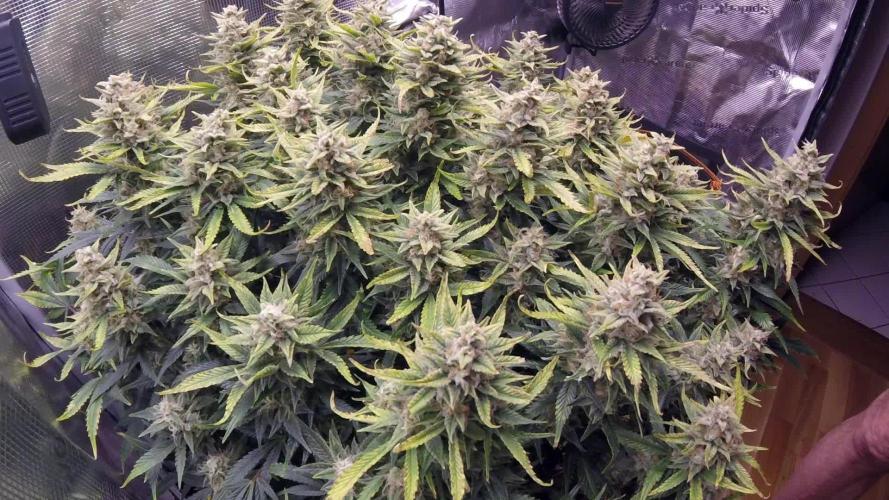
Nothing but colas on all 3 this is going to be a big harvest. Another 2 or 3 weeks max.
Likes
162
Share
Week Update – Final Flush Before the Chop! 🌿✂️ Last week of flushing and we’re just about ready to bring her down! I like to aim for a few ambers towards the end, so I’m closely monitoring those trichomes going for that sweet 70/30 cloudy to amber ratio. 👀💎 She’s absolutely stinking up the place in the best way possible pure skunk vibes, it’s amazing. Dense as a rock too! I seriously can't wait to smoke her.
Likes
36
Share
Que dire mise à part que se strain est tous simplement magnifique ? Il porte bien son nom, il commence à être bien Frosty! Et la couleur violet commence à apparaître de plus en plus! Les bud sont beau et dégagent une belle odeur fruité, le plant a une sacré couverture résineuse, je pense qu’elle pourrais être parfaite pour faire des extraction! Cette semaine je lui ai donné un thé de compost oxygéné, on va voir comment elle va réagir. Recette du tco pour 20 litres. (Grammes : gr) 50gr biochar 250gr zéolite 3gr granulé Micro-Organisme IT45 10gr pollen d’abeilles 10gr levure de bière 3gr endomychorize 10gr consoude 20gr vers de farine 10gr cendre coque de ricin 12gr ortie microniser 15gr Kelp 10gr spiruline 10gr de cbd living soil 20ml de miel liquide 30ml de mélasse 20ml d’acide humiques et fluvic Mettre tous les ingrédients (sauf la mélasse ,l’acide h/f et le miel) dans un filtre 400micron, le placer dans un seau avec de l’eau (10litres). Rajoutez le miel et 10ml de mélasse Y mettre un micro bulleur alimenter sur une pompe à air et faire oxygéné le mélange pendant 24h. Rajout de 10ml de mélasse après 12h le début de la mise en route de la pompe. A la fin des 24h rajoutez le restant de mélasse et d’acide h/f, mettez y en plus 10litres d’eau au mélange. Reste plus qu’à arroser! Pour la Frosty j’y ai incorporé 7litre de mélange La veille j’ai préparé le pot à l’arrosage avec 500ml d’eau et 2gr de Bacillus IT35 Amyloliquefaciens X5 Bacillus Amyloliquefaciens : rhyzosphère, probiotiques. Aspersion et arrosage. Utilisable pour toutes cultures. La bactérie Bacillus Amyloliquefaciens se fixe dans la rhizosphère en se nourrissant des exsudats racinaires. En contrepartie, elle stimule la croissance racinaire en sécrétant des métabolites de croissance et solubilise le phosphore en sécrétant des phytases (enzymes). Effet probiotique consistant en l’utilisation de micro-organismes bénéfiques pour la nutrition et la santé des plantes. La spiruline, le plus riche et le plus complet des amendements organiques La Spiruline est une algue aquatique connue comme complément alimentaire, la Spiruline est aussi un amendement organique et écologique très complet. D'une grande qualité nutritive, elle apporte à vos plantes une quantité de nutriments, dont l'azote, phosphore, potassium, minéraux, acides aminés, vitamines, chlorophylle et protéine. Le charbon végétal actif est capable d’absorber jusqu’à cinq fois son poids propre en eau ainsi que les éléments nutritifs qui s’y trouvent. Il joue ainsi le rôle de catalyseur et d'amplificateur pour les fertilisants traditionnels, qu'ils soient d'origine organique ou minérale. Ce pourquoi il est idéal pour activer un sol et pour les thés de compost oxygénés. Le charbon végétal améliore la diffusion et la disponibilité des éléments nutritifs dans le sol et offre des conditions propices au développement des micro-organismes. Le Biochar peut être introduit dans une grande variété de sols. Il est particulièrement efficace dans les sols pauvres, difficiles et acides. Pour faire agir rapidement et efficacement sa capacité d’amendement, le charbon végétal est enrichi et biologiquement activé avec des micro-organismes. Le Biochar se comporte ainsi comme un structurateur et un activateur dans le but de valoriser les sols. Composition : • Charbon végétal actif 31%
• Matière organique 33%
• Matière sèche 75%
• C/N : 17
• PH : 7,2
• Azote (N) : 2,1 % dont 1,2 % azote organique
• Phosphore (P205) : 0,74%
• Potassium (K20) : 1,18%
• Calcium (Ca) : 6,8%
• Magnésium (MgO) : 0,65% Le pollen est l'ingrédient de base de la fabrication du miel par les abeilles. Riche en vitamines et minéraux, il est qualifié « d'aliment parfait », y compris pour les plantes ! Les zéolithes sont des roches cristallines, présentant des capacités d'adsorption particulièrement importantes vis à vis des polluants que l'on rencontre dans l'eau et dans certains liquides, ainsi que dans l'air et les gaz. Elles sont extrêmement poreuses comme les charbons activés et elles peuvent être chargées électriquement pour opérer comme des échangeurs d'ions. La zéolithe est un produit naturel qui respecte notre environnement. Utilisé dans le milieu industriel depuis de longues années déjà, ce minerai aux propriétés filtrantes particulières commence à se vulgariser dans le domaine de la piscine privée, de l'aquariophilie, des bassins d'agrément, de la récupération des eaux de pluie, ou encore de la culture des bonsaïs et autres plantations diverses par exemple... 4 points techniques majeurs : - Grâce à leur propriété hydrophile, les zéolithes peuvent adsorber l'eau jusqu'à 30% de leur poids total et sans aucune variation de volume : pas de gonflement en présence d'eau ni de craquement en cas de déshydratation comme certaines argiles. Les zéolithes sont d'ailleurs de puissants agents anti-mottant (anti-agglomérant). Cette propriété est très appréciée dans le cas des terrains de golf et autres aires de jeux. - Les zéolithes ne captent pas l'eau de façon irréversible, elles se comportent comme une réserve au voisinage des racines. Celles-ci peuvent capter l'eau en fonction de leur besoin. Les zéolithes permettent ainsi de réduire les besoins d'arrosage jusqu'à 35 %. - Une zéolithe se comporte comme une "Zone de Stockage" qui retient l'azote et les éléments minéraux nutritifs au voisinage des racines et les relâche lentement en fonction des besoins de la plante. Cela se traduit par une croissance harmonieuse mais rapide du végétal. - La capacité d'adsorption et l'énorme rapport surface/volume des zéolithes, vont permettre à la fois la rétention de la solution du sol et une bonne oxygénation au voisinage du système racinaire. Les zéolithes favorisent donc l'organisation biologique des sols en contribuant au développement de la micropopulation. L'apport en nutriments (N, P, K) est réduit de 20 à 25 %. Ces derniers, adsorbés par la zéolithe, sont beaucoup moins sensibles au lessivage et à l'évaporation. Composition minéralogique : * Chabasite 70 % * Phillipsite 2 % * Feldspath 5 % * Augite 3 % * Illite - Mica 2% Analyse atomique: * Sio2 52 % * AL2o3 17 % * CaO 5,7 % * K2O 6,1 % * MgO 2 %, * Na2O 0,6 % * Fe2O3 3,6 % Amendement calcaire, dolomie et gypse avec préparation microbienne à base de Bacillus Amyloliquefaciens IT45 et Saccharomyces cerevisiae LYCC6420 Formulation : micro granulés (1 – 1,6 mm) à base de rhizobactéries favorisant la croissance des plantes qui se multiplient et colonisent rapidement la zone des racines, et de levures Saccharomyces cerevisiae souche LYCC ayant un effet probiotique. Les PGPR produisent des enzymes qui solubilisent le phosphore à partir de complexes inorganiques et organiques dans le sol et stimulent la croissance des racines efficaces augmentant ainsi la zone d'interception des éléments nutritifs. Les levures LYCC permettent une occupation de la rhizosphère par une flore bénéfique. Composition :
• Matière sèche : 96,8%
• Matière organique : 91,5%
• N total : 6,6% dont N soluble dans l'eau 0,17%
• P total : 2%
• K total : 1,7% Micro-granulés : 
• Oxyde de calcium (CaO) total : 30%
• Oxyde de magnesium (MgO) total : 7%
• Anhydride sulfurique (SO3) : 13% La levure de bière est une matière vivante qui permet un meilleur fermentation pour les thés de compost oxygénés notamment conseillé pour accompagner les croissances ou apporter un gros coup de pousse pendant la floraisons.  La levure stimule la vie des sols également à l'arrosage direct en apportant tout aussi bien que dans le TCO sa population l'espèce micro-bactérienne positive pour votre sols ainsi que des oligo-éléments et diverse vitamines.   Composition : • 2,8% (N) total dont 1% (Norg), • 2,3% (P205) • 1,6% (K20) • 35% de MO • C/N : 8. PH : 8,4. Sous forme de poudre mouillable. Il contient des spores du champignon mycorhizien Rhizophagus Irregularis MUCL57891 avec des levures inactivées spécifiques. 2000 spores/gramme d’endomycorhize Rhizophagus Irregularis MUCL57891 et Saccharomyces Cerevisiae LYC6420 inactivée. Se connecte efficacement au système racinaire et forme un vaste réseau souterrain de filaments, qui agissent comme des extensions pour atteindre les nutriments et l’eau au-delà de la rhizosphère Composition : • Poudre contenant 2000 spores/g. d’endomycorhizes Rhizophagus irregularis  La Consoude (Symphytum Officinale) est une plante présentant de nombreuses propriétés. Particulièrement riche en Potassium (K) organique, la consoude est une alliée idéale pour les périodes de floraison. La consoude a tout pour plaire : riche en vitamine B12, elle agira également comme stimulateur racinaire, mais aussi comme biostimulant cellulaire, grâce aux alcaloïdes, aux allantoïnes et jusqu'à 30% de protéine ! 100% déjection de vers de ténébrions.
Très riche en microorganismes, le guano de vers de farine est une matière directement composté par les vers. En effet, c'est bien la digestion de matières végétales par des larves, insectes ou autres arthropodes qui valident le processus de compostage, que ce soit en zone de production de cultures d'insectes, pour le compost maison ou la dégradation de litière forestière. Les bactéries et autres champignons obtenus grâce au système digestif de nos vers, permettent la dégradation accélérée des éléments nutritifs dans vos supersoils, et les symbioses permettant l'assimilation des éléments nutritifs. Cette bio-activation intense mettra dans vos sols, à la disposition de vos plantes, un panel tellement varié de nutriments frais qu'il nous est aujourd'hui technologiquement impossible de pouvoir tous les nommer et de les compter.  Le guano de vers de farine fournit une grande polyvalence. Très équilibré, il s'utilise en entretien ou en apport ciblé seul ou en complément de d'autres amendements ou fertilisants organiques. Il agit comme un puissant activateur de sol et/ou de substrat. Cendre coque de ricin NPK 0,1-18,6-16,5. 0,1% (N-Azote), 18,6% (P205-Phosphore), 16,5% (K2O-Potasse), 11,7%(Ca0), 9,1 (Mg0) - Origine : Inde ACTION SOL • rend rapidement accessible au sol Phosphore, Potasse, Magnésium et Calcium. ACTION PLANTE • Apport aux stades agronomiques propices. • Produit riche en éléments fertilisants : combinaison NPK 35%. • Régularité de l’apport, milieu et fin de floraison. . Favorise la sénescence. Analyse chimique : • NPK 0,1-18,6-16,5 • N-Azote 0.1% • P205-Phosphore 18,6% • K2O-Potasse 16,5% • CaO-Calcium 11,7% • MgO-Magnésium 9,1% Ortie bio micronisée Stimule la vie du sol et la végétation. Composition : • 2,8% (N) total dont 1% (Norg), • 2,3% (P205) • 1,6% (K20) • 35% de MO • C/N : 8. PH : 8,4 KELP poudre
ascophyllum nodosum
- amendement sol Croissance et floraison - Meilleure germination - Meilleur développement racinaire Meilleure assimilation - Résistance aux stress osmotiques - Augmente la production de chlorophylle = plantes plus vertes = lumière mieux captée - Lutte contre le stress osmotique - Développement des Micro-Organismes dans le sol – Riche en vitamines, fer, iode, oligo-éléments, hormones de croissance auxines et cytokinines - Idéal en épandage et pour les thés de compost oxygénés. Important : notre Kelp est un goémon noir mais il n'est pas le varech bien moins fertile de la même famille qui est l'algue qui pullule et pollue la Bretagne, notre algue pousse uniquement à plus de 50 mètres de fond dans les grands courants froids au large de la Norvège.
Likes
4
Share
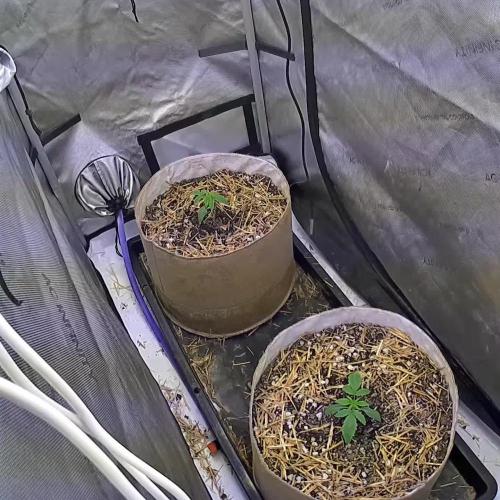
6/13/25 everything is coming along smoothly for the Divine Rapier autos. I had to pick a seed shell off of the more scraggly looking one but they’re green and happy In their environment except for the weird one that had the cotyledon leaves come out the seed before the tap root. Her tap root started to grow up out of the soil and that made me think that maybe I was wrong so I tried to bury her slightly so that maybe she’d figure it out for herself. She doesn’t seem to be so I may need to pop the 3rd seed Stay tuned for what comes next. Also check out my X account and YouTube for any extras that I can’t post here. I have a full seed planting video on YouTube of these strains, that is too Long to post on here.
Likes
12
Share
@SpliffDoc
Follow
Getting dense now, really enjoying growing this strain, I'm excited to see the end result in 3/4 weeks. Let's go.l... Have a good weekend people, stay high🏻😉💚
Likes
2
Share
Partway through last week I noticed that there was no runoff after feedings. I increased the time the fertigation pump runs to 2 mins twice a day. It seems like either the root system is drinking up more or the added aeration has changed how much runoff comes out. Plant 1 has fallen behind in growth. The inter-nodal spacing was so tight that the new growth was being strangled by the older fan leaves and other growth. I adjusted the LST to help and pruned a very small amount of leaves. It seems to be doing better, but is several inches shorter than Zkittlez 2 which has had some really explosive growth. I started the scrog today, bending many of Zkittlez 2’s branches down to fill out the tent. I bent a few branches on Zkittlez 1, but it’s still a little short. This week I upped the nutrients, almost doubling the Cocos A & B, Multizen and Cal Mag. I still tried to keep EC down though, only allowing it to rise by about 300mS/cm. This could actually be the first week of flower, but think I’ve started to spot some pistils, but I’m not sure. I can’t find the breeder’s info, but think it’s supposed to have a 4 week veg time and 10 week flowering period. Update: lots of pistils being thrown out especially from Zkittlez 2. It’s definitely the first week of flower. There has been a lot of growth since the start of the week. I continued to bend branches down and tuck them under the net, but now that buds are really starting to take shape I'm going to lay of any further stressing. I noticed that there was little runoff over the past couple days. Yesterday (Monday) I had to refill the reservoir and mix up new nutrients because there was only an inch of water left. These girls have gotten a lot thirstier over the past 2 weeks. I've upped the feeding times to 3 minutes twice a day.
Likes
32
Share
An Tag 50 sieht die Tropicana Cookies schon fast "erntereif" aus. Sie bekommt noch locker eine bis zwei Wochen, aber nach 50 Tagen vom Samen bis in diesen Zustand zu kommen ist für mich beeindruckend. Das ist wirklich schnell 💪 Die anderen beiden trödeln so vor sich hin, die eine blass, die andere klein, aber sie machen ihren Job. Vielleicht lässt die Tropicana die anderen beiden aufgrund ihrer Geschwindigkeit auch einfach nur etwas langsam aussehen. Wenn die also noch abliefern, hätte ich nichts dagegen 😅 An Tag 53 sieht alles soweit gut aus. Die Tropicana Cookies scheint schon langsam ihrem Ende entgegen zu gehen. Verdammt schnell würde ich sagen. Ich gebe ihr aber noch ein paar Tage, auch wenn ich den Platz den anderen beiden gönnen würde und später auch werde. Die Mimosa hat sich eingegrooved und man hat endlich das Gefühl Fortschritt zu sehen. Sie bekommt überall schöne, weiße Igel. Die MAC#1 ist scheinbar ein wenig lichtempfindlich. Ich hab versuchsweise den EC bis 4,0 hochgedrückt, aber sie bekommt die Farbe nicht zurück, solange ich ihr über 700 µmol/s/m² an Licht gebe. Gestern hab ich das Licht ein wenig reduziert und ich habe das Gefühl, dass sie wieder mehr Druck in den Blättern aufbaut. Leider bekam die Mimosa dadurch nur noch 580 µmol/s/m², also habe ich die vordere Lampe seitlich gehangen. So konnte ich genug Licht rein bekommen, da der seitliche Unterschied zur Tropicana Cookies bei Weitem nicht so groß ist, wie der Höhenunterschied.
Likes
15
Share
They survived the nutrient burn pretty well that they got from early transplanting. All have been connected to the autopot tank. The Mango Sherbet has been topped, the Apple Blossom and one OCP have been mainlined. Especially the Apple Blossom is growing like hell. Never had better genetics so far. Even though I topped/mainlined them there hasn't been any slow down or still stand in growth at all. Also I've connected the pump to the airdomes on the first 3 in the lower row as the leaves already reached the edges of the pots.
Likes
10
Share
@MrCogoyo
Follow
Buenos días gente, hoy tocaba poda y acomodar amarres, ayer le saque clones, esta planta va de maravilla 💚
Likes
13
Share
@Corwinism
Follow
So it has begun... I've had to start utilizing string to hold up branches by tying them to the ceiling rods and surrounding equipment. These plants are healthier and happier than my first grow, so I wasn't quite expecting them to blow up like they did, therefore my single-layer screen was not enough to support the branches. Not to mention the net used was store-bought and kind of sucks. I prefer my double-layer from the first harvest. The Mimosa is packing on some major frost, followed closely by the Glookies. American Pie trichomes seem to appear and ripen much closer to the ending stages of flower.
Likes
6
Share