


Likes
Comments
Share


@Verde_og
Follow
Fue un extendido cultivo,por problemas en un momento por problemas con el medidor de ph. Tuvo sobrefertilizacion y devido al tiempo que ocupe en recuperarla se extendió este cultivo. Muy buena cepa,de internudos cortos,buena resina y delicioso aroma. Sin duda aprendí mucho mas con este ejemplar de seet seed Sad s1...lo bueno de todo es que ya se probó y esta buenísima. Ya me la imagino cuando tenga un buen curado.
Ahora a curar y a disfrutar esta rica weed.

Likes
19
Share


@Mission420
Follow
This week I moved them into bigger pots, which is why I think now they were not growing as big as I hoped. They seem to be doing well, and I have added the net now and will let the canopy build up. Since I moved to bigger pots, I did not need to water for a bit, but I think it will be back to normal this week. Check out the video I did today of the room.

Likes
2
Share


@Drtomb
Follow
The inzane is so tall and the golf ball sized nugs are plentiful. They are really starting to gain the weight. Should see them tighten up in the next week or 2.

Likes
2
Share


@Ultraviolet_
Follow
We become aware at such times of man's wonderful ability to bring seemingly unrelated elements into harmonic balance, and receive a glimpse into a world where everything exists in conscious sympathetic attunement to everything else. When we listen to a piece of music that seems to strike a beautiful chord somewhere inside us, or view a painting that simply glows with harmonic awareness well executed, we probably do not spare much time to contemplate the wonderfully intricate combination of vibrations that our sensors make it possible for us to perceive. We tend to appreciate the relationship between the parts of something by an awareness of the harmony or dissonance of the whole. This ability enables us to say "what a beautiful house!" instead of "analysis has proven that this collection of building materials exhibits certain elements of harmonic proportion." While this ability to instinctively appreciate the beauty of true harmony has an important role to play in evolution, a more analytical understanding of the laws involved can be most useful. This is especially so if we wish to create works of art where each part exists in true harmony, not only with the other part of that particular whole, but with the universe within which the creator and the created exist.
Everything vibrates. From the most dense matter to the most subtle cosmic rays, everything which our senses allow our thoughts to become aware of, can be specified in terms of wavelength or frequency of vibration. These two terms define the same thing, but from different points of view.
The following are the approximate wavelengths of various energy carriers:
Cosmic rays 0.000,000,001 mm
Gamma rays 0.000,000,1 mm
X rays 0.000,500 mm
Ultraviolet rays 0.003 mm
Visible light 0.006 mm
Infrared 0.01 mm
Sound waves 1 meter
Radio waves 300 meters
Violet light 400 nm to 450 nm
Blue light 450 nm to 500 nm
Green light 500 nm to 570 nm
Yellow light 570 nm to 590 nm
Orange light 590 nm to 610 nm
Red light 610 to 700 nm
1 nanometer (nm) = 0.000,000,1 cm = 1/10,000,000 cm
If a guitar string is plucked and we hear a sound, it is not too difficult for the human mind to associate this sound with the vibration of the guitar string. With color it is quite different. It is difficult for us to conceive that the color of a substance is not an inherent property of the substance itself, but an indication picked up by our senses of that substance's ability to absorb or reflect the light which happens to be shining on it at that moment. Neither the matter nor the light is colored. What happens is that the brain learns to differentiate between the frequencies reflected or transmitted by the substance the eyes are focused on. The same thing happens with sound. When we say "Oh! Listen, they're playing my favorite song," what we really mean is: "My brain has stored within it a particular pattern of frequencies. I have compared the new information being received with this stored pattern and have deduced the answer that the two patterns are similar within certain specified tolerances." The 'pleasure' involved could have something to do with our running the pre-recorded pattern at the same time, in 'sympathy' with the new pattern as it is received.
The word sympathy describes very well our ability to appreciate color and sound. It also describes the reason behind certain elements of harmony. For instance, if a substance vibrating at 100 cycles per second (tone 1) is in the proximity of another substance vibrating at 200 cycles per second (tone 2), we could perceive, if we had the right equipment, a certain sympathetic relationship between the two.
We will see from this that there is a uniform doubling of the first tone seen in the second. At various points along the waves, the two are the same in amplitude. At other points, they are at opposite poles to each other. This doubled frequency has more points of similarity to the original than any other frequency except the original itself. If the equipment we had available for measuring these two frequencies was a soundboard amplifier and a pair of ears, then we would hear what would sound to us like one tone. If we had the opportunity to hear one at a time, we would hear that although they sound the same, one is higher in pitch than the other. This characteristic of 'the same but different in pitch', musicians have called the octave. Any two tones produced where one has exactly doubled the frequency of the other is called an octave. Speaking in ratios, an octave would appear then as the ratio 2:1 or 1:2, depending on whether we are talking of an octave up or down.
A single note produced by almost any instrument will contain more than one wavelength or frequency. It will have a dominant frequency, the wavelength of which we would call the note's 'fundamental' or 1st harmonic. It will also have a varying number of upper harmonics, gradually fading in intensity into infinity or silence.
Natural harmonics always have the same pattern of intervals between them. The interval between the 1st and 2nd harmonic is a perfect octave; between the 2nd and 3rd a perfect fifth; between the 3rd and 4th a perfect 4th; and so on, the intervals becoming smaller and smaller until they lose any relationship with the western 12 tone scale as it exists at the moment. Just as an octave has certain elements of sympathy with its fundamental, so some intervals have been noted to be more perfectly in sympathy with the fundamental than others. The ratio of the 'perfect 5th' or interval of 7 semitones, as it occurs in the harmonic series, is 3:2 or 2:3, while that of the 'perfect fourth" is 4:3 or 3:4. All the tones in the western 12 tone scale can be expressed in terms of the ratio between the upper tone and its fundamental. This would seem to be an ideal way of generating a scale from any given fundamental and several attempts have been made to do this, the Pythagorean system being probably the most well known. Although when working with a single tone instrument playing on its own, the Pythagorean formula works wonderfully well, if we had several instruments tuned this way together and asked them to play almost any western music, we would find that at times they sounded quite out of tune to each other.
The lack of flexibility of the various scale systems based on the harmonic series has led to what is known as the 'tempered' scale. This uses as its primary unit of interval the ratio of the octave or 2:1. It then proceeds to divide the interval between any fundamental and its upper octave into 12 smaller intervals by applying the ratio: two to the one-twelfth power, to one (21/12:1). This equals 1.059463094, so by multiplying any frequency by this number, we will obtain the tempered semitone next up from our fundamental. We will also find that any tone twelve semitones up from any other tone, in a scale generated in this way, will have exactly double the frequency.
If we took the note middle C on a piano and halved the wavelength, we would have the note C one octave above. If we halved this, we would have the C above, and so on. However, within about 6 octaves, we would find that although a 'sound' was being produced, no human ear could perceive it. If we kept on going, halving and producing upper octaves of our fundamental C, we would proceed through the infrared band, into the visible light spectrum. If we happened to be outside during the day, we would, for one octave only, see the note C with our eyes. The next octave above would already be in the ultraviolet band, and outside the eye's sensitivity range. If we can think of color as being an indication of a substance's vibratory rate or wavelength, we may begin to see a relationship that could exist between the color and sound spectrums.
The logical extension of what has so far been said is that there exists a scale in the color spectrum that corresponds exactly to the scale in the sound spectrum, each color tone being an octave of the equivalent note in the sound range.
This is not the end of the story but only the beginning. If we can for the moment accept that any wavelength in one band has upper and lower octave stretching out to infinity, then the next question is 'fine, but what shall we use as our fundamental? A particular color? A particular sound frequency?' The musicians among us will probably say 'A 440'. This means that the note A should vibrate at 440 Hertz, or 440 times per second. They would tell us that this is standard pitch has been adopted by most orchestras around the world; pianos are tuned to it, instruments are constructed to formulas based on it, and so to them it would probably seem the most appropriate place to begin. Some of these musicians may know of the battle that is still raging with regards to this being the standard, but few would know why A = 440 Hz was chosen except that it worked when it was set to be a suitable compromise between the many different pitches in use at the time.
432 Hz is said to be mathematically consistent with the patterns of the universe. Studies reveal that 432 Hz tuning vibrates with the universe’s golden mean PHI and unifies the properties of light, time, space, matter, gravity, and magnetism with biology, the DNA code, and consciousness. When our atoms and DNA start to resonate in harmony with the spiraling pattern of nature, our sense of connection to nature is said to be magnified.
Another interesting factor to consider is that the A=432 Hz tuning correlates with the color spectrum, while the A=440 Hz is off. Audiophiles have also stated that A = 432 Hz music seems to be non-local and can fill an entire room, whereas A=440 Hz can be perceived as directional or linear in sound propagation.
Once you adopt the idea that sound (or vibration in general) can have an equalizing and harmonizing effect (as well as a disturbing effect), the science of harmony can be applied to bring greater harmony into one's life or tune to specific energies. There is a form of absolute and relative harmony. Absolute harmony can, for example, be determined by the tuning of an instrument. The ancients tuned their instruments at an A of 432 Hz instead of 440 Hz - and for a good reason. There are plenty of music examples on the internet that you can listen to in order to establish the difference for yourself.
Attuning the instrument to 432 Hz results in a more relaxing sound, while 440 Hz slightly tenses up the body. This is because 440 Hz is out of tune with both macro and micro cosmos. On the contrary, 432 Hz is in tune. To give an example of how this is manifested microcosmically: our breath (0,3 Hz) and our pulse (1,2 Hz) relate to the frequency of the lower octave of an A of 432 Hz (108 Hz) as 1:360 and 1:90.
It is interesting to note that 432 Hz was the standard pitch of many old instruments and that it was only recently (19th and 20th century) the standard pitch was increased. This was done in order to be able to play for bigger audiences. Bigger audiences (more bodies) absorb more of the lower frequencies, so the higher pitch was more likely to “cut through”. One of the oldest instruments of the world is the bell ensemble of Yi Zeng (dated 423 BC), tuned to a standard F4 of 345 Hz, which gives an A= 432 Hz. The frequency of 345 Hz is that of the platonic year! Similarly, many old organs are tuned in A=432 as well; for example, St. Peter’s Capella Gregoriana, St. Peter’s Capella Giulia, S. Maria Maggiore in Rome.
Maria Renold’s book “Intervals Scales Tones and the Concert Pitch C=128 Hz” claims conclusive evidence that 440 Hz and raising concert pitch above scientific “C” Prime=128 Hz (Concert A=432 Hz) disassociates the connection of consciousness to the body and creates anti-social conditions in humanity.
The difference between concert pitch A=440 Hz and Concert A=432 Hz is only 8 cycles per second, but it is a perceptible difference of awareness in the human consciousness experience of the dream we share called existence.


Likes
37
Share

@Brujha77
Follow
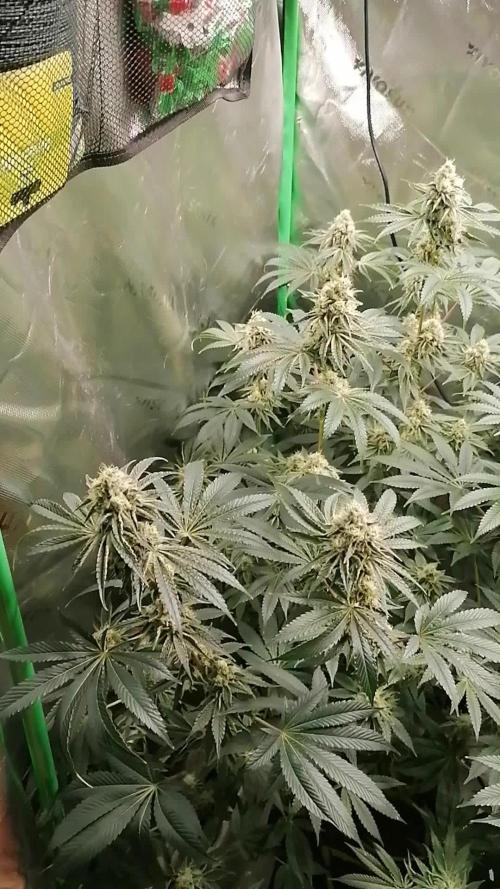
Beginn Woche 7 Blüte
Langsam legen die Buds an Masse zu.
Außer Tank füllen ist nix zu tun als Abwarten😉
Die 50l reichen so 4-5 Tage dann muss wieder nachgefüllt werden.
Likes
Comments
Share


@CityFarmer
Follow
Hello everyone,
These girls are still flowering!!! Been giving them water thinking they would finish soon. Let's see what happens this week
See you guys next week 🤘🤘🤙🤙👊👊👊

Likes
124
Share


@MiyaguiOkPolilla
Follow
Hola gente!!
Vaya semanita por favor... Unos calores de no creer con 37 Cº, humedad relativa extrema de hasta el 83% y poco viento... Ella está interesada en recibir un poco más de agua, pero no le daremos más de lo que necesita... No quiero arruinar los nutrientes y la vida de su sustrato así que la riego lentamente con sistema de goteo.
El fermento de guano de murciélago, palomas, conejo y cabra ya está listo. Tiene un agradable compuesto de melazas, microorganismos de Top Crop, Agrobacterias y almidones además de una buena dosis de humus de lombriz... Huele muy peculiar, ni feo ni agradable, como a levaduras...
Lo comenzamos a agregar en dosis de 1 litro a 25 litros de agua pura de lluvia para riego por goteo. Esta semana ella recibirá goteo permanente hasta acabar con la solución. Creo que los 25 litros durarán unos 10 días aproximadamente. (Podría variar según la necesidad del sustrato)
Estamos preparando además un top dress de composta, humus y trichoderma para cuando comience la temporada de floración ya que es a mi parecer la forma más eficiente de prevención contra hongos no deseados 🤞
Aplicaciones foliares permanentes cada 3 días intercalando una vez delta 9 y otra vez jabón potásico, aceite de neem y cola de caballo para mantener plagas a raya y también dar ese impulso al inicio de la floración que al parecer está funcionando más que bien.
Luego de todo esto, ella hoy toma un descanso previo al riego intenso que se viene.
Quiero dar mucho más con este cultivo y desearles a todos un gran camino de aprendizaje y agradecimiento 🙏🌿🌞🏄♂️
IRIE!

Likes
24
Share


@Green_Tool
Follow
Los abonos que se ven no se hicieron en el mismo riego esto es parte de la semana 4 se darán en diferentes días siempre regulando a 0.4, primer abono de VEG con Green Grow de Quemanta, en Fin de Semana se pasan a floración y aplicamos estimulantes de floración.
Riegos foliares cada 3 días con knactive, esta semana se hicieron 2 defoliaciones en diferentes días debido al rápido crecimiento y ya preparándose para la floración.
Se agregará un Ventilador mas para la semana siguiente.


Likes
4
Share

@GoodKarmaCannabis
Follow
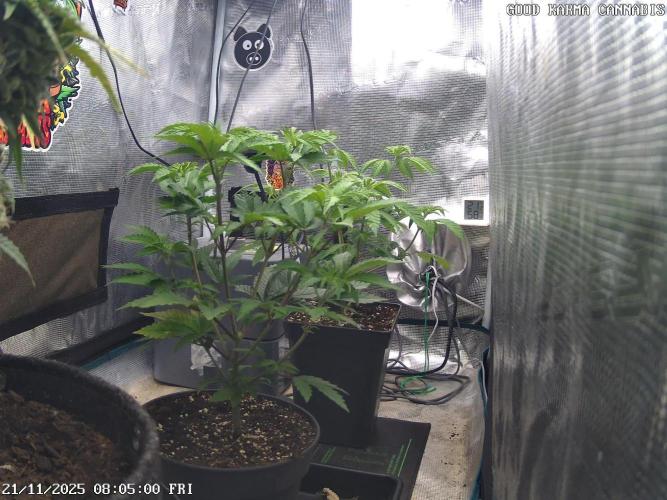
The one that xploded was labeled Automatic and hat to go
Time raffke is fro 14.12 ti 22.12.
Likes
26
Share


@Melloganja
Follow
Everything is going great, the planta are very healthy, waiting for the the bloom season.
Likes
19
Share

@Flavors
Follow
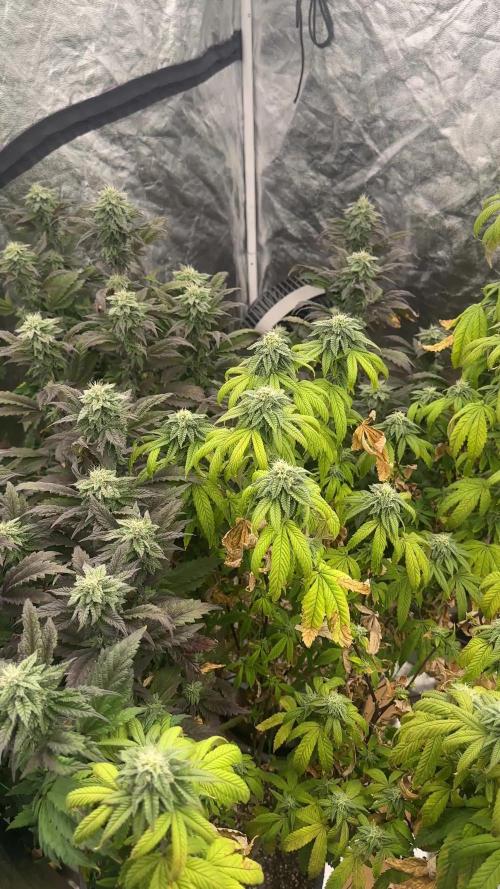
Another week in the books! 📅 Red Hot Violet is still thriving — stacking leaves and holding strong 💪💚. The Amaretto Sour is still tucked in beside her, and while I haven’t separated them yet, both are adapting to the shared space surprisingly well 🤞🌿.Growth is steady, color is deep, and the canopy looks lush 🍃✨. I’m keeping an eye on root competition, but so far they’re coexisting like stubborn siblings sharing the same room 😅.Nutrients and watering schedule are locked in 🔒💧, and I’m continuing to prep for that upcoming flip to flower soon 🌸🚀.Patience and balance — that’s the theme this week. 🙏🌱

Likes
10
Share


@Bigbombbudz
Follow
Again this was a great grow, everything was dialed in right, the Shiskaberry has a great smell, taste, and high..if you haven't grown it yet give it a try, you won't be disappointed.
Until next time, smoke a fatty, help out your fellow grower.


Likes
2
Share


@Viccrazyweed
Follow
Saturday 25 February;
The big one keep growing nice and healthy, the tiny has started growing but its like a week delayed, if both born at the sane time maybe the tiny one is gonna produce less, the shock of repotting has punished her a lot… in still worried about her…
Anyway im still super excited with this project
Custom 0.8 m2 tent, x2 Solux 50W LED, Canna profesional soil 5% perlite
Thank you Super Sativa Seed Club
To create Auto Purple OG Punch we crossed our feminised Purple Punch with an autoflower OG Kush. The original Purple Punch is a cross between Larry OG and Grandaddy Purple, illustrious and stable indica dominant THC-rich heavyweights!
The total grow cycle from autoflower seed to harvest is a short 9 weeks. You will be rewarded with a large yield of sticky resinous buds, up to 600g/m2 indoors. If you’re looking to grow a high quality indica auto made with cannabis cup winning genetics you will love Auto Purple OG Punch. THC content is always up-to/around 20%. Auto Purple OG Punch effects are intense, euphoric and relaxed. She also contains around 1% CDB which contributes to the very smooth, chilled smoke. Expect a mouthwatering blend of sweet tasting candy, dark fruit and hints of spice. A real connoisseur cocktail with powerful effects!
She normally reaches around 1m tall. But in optimised conditions with LED grow lights you can see occasional monster plants up to 2m tall with XXL yields. Auto Purple OG Punch is easy, potent and heavy yielding indoors. She also delivers well outdoors - such as the balcony or garden.
Auto Purple OG Punch is a perfect, powerful strain for a quiet relaxed day. The calming indica body effect is very satisfying and de-stressing.

Likes
4
Share


@DogDoctorOfficial
Follow
💙 8×8 Adventure – Week 14 🌿
Blueberry Muffin – Pheno B
🌸 A Little Further Ahead, Still in No Hurry — The Compact Girl Follows Her Own Clock
Welcome back to another chapter of the 8×8 Adventure! 🌱💚
And here we are again...
Blueberry Muffin Pheno B.
😂💙
Still compact.
Still taking her time.
Still looking at the rest of the room as if everybody else is running around for absolutely no reason.
And honestly?
I think she might have a point.
😂🌿
She's moving forward, she's developing beautifully, and she's actually a little further along than her sister.
But let's not get carried away.
We're not talking about a sudden transformation into the fastest girl in the room.
Nope.
She's still taking the scenic route.
She's simply a little further down that road than Pheno A.
And when I look at her now, I really like what I'm seeing.
The flowers have their own character.
The structure is beautiful.
She's continuing to evolve.
And despite her slower pace compared with much of the room, she's giving us plenty of reasons to keep watching.
💙🌸✨
So this week, we're keeping things simple.
No dramatic changes.
No new environmental strategy.
No attempt to force her to catch up with her neighbours.
We're letting her continue at her own pace while we observe the differences between these two sisters.
Because if the 8×8 Adventure has taught me anything, it's that the plants don't always follow the schedule we imagine for them.
And Blueberry Muffin Pheno B?
She's following hers.
Let's give this little lady her spotlight!
────────────────────────
🌱 THE 8×8 ADVENTURE — ONE ROOM, MANY DIFFERENT CLOCKS
For anyone discovering this diary for the first time, welcome to the 8×8 Adventure!
The idea behind this project is simple.
We're observing different genetics and phenotypes sharing the same general growing environment.
Same room.
Same lighting ecosystem.
Same 12/12 schedule.
Same general nutritional approach.
Same grower.
But very different plants.
Some stretch.
Some stay compact.
Some develop quickly.
Others take their time.
Some become giants.
Others seem perfectly happy keeping their feet on the ground.
😂🌿
And then there are plants like our Blueberry Muffin sisters.
Both compact.
Both progressing more slowly than much of the room.
Both beautiful.
But still following their own individual timelines.
That's what makes this experiment interesting.
We're not trying to make every plant behave identically.
We're watching what happens when different genetic expressions share the same general conditions.
And Pheno B is giving us another little piece of that puzzle.
💙🌱
────────────────────────
💙 STILL COMPACT — BUT A LITTLE FURTHER ALONG
Let's talk about the difference between the sisters.
Pheno B is a little more advanced than Pheno A at the moment.
Not dramatically.
Not enough to make us forget that both girls are progressing more slowly than many of their neighbours.
But it's noticeable.
And I like documenting those little differences.
Because when you look at the cultivar name alone, it's easy to imagine that both plants should behave in roughly the same way.
But plants aren't copies of one another.
Even when two plants share the same genetic background, individual phenotypes can express themselves differently.
They can have different structures.
Different growth patterns.
Different rates of development.
And different finishing timelines.
Here, Pheno B is just a little further along.
She's still compact.
Still taking her time.
But she's showing us her own version of Blueberry Muffin.
And that's exactly what we want to document.
💙🌸
────────────────────────
🐢 NO HURRY, NO PANIC, NO RACE
I swear these girls have their own calendars.
😂💙
The rest of the room keeps moving, and these two Blueberry Muffins seem perfectly comfortable doing things at their own speed.
And you know what?
That's fine.
We're not running a race.
We're not handing out prizes for the fastest plant to reach the next stage.
And we're certainly not going to assume that every difference in timing means something needs to be changed.
Pheno B is developing.
She's progressing.
She's looking beautiful.
She's simply taking longer than many of the other girls.
That's the observation.
And that's what we'll continue to document.
The important thing is to distinguish between a plant that is progressing slowly and a plant that is showing signs of a problem.
Those aren't automatically the same thing.
So rather than making assumptions based on the calendar alone, we're watching the actual plant and how she develops.
No unnecessary drama.
No imaginary deadlines.
Just Blueberry Muffin doing her thing.
😂💙🌿
────────────────────────
🌸 THE FLOWERS DESERVE THE ATTENTION
Now, let's leave the calendar aside for a moment.
Because I don't want this report to become entirely about how slowly she's moving.
There's much more to this girl than her timeline.
She's developing beautiful flowers, and her structure is worth appreciating on its own.
When I look at her, I don't just see a plant that's behind the others.
I see a plant with her own expression.
Her own structure.
Her own visual character.
And that is what makes photographing individual phenotypes so rewarding.
The whole-room view tells us one story.
Getting closer tells us another.
And when we compare those observations over several weeks, we begin to appreciate the small changes that might otherwise go unnoticed.
That's why we're here.
Not simply to count weeks.
Not simply to compare heights.
But to document what each individual plant actually does.
And Blueberry Muffin Pheno B?
She's still giving us something beautiful to look at.
💙📸✨
────────────────────────
🌿 TWO SISTERS, TWO INDIVIDUAL JOURNEYS
I know we're going to cover some of the same subjects in Pheno A's diary.
And that's completely fine.
Both reports need to make sense on their own, because someone might be following only one of these plants.
But the interesting part is how the same general story expresses itself differently in each diary.
Pheno A is moving at her own pace.
Pheno B is a little further along.
Both are compact.
Both are slower than much of the room.
And both are beautiful.
The differences aren't necessarily dramatic.
Sometimes they're small distinctions in timing or development.
But those distinctions are exactly what makes following individual phenotypes worthwhile.
We're giving each girl her own record rather than treating them as one generic plant.
And when the run is complete, we'll have two individual stories to look back on.
Same family.
Same room.
Different clocks.
💙🌸🌱
────────────────────────
💡 SAME ARTIFICIAL SUN — SAME PHOTONS
The lighting setup remains unchanged this week.
Our Future of Grow Black Series LEDs continue providing the main lighting, with the two additional Black Series 600W fixtures remaining part of the upgraded room setup.
After introducing the extra fixtures, we reduced the output to approximately 59% from the plug rather than simply running everything at maximum.
Our working reference remains around:
☀️ Approximately 1,500 PPFD across the upper canopy.
Actual intensity varies according to plant height and position, so that figure is a reference for the upper canopy rather than a claim that every flower receives exactly the same amount.
And Pheno B?
She's sharing the same lighting environment as the rest of the room.
Same artificial sun.
Same general lighting strategy.
Different genetic expression.
Some plants respond by building large structures.
Some stretch.
Some remain compact.
And some take their time developing their flowers.
The photons are available, but each plant has its own biology and its own way of responding to the environment.
That's one of the things that keeps this experiment interesting.
💡🌿💙
A huge thank you to Future of Grow for supplying the additional fixtures and allowing us to expand the lighting capability of the room.
────────────────────────
❤️ A LITTLE RED LIGHT BEFORE THE NIGHT
We're also continuing with our 15-minute red-light period after the main lighting period.
This is an additional part of the lighting routine we're exploring, and it's worth explaining what we mean by it.
Plants respond to different wavelengths of light through several photoreceptors.
Red and far-red light are particularly relevant to phytochrome signalling, which helps plants interpret changes in their light environment.
However, red light and far-red light are not interchangeable terms.
Their wavelengths differ, and the effects depend on the spectrum, intensity, duration, timing, and the plant's physiological response.
So, for our setup, the extra 15 minutes of red light is something we're documenting as part of the lighting routine.
We're not assuming that it automatically improves flowering, increases yield, or guarantees a better transition into the dark period.
We want to understand the science behind what we're doing rather than simply repeat claims we've heard.
❤️💡🌱
────────────────────────
🔬 QUICK SCIENCE BREAK — THE EMERSON EFFECT
Since we're talking about light, let's take a moment to revisit the Emerson effect.
The Emerson effect is a real phenomenon discovered through research into photosynthesis.
In simplified terms, photosynthetic activity can increase when certain wavelengths of red light and far-red light are provided together, beyond what would be expected from their separate effects under the conditions studied.
This helped scientists understand that photosynthesis involves two cooperating photosystems:
🌿 Photosystem II (PSII)
🌿 Photosystem I (PSI)
These systems work together in the photosynthetic electron transport chain.
Different wavelengths can contribute differently to their activity, and under suitable conditions, their combined contribution can enhance photosynthetic performance.
That's the fascinating part.
But here's the important distinction.
The Emerson effect is not simply another name for giving a plant a short red-light treatment after the main lights switch off.
The classic effect concerns photosynthetic responses under particular illumination conditions. An end-of-day lighting treatment is a different situation.
We therefore shouldn't assume that our 15-minute red-light period automatically triggers the Emerson effect or guarantees an improvement in plant performance.
The actual spectrum and conditions matter.
And that's why I prefer to keep the explanation honest.
We can explore lighting.
We can test ideas.
We can learn from the science.
But we shouldn't promise results that we haven't established.
🔬💡🌱
────────────────────────
🌙 THE DARK PERIOD STILL MATTERS
Our main lighting schedule remains 12/12.
The additional red-light period is a separate part of the lighting routine, and it doesn't mean plant responses to darkness can be reduced to a simple on/off switch.
Plants have internal rhythms and respond to changes in their light environment.
Photoreceptors, signalling pathways, and the timing of the light-dark cycle all play roles in how plants respond.
So we're keeping the distinction clear.
We're documenting the lighting treatment we're using.
We're keeping the rest of the room consistent.
And we're observing the plants rather than assuming that one small adjustment will explain every aspect of their development.
That's the approach I prefer.
Curiosity, observation, and a little bit of science.
💚🔬
────────────────────────
🌱 NUTRITION — NO CHANGES THIS WEEK
On the nutritional side, we're keeping the same general program as the rest of the room.
No new recipe for Pheno B.
No attempt to force her to catch up.
No changes simply because she's developing more slowly than some of the other plants.
The current recipe remains:
🌱 Plagron Pure Zym — 1 ml/L
⚗️ Plagron pH Plus — 0.03 ml/L
🍋 Plagron Lemon Kick — 0.03 ml/L
🌸 Plagron Terra Bloom — 2 ml/L
🌱 Plagron Power Buds — 1 ml/L
🍯 Plagron Sugar Royal — 1 ml/L
🌿 Plagron Green Sensation — 1 ml/L
Current solution readings are approximately:
⚗️ pH — 6.04
⚡ EC — ~2.05 mS/cm
The general nutritional approach remains unchanged.
We're keeping things consistent and observing the individual plants rather than assuming that slower development automatically calls for a different feeding program.
Pheno B is progressing.
She's a little further along than her sister.
And we're continuing to let her show us how her own story develops.
────────────────────────
🌡️ WEEK 14 — ROOM OVERVIEW
🌸 Flowering: Week 14
💡 Main lighting schedule: 12/12
❤️ Additional end-of-day red-light period: 15 minutes
💡 Lighting system: Future of Grow Black Series LEDs
🔌 Approximate fixture output: 59% from the plug after adjustment
☀️ Upper-canopy PPFD reference: approximately 1,500
🌱 Pot size: 15 L
The general room setup remains unchanged.
We're keeping the environment and overall approach consistent while observing the differences between the plants.
────────────────────────
✂️ THE BEST THING WE CAN DO IS NOT INVENT WORK
At this stage, we're not trying to create tasks just because we feel we should be doing something.
😂🌱
The plants have established their structures.
The flowers are developing.
And the room continues along the same general path.
So we're observing, documenting, and making changes only when there's a genuine reason to do so.
Pheno B doesn't need us constantly interfering with her just because she's moving more slowly than some of the other girls.
She needs us to pay attention to what she's actually doing.
And that's exactly what we're doing.
Sometimes growing involves plenty of hands-on work.
Sometimes it involves stepping back and allowing the plant to continue.
Right now, this girl is giving us plenty to observe.
So we're letting her get on with it.
💙🌿
────────────────────────
📸 THE VALUE OF KEEPING INDIVIDUAL RECORDS
This is where the separate phenotype diaries really come into their own.
When we document Pheno A and Pheno B individually, we can look back and compare their development rather than relying on memory.
We can see which plant was a little further along.
We can compare their structures.
We can follow their individual timelines.
And we can appreciate how two plants sharing the same general environment can still express themselves differently.
That's useful information for the diary, and it's part of what makes this project enjoyable.
Not every observation has to be dramatic.
Sometimes it's simply:
"She's still moving slowly, but she's a little further along than her sister."
And that's a perfectly worthwhile observation.
Because this isn't about inventing differences.
It's about documenting the ones we actually see.
💙📸🌱
────────────────────────
😂 BLUEBERRY MUFFIN IS NOT CHECKING THE CALENDAR
If this girl could talk, I suspect the conversation would go something like this:
Me: "You know the rest of the room is moving a little faster, right?"
Blueberry Muffin Pheno B: "And?"
Me: "Nothing. Just checking."
Blueberry Muffin Pheno B: "Good. Now leave me alone."
😂💙🌸
And honestly, fair enough.
She's not here to satisfy my curiosity on a schedule.
She's here, she's developing, and she's doing things at her own pace.
The job is to observe her actual progress rather than decide in advance where she should be.
So, little lady...
take your time.
Just don't be surprised when I come back with the camera again.
😂📸
────────────────────────
💙 FINAL THOUGHTS — A LITTLE AHEAD, STILL COMPLETELY HERSELF
Week 14.
Blueberry Muffin Pheno B.
Still compact.
Still slower than much of the room.
Still taking her time.
But a little further along than her sister, and still looking beautiful.
💙🌸✨
We're not changing the general setup this week.
The lighting remains the same.
The nutritional approach remains the same.
The room continues along its established path.
And we're keeping the additional 15-minute red-light period as part of the lighting routine we're documenting.
We've also taken a moment to discuss red and far-red light, along with the Emerson effect, because understanding the science behind our equipment and routines matters.
The Emerson effect is fascinating, but it shouldn't be confused with a guaranteed benefit from a short end-of-day red-light treatment.
We'll keep the explanation grounded, keep observing the plants, and let the evidence guide what we conclude.
And as for Blueberry Muffin Pheno B?
She's doing her thing.
She's a little further along than Pheno A.
She's still taking the scenic route compared with much of the room.
And she's continuing to show us her own expression.
That's what I want to celebrate this week.
Not a race.
Not a competition.
Not an arbitrary deadline.
Just another chapter in the life of this beautiful little plant.
So let's give her the spotlight.
Let's appreciate her flowers.
Let's appreciate her structure.
Let's appreciate the differences between the sisters.
And let's remember why we started documenting these individual phenotypes in the first place.
Same room.
Same general conditions.
Different plants.
Different personalities.
Different timelines.
And a whole lot to learn along the way.
💙🌱🌸
Keep doing your thing, Blueberry Muffin Pheno B.
You're a little further along than your sister, but you're still in no hurry to join the fast lane.
😂💙
And that's fine.
We're watching.
We're documenting.
And we're letting you write your own story.
────────────────────────
🙏 THANK YOU
A huge thank you to Zamnesia for the Blueberry Muffin genetics and for giving us the opportunity to discover these individual phenotypes. 💙🌸
Thank you to Plagron for supporting the nutritional side of the 8×8 Adventure. 🌱
A massive thank you to Future of Grow for the Black Series lighting and especially for supplying the additional Black Series 600W fixtures that have expanded the lighting capability of this room. 💡🙏
Thank you to LumiFlora for helping illuminate the deeper parts of the canopy.
Thank you to TrolMaster for helping maintain the environment behind the scenes.
And, of course, thank you to everyone following along on GrowDiaries.
Every comment.
Every question.
Every observation.
Every photograph.
Every week spent following these different plants and their individual journeys.
It all becomes part of the story.
And Blueberry Muffin Pheno B?
She's still here.
Still compact.
Still beautiful.
Still progressing.
And still doing things at her own pace.
💙🌸✨
I'm looking forward to seeing how her story continues to unfold alongside her sister and the rest of the room.
Until then, keep growing, little lady.
Keep developing.
Keep shining.
And keep reminding us that not every plant needs to follow the same clock.
Growers Love, my friends, and happy growing! 🌱💚💙
See you next week in the 8×8 jungle...
where the faster girls keep moving,
the Blueberry Muffin sisters continue taking the scenic route,
the photons keep flying,
and we're still learning something new from every plant.
Let's grow, observe, and let every phenotype tell her own story. 💙🌱✨
Likes
22
Share


@Fatnastyz
Follow
9-15
Day 21
Today was water day! 2 liters ph 6.0 Added Kelp, Humic, yucca and build-a-bloom. Ratios above.
PH to 6.0 forgot to add booster. only raised ph to 6.2, so I went with it.
Readjusted LST.
She has been super easy thus far. When I adjust lst, she just falls in place. Very happy with her.
Nervous about flower, as all of my flowering agents are new to me.
She loves it all so far, zero issues noticed with her.
stays 80f when awake and solid 72 at night. vpd stays stead at 1.2
Moderate ppfd of 475-490. The bud sites should out grow the leaves soon, I'll crank it soon!
( some of my other plants are more picky) Great everything with her!
9-18
Day 24
Around 1500 ml water with yucca. Turns out, coulda added a little more. Oh well. Doing well and adjusted LST.
Thanks for stoppin by!
9-21
Gave 2k ml ph 6.4
Tea brewed 30ish hrs. Worm poo, recharge, kelp, yucca and 1 tsp build-a-bloom ,molasses. 3 gallons water.
Adjusted lst, full on flower!

Likes
4
Share


@Canna055
Follow
Ladys got a bloom topdress (greenhouse Feeding Bioline ) & flipped to 12/12 After long 60 days of vegging


Likes
7
Share

@GERGrowDesigns
Follow
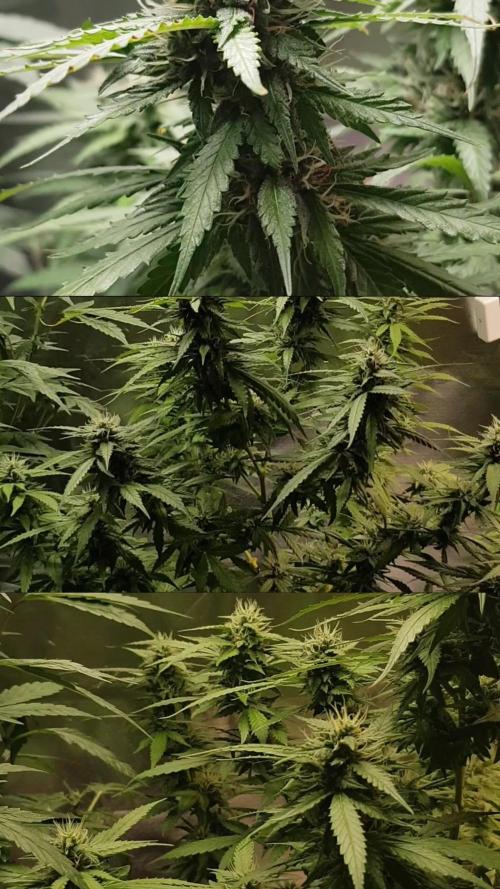
Welcome to Flower Week 4-5 of Divine Seeds Auto Black Op1um
I'm excited to share my grow journey with you all as part of the Divine Seeds Autoflowering Competition 2025. It's going to be an incredible ride, full of learning, growing, and connecting with fellow growers from all around the world!
For this competition, I’ve chosen the Feminized Automatic strain: Black Op1um
Here’s what I’m working with:
• 🌱 Tent: 120x60x80
• 🧑🌾 Breeder Company: Divine Seeds
• 💧 Humidity Range: 50
• ⏳ Flowering Time: 8W-10W
• Strain Info: 21-23%THC
• 🌡️ Temperature: 26
• 🍵 Pot Size: 0.5l
• Nutrient Brand: Narcos
• ⚡ Lights : 200W x 2
A huge thank you to Divine Seeds for allowing me to be a part of this amazing competition and Sponsoring the Strains. Big thanks for supporting the grower community worldwide! Your genetics and passion speak for themselves!
I would truly appreciate every bit of feedback, help, questions, or discussions – and of course, your likes and interactions mean the world to me as I try to stand out in this exciting competition!
Let’s grow together – and don’t forget to stop by again to see the latest updates!
Happy growing!
Stay lifted and stay curious!
Peace & Buds!

Likes
8
Share


@eldruida_lamota
Follow
Impresionante, mirad que flores se están formando aquí , Zambezaseeds si a echo un buen trabajo con estas candy caramelo version fast flowering.
6 semanas de floración y ya no queda casi para cosechar, Añadi esta semana overdrive y retire big bud de advanced nutrients.
Las flores no son muy grandes pero si se ven flores muy compactas y con mucha resina.
Ph controlado 6.2 , humedad entorno al 50% y temperatura media de 26.5 grados, que cara al verano no está mal.
Todas estas flores fueron logradas gracias a una buena iluminación (ts-600 mars hydro) y vaya resultados.
Estas semanas sigo actualizándoos todo , sin más novedades me despido, un saludo fumetillas y buenos humazooos 💨💨💨


