Likes
3
Share
@Hempcules
Follow
WEEK 4 (Day 22-28) These Runtz are growing really well. I'm thrilled with this Barneys genetics. I applied two different topping techniques to my two plants. The larger plant was topped once after four nodes to create eight main shoots, while the second plant was topped at the second node to create four shoots and then topped again to reach eight. That's it for cutting now. I think the plants are handling it very well and will continue to thrive beautifully.
Likes
Comments
Share
Likes
8
Share
@RunWithIt
Follow
Did the switch i was talking about last week, moved my tent plants to the closet and closet plants to the tent. Made a video explaining briefly my rationale behind it. Hopefully they will speed up growth in my warm closet. The next week will be an update for when ALL the plants are starting 🌼. Ill also be starting them on that Fox Farm Big Bloom i was talking about last week, and supplementing them with some Cal-mag by Botanicare as well. Cheers all, you wont be seeing me until there's visible flowers in the closet! ✌️
Likes
13
Share
Everything was fine. So I started to bath each pot by using a fermentation nutrient by using beneficial bacteria, mycobacteria, some Orgatrex, different mycorrhiza's as 36 hours fermented potions with 2 liters/pot. Oh I forget to tell You, as You can see in the Video the water drops 💦 on the surfaces of their leafs @ day 23 I used Boom Boom Spray too for preparing the next stage of powerful photosynthesis by raising up my SanLights @ 300 µmol/m² s. Second video was @ day 26. I raised up a little natural CO2 from 450 ppm to 550 ppm. So they were prepared for more powerful photosynthesis coming up the next days… Critical Orange Punch and Amnesia Zkittlez showed some typical nutritional sensitivities some phenotypes of Sativa dominated strains can show @ the way to powering up the system. Light tops on the head of the leaf area. But again: “Don’t panic, it’s organic.” Also @ day 26 I started with my preferred technique of LST by mainly just pull down a little, the biggest fan leafs, so the little Life-hungry drives were able to came through and got enough homogeneous ppfd for uniform growth rate too.
Likes
60
Share
half way through the first week of flower and the stretch is in full effect. canopy is going to be completely full in a few days, scared for my dwarf white runtz in the middle of the group, itll get swallowed
Likes
64
Share
@yan420
Follow
FERMAKOR BARREL MIX – BASE IN USE (Testing on the Fantasy Feast girl we pulled out of another diary https://growdiaries.com/diaries/274722-grow-journal-by-yan402 ) (FERMAKOR BASE SYSTEM KOH VERSION diary https://growdiaries.com/diaries/278391-grow-journal-by-yan402) (Urea & Micros on the way — first week running without them) 🍶💧🍶💧🍶💧🍶💧🍶 💧 30 L Barrel – Current Working Mix 🍶💧🍶💧🍶💧🍶💧🍶 Step 1 – Calcium Nitrate (Part A) 7 L warm water (~35–40 °C) → added 45 g Calcinit, stirred until fully clear. That’s the calcium + nitrogen backbone for the feed. Step 2 – FERMAKOR PK Base (Part B) 15 L water in the main barrel → added 30 ml FERMAKOR PK Concentrate, mixed well. This forms the main P + K part of the formula. Step 3 – Combine Solutions Slowly poured the Calcinit mix into the barrel while stirring — no reaction, still crystal clear. That confirms the mix is stable and precipitation-free. 🌿 Step 4 – FPJ / FFJ Batch Added 30 ml homemade FPJ (fish + veg batch) ≈ 1 ml/L. Color shifted to a light-amber tone — looks alive and active. 🍋 Step 5 – Citric Acid Balance Added 1 tsp citric acid after everything was blended to fine-tune pH and help chelate micros later on. 📦 Step 6 – Top Up & Check Filled to the 30 L mark with plain water → pH tested with drops, showing yellow-green — roughly 5.8 – 6.0 range. Nice clean look, stable smell, no residue. 💧 Current Base Ingredients (Active Mix) Warm Water ≈ 22 L total Calcinit 45 g → N + Ca foundation FERMAKOR PK Base 30 ml → P + K support Citric Acid 1 tsp → Chelation + pH balance FPJ / Fish Emulsion 30 ml → Organic enzyme booster Result: clean amber mix, mild and balanced. I’ll let this version run for a week before adding anything. 👀👀👀👀👀👀 Observations and changes 👀👀👀👀👀👀 27.10.25 VW27 noticed some min burnt tips so I decreased Calcium Nitrate 45 to → 40g, decided to add two more elements micros and Epsom salts just to make sure they got everything, Fetrilon Combi 1 (Micros): 0.5 g, Epsom salts: 8 g 28.10.25 VW27 she seems devoid of any deficiencies, seems ready for the flip to 12/12 02.11.25 VW27 girl is looking good so I decided to stop making daily videos and do a standard once a week update. 09.11.25 aVW28 7 days since flip,stretch in full swing, first pistils showing, leaf color deep and healthy. Slight tip burn early week → gone after pH stabilized. Feed stayed clear, no residue, roots clean and sweet-smelling, did what I hope is a last cleanup and pruning🎥 10.11.25 VW29 added Phosphoric acid pH down to the schedule for flowering stage. 14.11.25 FW1 FERMAKOR PK Micros 40 → 50 ml 23.11.25 FW2 got some burnt tips, observe and act accordingly in case it worsens, diluted by 25% for this week. 05.12.25 FW3 about 2 weeks ago Calcium Nitrate 35 g → 25 g, FERMAKOR PK Micros 50 ml → 60 ml 12.12.25 FW4 Calcium Nitrate 25 g → 20 g, FERMAKOR PK Micros 60 ml → 80ml 16.12.25 FW4 Calcium Nitrate 20 g → 17 g, FERMAKOR PK Micros 80 ml → 110 ml 🌱💦🌱💦🌱💦🌱💦🌱💦🌱 🌿 Day to day tasks & actions 🌿 🌱💦🌱💦🌱💦🌱💦🌱💦🌱 Fed about 5l a day of #1 and on the weekends I do a pure FERMAKOR PK flush 2l runoff (*RUNOFF reused for tomato plants) 💧💧💧💧💧💧💧💧💧 🌱 Nutrients in 30 L #1 Veg – FERMAKOR 💧💧💧💧💧💧💧💧💧 Calcium Nitrate (Calcinit / Nitcal): 45 → 40 g → 35 g → 25 g → 20 g → 17 g = 1.50 g/L → 1.33 g/L → 1.17 g/L → 0.83 g/L → 0.67 g/L → 0.57 g/L = 207 ppm N / 253 ppm Ca → 184 / 225 → 161 / 197 → 115 / 141 → 92 / 113 → 78 / 96 PK Concentrate (FERMAKOR Base): 30 → 40 ml → 50 ml → 60 ml → 80 ml → 110 ml = 1.00 → 1.33 ml/L → 1.67 ml/L → 2.00 ml/L → 2.67 ml/L → 3.67 ml/L → balanced 1:1 P:K + light micros (from extract) Home-made FFJ/FPJ (Fish + Veg): 30 ml = 1.00 ml/L Epsom Salt (MgSO₄·7H₂O): 8 g = 0.27 g/L → ~26 ppm Mg + ~35 ppm S Fetrilon Combi 1 (Micros): 0.5 g = 0.017 g/L → Fe 0.7 ppm · Mn 0.7 ppm · Zn 0.3 ppm · Cu 0.3 ppm · B 0.1 ppm · Mo 0.02 ppm Phosphoric Acid (pH down) + Citric Acid (chelation): as needed → First set pH with phosphoric acid, then add a little citric only if you want extra chelation Target pH: 5.8 – 6.0 (drop test yellow-green) 📦 TOTAL: Liquids: 60 → 70 → 80 → 90 → 110 → 140 ml per 30 L = 2.00 → 2.33 → 2.67 → 3.00 → 3.67 → 4.67 ml/L Solids (CaNO₃ + Epsom + Fetrilon): 53.5 → 48.5 → 43.5 → 33.5 → 28.5 → 25.5 g per 30 L = 1.78 → 1.62 → 1.45 → 1.12 → 0.95 → 0.85 g/L YouTube Link: https://youtube.com/-m8h?si=A7x4Zlr2kj-_ga31
Likes
9
Share
@Drtomb
Follow
Just purchased a new Gorilla grow Tent, and completely redid my setup in my 4x8 veg area and my new 4x8 Flower area. First the Veg area. It consists of a 4x4 flood table, the other side contains 13 4gal buckets full of hydroton. Also 1 control bucket. This control bucket not only floods the flood buckets, but also floods the table. The plants start off from the moms, they are moved from the flood table into s flood bucket and vegged to produce at least 9 clones (hopefully more like 15) . They are then cloned and after 1-2 weeks they are moved into the 4gal buckets. They sit for ~1month growing bigger, all while waiting for there flowering spot to be opened up. While vegging they are topped and have 3-4 tops selected and focused by trimming any branches that start to reach for light. By the time they are moved they are about 16" inches high. All have 3 tops and are approximately the same height. They are moved into the flowering spot snd immediately are switched from veg nutes to bloom nutes. Over the next 3 weeks i will trim branches that reach away from the 3 main cola stems by more than 2". Also if one or 2 branches on the plant are having a bugger growth spurt, i pinch the tops. This allows the plant to focus growth hormones to the other tops.
Likes
5
Share
She stretchin’ hard and throwin’ out sites 🔥 Got her topped, light defol + lollipopped — airflow’s clean. Might strip a bit more soon if she bulks up. Stackin’ up nice so far… let’s see what she doin’ next 💪🌿
Processing
Likes
19
Share
Buenas noches familia, actualizamos la semana 3 de floración, y es que están increíbles nuestras gorillas girls, tienen un grosor de 7mm de tallo central, espectacular. Empezaron a formarse nuestras flores y es que ya tenemos muchas ganas de ver como se ponen estos ejemplares. El ph está controlado en 6,5 regamos cada 48h , todos los riegos llevan nutrientes. Es predominante sativa y tarda alrededor de 9 semanas.
Likes
55
Share
High UV-B radiation can necessitate increased magnesium because it plays a crucial role in mitigating the stress and damage caused by UV-B exposure. High UV-B can lead to the production of harmful reactive oxygen species, and magnesium helps the plant's antioxidant systems and chlorophyll function to cope with this stress, making adequate magnesium supply essential for plant health under such conditions. Why UV? To do with the way anthocyanin is different from other pigmentations in that its colouration is not attached to the cell itself, it's a pH thing, if you force the color through high dose, as soon as she stops being in that environment, it will begin to revert back to chlorophyll, nitrogen deficiency causes anthocyanin to be produced in the first place, and nitrogen is needed to create new chlorophyll. When plants have a nitrogen deficiency, they produce anthocyanins to protect the leaves from stress while they try to salvage remaining nutrients, like nitrogen, before leaf drop. 24:1 C:N carbon&nitrogen ratio in medium will trigger autophagy, which will begin the dumping of nitrogen into the soil to feed micros as they FEED on nitrogen to convert carbon sugars into chemical energy via cellular root respiration (calcium/phosphorous VITAL for sugar processing). Couple the UV with a nitrogen dump for all the colors of the rainbow, and remove the possibility of allowing the conversion back to chlorophyll. 10/14 mimics late autumn, winter is coming, maximizing genetic expressions of desired purple genes if they do exist, I have seen no indications that I'd expect from previous grows. Oxygen is the oxidizer; if a soil cannot breathe, nothing good will EVER happen. Raised UV to lower the dosage. The leaves begin producing a protein hormone called florigen (produced via the Flowering Locus T gene). DELLA proteins. The plant measures the duration of the night by monitoring the amount of Pfr that has reverted to Pr. I imagine it like an egg timer with sand. You can speed up the flow of sand one way or another, determined by what type of red light and the ratio overall. The standard flowering cycle for many indoor plants is 12 hours of light and 12 hours of darkness. By applying a short pulse of far-red light at the very beginning of the dark cycle, a grower can trick the plant's internal clock. Forcing the conversion: A pulse of far-red light (730 nm) rapidly converts the active (P_{fr}) back into the inactive (P_{r}) form, simulating several hours of dark reversion. This amplified "sleep" signal causes the plant to believe the night started hours earlier than it actually did. For a short-day plant, this rapid reset means it can perceive a 14-hour night even though it only received 10 hours of darkness. This allows growers to use a 14/10 light cycle (14 hours of light, 10 hours of dark) without disrupting the flowering of short-day plants, as the far-red pulse makes the night effectively "long enough". This provides plants with more light for photosynthesis and can speed up the flowering process. What about all night? Or a pulse (15-30min)? High Pfr (Far-Red) overnight mimics a short night:If you maintain a high Pfr:Pr ratio overnight, the plant never receives the signal that a sufficient dark period has occurred. This mimics the conditions of a short night, during which Pfr levels remain high. Flowering is inhibited: As a result, the plant will not flower. This is the same effect that is observed when a flash of red light interrupts a long night, which instantly converts any Pr back to Pfr and resets the dark-reversion clock. But it's not that simple, I do not necessarily want a 14/10 for the entirety of the flower. Suppose you give a 12/12 with the pr/pfr conversion to make her more of a 10/14. It may not be the best option for the entirety of flower. A photoperiod cannabis plant will develop differently under a 14/10 light cycle compared to a 10/14 cycle during the flowering phase. The differing lengths of light and darkness trigger different hormonal responses, influencing the plant's growth, final yield, potency, and maturation time. A faster maturation time in flowering cannabis offers quicker harvests and lower potential risk, but can result in diminished potency, lower yields, and a less complex flavor and aroma profile comparatively. The trade-offs depend on the grower's priorities and the specific cannabis genetics. 14/10 physical light cycle with pr/pfr conversion for optimal yield to make the plant think it's on a 12/12. After the first 4/5 weeks of flower, when trichomes ramp up, I will change it to 12/12, keeping the pr/pfr conversion. I should switch her to a more 10/14. Although this is stressful, make sure she is not suffering from undue stress from other areas. If enough stress accumulates, there is a chance the increased levels of jasmonic acid will make her pop a few seeds. Be aware, play it by how she is at the time. If you want to make the 10/14 make sure one also applies a second pulse of far-red light (15-30min) two hours into the dark period. This mimics an even longer night, causing the plant to perceive a very short day of 10 hours and a long night of 14 hours. A pulse of only far-red light during a short-day plant's dark period will not disrupt its sleep. Unlike a pulse of red light, which would actively interrupt the dark period and inhibit flowering, far-red light promotes the biochemical state that signals a long, uninterrupted night. This simulates the shortening days of late autumn/winter and can stress the plant, triggering a defensive response. Some growers report that this low, controlled stress can increase resin and trichome production as the plant works to protect its flowers. This mimics a natural outdoor harvest cycle where days get progressively shorter and nights longer. Reduce relative humidity during the late flowering stage to around 30%. This is another controlled stressor that can boost trichome production while reducing the risk of mold. Unlock the full genetic potential and allow for maximal expression of desired genes during critical times. Autoflowers contain genetics from the Cannabis ruderalis subspecies, which evolved to flower automatically based on a predetermined internal clock, or age that flowers based on age rather than light triggers, red and far-red light do not play a role in initiating the flowering stage. However, they significantly affect other aspects of the plant's growth and morphology. The premise that autoflowers do not use phytochrome red (Pr) to phytochrome far-red (Pfr) conversion for any function is incorrect. Like other plants, autoflowers utilize the phytochrome system to sense their light environment and manage processes like germination, shade avoidance, and vegetative growth, even if the phytochrome system isn't what signals them to flower. Thank you 🙏 Almost time. Sound the horn! Maintaining 12-1600ppm by the morning's compensation point alone. She is consistently experiencing noticeable growth every day. Sulfur is in prior to flower, medium loaded with abundance, CEC charged, as the plant grows, so does its respiratory footprint. The exhaust fan starts to flare up at night far more often. The pH is unlocking hydrogen, allowing the plant to cycle CEC for its needs, which is optimal for soil microorganisms. It is charged with controlled doses of sucrose at optimal uptake temperatures. Full negative pressure diffusion setup linked to RH for nights, with negative pressure linked to daytime heat extraction. Just need to throw in the second net, switch spectral ratio and enjoy the show. The struggle of the butterfly to escape through its caterpillar sac strengthens its wings; without this struggle, it would not be able to fly.
Likes
245
Share
@Roberts
Follow
Has started to fade and looking to harvest soon. Has grown great under 100 watt spiderfarmer SF-1000 light. Thank you Bomb seeds, and spiderfarmer 👍 Thank you grow diaries community for the likes, follows, and subscriptions on my YouTube channel. I greatly appreciate the support. 🌱🌱🌱 To purchase the light please visit the appropriate link below: US:https://amzn.to/396hXXb CA:https://amzn.to/3ol4oK4 DE:https://amzn.to/3q15SJT UK:https://amzn.to/2L7NVKN AU:https://amzn.to/3pZD6ZQ FR:https://amzn.to/2Xkomsi IT:https://amzn.to/3nk7A7h ES:https://amzn.to/2XhtGwB Discount code: saveurcash
Likes
12
Share
Buds are still wet and sticky. They have been cleaned and put in the drying rack with a humidity control. Once dried, they will be stored in jars with humidity packs. Smell is fruity and pistols seem almost perfect in colour. Will keep an eye on humidity in the coming days so that we don’t dry out the plant too much
Processing
Likes
1
Share
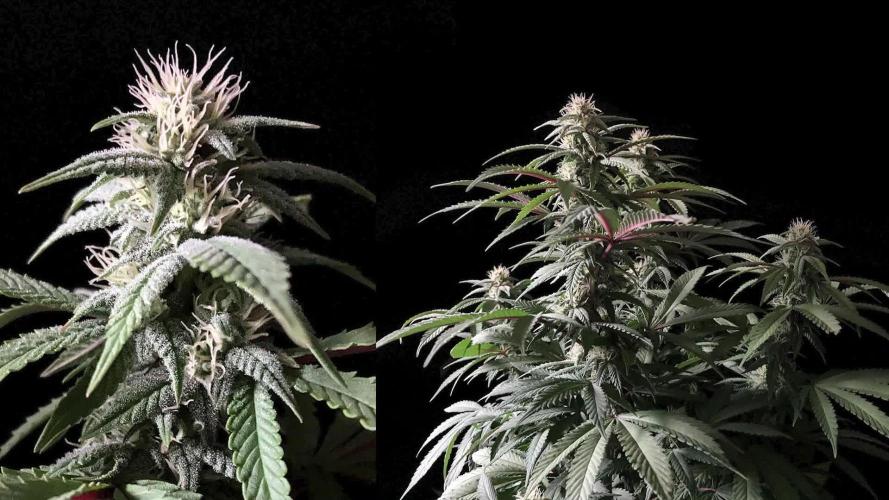
Week 5 purple showing , 2 slight differences in the structures on each plant . Had both these phenotypes before
Likes
58
Share
Info: Unfortunately, I had to find out that my account is used for fake pages in social media. I am only active here on growdiaries. I am not on facebook instagram twitter etc All accounts except this one are fake. Flowering day 15 since the time change to 12/12 h. Hey guys :-) This week the lady starts developing her buds. She has also gained a few cm again :-) Today I have downstairs the shoots removed so that the upper ones get more energy :-). This week it was poured twice with 1.2 l each time (for nutrients, see table above). The plant has been checked for health and everything has been cleaned. Fresh osmosis water was filled into canisters for the next few weeks. I wish you a lot of fun with the update. Stay healthy 🙏🏻 You can buy this Nutrients at : https://greenbuzzliquids.com/en/shop/ With the discount code: Made_in_Germany you get a discount of 15% on all products from an order value of 100 euros. You can buy this Strain at : www.Zamnesia.com Type: Banana ☝️🏼 Genetics: OG Kush x unkown 👍 Vega lamp: 2 x Todogrow Led Quantum Board 100 W 💡 Bloom Lamp : 2 x Todogrow Led Cxb 3590 COB 3500 K 205W 💡💡☝️🏼 Soil : Canna Coco Professional + ☝️🏼 Nutrients : Green Buzz Liquids : Organic Grow Liquid Organic Bloom Liquid Organic more PK More Roots Fast Buds Humic Acid Plus Growzyme Big Fruits Clean Fruits Cal / Mag Organic Ph - Pulver ☝️🏼🌱 Water: Osmosis water mixed with normal water (24 hours stale that the chlorine evaporates) to 0.2 EC. Add Cal / Mag to 0.4 Ec Ph with Organic Ph - to 5.5 - 5.8 .